
Life, 1916-08-17 · page 18 of 38
Life — August 17, 1916 — page 18: what you’re looking at
What you’re looking at
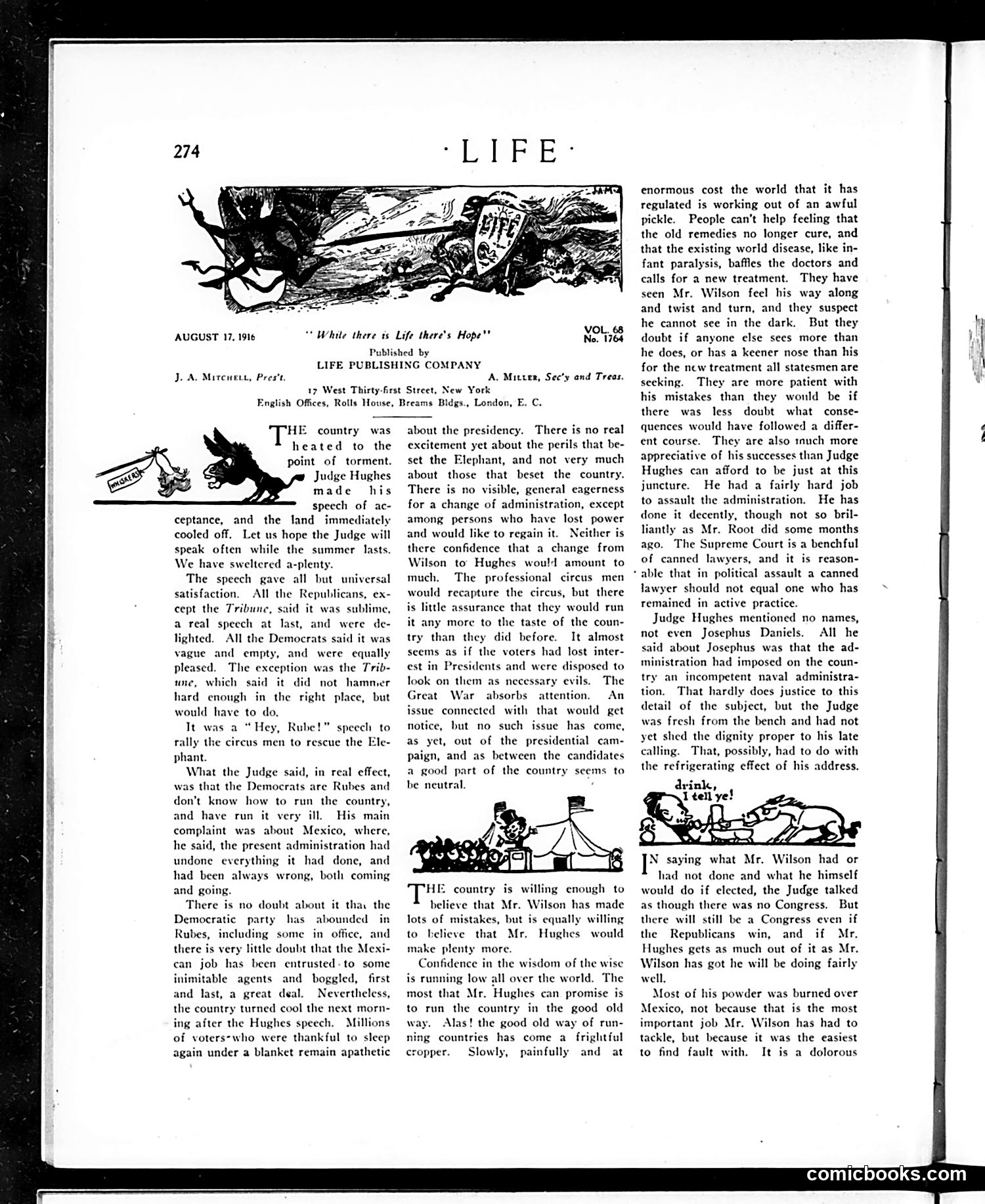
This article analyzes Judge Charles Evans Hughes's acceptance speech as the Republican presidential nominee against incumbent Democrat Woodrow Wilson in the 1916 election. The satire captures voter apathy. Hughes's speech—depicted as a "Hey, Rube!" carnival call to rally Republicans (the "Elephant")—criticized Wilson's handling of Mexico but generated only lukewarm enthusiasm. Life's columnist notes both parties found the speech satisfying yet unconvincing: Republicans praised it as "sublime," Democrats dismissed it as "vague and empty." The key point: voters have lost faith in political solutions generally. The Great War dominates attention. While acknowledging Wilson's mistakes, voters doubt Hughes would do better, trusting neither candidate's wisdom. The article reflects 1916's deep political exhaustion—voters see presidents as "necessary evils" rather than solutions, unable to address fundamental modern problems that old remedies cannot cure.
📄 Transcribed text from this page (OCR, searchable)
Machine-transcribed from the original scan — historical spelling and the odd misread are preserved.
AUGUST 17, 1916 VOL. 68 “* While there is Life there's Hope" No. 1764 Published by LIFE PUBLISHING COMPANY J. A. Mirenent, Pres’t, A, Mitten, Sec’y and Treas. 17 West Thirty-first Street, New York English Offices, Rolls House, Breams Bidgs., London, HE country was heated to the point of torment. Judge Hughes made his speech of ac- ceptance, and the land immediately cooled off. Let us hope the Judge will speak often while the summer lasts. We have sweltered a-plenty. The speech gave all but universal satisfaction. All the Republicans, ex- cept the Tribune id it was sublime, a real speech at last, and were de- lighted. All the Democrats said it was vague and empty, and were equally pleased. The exception was the Trib- une, which said it did not hammer hard enough in the right place, but would have to do. Tt was a “Hey, Rube!” speech to rally the circus men to rescue the Ele- phant. What the Judge said, in real effect, was that the Democrats are Rubes and don’t know how to run the country, and have run it very ill, His main complaint was about Mexico, where, he said, the present administration had undone everything it had done, and had been always wrong, both coming and going. There is no doubt about it thar the Democratic party has abounded in Rubes, including some in office, and there is very little doubt that the Mexi- can job has been entrusted. to some inimitable agents and boggled, first and last, a great deal. Nevertheless, the country turned cool the next morn- ing after the Hughes speech. Millions of voters-who were thankful to sleep again under a blanket remain apathetic about the presidency. There is no real excitement yet about the perils that be- set the Elephant, and not very much about those that beset the country. There is no visible, general eagerness for a change of administration, except among persons who have lost power and would like to regain it. Neither is there confidence that a change from Wilson to’ Hughes would amount to much, The professional circus men would recapture the circus, but there is little assurance that they would run it any more to the taste of the coun- try than they did before. It almost seems as if the voters had lost inter- est in Presidents and were disposed to look on them necessary evils. The Great War absorbs attention, An issue connected with that would get notice, but no such issue has come, as yet, out of the presidential cam- paign, and as between the candidates a good part of the country seems to he neutral. HE country is willing enough to believe that Mr. Wilson has made lots of mistakes, but is equally willing to believe that Mr. Hughes would make plenty more. Confidence in the wisdom of the wise is running low all over the world. The most that Mr. Hughes can promise is to run the country in the good old way. Alas! the good old way of run- ning countries has come a frightful cropper. Slowly, painfully and at enormous cost the world that it has regulated is working out of an awful pickle. People can’t help feeling that the old remedies no longer cure, and that the existing world disease, like in- fant paralysis, baffles the doctors and calls for a new treatment. They have seen Mr. Wilson feel his way along and twist and turn, and they suspect he cannot see in the dark, But they doubt if anyone else sees more than he does, or has a keener nose than his for the new treatment all statesmen are seeking. They are more patient with his mistakes than they would be if there was less doubt what conse- quences would have followed a differ- ent course. They are also inuch more appreciative of his successes than Judge Hughes can afford to be just at this juncture. He had a fairly hard job to assault the administration. He has done it decently, though not so bril- liantly as Mr. Root did some months ago. The Supreme Court is a benchful of canned lawyers, and it is reason- ‘able that in political assault a canned lawyer should not equal one who has remained in active practice. Judge Hughes mentioned no names, not even Josephus Daniels. All he id about Josephus was that the ad- ministration had imposed on the coun- try an incompetent naval administra- tion. That hardly does justice to this detail of the subject, but the Judge was fresh from the bench and had not yet shed the dignity proper to his late calling. That, possibly, had to do with the refrigerating effect of his address. N saying what Mr. Wilson had or had not done and what he himself would do if elected, the Judge talked as though there was no Congress. But there will still be a Congress even if the Republicans win, and if Mr. Hughes gets as much out of it as Mr. Wilson has got he will be doing fairly well, Most of his powder was burned over Mexico, not because that is the most important job Mr. Wilson has had to tackle, but because it was the easiest to find fault with. It is a dolorous comicbooks.com