
Life, 1916-08-17 · page 10 of 38
Life — August 17, 1916 — page 10: what you’re looking at
What you’re looking at
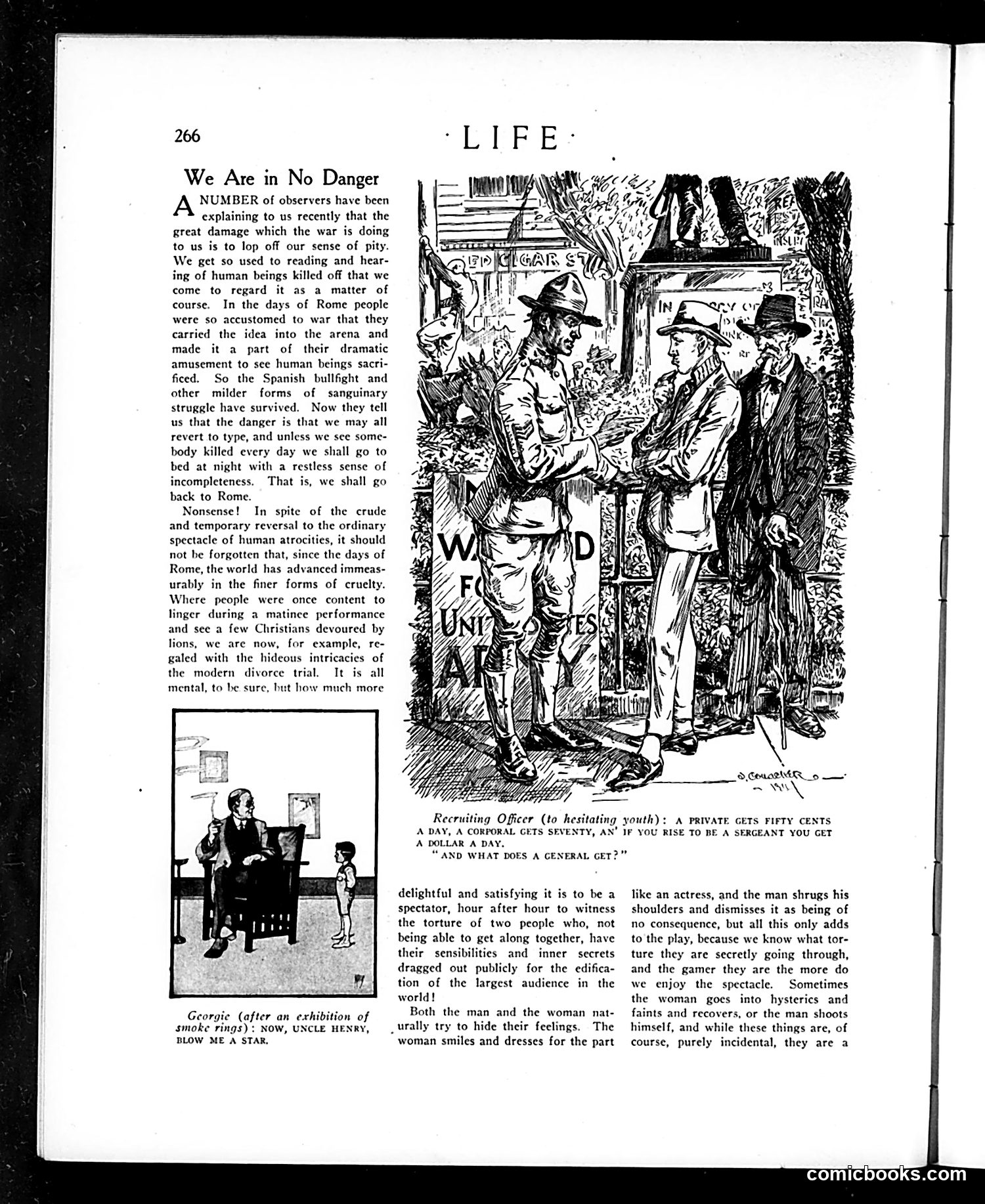
This page critiques societal indifference to war's casualties. The article "We Are in No Danger" sarcastically argues that people have become desensitized to human suffering—comparing ancient Rome's gladiatorial spectacles to modern entertainment like divorce trials, where audiences treat real human tragedy as spectacle. The main cartoon depicts a military recruiting officer (identifiable by uniform) offering enlistment terms to a young man at what appears to be a storefront or public space. The caption suggests financial incentives (fifty cents daily, potential sergeant rank), satirizing how economic desperation drives recruitment. The smaller illustration shows a woman and child watching a theatrical performance, reinforcing the theme that people passively consume entertainment—including wartime content—without emotional engagement or moral concern.
📄 Transcribed text from this page (OCR, searchable)
Machine-transcribed from the original scan — historical spelling and the odd misread are preserved.
266 We Are in No Danger NUMBER of observers have been explaining to us recently that the great damage which the war is doing to us is to lop off our sense of pity. We get so used to reading and hear- ing of human beings killed off that we come to regard it as a matter of course. In the days of Rome people were so accustomed to war that they carried the idea into the arena and made it a part of their dramatic amusement to sce human beings sacri- ficed. So the Spanish bullfight and other milder forms of sanguinary struggle have survived. Now they tell us that the danger is that we may all revert to type, and unless we see some- body killed every day we shall go to bed at night with a restless sense of incompleteness. That is, we shall go back to Rome. Nonsense! In spite of the crude and temporary reversal to the ordinary spectacle of human atrocities, it should not be forgotten that, since the days of Rome, the world has advanced immeas- urably in the finer forms of cruelty. Where people were once content to linger during a matinee performance and see a few Christians devoured by lions, we are now, for example, re- galed with the hideous intricacies of the modern divorce trial. It is all mental, to be sure, but how much more ibition of Georgie (after an e. E HENRY, smoke rings): Now, vu. BLOW ME A STAR, _urally try to hide their feelings. Recruiting Officer (to hesitating A DAY, A CORPORAL GETS SEVENTY, A DOLLAR A DAY, “AND WHAT DOES A GENERAL GET?” delightful and satisfying it is to be a spectator, hour after hour to witness the torture of two people who, not being able to get along together, have their sensibilities and inner secrets dragged out publicly for the edifica- tion of the largest audience in the world! Both the man and the woman nat- The woman smiles and dresses for the part Od, CouaeiR_» ~ SON uth): A PRIVATE GETS FIFTY CENTS YOU RISE TO BE A SERGEANT YOU GET like an actress, and the man shrugs his shoulders and dismisses it as being of no consequence, but all this only adds to the play, because we know what tor- ture they are secretly going through, and the gamer they are the more do we enjoy the spectacle. Sometimes the woman goes into hysterics and faints and recovers, or the man shoots himself, and while these things are, of course, purely incidental, they are a comicbooks.com