
Life, 1916-08-17 · page 25 of 38
Life — August 17, 1916 — page 25: what you’re looking at
What you’re looking at
This piece satirizes the derby hat, a ubiquitous symbol of early 20th-century masculinity. Set in a future museum (2016), a mother explains to her son Gaspard why men wore these impractical hats despite technological progress. The satire works on two levels: it mocks the derby's obvious discomforts (causing baldness, breaking easily, flying off in wind, uncomfortable in all weather) while simultaneously critiquing the era's contradictions. The punchline—that an age producing X-rays, wireless telegraphs, automobiles, and aeroplanes also produced the derby hat AND World War I—suggests that modern "progress" coexists with absurdity and destruction. By framing this as future anthropology, the author ridicules both fashion conformity and the pretensions of technological advancement. The mention of "motor-skates" and "gasoline rooms" emphasizes the satirist's skepticism about what future society will find equally ridiculous about the present day.
📄 Transcribed text from this page (OCR, searchable)
Machine-transcribed from the original scan — historical spelling and the odd misread are preserved.
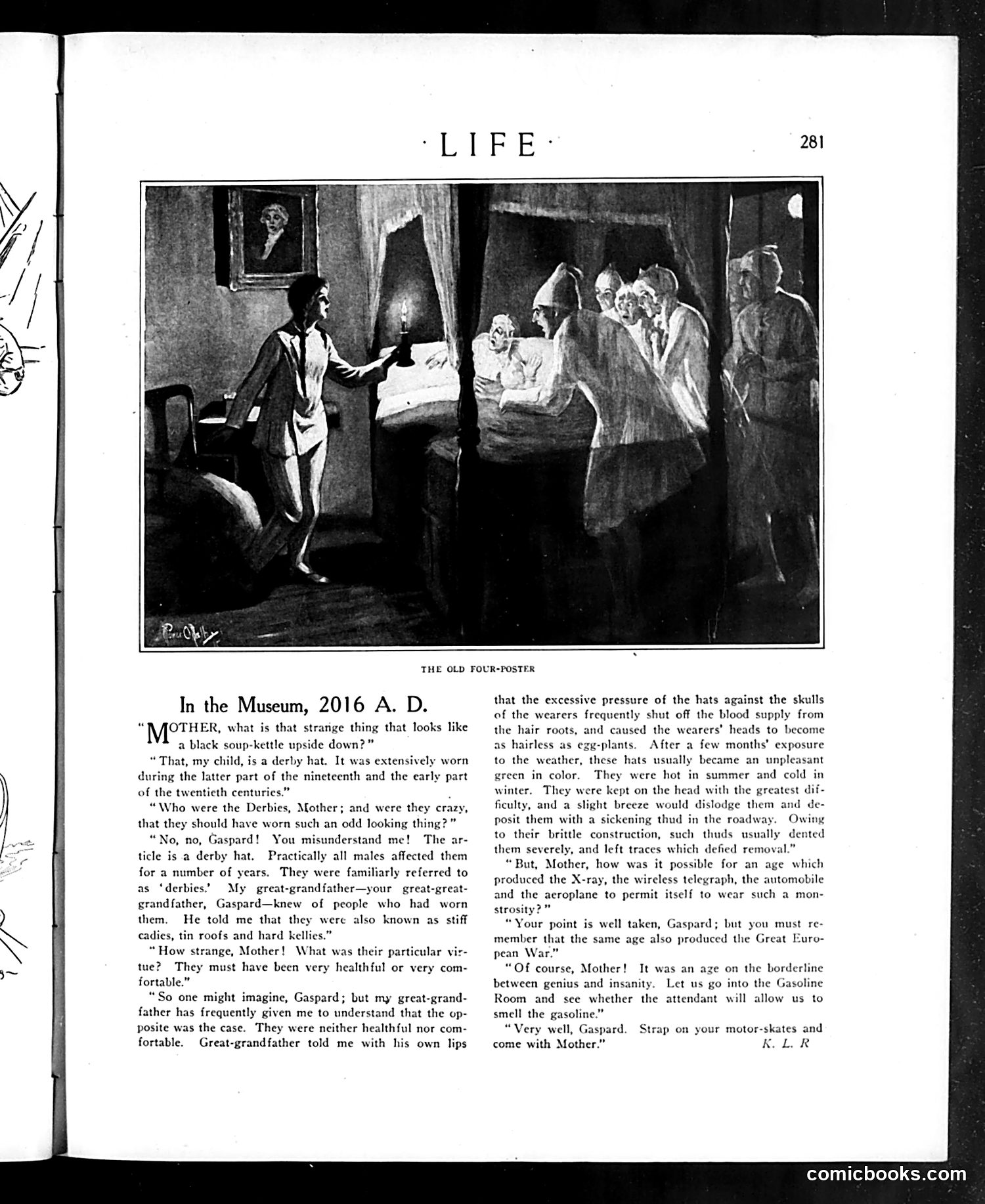
THE OLD FOUR-POSTER In the Museum, 2016 A. D. sl OTHER, what is that strange thing that looks like a black soup-kettle upside down?” “That, my child, is a derby hat. It was extensively worn during the latter part of the nineteenth and the early part of the twentieth centuries.” ‘ “Who were the Derbies, Mother; and were they crazy, that they should have worn such an odd looking thing?” “No, no, Gaspard! You misunderstand me! The ar- ticle is a derby hat. Practically all males affected them for a number of years. They were familiarly referred to as ‘derbies.’ My great-grandfather—your great-great- grandfather, Gaspard—knew of people who had worn them. He told me that they were also known as stiff cadies, tin roofs and hard kellies.” “How strange, Mother! What was their particular vir- tue? They must have been very healthful or very com- fortable.” “So one might imagine, Gaspard; but my great-grand- father has frequently given me to understand that the op- posite was the case. They were neither healthful nor com- fortable. Great-grandfather told me with his own lips that the excessive pressure of the hats against the skulls of the wearers frequently shut off the blood supply from the hair roots, and caused the wearers’ heads to become as hairless as egg-plants. After a few months’ exposure to the weather, these hats usually became an unpleasant green in color. They were hot in summer and cold in winter. They were kept on the head with the greatest dii- ficulty, and a slight breeze would dislodge them and de- posit them with a sickening thud in the roadway. Owing to their brittle construction, such thuds usually dented them severely, and left traces which defied removal.” “But, Mother, how was it possible for an age which produced the X-ray, the wireless telegraph, the automobile and the aeroplane to permit itself to wear such a mon- strosity?” “Your point is well taken, Gaspard; but you must re- member that the same age also produced the Great Euro- pean War.” “Of course, Mother! It was an age on the borderline between genius and insanity. Let us go into the Gasoline Room and see whether the attendant will allow us to smell the gasoline.” “Very well, Gaspard. come with Mother.” Strap on your motor-skates and KLL.R comicbooks.com