
Life, 1916-08-17 · page 23 of 38
Life — August 17, 1916 — page 23: what you’re looking at
What you’re looking at
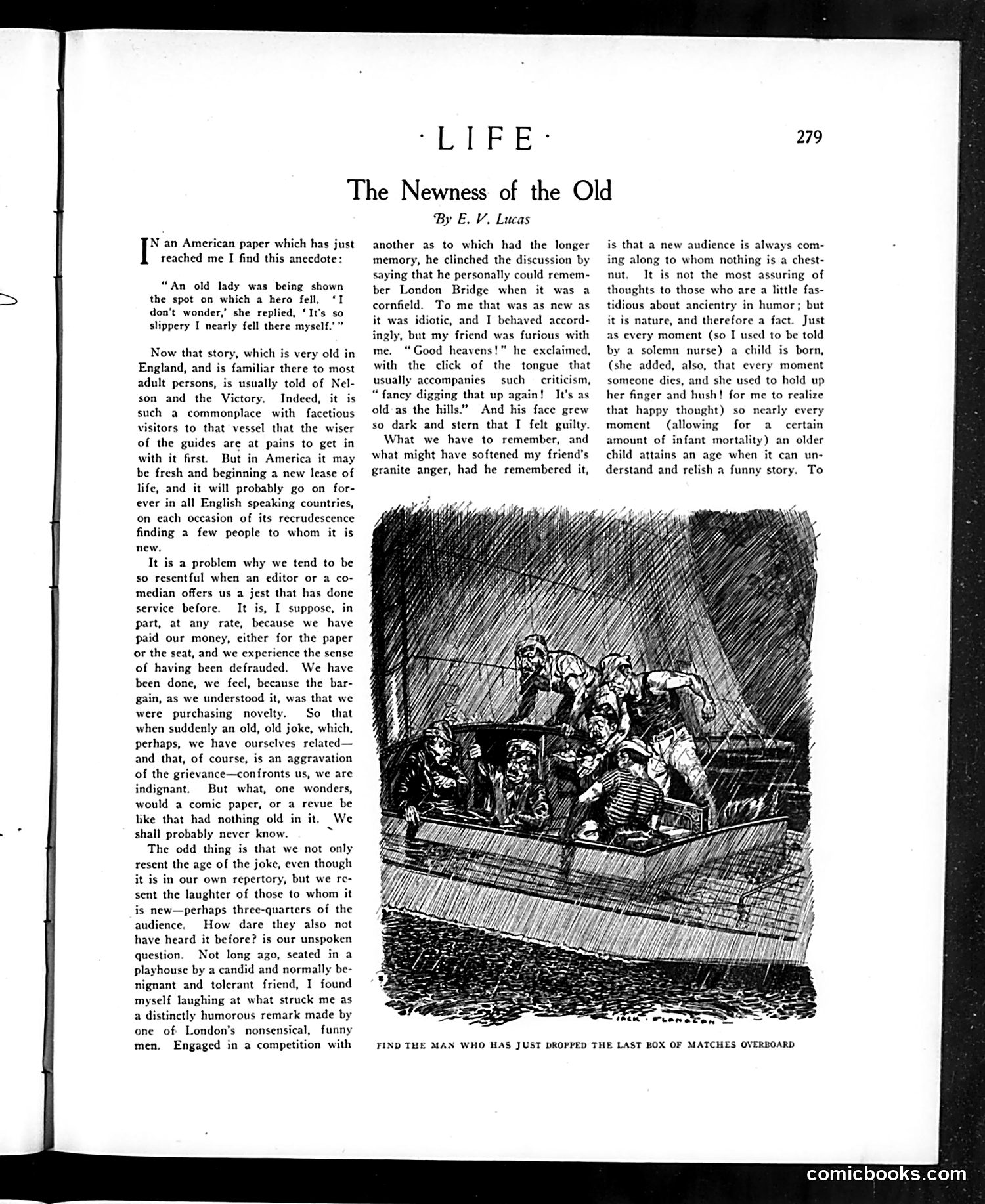
This essay critiques our resentment toward recycled humor. Lucas argues that old jokes feel like fraud when we pay for entertainment, yet this resentment is illogical—new audiences constantly arrive for whom "nothing is a chestnut" (slang for old joke). The accompanying illustration depicts a chaotic boat scene with multiple figures, captioned "FIND THE MAN WHO HAS JUST DROPPED THE LAST BOX OF MATCHES OVERBOARD." This is itself an old riddle/joke—a visual gag showing pandemonium where everyone looks equally guilty, making identification impossible. **The satire is meta:** by illustrating an ancient joke while discussing why we resent ancient jokes, Lucas demonstrates his own point. The puzzle-picture was a popular Victorian parlor game format that likely felt "new" to many readers despite its age, proving Lucas's thesis that generational turnover constantly refreshes stale material.
📄 Transcribed text from this page (OCR, searchable)
Machine-transcribed from the original scan — historical spelling and the odd misread are preserved.
*LIFE* The Newness of the Old N an American paper which has just reached me I find this anecdote: “An old lady was being shown the spot on which a hero fell. ‘I don’t wonder,’ she replied, ‘It’s so slippery I nearly fell there myself.’ ” Now that story, which is very old in England, and is familiar there to most adult persons, is usually told of Nel- son and the Victory. Indeed, it is such a commonplace with facetious itors to that vessel that the wiser of the guides are at pains to get in with it first. But in America it may be fresh and beginning a new lease of life, and it will probably go on for- ever in all English speaking countries, on each occasion of its recrudescence finding a few people to whom it is new. It is a problem why we tend to be so resentful when an editor or a co- median offers us a jest that has done service before. It is, I suppose, in part, at any rate, because we have paid our money, either for the paper or the seat, and we experience the sense of having been defrauded. We have been done, we feel, because the bar- gain, as we understood it, was that we were purchasing novelty. So that when suddenly an old, old joke, which, perhaps, we have ourselves related— and that, of course, is an aggravation of the grievance—confronts us, we are indignant. But what, one wonders, would a comic paper, or a revue be like that had nothing old in it, We shall probably never know. ~ The odd thing is that we not only resent the age of the joke, even though it is in our own repertory, but we re- sent the laughter of those to whom it is new—perhaps three-quarters of the audience. How dare they also not have heard it before? is our unspoken question. Not long ago, seated in a playhouse by a candid and normally be- nignant and tolerant friend, I found myself laughing at what struck me as a distinctly humorous remark made by one of London's nonsensical, funny men. Engaged in a competition with By E. V. Lucas another as to which had the longer memory, he clinched the discussion by saying that he personally could remem- ber London Bridge when it was a cornfield. To me that was as new as it was idiotic, and I behaved accord- ingly, but my friend was furious with me. “Good heavens!” he exclaimed, with the click of the tongue that usually accompanies such criticism, “fancy digging that up again! It’s as old as the hills.” And his face grew so dark and stern that I felt guilty. What we have to remember, and what might have softened my friend's granite anger, had he remembered it, is that a new audience is always com- ing along to whom nothing is a chest- nut. It is not the most assuring of thoughts to those who are a little fas- tidious about ancientry in humor; but it is nature, and therefore a fact. Just as every moment (so I used to be told by a solemn nurse) a child is born, (she added, also, that every moment someone dies, and she used to hold up her finger and hush! for me to realize that happy thought) so nearly every moment (allowing for a certain amount of infant mortality) an older child attains an age when it can un- derstand and relish a funny story. To FIND THE MAN WHO HAS JUST DROPPED THE LAST BOX OF MATCHES OVERBOARD comicbooks.com