
Life, 1916-08-17 · page 24 of 38
Life — August 17, 1916 — page 24: what you’re looking at
What you’re looking at
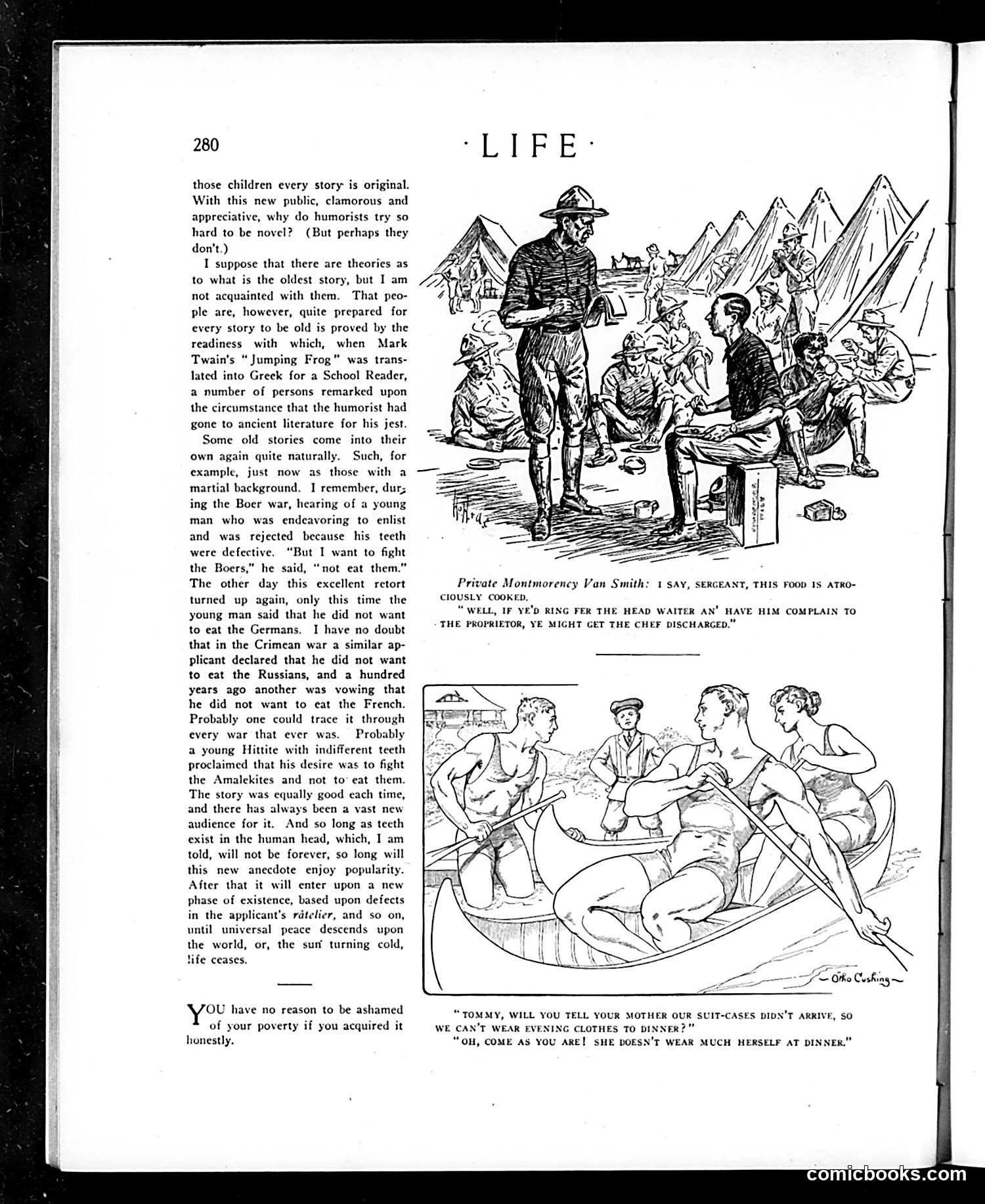
This page satirizes the recycling of old stories across generations, particularly jokes tied to military conflicts. The essay notes that a joke about a recruit with bad teeth wanting to fight enemies "not eat them" has appeared during the Boer War, and now resurfaces during WWI (the "Germans" reference), likely having circulated through the Crimean War and Napoleonic conflicts. The satire suggests this anecdote will persist as long as dentition exists. The two cartoons mock social pretension. The upper cartoon shows "Private Montmorency Van Smith," a soldier with an aristocratic name complaining about military food quality—the sergeant's response mocks his entitled expectation of restaurant service standards. The lower cartoon depicts wealthy characters worrying about formal dinner attire when suitcases went missing, with a child's innocent reminder that his mother doesn't dress formally either. Both ridicule upper-class affectations clashing absurdly with actual circumstances.
📄 Transcribed text from this page (OCR, searchable)
Machine-transcribed from the original scan — historical spelling and the odd misread are preserved.
280 those children every story is original. With this new public, clamorous and appreciative, why do humorists try so hard to be novel? (But perhaps they don’t.) I suppose that there are theories as to what is the oldest story, but I am not acquainted with them. That peo- ple are, however, quite prepared for every story to be old is proved by the readiness with which, when Mark Twain's “Jumping Frog” was trans- lated into Greek for a School Reader, a number of persons remarked upon the circumstance that the humorist had gone to ancient literature for his jest. Some old stories come into their own again quite naturally. Such, for example, just now as those with a martial background. I remember, dur; ing the Boer war, hearing of a young man who was endeavoring to enlist and was rejected because his teeth were defective. “But I want to fight the Boers,” he said, “not eat them.” The other day this excellent retort turned up again, only this time the young man said that he did not want to eat the Germans. I have no doubt that in the Crimean war a similar ap- plicant declared that he did not want to eat the Russians, and a hundred years ago another was vowing that he did not want to cat the French. Probably one could trace it through every war that ever was. Probably a young Hittite with indifferent teeth proclaimed that his desire was to fight the Amalekites and not to’ eat them. The story was equally good each time, and there has always been a vast new audience for it. And so long as teeth exist in the human head, which, I am told, will not be forever, so long will this new anecdote enjoy popularity. After that it will enter upon a new phase of existence, based upon defects in the applicant's rdtelier, and so on, until universal peace descends upon the world, or, the sun turning cold, life ceases. OU have no reason to be ashamed of your poverty if you acquired it honestly. Private Montmorency Van Smith: 1 SAY, SERGEANT, THIS FOOD IS ATRO- CIOUSLY COOKED, “WELL, IF YE'D RING FER THE HEAD WAITER AN’ HAVE HIM COMPLAIN TO THE PROPRIETOR, YE MIGHT GET THE CHEF DISCHARGED.” “TOMMY, WILL YOU TELL YOUR MOTHER OUR SUIT-CASES DIDN'T ARRIVE, SO WE CAN'T WEAR EV G CLOTHES TO DI ? “OH, COME AS YOU ARE! SHE DOESN'T WEAR MUCH HERSELF AT DINNER.”