
Life, 1916-08-17 · page 16 of 38
Life — August 17, 1916 — page 16: what you’re looking at
What you’re looking at
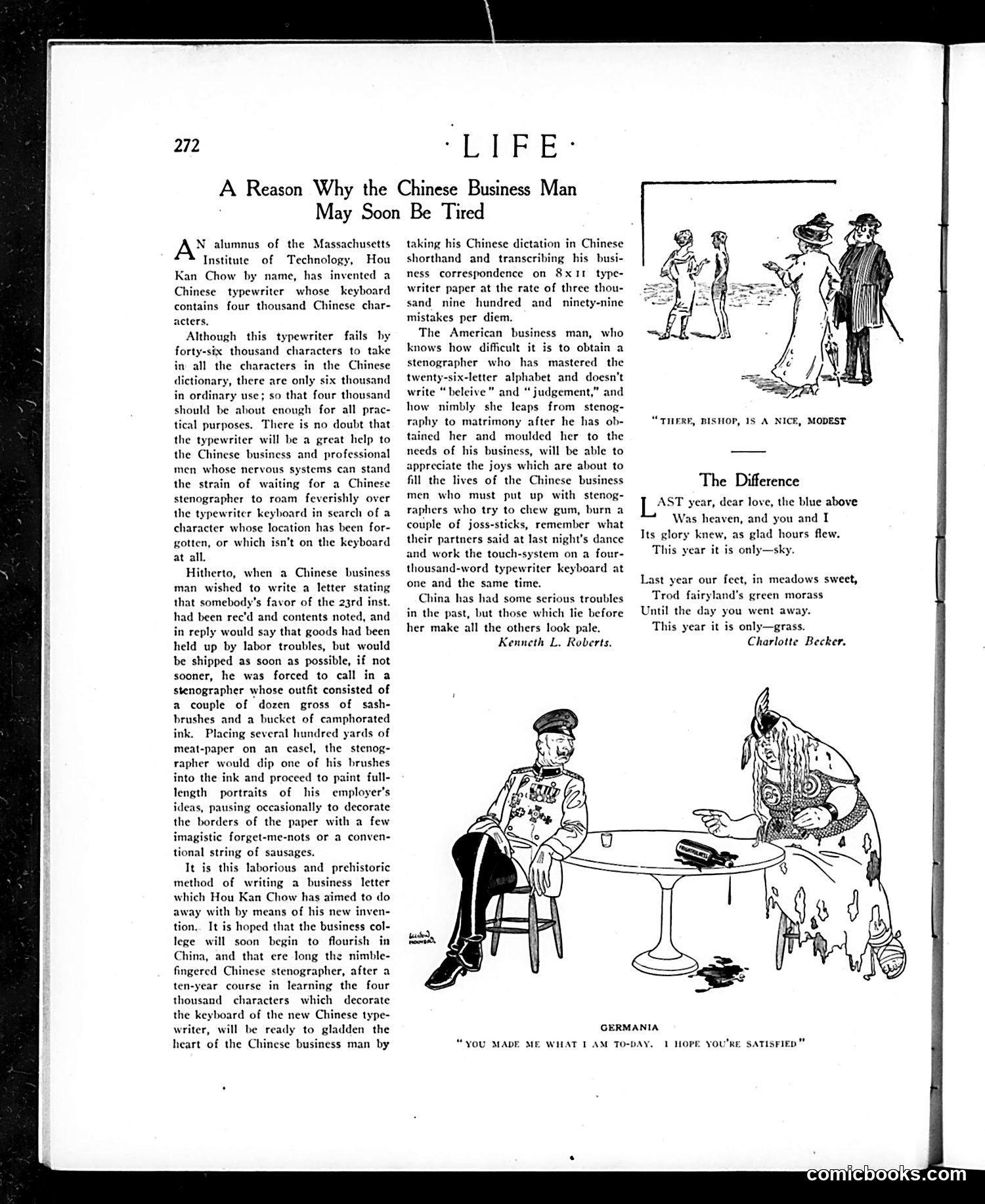
This satirical article by Kenneth L. Roberts mocks the impracticality of a new Chinese typewriter invention by MIT alumnus Hou Kan Chow. The typewriter contains 4,000 characters—enough for ordinary use, but a fraction of the full Chinese written language. Roberts uses exaggerated humor to highlight the absurdity: he describes traditional Chinese business letter writing as requiring stenographers with "sash-brushes" and "camphorated ink" who paint full-length portraits of ideas on meat-paper. He then predicts the new typewriter will require stenographers undergoing "a ten-year course" to master 4,000 characters, making them prone to "three thousand nine hundred and ninety-nine mistakes per diem." The joke targets both Chinese and American business practices—satirizing the already-difficult task of finding competent English stenographers who master just 26 letters, while suggesting Chinese businessmen face even more impossible odds. The cartoons illustrate unrelated social humor; the lower cartoon labeled "Germania" appears to satirize German culture or politics through a grotesque caricature.
📄 Transcribed text from this page (OCR, searchable)
Machine-transcribed from the original scan — historical spelling and the odd misread are preserved.
-LIFE- A Reason Why the Chinese Business Man May Soon Be Tired A alumnus of the Massachusetts Institute of Technology, Hou Kan Chow by name, has invented a Chinese typewriter whose keyboard contains four thousand Chinese char- acters. Although this typewriter fails by forty-six thousand characters to take in all the characters in the Chinese dictionary, there are only six thousand in ordinary use; so that four thousand should be about enough for all prac- tical purposes. There is no doubt that the typewriter will be a great help to the Chinese business and professional men whose nervous systems can stand the strain of waiting for a Chinese stenographer to roam feverishly over the typewriter keyboard in search of a character whose location has been for- gotten, or which isn’t on the keyboard at all. Hitherto, when a Chinese business man wished to write a letter stating that somebody's favor of the 23rd inst. had been rec'd and contents noted, and in reply would say that goods had been held up by labor troubles, but would be shipped as soon as possible, if not sooner, he was forced to call in a stenographer whose outfit consisted of a couple of dozen gross of sash- brushes and a bucket of camphorated ink. Placing several hundred yards of meat-paper on an easel, the stenog- rapher would dip one of his brushes into the ink and proceed to paint full- length portraits of his employer's ideas, pausing occasionally to decorate the borders of the paper with a few imagistic forget-me-nots or a conven- tional string of sausages. It is this laborious and prehistoric method of writing a business letter which Hou Kan Chow has aimed to do away with by means of his new inven- tion. It is hoped that the business col- lege will soon begin to flourish in China, and that ere long the nimble- fingered Chinese stenographer, after a ten-year course in learning the four thousand characters which decorate the keyboard of the new Chinese type- writer, will be ready to gladden the heart of the Chinese business man by taking his Chinese dictation in Chinese shorthand and transcribing his busi- ness correspondence on 8x It type- writer paper at the rate of three thou- sand nine hundred and_ ninety-nine mistakes per diem. The American business man, who knows how difficult it is to obtain a stenographer who has mastered the twenty-six-letter alphabet and doesn't write “beleive” and “ judgement,” and how nimbly she leaps from stenog- raphy to matrimony after he has ob- tained her and moulded her to the needs of his business, will be able to appreciate the joys which are about to fill the lives of the Chinese business men who must put up with stenog- raphers who try to chew gum, burn a couple of joss-sticks, remember what their partners said at last night’s dance and work the touch lem on a four- thousand-word typewriter keyboard at one and the same time. China has had some serious troubles in the p; but those which lie before her make all the others look pale. Kenneth L. Roberts. “THERE, BISHOP, 1S A NICE, MODEST The Difference L AST year, dear love, the blue above Was heaven, and you and I Its glory knew, as glad hours flew. This year it is only—sky. Last year our feet, in meadows sweet, Trod fairyland’s green morass Until the day you went away. This year it is only—grass. Charlotte Becker. GERMANIA. MADE ME WHAT I AM TO-DAY. 1 HOPE you'r