
A complete issue · 40 pages · 1916
Life — July 13, 1916
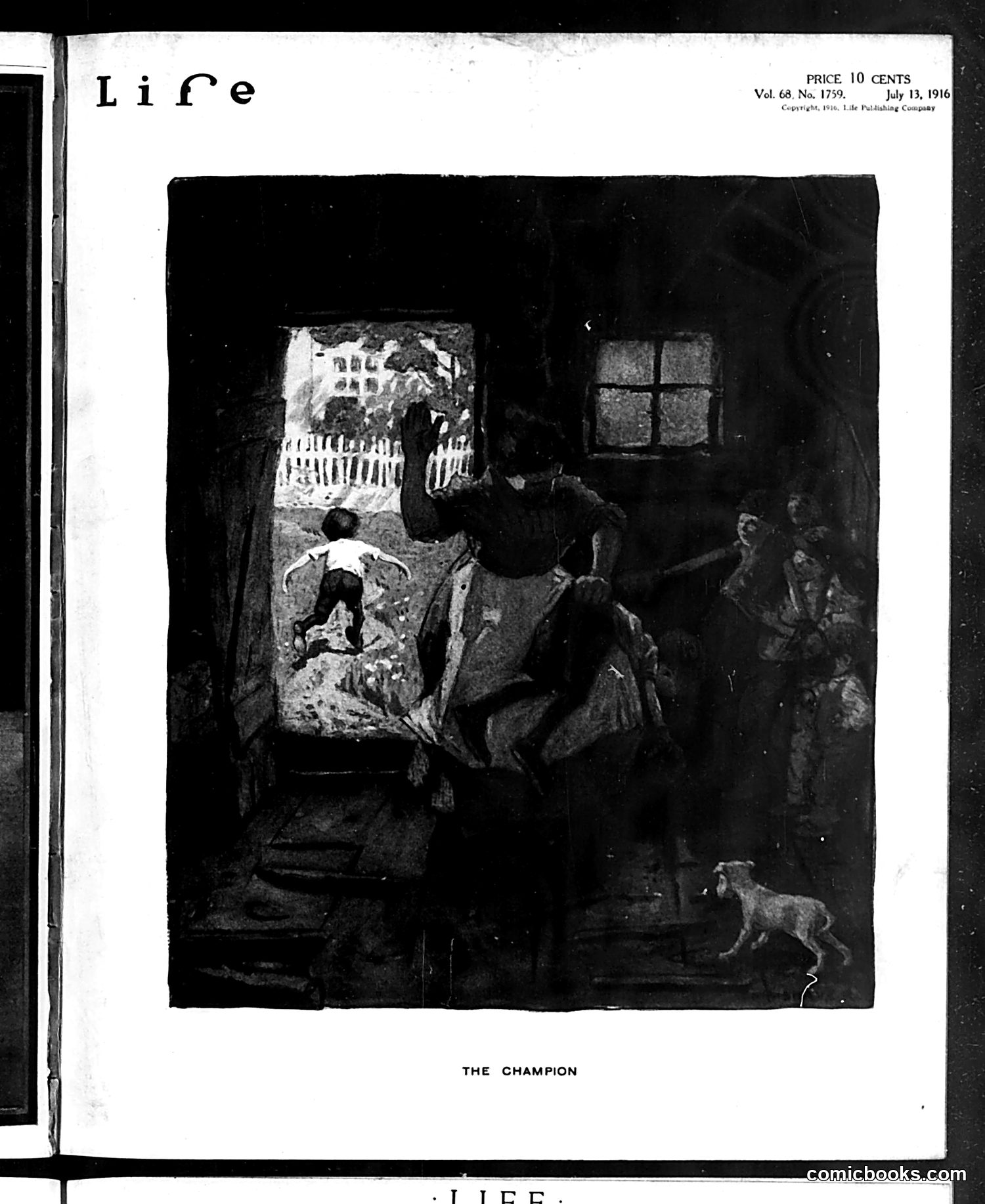
This Life magazine cover from July 13, 1916 depicts a dark interior scene titled "The Champion." A small dog appears to be the focal figure, standing assertively in what looks like a modest home or barn setting. Several human figures observe from the shadows in the background. The cartoon likely uses the dog as a metaphor for an underdog competitor or political figure, with "Champion" suggesting triumph despite humble circumstances. The contrast between the confident, illuminated dog and the shadowy observers may satirize how unconventional or unexpected champions gain prominence. Without additional context about 1916 events, the specific political reference remains unclear, though the composition emphasizes the small figure's dominance over larger, watching figures.
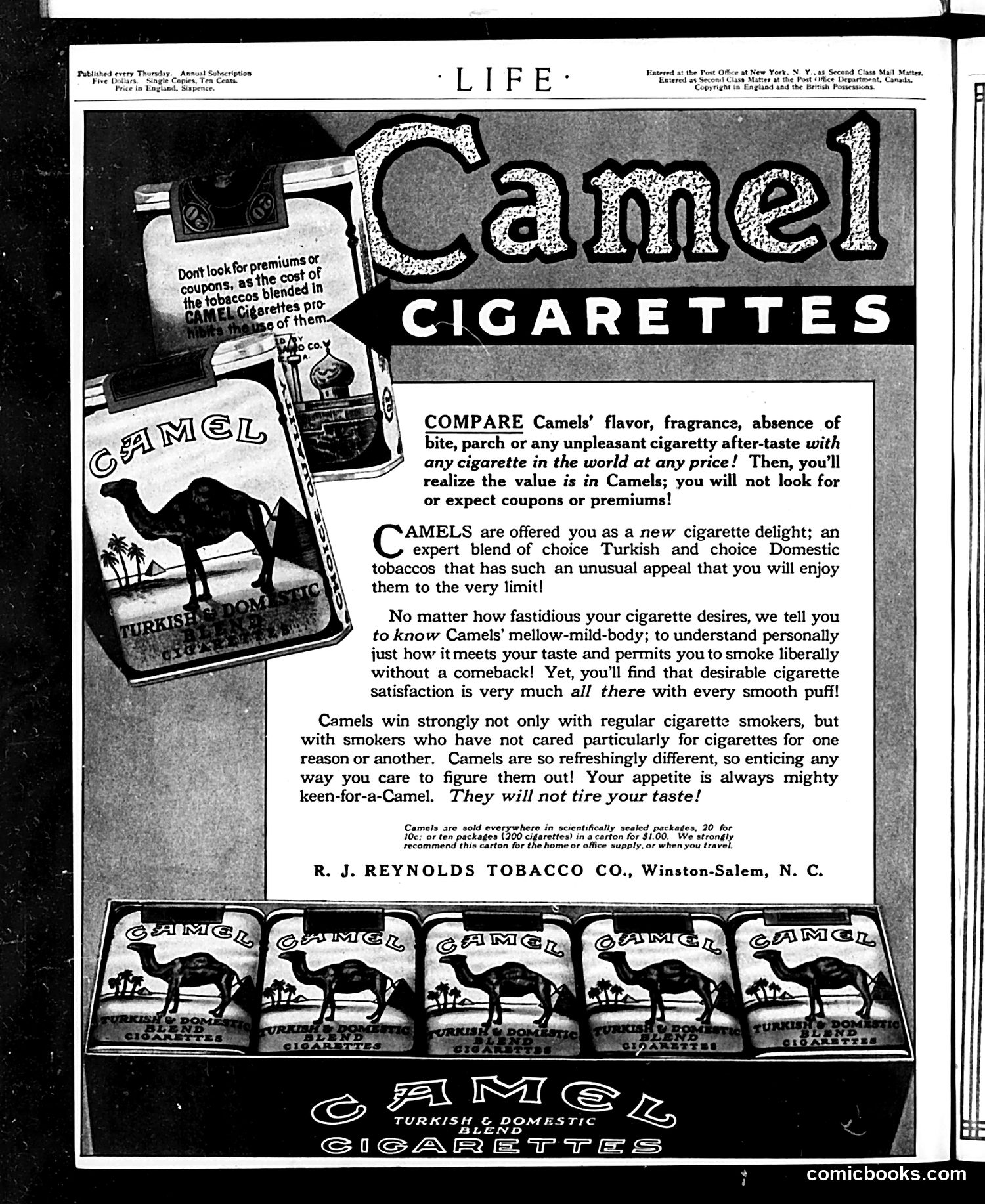
This is a straightforward **cigarette advertisement**, not satire or political commentary. The page promotes Camel brand cigarettes from R.J. Reynolds Tobacco Co. (Winston-Salem, N.C.). The ad emphasizes that Camels offer superior quality without needing coupons or premiums—a selling point distinguishing them from competitors who used promotional giveaways. The camel imagery refers to the blend of Turkish and domestic tobaccos. Key messaging targets both regular and non-smokers, claiming Camels satisfy all tastes without an unpleasant aftertaste. The ad includes product packaging showing the iconic camel logo and desert imagery. This represents early 20th-century cigarette marketing before tobacco health warnings were required—a era when such direct advertising appeared routinely in mainstream publications.
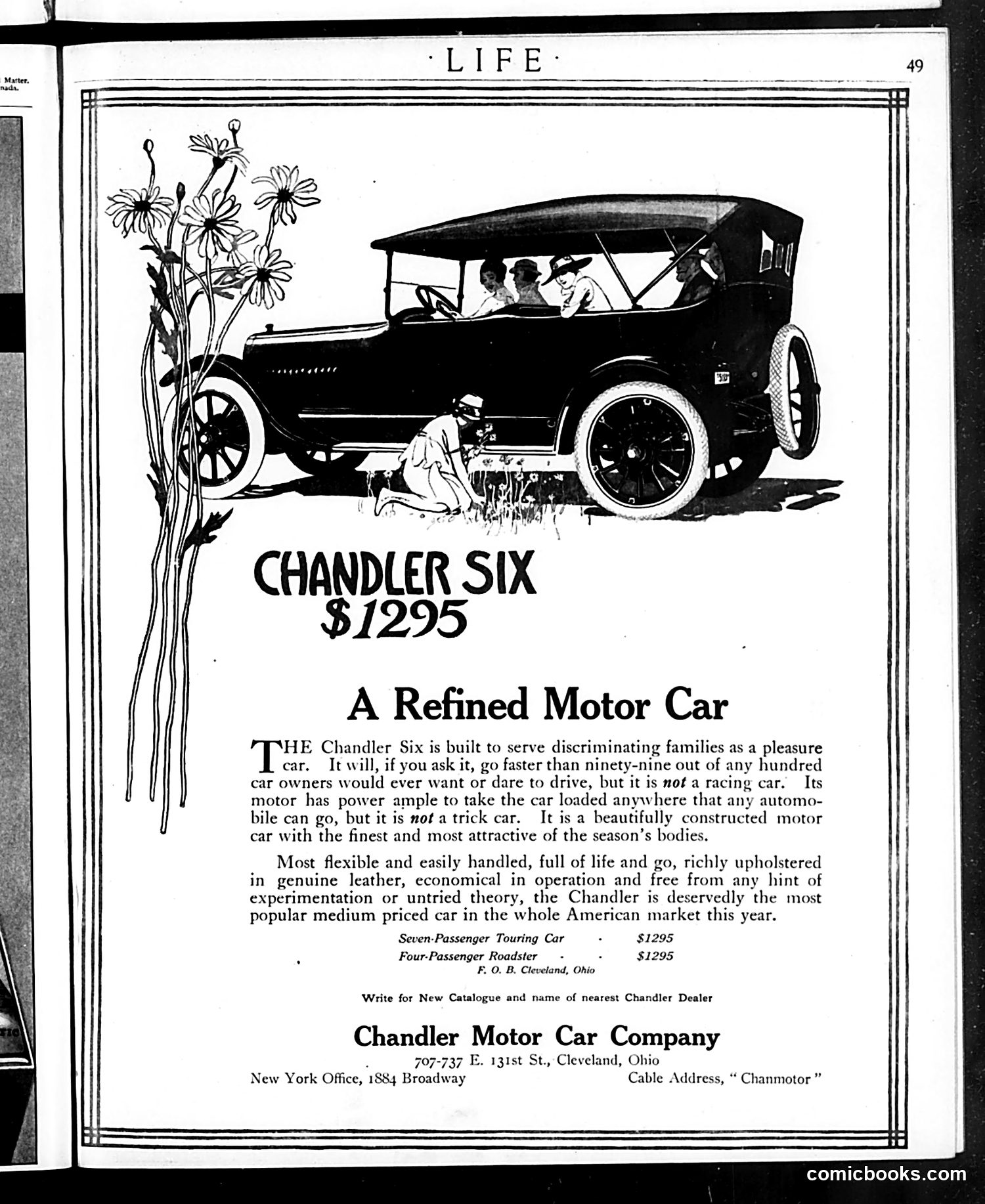
This page is primarily a **period automobile advertisement**, not satirical content. It's a full-page ad for the Chandler Six motor car, priced at $1295, from the Chandler Motor Car Company in Cleveland, Ohio. The ad uses decorative illustration typical of 1920s marketing: a stylized drawing of the car with passengers and a man kneeling beside it (possibly performing maintenance or admiration). Decorative flowers frame the left side. The text emphasizes the car's refined qualities—it's described as reliable, well-constructed, and popular among middle-class families, explicitly stating it is "**not** a racing car" and "**not** a trick car." This positioning suggests contemporaneous competition from other manufacturers marketing speed or experimental features. No political satire or caricature is present.
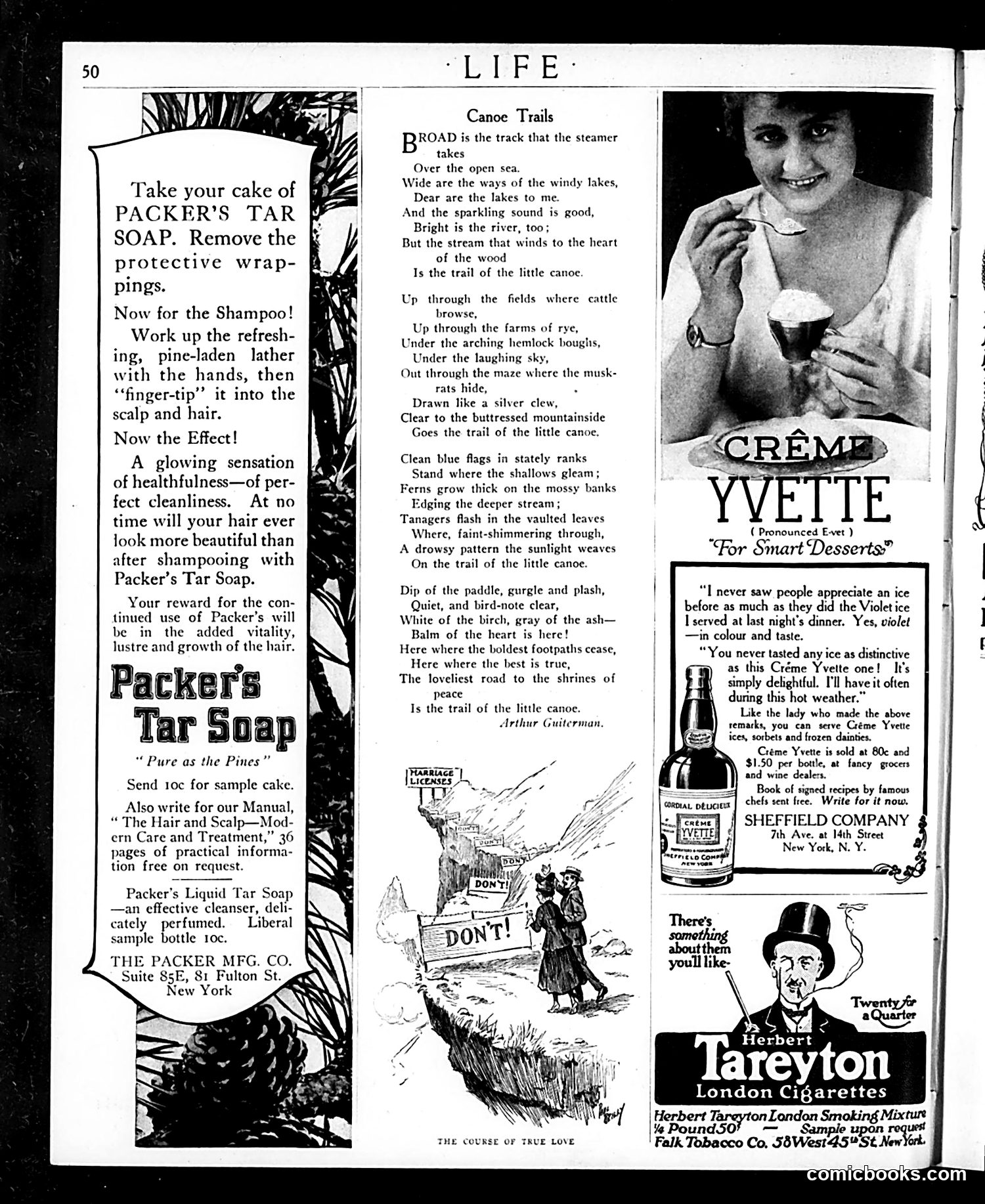
This page is **primarily advertising** with one central cartoon feature. The main content includes ads for Packer's Tar Soap, Crème Yvette liqueur, and Herbert Tareyton cigarettes. The central cartoon titled "The Course of True Love" depicts a couple near a canoe with a "DON'T!" warning sign. The illustration appears to be a humorous commentary on romantic scenarios in nature—warning against improper behavior during outdoor activities. The cartoon's message aligns with early 20th-century social propriety standards regarding courtship and public conduct. The accompanying poem "Canoe Trails" by Arthur Guiterman romanticizes wilderness travel and rural landscapes, contrasting with the cautionary cartoon's implicit social morality. Overall, the page reflects period concerns about decorum and acceptable public behavior during romantic encounters.
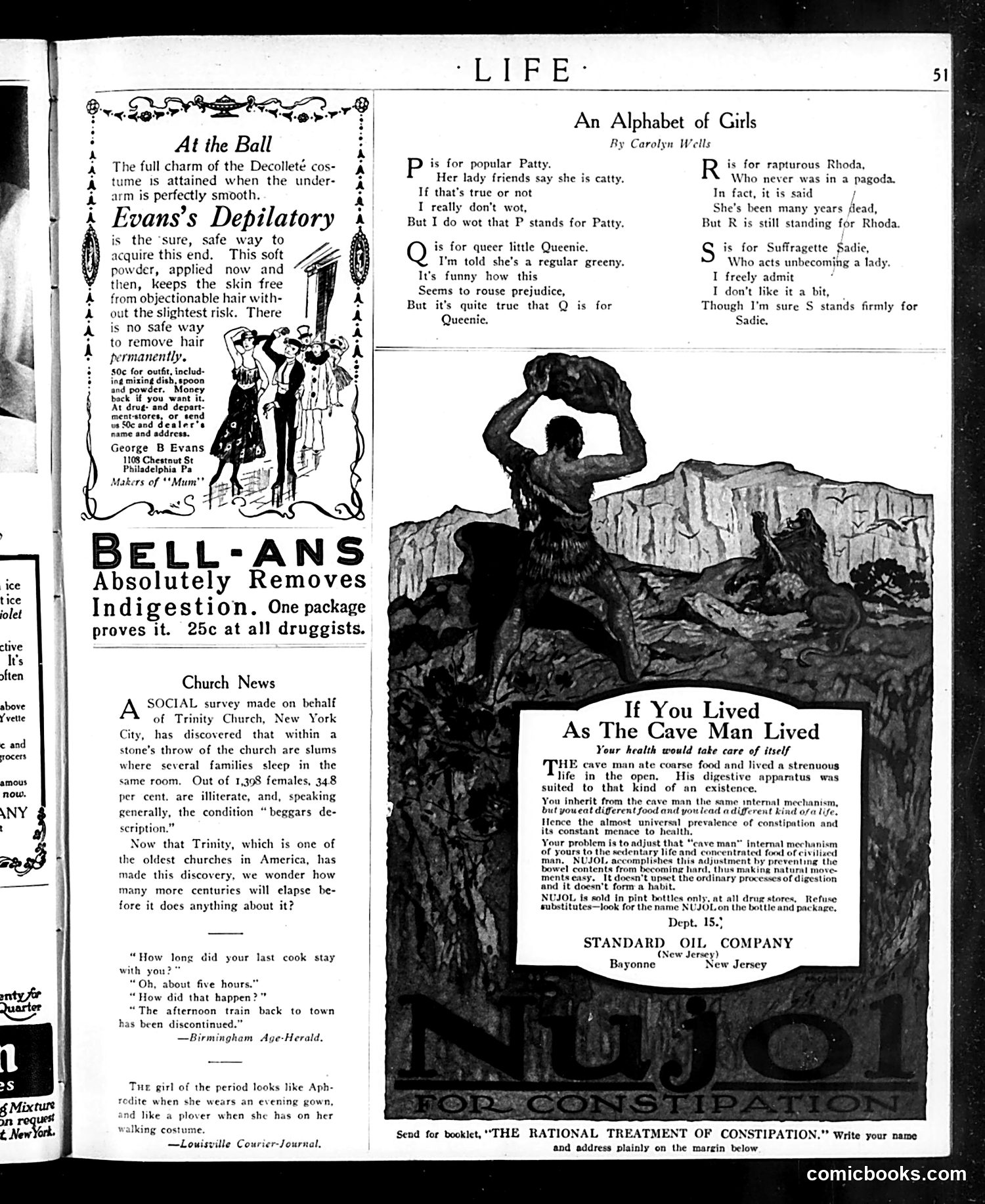
This page is primarily **advertising and light social content** rather than political satire. The main elements include: 1. **"An Alphabet of Girls"** — a humorous poem by Carolyn Wells offering playful character sketches of women (Patty is "catty," Queenie is a "greenie," etc.). This is gentle social comedy about female stereotypes. 2. **"At the Ball"** and **"Evans's Depilatory"** — advertisements dressed as editorial content, common in early 20th-century magazines. The depilatory ad promises smooth skin removal without risk of hair regrowth. 3. **"If You Lived As The Cave Man Lived"** — a Standard Oil Company advertisement using a caveman illustration to pitch their constipation remedy (Nujol), claiming modern digestive problems require modern solutions. 4. **Church News** — a brief social item about housing conditions in New York City. The page reflects **period attitudes toward women, beauty standards, and patent medicine marketing**.
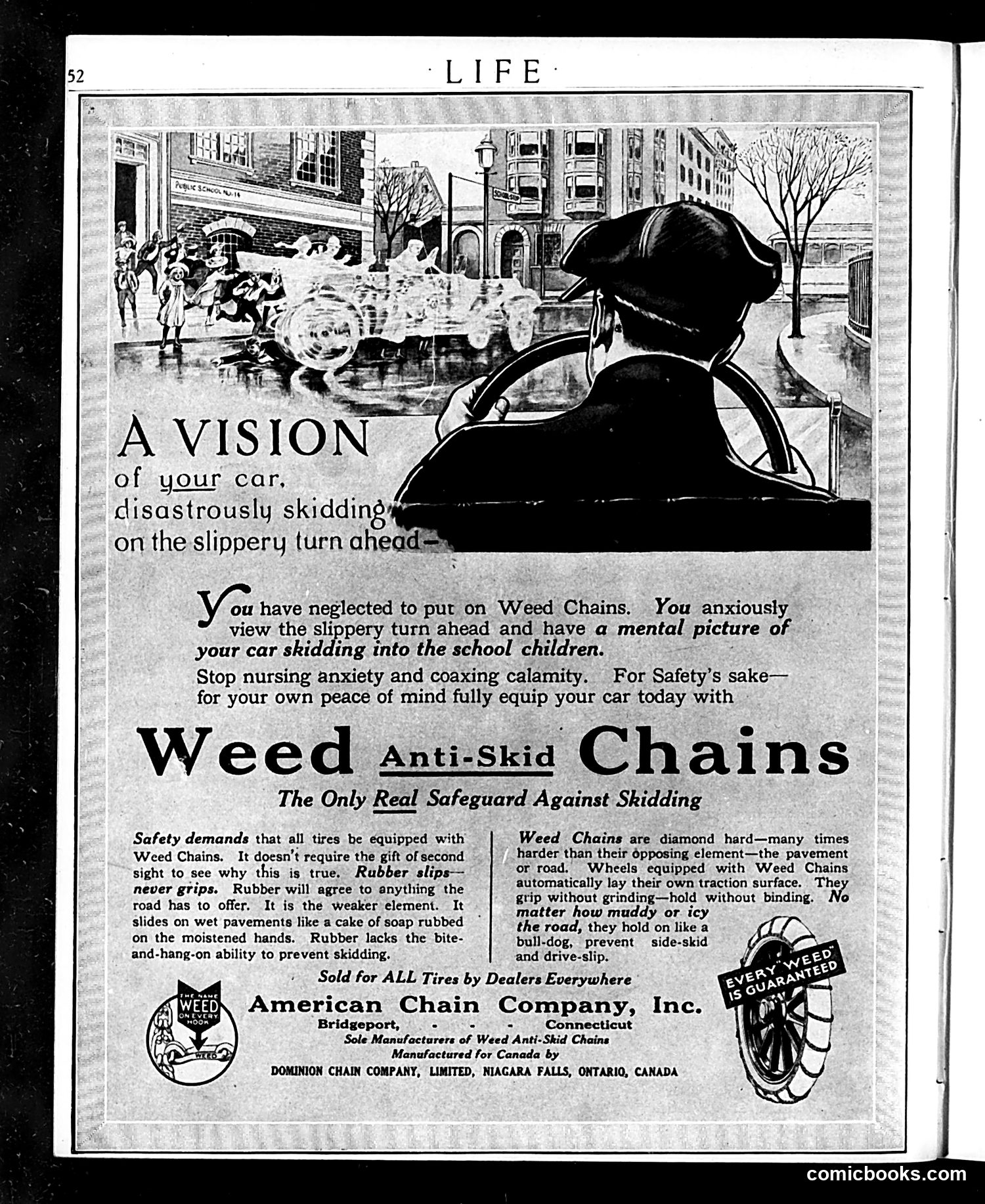
This page is primarily a **product advertisement**, not satire or political commentary. It advertises Weed Anti-Skid Chains for car tires. The advertisement uses fear-based messaging common to early 20th-century marketing. The illustration depicts a driver's anxious vision of a car skidding dangerously on a slippery road toward pedestrians and schoolchildren. The text emphasizes the mental anguish of imagining such an accident. The rhetorical strategy exploits parental anxiety: by vividly depicting the catastrophic consequences of unequipped tires on winter roads, the ad pressures readers to purchase safety chains "for your own peace of mind fully." The product itself—tire chains for winter traction—was genuinely practical for the era before modern tire technology, making this an earnest safety appeal rather than satire.
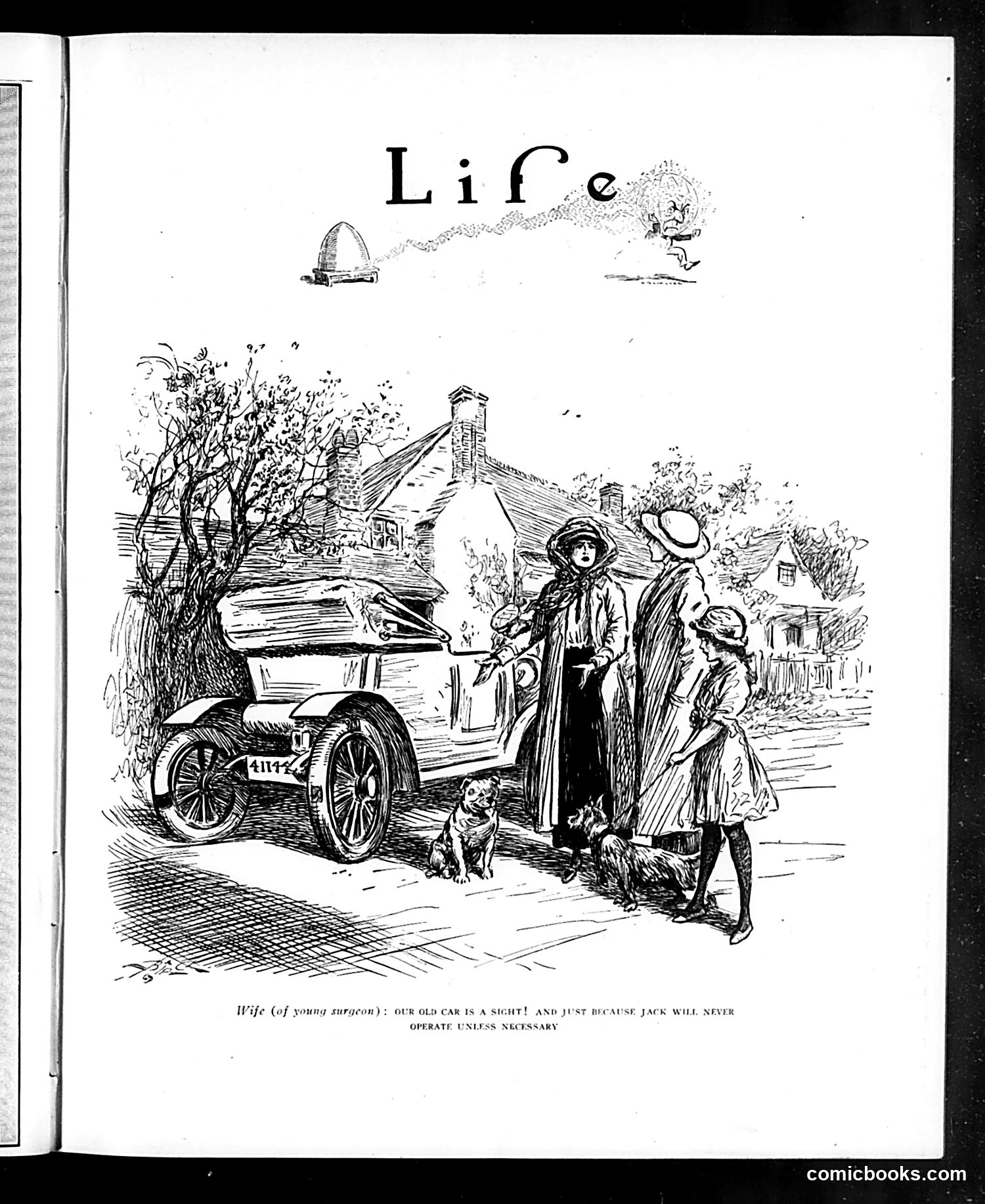
This page features a satirical cartoon titled "Life" depicting an early automobile scene. The caption reads: "Wife (of young surgeon): 'OUR OLD CAR IS A SIGHT! AND JUST BECAUSE JACK WILL NEVER OPERATE UNLESS NECESSARY.'" The joke satirizes a surgeon who applies his professional caution to automobile maintenance. Rather than repair the car, he refuses to "operate" on it unless absolutely necessary—using medical terminology humorously. The woman, his wife, complains their vehicle looks shabby as a result of his excessive caution. This reflects early 20th-century attitudes toward automobiles as novel, fragile machines requiring careful handling. The cartoon mocks both over-cautious behavior and the analogy between surgical and mechanical "operations," playing on professional vocabulary for comedic effect.
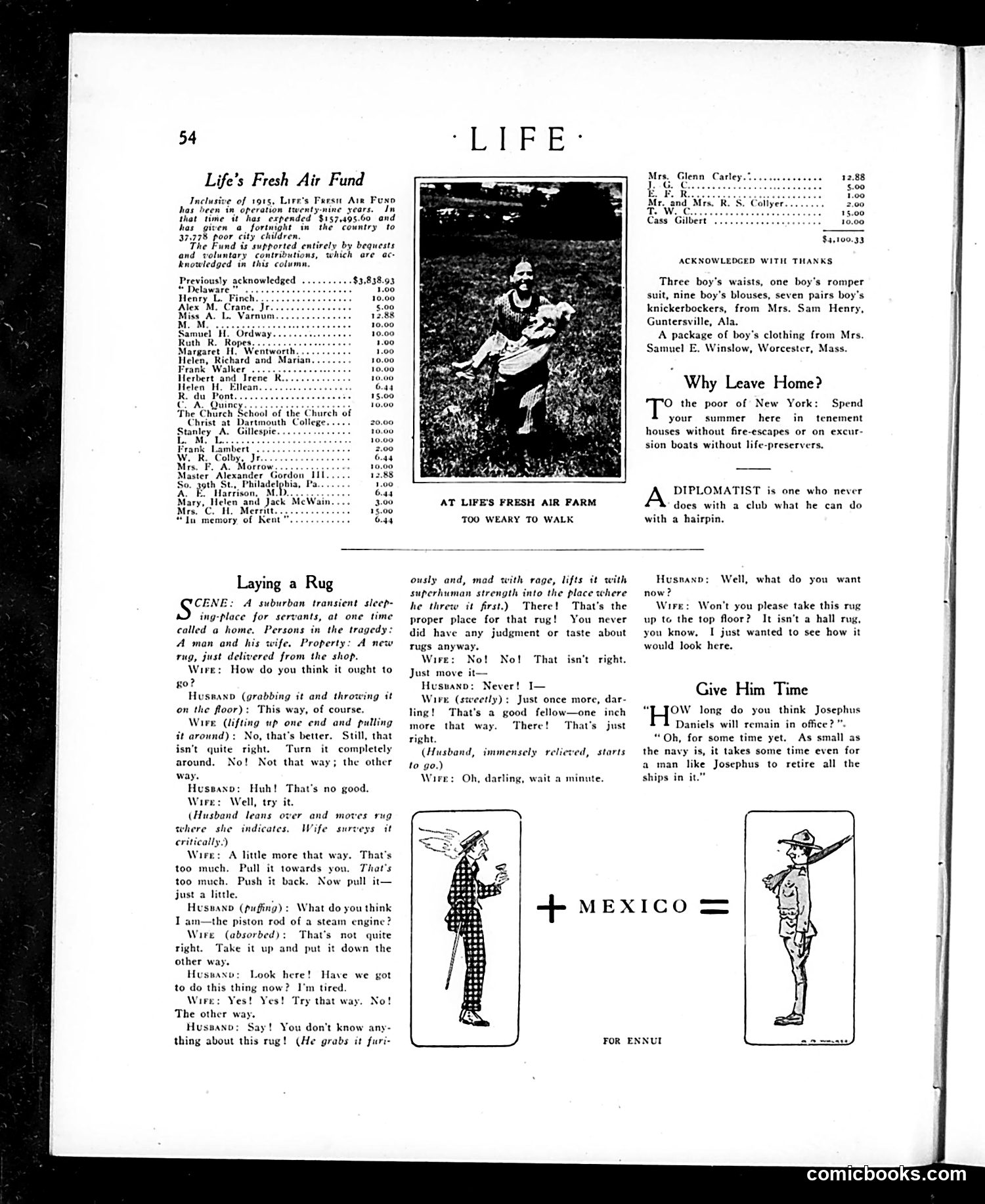
This page contains several distinct sections: **"Life's Fresh Air Fund"** is a charitable fundraising list acknowledging donations to send poor children to the countryside. **"Laying a Rug"** is a domestic humor sketch depicting a husband and wife arguing about proper rug placement in their home, with the wife repeatedly correcting the husband's positioning. The satire targets marital dynamics and the stereotypical husband's incompetence at household tasks. **"Why Leave Home?"** critiques tenement housing conditions in New York, contrasting dangerous urban living (no fire escapes, unsafe boats) with rural alternatives. **"Give Him Time"** appears to be a brief joke about patience regarding someone named Josephus. **The Mexico cartoon** uses simple addition-style imagery (man + Mexico = different man), likely satirizing how travel or relocation changes people, though the specific reference remains unclear without additional context.
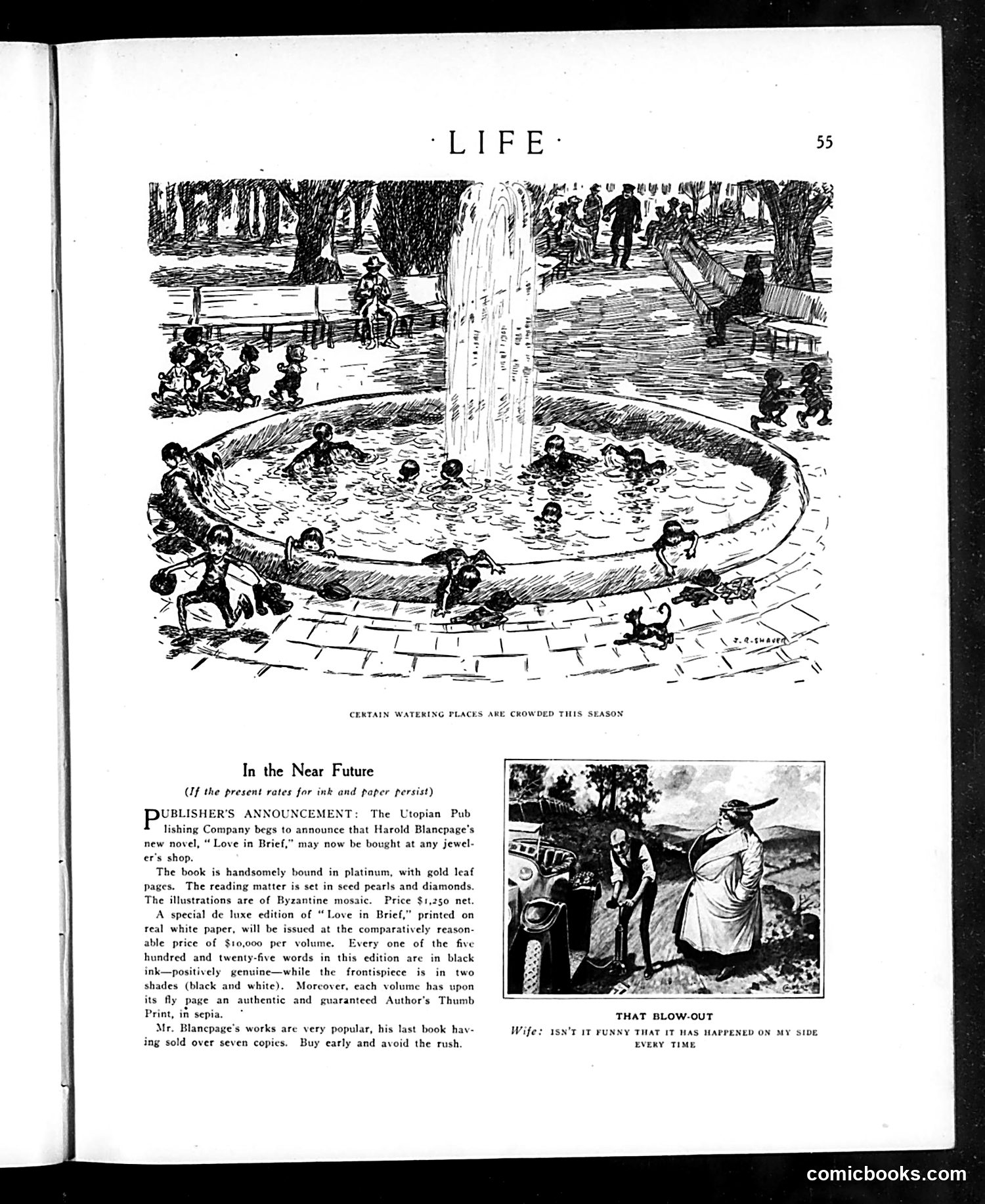
This page contains a large editorial illustration depicting a crowded public swimming pool or bathing area, captioned "CERTAIN WATERING PLACES ARE CROWDED THIS SEASON." The cartoon satirizes overcrowding at popular summer leisure destinations—a social observation about post-war recreation trends. Below is a publisher's announcement for Harold Blancpage's novel "Love in Brief," describing it as a luxurious edition with platinum binding, gold leaf pages, and Byzantine mosaic illustrations. The accompanying small illustration and caption "THAT BLOW-OUT" joke about an unexpected mishap during intimate moments. The page primarily functions as satirical social commentary on class, leisure, and consumerism, combined with literary advertising typical of Life magazine's era.
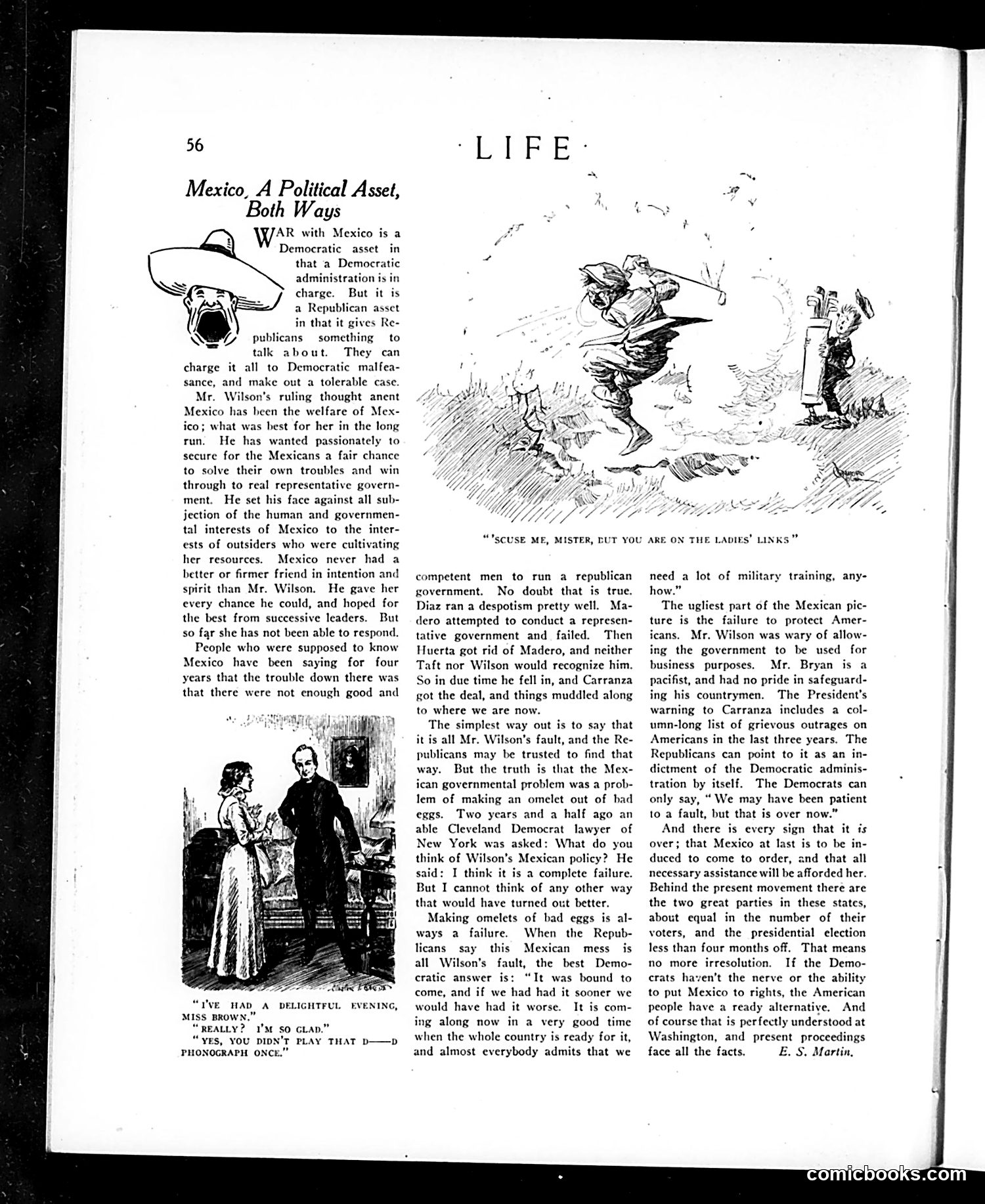
This page critiques President Wilson's Mexican policy during the Mexican Revolution. The top cartoon shows a Mexican figure on "the Ladies' Links" (a golf course), suggesting Wilson allowed Mexico to be used for political purposes rather than protecting American interests. The lower illustration depicts a couple in formal dress with dialogue about a phonograph, likely representing the artificiality of Wilson's approach—performing solutions rather than implementing real ones. The accompanying article argues that Mexico's instability resulted from poor governance, not Wilson's Democratic administration specifically. It suggests Republicans blame Democrats for Mexican chaos, though the underlying problem was Mexico's inability to sustain competent republican government. The satire critiques how both parties weaponized the "Mexican problem" for domestic political gain.
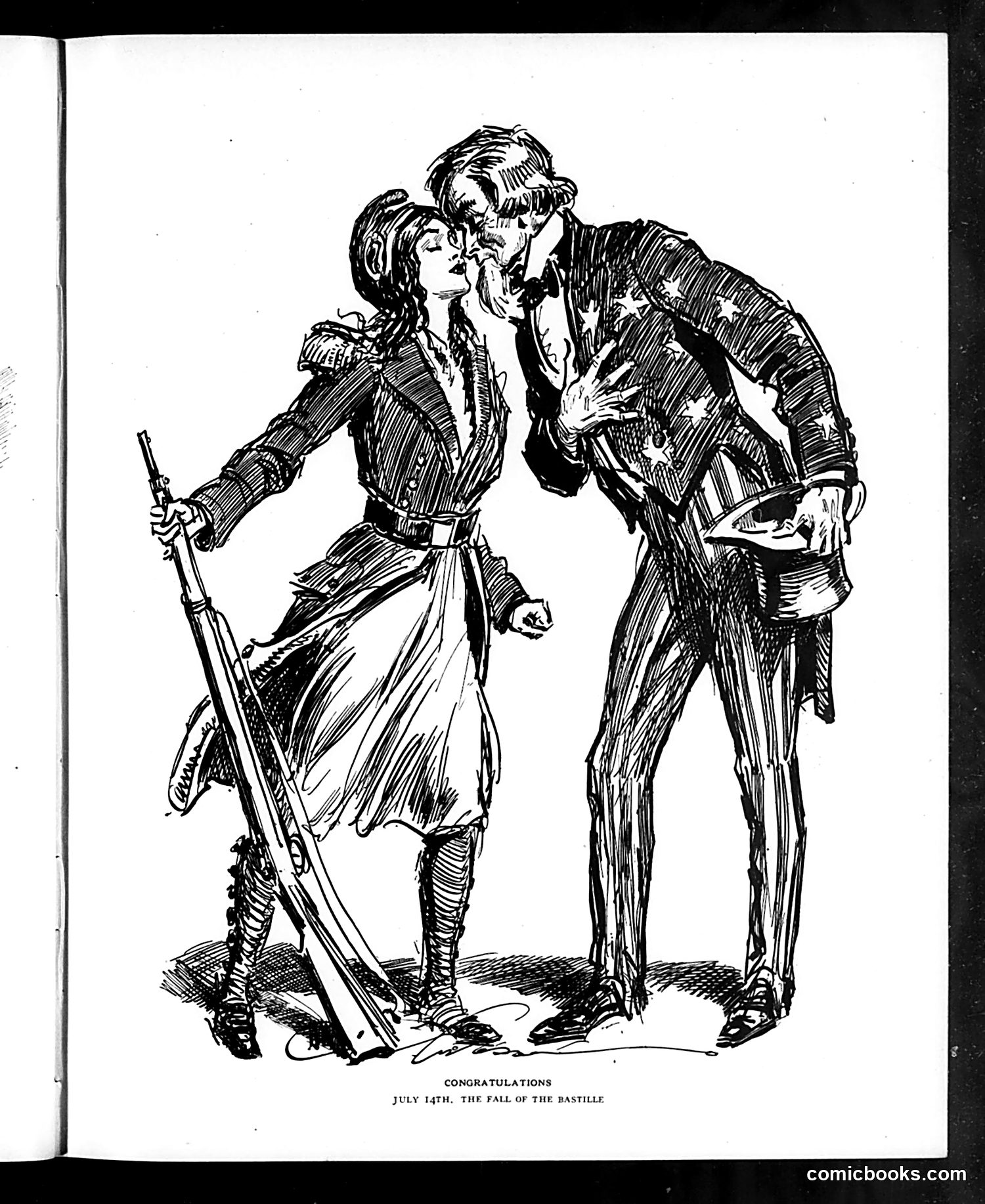
This cartoon celebrates **July 14th, the Fall of the Bastille** — the French Revolution's pivotal 1789 event. The image depicts a woman in military dress holding a rifle, representing **Liberty or France personified**, being congratulated by a formally-dressed gentleman (likely representing America or an American ally). The woman's military garb and weapons symbolize France's revolutionary struggle for freedom. The man's gesture of embrace or congratulation expresses international support for the French revolutionary cause. This reflects American sympathy for the early French Revolution, before it became more violent and radical. The satire uses allegorical figures rather than mocking specific politicians — celebrating revolutionary ideals of liberty and democratic overthrow of monarchy.
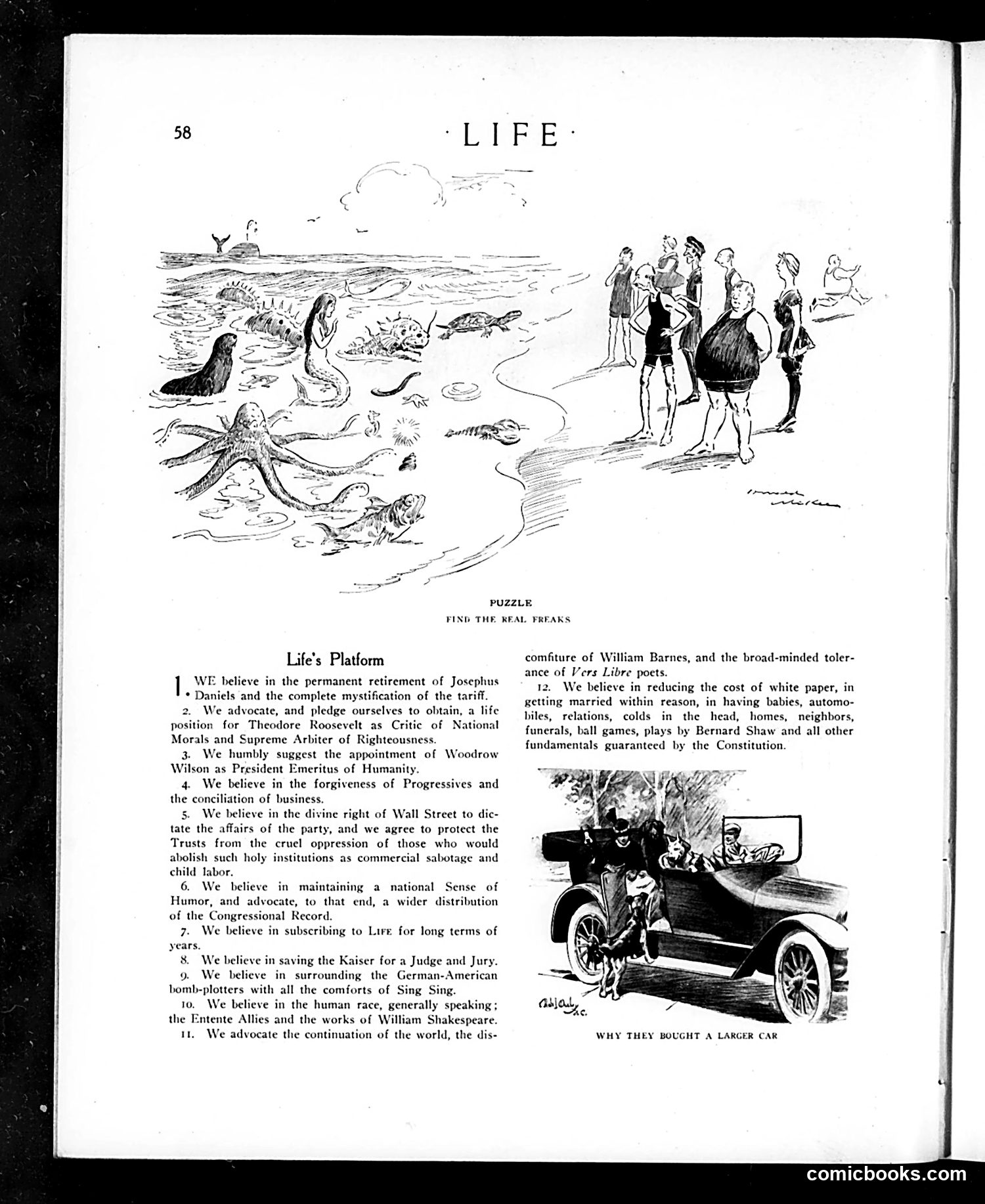
**Top Cartoon: "Puzzle - Find the Real Freaks"** This cartoon contrasts a group of well-dressed beachgoers observing various sea creatures (octopus, seal, snake, starfish). The satire suggests that the "real freaks" are the humans themselves—a commentary on human vanity and pretension. By positioning fashionable people as equally bizarre to marine life, the artist mocks societal affectation. **Bottom Cartoon: "Why They Bought a Larger Car"** An overstuffed automobile packed with passengers illustrates the absurdity of purchasing a larger vehicle. The joke likely critiques either consumer excess or the impracticality of automotive solutions to social/family problems—a common satirical theme during the automobile boom era. **"Life's Platform"** lists 12 numbered beliefs mixing genuine social commentary (tariff reform, child labor opposition) with humorous absurdities (reducing white paper costs, preserving Shakespeare).
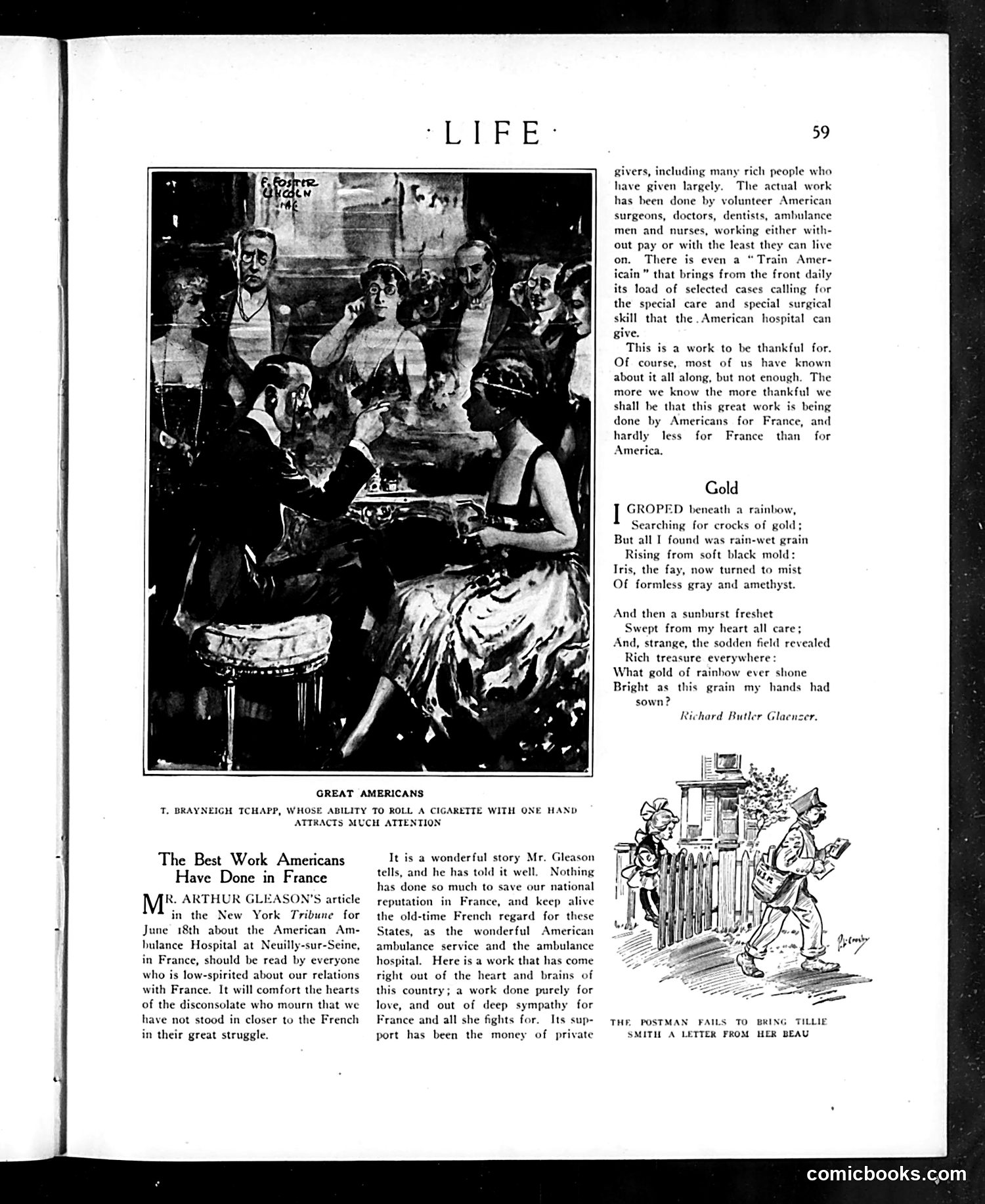
This page celebrates American medical aid to France during World War I. The large photograph shows what appears to be a social gathering at an American hospital in France, captioned "Great Americans: T. Brayneigh Tchaff, Whose Ability to Roll a Cigarette with One Hand Attracts Much Attention." The accompanying article by Arthur Gleason praises American ambulance services and hospitals operating in France, emphasizing volunteer work by American doctors, surgeons, and nurses. The small cartoon at bottom right, captioned "The Postman Fails to Bring Tillie Smith a Letter from Her Beau," appears to be a humorous vignette about wartime separation. The page's purpose is patriotic: promoting American humanitarian efforts in France and building support for American involvement in the war.
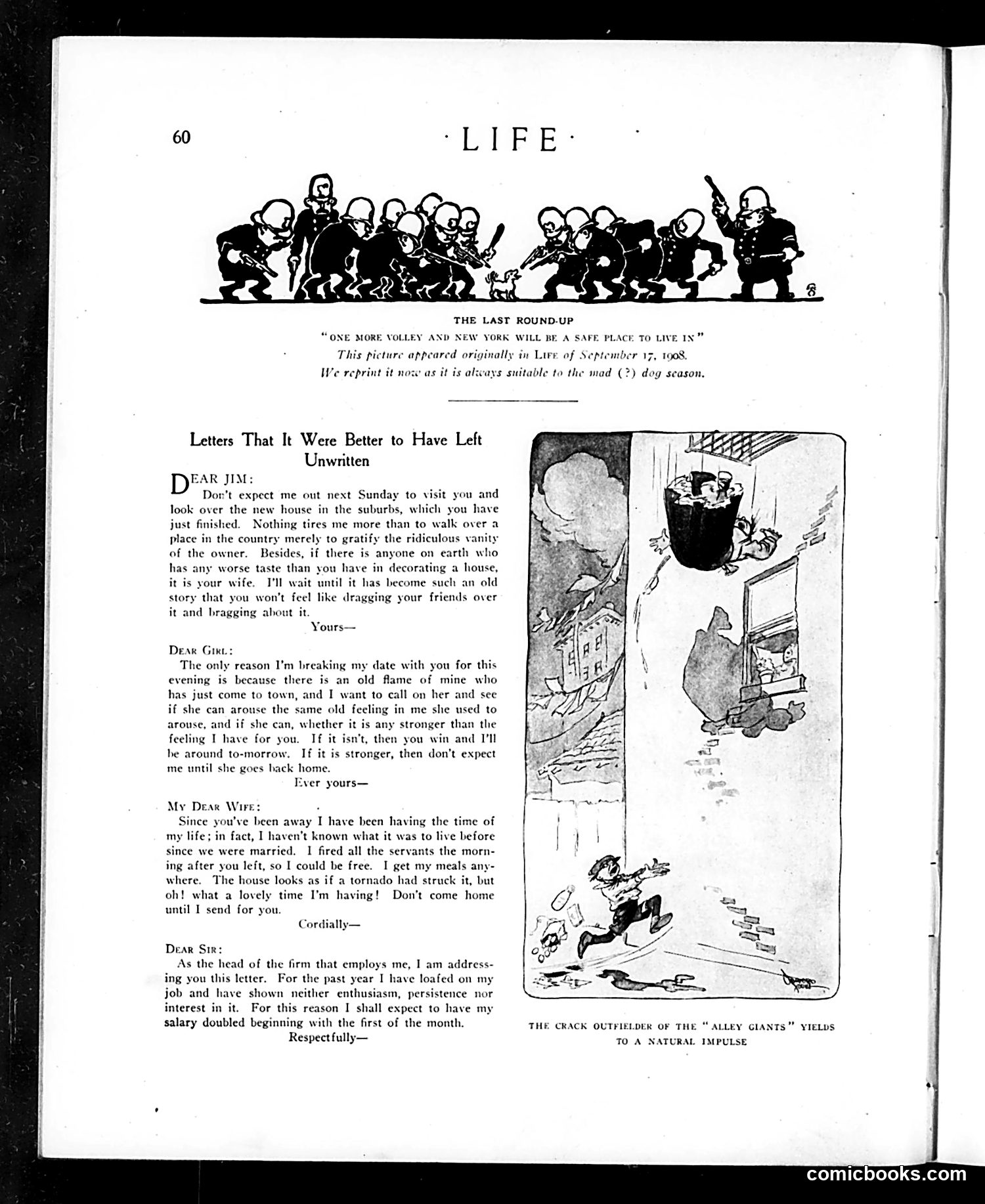
**Top Cartoon ("The Last Round-Up"):** A silhouette shows caricatured figures (appearing to be politicians or officials) rounding up smaller figures with clubs and weapons. The caption quotes: "One more volley and New York will be a safe place to live in." Originally published September 17, 1908, this satirizes political corruption or crime in New York City, suggesting violent suppression as a solution to urban safety problems. **Lower Section:** The page features humorous fictional letters—a satire device where people write absurd justifications for breaking social commitments (canceling dates, abandoning jobs, neglecting spouses). The joke mocks self-centered rationalization and social irresponsibility. **Right Illustration:** "The Crack Outfielder of the 'Alley Giants'" shows a figure jumping/diving, likely satirizing amateur baseball or street sports.
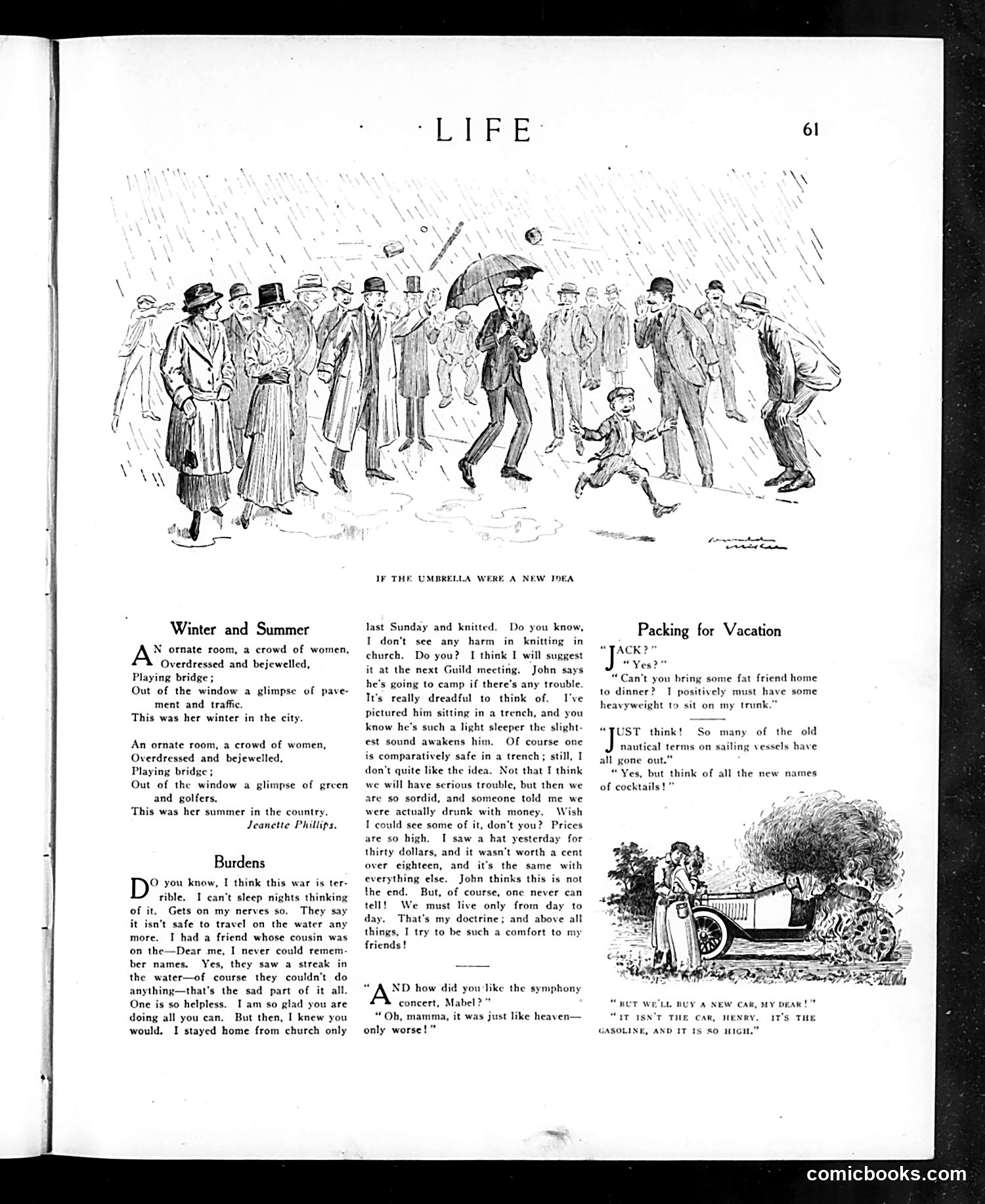
The top illustration, titled "If the Umbrella Were a New Idea," is a satirical cartoon depicting a crowd of well-dressed men and women in early 20th-century attire gathered around someone holding an umbrella in the rain. The joke appears to mock how people treat genuinely useful innovations—the crowd seems baffled or overly fascinated by this everyday object, as if witnessing something revolutionary. The page contains three separate humorous prose pieces ("Winter and Summer," "Burdens," and "Packing for Vacation") that offer satirical commentary on domestic life and wartime concerns, including references to war worries and financial hardship. A small illustration accompanies "Packing for Vacation," showing a couple discussing automobile expenses.
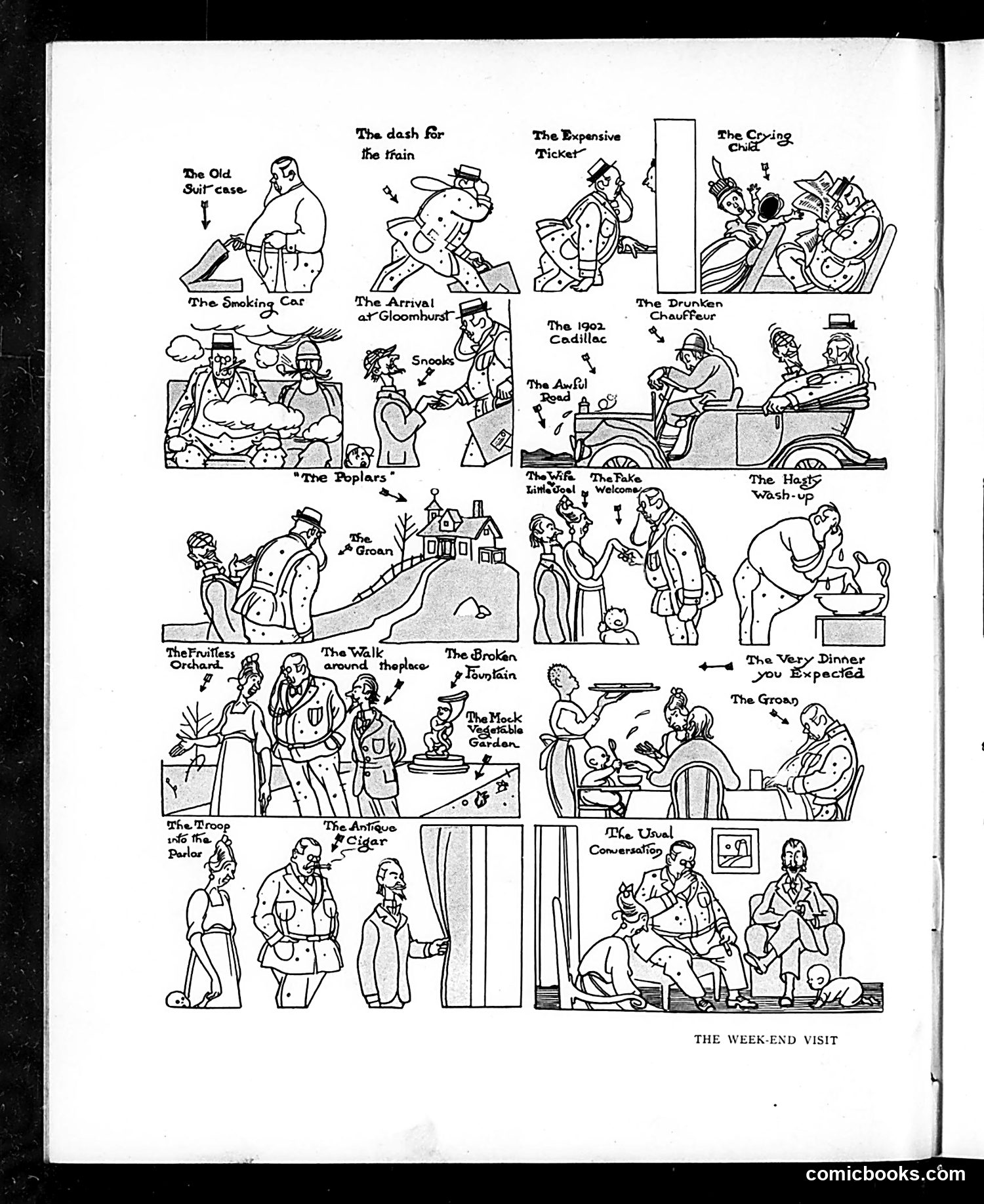
This comic strip satirizes the chaos of a middle-class family's weekend visit, likely from the 1920s-1930s based on the style. Each panel depicts a domestic mishap: an old suit case, smoking cat, train dash, expensive auto repairs, drunk chauffeur, messy dinner preparations, broken plumbing, failed garden, and awkward social interactions. The humor targets the pretensions and incompetence of attempting to maintain respectability during a guest visit—servants fail, machinery breaks down, food disasters occur, and social conventions collapse. The satire mocks the gap between aspirations (appearing refined and organized) and reality (everything going hilariously wrong). This reflects common Life magazine humor mocking middle-class domestic life and the complications of entertaining guests.
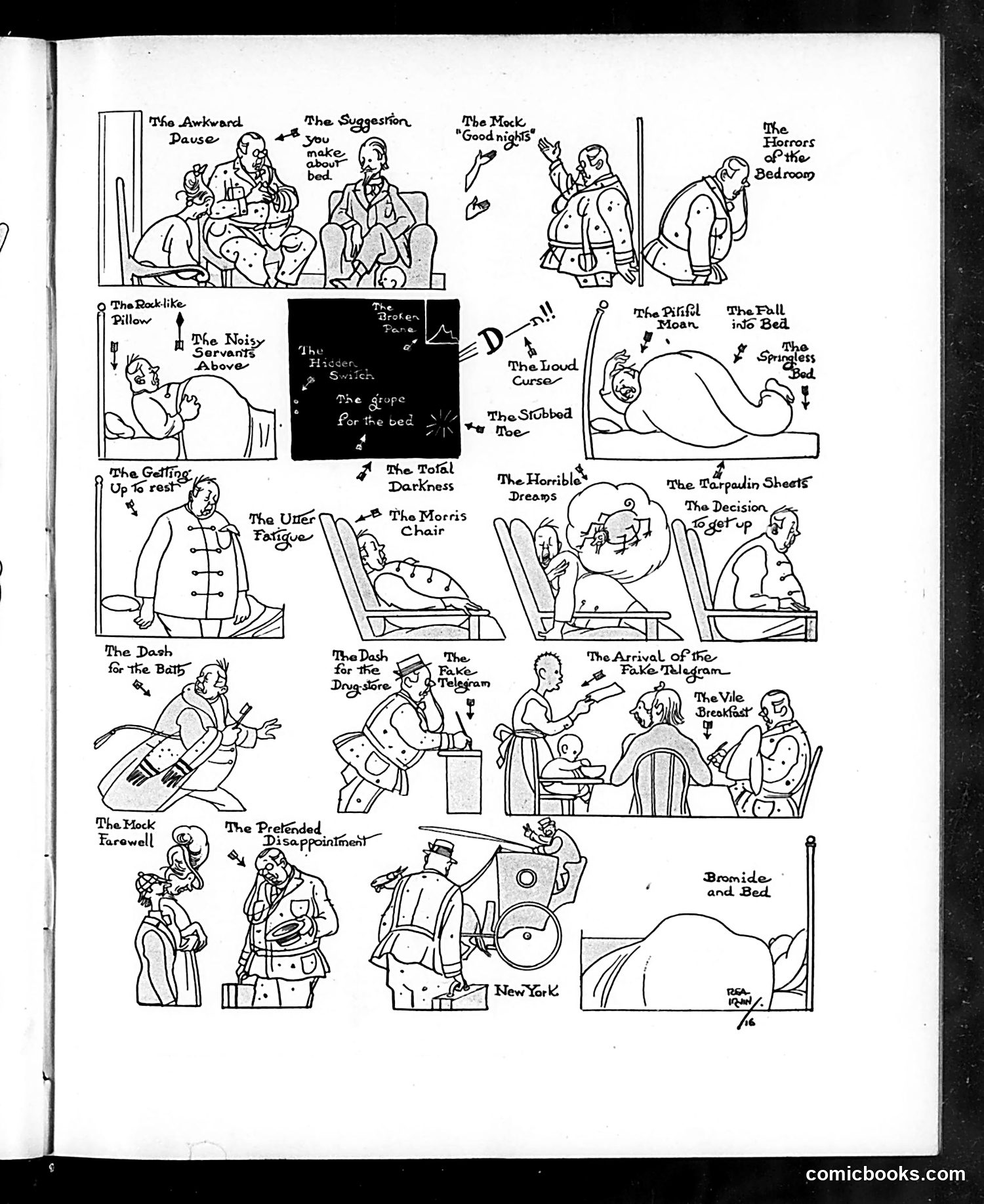
This is a humorous illustrated guide depicting the various frustrations and comedic scenarios of married life and domestic arrangements. Each labeled panel represents common domestic annoyances: noisy servants, uncomfortable furniture (Morris Chair), marital bed difficulties (spineless bed, fall into bed), sleeplessness, and relationship tensions (the "decision to get up," "horrible dreams," "fake telegram" arrival). The satire targets Victorian-era domestic life's petty irritations and marital discord. The "Bromide and Bed" conclusion suggests resignation as life's cure. The style and subject matter—focusing on servants, specific furniture, and telegraph communications—indicate this is early 20th-century American satire aimed at middle-class readers dealing with household management and marital routines. The cartoon chronicles mundane domestic unhappiness through visual gags about sleep disruptions, uncomfortable furnishings, and relationship awkwardness.
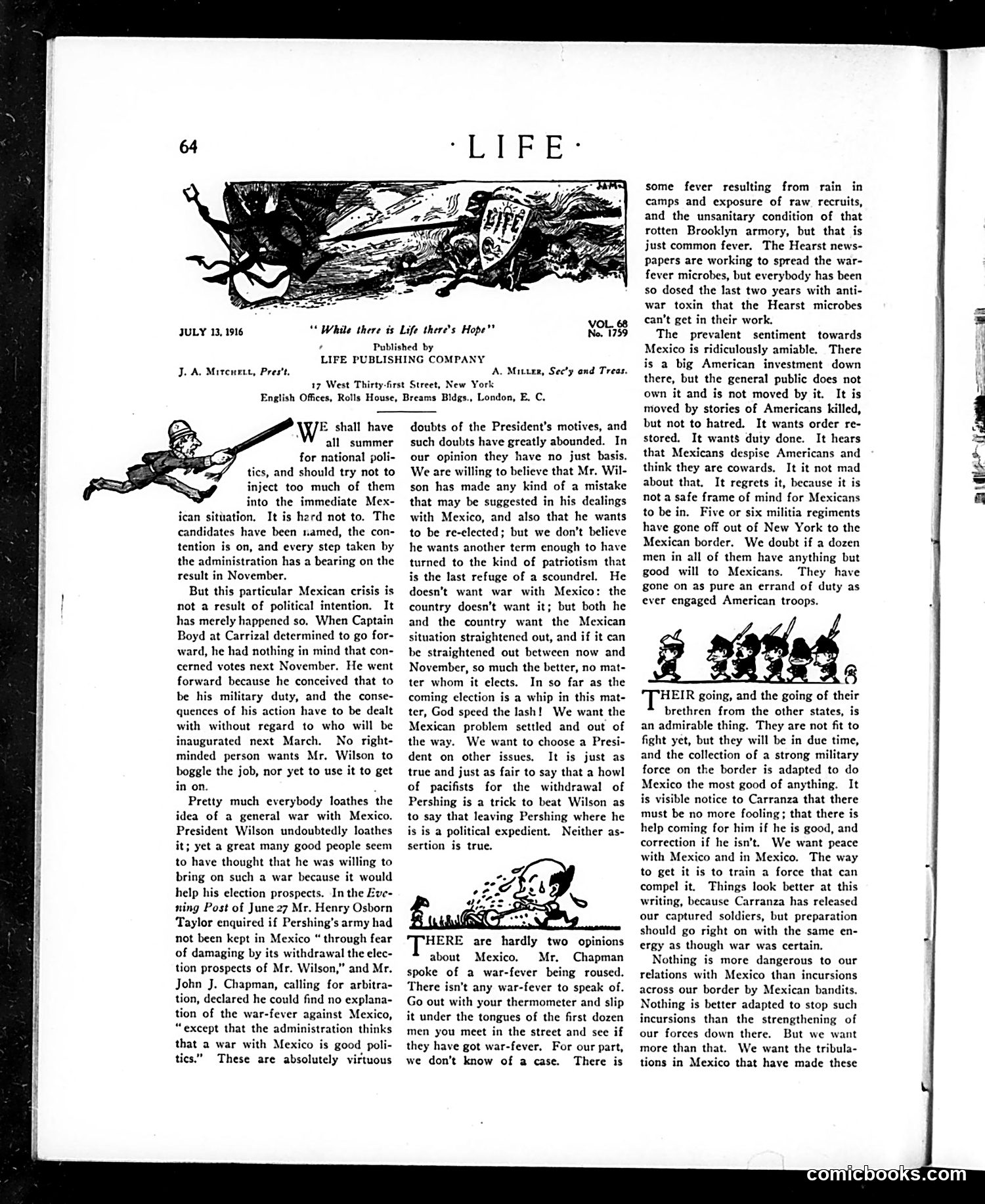
This editorial page addresses the **Carrizal Incident** (June 1916), where U.S. Army Captain Boyd clashed with Mexican forces under General Carranza. The article defends President Wilson against accusations that he prolonged the military engagement for electoral advantage in the November 1916 election. The cartoons depict soldiers, likely representing American troops involved in the Mexico border campaign. The editorial argues that critics—particularly pacifist groups and publications like William Randolph Hearst's newspapers—wrongly politicize the military situation. Life's editors insist there is no genuine "war-fever" among Americans; instead, they blame Hearst's papers for attempting to manufacture anti-war sentiment through propaganda. The piece dismisses both pro-war and anti-war political opportunism, claiming Wilson genuinely seeks to resolve the Mexican situation independently of electoral considerations. The tone is defensive of the administration's handling of the border crisis.
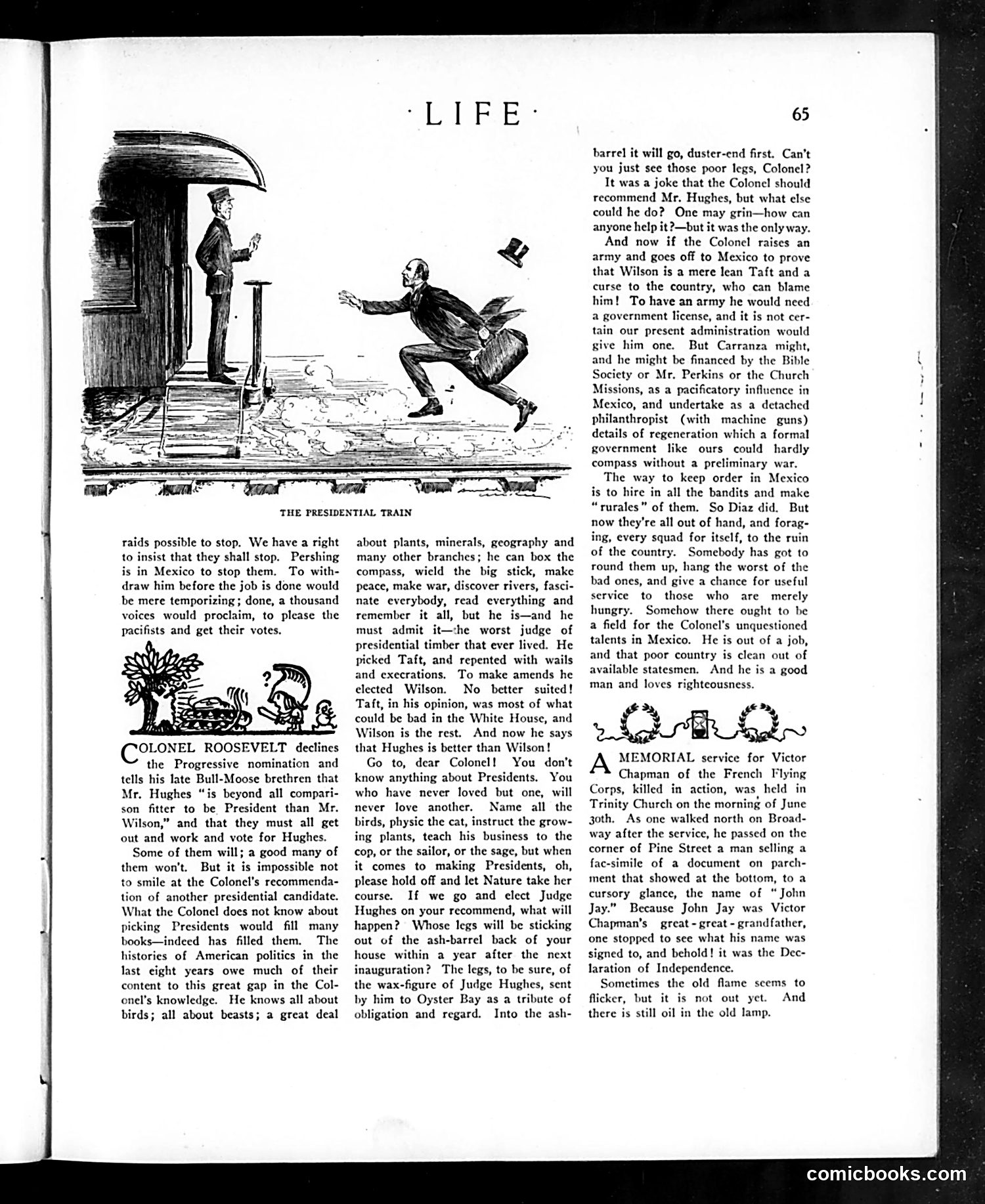
This page satirizes Theodore Roosevelt's 1916 endorsement of Republican Charles Evans Hughes for president. The cartoon shows Roosevelt literally jumping off a train platform—a visual metaphor for his political departure. The article mocks Roosevelt's poor judgment in picking presidential candidates: he previously championed William Howard Taft (whom he later repudiated), then supported Woodrow Wilson (whom he also turned against), and now backs Hughes. The writer predicts Hughes will suffer the same fate as the others—a wax figure of him will end up in Roosevelt's trash can within a year. The satire extends to Roosevelt's rumored interest in leading military intervention in Mexico against Pancho Villa's raids. The piece sardonically suggests Mexico could use Roosevelt's talents since "that poor country is clean out of available statesmen"—backhanded praise mocking his outsized ego and interventionist impulses. The fundamental joke: Roosevelt's catastrophic record at judging presidents makes his endorsement worthless, yet he remains temperamentally incapable of restraint.
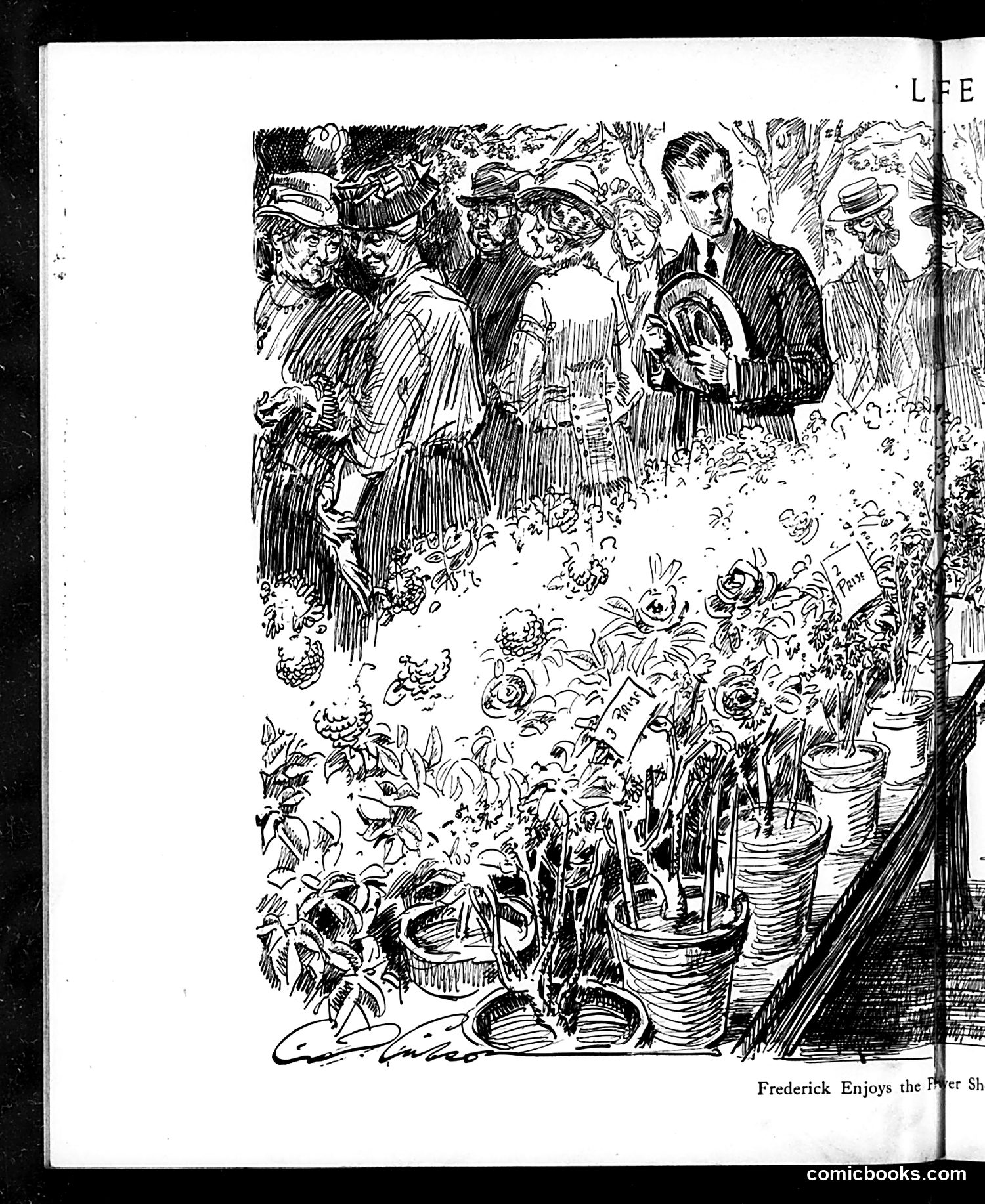
This Life magazine illustration depicts a group of well-dressed men in formal attire and hats observing potted flowers and plants at what appears to be a horticultural exhibition. The caption identifies the scene as "Frederick Enjoys the Flower Show." The satire likely plays on contrasts between masculine formality and delicate floral interest, or possibly mocks social pretension—upper-class men attending refined cultural events. Without additional context about "Frederick" or the publication date, the specific target of the joke remains unclear. The detailed cross-hatching and signature style suggest this is a professional illustrator's work, typical of Life's satirical content from the early-to-mid 20th century. The humor may derive from the incongruity of stern-faced gentlemen seriously examining flowers, or from social commentary about leisure activities and class display.
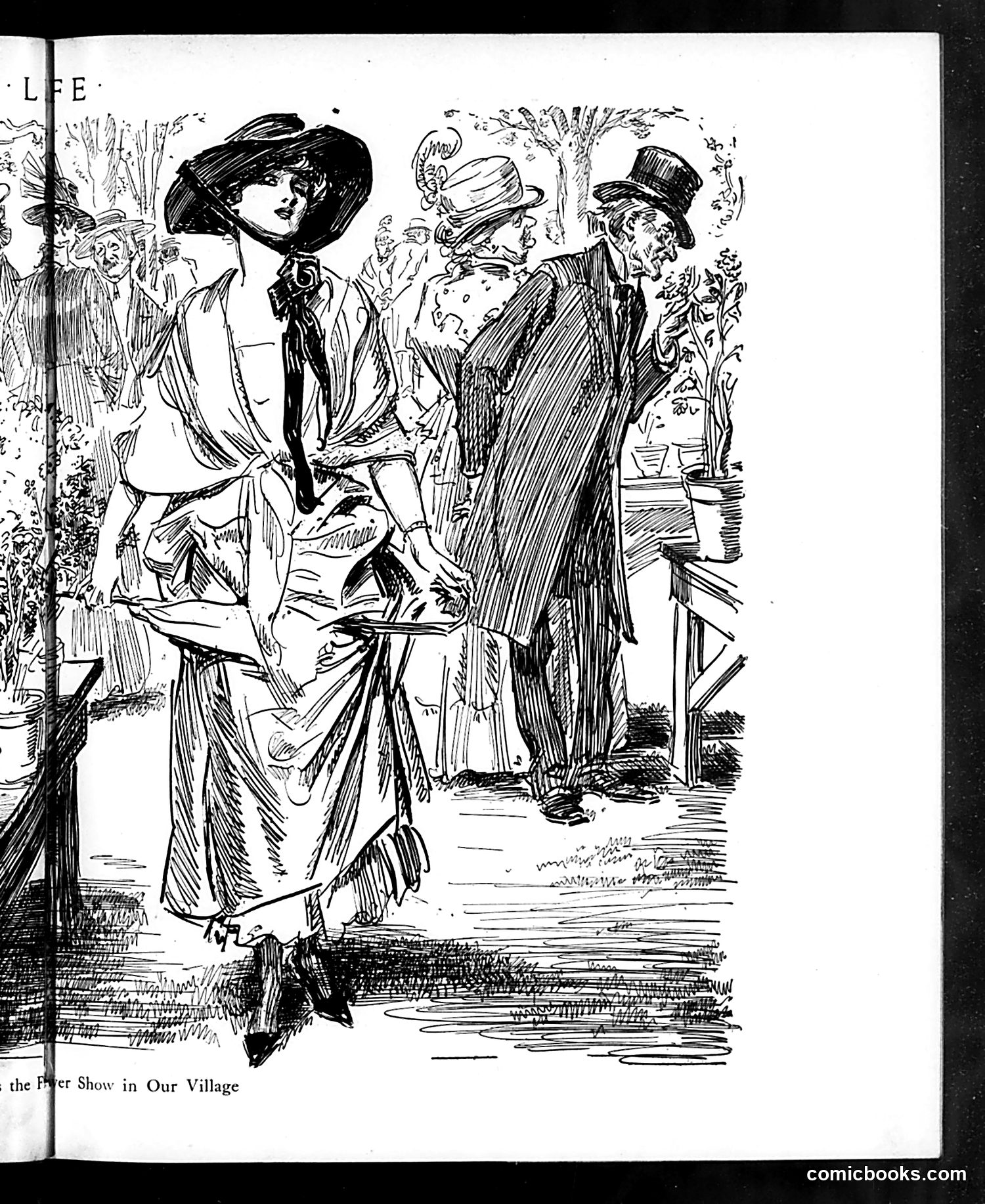
This Life magazine illustration satirizes small-town social pretension. The caption references a village flower show, a genteel community event. The sketch depicts what appears to be fashionable urbanites—a woman in stylish dress with a large hat and feathered accessory, accompanied by well-dressed gentlemen in top hats—intruding upon or "showing off" at a rural village gathering. The satire likely mocks the contrast between cosmopolitan sophistication and provincial simplicity, or perhaps ridicules villagers' desire to appear cultured by adopting city fashions and manners. The caricatured figures suggest pretension or affectation—the exaggerated hats and clothing emphasizing artificial refinement. Without additional context, the specific social commentary remains somewhat unclear, but the tone appears gently mocking toward small-town social aspirations.
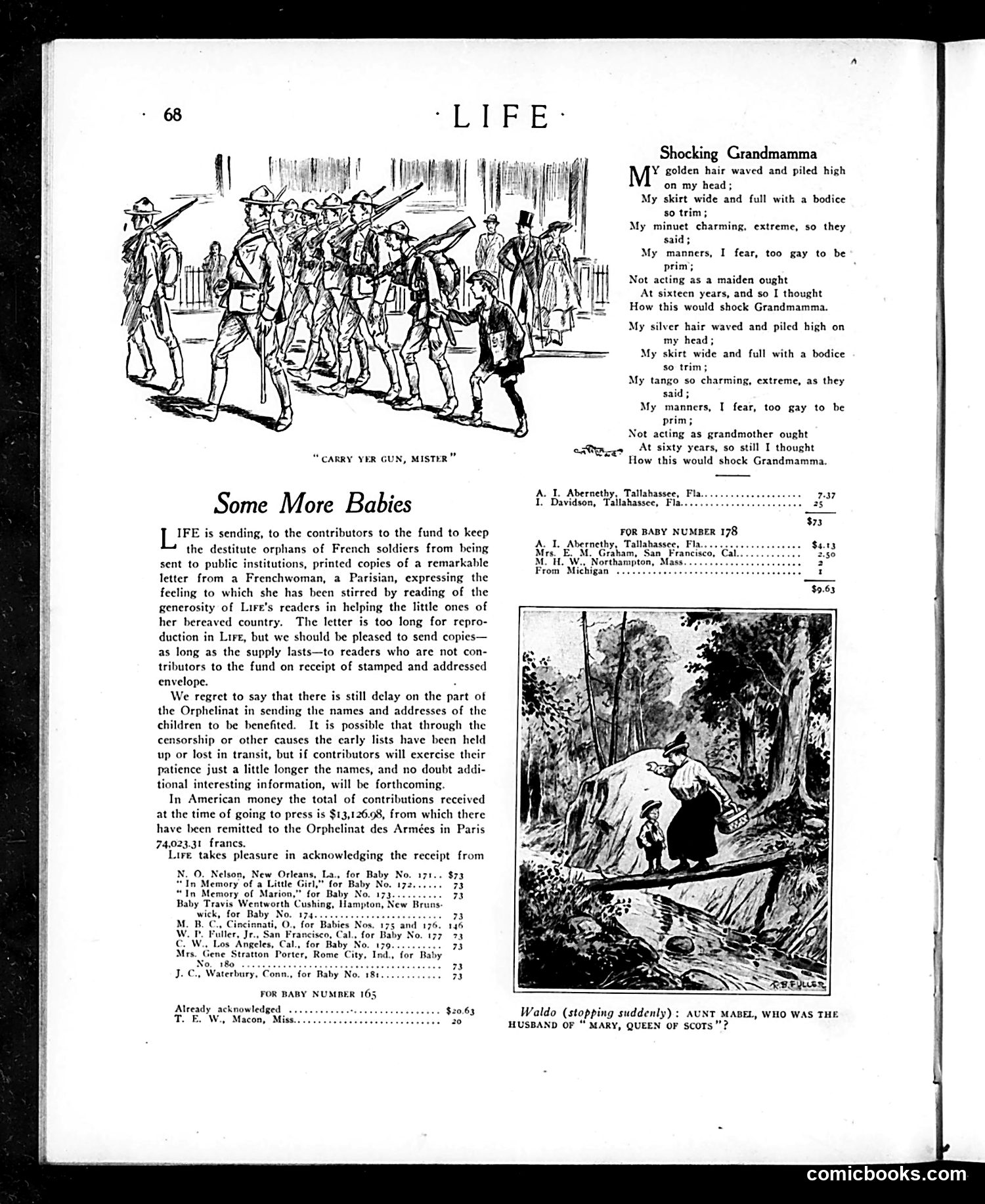
**The Cartoon "Carry Yer Gun, Mister"**: Shows soldiers in military formation, likely referencing World War I recruitment or training. The caption suggests soldiers being armed or mobilized—probably satirizing militarism or the draft during the war era. **The Poetry "Shocking Grandmamma"**: A humorous comparison of a woman's behavior at sixteen versus sixty. At both ages, she acted inappropriately (minuet vs. tango dancing, "gay" manners), yet still expected to scandalize her grandmother. The joke: women's rebellious behavior hasn't changed across generations, contradicting expectations that aging brings propriety. **"Some More Babies"**: The main content documents Life magazine's charitable fundraising for French war orphans. It acknowledges donations and explains delays in recipient lists, likely due to WWI censorship. The illustration "Waldo" cartoon appears unrelated—a child asking about Mary Queen of Scots' husband, seemingly a non-sequitur joke. The page mixes wartime charity appeals with light satirical humor.
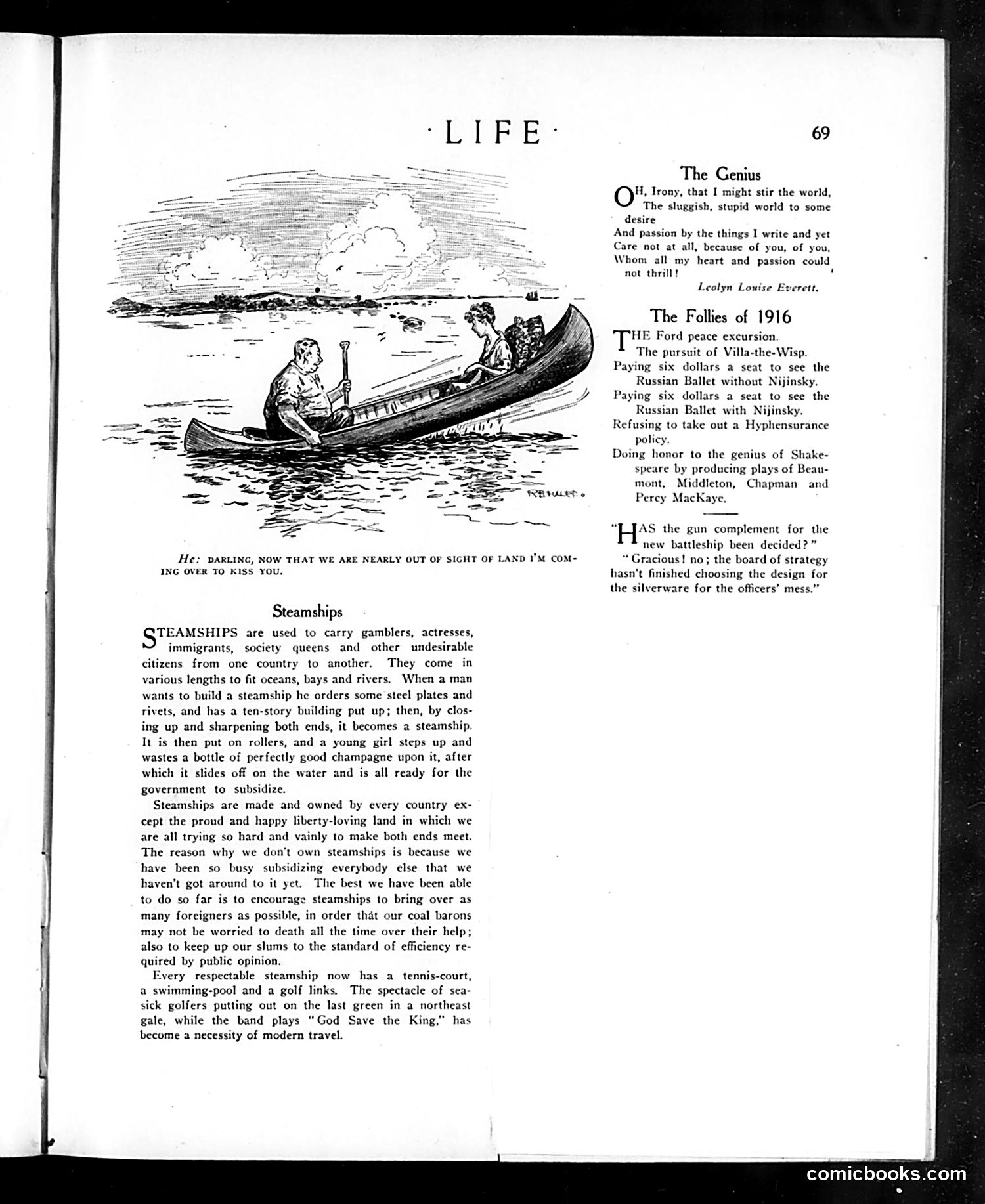
This page from *Life* magazine (1916) contains multiple satirical pieces mocking American follies and hypocrisies: **"The Follies of 1916"** lists contemporary absurdities, including Henry Ford's failed peace mission (he chartered a ship to end WWI), the pursuit of Mexican revolutionary Pancho Villa, and the expensive Russian Ballet craze (where audiences paid premium prices regardless of whether star dancer Nijinsky performed). **The cartoon** shows a couple in a gondola with a romantic caption that's undermined by the accompanying joke: while he promises affection now they're isolated, she responds with wartime concerns about battleship design details—satirizing how even intimate moments were overshadowed by military preoccupation. **"Steamships"** is a lengthy satirical essay attacking American hypocrisy: while the U.S. claims to value independence, it subsidizes foreign steamships while neglecting its own maritime industry, importing cheap labor that depresses wages and maintains urban slums. The absurdist ending describes seasick golfers playing on ship decks—mocking the era's obsession with leisure amenities aboard vessels.
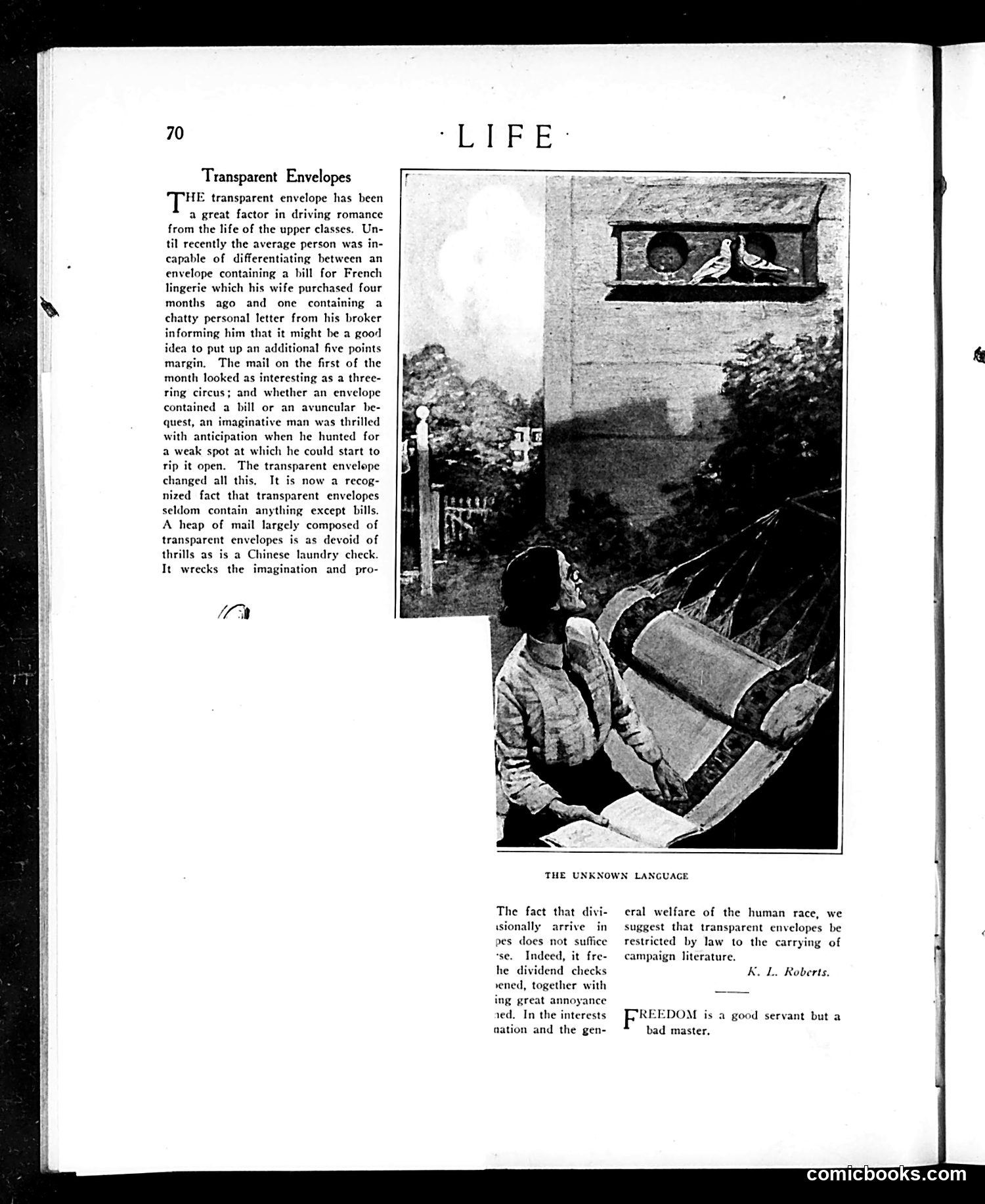
This humorous essay attacks the transparent envelope as a romantic and social nuisance for upper-class men. The satire's point: transparent envelopes have eliminated the thrill of mail by making bills immediately visible, destroying the anticipation and imagination that once accompanied opening correspondence. The author laments that before transparent envelopes, a man couldn't distinguish between a bill from his wife's lingerie purchases or a letter from his broker—creating delicious uncertainty. Now, transparent envelopes contain "nothing except bills," reducing mail to dull financial documents. The accompanying photograph labeled "The Unknown Language" appears to show someone examining or reading papers, visually reinforcing the theme of mail and correspondence. The essay concludes with a tongue-in-cheek suggestion that transparent envelopes be legally restricted to campaign literature only—a mild jab at political mail. The satire reflects early 20th-century anxieties about modern conveniences eroding romance and imagination from everyday life.
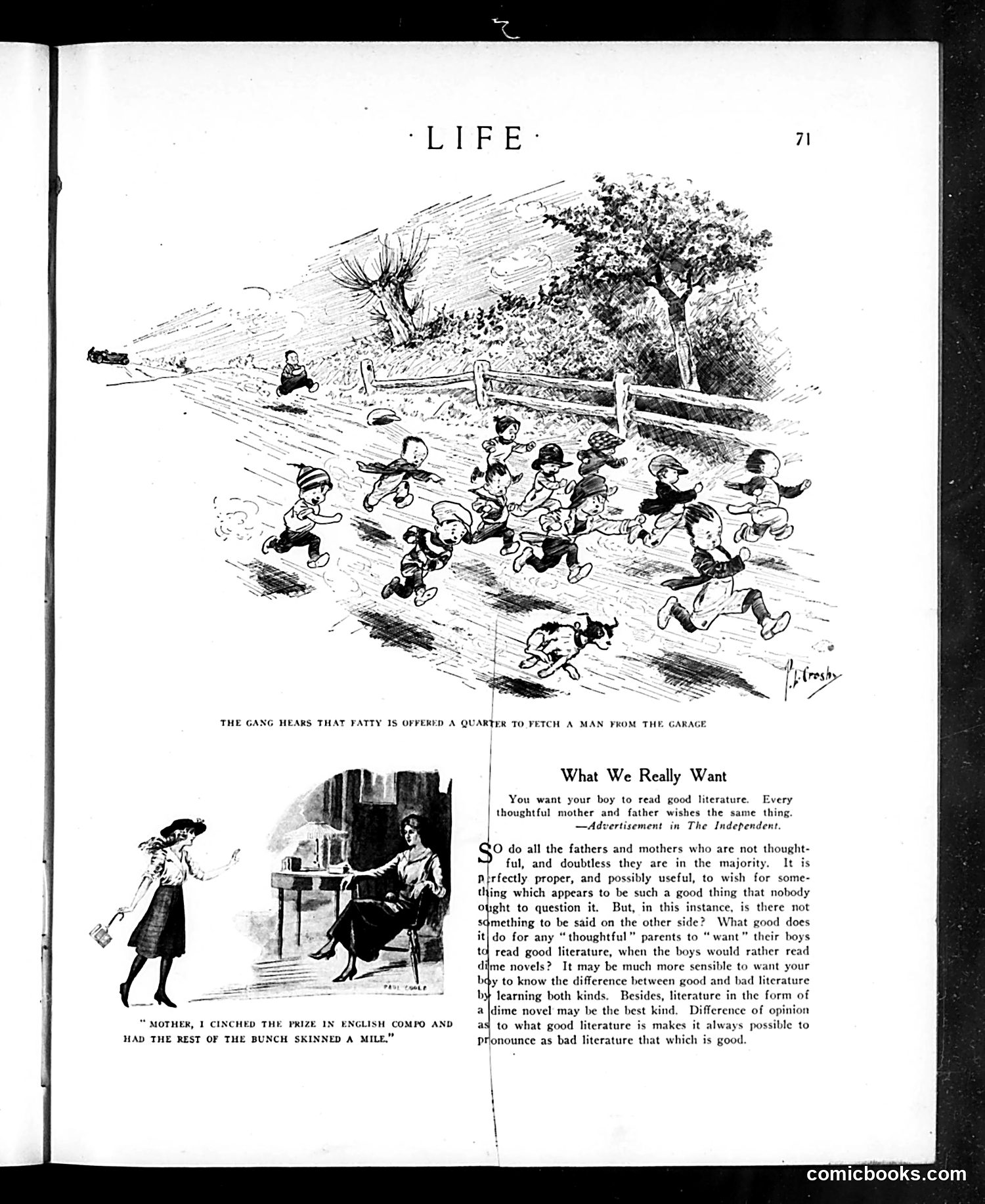
The top cartoon satirizes childhood mischief: a gang of children runs wildly through a rural setting, apparently having been offered money to fetch a man from a garage—likely depicting the chaos and pandemonium such an offer would create among rowdy kids. The bottom illustration shows a child boasting to his mother about winning an English composition prize, with the caption using period slang ("cinched," "skinned a mile") to convey youthful pride. The accompanying essay mocks parental pretension. While parents claim to want their sons reading "good literature," the piece argues this is meaningless moralizing. Boys prefer dime novels, and parents might better serve them by teaching discernment between quality and poor writing rather than simply demanding they read "proper" books. The satire targets the gap between what parents *say* they want and what actually interests children—a gentle critique of Victorian-era parental sanctimoniousness about cultural improvement.
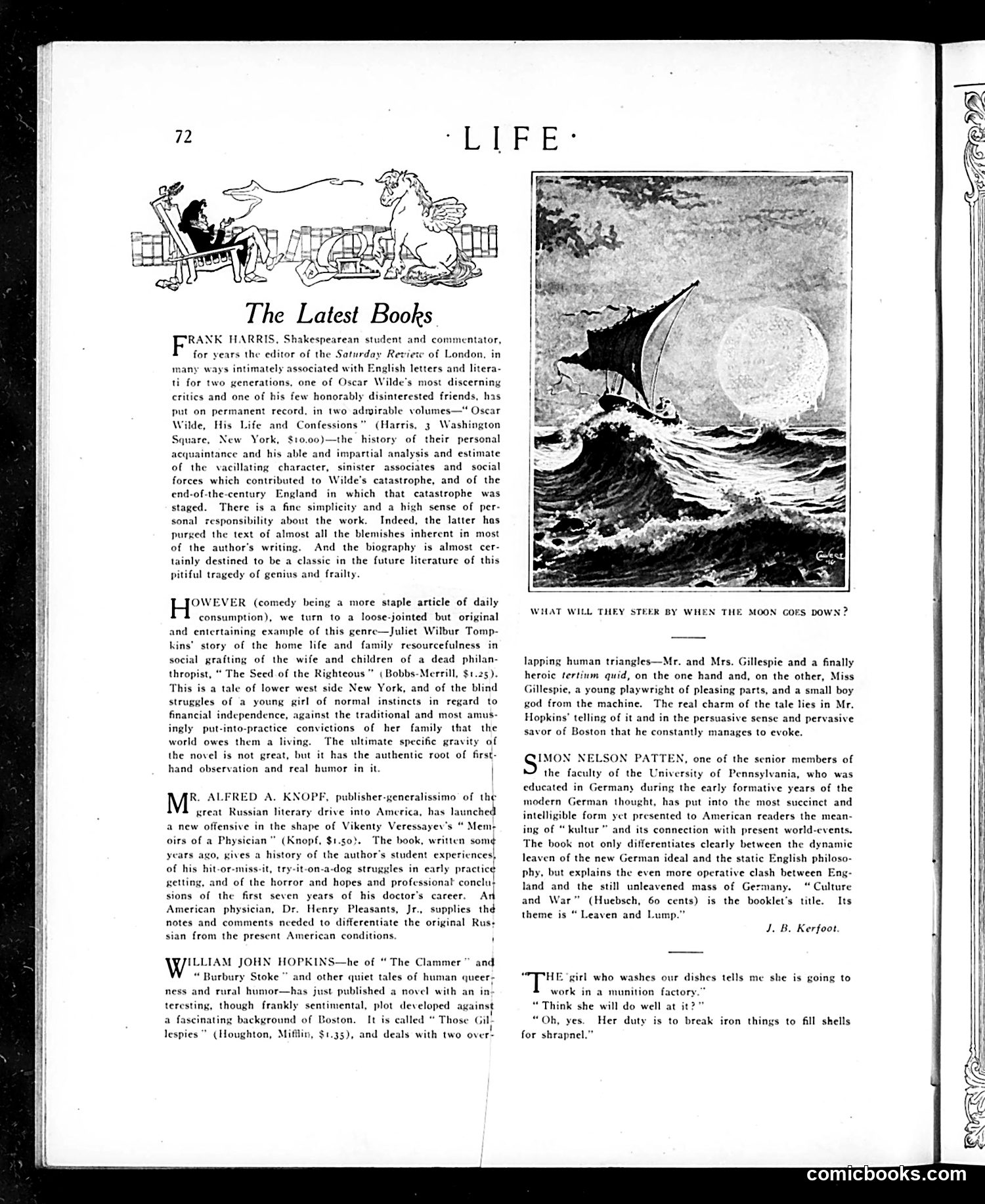
This page presents literary reviews from Life magazine's "Latest Books" section. The small cartoon at top shows a figure lounging while reading, introducing the leisure activity of book consumption. The reviews discuss recent publications, including Frank Harris's biography of Oscar Wilde (a major literary scandal figure of the era), a novel about working-class New York family life, Russian literature being promoted in America, and Boston-set fiction. The tone is witty and evaluative—typical of Life's satirical approach to culture. The dramatic illustration labeled "What Will They Steer By When the Moon Goes Down?" appears unrelated to the text below it; it depicts a sailing vessel in rough waters, likely illustrating a different story or serving as thematic visual content about uncertainty and navigation—possibly metaphorically connected to literary themes of direction and fate discussed in the reviews. This reflects Life's role as a sophisticated cultural commentary magazine for educated American readers.
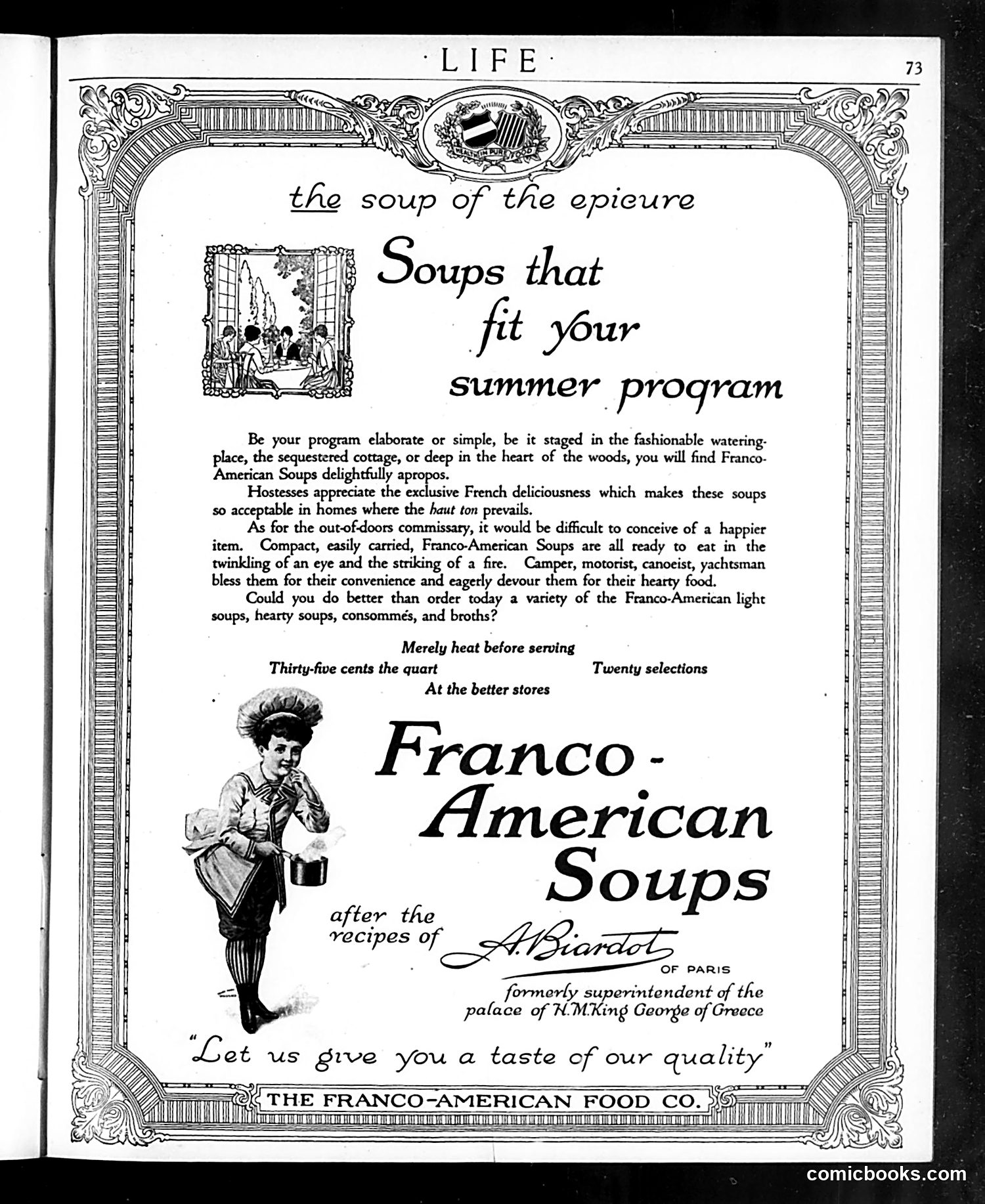
This is a **product advertisement**, not satire or political commentary. It promotes Franco-American Soups by Franco-American Food Company, marketed as convenient, elegant provisions for summer entertaining. The ad features a **French chef character** (illustrated in period dress) representing the brand's association with French culinary prestige. The copy emphasizes that the soups suit both formal "haut ton" (high-society) gatherings and outdoor camping—appealing to wealthy hostesses and adventurous sportsmen alike. The key selling points: ready-to-eat convenience (merely heat before serving), affordability (thirty-five cents per quart), and authentic "French deliciousness" derived from recipes by A. Biardot of Paris, formerly superintendent of the palace of King George of Greece—a credential meant to establish legitimacy and refinement. This reflects early 20th-century marketing strategy: combining French sophistication with modern American convenience for middle-to-upper-class consumers.
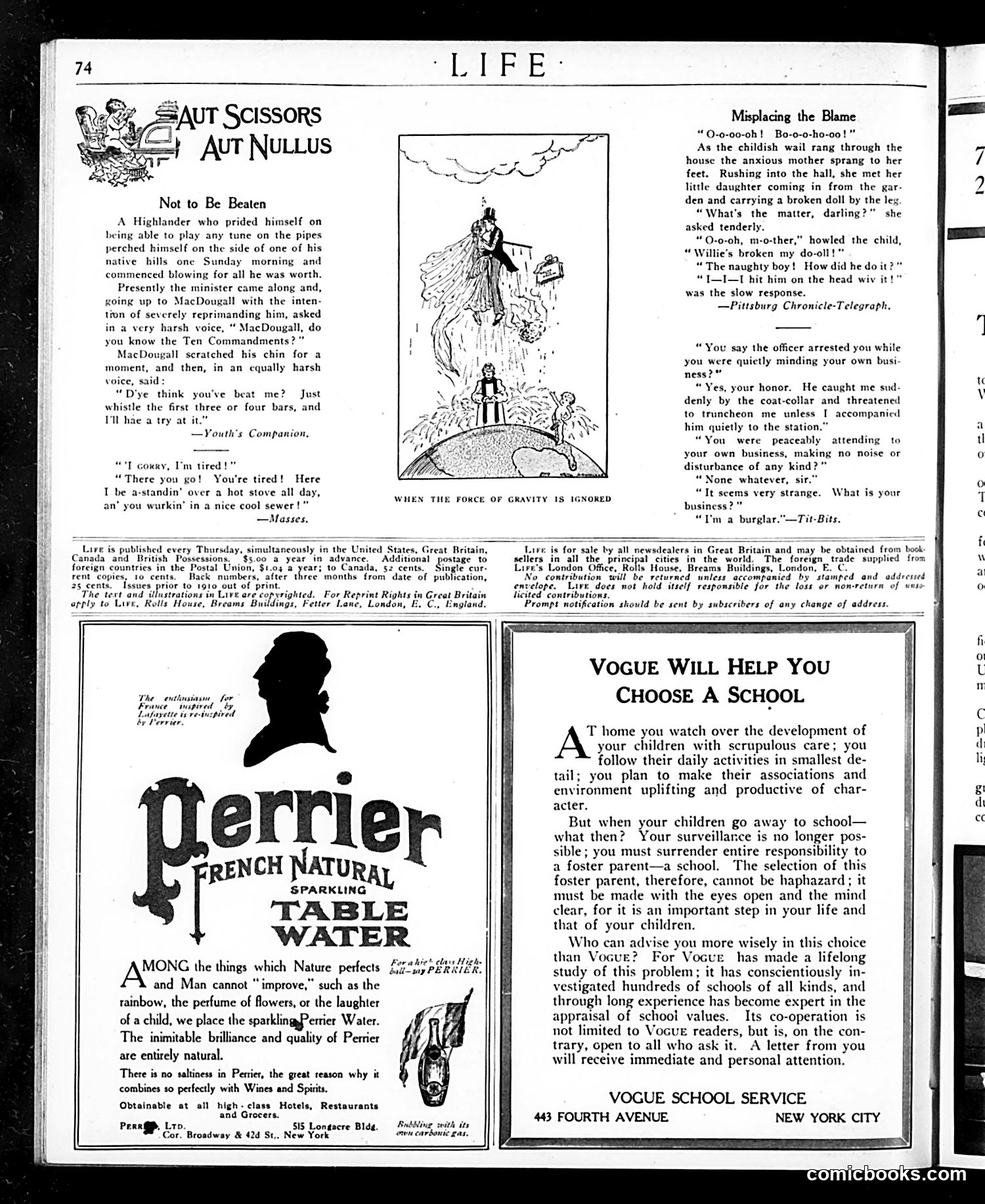
This page from *Life* magazine contains three humorous short anecdotes and advertisements. **"Not to Be Beaten"** satirizes Scottish stubbornness. A Highland bagpiper, confronted by a minister about playing on Sunday (violating religious observance), refuses to be shamed and challenges the minister to a musical duel—a joke about Scottish pride and competitive spirit. **"Misplacing the Blame"** uses ironic wordplay: a child breaks her doll hitting a boy with it, but blames the boy for breaking it—commenting on how people deflect responsibility. **"You say the officer arrested you..."** features dark comedy: a burglar admits to police he was "quietly minding [his] own business" while committing burglary, highlighting criminal audacity and the absurdity of his excuse. The page also contains period advertisements for Perrier water and Vogue's school-selection service, typical of magazine content from this era.
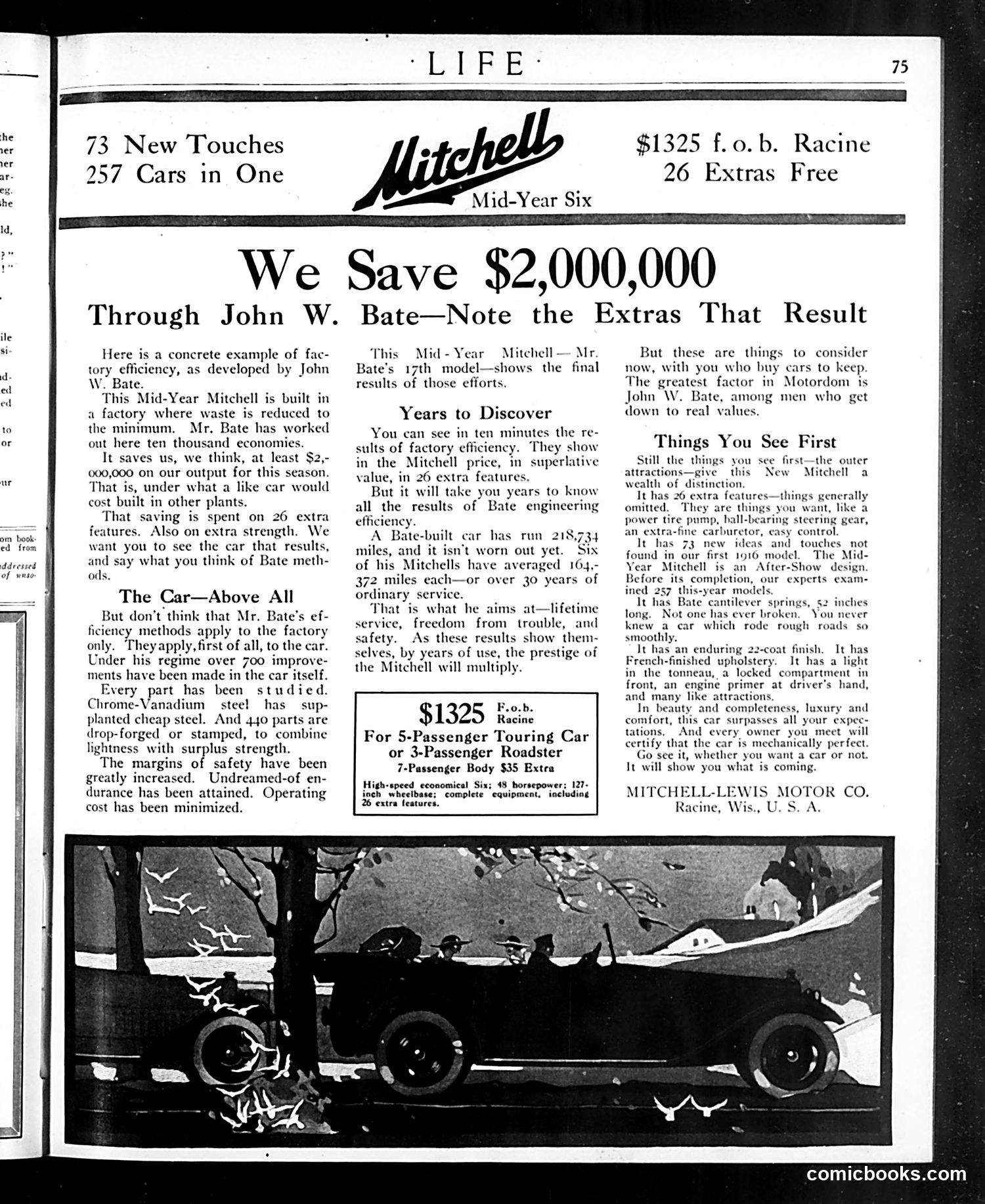
This is primarily a **car advertisement**, not political satire. It promotes the Mitchell automobile's "Mid-Year Six" model priced at $1,325. The ad celebrates **factory efficiency** under engineer John W. Bate, claiming $2 million in savings redirected toward 26 extra features and improved construction. Key selling points include: - **700+ car improvements** using Chrome-Vanadium steel and drop-forged parts - **Durability claims**: Bate-built cars allegedly run 218,734 miles without major wear - **73 new design touches** added after studying competing models - **26 "free extras"** like power tire pumps and cantilever springs The accompanying photo shows the car's profile in silhouette. For modern readers: this reflects **1910s manufacturing enthusiasm**—an era when companies heavily marketed engineering innovations and efficiency gains as consumer benefits. The emphasis on Bate's name personalizes industrial achievement, a common marketing approach of that era.
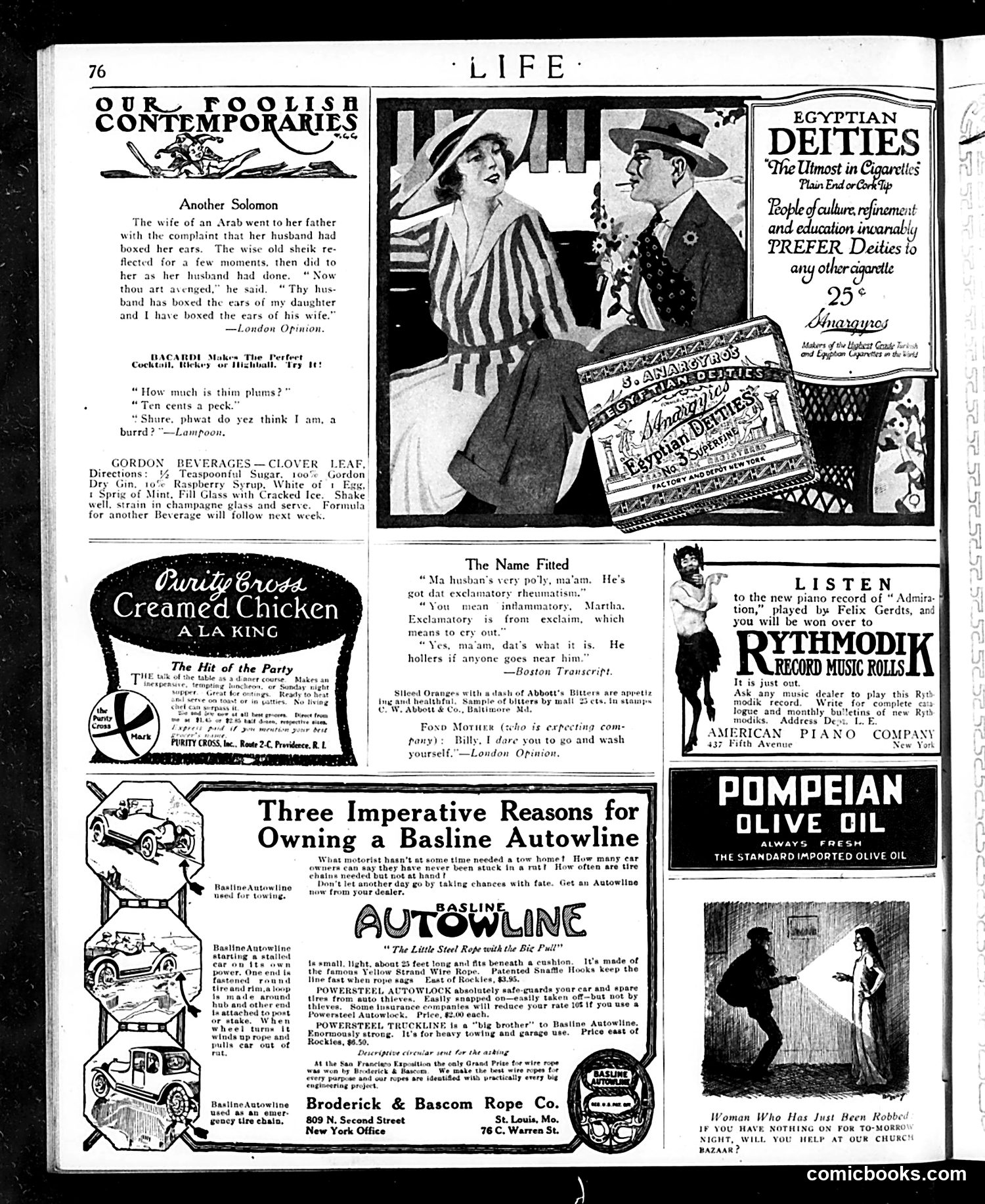
This page contains primarily **advertising and light humor** rather than political satire. The main content includes: **Humor pieces:** Brief anecdotes with ethnic/dialect humor typical of the era—an "Arab Solomon" story and Irish dialect jokes ("Shure, phwat do yez think I am, a burrd?"). These reflect early-20th-century magazine conventions of using exaggerated accents for comedy. **The cartoon at top:** Shows a couple in what appears to be a domestic disagreement, illustrating the "Solomon" anecdote about an Arab man boxing his wife's ears. **Advertisements:** The bulk of the page advertises consumer goods—Egyptian Deities cigarettes, Basline Autowline (a rope/towing device for automobiles), Pompeian olive oil, and piano rolls. **Social note:** A small item at bottom—"Woman Who Has Just Been Robbed"—asks if readers might help at a church bazaar, likely mocking the juxtaposition of the serious headline with a mundane charitable request. The page reflects turn-of-the-century American magazine culture: casual ethnic humor, automobile novelties, and heavy commercial advertising.
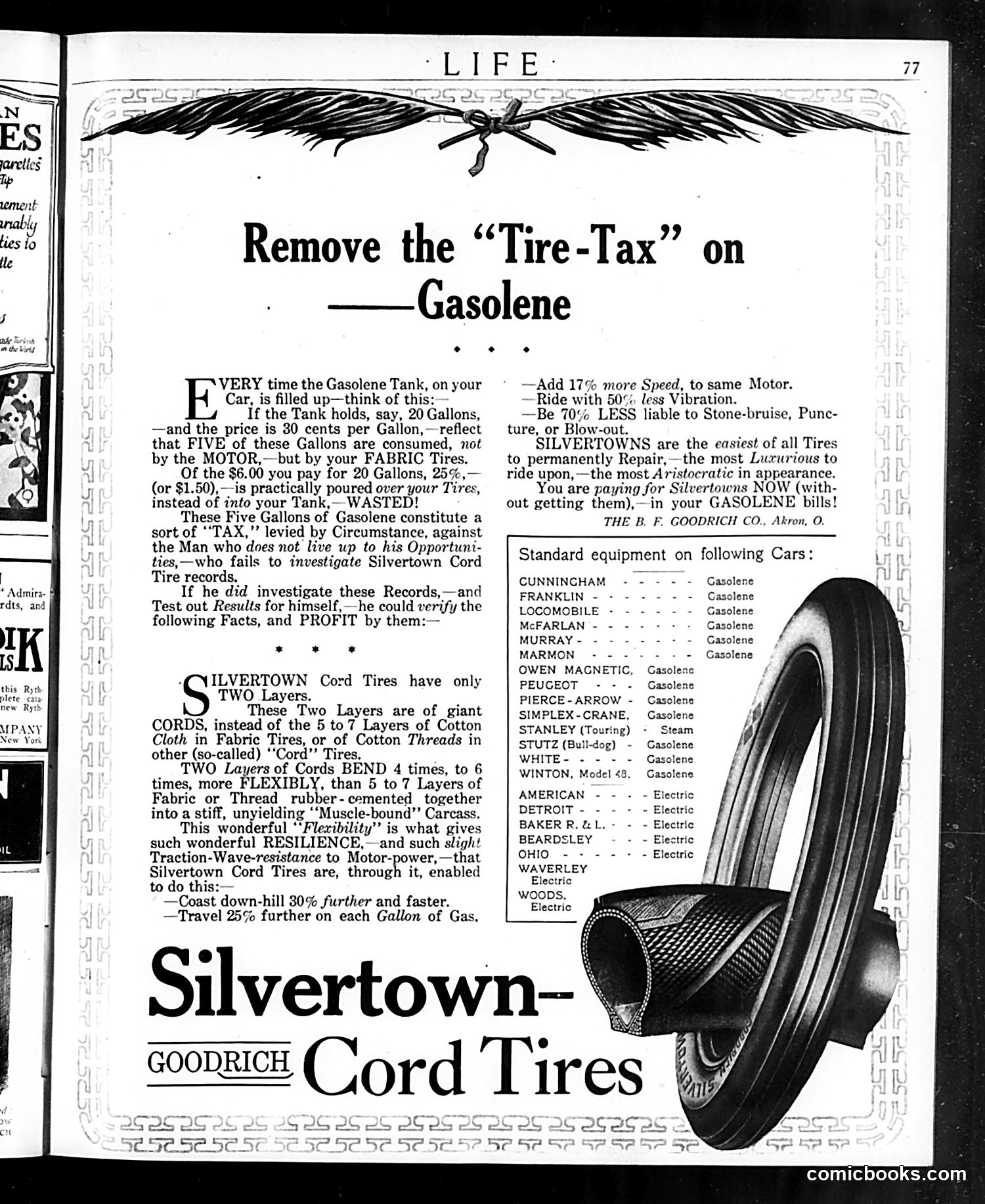
This is primarily a **Goodrich Silvertown Cord Tires advertisement**, not political satire. However, it employs a clever rhetorical strategy by framing tire choice as an economic justice issue. The ad's central argument: inferior tires waste 25% of gasoline (a "tax" levied by circumstance on the uninformed consumer). Silvertown Cord Tires, with only two flexible cord layers versus five-to-seven fabric layers, reduce rolling resistance and fuel consumption by 25%. The satire targets not politicians but **consumer ignorance**—suggesting ordinary drivers unknowingly "pay" a penalty for not investigating tire quality. By calling this waste a "tax," the advertisement appropriates populist language about unfair burdens while actually selling a premium product as the solution. The list of luxury automobile brands (Cunningham, Pierce-Arrow, Stutz) equipped with Silvertowns suggests these tires suit discerning, successful buyers—lending aspirational appeal.
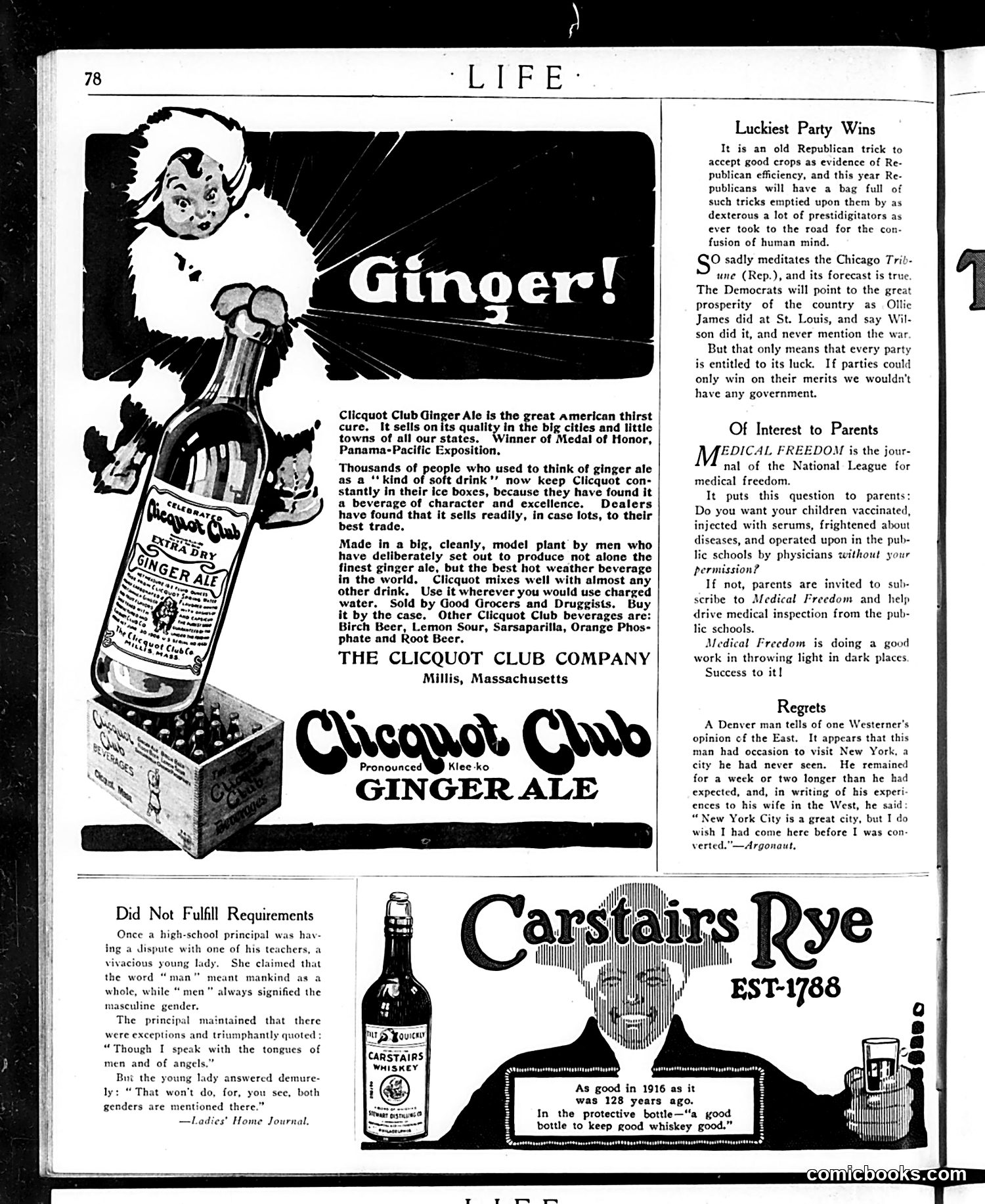
This page is primarily **advertising** for three products: Clicquot Club Ginger Ale, Carstairs Rye Whiskey, and mentions of Medical Freedom journal. The page includes one political **commentary** titled "Luckiest Party Wins," which satirizes both Republican and Democratic campaign tactics. It suggests both parties claim credit for good economic conditions (prosperity/crops) without acknowledging other factors like war. The piece cynically argues that parties win on "luck" rather than merit—a commentary on early 20th-century election politics, likely referencing the 1916 presidential race between Wilson (Democrat) and his Republican challenger. The remaining content includes a humorous anecdote about a high-school principal debating grammar with a teacher, and brief items about medical freedom advocacy and a Westerner's impressions of New York City. The page reflects period concerns: patent medicines, whiskey advertising, anti-vaccination sentiment, and partisan political criticism.
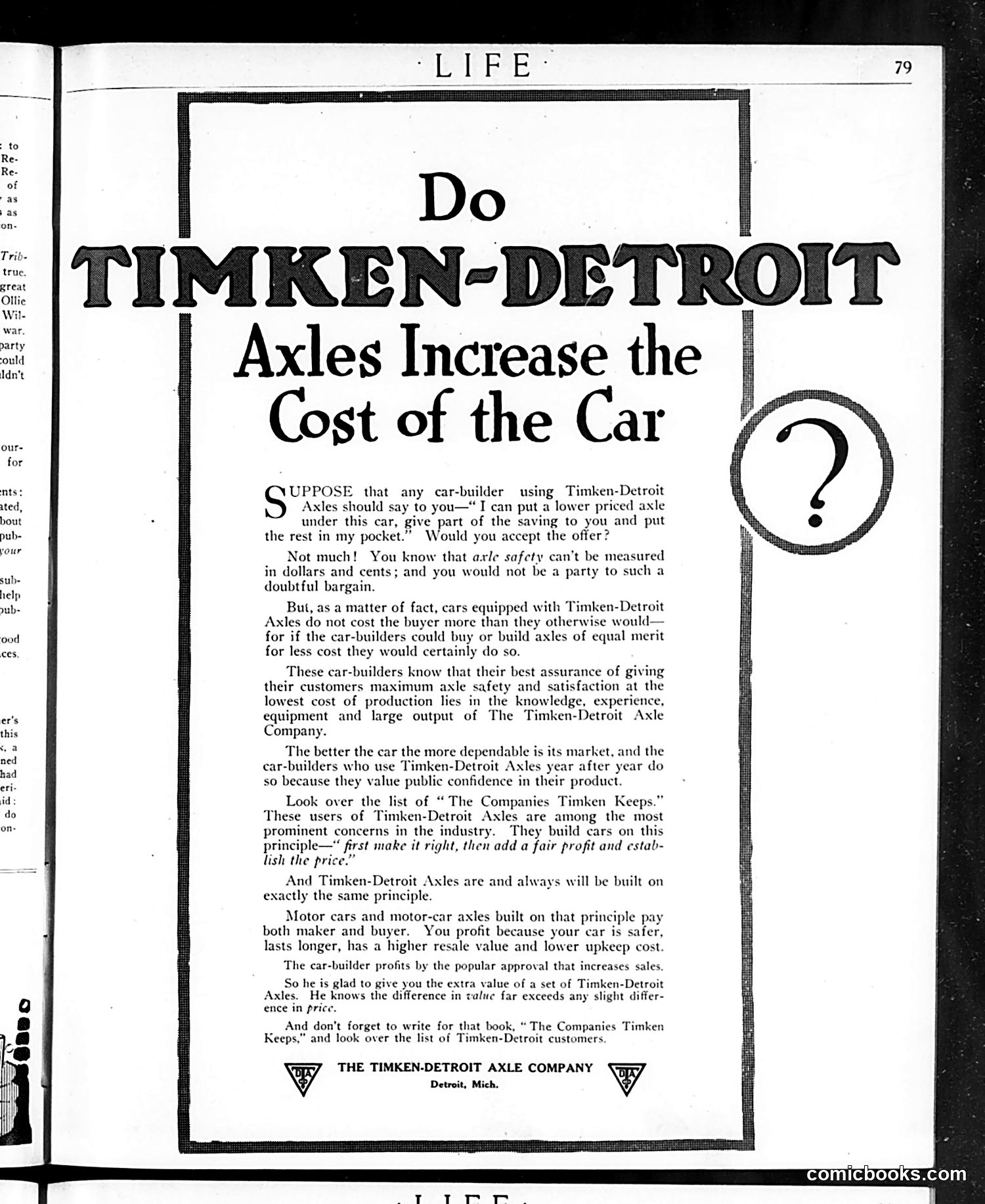
This is a **full-page advertisement**, not satirical content. It promotes Timken-Detroit Axles to automobile manufacturers and consumers. The ad uses a rhetorical device: it poses a hypothetical scenario where a car-builder offers to use cheaper axles and pocket the savings. The question mark in the circle emphasizes the absurdity of accepting such a deal, since axle safety cannot be compromised for price. The argument appeals to manufacturers' self-interest: using quality Timken-Detroit Axles actually *doesn't* increase car costs (because competitors would use equally affordable alternatives if available), but *does* enhance reputation and sales through the perception of safety and reliability. The ad references "The Companies Timken Keeps"—a roster of prominent automakers already using their product—as social proof of quality. For modern readers: this represents early-1900s industrial marketing that emphasized engineering reliability and brand reputation as competitive advantages, before automotive safety became legally mandated rather than voluntarily marketed.
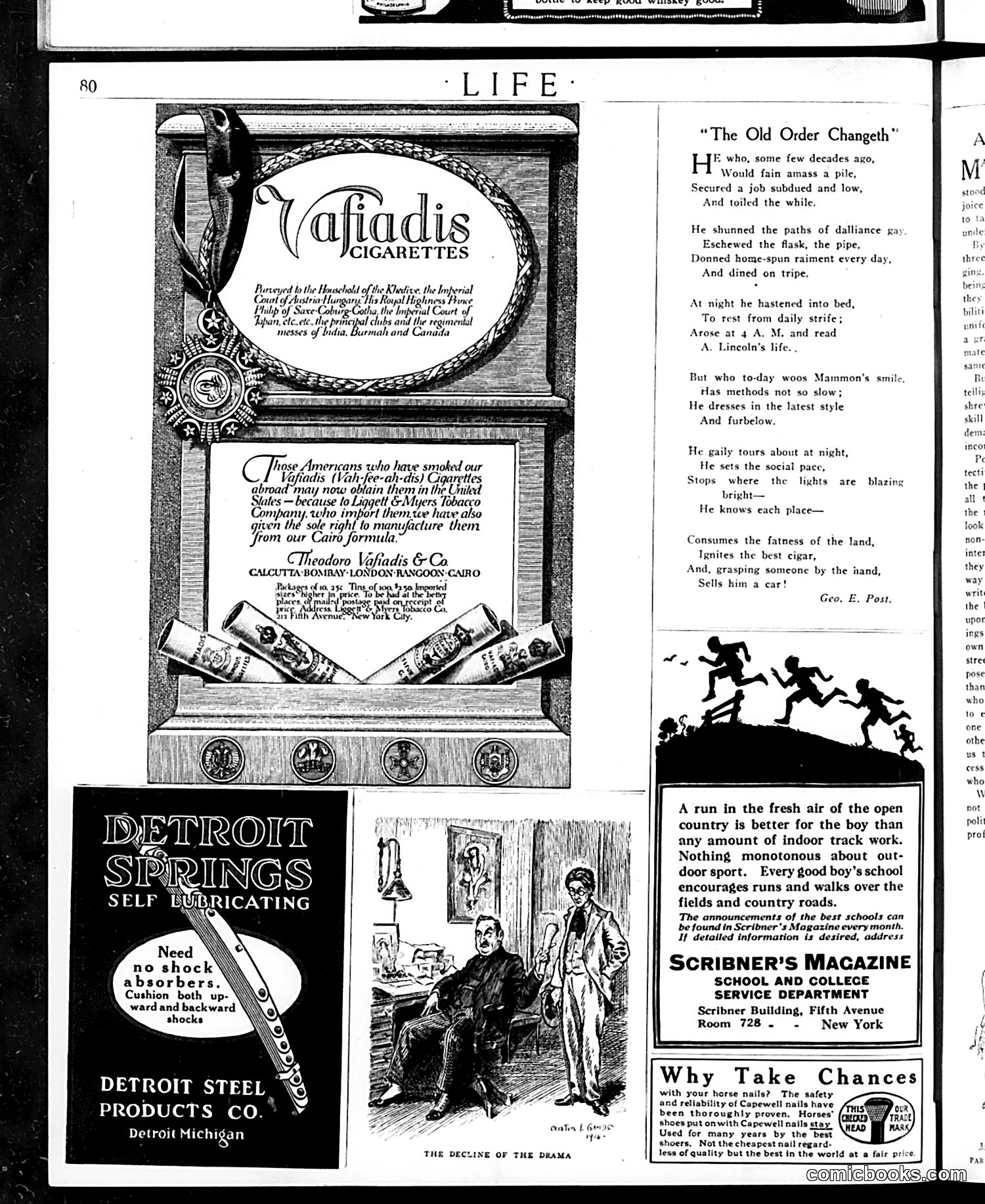
This page combines advertisements with satirical verse commentary on social change. **Main Cartoon/Illustration:** "The Decline of the Drama" depicts a Victorian-era gentleman meeting a modern man—likely representing the contrast between 19th and early 20th-century values. The verse by Geo. E. Post satirizes shifting American ambitions: the old-fashioned worker ("some few decades ago") lived frugally, read Lincoln, and rose at 4 A.M., embodying Protestant work ethic. Today's ambitious man, by contrast, dresses fashionably, frequents nightclubs, consumes luxuries, smokes expensive cigars, and sells automobiles—representing the modern consumer culture and commercialism that replaced Victorian restraint. **Context:** This reflects early 20th-century anxiety about rapid social modernization, urbanization, and materialism replacing traditional values. The satire is gentle, even admiring of the "new order's" success and style, while nostalgic for older virtues. **Advertisements:** Vafiadis cigarettes, Detroit Springs lubricant, Scribner's Magazine, and Capewell nails fill remaining space—typical period advertising.
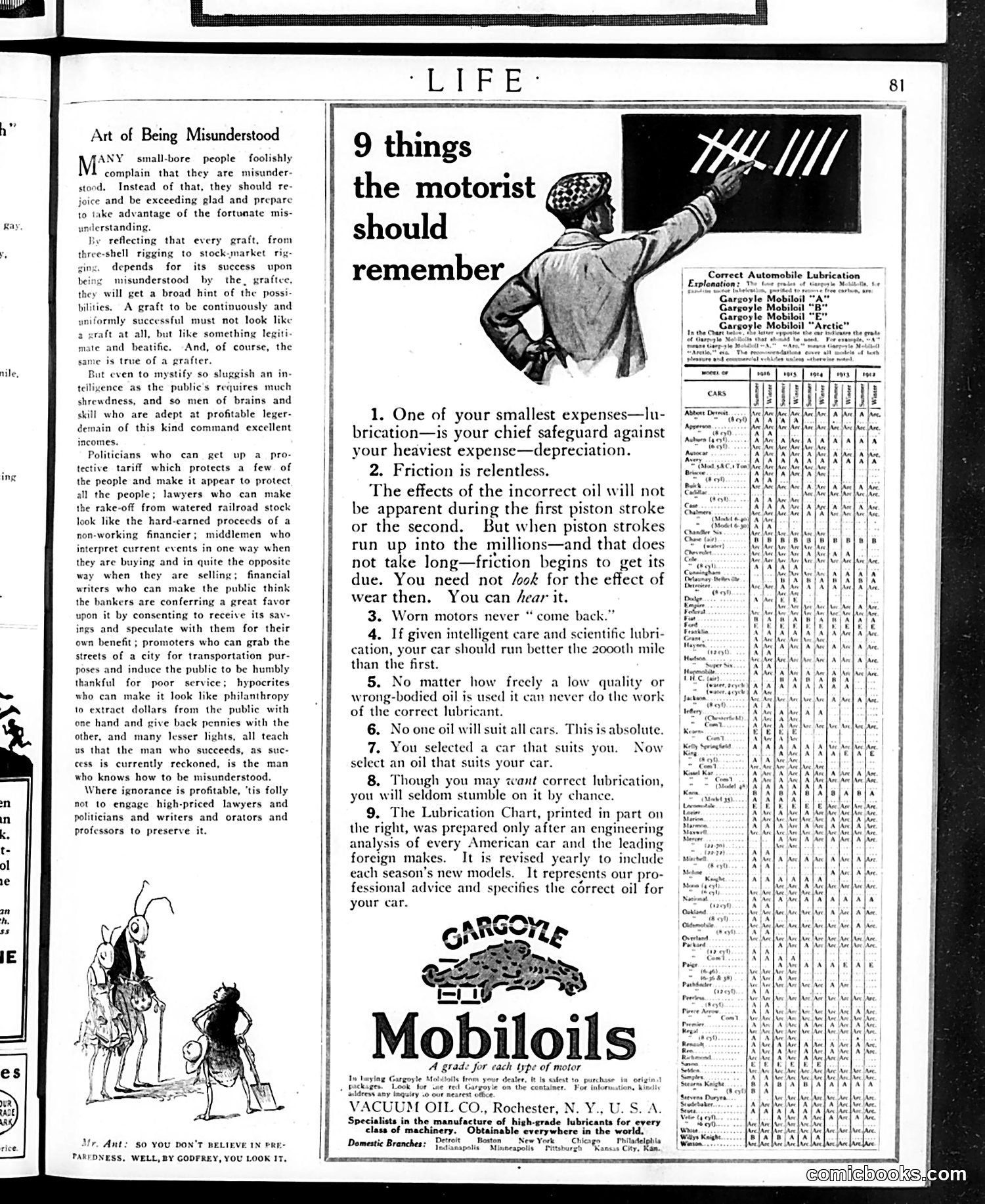
This page combines satirical editorial content with automobile advertising. **Left column ("Art of Being Misunderstood"):** A cynical essay mocking how successful people—politicians, lawyers, financiers, promoters—profit by deceiving the public. It argues that appearing legitimate while serving narrow interests is the true art of modern success. The tone is darkly humorous social criticism, characteristic of Life's satirical voice. **Bottom cartoon:** A simple two-figure sketch showing an ant addressing a shabby-looking man, making a joke about appearance and "preparedness" (unclear what specific event this references). **Right side:** A Mobiloils advertisement disguised as motorist advice, listing nine reasons to use correct lubrication, with a detailed oil-recommendation chart for various car models. This is straightforward advertising, though its placement adjacent to satire about deception creates ironic juxtaposition—the ad itself uses pseudo-scientific reasoning to sell product. The page is primarily **advertisement** (the Mobiloils content dominates visually) framed by satirical commentary on how persuasion and deception function in American commerce.
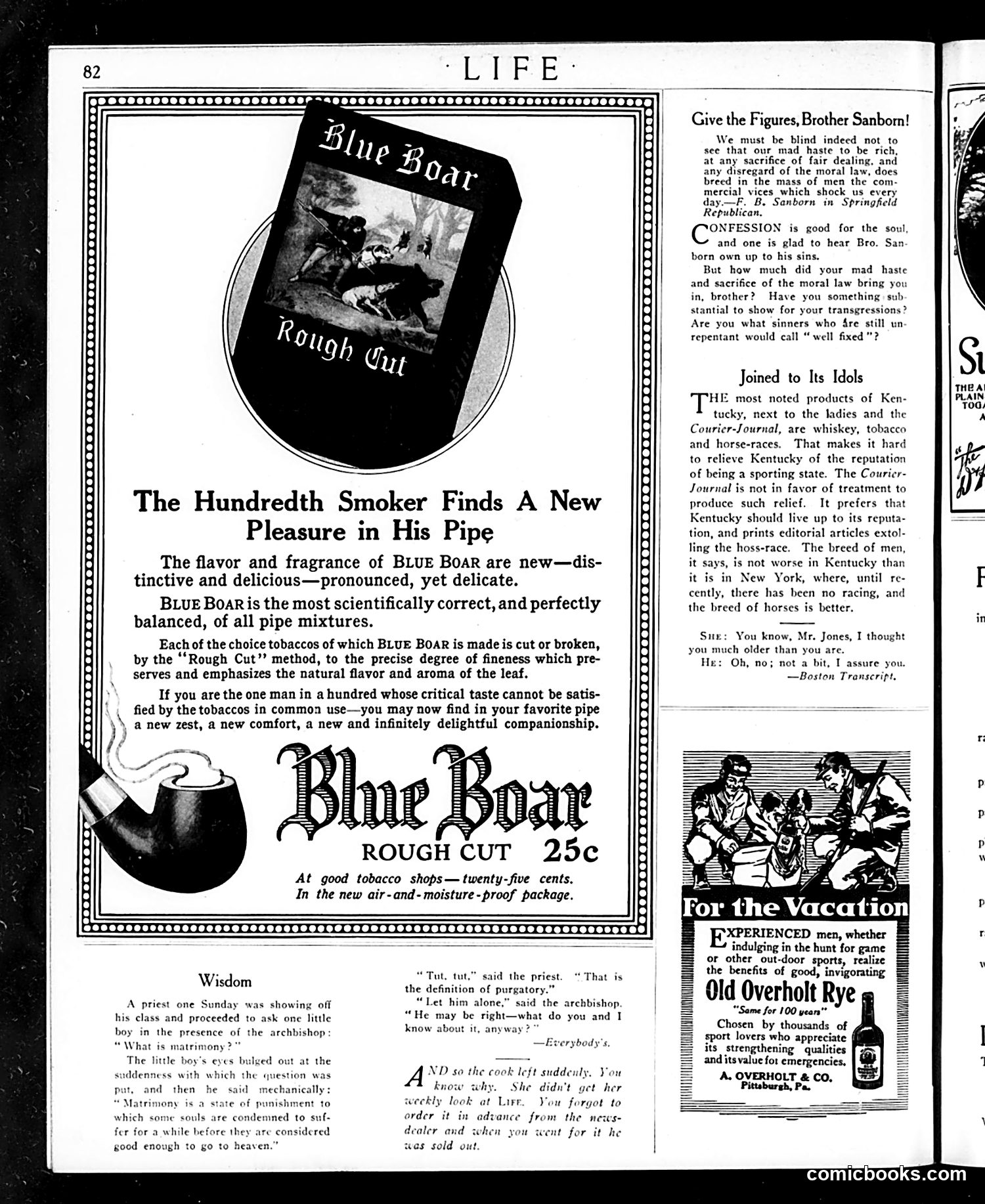
This page mixes advertising with editorial commentary typical of *Life* magazine's satirical format. The main content is a **Blue Boar pipe tobacco advertisement** (top), marketing "Rough Cut" tobacco at 25 cents as scientifically formulated for discerning smokers—a pitch to the one man in a hundred with refined taste. Below, **editorial commentary** satirizes F. B. Sanborn's moralistic column in the Springfield Republican. The editor challenges Sanborn's claims about American greed and moral decay—essentially asking: if you're so concerned about our "mad haste to be rich," how much wealth did *you* accumulate through questionable means? It's sarcastic gotcha-journalism. Another section mocks Kentucky's *Courier-Journal* newspaper for celebrating horse-racing and whiskey as defining state products while claiming moral high ground. The page also includes humorous anecdotes and advertisements for **Old Overholt Rye whiskey**. Overall, the page satirizes moral hypocrisy—publications and figures preaching virtue while profiting from vice and commercialism.
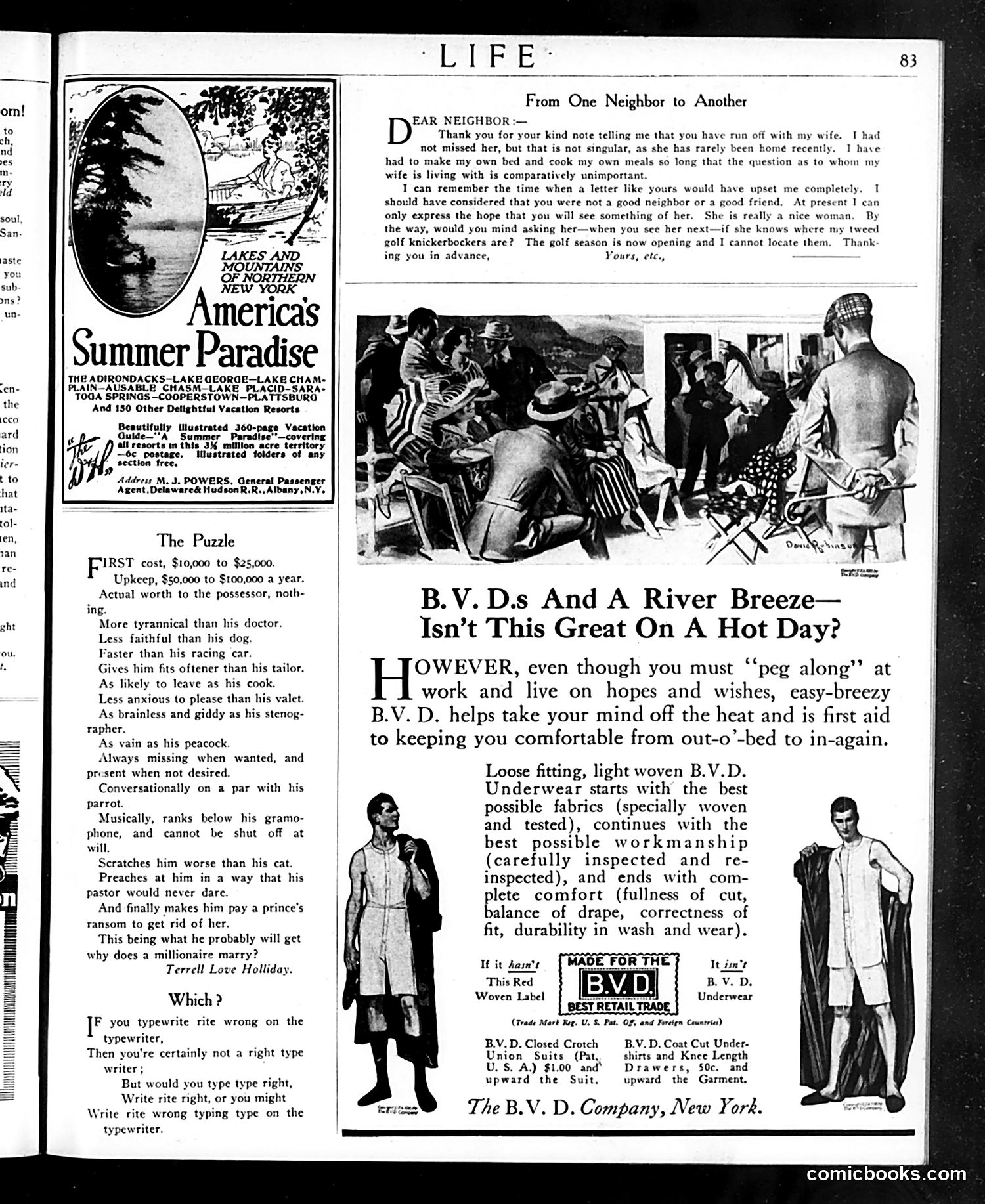
**Main Satirical Letter ("From One Neighbor to Another"):** This piece mocks the indifference of wealthy husbands to their wives' infidelity. The narrator's wife has run away with a neighbor, yet he's unmoved—he's more concerned about locating his golf knickerbockers than her departure. The satire targets the emotional detachment and preoccupation with leisure (golf) among the affluent class, suggesting marriages of convenience rather than affection. The husband's casual tone ridicules both marital dissolution and the triviality of upper-class concerns. **"The Puzzle":** A riddle describing a wife through insulting comparisons (vain, brainless, giddy, expensive to maintain). The punchline—"why does a millionaire marry?"—satirizes wealthy men entering loveless marriages, questioning the economic and social logic of matrimony among the rich. **Advertisement Content:** The B.V.D. underwear ad and vacation resort advertisement are period marketing; not satirical.
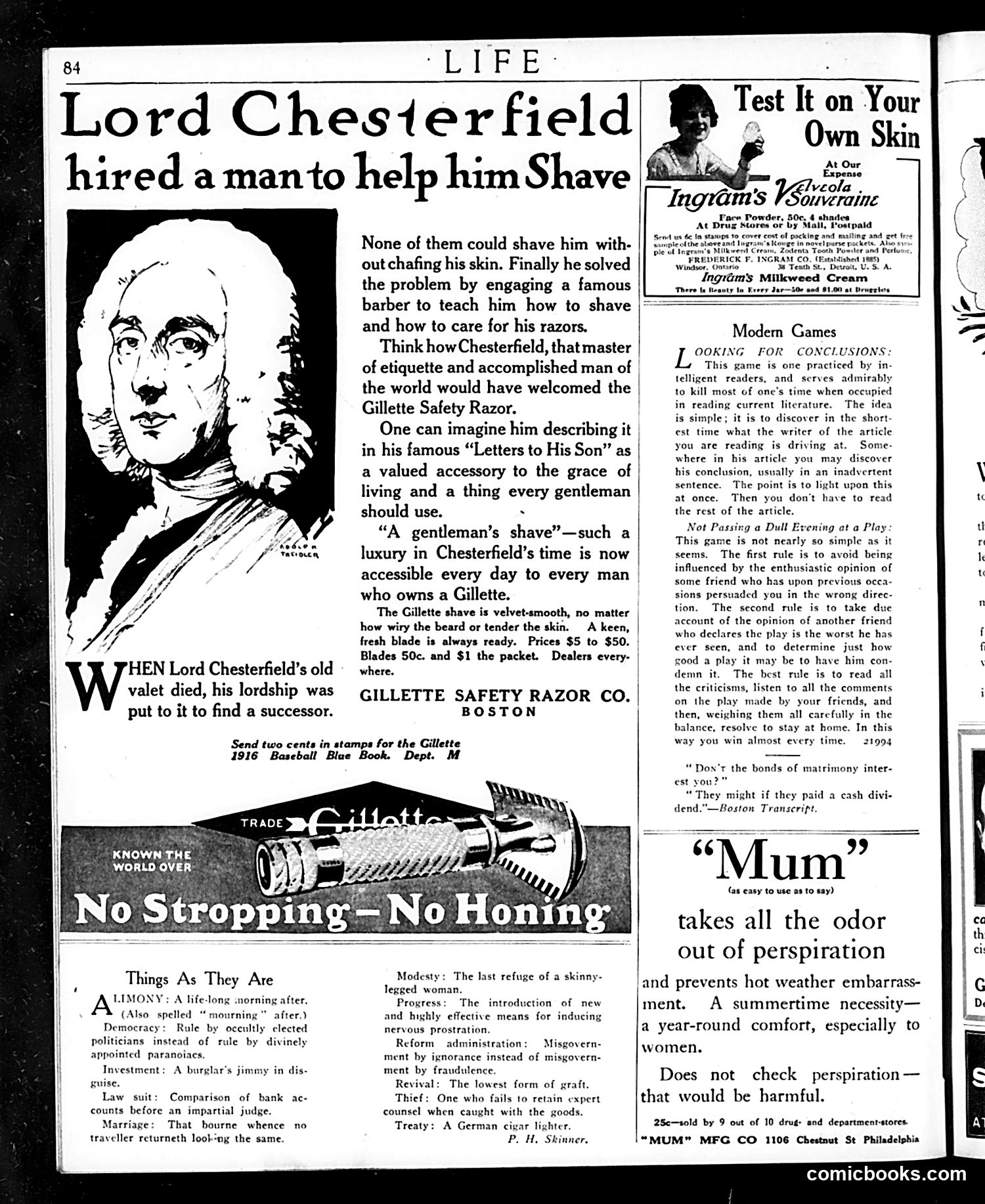
This is primarily a **Gillette Safety Razor advertisement** dressed as humorous editorial content. The "cartoon" is a portrait of Lord Chesterfield, the 18th-century British aristocrat famous for his etiquette writings ("Letters to His Son"). The ad's premise: even the refined Lord Chesterfield struggled to find someone who could shave him without skin irritation—until a famous barber taught proper technique. The joke is that Gillette now makes this "gentleman's luxury" accessible to ordinary men. The satire is gentle and self-serving: it uses Chesterfield's historical reputation for refinement to position Gillette razors as markers of civilized masculinity. The accompanying "Things As They Are" section offers cynical one-liners defining concepts like "Democracy" and "Marriage," providing satirical filler typical of Life magazine's style. The page also advertises beauty products and includes a game about reading articles critically.
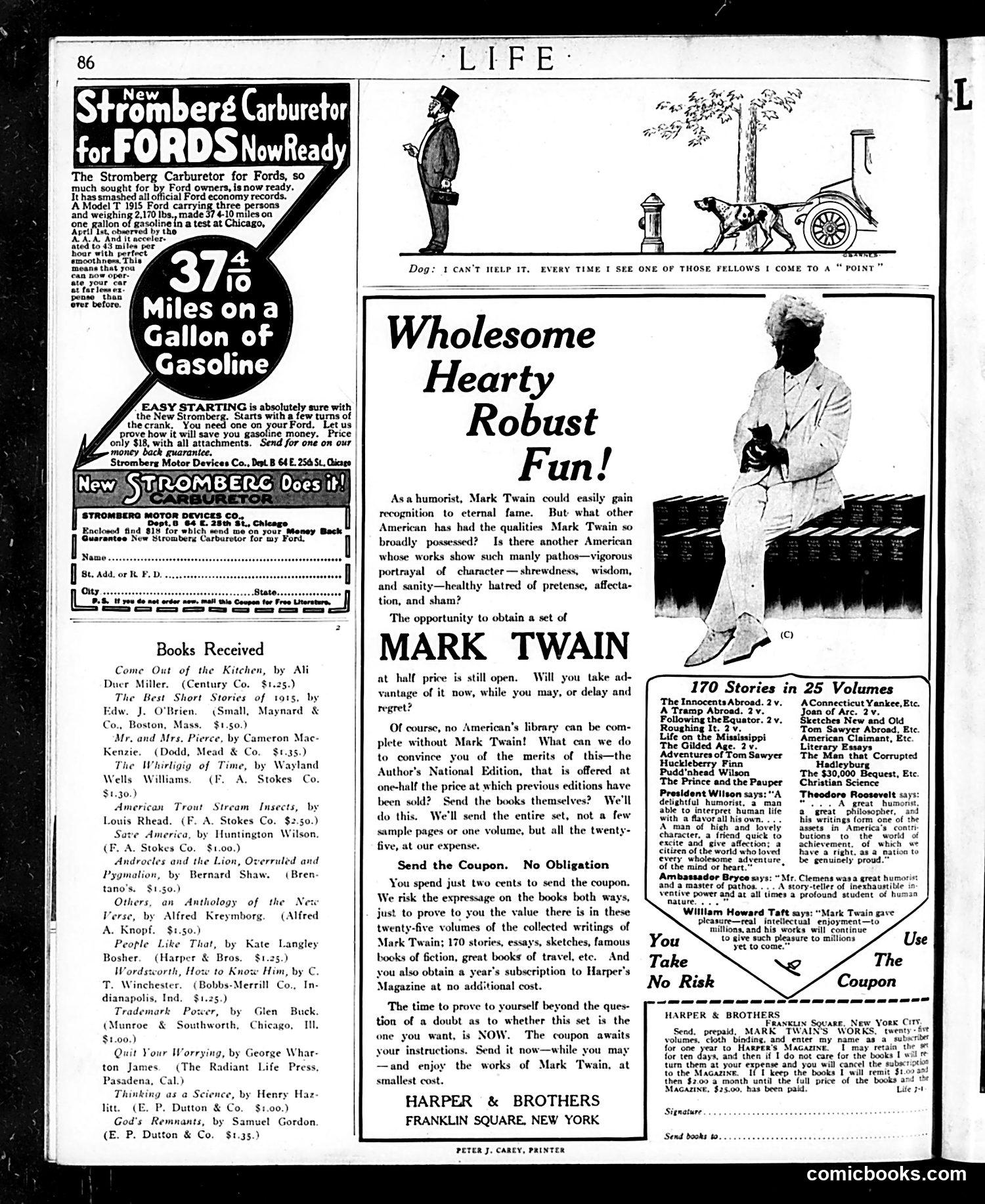
This page is primarily **advertising and book promotion**, not political satire. The main content includes: 1. **Stromberg Carburetor ad** (left): A Ford Model T carburetor claiming 37.4 miles per gallon—genuine automotive advertising with performance claims and a mail-order coupon. 2. **Small cartoon** (top right): A dog encountering a formal gentleman at a "point," with the dog unable to help reacting. The joke appears to be about class contrast or the dog's instinctive response to formal attire, though the humor is mild and unclear to modern readers. 3. **Mark Twain book promotion** (right): Harper & Brothers advertising a 25-volume "Author's National Edition" of Mark Twain's collected works at half price, emphasizing his qualities as an American writer and offering a free subscription to Harper's Magazine. 4. **Books Received section** (left): A standard literary review list of recent publications. The page reflects early 20th-century magazine formatting: mixed commercial and cultural content targeting educated, middle-class readers interested in automobiles and literature.