
Life, 1916-07-13 · page 26 of 40
Life — July 13, 1916 — page 26: what you’re looking at
What you’re looking at
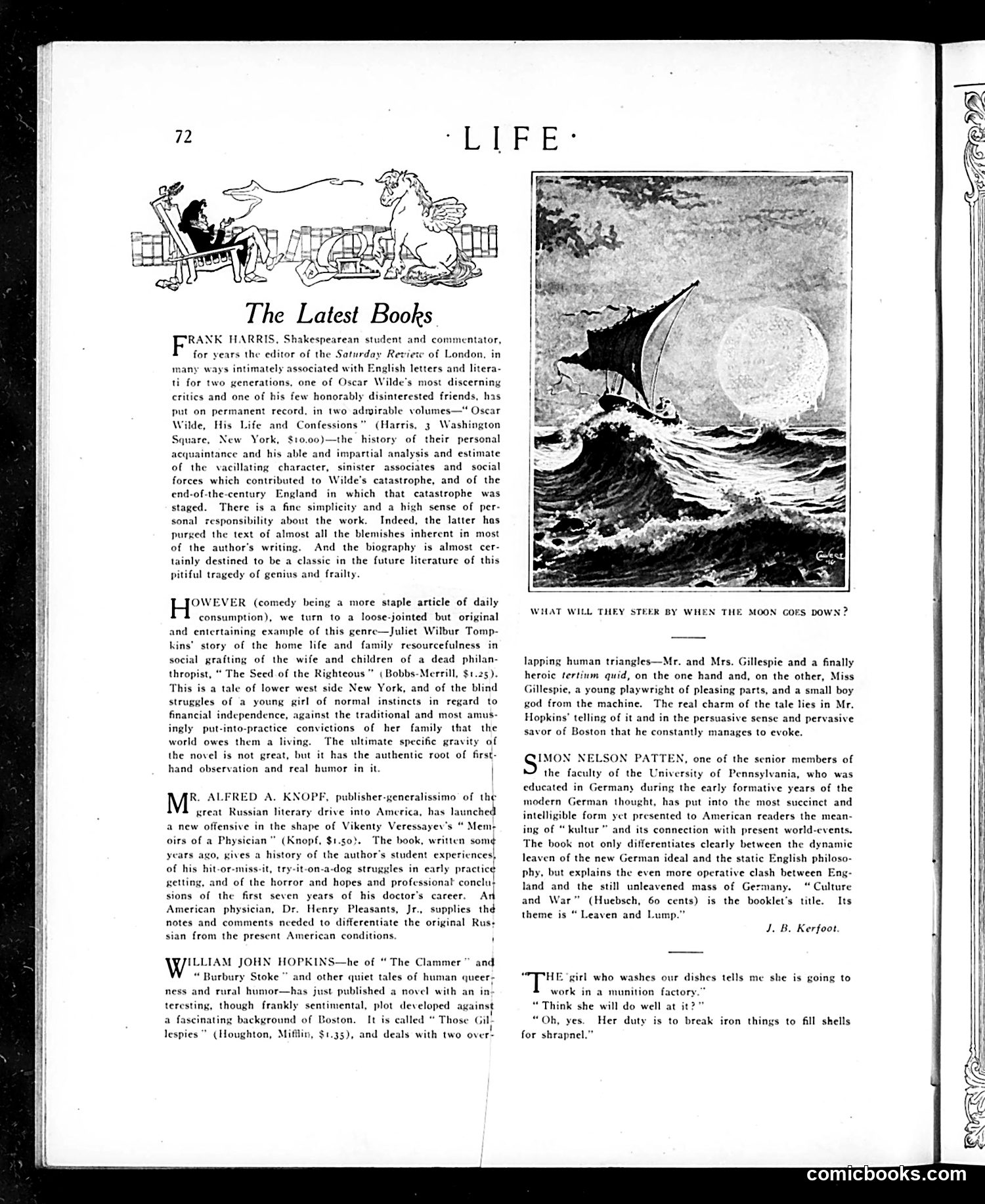
This page presents literary reviews from Life magazine's "Latest Books" section. The small cartoon at top shows a figure lounging while reading, introducing the leisure activity of book consumption. The reviews discuss recent publications, including Frank Harris's biography of Oscar Wilde (a major literary scandal figure of the era), a novel about working-class New York family life, Russian literature being promoted in America, and Boston-set fiction. The tone is witty and evaluative—typical of Life's satirical approach to culture. The dramatic illustration labeled "What Will They Steer By When the Moon Goes Down?" appears unrelated to the text below it; it depicts a sailing vessel in rough waters, likely illustrating a different story or serving as thematic visual content about uncertainty and navigation—possibly metaphorically connected to literary themes of direction and fate discussed in the reviews. This reflects Life's role as a sophisticated cultural commentary magazine for educated American readers.
📄 Transcribed text from this page (OCR, searchable)
Machine-transcribed from the original scan — historical spelling and the odd misread are preserved.
The Latest Books RANK HARRIS, Shakespearean student and commentator, for years the editor of the Saturday Review of London, in ny way’ intimately associated with English letters and litera- for two generations, one of Oscar Wilde's most discerning critics and one of his few honorably disinterested friends, has put on permanent record. in two admirable volumes—* Oscar Wilde, His Life and Confessions” (Harris, 3 Washington Square, New York, $10.00)—the history of their personal acquaintance and his able and impartial analysis and estimate of the vacillating character, sinister associates and social forces which contributed to Wilde's catastrophe, and of the end-of-the-century England in which that catastrophe was staged. There is a fine simplicity and a high sense of per- sonal responsibility about the work. Indeed, the latter has purged the text of almost all the blemishes inherent in most of the author's writing. And the biography is almost cer- tainly destined to be a classic in the future literature of this pitiful tragedy of genius and frailty. OWEVER (comedy being a more staple article of daily consumption), we turn to a loose-jointed but original and entertaining example of this genre—Juliet Wilbur Tomp- kins’ story of the home life and family resourcefulness in social grafting of the wife and children of a dead philan- thropist, “ The Seed of the Righteous” ( Bobbs-Merrill, $1.25). This is a tale of lower west side New York, and of the blind struggles of a young girl of normal instincts in regard to financial independence, against the traditional and most amus- ingly put-into-practice convictions of her family that the world owes them a living. The ultimate specific gravity of the novel is not great, but it has the authentic root of first- hand observation and real humor in it. | M*® ALFRED A. KNOPF, publisher-generalissimo of the great Russian literary drive into America, has launched a new offensive in the shape of Vikenty Veressayev's “ Mem; oirs of a Physician” (Knopf, $1.50). The book, written som¢ years ago, gives a history of the author's student experiences) of his hit-or-miss-it, try-it-on-a-dog struggles in early practice getting, and of the horror and hopes and professionat conclu sions of the first seven years of his doctor's career. Att American physician, Dr. Henry Pleasants, Jr. supplies thé notes and comments needed to differentiate the original Rus; sian from the present American conditions | YY ILLIAM JOHN HOPKINS—he of “ The Clammer” and “Burbury Stoke” and other quiet tales of human queer- ness and rural humor—has just published a novel with an in teresting, though frankly sentimental, plot developed against a fascinating background of Boston. It is called “ Those Gil: lespies ” (Houghton, Mifilin, $1.35), and deals with two over: RES ENE Sd WHAT WILL THEY STEER BY WHEN THE MOON GOES DOWN? lapping human triangles—Mr. and Mrs. Gillespie and a finally heroic tertinm quid, on the one hand and, on the other, Miss Gillespie, a young playwright of pleasing parts, and a small boy god from the machine. The real charm of the tale lies in Mr. Hopkins’ telling of it and in the persuasive sense and pervasive savor of Boston that he constantly manages to evoke. IMON NELSON PATTEN, one of the senior members of the faculty of the University of Pennsylvania, who was educated in Germany during the early formative years of the modern German thought, has put into the most succinct and intelligible form yet presented to American readers the mean- ing of “kultur” and its connection with present world-cvents. The book not only differentiates clearly between the dynamic leaven of the new German ideal and the static English philoso- phy, but explains the even more operative clash between Eng- land and the still unleavened mass of Germany. “Culture and War” (Huebsch, 60 cents) is the booklet’s title. Its theme is “Leaven and Lump.” J. B. Kerfoot HE ‘girl who washes our dishes tells me she is going to work in a munition factory.” “ Think she will do well at it?” Oh, yes. Her duty is to break iron things to fill shells for shrapnel.” comicbooks.com