
Life, 1916-07-13 · page 18 of 40
Life — July 13, 1916 — page 18: what you’re looking at
What you’re looking at
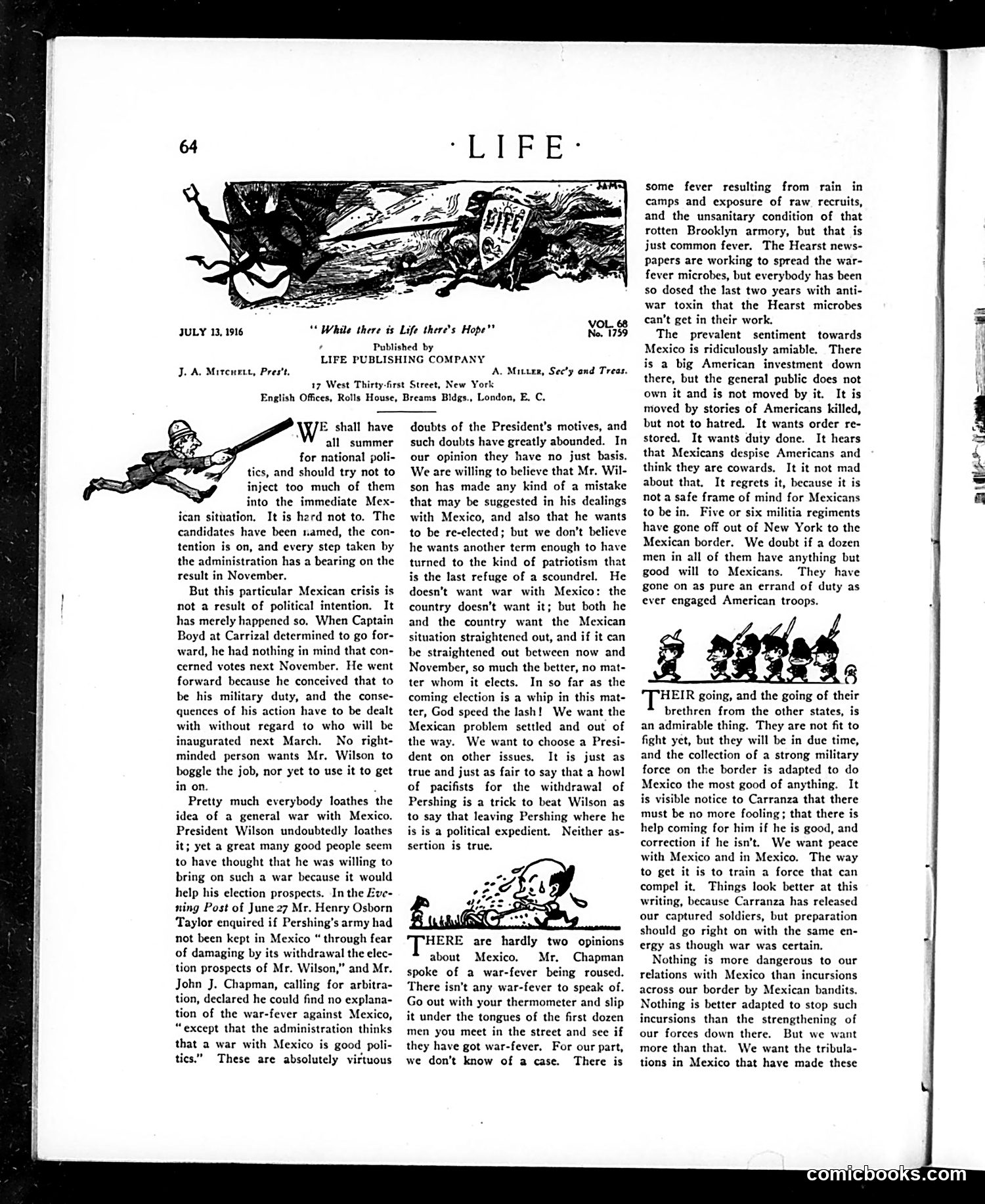
This editorial page addresses the **Carrizal Incident** (June 1916), where U.S. Army Captain Boyd clashed with Mexican forces under General Carranza. The article defends President Wilson against accusations that he prolonged the military engagement for electoral advantage in the November 1916 election. The cartoons depict soldiers, likely representing American troops involved in the Mexico border campaign. The editorial argues that critics—particularly pacifist groups and publications like William Randolph Hearst's newspapers—wrongly politicize the military situation. Life's editors insist there is no genuine "war-fever" among Americans; instead, they blame Hearst's papers for attempting to manufacture anti-war sentiment through propaganda. The piece dismisses both pro-war and anti-war political opportunism, claiming Wilson genuinely seeks to resolve the Mexican situation independently of electoral considerations. The tone is defensive of the administration's handling of the border crisis.
📄 Transcribed text from this page (OCR, searchable)
Machine-transcribed from the original scan — historical spelling and the odd misread are preserved.
JULY 13, 1916 ““ While there is Life there’s Hop. Published by LIFE PUBLISHING COMPANY J. A. Mitcnete, Pres’t. A, Miturr, Sec’y ond Treas. 17 West Thirty-first Street, New York English Offices, Rolls House, Breams Bldgs., London, E. C. W* shall have all summer for national poli- tics, and should try not to inject too much of them into the immediate Mex- ican situation. It is hard not to. The candidates have been named, the con- tention is on, and every step taken by the administration has a bearing on the result in November. But this particular Mexican crisis is not a result of political intention. It has merely happened so. When Captain Boyd at Carrizal determined to go for- ward, he had nothing in mind that con- cerned votes next November. He went forward because he conceived that to be his military duty, and the conse- quences of his action have to be dealt with without regard to who will be inaugurated next March. No right- minded person wants Mr. Wilson to boggle the job, nor yet to use it to get in on. Pretty much everybody loathes the idea of a general war with Mexico. President Wilson undoubtedly loathes it; yet a great many good people seem to have thought that he was willing to bring on such a war because it would help his election prospects. In the Eve- ning Post of June 27 Mr. Henry Osborn Taylor enquired if Pershing’s army had not been kept in Mexico “ through fear of damaging by its withdrawal the elec- tion prospects of Mr. Wilson,” and Mr. John J. Chapman, calling for arbitra- tion, declared he could find no explana- tion of the war-fever against Mexico, “except that the administration thinks that a war with Mexico is good poli- tics." These are absolutely virtuous doubts of the President’s motives, and such doubts have greatly abounded. In our opinion they have no just basis. We are willing to believe that Mr. Wil- son has made any kind of a mistake that may be suggested in his dealings with Mexico, and also that he wants to be re-elected; but we don’t believe he wants another term enough to have turned to the kind of patriotism that is the last refuge of a scoundrel. He doesn’t want war h Mexico: the country doesn’t want it; but both he and the country want the Mexican situation straightened out, and if it can be straightened out between now and November, so much the better, no mat- ter whom it elects. In so far as the coming election is a whip in this mat- ter, God speed the lash! We want the Mexican problem settled and out of the way. We want to choose a Presi- dent on other issues. It is just as true and just as fair to say that a howl of pacifists for the withdrawal of Pershing is a trick to beat Wilson as to say that leaving Pershing where he is is a political expedient. Neither as- sertion is true. HERE are hardly two opinions about Mexico, Mr. Chapman spoke of a war-fever being roused. There isn’t any war-fever to speak of. Go out with your thermometer and slip it under the tongues of the first dozen men you meet in the street and see if they have got war-fever, For our part, we don’t know of a case. There is some fever resulting from rain in camps and exposure of raw recruits, and the unsanitary condition of that rotten Brooklyn armory, but that is just common fever. The Hearst news- Papers are working to spread the war- fever microbes, but everybody has been so dosed the last two years with anti- war toxin that the Hearst microbes can’t get in their work. The prevalent sentiment towards Mexico is ridiculously amiable. There is a big American investment down there, but the general public does not own it and is not moved by it. It is moved by stories of Americans killed, but not to hatred. It wants order re- stored. It wants duty done. It hears that Mexicans despise Americans and think they are cowards. It it not mad about that, It regrets it, because it is not a safe frame of mind for Mexicans to be in. Five or six militia regiments have gone off out of New York to the Mexican border. We doubt if a dozen men in all of them have anything but good will to Mexicans. They have gone on as pure an errand of duty as ever engaged American troops. ar HEIR going, and the going of their brethren from the other states, is an admirable thing. They are not fit to fight yet, but they will be in due time, and the collection of a strong military force on the border is adapted to do Mexico the most good of anything. It is visible notice to Carranza that there must be no more fooling; that there is help coming for him if he is good, and correction if he isn’t. We want peace with Mexico and in Mexico. The way to get it is to train a force that can compel it. Things look better at this writing, because Carranza has released our captured soldiers, but preparation should go right on with the same en- ergy as though war was certain. Nothing is more dangerous to our relations with Mexico than incursions across our border by Mexican bandits. Nothing is better adapted to stop such incursions than the strengthening of our forces down there. But we want more than that. We want the tribula- tions in Mexico that have made these