
Life, 1916-07-13 · page 19 of 40
Life — July 13, 1916 — page 19: what you’re looking at
What you’re looking at
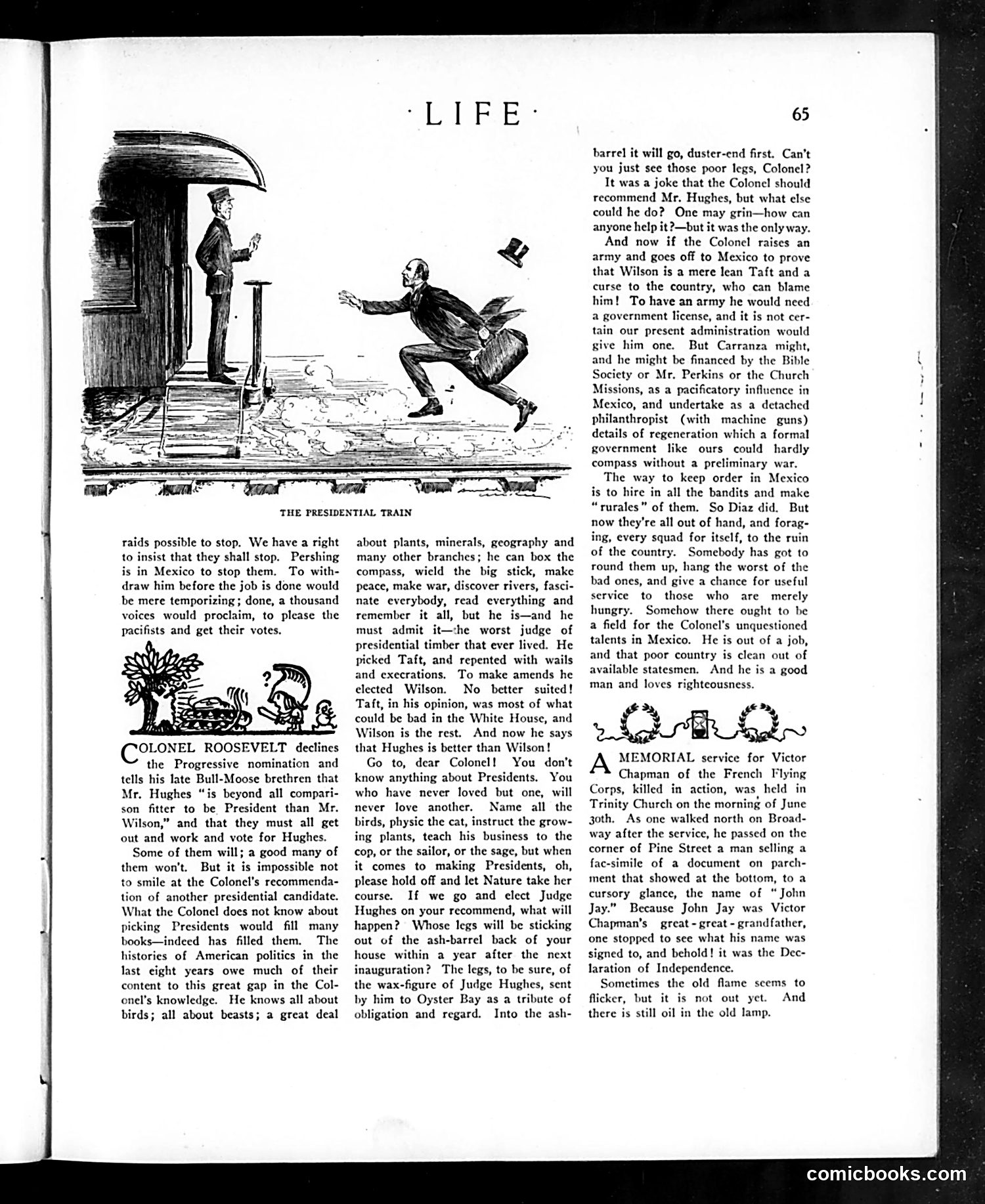
This page satirizes Theodore Roosevelt's 1916 endorsement of Republican Charles Evans Hughes for president. The cartoon shows Roosevelt literally jumping off a train platform—a visual metaphor for his political departure. The article mocks Roosevelt's poor judgment in picking presidential candidates: he previously championed William Howard Taft (whom he later repudiated), then supported Woodrow Wilson (whom he also turned against), and now backs Hughes. The writer predicts Hughes will suffer the same fate as the others—a wax figure of him will end up in Roosevelt's trash can within a year. The satire extends to Roosevelt's rumored interest in leading military intervention in Mexico against Pancho Villa's raids. The piece sardonically suggests Mexico could use Roosevelt's talents since "that poor country is clean out of available statesmen"—backhanded praise mocking his outsized ego and interventionist impulses. The fundamental joke: Roosevelt's catastrophic record at judging presidents makes his endorsement worthless, yet he remains temperamentally incapable of restraint.
📄 Transcribed text from this page (OCR, searchable)
Machine-transcribed from the original scan — historical spelling and the odd misread are preserved.
THE PRESIDENTIAL TRAIN raids possible to stop. We have a right to insist that they shall stop. Pershing is in Mexico to stop them. To with- draw him before the job is done would be mere temporizing; done, a thousand voices would proclaim, to please the pacifists and get their votes, Cc the Progressive nomination and tells his late Bull-Moose brethren that Mr. Hughes “is beyond all compari- son fitter to be President than Mr. Wilson,” and that they must all get out and work and vote for Hughes. Some of them will; a good many of them won't. But it is impossible not to smile at the Colonel's recommenda- tion of another presidential candidate. What the Colonel does not know about picking Presidents would fill many books—indeed has filled them. The histories of American politics in the last eight years owe much of their content to this great gap in the Col- onel’s knowledge. He knows all about birds; all about beasts; a great deal about plants, minerals, geography and many other branches; he can box the compass, wield the big stick, make peace, make war, discover rivers, fasci- nate everybody, read everything and remember it all, but he is—and he must admit it—the worst judge of presidential timber that ever lived. He picked Taft, and repented with wails and execrations, To make amends he elected Wilson. No better suited! Taft, in his opinion, was most of what could be bad in the White House, and Wilson is the rest. And now he says that Hughes is better than Wilson! Go to, dear Colonel! You don’t know anything about Presidents. You who have never loved but one, will never love another. Name all the birds, physic the cat, instruct the grow- ing plants, teach his business to the cop, or the sailor, or the sage, but when it comes to making Presidents, oh, please hold off and let Nature take her course. If we go and elect Judge Hughes on your recommend, what will happen? Whose legs will be sticking out of the ash-barrel back of your house within a year after the next inauguration? The legs, to be sure, of the wax-figure of Judge Hughes, sent by him to Oyster Bay as a tribute of obligation and regard. Into the ash- 65 barrel it will go, duster-end first. Can't you just see those poor legs, Colonel? It was a joke that the Colonel should recommend Mr. Hughes, but what else could he do? One may grin—how can anyone help it ?—but it was the only way. And now if the Colonel raises an army and goes off to Mexico to prove that Wilson is a mere lean Taft and a curse to the country, who can blame him! To have an army he would need a government license, and it is not cer- tain our present administration would give him one. But Carranza might, and he might be financed by the Bible Society or Mr. Perkins or the Church Missions, as a pacificatory influence in Mexico, and undertake as a detached philanthropist (with machine guns) details of regeneration which a formal government like ours could hardly compass without a preliminary war. The way to keep order in Mexico is to hire in all the bandits and make “rurales” of them. So Diaz did. But now they're all out of hand, and forag- ing, every squad for itself, to the ruin of the country. Somebody has got to round them up, hang the worst of the bad ones, and give a chance for useful service to those who are merely hungry. Somehow there ought to be a field for the Colonel's unquestioned talents in Mexico. He is out of a job, and that poor country is clean out of available statesmen. And he is a good man and loves righteousness. » 3 PUN MEMORIAL service for Victor Chapman of the French I Corps, killed in action, was held in Trinity Church on the morning of June goth, As one walked north on Broad- way after the service, he passed on the corner of Pine Street a man selling a fac-simile of a document on parch- ment that showed at the bottom, to a cursory glance, the name of “John Jay.” Because John Jay was Victor Chapman's great - great - grandfather, one stopped to see what his name was signed to, and behold! it was the Dec- laration of Independence. Sometimes the old flame scems to flicker, but it is not out yet. And there is still oil in the old lamp. comicbooks.com