
A complete issue · 48 pages · 1916
Life — June 22, 1916
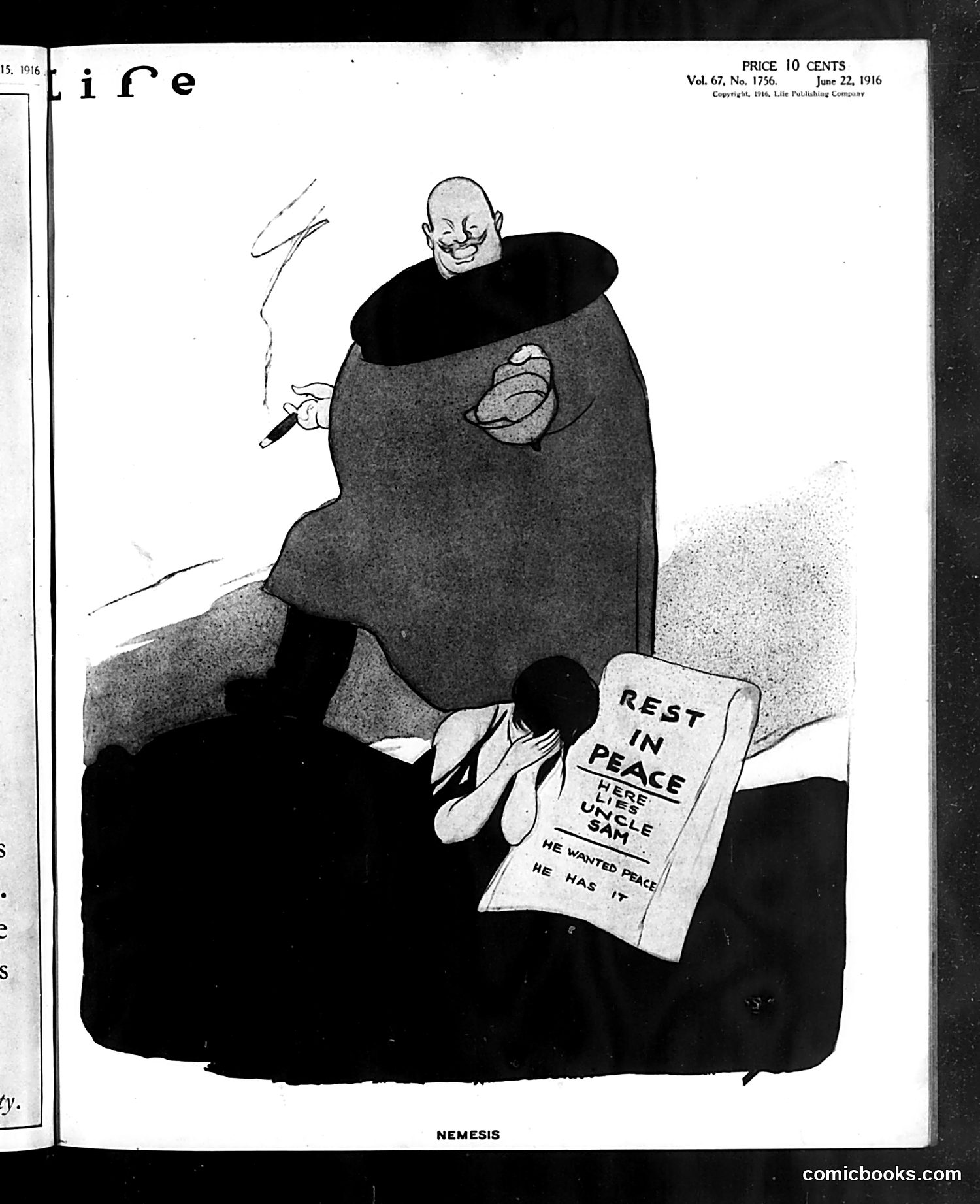
This political cartoon depicts a sinister, grinning figure in dark robes standing over a grave marked "REST IN PEACE / HERE LIES UNCLE SAM / HE WANTED PEACE / HE HAS IT." The figure appears to represent Death or a malevolent force, holding a pen or weapon, suggesting imminent doom. The satire comments on American foreign policy during World War I. By 1916, the U.S. maintained official neutrality while facing pressure to enter the conflict. The cartoon ironically warns that America's desire for peace—embodied by "Uncle Sam"—may result in actual death if the nation remains passive or unprepared during the global war. The grim reaper-like figure threatens that pacifism could be fatally naive.
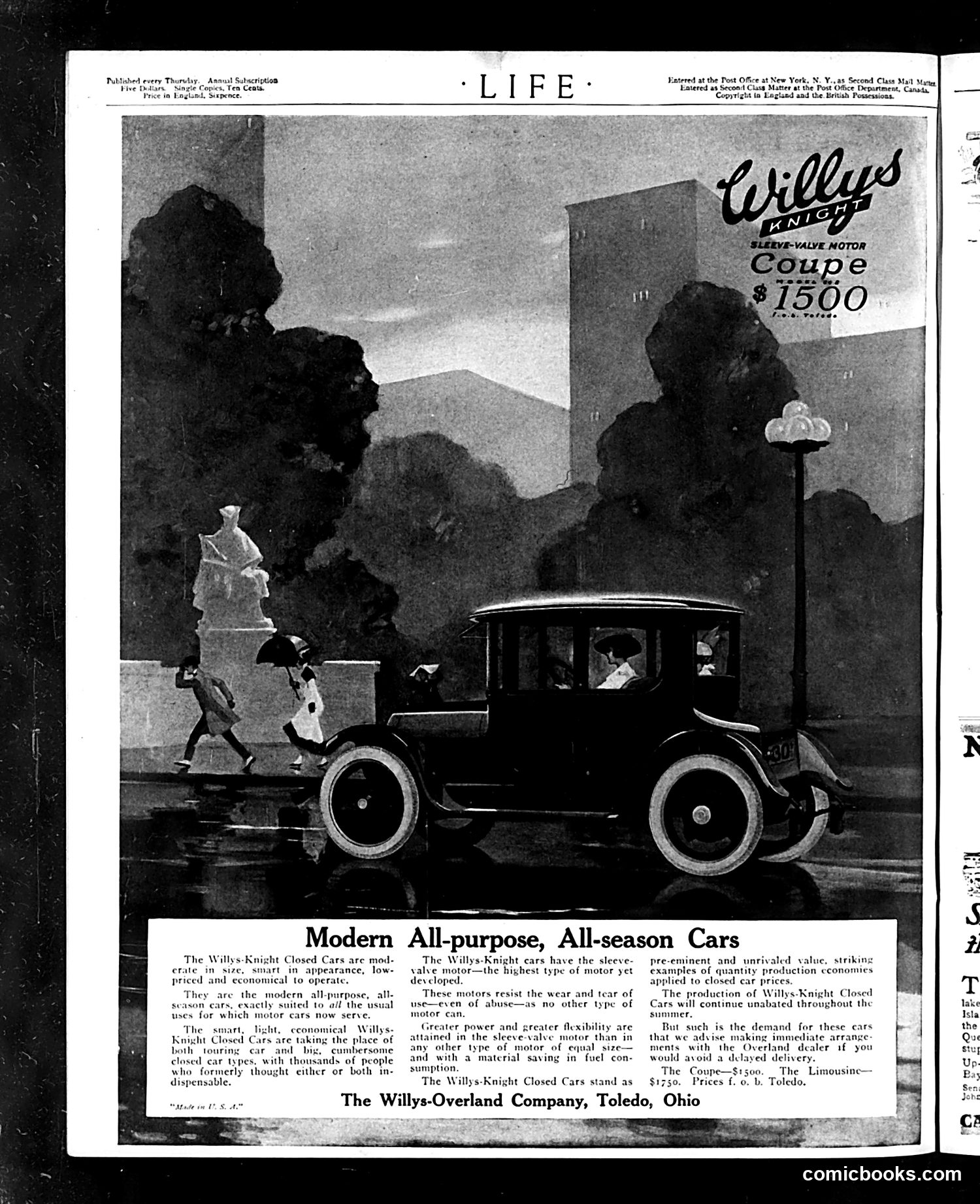
This page is primarily **advertising, not satire or political commentary**. It's a full-page advertisement for the Willys-Knight automobile, specifically promoting their "Coupe" model priced at $1,500. The image shows an elegantly dressed couple in an urban setting with classical architecture and street lamps. The advertisement emphasizes the car's practical features: it's an "all-purpose, all-season" vehicle with a sleeve-valve motor offering reliability and flexibility. The text highlights that Willys-Knight closed cars represent modern convenience, replacing both touring cars and limousines. It targets consumers seeking economical yet dependable transportation. The manufacturer was The Willys-Overland Company of Toledo, Ohio. This is a straightforward product advertisement with no political or satirical content.
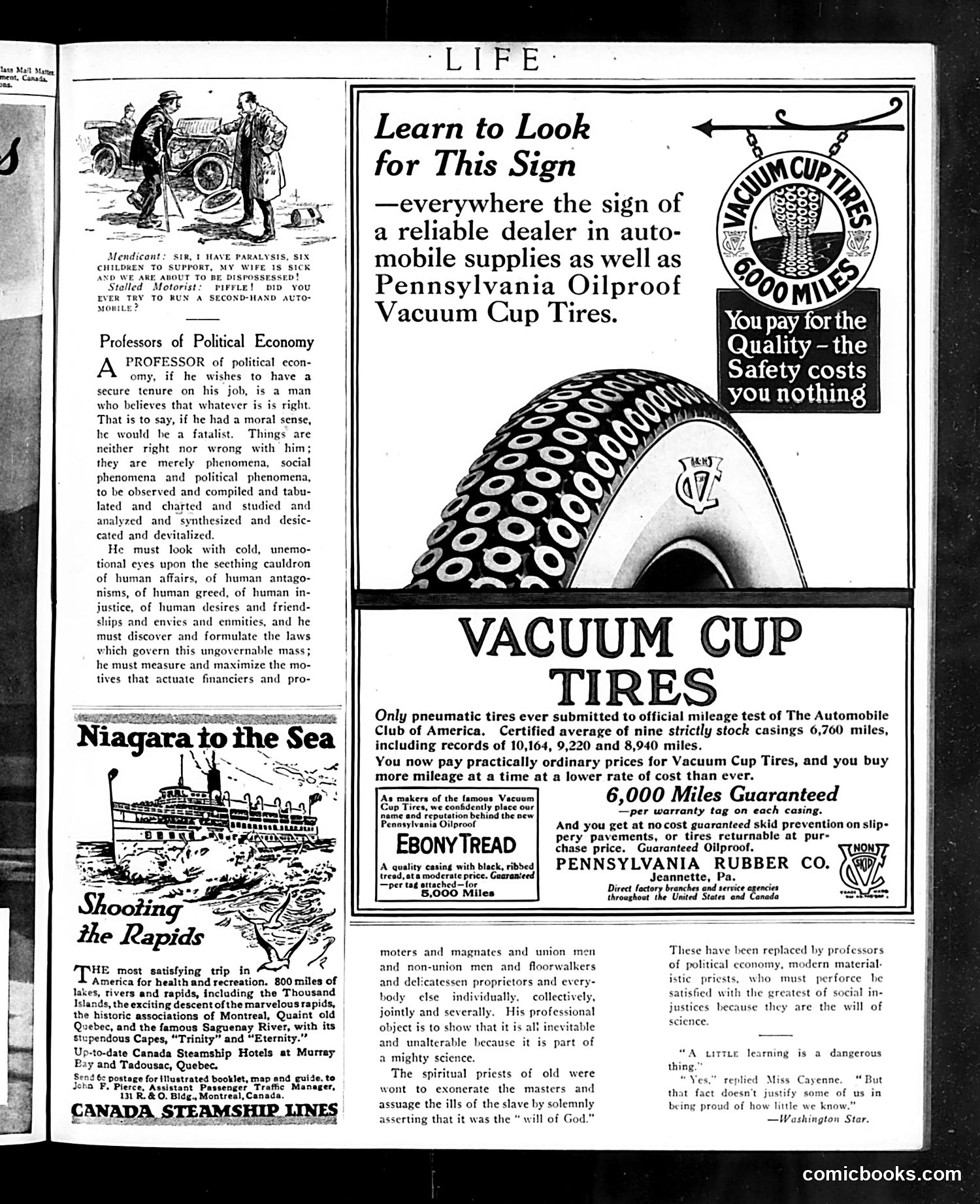
This page is primarily **commercial advertising** for Pennsylvania Rubber Company's Vacuum Cup Tires, dominating the right side with product claims ("6,000 Miles Guaranteed"). The **left side contains editorial content**: a humorous sketch about automobile troubles and a serious essay on "Professors of Political Economy." The sketch depicts a motorist with mechanical problems consulting what appears to be a stalled mechanic—satirizing early automotive unreliability and the expertise gap between owners and repair workers. The essay discusses how political economists must observe social phenomena objectively, without moral judgment—a 1910s-era argument about scientific detachment in social study. Additional ads promote Canadian steamship travel and ebony tread tires, typical of Life's mixed editorial-advertising format during this period.
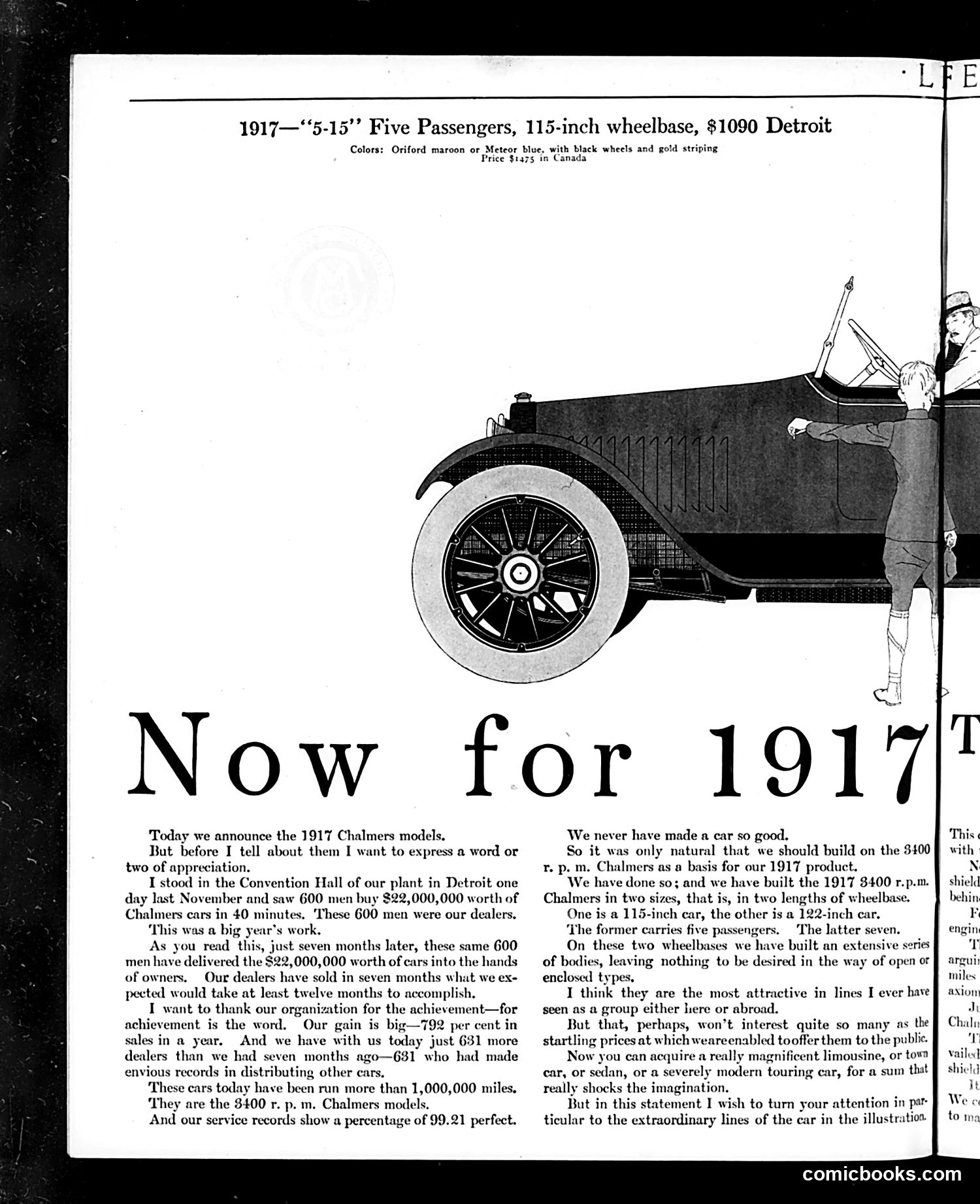
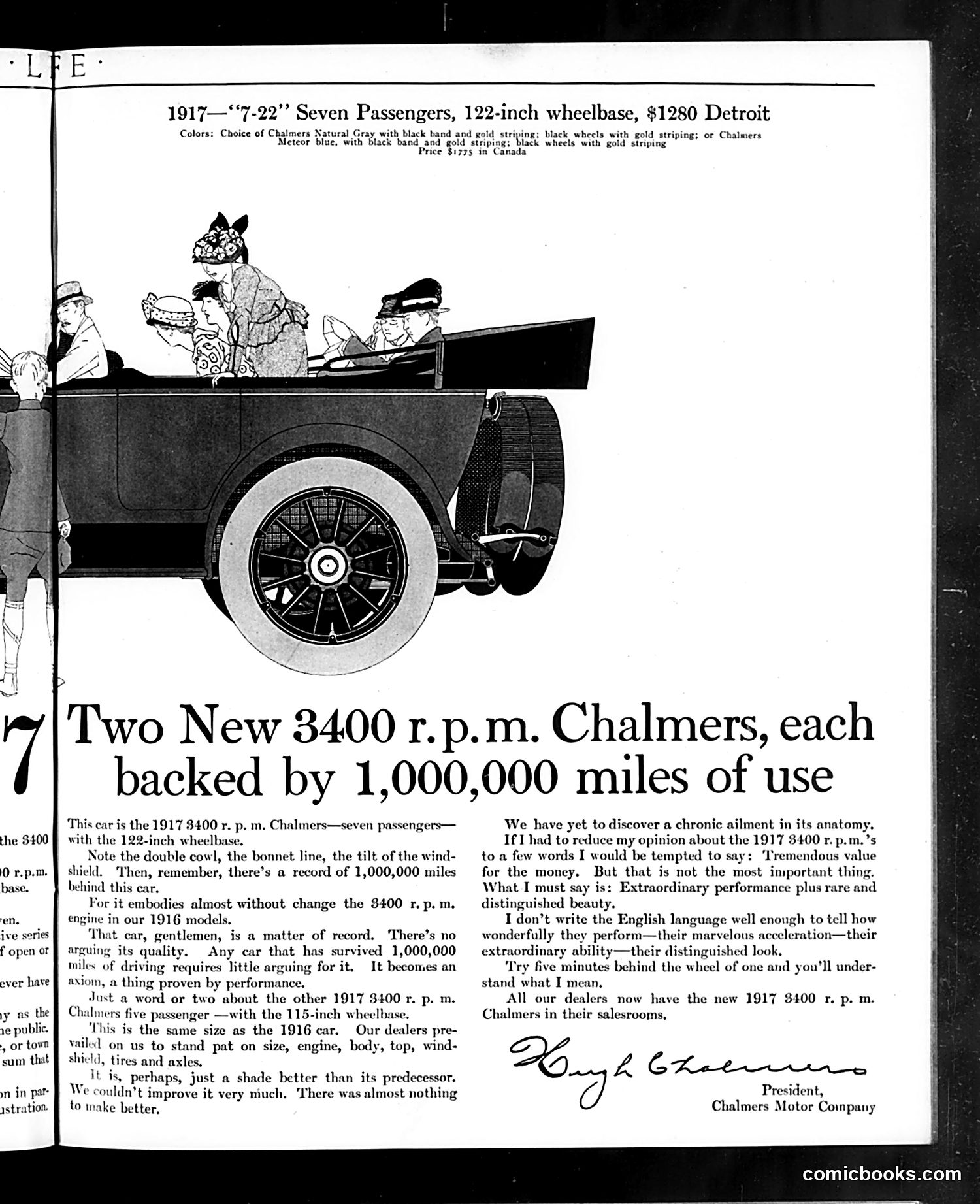
This page is **primarily an advertisement**, not satire or political cartoon. It promotes the 1917 Chalmers automobile—a "5-15" model priced at $1090 in Detroit. The illustration shows a touring car with two figures: a driver and a passenger. The accompanying text celebrates Chalmers' sales achievements, noting 600 men delivered $22 million worth of cars in seven months, with 631 dealers now stocked. The headline "Now for 1917" announces the new model year. The text emphasizes the car's reliability (99.21% perfect service records) and availability in two wheelbases. There is no political satire here—this is straightforward early-automotive marketing material typical of *Life* magazine's commercial content from this period.
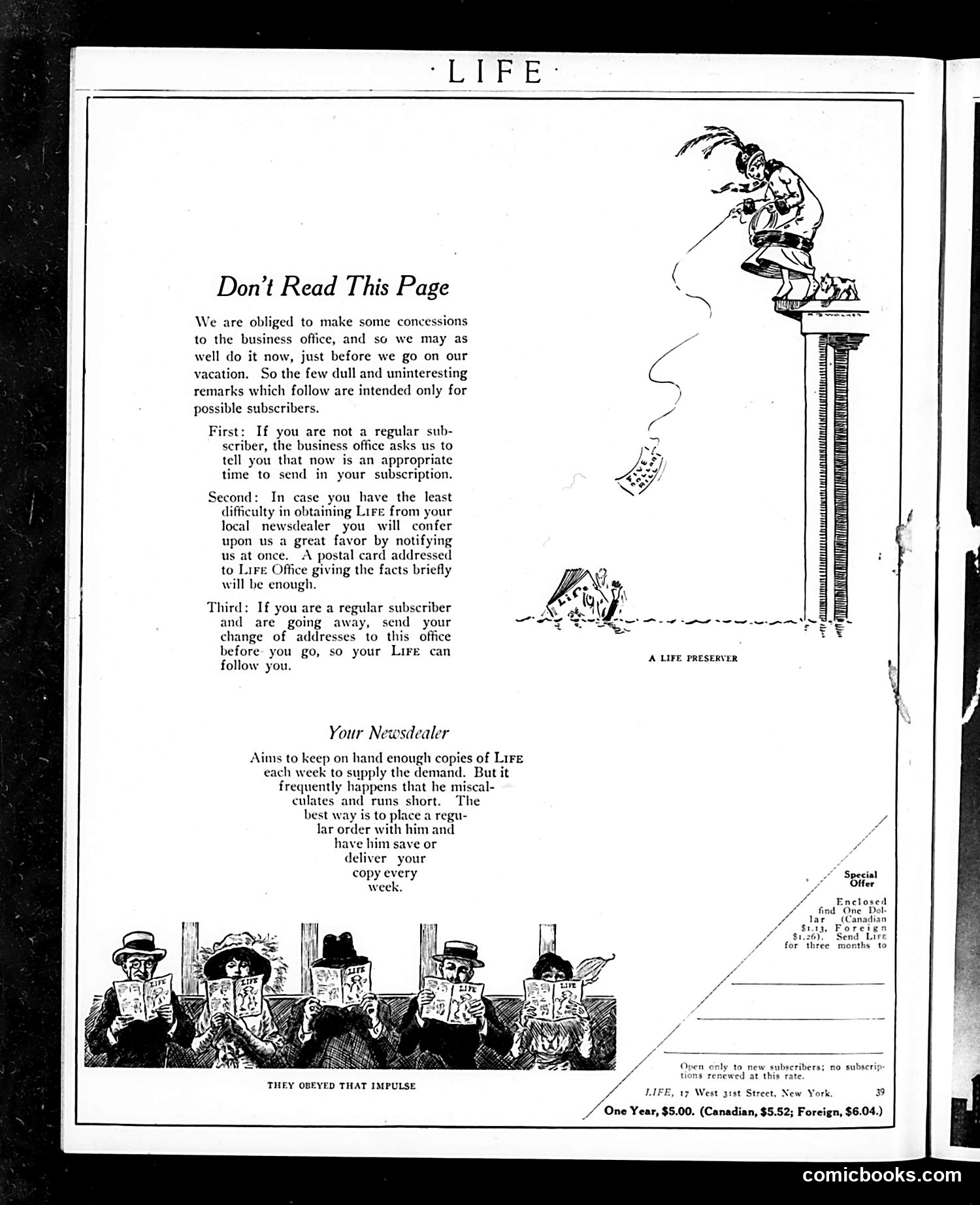
This page is primarily administrative content addressing subscribers, not political satire. The heading "Don't Read This Page" humorously acknowledges the business notices that follow—subscription information and newsdealer instructions. The cartoons illustrate these mundane points: the top image shows a figure perched atop a tall column labeled "A LIFE PRESERVER," likely satirizing Life magazine itself as a stabilizing force. The bottom cartoon depicts several figures reading Life magazines, captioned "THEY OBEYED THAT IMPULSE," promoting subscription benefits. The page includes a special subscription offer at bottom. Rather than satirizing politics or current events, this page uses light humor to handle routine subscription management—a clever editorial choice to make administrative content more engaging for readers.
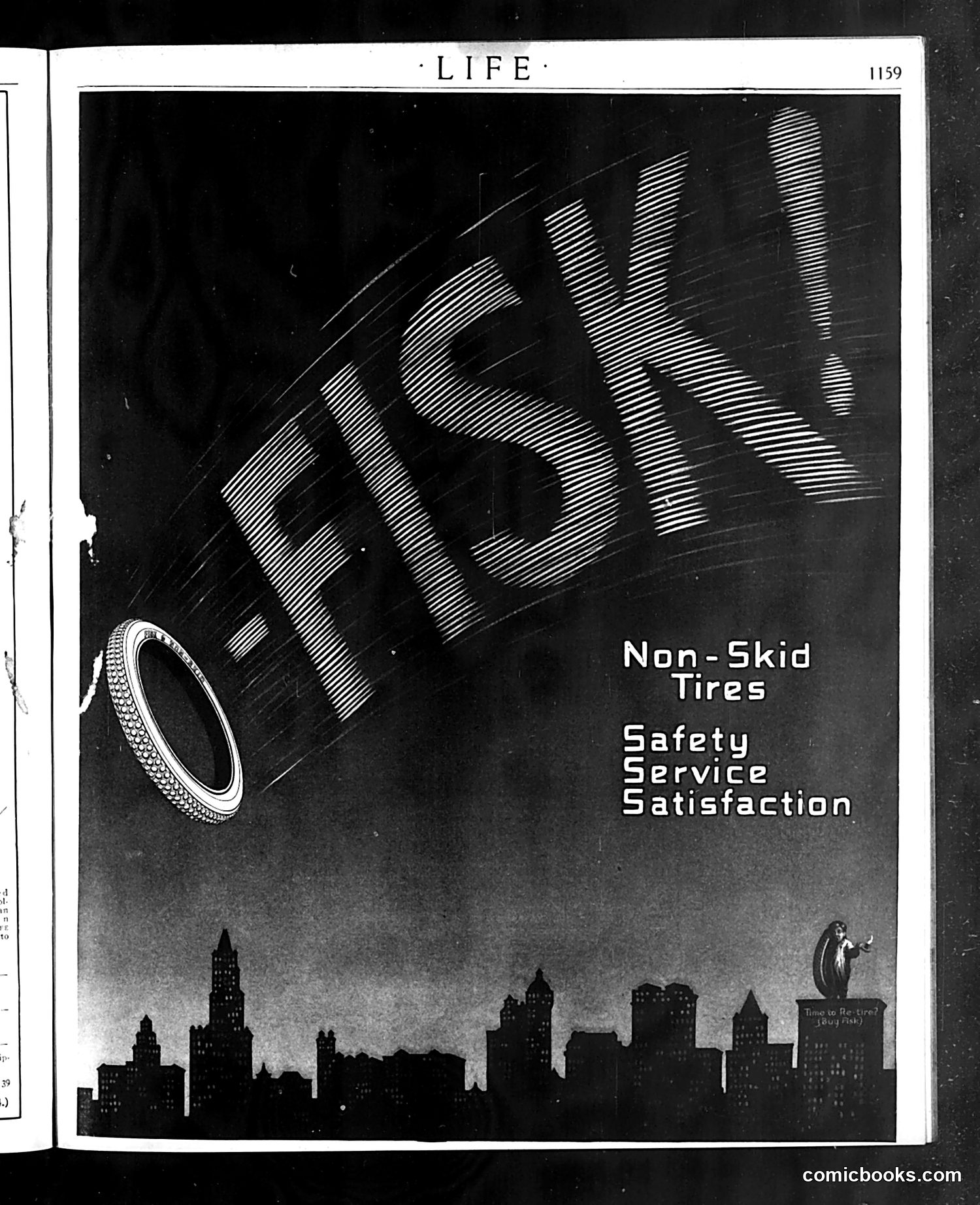
This page is a **vintage advertisement** rather than political satire or editorial cartooning. It advertises a tire brand's "Non-Skid Tires," emphasizing three selling points: "Safety Service Satisfaction." The visual design features a large tire in the upper left and prominent text spelling what appears to be the brand name in bold letters across the composition. Below is a silhouetted cityscape, likely representing a major American city (possibly New York, given the iconic skyline). The advertisement uses modernist graphic design typical of early-to-mid 20th century marketing—dynamic angles, high contrast black and white, and bold typography—to convey reliability and forward-thinking innovation. This is commercial messaging, not editorial commentary or political satire.
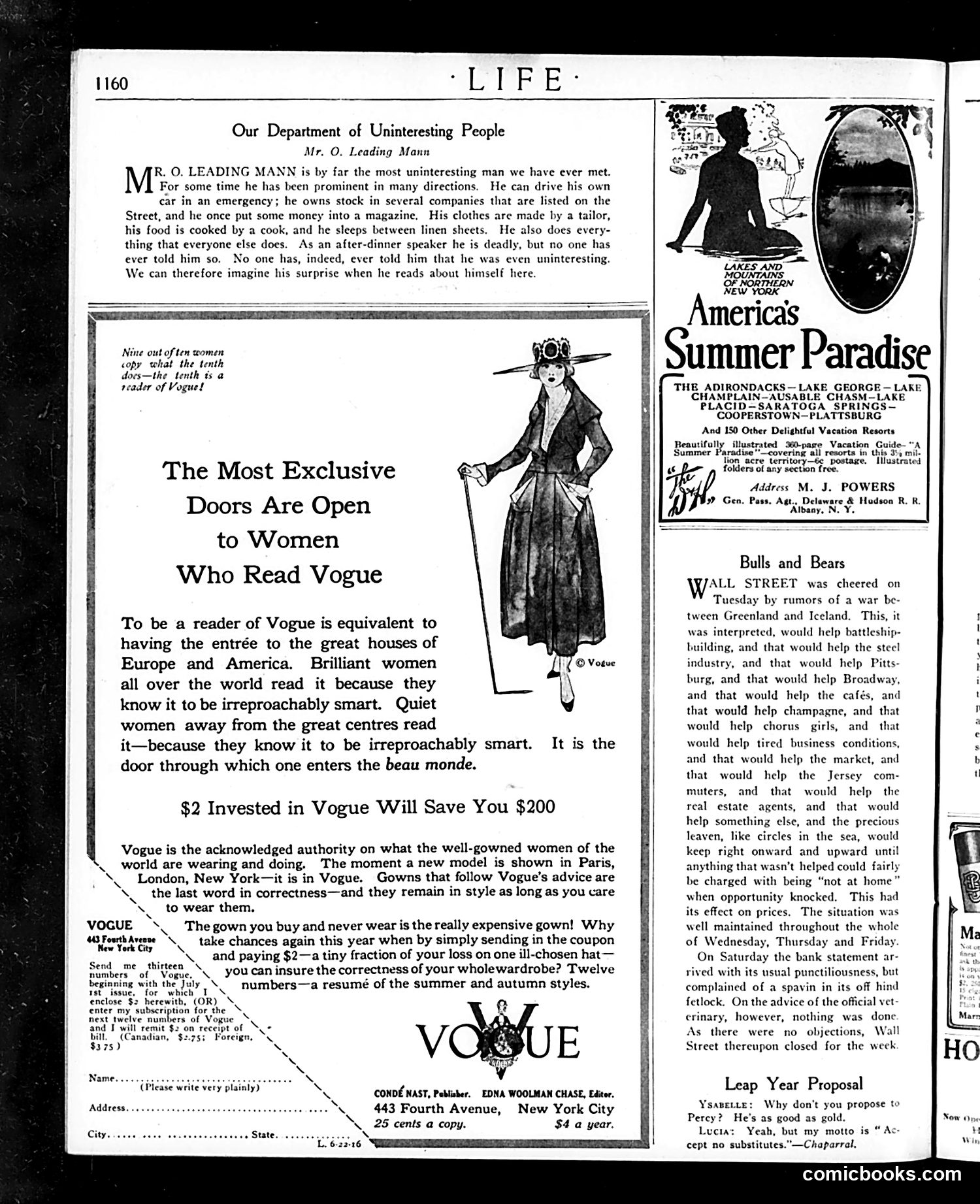
This page is primarily **advertising and editorial content** rather than political satire. The left side features a **Vogue magazine advertisement** mocking affluent women readers through satire. It claims that reading Vogue grants access to "exclusive doors" and European high society—positioning the magazine as a status symbol. The copy suggests buying a subscription is a bargain investment ($2) compared to the expensive wardrobes Vogue readers supposedly maintain. This gently satirizes both the aspirational marketing of fashion magazines and the pretensions of wealthy women who read them. The right side advertises "America's Summer Paradise," promoting upstate New York vacation resorts. A separate article titled "Bulls and Bears" discusses Wall Street market rumors, while "Leap Year Proposal" presents a humorous anecdote about marriage proposals. The overall page reflects 1920s consumer culture and social commentary.
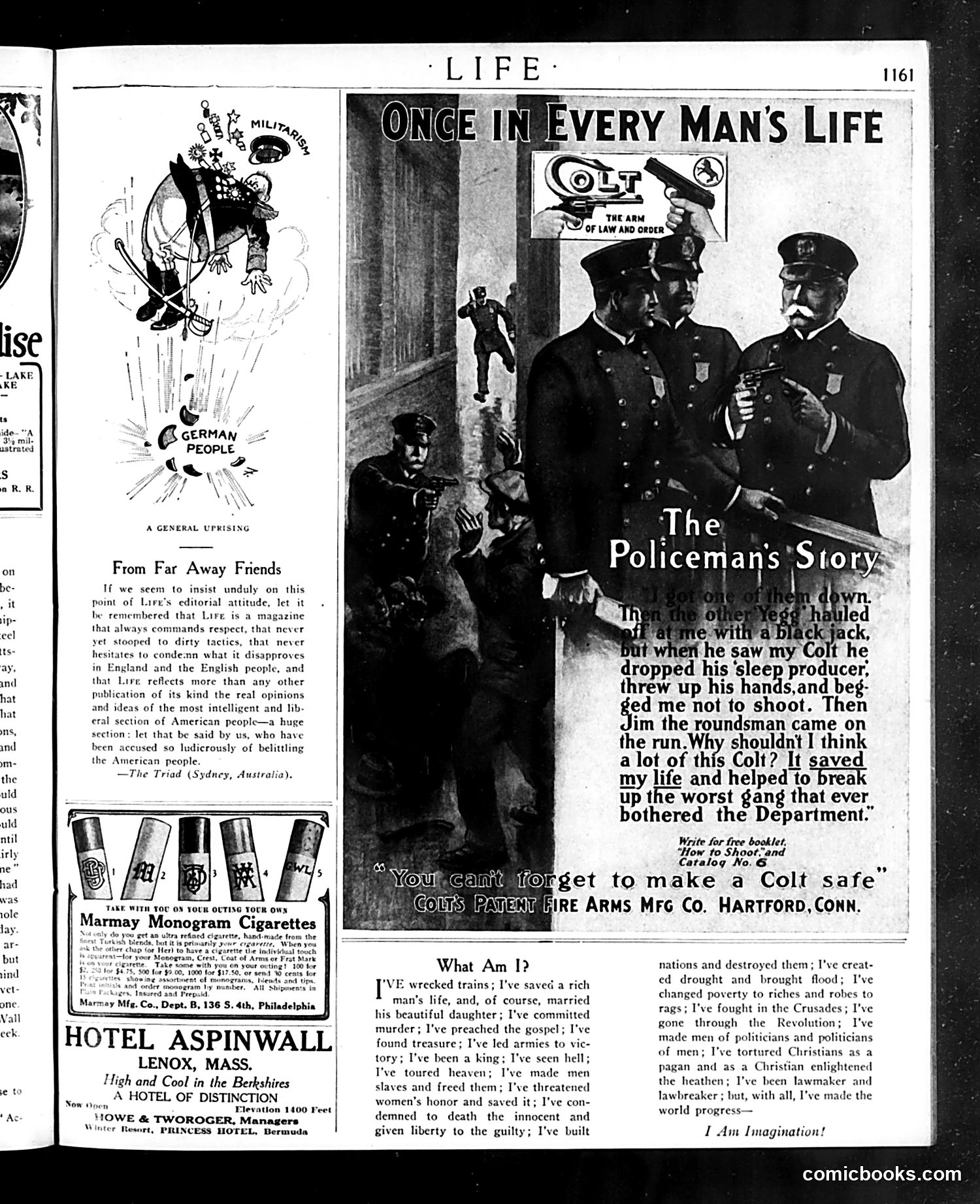
This political cartoon depicts militarism and German aggression. A caricatured German military figure explodes upward from a map labeled "German People," surrounded by weapons and chaos. The caption "A General Uprising" satirizes German militaristic expansion. The accompanying editorial, "From Far Away Friends," defends Life magazine's editorial stance against British criticism. It argues that Life reflects genuine American opinion and shouldn't be accused of unfairly attacking England or the English people. The rest of the page features advertisements (Colt firearms, Hotel Aspinwall, Marmay cigarettes) and "The Policeman's Story"—likely a serialized narrative promoting Colt revolvers as tools of law enforcement. The content reflects pre-WWI American attitudes toward German militarism and debates about American neutrality.
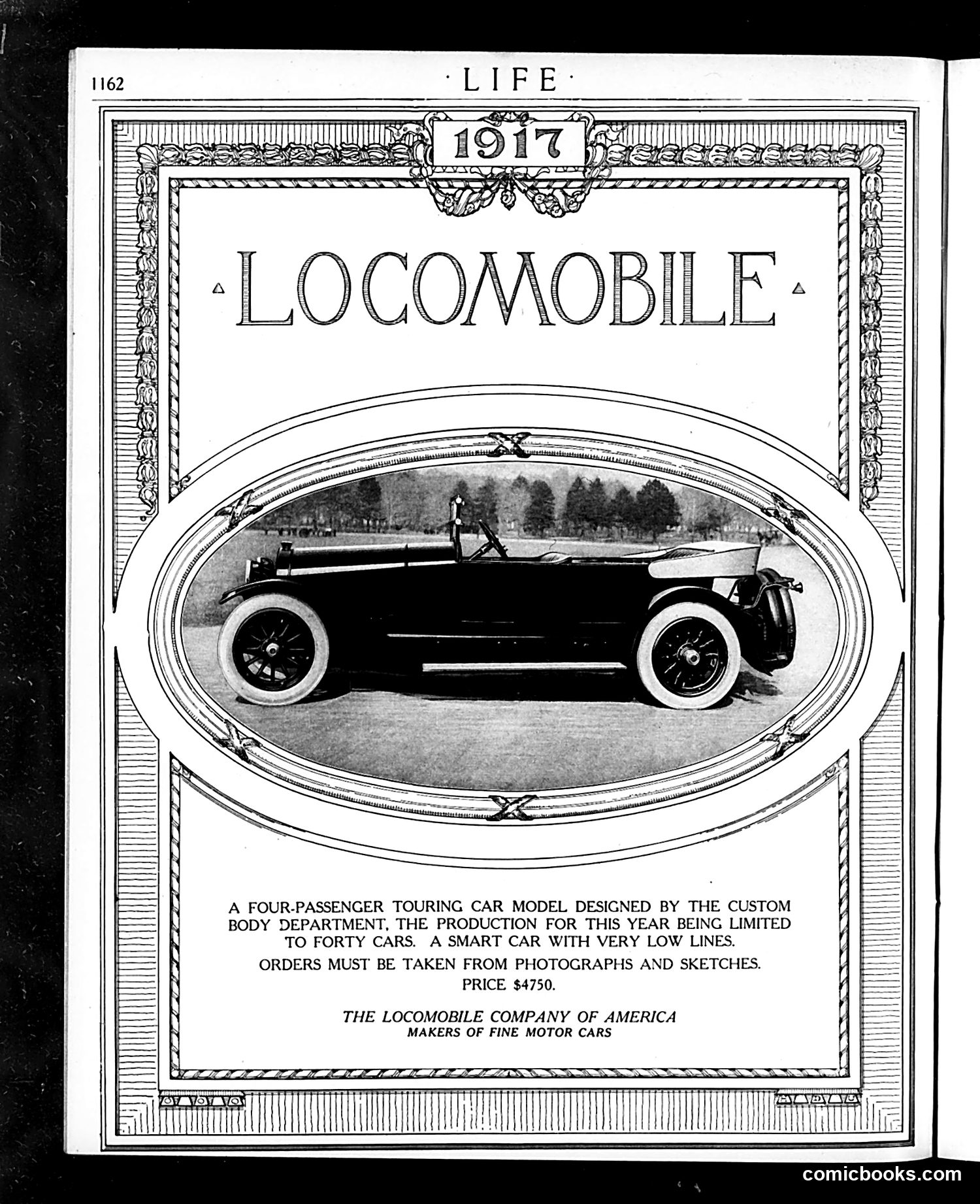
This is an advertisement, not a cartoon or satirical content. It promotes the 1917 Locomobile, a four-passenger touring car manufactured by the Locomobile Company of America. The ad emphasizes that this model was "designed by the custom body department" with "limited production for this year being limited to forty cars," positioning it as an exclusive, luxury vehicle. The photograph shows a sleek, open-top automobile with spoke wheels typical of the era. At $4,750 (approximately $130,000 in today's dollars), this was an expensive vehicle marketed to wealthy Americans. The text notes that "orders must be taken from photographs and sketches," indicating the custom nature of production. There is no political satire or social commentary present—this is straightforward period advertising from Life magazine's commercial pages.
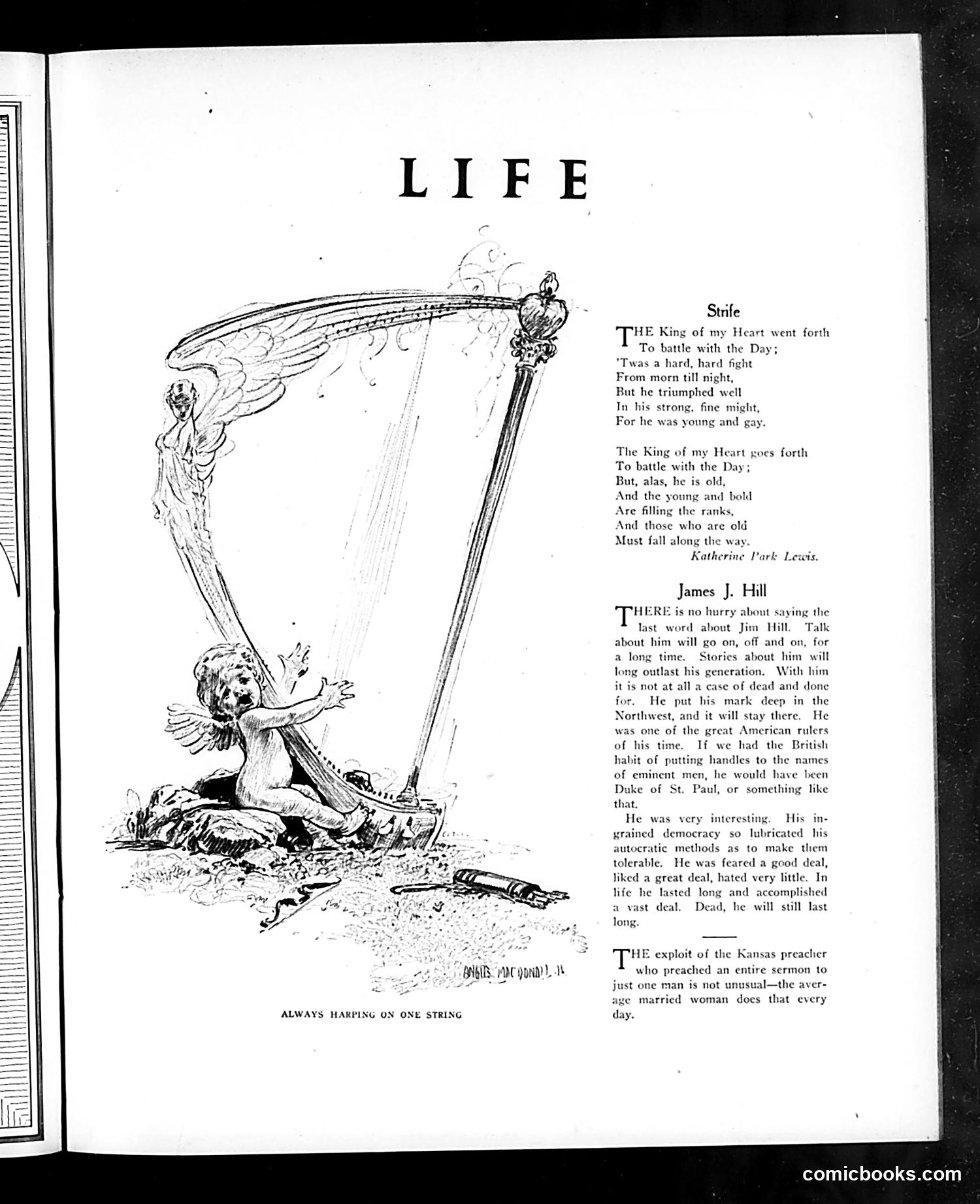
This page features a satirical illustration titled "Always Harping on One String" depicting a skeletal figure playing a harp-like instrument. The skeleton appears to represent Death or mortality itself. The accompanying text discusses **James J. Hill**, a major American railroad magnate and political figure. The satire critiques Hill's relentless pursuit of power and control—he "put his mark deep in the Northwest" and was "one of the great American rulers of his time." The "harping on one string" metaphor suggests Hill was single-minded and obsessive about his goals. The page also includes a poem titled "Strife" about conflict between old and young leadership, likely commenting on generational power struggles in American business and politics during Hill's era.
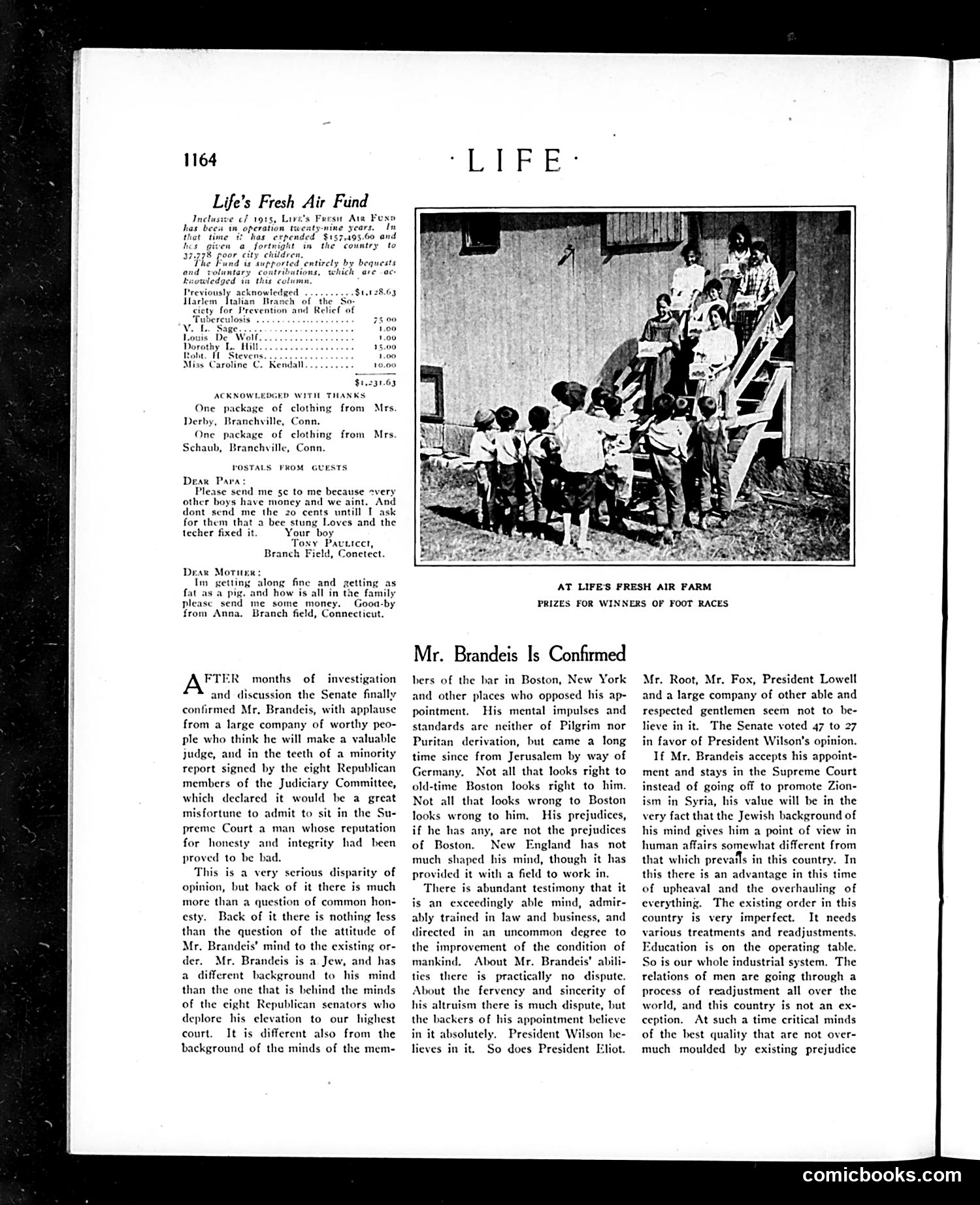
This page contains two distinct sections: **Top section:** "Life's Fresh Air Fund" - a charitable fundraising notice describing a twenty-nine-year-old program providing fresh air experiences for poor children. The accompanying photograph shows children at what appears to be Life's Fresh Air Farm, with a caption noting "PRIZES FOR WINNERS OF FOOT RACES." This is a straightforward charitable appeal, not satire. **Bottom section:** "Mr. Brandeis Is Confirmed" - a substantial article discussing Louis Brandeis's Senate confirmation as a Supreme Court justice. The text defends Brandeis against opposition from Boston establishment figures and members of the bar who opposed his appointment, noting his Jewish background and different perspective made him valuable despite prejudice against him. Neither section contains political cartoons or satirical imagery.
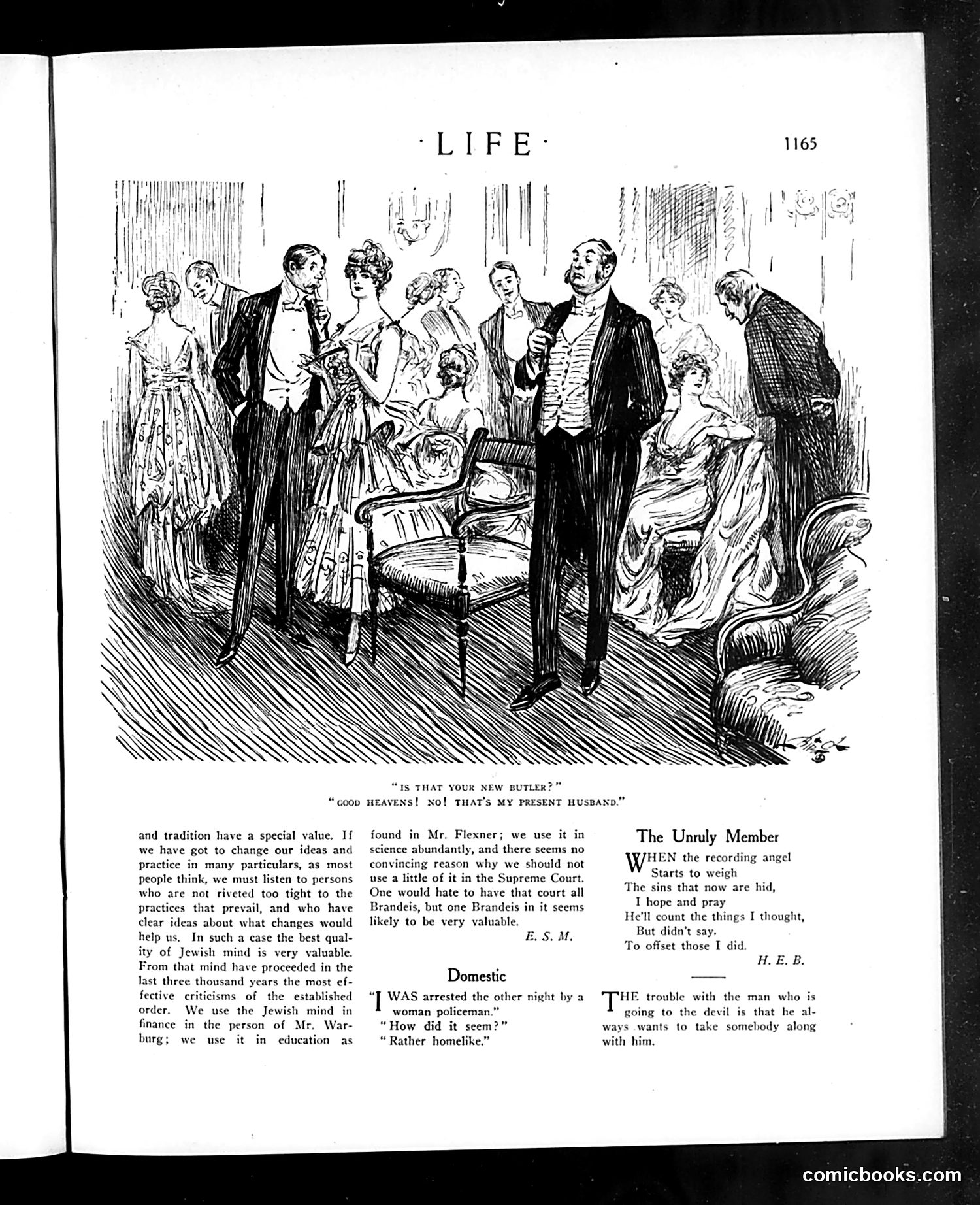
This page from *Life* magazine contains a satirical cartoon and several short humor pieces. The main cartoon depicts a social gathering where a man presents a new servant to guests, with the caption: "IS THAT YOUR NEW BUTLER?" "GOOD HEAVENS! NO! THAT'S MY PRESENT HUSBAND." The joke satirizes shifting gender roles and domestic labor expectations—specifically, the blurred lines between husband and hired help in the household. The visual gag relies on the servant appearing indistinguishable from the husband, suggesting the husband has been reduced to servant-like status in domestic life, likely reflecting early-20th-century anxieties about women's changing social position and authority within marriage. The accompanying text pieces offer brief satirical observations on Jewish intellectual traditions, domestic arrest anecdotes, and marital relationships—typical *Life* magazine fare from this era.
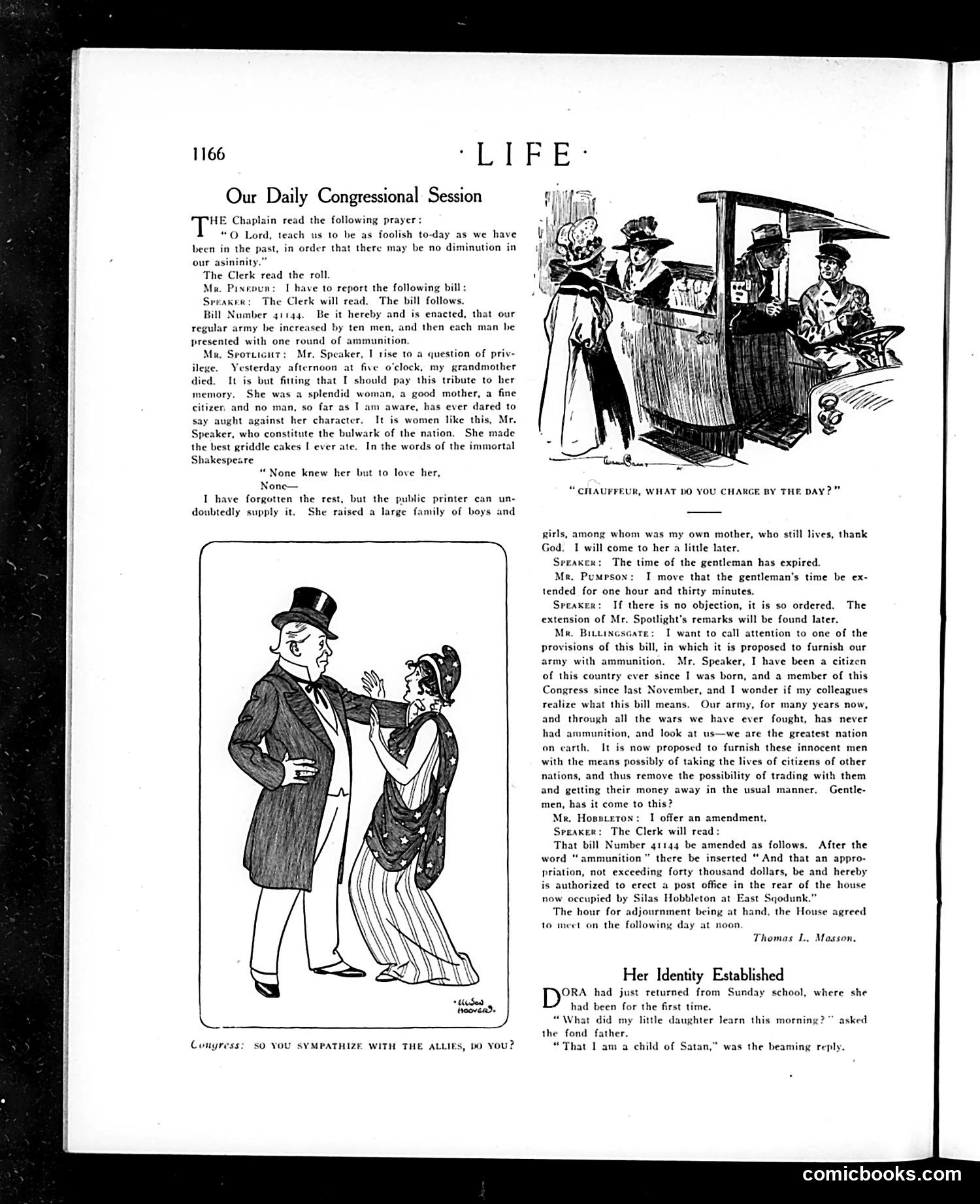
This page satirizes early 20th-century Congressional debates about military preparedness. The upper cartoon depicts a well-dressed woman (labeled "CHAUFFEUR, WHAT DO YOU CHARGE BY THE DAY?") encountering what appears to be a street vendor or laborer—likely mocking the wealthy's disconnect from common people's economic struggles. The lower cartoon, captioned "CONGRESS: SO YOU SYMPATHIZE WITH THE ALLIES, DO YOU?" shows a gentleman in formal dress being confronted by a woman—appearing to mock Congressional members who publicly supported Allied nations in WWI while debating whether to provide actual military support and ammunition. The accompanying Congressional session text discusses Bill 41144, concerning ammunition procurement and military provisions, suggesting debate over whether America should genuinely support the Allies or merely offer rhetoric.
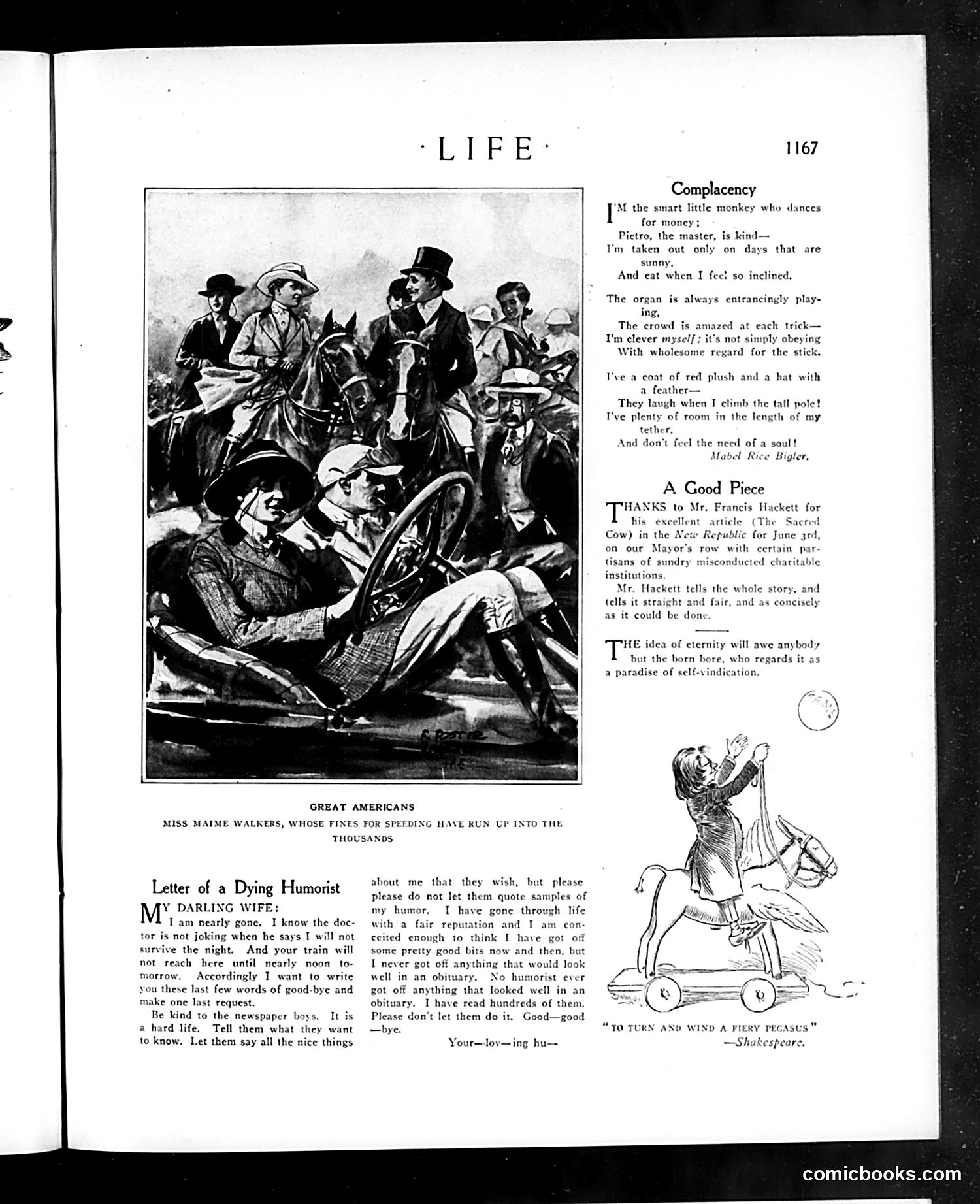
The main illustration shows a street scene with multiple figures gathered around what appears to be a street performer or organ grinder with a monkey. The caption identifies this as "Miss Maine Walkers, whose fines for speeding have run up into the thousands"—satirizing a wealthy woman's reckless driving and ability to pay traffic fines without consequence. The page contains three separate pieces: the illustration above, a poem titled "Complacency" about a performing monkey, and an article titled "A Good Piece" praising Francis Hackett's journalism. Below is "Letter of a Dying Humorist," a satirical farewell letter requesting kindness toward newspaper boys. The overall theme mocks privilege, vanity, and social hypocrisy common to early 20th-century American satirical commentary.
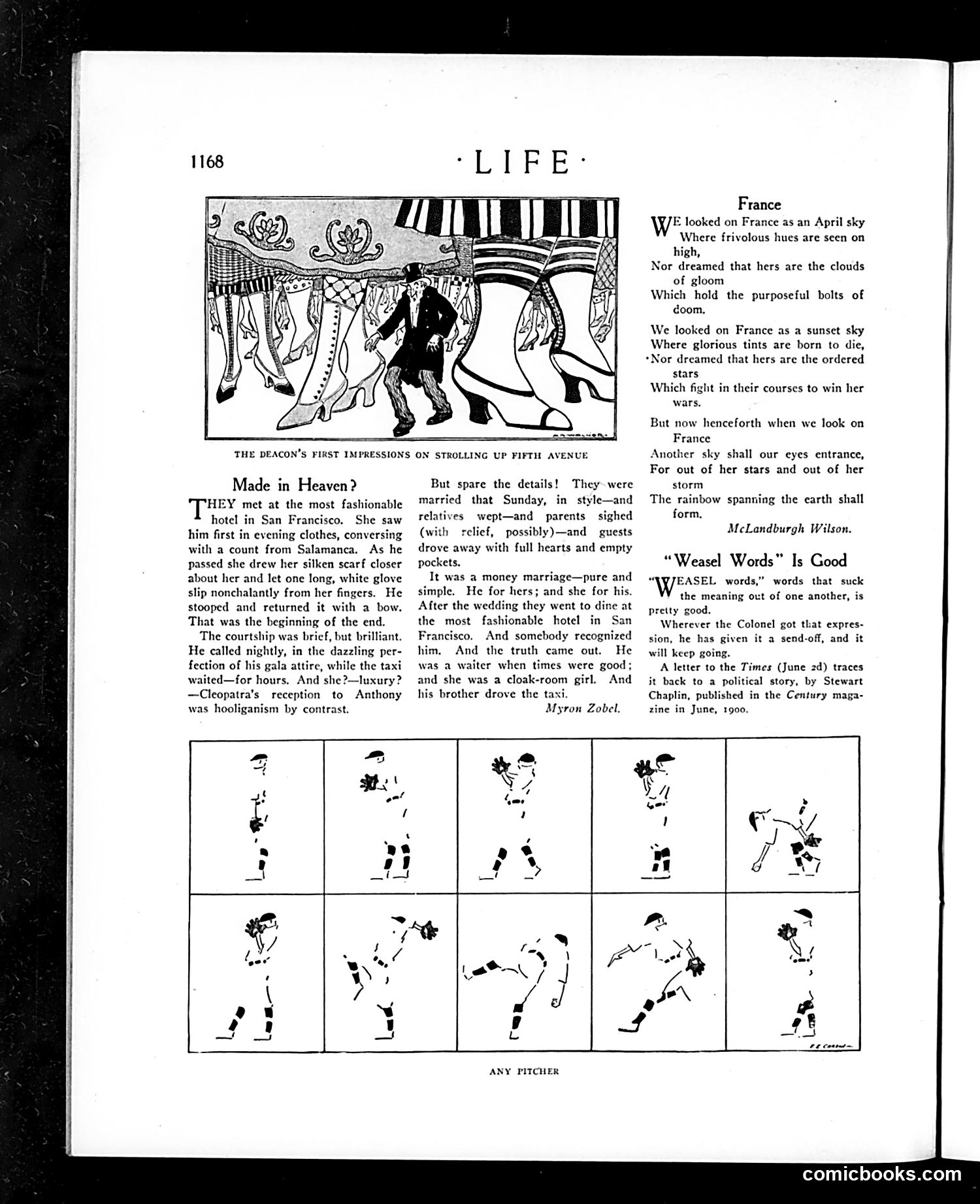
This page contains three distinct pieces of satire: **"Made in Heaven?"** is a short story about a wealthy couple whose romantic encounter in San Francisco turns out to be a hoax. The twist: both the husband and wife were working-class service employees (waiter and cloakroom girl) who deceived each other about their wealth and status. Their lavish courtship was entirely performative. The satire mocks both the nouveau riche pretension of the era and the superficiality of marriages based on assumed wealth rather than genuine compatibility. **"France"** is a poem by McLandburgh Wilson offering a shifting perspective on France—from frivolous April sky to sunset to warrior constellation. It appears to reference France's military struggles, likely relating to WWI concerns. **"Weasel Words Is Good"** is a brief note praising the phrase "weasel words" (language that obscures meaning) and crediting its origin to an 1900 *Century* magazine political story. The bottom section, labeled "ANY PITCHER," shows comic sketches of baseball pitching motions.
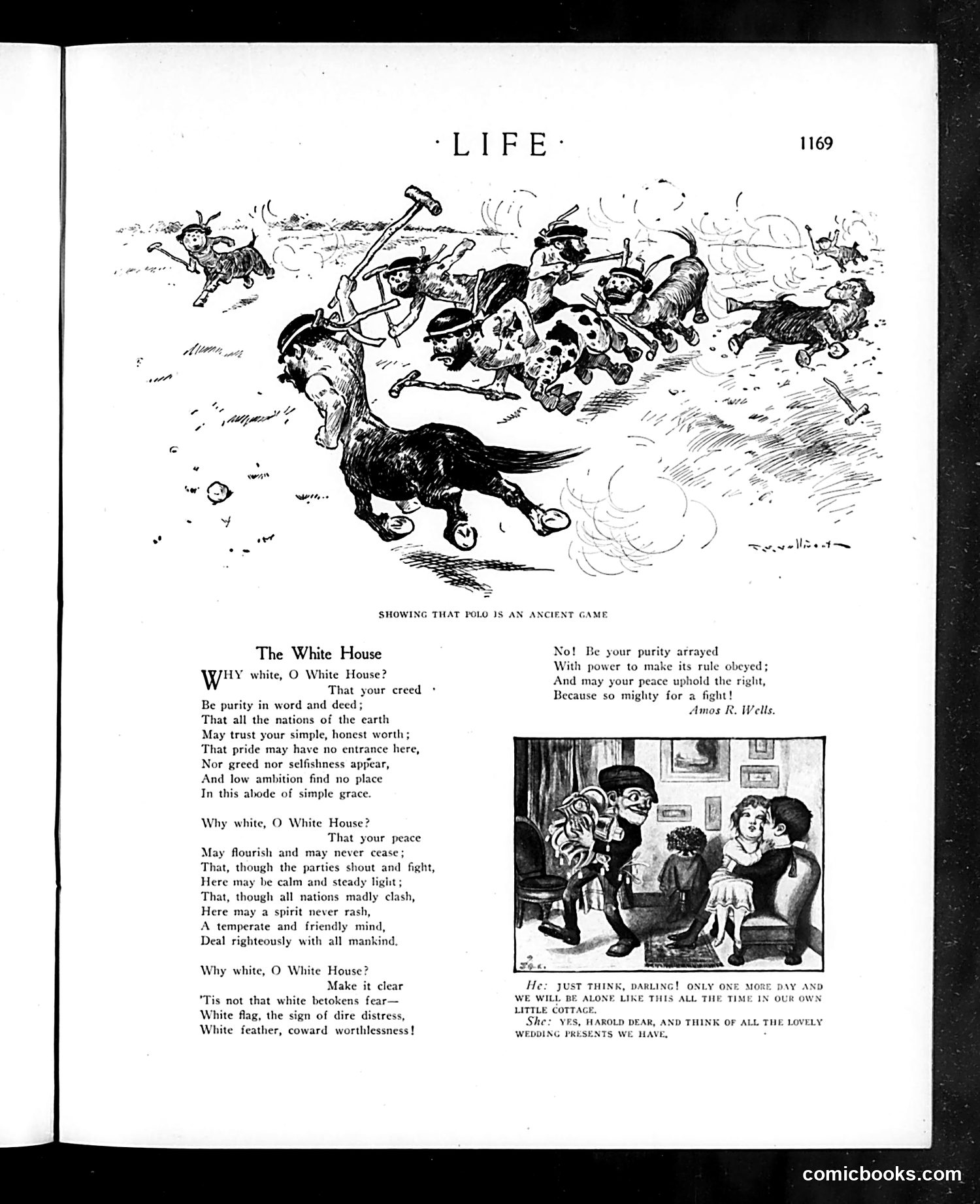
This page contains two distinct elements: **Upper section:** A satirical cartoon titled "Showing that Polo is an Ancient Game" depicts animals (likely dogs or similar creatures) playing polo in a chaotic scene, suggesting polo's origins predate human civilization—a humorous anachronism. **Lower section:** A sentimental poem titled "The White House" by an unknown author appeals to the White House to embody purity, honesty, and peaceful diplomacy. It's a patriotic plea for the institution to maintain moral standards and mediate international conflicts with temperance and righteousness. **Adjacent illustration:** A domestic scene shows an engaged couple discussing their future cottage and wedding gifts—a conventional romantic narrative contrasting sharply with the political idealism above. The juxtaposition appears ironic: while the poem earnestly beseeches the White House for moral leadership, the couple's mundane domestic fantasy sits beside it, suggesting perhaps the gap between national ideals and personal concerns, though the exact satirical intent remains unclear without additional context.
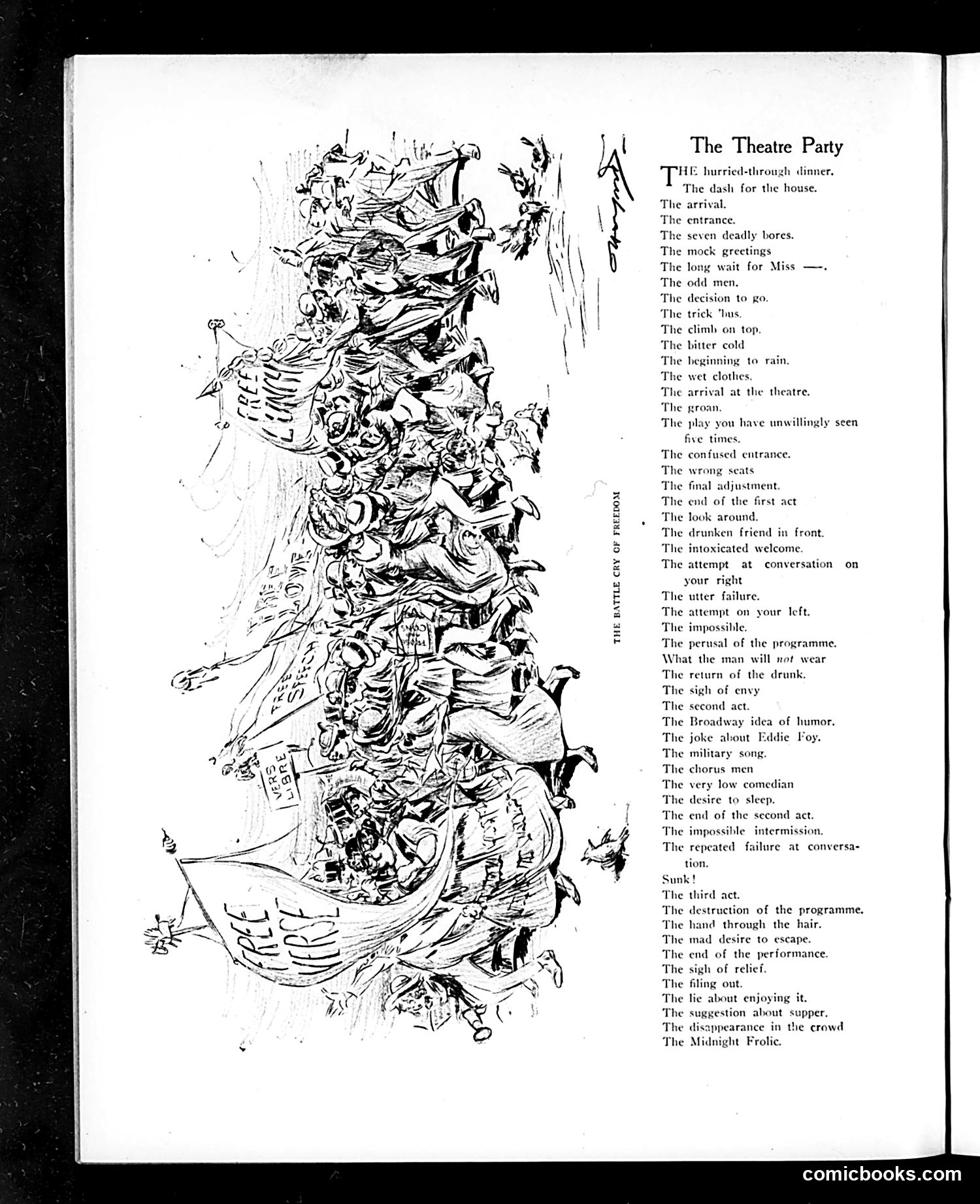
This cartoon satirizes the tedious social ritual of attending Broadway theater in early 20th-century urban society. The chaotic, grotesque illustration depicts a tangled mass of human figures—representing the various tedious stages of a theater outing. The accompanying text humorously catalogs every mundane or uncomfortable moment: rushed dinner preparations, uncomfortable travel, sitting near drunk patrons, awkward conversation attempts, enduring a play you've "unwillingly seen five times," and the social obligation to pretend you enjoyed it afterward. The satire targets upper-middle-class social conventions—the pressure to attend theater as a fashionable activity despite genuine disinterest, the uncomfortable proximity to other theatergoers, and the performative politeness required throughout. References like "Eddie Foy" (a contemporary vaudeville star) and "The Midnight Frolic" (a nightclub) date this to the 1910s Broadway era. The joke: going to the theater isn't entertainment—it's an exhausting social performance worse than the actual play.
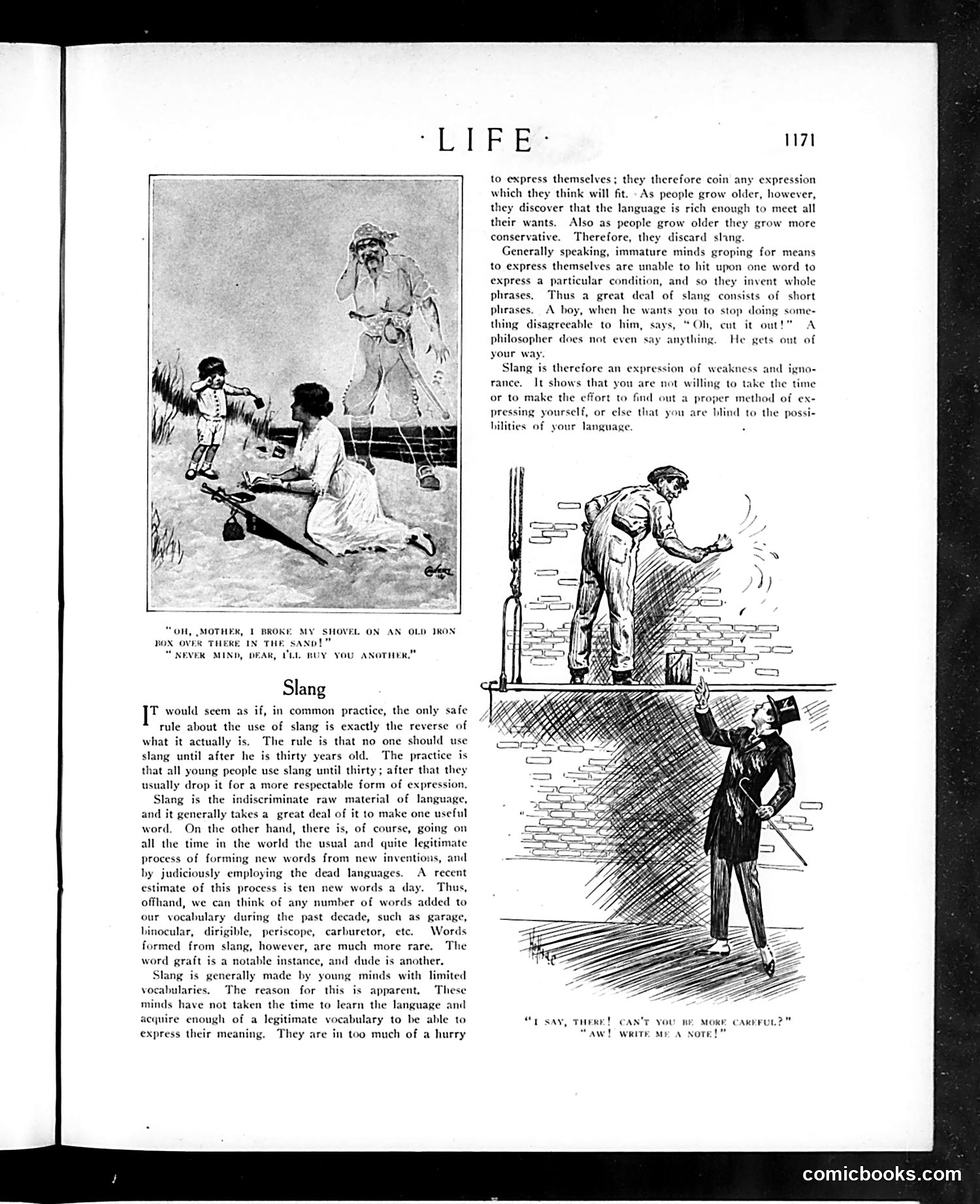
This page from *Life* magazine presents an editorial argument against slang usage, illustrated by two cartoons mocking young people's speech habits. **The argument:** The text claims slang represents intellectual laziness and limited vocabulary. It's used by young people unable or unwilling to express themselves properly, then abandoned as people mature and grow "conservative." The piece distinguishes slang from legitimate new words (garage, dirigible, carburetor) coined from technological innovation or classical languages. **The cartoons:** - Top: A child telling his mother he "broke my shovel on an old iron box"—crude, imprecise language - Bottom: A figure scolding another for carelessness, with the response "aw! write me a note!"—mocking casual, dismissive speech The satire targets youth culture's supposedly debased language as evidence of moral and intellectual deficiency. This reflects early-20th-century anxieties about generational decline and linguistic "proper" usage as markers of class and refinement.
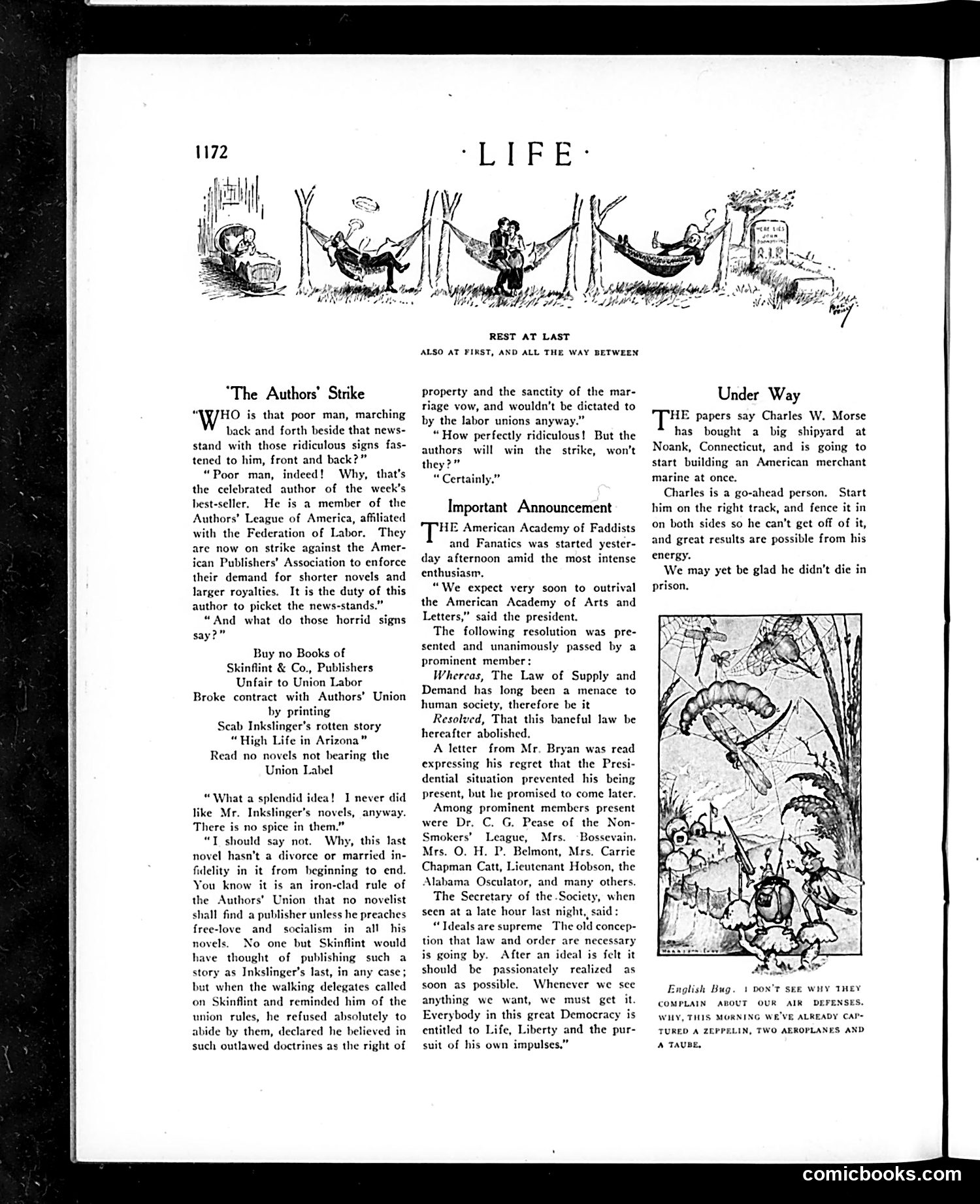
This page contains three satirical pieces mocking progressive activism and labor movements circa 1910s: **"The Authors' Strike"** ridicules authors' unions demanding shorter novels, higher royalties, and ideological content (free-love and socialism). The satire suggests union rules are absurdly controlling—publishers like "Skinflint" who believe in traditional property rights and marriage are cast as villains for refusing to toe the ideological line. **"American Academy of Faddists and Fanatics"** lambastes radical reformers (naming real figures like Carrie Chapman Catt and William Jennings Bryan) who absurdly propose abolishing the Law of Supply and Demand. The satire mocks their passion for immediate radical change without practical consideration. **"Under Way"** offers cryptic praise for Charles W. Morse (a financier who served prison time for fraud), joking he shouldn't have survived prison—likely sarcastic commentary on corruption or rehabilitation. The overall tone: Life magazine dismisses progressive labor activism and radical reform movements as naive, self-righteous, and impractical.
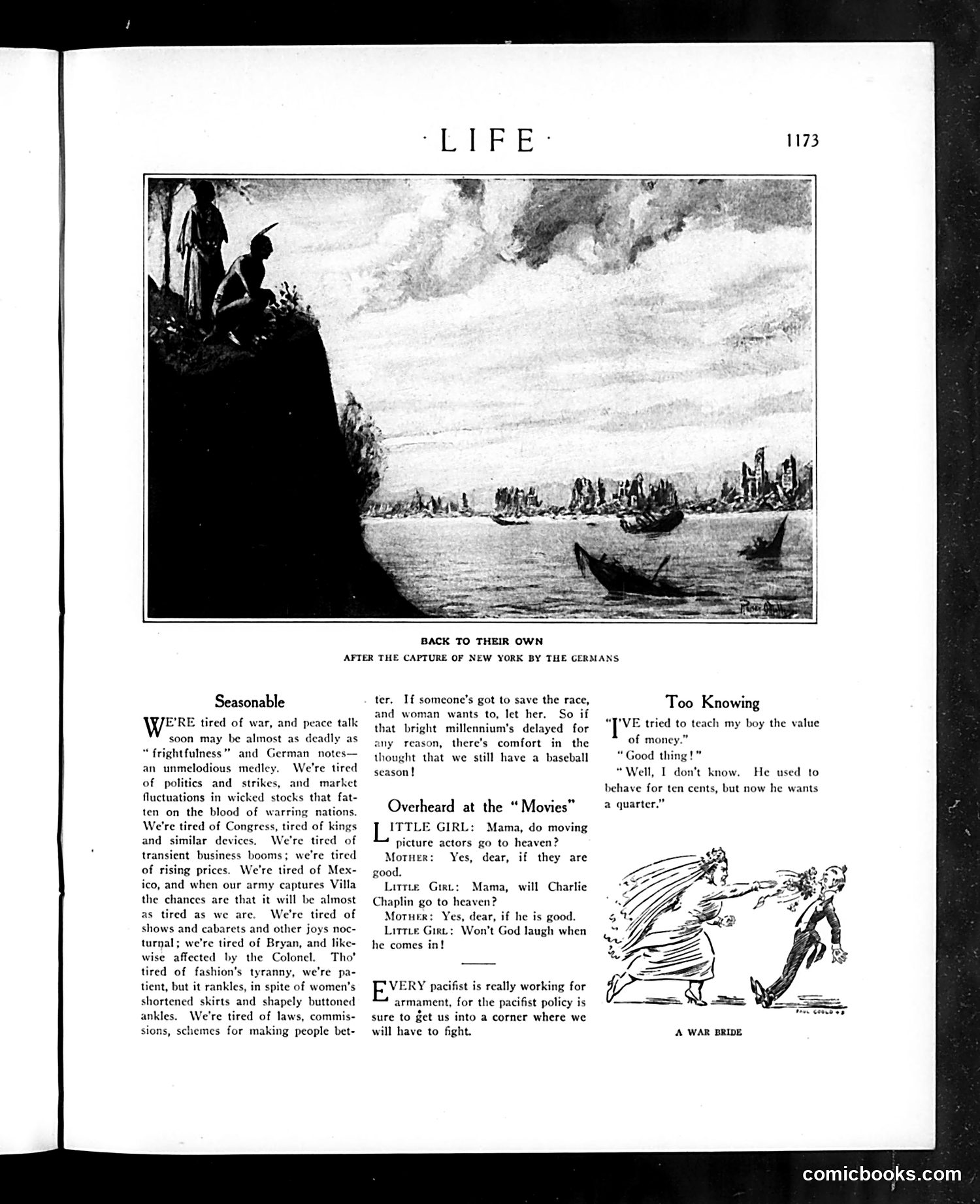
This page from Life presents three satirical pieces reflecting American war-weariness during World War I (the headline references a hypothetical German capture of New York). **"Seasonable"** catalogues public exhaustion with war, politics, strikes, and social upheaval—yet finds comic relief that baseball season continues. The satire suggests Americans are fatigued by everything except entertainment. **"Overheard at the Movies"** mocks Charlie Chaplin (then a major film star). A child's innocent question—whether Chaplin will go to heaven if he's good—becomes a joke implying Chaplin is morally questionable or hypocritical, reflecting contemporary criticism of his public persona. **"Too Knowing"** satirizes childhood inflation: a boy once behaved for ten cents but now demands a quarter, suggesting wartime economic inflation has corrupted even children's values. **"A War Bride"** (illustration) likely depicts the social consequences of war—possibly a woman abandoned or displaced by conflict. The page reflects 1917-era American anxieties: war fatigue, celebrity scrutiny, economic disruption, and social instability.
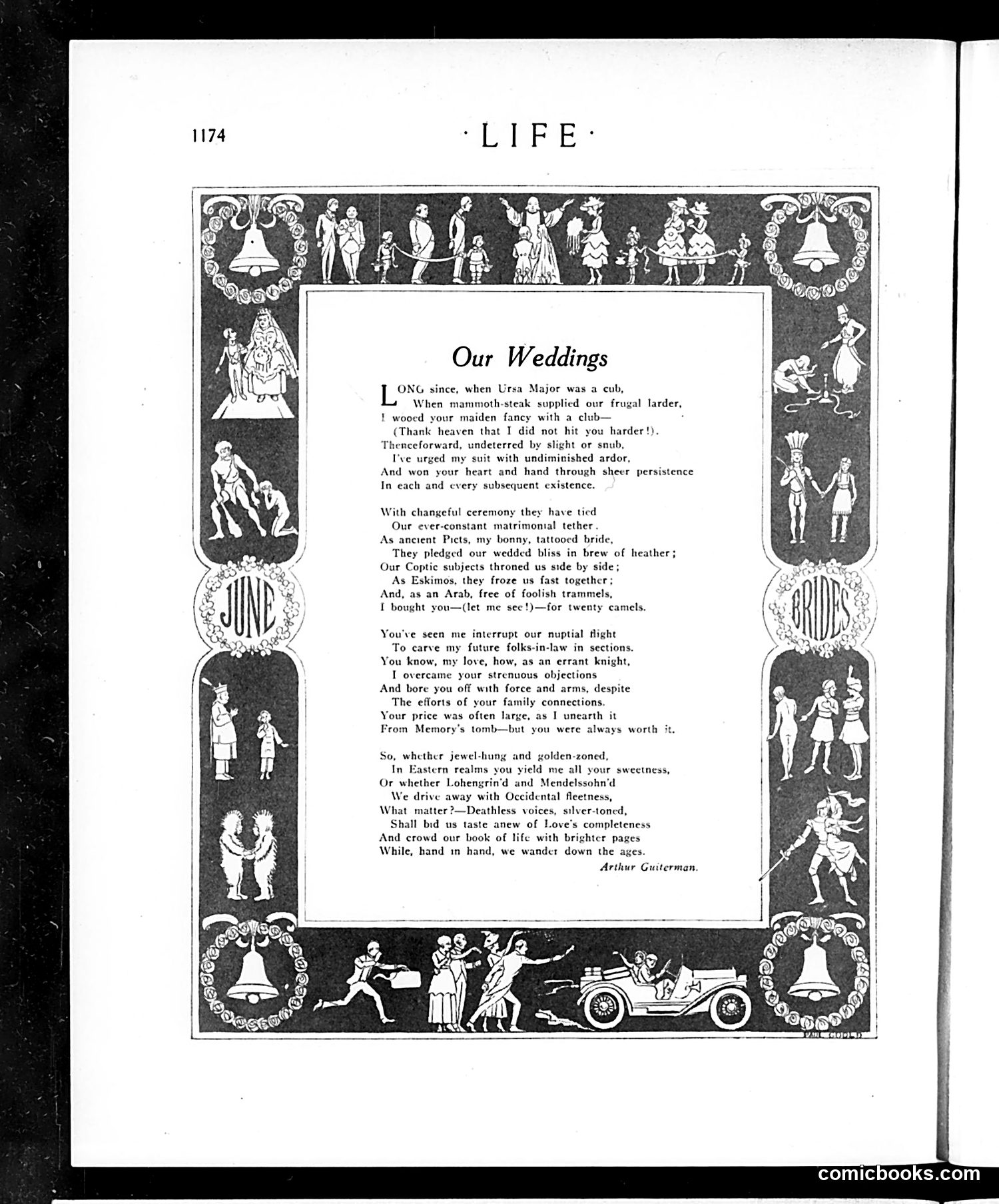
This is a humorous poem about marriage across human history and cultures, not a political cartoon. The decorative border illustrates various wedding ceremonies and domestic scenes from different eras and civilizations. The satire's humor lies in the speaker's romantic exaggeration: he claims to have married the same woman repeatedly throughout history—as prehistoric cave-dwellers, ancient Picts, Coptic Christians, Eskimos, Arabs, medieval knights, and modern couples. Each stanza references a different cultural wedding tradition (the Picts' heather brew, Arab bride-price of camels, Lohengrin operas, etc.). The joke suggests that despite humanity's vastly different customs and circumstances, romantic love and marriage remain constant themes. The speaker ironically catalogs his past rough treatment of his bride—clubbing her, kidnapping her, buying her—while insisting their bond has persisted through "sheer persistence" across lifetimes. It's sentimental satire aimed at newlyweds: a witty assertion that true love transcends cultural differences and historical change.
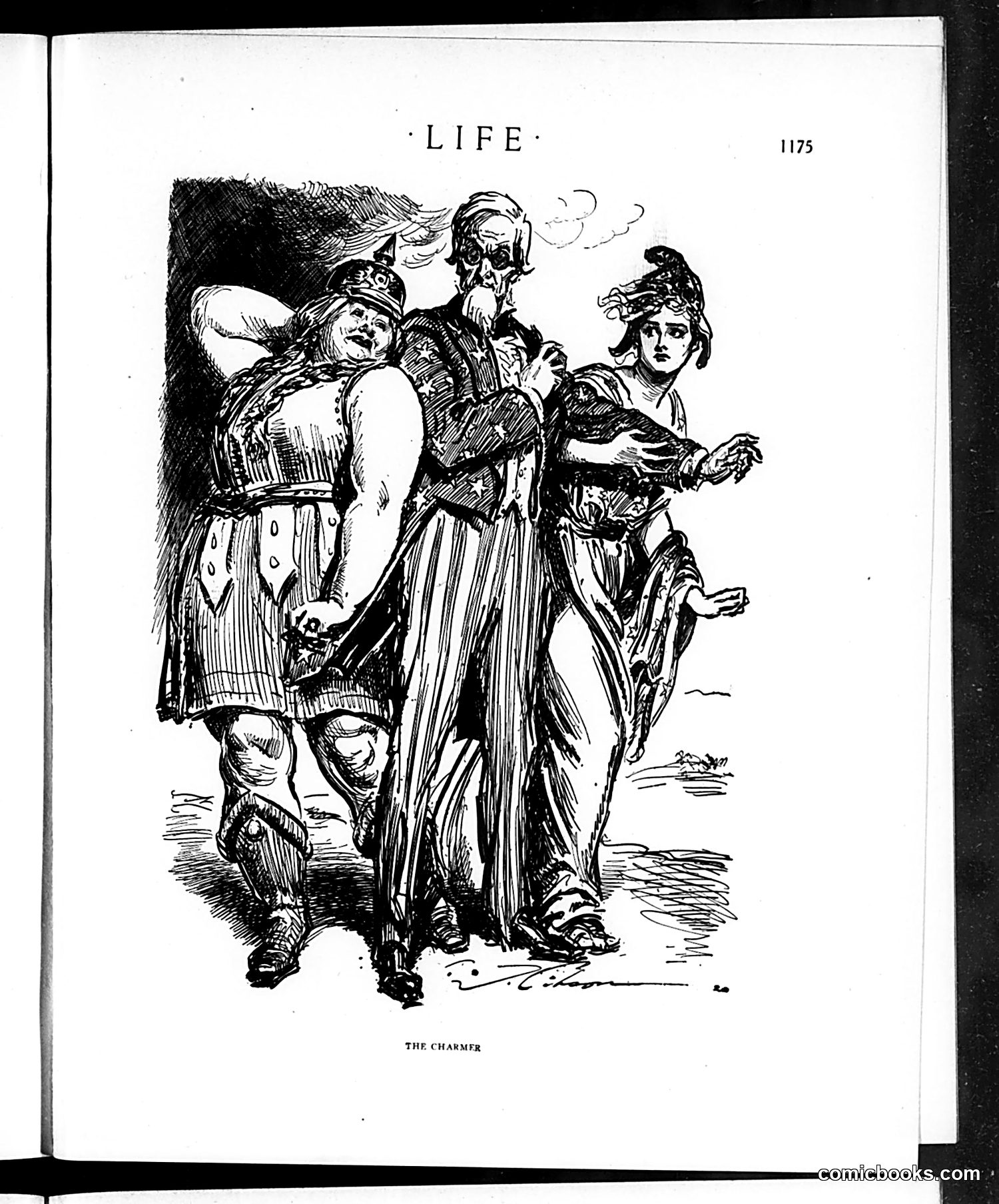
This political cartoon from *Life* magazine (page 1175) is titled "The Charmer" and depicts a skeletal Death figure in elaborate period costume, appearing to charm or seduce a group of figures around him. The skeleton wears ornate robes and a feathered hat, gesturing persuasively. The other characters seem drawn toward or influenced by this Death personification, suggesting they are being "charmed" by him despite his deadly nature. The satire likely comments on how Death or some destructive force—possibly war, disease, or a particular political figure or policy—seduces people through charm and persuasion despite bringing harm. Without additional context about the publication date, the specific historical moment remains unclear, but the image critiques how dangerous things can attract followers through superficial appeal.
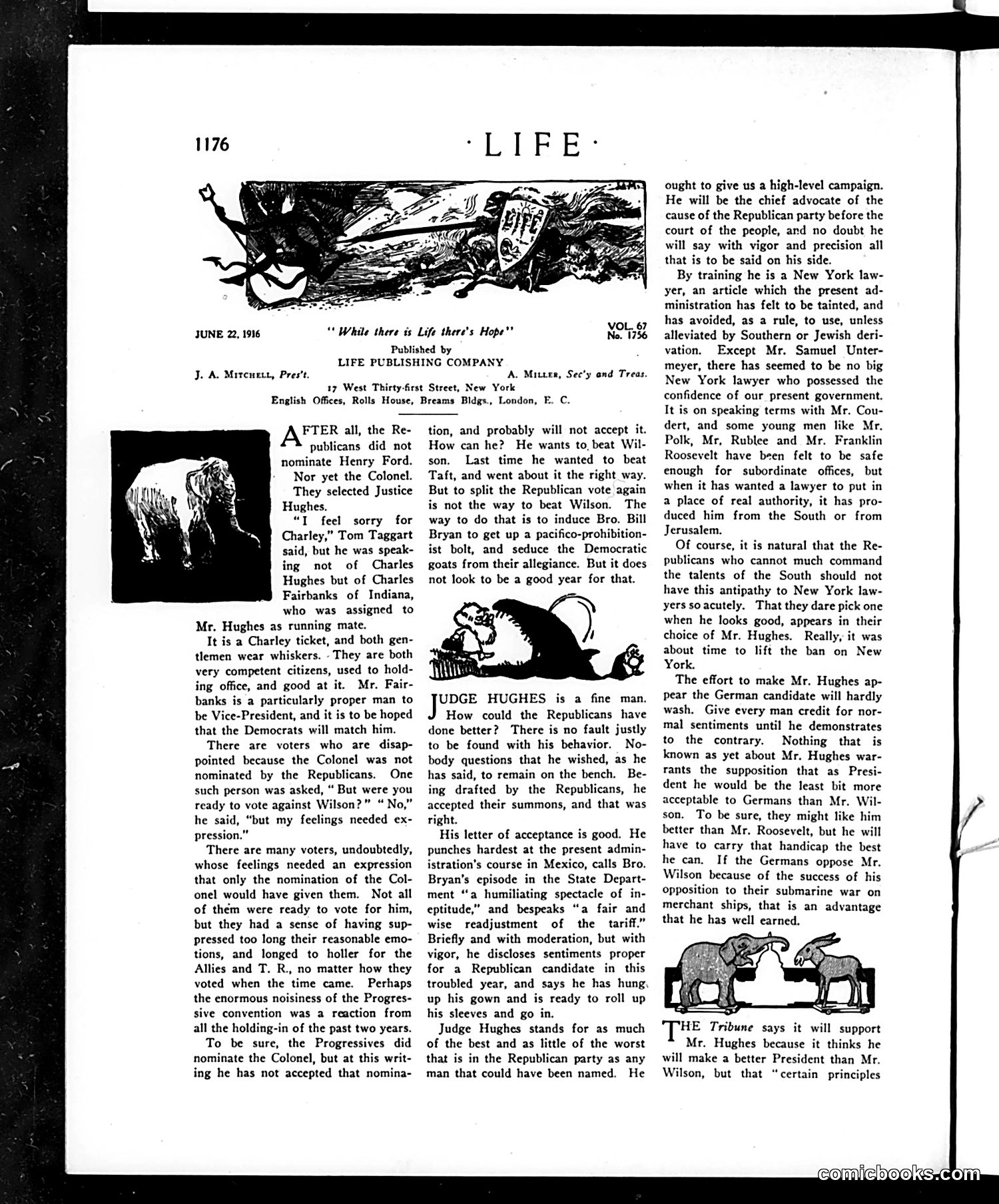
This page discusses the Republican Party's 1916 presidential nomination of **Justice Charles Evans Hughes** with **Charles Fairbanks** as running mate—described as a "Charley ticket" of two whiskered, competent men. The cartoons satirize Republican strategy. One depicts a horse (labeled "A horse"), likely representing the party's predicament. The text reveals disappointment that **Theodore Roosevelt** wasn't nominated; Progressives nominated him separately, but he may refuse to split the Republican vote against Wilson. Hughes is characterized as an acceptable but not inspiring choice—a New York lawyer (oddly, the administration has distrusted New York lawyers except those with Southern or Jewish connections). The piece notes Hughes's strong letter accepting the nomination, particularly attacking the Wilson administration's Mexican policy and Bryan's State Department role. The satire suggests Hughes represents competence without excitement—a safe, moderate alternative to both Roosevelt's vigor and Wilson's incumbent position.
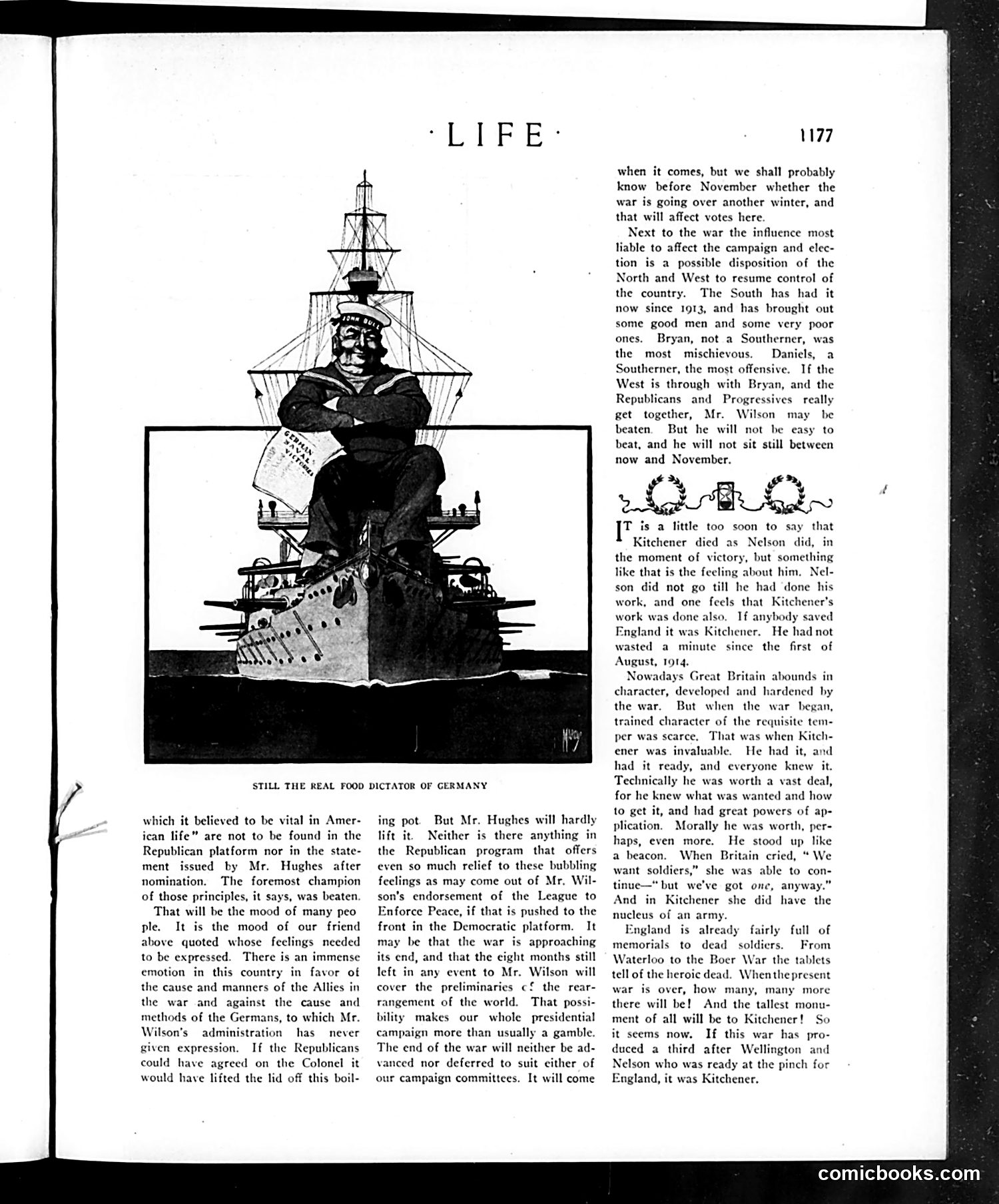
The cartoon depicts a German military officer (likely the Kaiser or a German general) seated atop a warship, holding what appears to be a document or newspaper. The title sarcastically refers to him as a "food dictator," referencing Germany's use of unrestricted submarine warfare to blockade Allied supply lines and starve Britain into submission—a central World War I strategy. The accompanying article discusses the 1916 U.S. presidential election between Wilson and Hughes, arguing that American public emotion strongly favors the Allied cause against German methods. The piece notes this pro-Allied sentiment hasn't been adequately expressed by either candidate, and discusses whether the war's continuation might influence November voting. The cartoon satirizes German military aggression and its deliberate targeting of civilian food supplies as a weapon of war, illustrating the visceral anti-German sentiment the article describes.
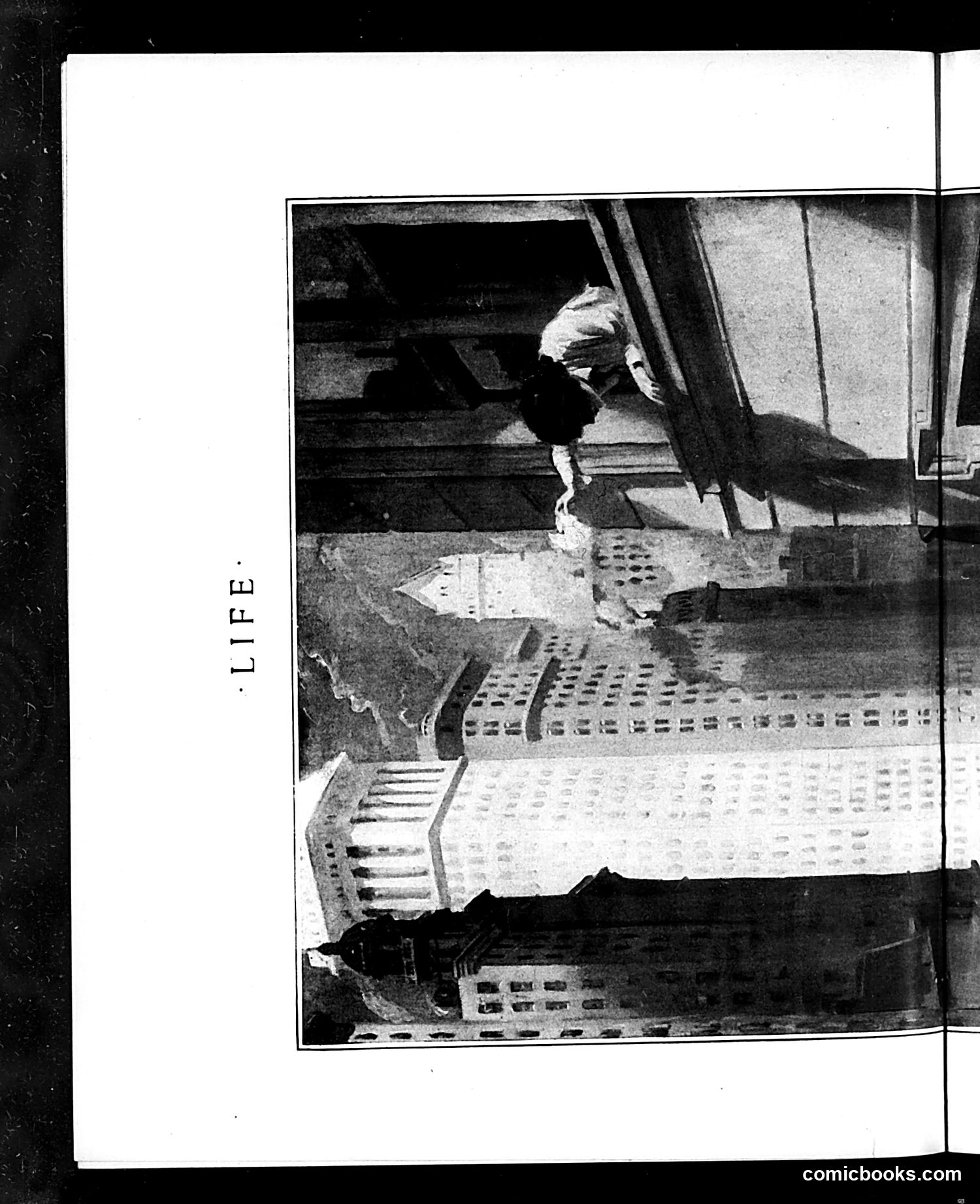
The OCR text appears to be corrupted or unreadable, providing no usable content. The black-and-white photograph shows a person in light-colored clothing bending over what appears to be an industrial or factory setting with repetitive grid patterns visible on the ground and structures. The page is labeled "LIFE" on the left margin. Without legible text or clear identifying details in the image itself, I cannot reliably determine what specific political or social commentary this page intends. The industrial setting and the person's posture suggest labor or manufacturing work, but identifying the specific satire, figures involved, or historical context would require either clearer text or additional context I cannot assert from what's visible here.
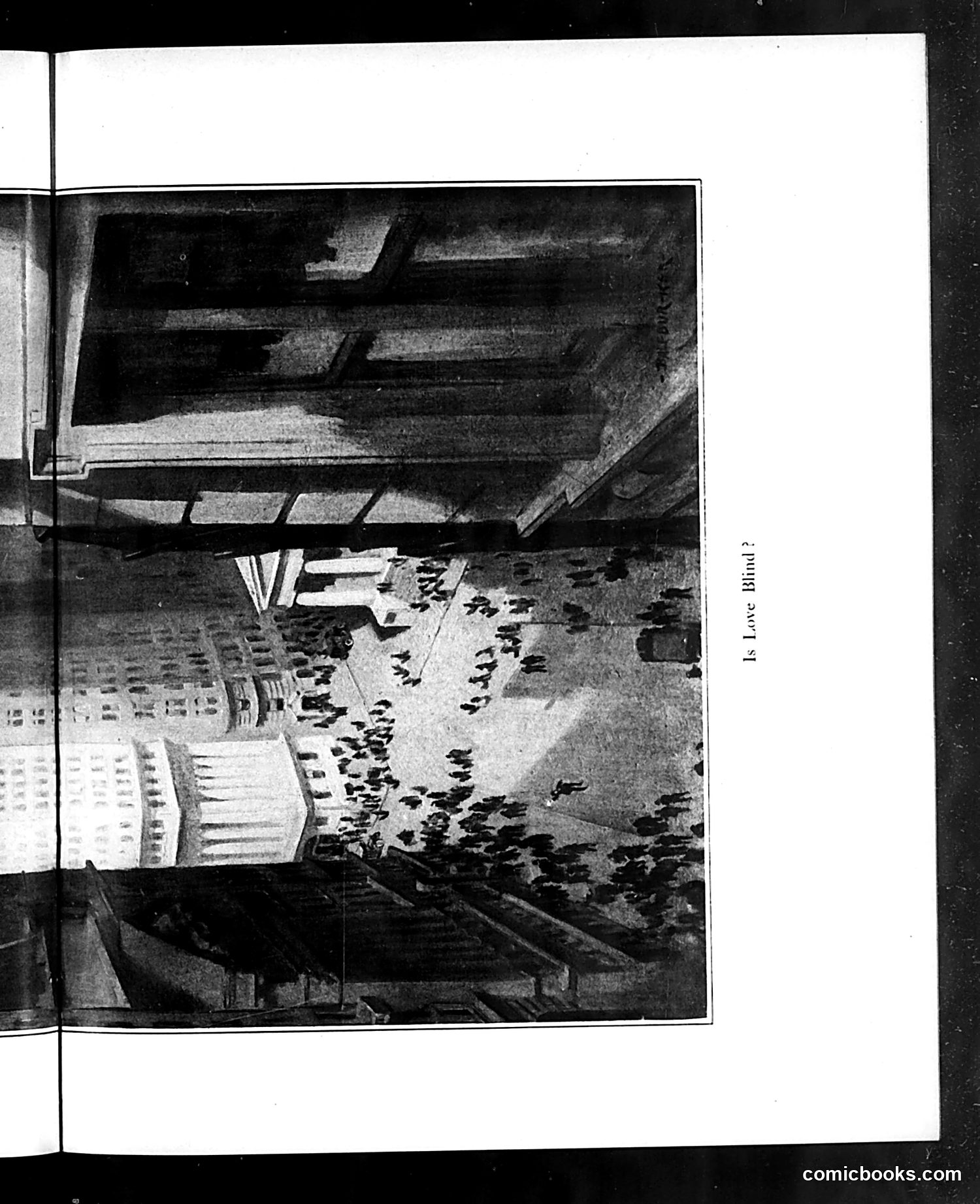
I can see this is a black and white photograph or illustration from Life magazine, but the image quality and orientation make it difficult to discern clear details. The photo appears to show an interior space with wooden structural elements and what looks like multiple figures, but the image is rotated and grainy enough that I cannot confidently identify specific individuals, caricatures, or the exact subject matter. The text visible includes only "Is Love Blind?" as a caption and the comicbooks.com attribution. Without being able to read additional OCR text or clearly identify the scene depicted, I cannot reliably explain the satirical point or political/social references this page was meant to convey to contemporary readers.
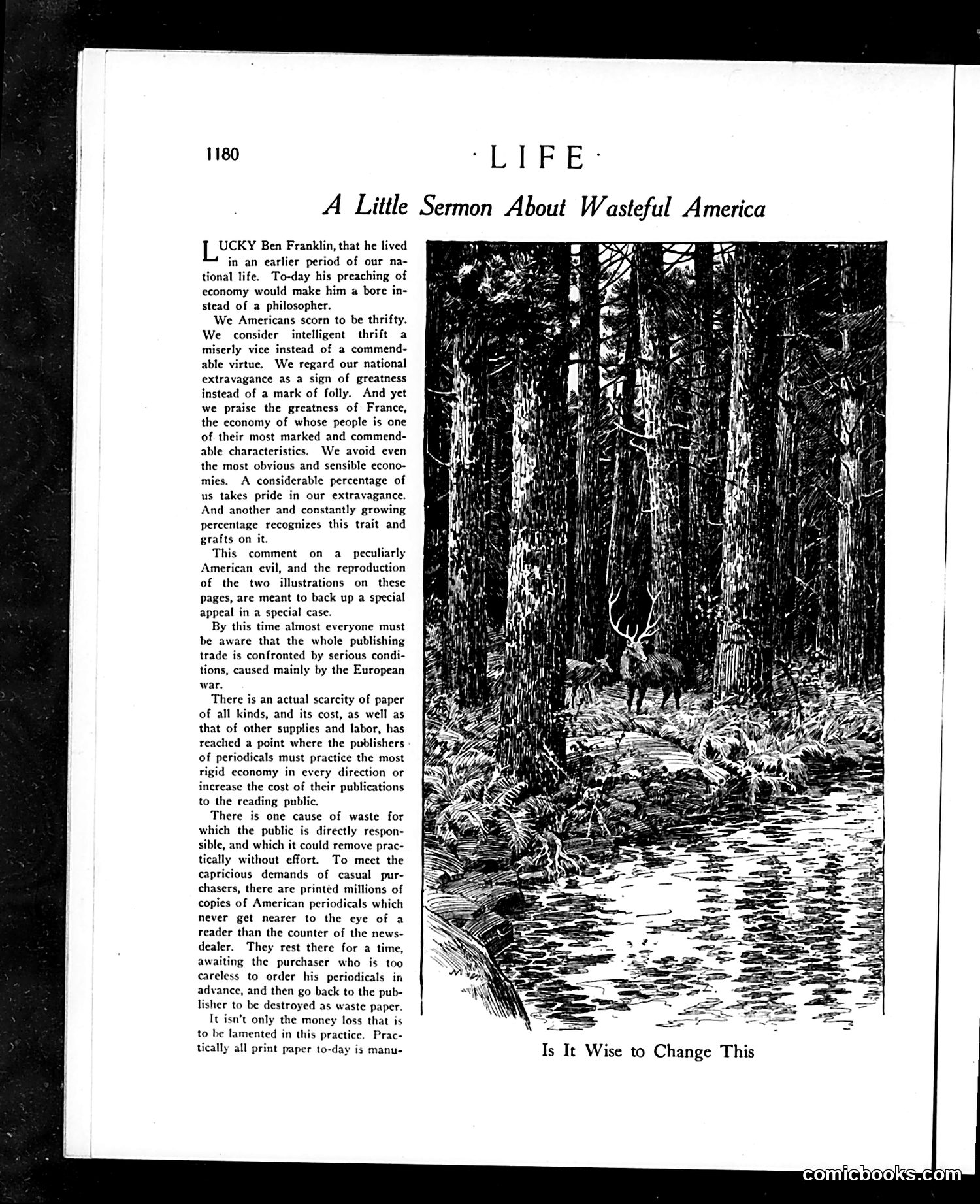
This 1915 Life magazine page critiques American wasteful consumption culture during World War I paper shortages. The accompanying illustration depicts a deer in a forest stream—likely representing nature's bounty being squandered. The article argues Americans pride themselves on extravagance while hypocritically admiring French thriftiness. The central complaint: publishers print millions of magazine copies that never reach readers, sitting unsold at newsstands before being destroyed as waste paper. The author blames casual buyers who won't subscribe in advance, forcing overproduction. The essay frames this as patriotic concern during wartime—paper is scarce due to "European war" (WWI). The headline's question "Is It Wise to Change This" sarcastically challenges whether Americans will reform wasteful habits. The piece references Benjamin Franklin's colonial-era frugality values, implying modern America has abandoned such virtue for destructive consumerism.
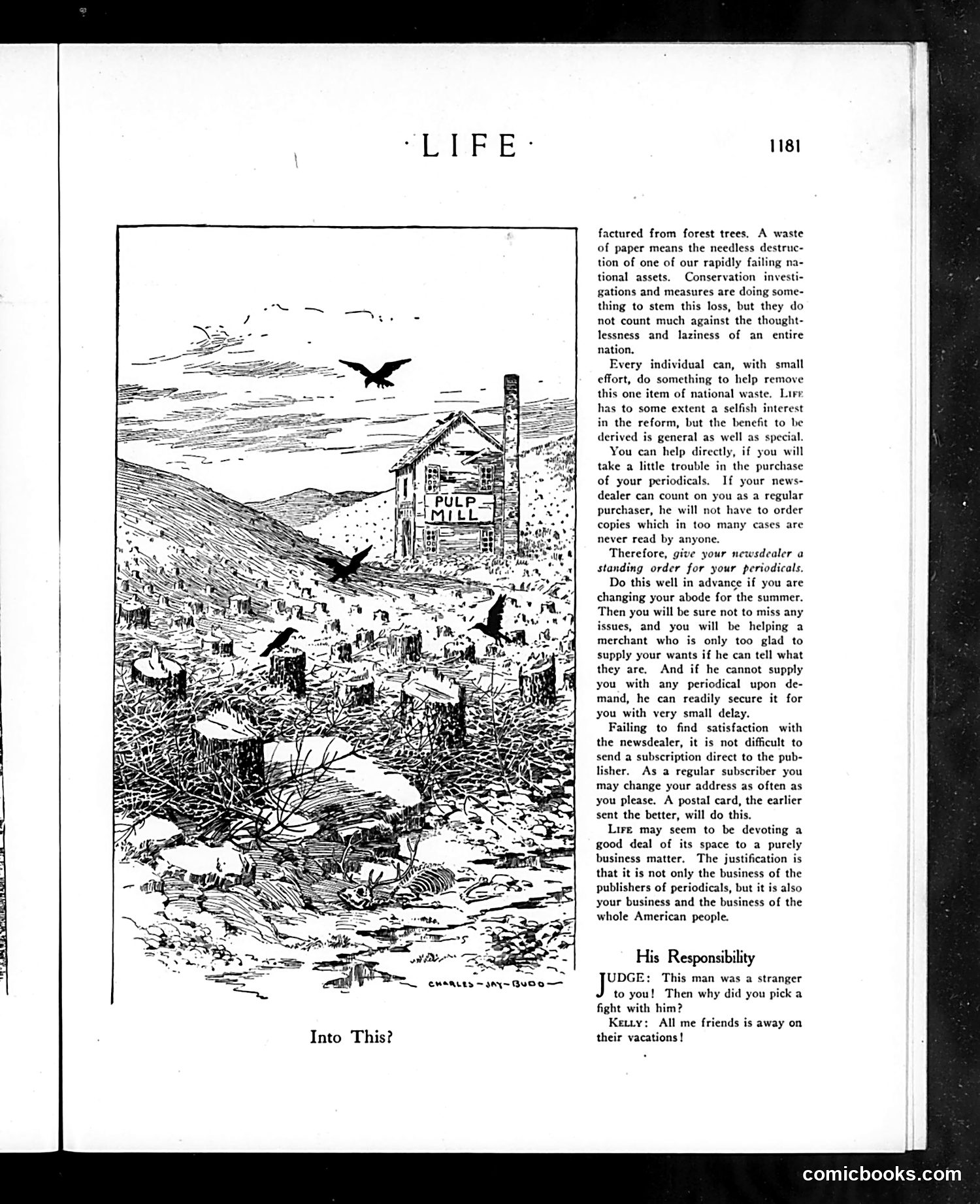
The main illustration depicts a deforested landscape—tree stumps covering the ground, a shuttered mill, and birds flying overhead—captioned "Into This?" This is an environmental advocacy cartoon warning about **paper waste and forest depletion**. The text argues that wasteful periodical ordering destroys "one of our rapidly failing national assets" and urges readers to support conservation by placing standing orders with newsdealers, thereby reducing overprinted, unread copies. Below is an unrelated comic dialogue between "Judge" and "Kelly" about a street fight. When Judge questions why Kelly fought a stranger, Kelly replies that all his friends are away on vacation—a humorous deflection suggesting boredom or loneliness drove the altercation. The page combines **Progressive-era environmental messaging** with lighthearted humor, typical of Life's satirical format.
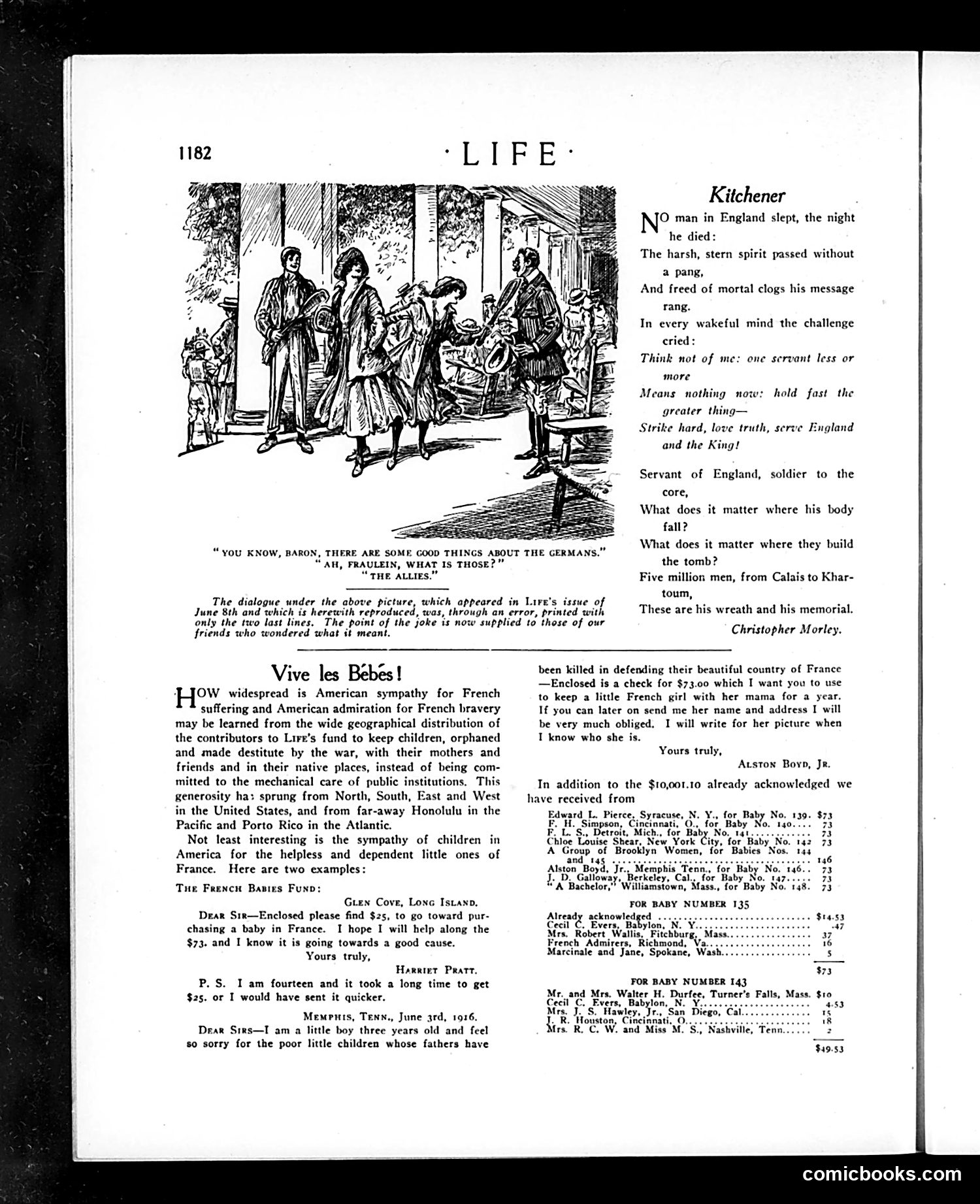
This page contains two distinct sections: **The Cartoon**: A wartime joke depicting a German baron and French woman. She says Germans have "some good things," and when he eagerly asks what, she replies: "The Allies." The caption notes this joke was previously printed incomplete in Life's June 8th issue, missing its setup. The humor relies on the woman's patriotic insult—suggesting the only good thing about Germans is their enemies. **The Kitchener Poem and "Vive les Bébés" Section**: These are tributes to British military leader Kitchener (who died in 1916, as the poem references) and a fundraising campaign for French war orphans. American readers are contributing money to support French children left destitute by World War I combat. The examples show even American children donating their savings. **Context**: This is 1916 America, still officially neutral but sympathetic to Allied causes. The page reflects widespread American support for Britain and France against Germany, evident in both the anti-German satire and the charitable relief efforts for French civilians.
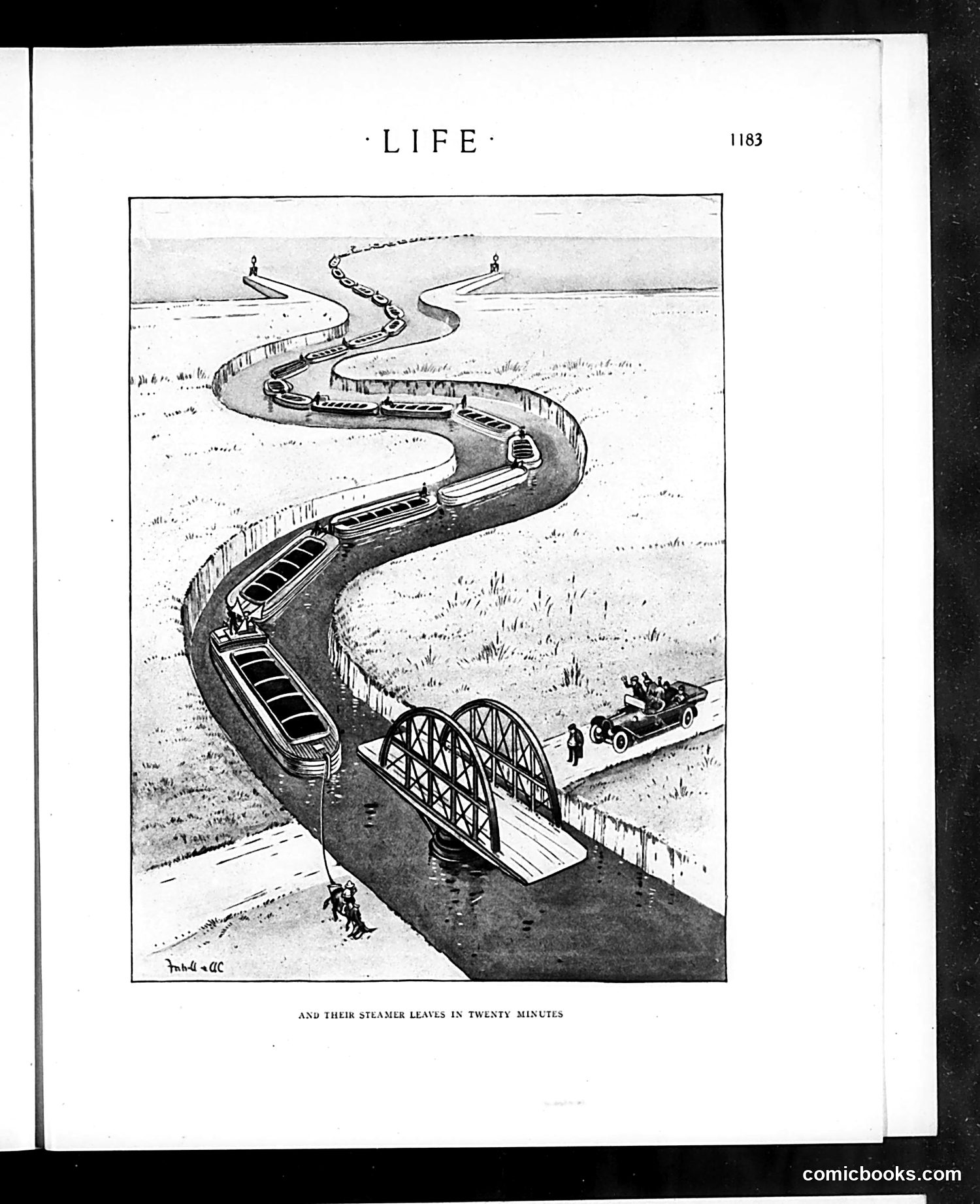
This cartoon depicts an absurdly meandering waterway with multiple steamboats navigating an extremely serpentine river path. The caption reads "AND THEIR STEAMER LEAVES IN TWENTY MINUTES," suggesting satire about time pressure and inefficiency. The illustration appears to mock bureaucratic or transportation inefficiency—travelers face an impractically winding route that would take far longer than the twenty minutes available. The contrast between the urgent timeline and the river's tortuous course creates the humor. A bridge and automobile visible in the foreground suggest this may compare outdated water transportation to newer, more direct land travel methods. However, without additional context about the specific historical moment or publication date, the precise satirical target remains unclear.
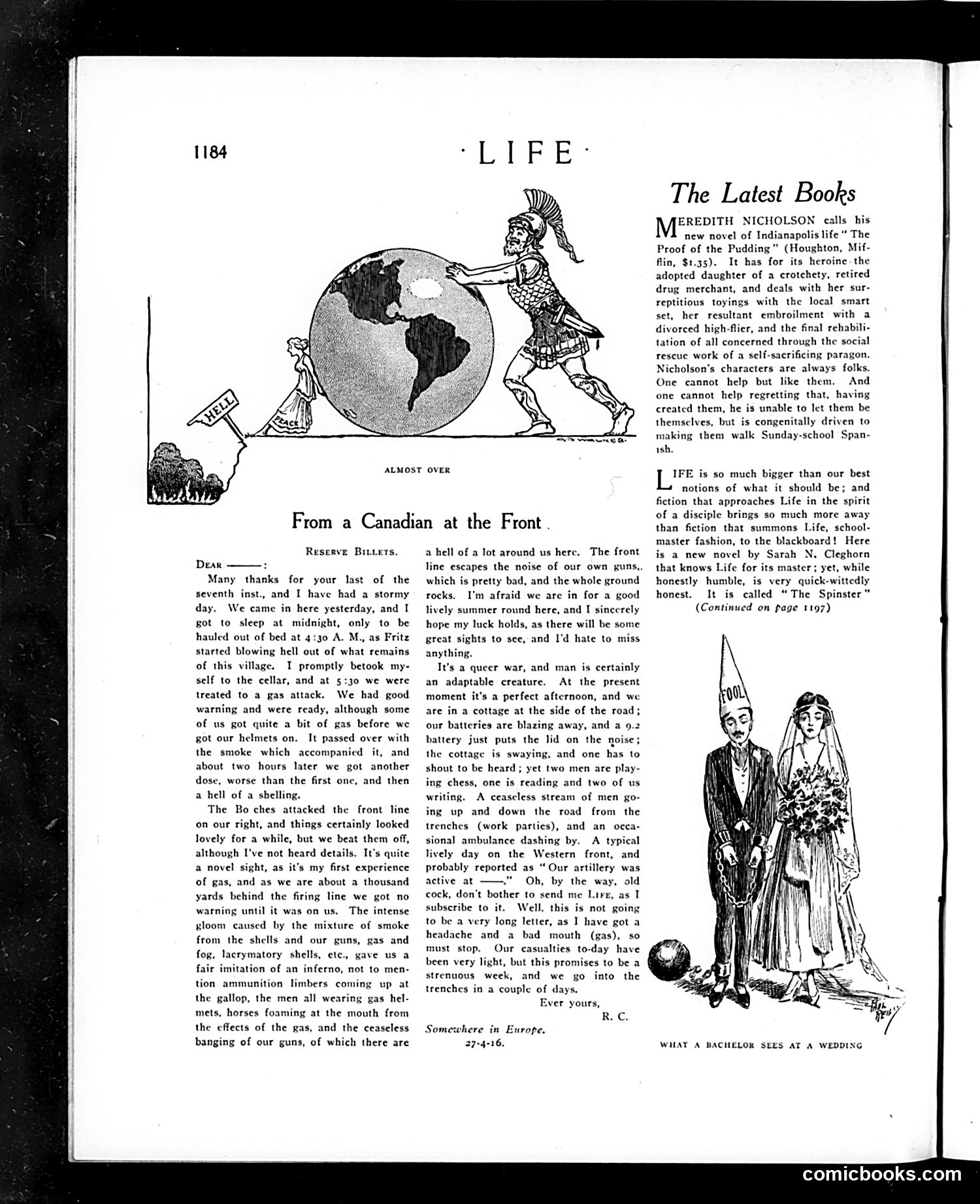
**Top Cartoon ("Almost Over"):** A classical warrior figure pushes a globe showing the Americas, suggesting Allied confidence that WWI victory is near. The title ironically undercuts this optimism. **Letter "From a Canadian at the Front":** This is a first-person account from a Canadian soldier (dated April 27, 1916) describing trench warfare on the Western Front. He describes gas attacks, artillery bombardment, and the surreal juxtaposition of combat horror with ordinary activities like chess and reading. The tone is matter-of-fact, reflecting soldiers' adaptation to mechanized industrial warfare. **Book Reviews Section:** Standard literary reviews of contemporary fiction by Meredith Nicholson, noting how his characters, while likeable, are morally constrained by the author into "Sunday-school Spanish" behavior—a critique of overly didactic fiction that sacrifices authenticity for moral lessons. The page illustrates Life magazine's typical mix of satire, war correspondence, and cultural criticism aimed at educated American readers in 1916.
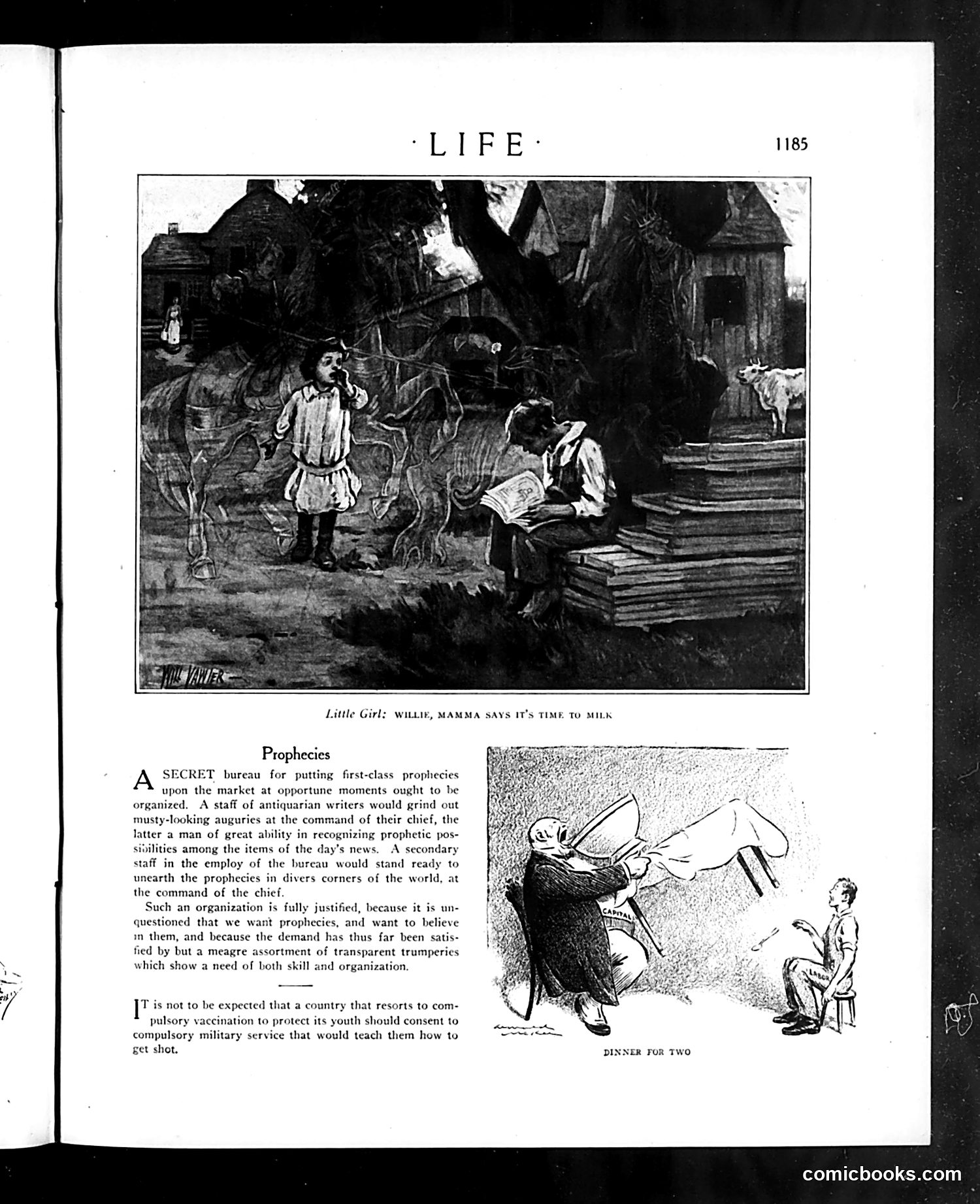
This Life magazine page contains two separate satirical pieces: **Top cartoon** ("Little Girl: Willie, Mamma Says It's Time to Milk"): A rural scene where a child calls to another child to help with milking chores, using the cow's name "Willie." The humor likely plays on the child mistaking the cow for a person—or satirizes rural life's demands on children. **"Prophecies" article**: Satirizes public appetite for predictions and fortune-telling. The author mocks the market for "prophecies," suggesting a bureau should be organized to manufacture fake predictions systematically, since people eagerly believe transparent frauds anyway. **Final paragraph**: Critiques military conscription by arguing that if a country mandates compulsory vaccination to protect youth, it's hypocritical to then impose compulsory military service that teaches young men "how to get shot"—a dark joke highlighting the contradiction between protecting public health and sending conscripted soldiers to potential death. The page satirizes gullibility, false prophets, and government hypocrisy regarding youth welfare.
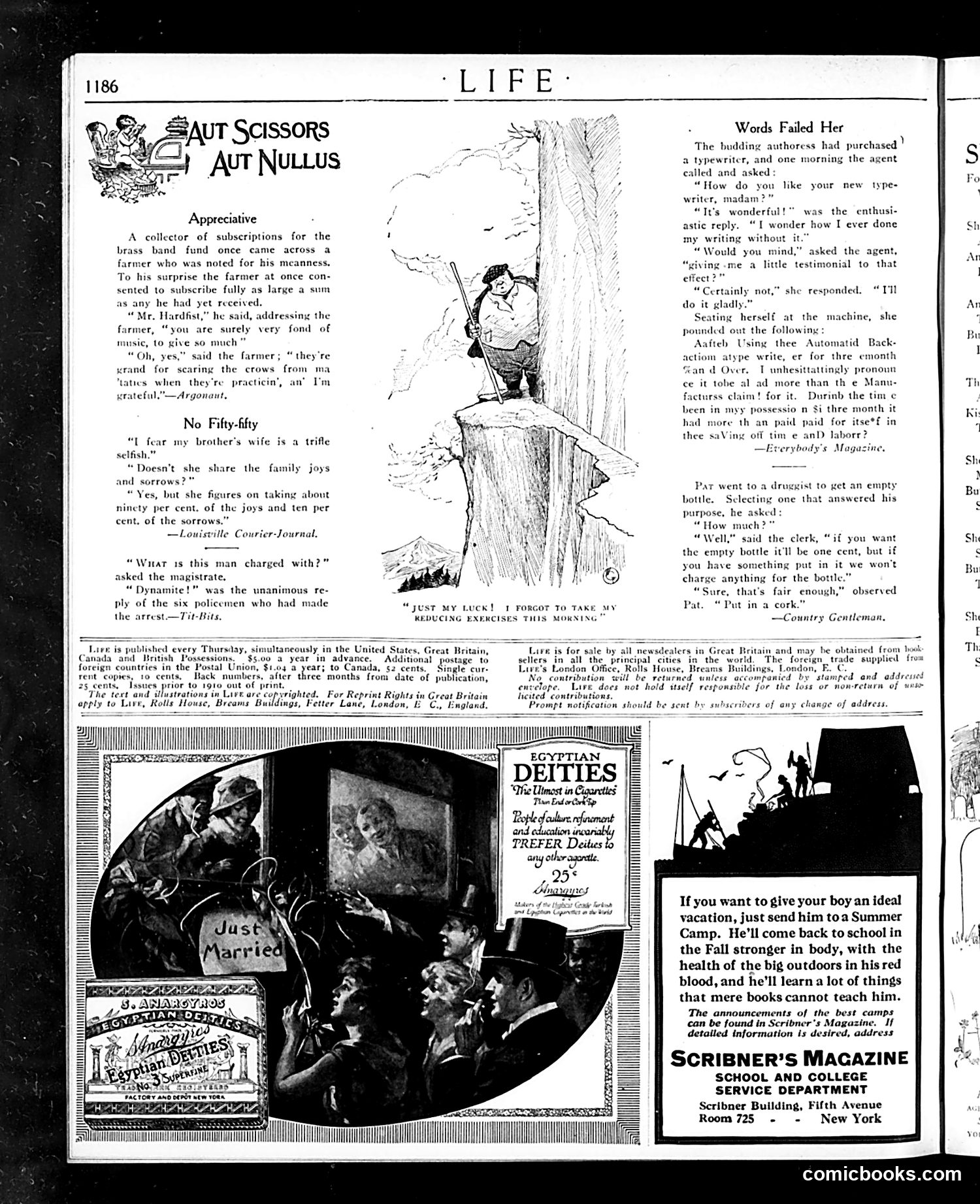
This page contains three brief humorous anecdotes typical of early 20th-century American satire: 1. **"Appreciative"**: A fundraiser discovers a notoriously stingy farmer willing to donate generously—the farmer explains he values the band because the brass instruments effectively scare crows from his fields. The joke mocks both the farmer's miserly reasoning and the band's musical quality. 2. **"No Fifty-Fifty"**: A complaint about a selfish sister-in-law who monopolizes family joys (90%) while sharing only sorrows (10%). This satirizes unequal domestic relationships and selfishness. 3. **"Dynamite"**: A magistrate asks what a man is charged with; six policemen unanimously answer "Dynamite!"—implying the suspect is literally dangerous/volatile, not guilty of a specific crime. The page includes a cartoon of a woman at a typewriter (illustrating the "Words Failed Her" anecdote about an author praising her new typewriter) and period advertisements for Egyptian cigarettes and summer camps. These are gentle, domestic satires reflecting early 1900s social anxieties about family dynamics and modern technology.
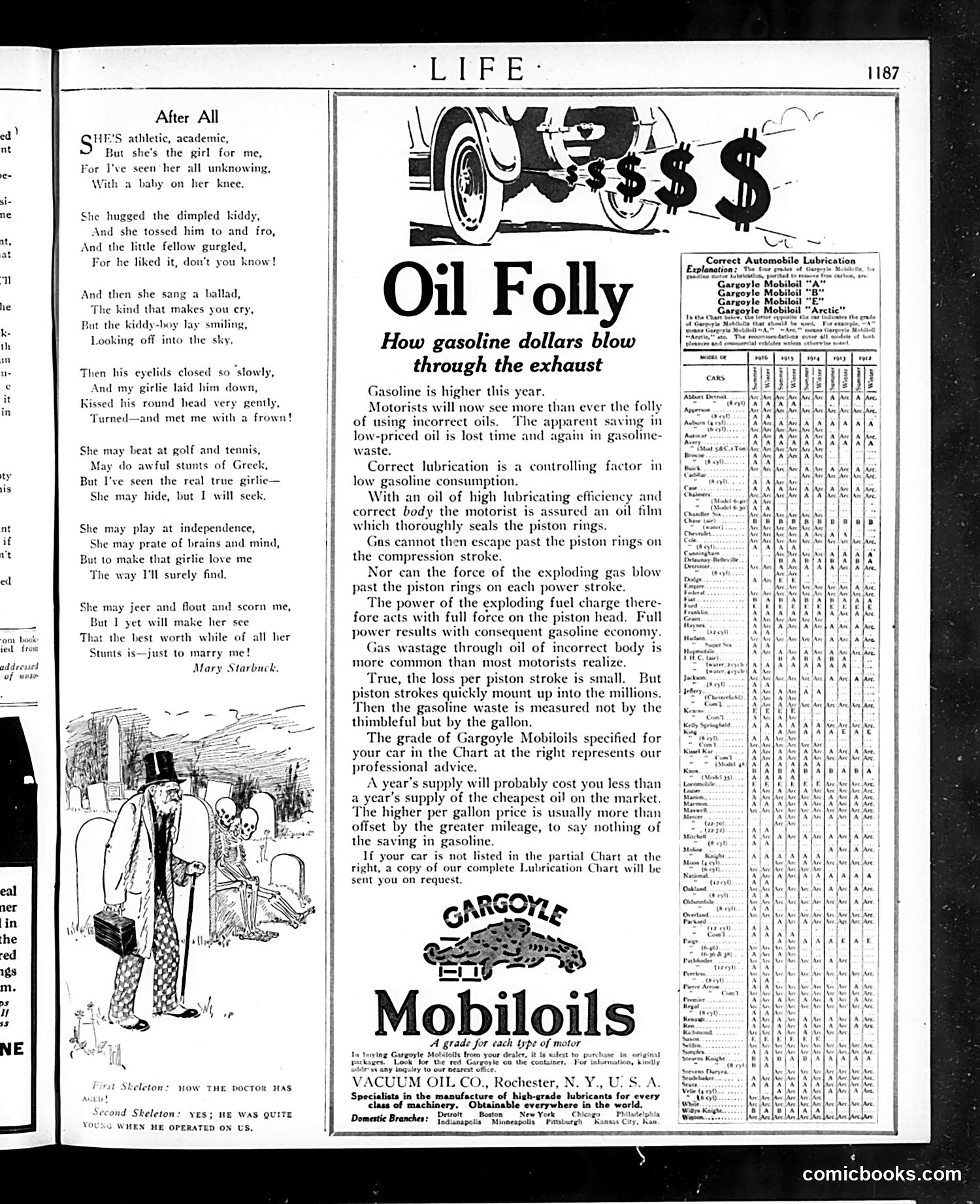
This page mixes a sentimental poem with automotive advertising. **"After All"** is a romantic poem by Mary Starbuck celebrating traditional femininity. It describes a man observing his girlfriend tenderly caring for a child, concluding that despite her athletic and intellectual accomplishments, her "true" worth lies in her suitability for marriage and motherhood. This reflects early 20th-century gender ideology valorizing women's domestic roles. **"Oil Folly"** is a Gargoyle Mobiloils advertisement explaining that cheap motor oil wastes gasoline through poor piston-ring sealing, causing gas to escape during engine compression and power strokes. The ad argues that premium oil, though costlier per gallon, saves money overall through improved fuel efficiency. The accompanying chart recommends specific oil grades for different car models. Both pieces reflect their era's concerns: gender roles and consumerism through technical education about automotive maintenance as a purchasing decision.
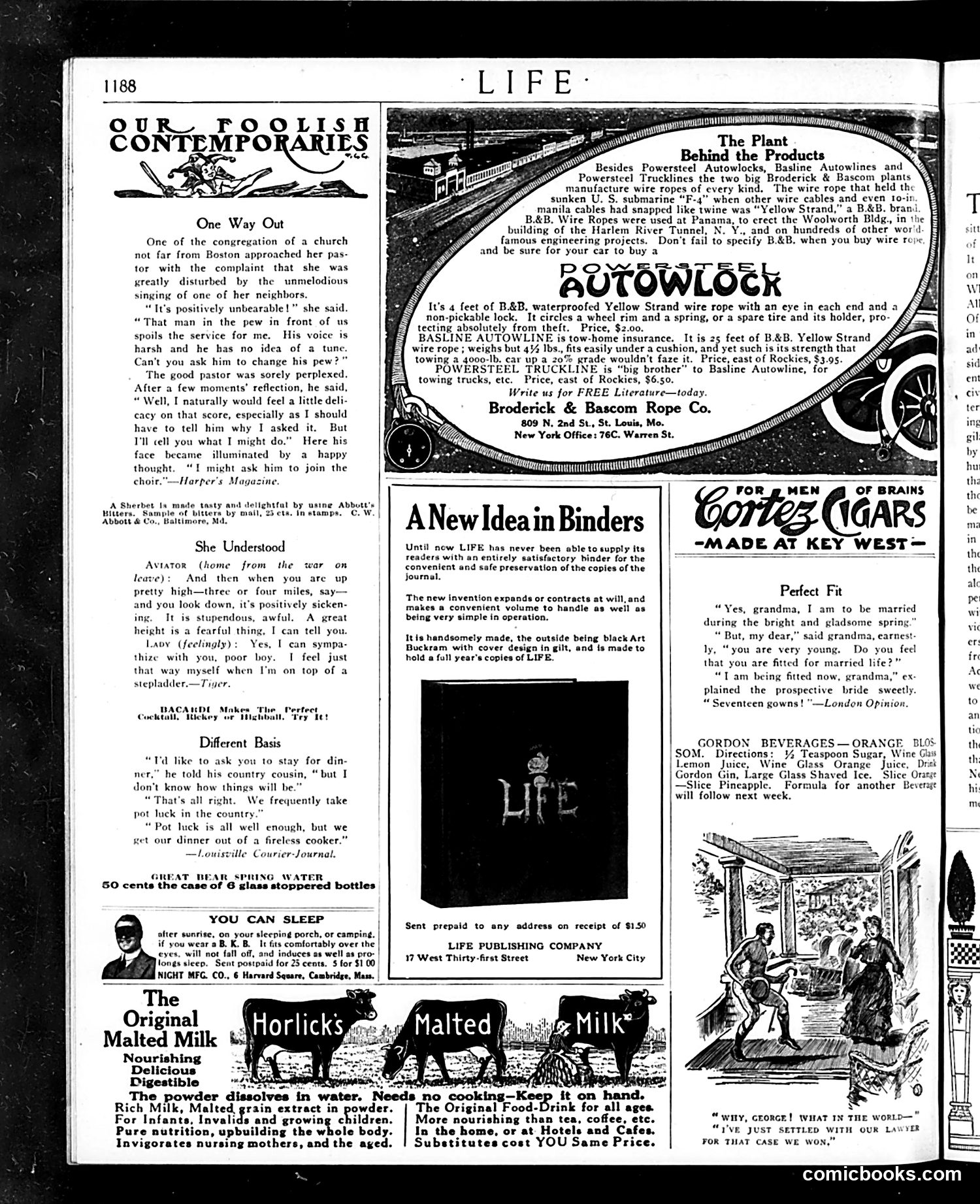
This page from *Life* magazine consists primarily of **advertisements and humor columns** rather than political cartoons. The content includes: - **"Our Foolish Contemporaries"**: A humor section with three short anecdotes (a church parishioner complaining about bad singing, an aviator discussing altitude sickness, and a young woman discussing her wedding preparations). These mock everyday social situations and pretensions. - **Multiple product advertisements**: Wire rope, auto locks, malted milk, cigars, and beverages dominate the page—typical of early 20th-century *Life* magazine content. - The humor is gentle social satire rather than political commentary, poking fun at middle-class concerns and conversational absurdities. The page lacks a singular political message or identifiable caricatured figures. It represents *Life*'s format as a magazine blending light humor with commercial advertising, aimed at affluent readers interested in consumer goods and gentle mockery of contemporary manners.
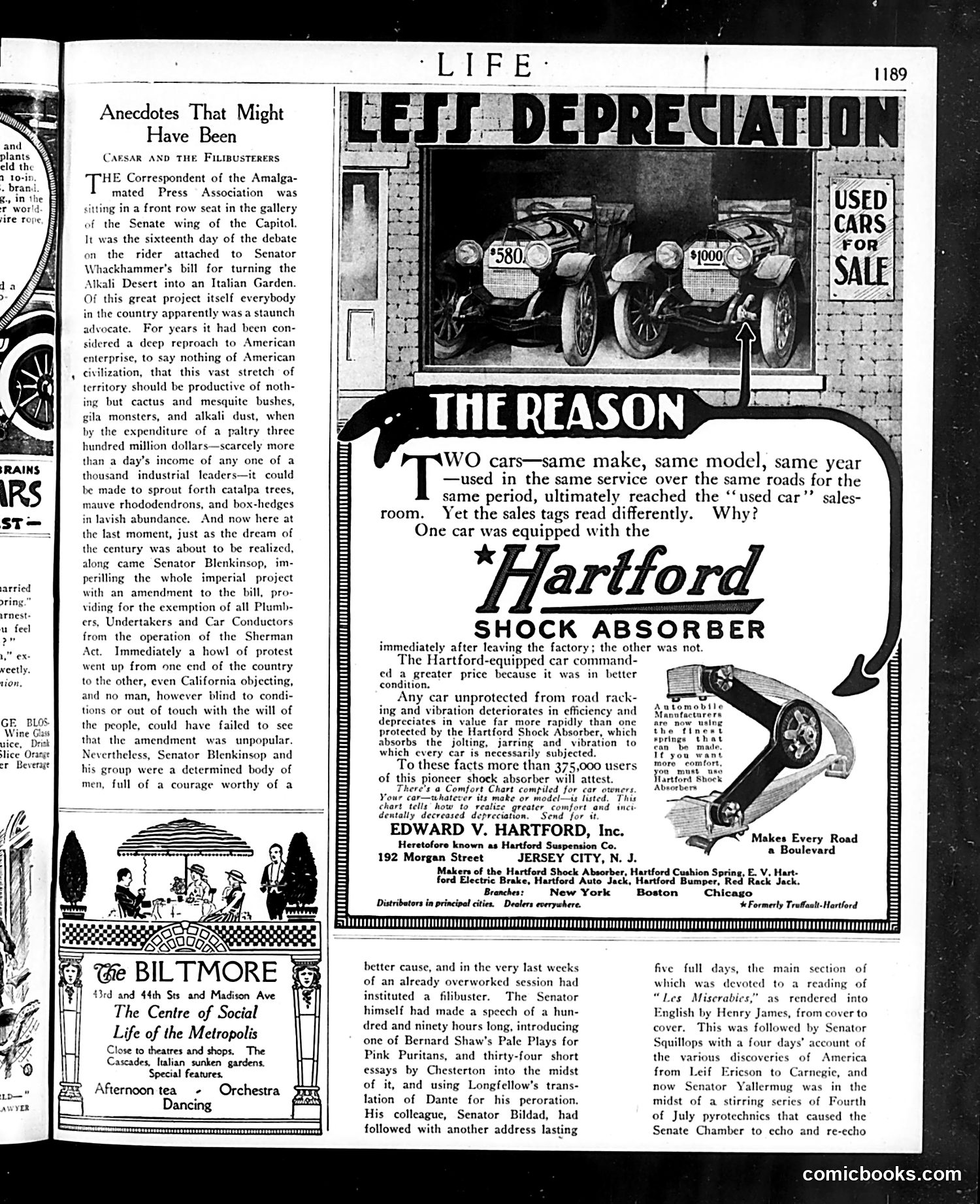
This page contains two distinct elements: **Left side - "Anecdotes That Might Have Been"**: A satirical short piece about a Senate filibuster over Senator Whackhammer's bill to develop the Alkali Desert into an Italian Garden. Senator Blenkinsop leads a filibuster opposing an amendment exempting plumbers, undertakers, and car conductors from Sherman Act restrictions. The satire mocks the absurdity of prolonged Senate obstruction—the senator delivers a 190-hour speech incorporating Bernard Shaw plays and Chesterton essays—highlighting how filibusters delay obviously popular legislation over minor procedural disputes. It's political commentary on Congressional inefficiency. **Right side - Hartford Shock Absorber Advertisement**: A product ad comparing two identical cars with different depreciation rates based solely on shock absorber equipment, arguing that Hartford absorbers preserve vehicle value by reducing road damage. The ad emphasizes that proper maintenance equipment prevents deterioration. The page is primarily advertising, with satirical commentary as secondary content.
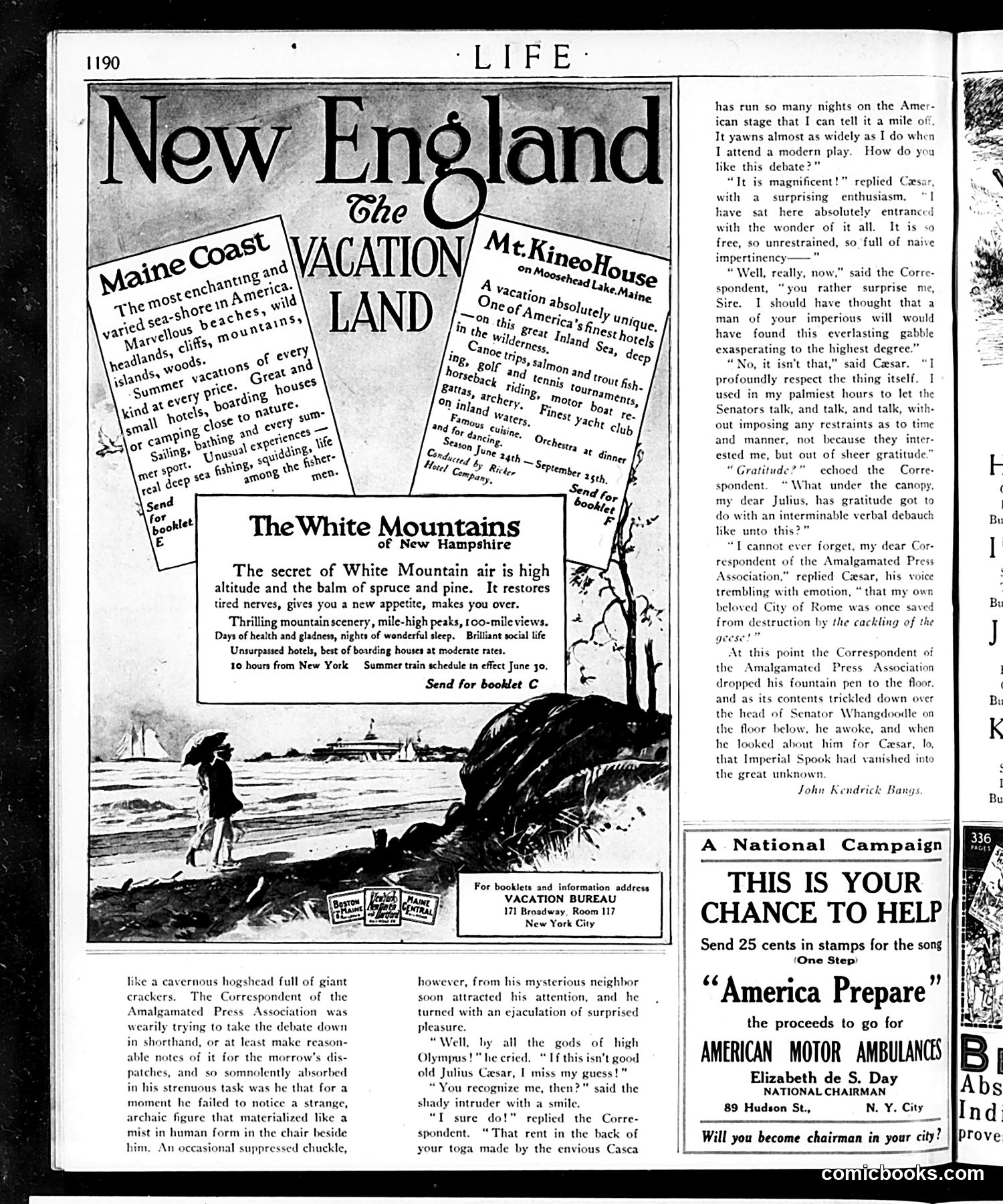
This page is primarily **advertisements and travel promotions** interspersed with a humorous short story by John Kendrick Bangs. ## The Story's Satire The narrative features a fictional encounter between a newspaper correspondent covering a Senate debate and the ghost of **Julius Caesar**. Caesar praises the modern debate's "freedom" and "unrestrained" nature, explaining his admiration stems from gratitude—Rome was once saved by "the cackling of the geese." The joke operates on multiple levels: Caesar's comparison of Senate speeches to meaningless goose noise satirizes **Congressional verbosity and ineffectiveness**. His gratitude for chaos that accidentally prevented disaster mocks the notion that endless talking somehow serves democracy. The story ends absurdly when the correspondent's pen drips onto a sleeping senator below, revealing the whole encounter was a dream—suggesting the entire debate was as insubstantial as a hallucination. ## Context for Modern Readers This reflects early 20th-century American skepticism toward legislative processes—a common target in *Life*'s satirical commentary on politics and institutions.
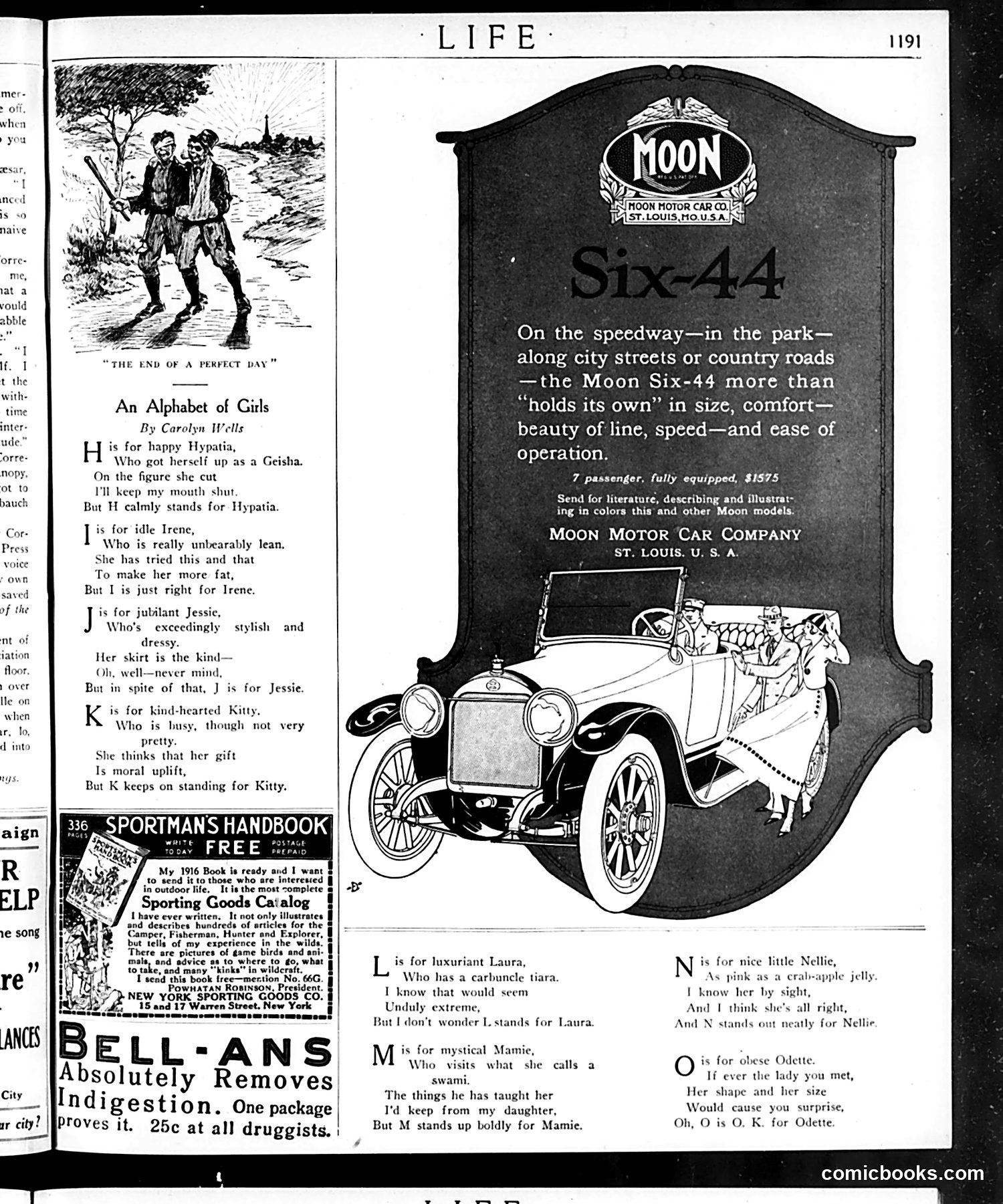
This page combines a **Moon Motor Car advertisement** with **light satirical poetry** by Carolyn Wells titled "An Alphabet of Girls." ## The Advertisement The Moon Six-44 is promoted as a 7-passenger automobile priced at $1575, emphasizing its performance on speedways, city streets, and country roads. The illustration shows well-dressed passengers enjoying the vehicle—typical early automotive advertising targeting affluent buyers. ## The Poetry Wells's alphabet verse humorously sketches female archetypes of the era through their supposed character flaws: Hypatia's affectation, Irene's thinness, Jessie's flashy fashion, Kitty's self-righteous charity work, Laura's vanity, Mamie's interest in spiritualism, Nellie's conventional prettiness, and Odette's obesity. **The satire targets** women's social behavior and appearance obsessions rather than critiquing the car itself. The humor relies on gentle, gossip-column mockery typical of 1910s magazines—poking fun at feminine vanity while maintaining propriety. The juxtaposition with the automotive advertisement suggests both were marketed to Life's upper-class readership.
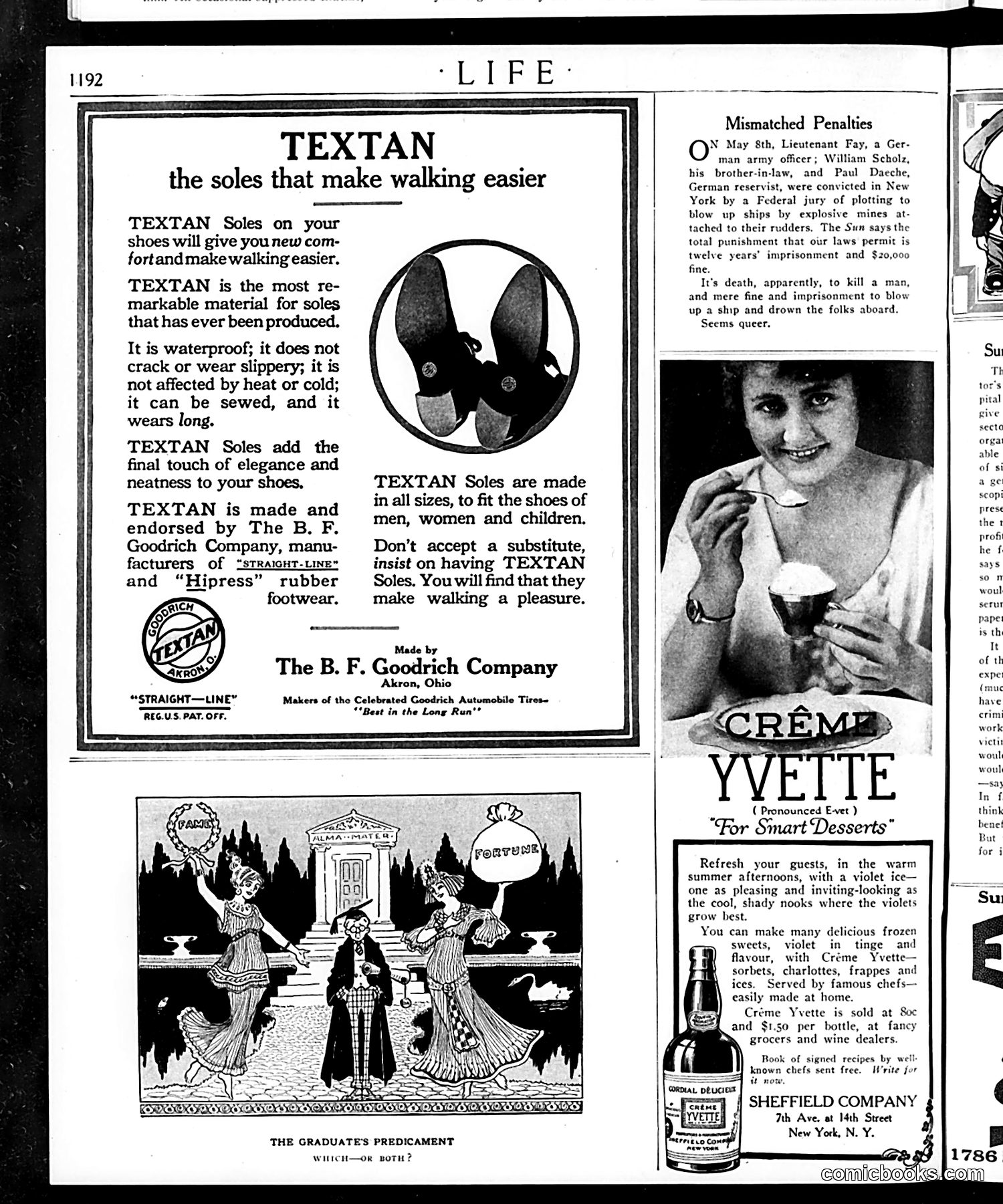
This is primarily an **advertising page** from Life magazine, featuring three unrelated ads: 1. **TEXTAN Shoe Soles** (top left): A product advertisement for waterproof, durable shoe soles made by B.F. Goodrich Company. 2. **Crème Yvette** (right side): An advertisement for a violet-flavored liqueur/dessert product, marketed toward entertaining guests with frozen violet-flavored treats. 3. **"Mismatched Penalties"** (top right): A brief political commentary piece criticizing what appears to be a **WWI-era German sabotage case** (May 8th conviction). The piece notes the irony that three German officers/reservists plotting to bomb ships received only 12 years imprisonment and $20,000 fines—lighter sentences than murder charges would carry. The author finds this sentencing disparity illogical and unfair. 4. **"The Graduate's Predicament"** (bottom): A small cartoon titled "Which—Or Both?" (unclear what this satirizes without seeing the full image clearly). The page is primarily commercial rather than satirical content.
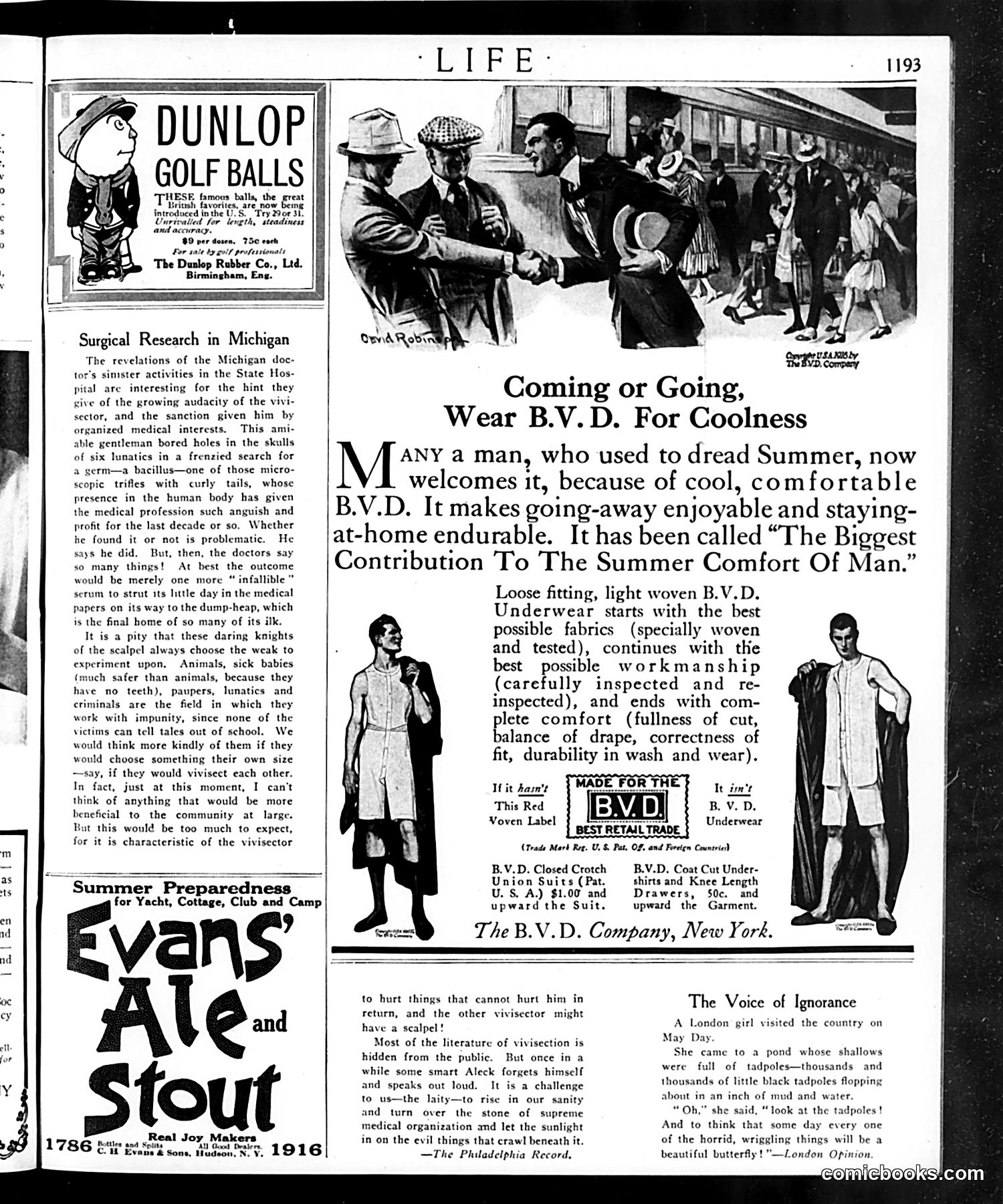
This page contains **advertisements and editorial commentary**, not political cartoons. The main content is a **B.V.D. underwear advertisement** promoting lightweight summer underwear as a solution to heat discomfort—marketed as "The Biggest Contribution To The Summer Comfort Of Man." The ad shows men in various states of undress to demonstrate the product's fit. The **editorial section critiques vivisection** (animal and human experimentation). The author attacks a Michigan doctor who drilled into mental patients' skulls searching for germs, condemning how medical researchers exploit vulnerable populations—the poor, mentally ill, and infants—rather than experimenting on themselves or each other. The sarcasm suggests contempt for unaccountable medical authority. A brief **humorous anecdote** ("The Voice of Ignorance") mocks a London girl's naïveté about tadpoles becoming butterflies—implying British ignorance of nature. The page also advertises **Evans' Ale and Stout**, **Dunlop Golf Balls**, and **surgical instruments**.
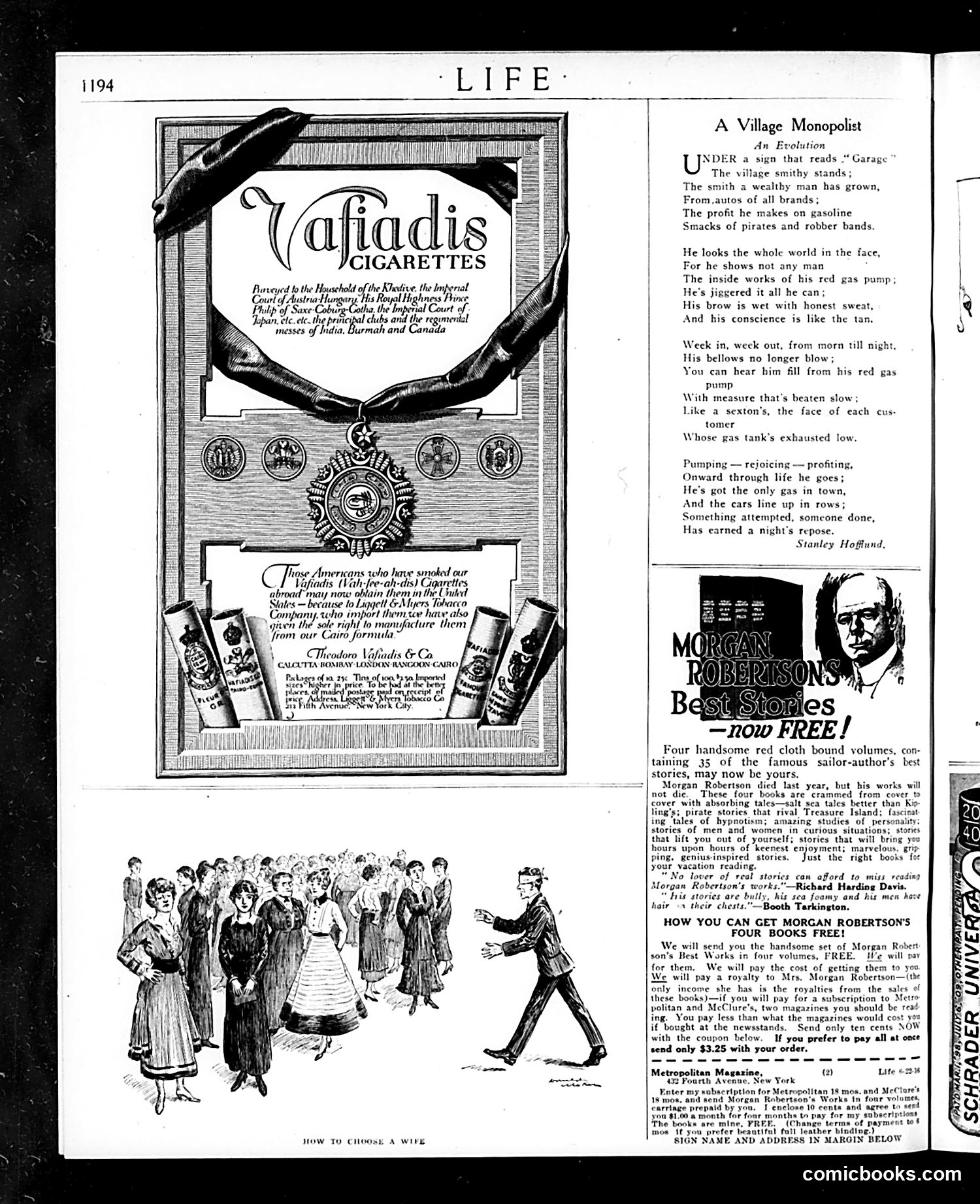
This page contains a satirical poem by Stanley Hofland about the transformation of a rural blacksmith into a wealthy gas station owner—a commentary on early 20th-century economic shifts. The poem traces the evolution: the traditional village smithy now operates a "Garage," profiting handsomely from gasoline sales. The satire highlights how the smith has become a monopolist—he's "got the only gas in town," giving him unfair leverage over customers whose "gas tank's exhausted low." His conscience troubles him despite his "honest sweat." The poem mimics Longfellow's "The Village Blacksmith," invoking that iconic image of honest labor, only to subvert it: instead of noble craftsmanship, the modern version involves exploitative monopoly practices. The "jiggered" (rigged) pump and customers' defeated expressions suggest price manipulation and consumer helplessness. This reflects Progressive Era anxieties about monopolistic business practices and the displacement of traditional trades by industrial capitalism.
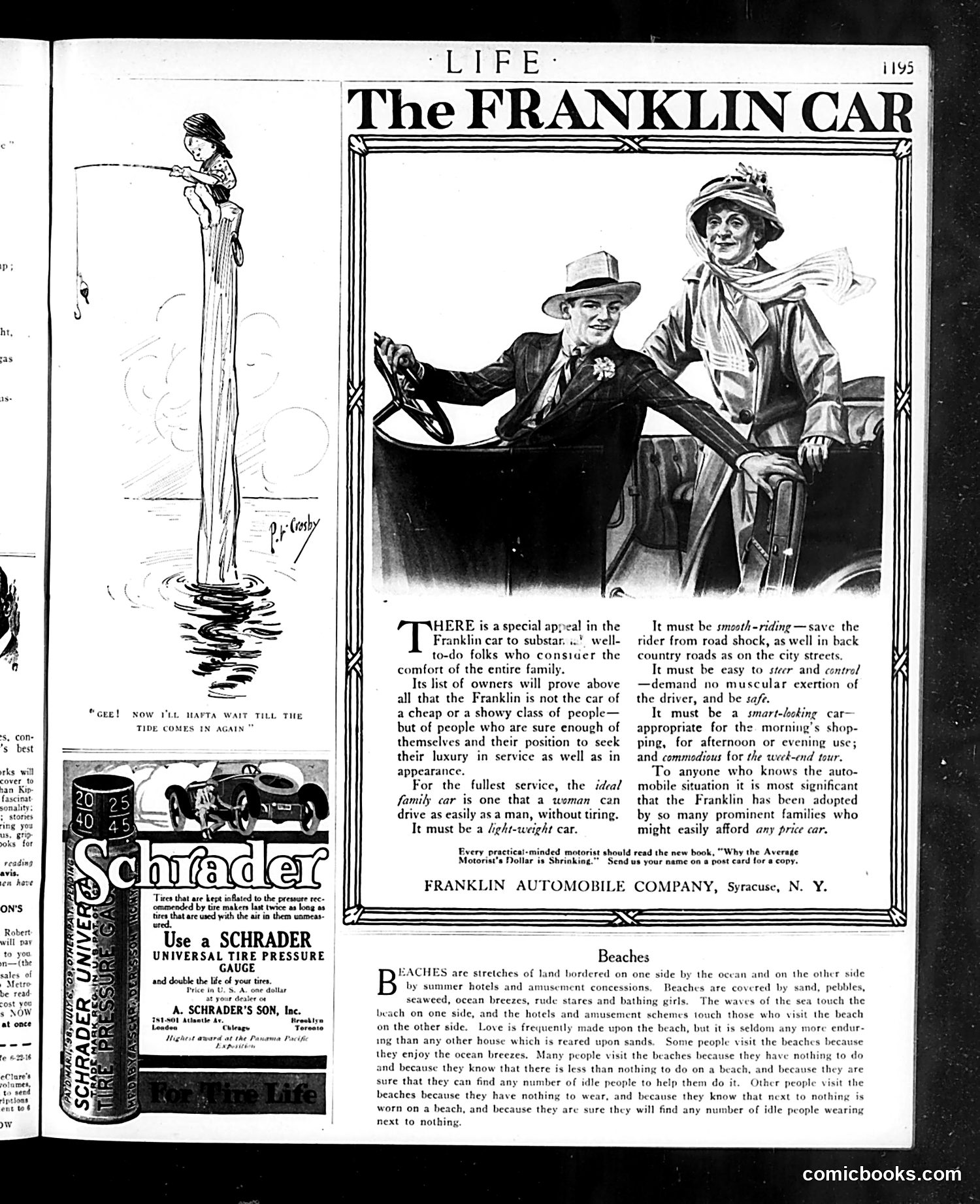
**Left Side - Cartoon:** A child stands on a tall pole fishing while the tide rises below. The caption reads "Gee! now I'll hafta wait till the tide comes in again," suggesting the child miscalculated timing. This appears to be simple humor about impatience and poor planning rather than political satire. **Center - Franklin Automobile Advertisement:** A luxury car advertisement targeting wealthy families, emphasizing the Franklin's ease of operation ("a woman can drive as easily as a man") and smooth ride. The ad appeals to upper-class sensibilities—not the "cheap or showy class" but people secure enough to seek "luxury in service." **Right Side - "Beaches" Essay:** A satirical prose piece mocking beach culture. It humorously catalogs why people visit beaches: some have nothing better to do, some wear minimal clothing, some seek romance. The tone is gently cynical about idle leisure and social posturing among the affluent. **Overall:** This page blends advertising (Franklin cars) with light social satire about 1920s American leisure culture and class attitudes.
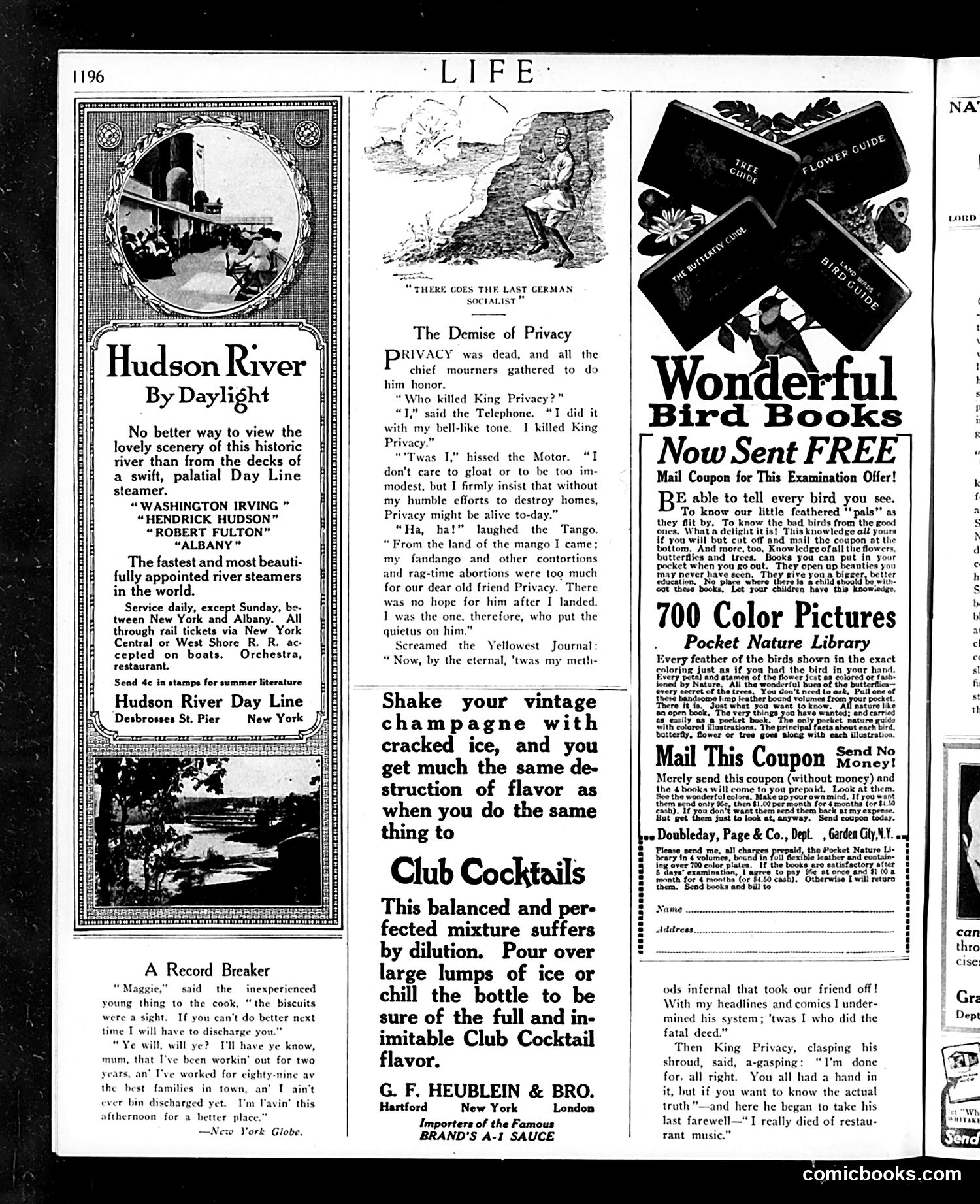
This satirical piece personifies modern inventions as murderers of personal privacy. Each figure claims credit for killing "King Privacy": - **The Telephone** boasts of its intrusive bell - **The Motor** (automobile) destroyed home life by enabling escape and social mixing - **The Tango** represents scandalous new dance crazes from Latin America that violated Victorian propriety - **The Yellowest Journal** (sensationalist newspapers) exposed private affairs publicly The cartoon reflects early-20th-century anxieties about rapid modernization. Urban Americans faced unprecedented surveillance through telecommunications, automobiles enabling new social freedoms, "immoral" foreign cultural imports, and invasive yellow journalism. What we'd recognize as normal privacy erosion from technology was then shocking. The satire targets how these innovations collectively dismantled the social boundaries that protected private life—a genuinely disorienting transformation for the era's readers.
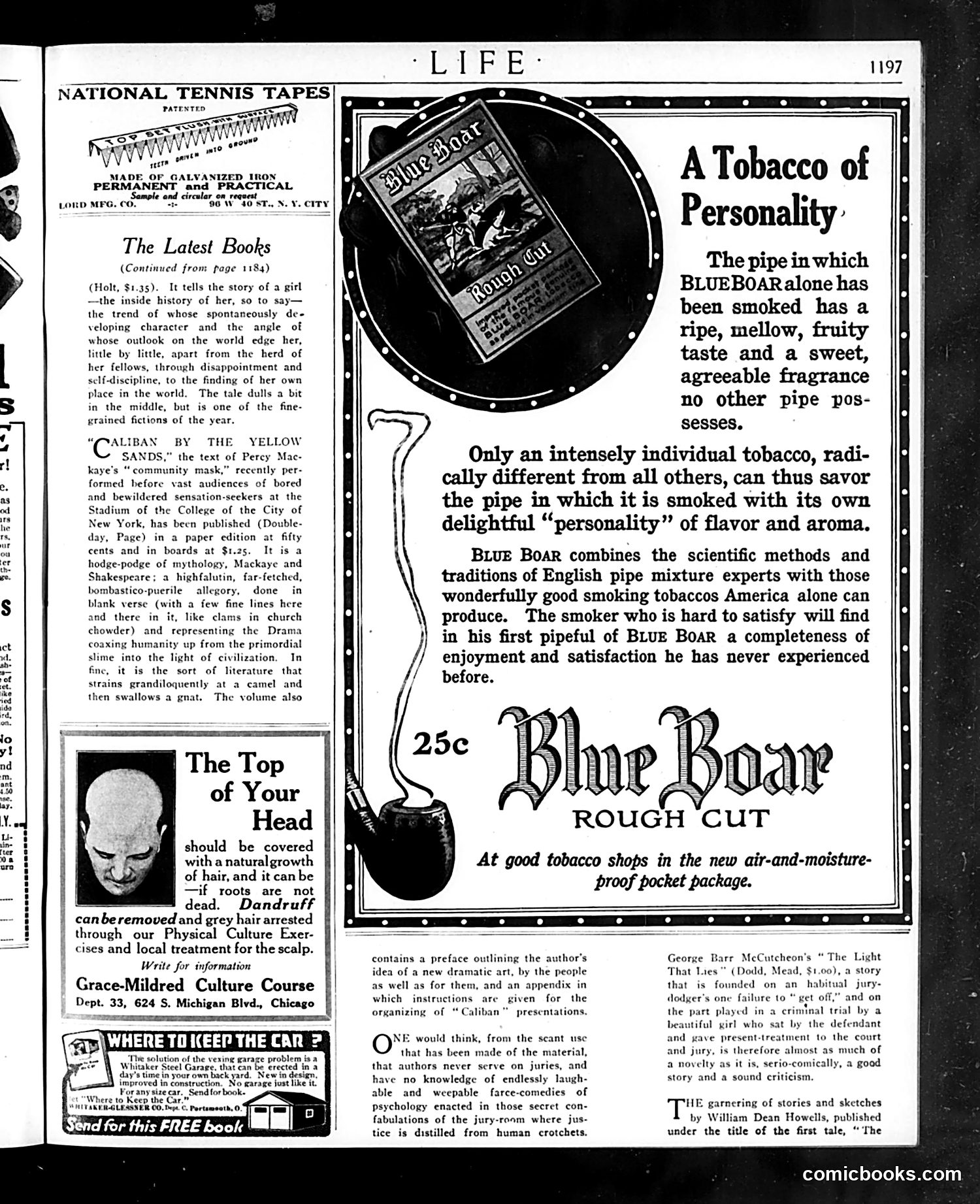
This page consists primarily of **advertisements and book reviews**, not political cartoons. The main elements are: **Advertisements:** - National Tennis Tapes (top left) - Blue Boar pipe tobacco (center-right, largest ad) — emphasizes the tobacco's unique "personality" and flavor - Grace-Mildred Culture Course (dandruff/hair treatment) - Whitaker Steel Garage **Book Reviews:** The "Latest Books" section critiques contemporary works, notably Percy Mackaye's "Caliban" — a community dramatic piece performed at City College stadium. The reviewer satirizes it as overwrought ("hodge-podge," "bombastico-puerile"), using the metaphor "strains grandiloquently at a camel and then swallows a gnat" to mock pretentious but ultimately hollow writing. There is **no political cartoon** on this page. It's a typical *Life* magazine spread mixing consumer advertising with literary criticism, reflecting early 20th-century magazine format.
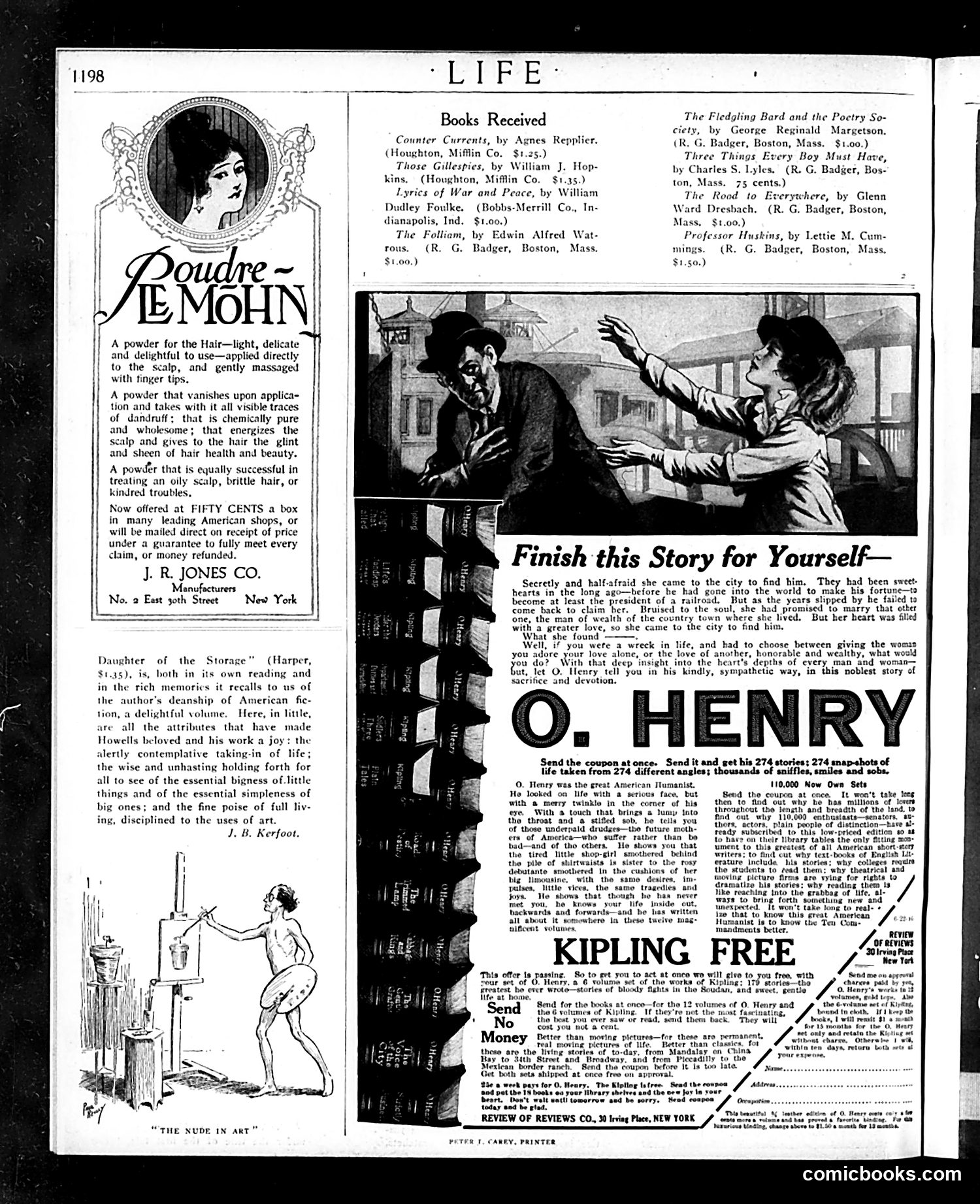
This page combines advertisements with literary content typical of Life magazine's format. **The cartoons:** "The Nude in Art" (lower left) appears to be a satirical commentary on artistic pretense—showing a figure in an exaggerated classical pose, likely mocking both the art world's elevation of nude studies and the prudishness of American society regarding such subjects. This reflects Life's role as a vehicle for social satire. **Main content:** The page features a serialized O. Henry story ("Finish this Story for Yourself") and promotional material for a 274-story collection of Henry's work, emphasizing his ability to capture universal human experiences across social classes. **Advertisements:** Poudre Lemohn (hair powder) and J.R. Jones Co. represent typical early-1900s patent medicine/cosmetic marketing, using quasi-scientific language to promote products. The overall page reflects Life's dual purpose: sophisticated literary commentary and social satire mixed with commercial advertising.
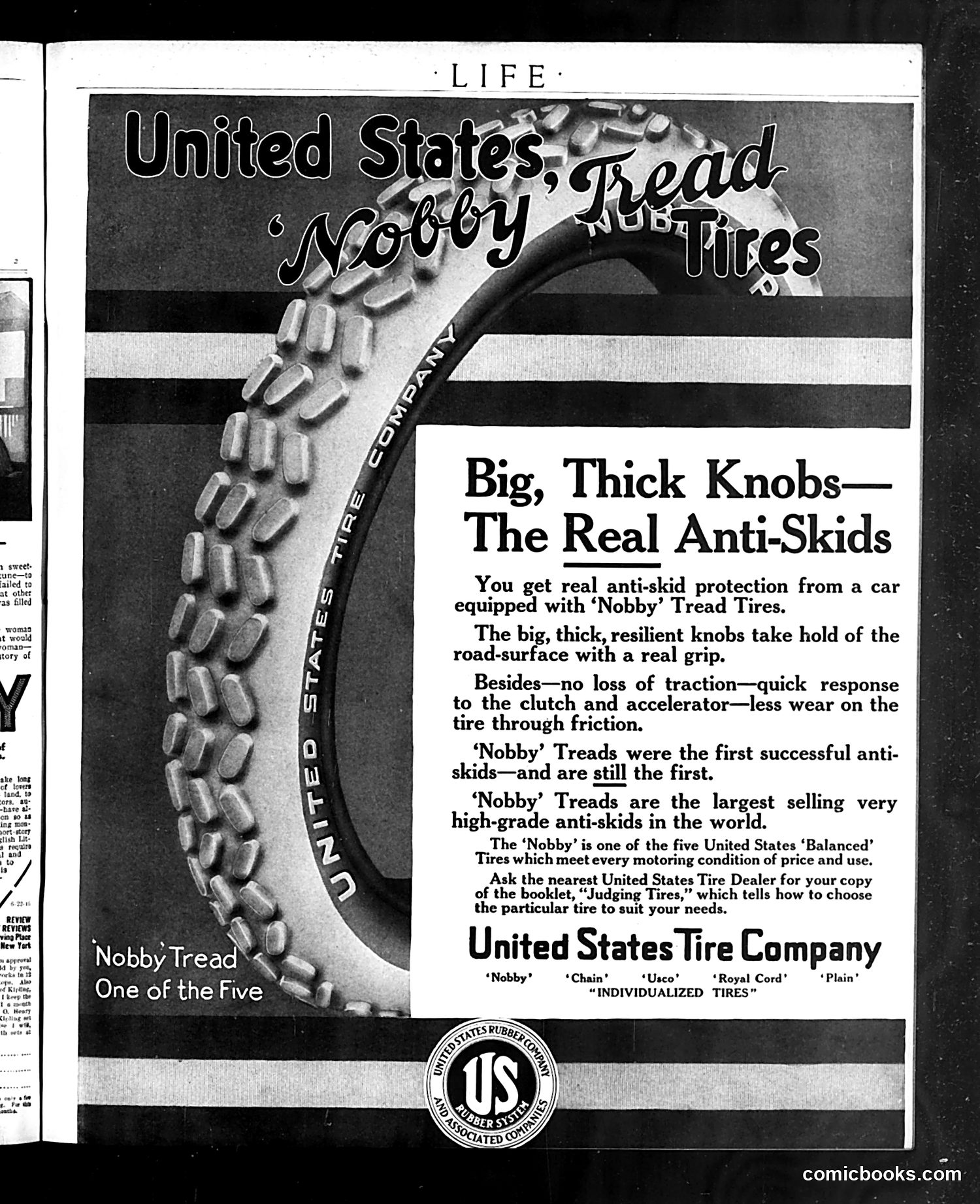
This page is **not a cartoon or satire**—it's a **straightforward advertisement** for United States Tire Company's "Nobby" brand tires, published in *Life* magazine. The ad features a close-up photograph of a tire tread with prominent knobs (the bumps designed to improve grip). The sales pitch emphasizes that these "big, thick knobs" provide anti-skid protection and better traction than competitors. The copy claims "Nobby" Treads were "the first successful anti-skids" and are "the largest selling very high-grade anti-skids in the world." It positions the tire as one of five "Balanced" tire options from United States Rubber Company. This represents early automotive advertising, when tire safety features like tread patterns were novel selling points. Modern readers should note the era's emphasis on "anti-skids" as a premium safety feature—what we'd now consider basic tire technology.
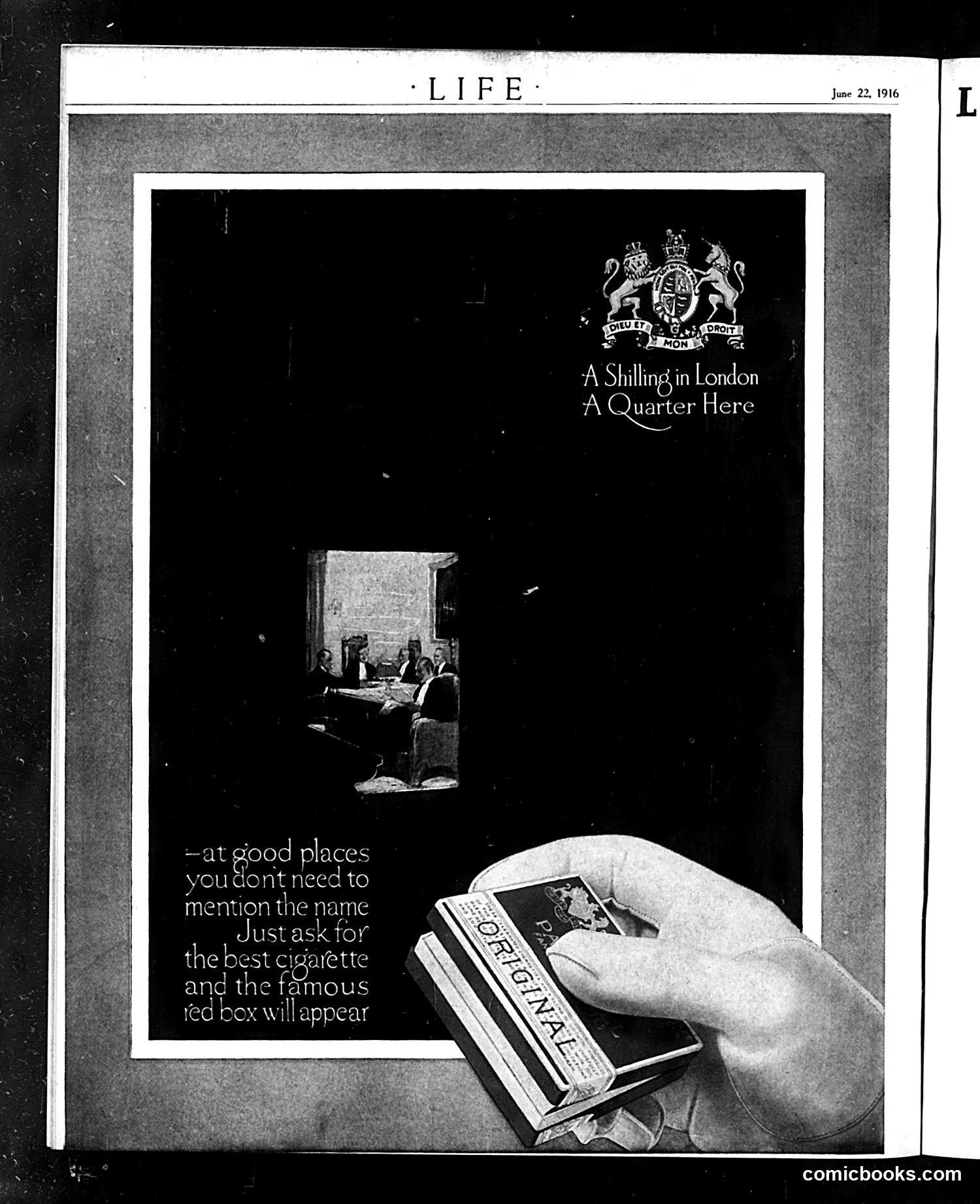
This is a cigarette advertisement for Fortnum & Mason cigarettes, published in Life magazine on June 22, 1916. The ad features a hand holding a red box of cigarettes and depicts a scene of well-dressed men dining in what appears to be an upscale London restaurant. The advertisement's appeal is snobbish and class-based: it claims that at prestigious establishments ("good places"), the product is so famous and recognizable that customers need only ask for "the best cigarette"—the red box will automatically appear without naming the brand. The tagline "A Shilling in London / A Quarter Here" references pricing differences between British and American markets. This reflects early 20th-century luxury marketing targeting affluent consumers who would frequent fine dining establishments.