
Life, 1916-06-22 · page 19 of 48
Life — June 22, 1916 — page 19: what you’re looking at
What you’re looking at
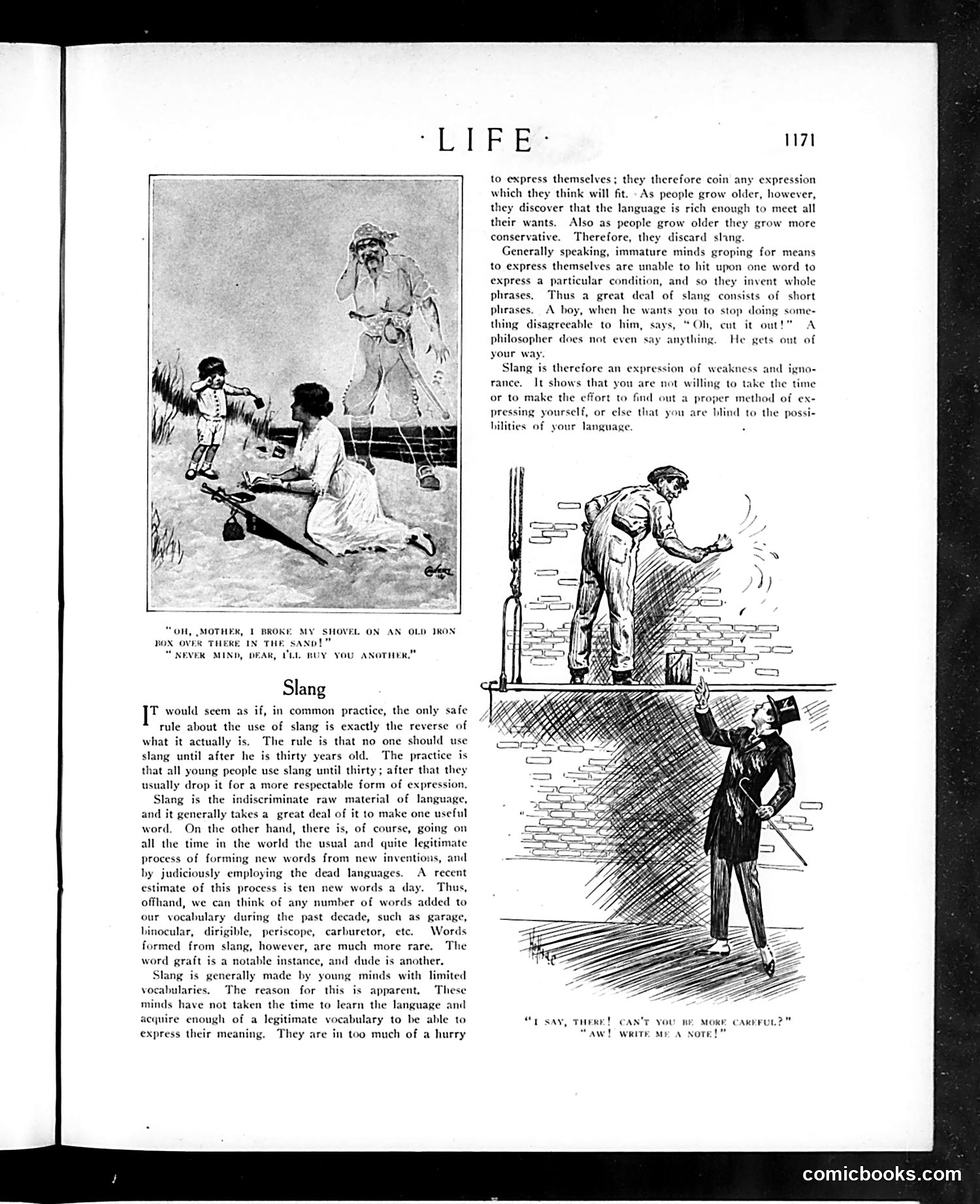
This page from *Life* magazine presents an editorial argument against slang usage, illustrated by two cartoons mocking young people's speech habits. **The argument:** The text claims slang represents intellectual laziness and limited vocabulary. It's used by young people unable or unwilling to express themselves properly, then abandoned as people mature and grow "conservative." The piece distinguishes slang from legitimate new words (garage, dirigible, carburetor) coined from technological innovation or classical languages. **The cartoons:** - Top: A child telling his mother he "broke my shovel on an old iron box"—crude, imprecise language - Bottom: A figure scolding another for carelessness, with the response "aw! write me a note!"—mocking casual, dismissive speech The satire targets youth culture's supposedly debased language as evidence of moral and intellectual deficiency. This reflects early-20th-century anxieties about generational decline and linguistic "proper" usage as markers of class and refinement.
📄 Transcribed text from this page (OCR, searchable)
Machine-transcribed from the original scan — historical spelling and the odd misread are preserved.
“LIFE: 71 to express themselves; they therefore coin any expression which they think will fit. -As people grow older, however, they discover that the language is rich enough to meet all their wants. Also as people grow older they grow more conservative. Therefore, they discard sling. Generally speaking, immature minds groping for means to express themselves are unable to hit upon one word to express a particular condition, and so they invent whole phrases, Thus a great deal of slang consists of short phrases. A boy, when he wants you to stop doing some- thing disagreeable to him, says, “Oh, cut it out!" A philosopher does not even say anything. He gets out of your way. Slang is therefore an expression of weakness and igno- rance, It shows that you are not willing to take the time or to make the effort to find out a proper method of ¢ pressing yourself, or else that you are blind to the possi- bilities of your language OH, MOTHER, 1 BROKE MY SHOVEL ON AN OLD IRON ROX OVER THERE IN THE SAND!” “NEVER MIND, DEAR, ULI. RUY YOU ANOTHER.” Slang T would seem as if, in common practice, the only safe rule about the use of slang is exactly the reverse of what it actually is. The rule is that no one should use slang until after he is thirty years old. The practice is that all young people use slang until thirty; after that they usually drop it for a more respectable form of expression. Slang is the indiscriminate raw material of lang and it generally takes a great deal of it to make one useful word. On the other hand, there is, of course, going on all the time in the world the usual and quite legitimate process of forming new words from new inventions, and by judiciously employing the dead languages. A_ recent estimate of this process is ten new words a day. Thus, offhand, we can think of any number of words added to our vocabulary during the past decade, such as garage, Linocular, dirigible, periscope, carburetor, etc. Words formed from slang, however, are much more rare. The word graft is a notable instance, and dude is another. Slang is generally made by young minds with limited vocabularies. The reason for this is apparent, These minds have not taken the time to learn the language and acquire enough of a legitimate vocabulary to be able to “1 SAY, THERE! CAN'T VOU HE MORE CAREFUL express their meaning. They are in too much of a hurry “aw! write ate a Nore!” comicbooks.com