
Life, 1916-06-22 · page 32 of 48
Life — June 22, 1916 — page 32: what you’re looking at
What you’re looking at
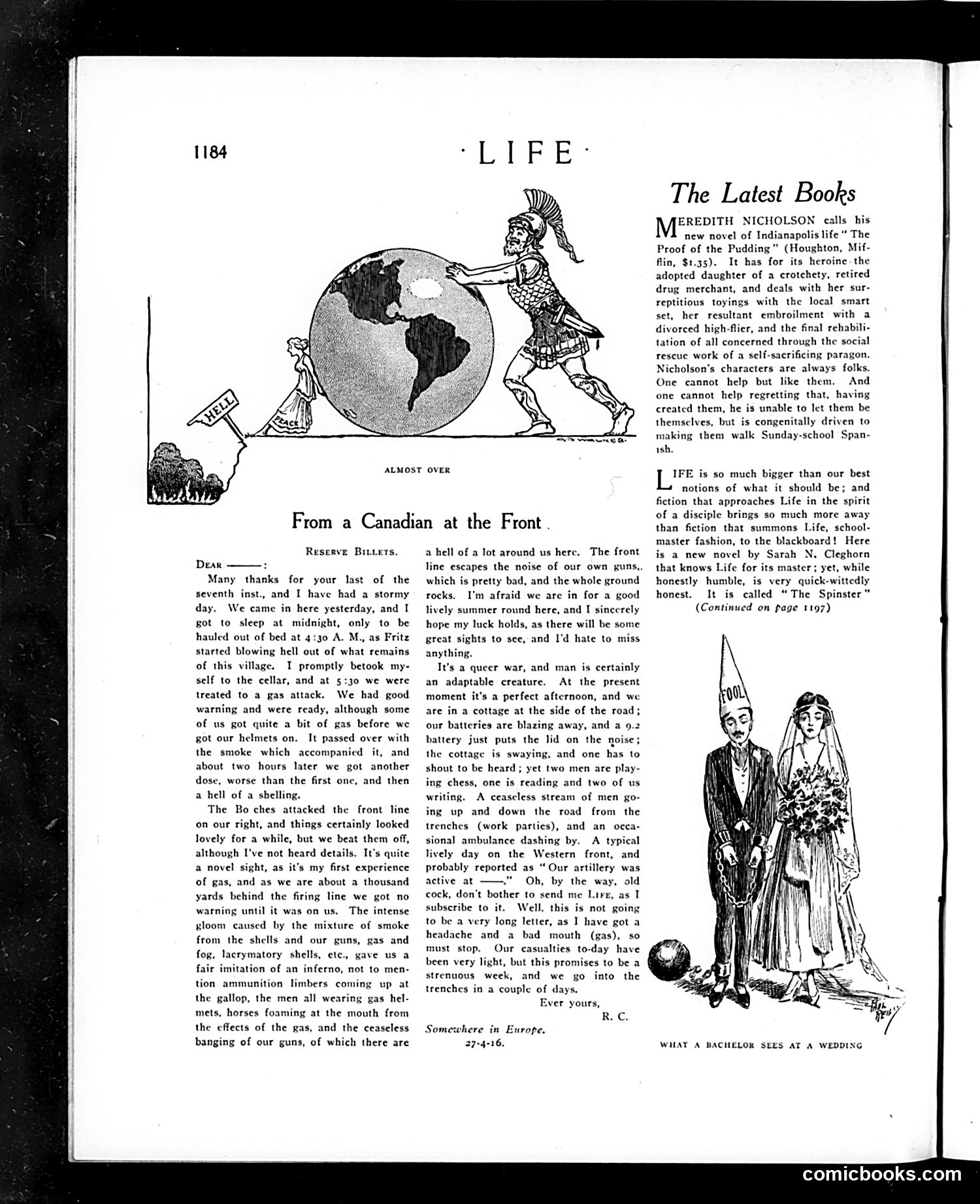
**Top Cartoon ("Almost Over"):** A classical warrior figure pushes a globe showing the Americas, suggesting Allied confidence that WWI victory is near. The title ironically undercuts this optimism. **Letter "From a Canadian at the Front":** This is a first-person account from a Canadian soldier (dated April 27, 1916) describing trench warfare on the Western Front. He describes gas attacks, artillery bombardment, and the surreal juxtaposition of combat horror with ordinary activities like chess and reading. The tone is matter-of-fact, reflecting soldiers' adaptation to mechanized industrial warfare. **Book Reviews Section:** Standard literary reviews of contemporary fiction by Meredith Nicholson, noting how his characters, while likeable, are morally constrained by the author into "Sunday-school Spanish" behavior—a critique of overly didactic fiction that sacrifices authenticity for moral lessons. The page illustrates Life magazine's typical mix of satire, war correspondence, and cultural criticism aimed at educated American readers in 1916.
📄 Transcribed text from this page (OCR, searchable)
Machine-transcribed from the original scan — historical spelling and the odd misread are preserved.
ALMOST over From a Canadian at the Front Reserve Biuwers. Dear Many thanks for your last of the seventh inst., and I have had a stormy day. We came in here yesterday, and I got to sleep at midnight, only to be hauled out of bed at 4:30 A. M., as Fritz started blowing hell out of what remains of this village. I promptly betook my- self to the cellar, and at 5:30 we were treated to a gas attack. We had good warning and were ready, although some of us got quite a bit of gas before we got our helmets on. It passed over with the smoke which accompanied it, and about two hours later we got another dose, worse than the first one, and then a hell of a shelling. The Bo ches attacked the front line on our right, and things certainly looked lovely for a while, but we beat them off, although I've not heard details. It's quite a novel sight, as it's my first experience of gas, and as we are about a thousand yards behind the firing line we got no warning until it was on us. The intense gloom caused by the mixture of smoke from the shells and our guns, gas and fog, lacrymatory shells, etc., gave us a fair imitation of an inferno, not to men- tion ammunition limbers coming up at the gallop, the men all wearing gas hel- mets, horses foaming at the mouth from the effects of the gas, and the ceaseless banging of our guns, of which there are a hell of a lot around us here. The front line escapes the noise of our own guns,, which is pretty bad, and the whole ground rocks. I'm afraid we are in for a good lively summer round here, and I sincerely hope my luck holds, as there will be some great sights to sce, and I'd hate to miss anything. It’s a queer war, and man is certainly an adaptable creature. At the present moment it's a perfect afternoon, and we are in a cottage at the side of the road; our batteries are blazing away, and a 9.2 battery just puts the lid on the noise; the cottage is swaying, and one has to shout to be heard; yet two men are play- ing chess, one is reading and two of us writing, A ceaseless stream of men go- ing up and down the road from the trenches (work parties), and an occa- sional ambulance dashing by. A typical lively day on the Western front, and probably reported as “Our artillery was active at —." Oh, by the way, old cock, don't bother to send me Lire, as T subscribe to it. Well, this is not going to be a very long letter, as I have got a headache and a bad mouth (gas), so must stop. Our casualties to-day have been very light, but this promises to be a strenuous week, and we go into the trenches in a couple of days. Ever yours, R.C. Somewhere in Europe. 27-4-16, The Latest Books EREDITH NICHOLSON calls his new novel of Indianapolis life “ The Proof of the Pudding” (Houghton, Mi flin, $1.35). It has for its heroine the adopted daughter of a crotchety, retired drug merchant, and deals with her sur- reptitious toyings with the local smart set, her resultant embroilment with a divorced high-flier, and the final rehabili tation of all concerned through the so rescue work of a self-sacrificing paragon. Nicholson’s characters are always folks. One cannot help but like them. And one cannot help regretting that, having created them, he is unable to let them be themselves, but is congenitally driven to making them walk Sunday-school Span- ash. IFE is so much bigger than our best notions of what it should be; and fiction that approaches Life in the spirit of a disciple brings so much more away than fiction that summons Life, school- master fashion, to the blackboard! Here is a new novel by Sarah N, Cleghorn that knows Life for its master; yet, while honestly humble, is very quick-wittedly honest. It is called “The Spinster” (Continued on page 1197) WHAT A BACHELOR SEES AT A WEDDING comicbooks.com