
Life, 1916-06-22 · page 25 of 48
Life — June 22, 1916 — page 25: what you’re looking at
What you’re looking at
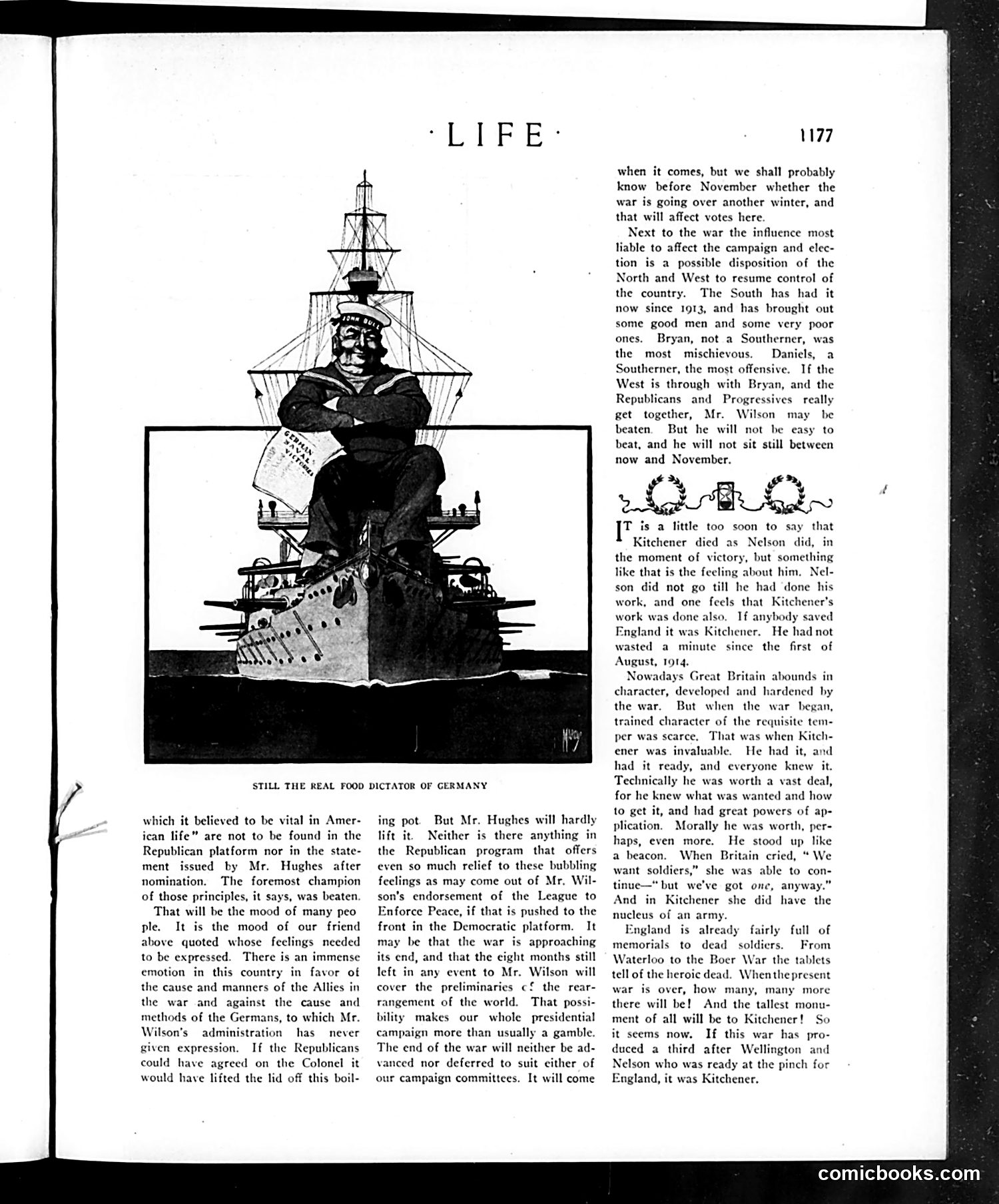
The cartoon depicts a German military officer (likely the Kaiser or a German general) seated atop a warship, holding what appears to be a document or newspaper. The title sarcastically refers to him as a "food dictator," referencing Germany's use of unrestricted submarine warfare to blockade Allied supply lines and starve Britain into submission—a central World War I strategy. The accompanying article discusses the 1916 U.S. presidential election between Wilson and Hughes, arguing that American public emotion strongly favors the Allied cause against German methods. The piece notes this pro-Allied sentiment hasn't been adequately expressed by either candidate, and discusses whether the war's continuation might influence November voting. The cartoon satirizes German military aggression and its deliberate targeting of civilian food supplies as a weapon of war, illustrating the visceral anti-German sentiment the article describes.
📄 Transcribed text from this page (OCR, searchable)
Machine-transcribed from the original scan — historical spelling and the odd misread are preserved.
STILL THE REAL FOOD DICTATOR OF GERMANY which it believed to be vital in Amer- ican life” are not to be found in the Republican platform nor in the state- ment issued by Mr. Hughes after nomination. The foremost champion of those principles, it says, was beaten. That will be the mood of many peo ple, It is the mood of our friend above quoted whose feelings needed to be expressed. There is an immense emotion in this country in favor of the cause and manners of the Allies in the war and against the cause and methods of the Germans, to which Mr. Wilson’s administration has never given expression. If the Republicans could have agreed on the Colonel it would have lifted the lid off this boil- ing pot. But Mr. Hughes will hardly lift it. Neither is there anything in the Republican program that offers even so much relief to these bubbling feelings as may come out of Mr, Wil- son’s endorsement of the League to Enforce Peace, if that is pushed to the front in the Democratic platform. It may be that the war is approaching its end, and that the cight months still left in any event to Mr. Wilson will cover the preliminaries cf the rear- rangement of the world. That possi- bility makes our whole presidential campaign more than usually a gamble. The end of the war will neither be ad- vanced nor deferred to suit cither of our campaign committees. It will come 1177 when it comes, but we shall probably know before November whether the war is going over another winter, and that will affect votes here. Next to the war the influence most liable to affect the campaign and elec- tion is a possible disposition of the North and West to resume control of the country. The South has had it now since 1913, and has brought out some good men and some very poor ones. Bryan, not a Southerner, was the most mischievous. Daniels, a Southerner, the most offensive. If the West is through with Bryan, and the Republicans and Progressives really get together, Mr. Wilson may be beaten. But he will not be easy to beat, and he will not sit still between now and November. meL ear T is a little too soon to say that Kitchener died as Nelson did, in the moment of victory, but something like that is the feeling about him, Nel- son did not go till he had done his work, and one feels that Kitchener's work was done also, If anybody saved England it was Kitchener. He had not wasted a minute since the first of August, 1014. Nowadays Great Britain abounds in character, developed and hardened by the war. But when the war began, trained character of the requisite tem- per was scarce. That was when ener was invaluable. He had it, and had it ready, and everyone knew it. Technically he was worth a vast deal, for he knew what was wanted and how to get it, and had great powers of ap- plication. Morally he was worth, per- haps, even more. He stood up like a beacon. When Britain cried, “We want soldiers,” she was able to con- tinue—" but we've got one, anyway.” And in Kitchener she did have the nucleus of an army. England is already fairly full of memorials to dead soldiers. From Waterloo to the Boer War the tablets tell of the heroic dead. Whenthepresent war is over, how many, many more there will be! And the tallest monu- ment of all will be to Kitchener! So it seems now. If this war has pro- duced a third after Wellington and Nelson who was ready at the pinch for England, it was Kitchener. itch- comicbooks.com