
Life, 1916-06-22 · page 24 of 48
Life — June 22, 1916 — page 24: what you’re looking at
What you’re looking at
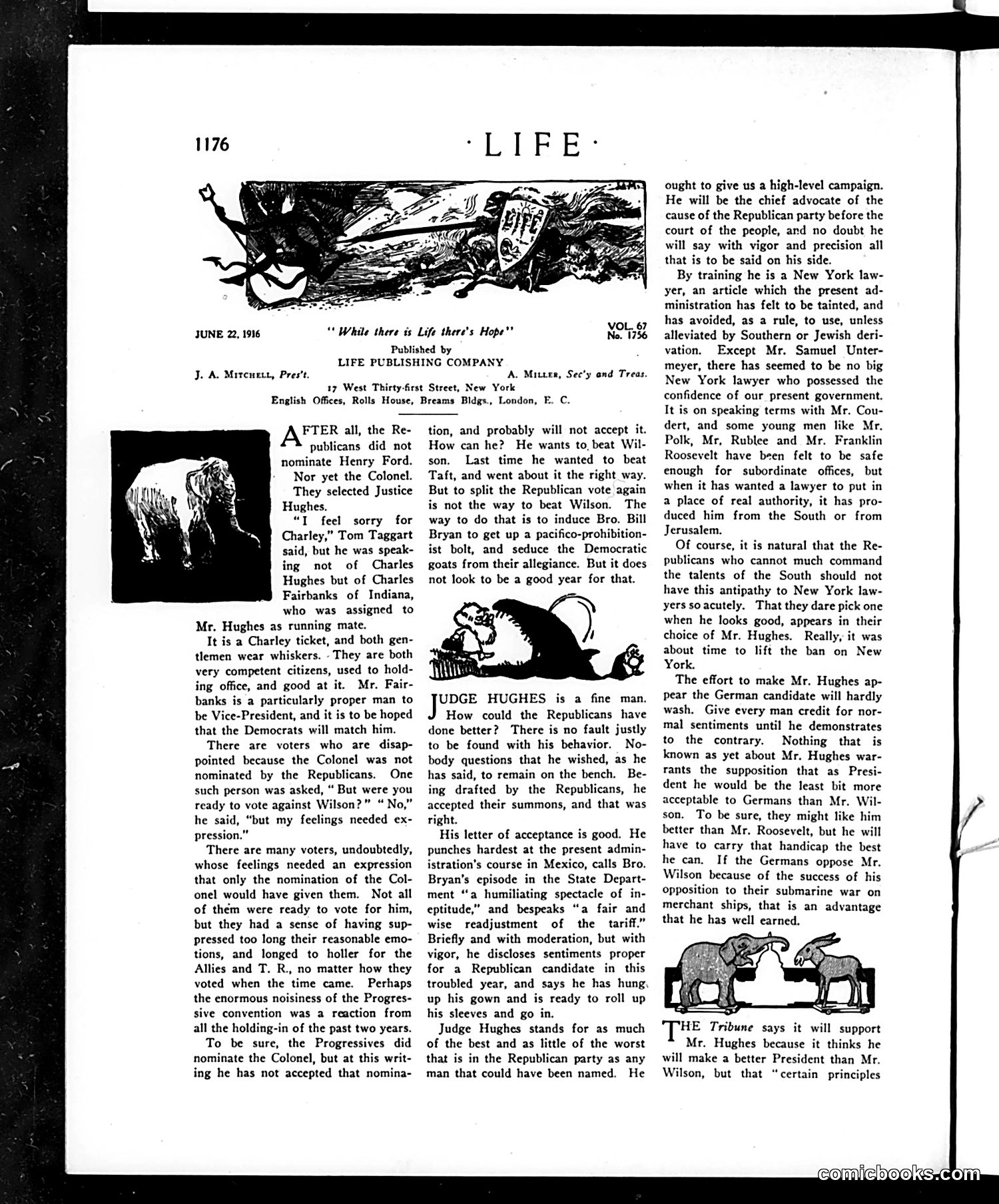
This page discusses the Republican Party's 1916 presidential nomination of **Justice Charles Evans Hughes** with **Charles Fairbanks** as running mate—described as a "Charley ticket" of two whiskered, competent men. The cartoons satirize Republican strategy. One depicts a horse (labeled "A horse"), likely representing the party's predicament. The text reveals disappointment that **Theodore Roosevelt** wasn't nominated; Progressives nominated him separately, but he may refuse to split the Republican vote against Wilson. Hughes is characterized as an acceptable but not inspiring choice—a New York lawyer (oddly, the administration has distrusted New York lawyers except those with Southern or Jewish connections). The piece notes Hughes's strong letter accepting the nomination, particularly attacking the Wilson administration's Mexican policy and Bryan's State Department role. The satire suggests Hughes represents competence without excitement—a safe, moderate alternative to both Roosevelt's vigor and Wilson's incumbent position.
📄 Transcribed text from this page (OCR, searchable)
Machine-transcribed from the original scan — historical spelling and the odd misread are preserved.
JUNE 22, 1916 “While there is Life there's Hope"’ No. 1756 Published by LIFE PUBLISHING COMPANY J. A. Mrreuntt, Pres't. A. Minter, Sec'y and Treas. 17 West Thirty-first Street, New York English Offices, Rolls House, Breams Bldgs, London, E. C. FTER all, the Re- publicans did not nominate Henry Ford. Nor yet the Colonel. They selected Justice Hughes. “I feel sorry for Charley,” Tom Taggart said, but he was speak- ing not of Charles Hughes but of Charles Fairbanks of Indiana, who was assigned to Mr. Hughes as running mate. It is a Charley ticket, and both gen- tlemen wear whiskers. -They are both very competent citizens, used to hold- ing office, and good at it. Mr. Fair- banks is a particularly proper man to be Vice-President, and it is to be hoped that the Democrats will match him. There are voters who are disap- pointed because the Colonel was not nominated by the Republicans. One such person was asked, “ But were you ready to vote against Wilson?” “ No,” he said, “but my feelings needed ex- pression.” There are many voters, undoubtedly, whose feelings needed an expression that only the nomination of the Col- onel would have given them. Not all of them were ready to vote for him, but they had a sense of having sup- pressed too long their reasonable emo- tions, and longed to holler for the Allies and T. R., no matter how they voted when the time came. Perhaps the enormous noisiness of the Progres- sive convention was a reaction from all the holding-in of the past two years. To be sure, the Progressives did nominate the Colonel, but at this writ- ing he has not accepted that nomina- tion, and probably will not accept it. How can he? He wants to, beat Wil- son. Last time he wanted to beat Taft, and went about it the right way. But to split the Republican vote again is not the way to beat Wilson. The way to do that is to induce Bro. Bill Bryan to get up a pacifico-prohibition- ist bolt, and seduce the Democratic goats from their allegiance. But it does not look to be a good year for that. is a fine man. A horse HUGHES How could the Republicans have done better? There is no fault justly to be found with his behavior. No- body questions that he wished, as he has said, to remain on the bench. Be- ing drafted by the Republicans, he accepted their summons, and that was right. His letter of acceptance is good. He punches hardest at the present admin- istration’s course in Mexico, calls Bro. Bryan’s episode in the State Depart- ment “a humiliating spectacle of in- eptitude,” and bespeaks “a fair and wise readjustment of the tariff.” Briefly and with moderation, but with vigor, he discloses sentiments proper for a Republican candidate in this troubled year, and says he has hung, up his gown and is ready to roll up his sleeves and go in. Judge Hughes stands for as much of the best and as little of the worst that is in the Republican party as any man that could have been named. He ought to give us a high-level campaign. He will be the chief advocate of the cause of the Republican party before the court of the people, and no doubt he will say with vigor and precision all that is to be said on his side. By training he is a New York law- yer, an article which the present ad- ministration has felt to be tainted, and has avoided, as a rule, to use, unless alleviated by Southern or Jewish deri- vation. Except Mr. Samuel Unter- meyer, there has seemed to be no big New York lawyer who possessed the confidence of our present government. It is on speaking terms with Mr. Cou- dert, and some young men like Mr. Polk, Mr, Rublee and Mr. Franklin Roosevelt have been felt to be safe enough for subordinate offices, but when it has wanted a lawyer to put in a place of real authority, it has pro- duced him from the South or from Jerusalem. Of course, it is natural that the Re- publicans who cannot much command the talents of the South should not have this antipathy to New York law- yers soacutely. That they dare pick one when he looks good, appears in their choice of Mr. Hughes. Really, it was about time to lift the ban on New York. The effort to make Mr. Hughes ap- pear the German candidate will hardly wash. Give every man credit for nor- mal sentiments until he demonstrates to the contrary. Nothing that is known as yet about Mr. Hughes war- rants the supposition that as Presi- dent he would be the least bit more acceptable to Germans than Mr. Wil- son. To be sure, they might like him better than Mr. Roosevelt, but he will have to carry that handicap the best he can, If the Germans oppose Mr. Wilson because of the success of his opposition to their submarine war on merchant ships, that is an advantage that he has well earned. HE Tribune says it will support Mr. Hughes because it thinks he will make a better President than Mr. Wilson, but that “certain principles