
Life, 1916-06-22 · page 28 of 48
Life — June 22, 1916 — page 28: what you’re looking at
What you’re looking at
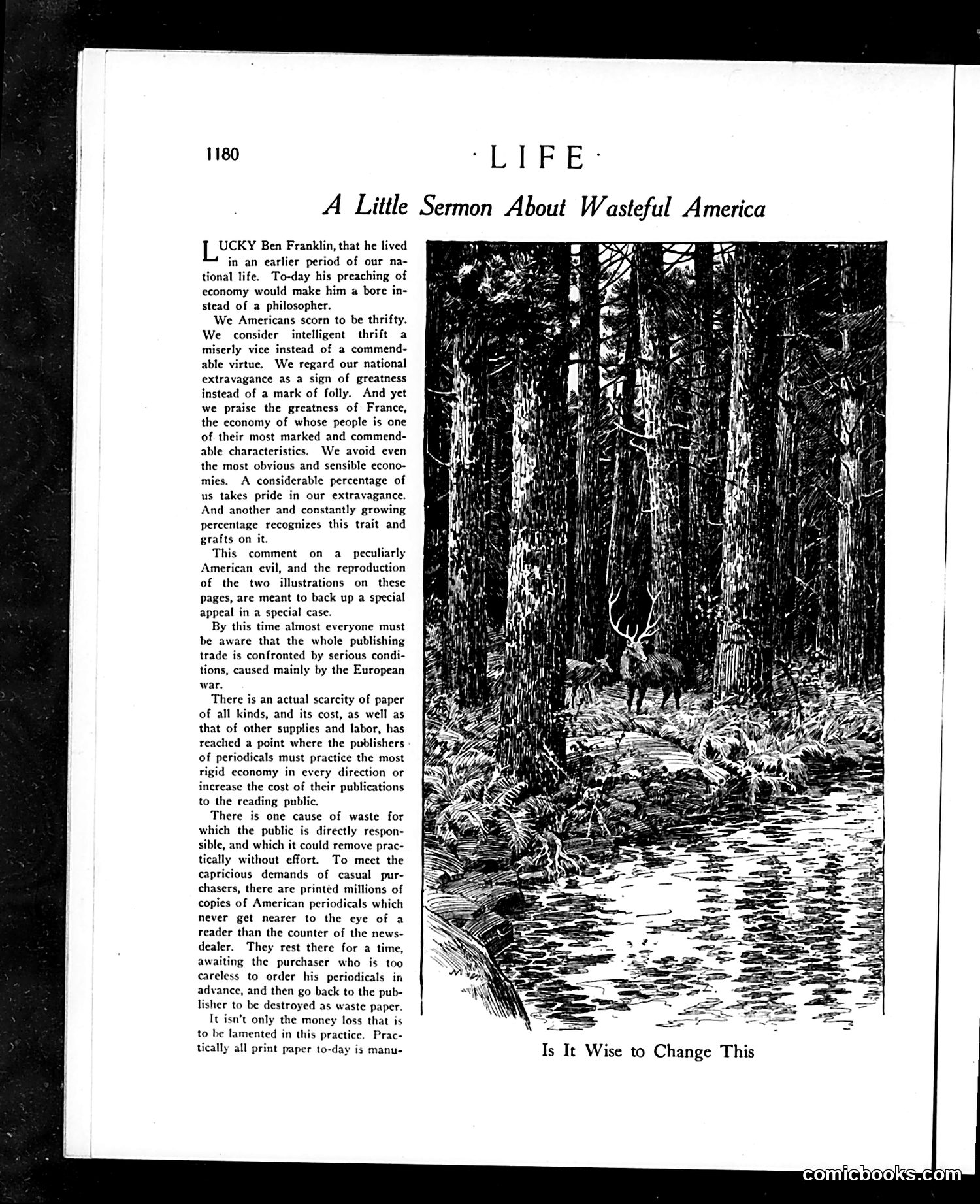
This 1915 Life magazine page critiques American wasteful consumption culture during World War I paper shortages. The accompanying illustration depicts a deer in a forest stream—likely representing nature's bounty being squandered. The article argues Americans pride themselves on extravagance while hypocritically admiring French thriftiness. The central complaint: publishers print millions of magazine copies that never reach readers, sitting unsold at newsstands before being destroyed as waste paper. The author blames casual buyers who won't subscribe in advance, forcing overproduction. The essay frames this as patriotic concern during wartime—paper is scarce due to "European war" (WWI). The headline's question "Is It Wise to Change This" sarcastically challenges whether Americans will reform wasteful habits. The piece references Benjamin Franklin's colonial-era frugality values, implying modern America has abandoned such virtue for destructive consumerism.
📄 Transcribed text from this page (OCR, searchable)
Machine-transcribed from the original scan — historical spelling and the odd misread are preserved.
“LIFE: A Little Sermon About Wasteful America UCKY Ben Franklin, that he lived in an earlier period of our na- tional life. To-day his preaching of economy would make him a bore in- stead of a philosopher. We Americans scorn to be thrifty. We consider intelligent thrift a miserly vice instead of a commend- able virtue. We regard our national extravagance as a sign of greatness instead of a mark of folly. And yet we praise the greatness of France, the economy of whose people is one of their most marked and commend- able characteristics. We avoid even the most obvious and sensible econo- mies. A considerable percentage of us takes pride in our extravagance. And another and constantly growing percentage recognizes this trait and grafts on it. This comment on a_ peculiarly American evil, and the reproduction of the two illustrations on these pages, are meant to back up a special appeal in a special case. By this time almost everyone must be aware that the whole publishing trade is confronted by serious condi- tions, caused mainly by the European war. There is an actual scarcity of paper of all kinds, and its cost, as well as that of other supplies and labor, has reached a point where the publishers of periodicals must practice the most rigid economy in every direction or increase the cost of their publications to the reading public. There is one cause of waste for which the public is directly respon- sible, and which it could remove prac- tically without effort. To meet the capricious demands of casual pur- chasers, there are printéd millions of copies of American periodicals which never get nearer to the eye of a reader than the counter of the news- dealer. They rest there for a time, awaiting the purchaser who is too careless to order his periodicals in advance, and then go back to the pub- lisher to be destroyed as waste paper. It isn’t only the money loss that is to be lamented in this practice. Prac- ~ tically all print paper to-day is manus Is It Wise to Change This