
A complete issue · 48 pages · 1916
Life — February 3, 1916
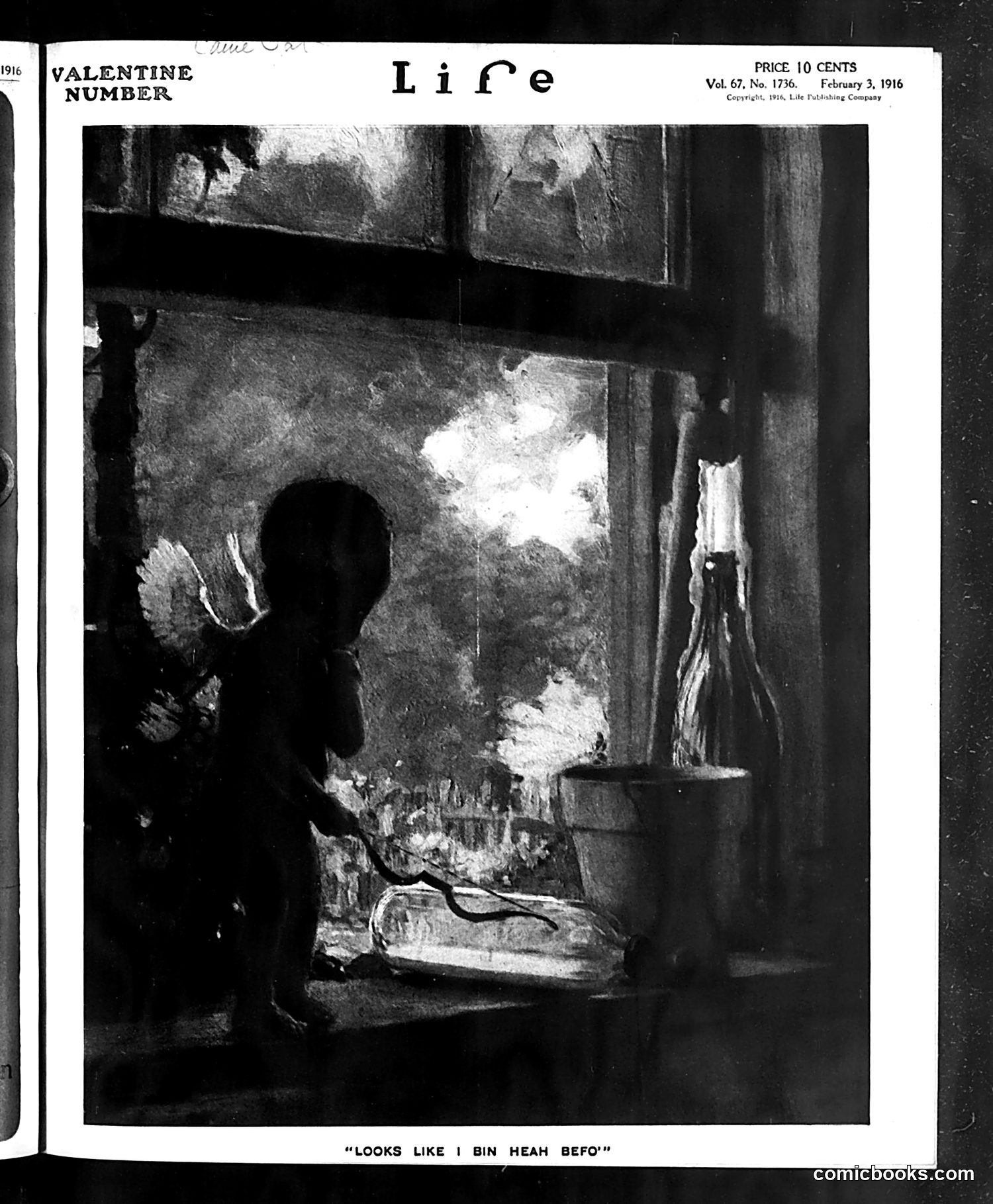
This is a Valentine's Day issue (February 3, 1916) of *Life* magazine featuring a silhouetted photograph. The caption reads "LOOKS LIKE I BIN HEAH BEFO'" — written in dialect suggesting an African American speaker using non-standard English ("been here before"). The image shows a silhouetted figure examining what appears to be a nativity scene or religious tableau with figures and light. The joke appears to reference the biblical nativity story, with the dialect-heavy caption creating a racial caricature common to 1916 satire. This reflects the era's pervasive use of offensive racial stereotypes in mainstream humor, where exaggerated dialect was used to demean Black Americans. The "joke" relies entirely on racist assumptions about speech patterns and comic inferiority.
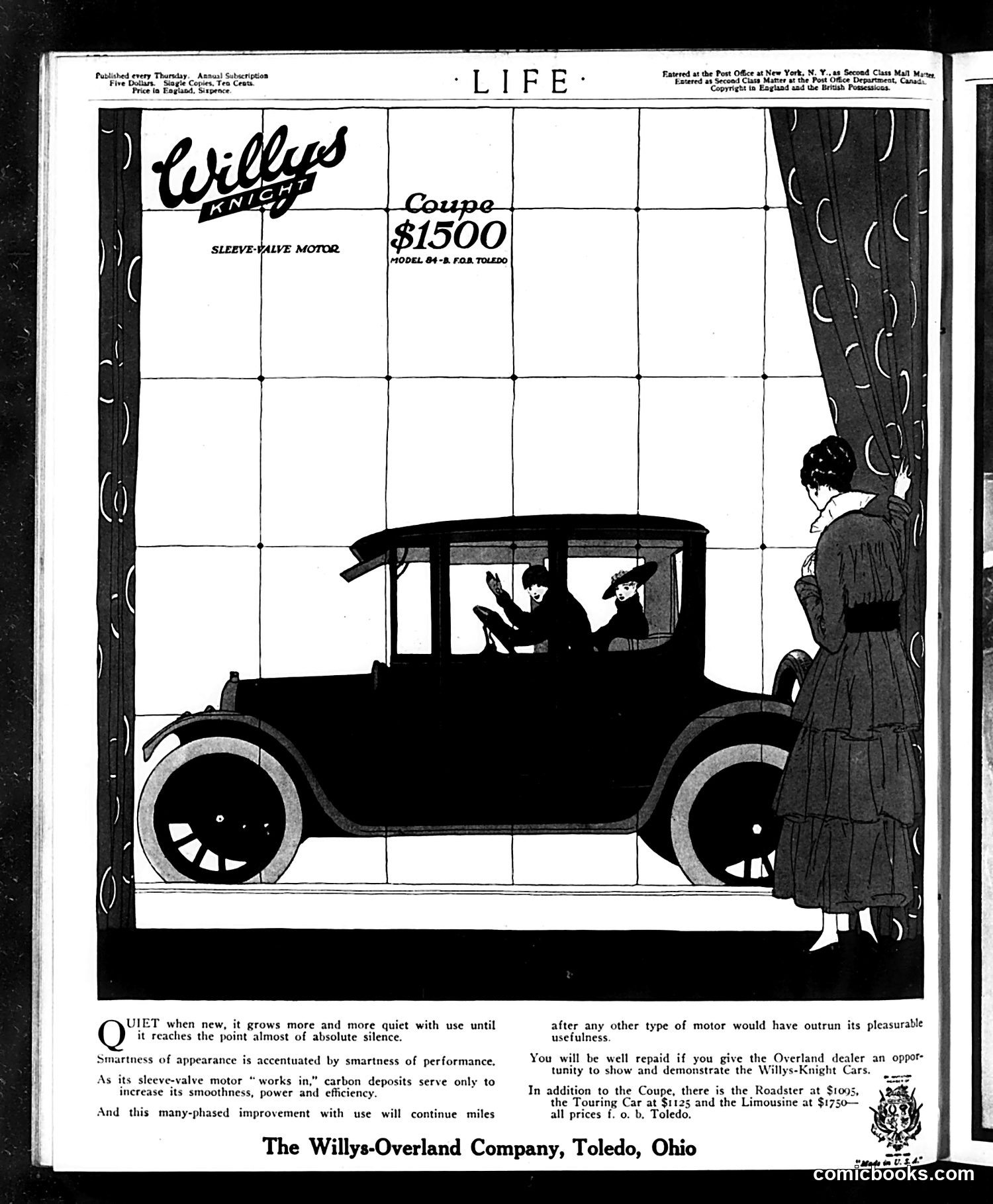
This page is primarily **advertising, not satire or political commentary**. It's a Willys-Knight automobile advertisement from *Life* magazine featuring their Coupe model priced at $1500. The illustration shows a sleek car in silhouette with two figures inside and a well-dressed woman observing from the side—a common advertising trope emphasizing the vehicle's appeal and elegance. The ad emphasizes the "sleeve-valve motor" technology that makes the car run quietly and smoothly, improving performance over time. The text notes that Willys-Knight automobiles maintain value and utility better than competitors. There is no political or social satire present—this is straightforward product marketing targeting affluent consumers interested in automobiles as status symbols.
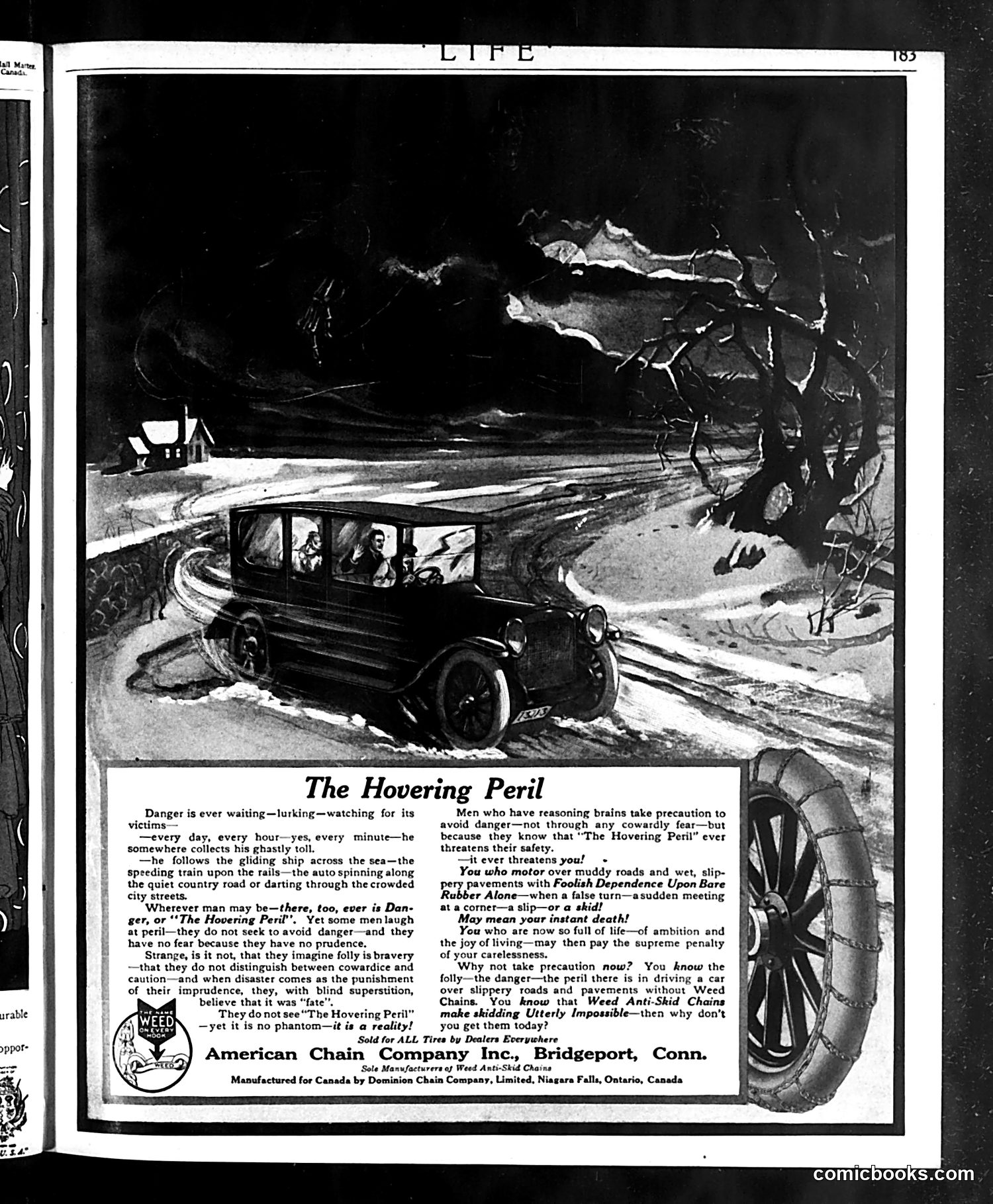
This is primarily an advertisement for Weed Anti-Skid Chains, a tire accessory for winter driving. The "peril" referenced is not political but automotive: the dangers of driving on icy, snowy roads without proper traction. The ad uses fear-based marketing, warning motorists that accidents lurk constantly—on slippery pavements, muddy roads, and icy surfaces. It contrasts careless drivers who ignore danger with prudent ones who install Weed Chains. The accompanying illustration shows a car navigating a treacherous winter landscape with cliff edges and bare trees, emphasizing how chains make "skidding utterly impossible." This reflects early 1920s concerns about automobile safety as cars became commonplace.
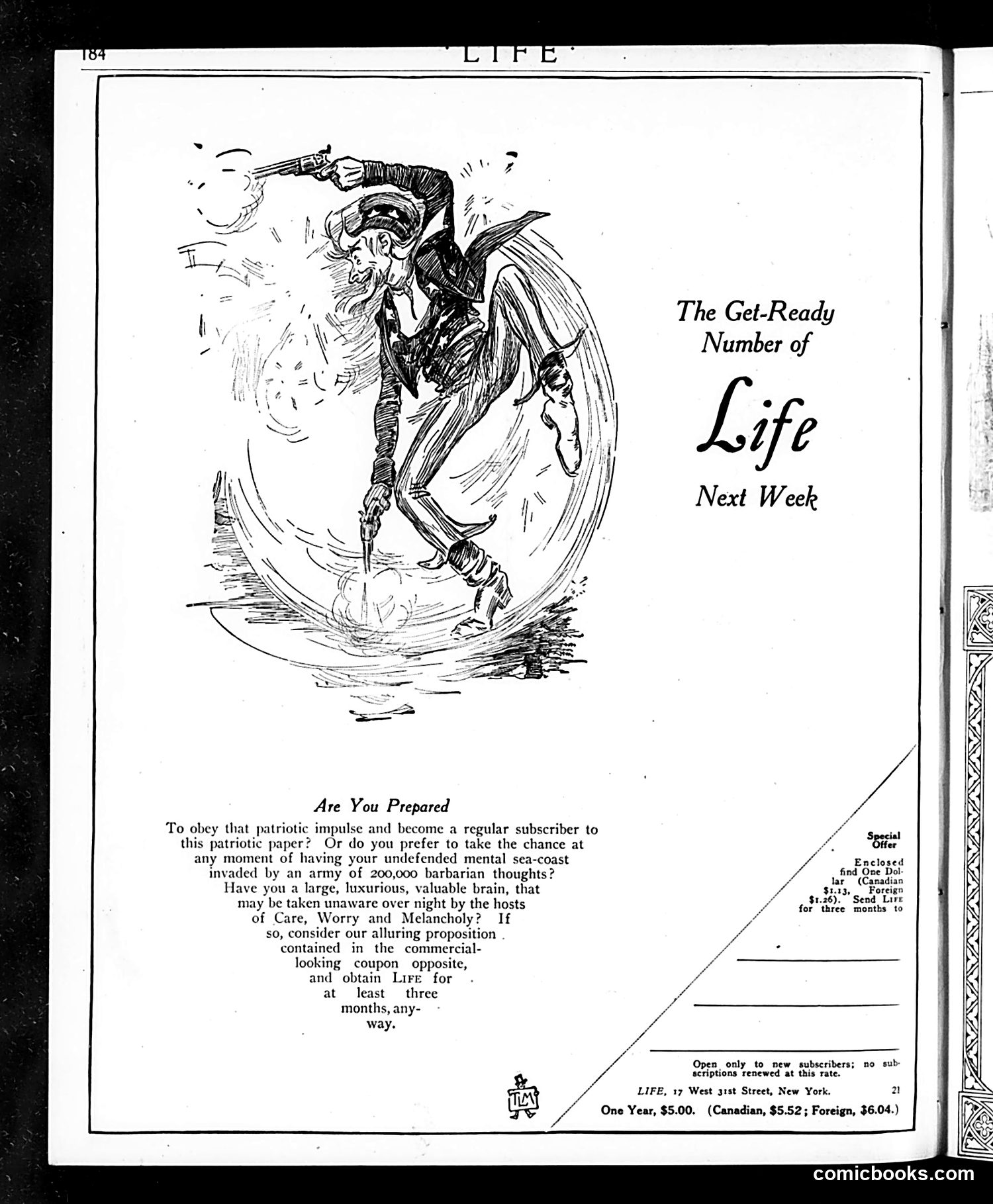
This is primarily a **subscription advertisement** for *Life* magazine rather than a political cartoon. The dramatic illustration depicts a menacing figure (appearing to be a bearded, aggressive character) wielding weapons in a dynamic, threatening pose, likely representing **invasion or foreign military threat**. The accompanying text uses **fear-based persuasion**, asking readers: "Are You Prepared?" It references concerns about "an army of 200,000 barbarian thoughts" invading American shores and mentions "the hosts of Care, Worry and Melancholy." The ad plays on **anxiety and patriotic duty**, urging readers to become "regular subscriber[s]" to this "patriotic paper" as a form of national preparedness. This suggests the ad was published during a period of American military tension or war anxiety, likely early 20th century. The tone reflects wartime or pre-war propaganda messaging designed to boost subscriptions through appeals to patriotism and security.
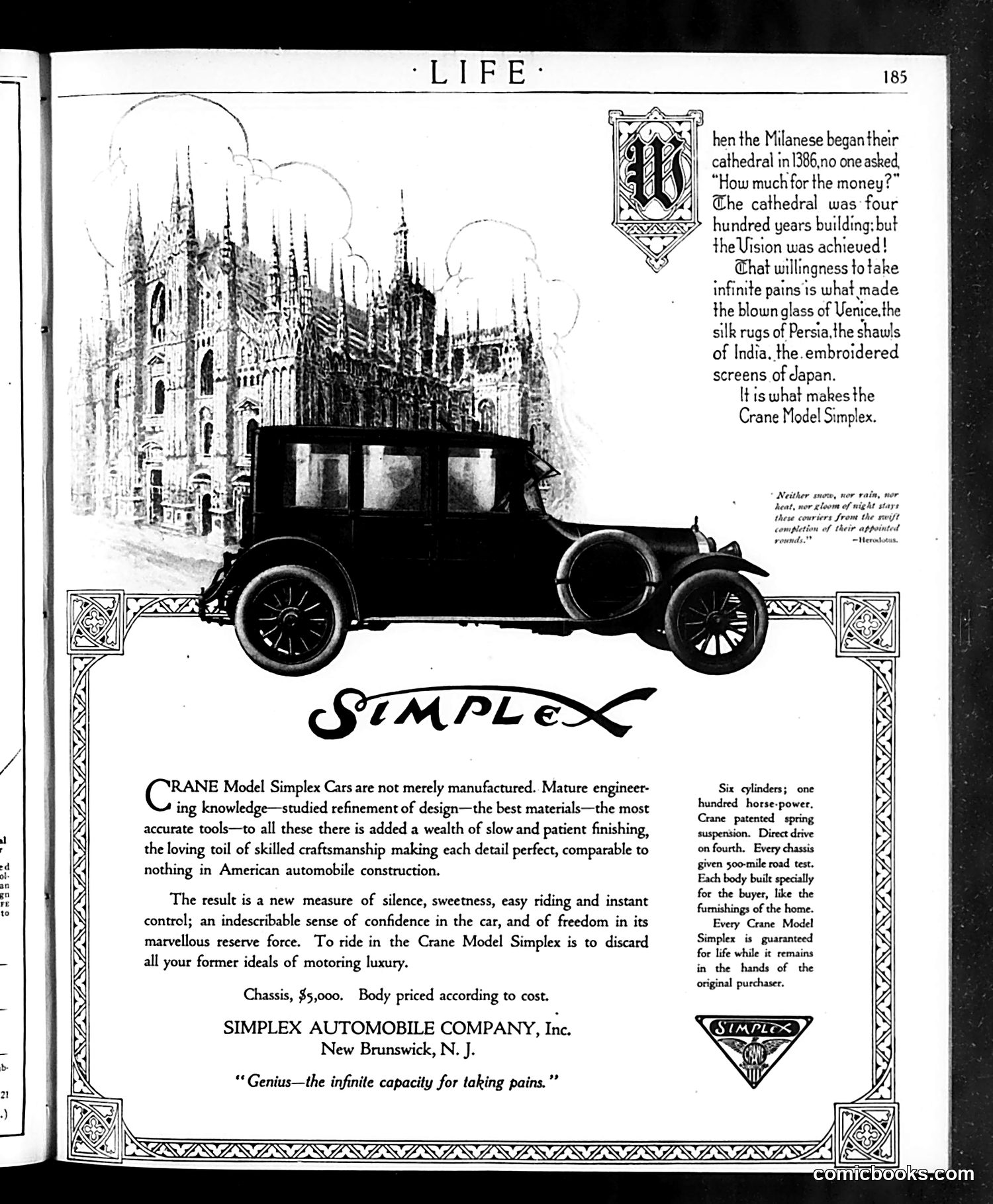
This page is **primarily an advertisement** for the Crane Model Simplex automobile, not a political cartoon. The ad uses architectural grandeur (Milan Cathedral) juxtaposed with the car to suggest that automotive engineering represents modern achievement equivalent to medieval masterworks. The text explicitly compares craftmanship—claiming the car's construction rivals cathedral-building in precision and care. The philosophical quote at bottom ("Genius—the infinite capacity for taking pains") reinforces this comparison between patient human labor and quality manufacturing. This is **commercial messaging disguised as cultural commentary**, typical of 1920s luxury-car advertising that positioned automobiles as expressions of refined taste and engineering excellence rather than mere transportation. The cathedral imagery elevates the product to artistic status.
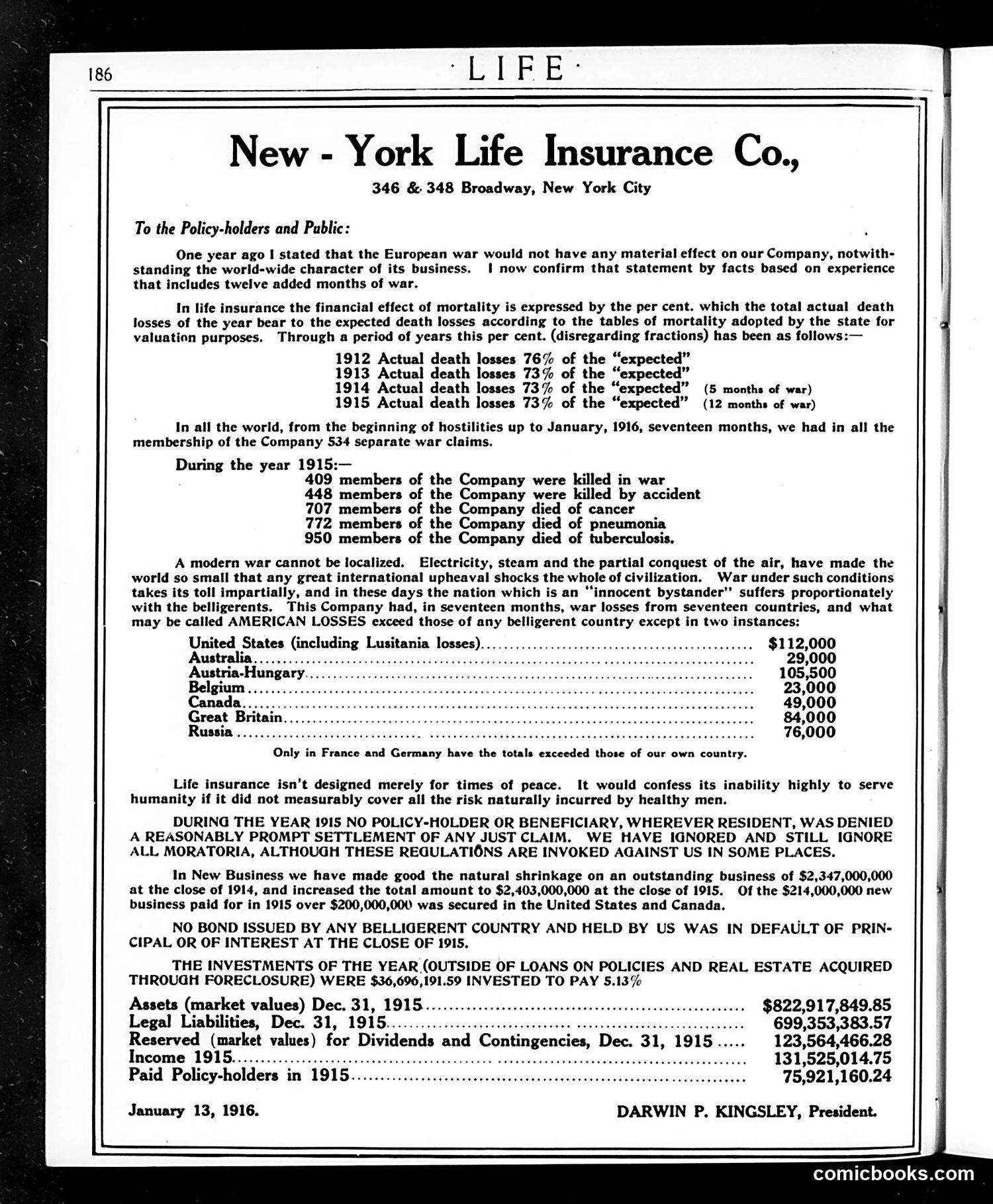
This is not a cartoon or satirical piece, but rather a corporate advertisement/statement from the New-York Life Insurance Company addressed to policyholders and the public. The text is a defense of the company's financial performance during World War I. The company argues that despite the war's impact—including 409 members killed in combat during 1915—their actual death losses remained at only 73% of "expected" rates. They list American war losses and emphasize that the company denied no claims from policyholders, even those in belligerent nations. The statement includes detailed financial figures showing strong assets and income for 1915, signed by President Darwin P. Kingsley on January 13, 1916. It's essentially a reassurance to investors and policyholders that the war hasn't destabilized the company.
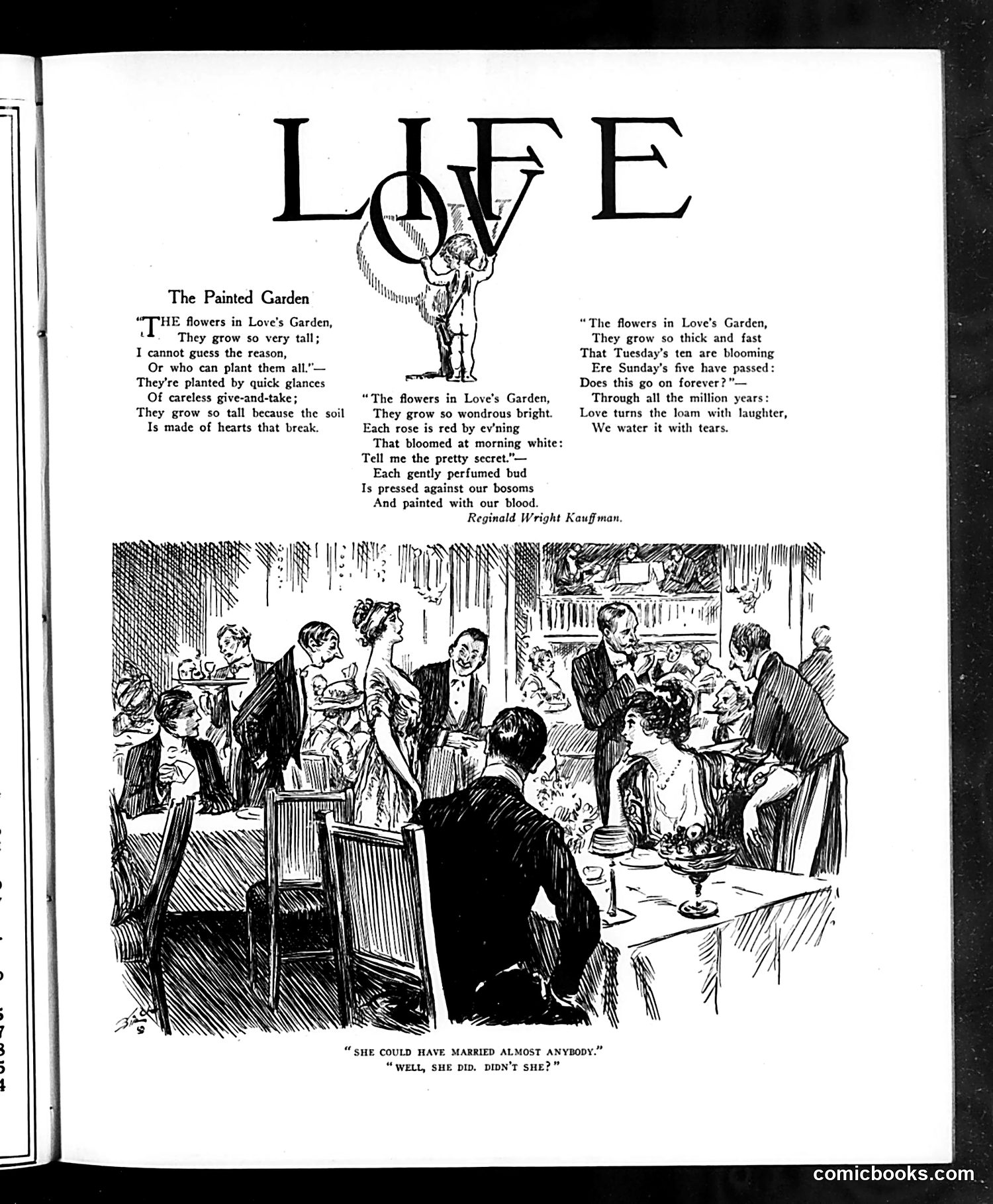
This page presents a romantic satire titled "The Painted Garden," featuring poetry by Reginald Wright Kaufman. The verses use garden metaphors to explore love's beauty and transience—flowers that grow impossibly tall, bloom briefly, and fade. The illustration depicts an elegant social gathering, likely a party or reception. The caption quotes dialogue: "She could have married almost anybody." "Well, she did. Didn't she?" This joke satirizes marriage among the upper classes, suggesting that the woman's choice of husband was unremarkable or disappointing—implying she married "anybody" rather than someone truly exceptional. It's social commentary on romantic expectations versus the mundane reality of matrimonial outcomes in high society.
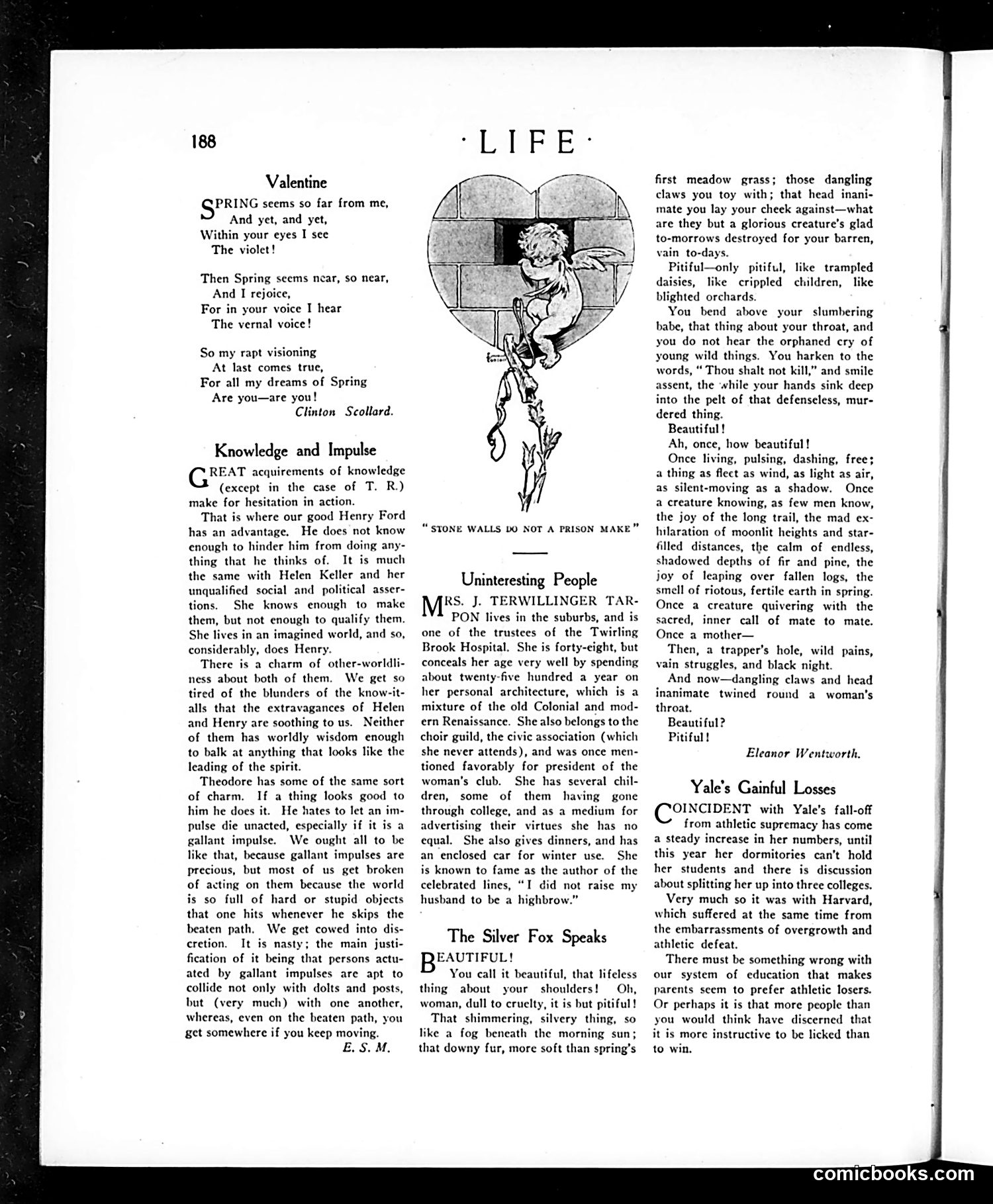
The page contains several literary pieces rather than political cartoons. The central illustration shows a cherub or cupid figure climbing chains within a heart shape—accompanying "Valentine," a poem by Clinton Scollard about Spring and romantic longing. Below are prose sections: "Knowledge and Impulse" discusses Henry Ford's business success despite limited education; "Uninteresting People" satirizes a wealthy suburban woman (Mrs. J. Terwillinger Tarpon) who performs charitable duties perfunctorily; "The Silver Fox Speaks" critiques women's treatment of animals; and "Yale's Gainful Losses" comments on Yale University's athletic struggles. The satire targets upper-class pretension, suggesting wealthy people perform social obligations without genuine commitment or understanding.
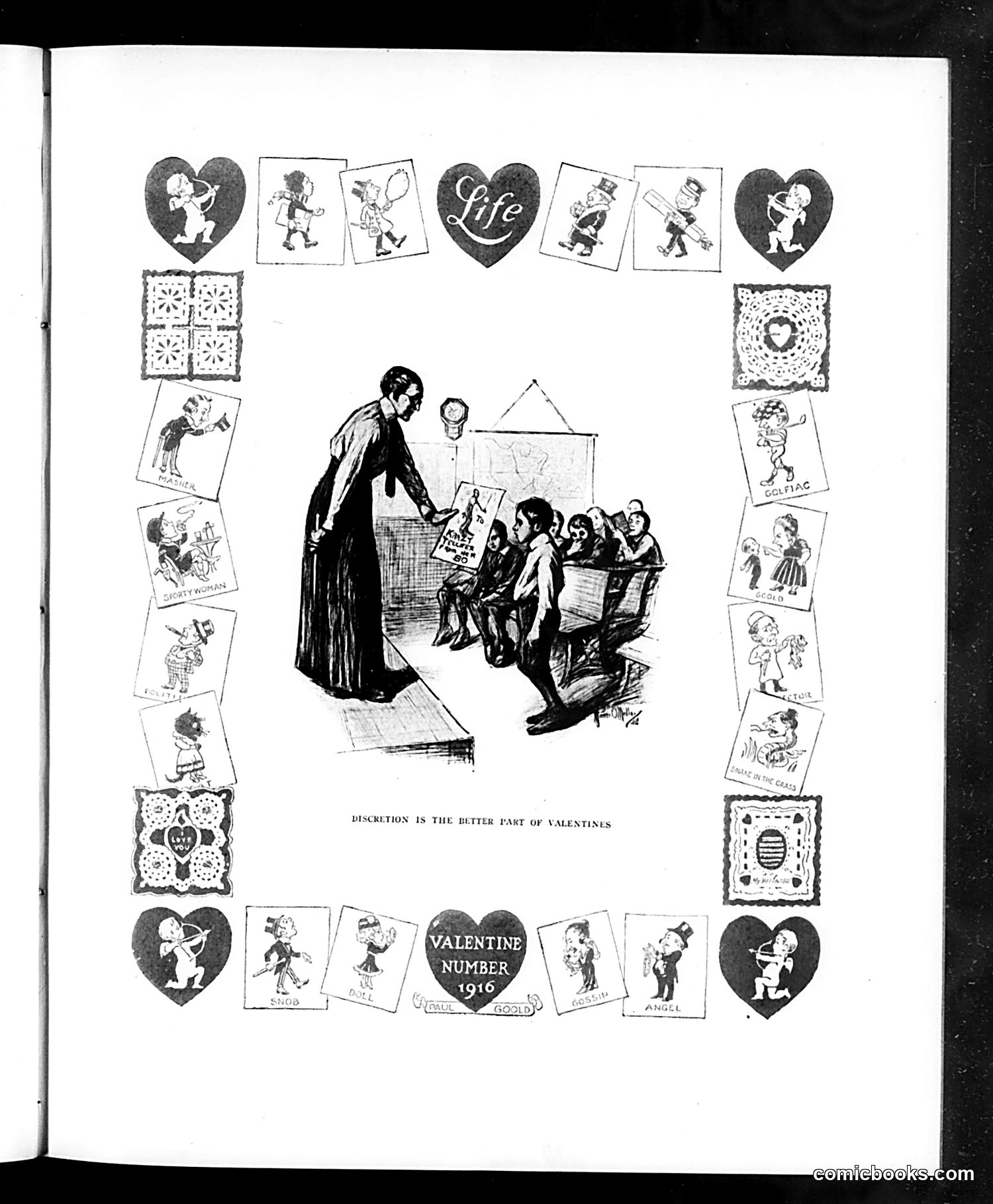
This is a Valentine's Day–themed page from *Life* magazine's 1916 Valentine Number. The central illustration shows a schoolteacher presenting valentine cards to a group of children, with the caption "DISCRETION IS THE BITTER PART OF VALENTINES." The satire appears to target the social awkwardness of Valentine's Day exchanges in schools. The joke suggests that teachers (or adults) must exercise discretion when distributing valentines to avoid hurt feelings—some children receive valentines while others may not, creating uncomfortable situations. The ornamental border features decorative valentine elements (hearts, cherubs, lace doilies) typical of early 1900s Valentine imagery, along with small comic character illustrations. The page mocks the sentimental tradition by highlighting its potential for social embarrassment, particularly in institutional settings where equal treatment is expected but impossible.
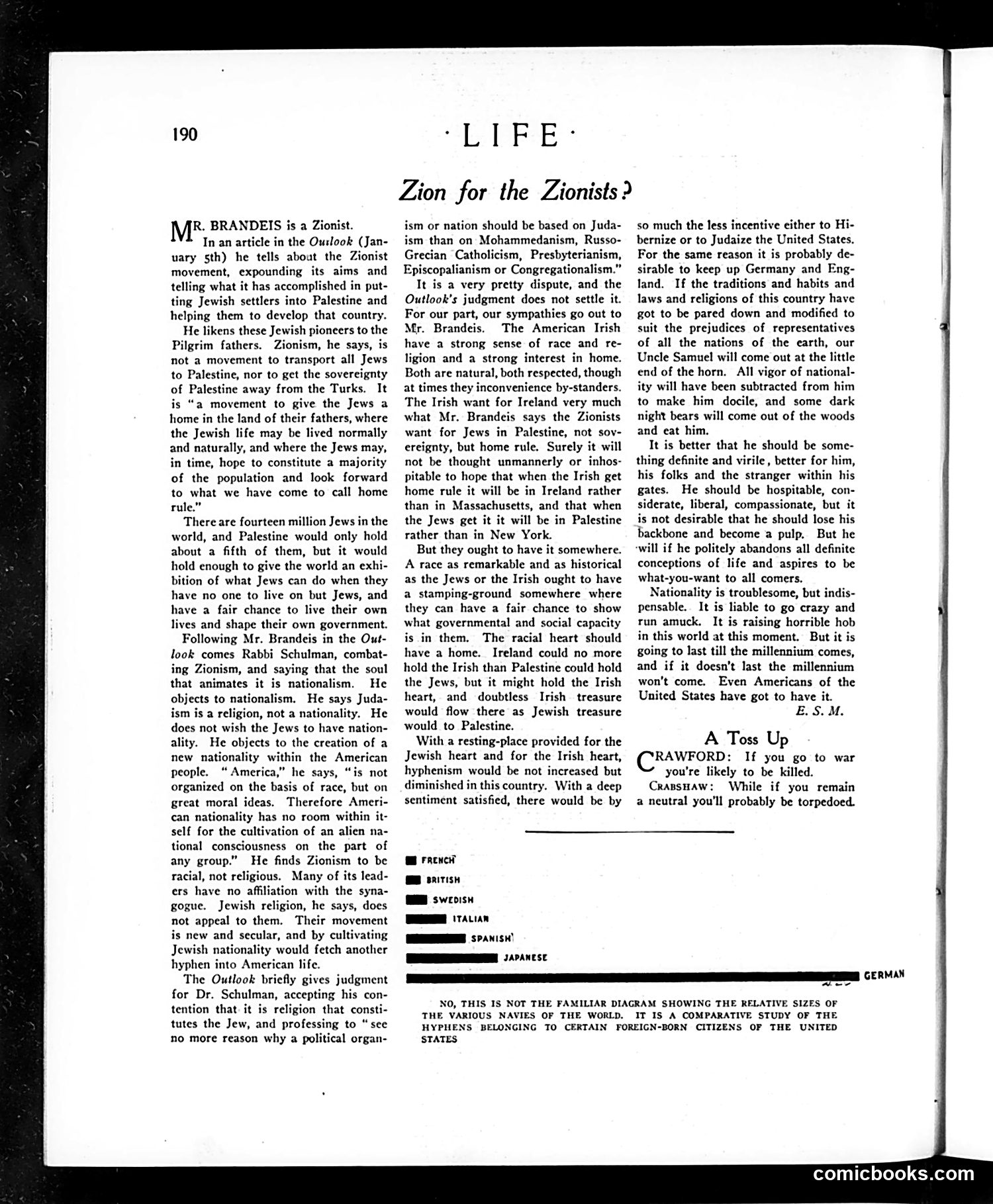
This page contains two distinct pieces: **"Zion for the Zionists?"** - A lengthy article debating Zionism. The text discusses Mr. Brandeis (likely Supreme Court Justice Louis Brandeis, a prominent Zionist), comparing Jewish aspirations for a Palestinian homeland to Irish nationalist desires for Ireland. The piece argues both groups deserve self-determination but questions whether creating distinct national states within America is wise, fearing it undermines American unity and national consciousness. **"A Toss Up"** - A brief joke contrasting war and neutrality outcomes for named individuals Crawford and Chastain. The page also includes a bar chart comparing the relative sizes of foreign-born citizens from various nations living in the United States, with German citizens shown as the largest group. The content reflects early 20th-century American debates about nationalism, immigration, and divided loyalties.
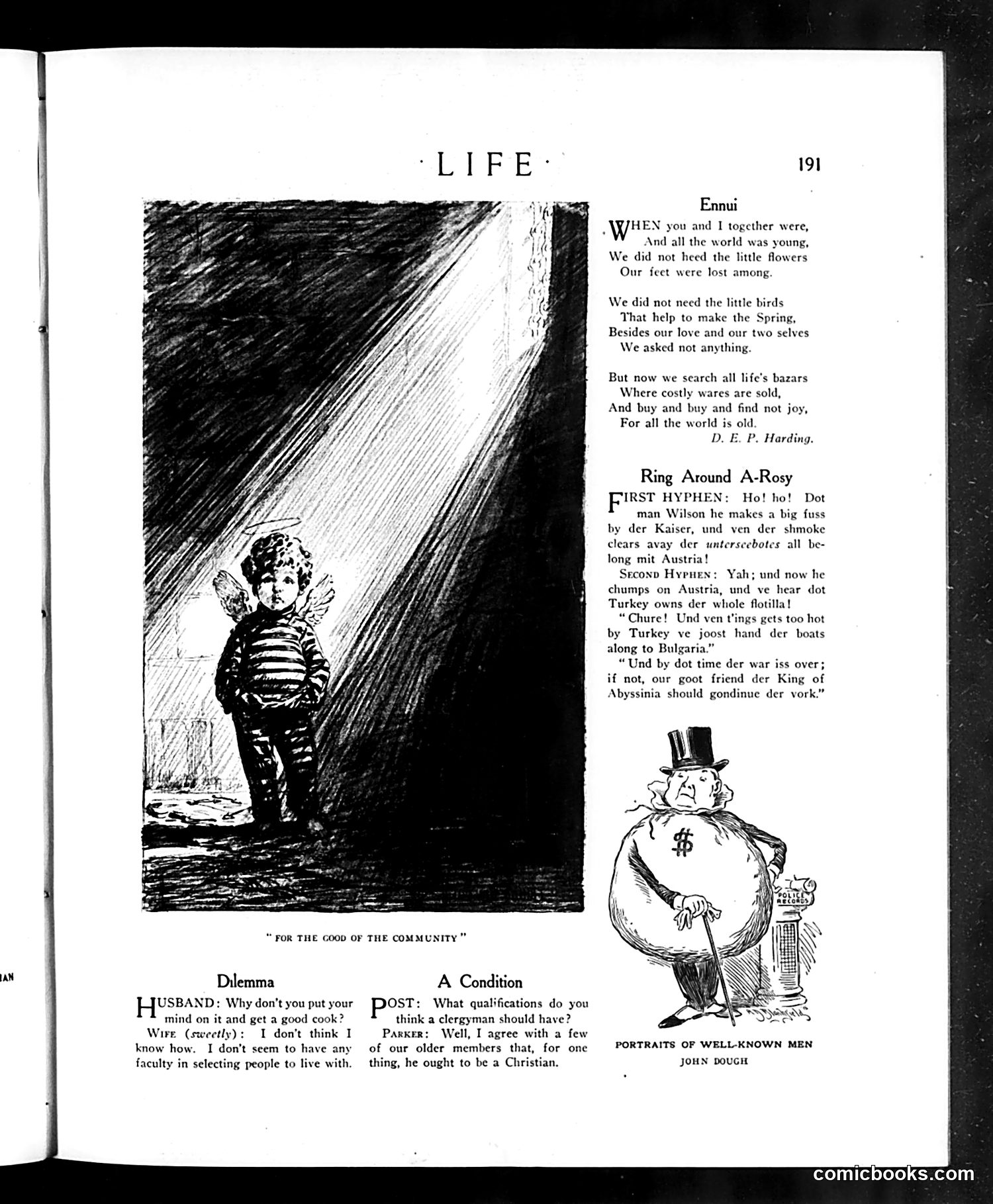
The page contains three distinct pieces: 1. **"Ennui"** - A poem by D.E.P. Harding contrasting youthful romance with adult materialism and worry. 2. **"Ring Around A-Rosy"** - A satirical dialogue in German-inflected English mocking World War I politics, specifically criticizing American intervention and European political entanglements involving Austria, Turkey, and Bulgaria. The hyphenated characters debate whether the war is over and make cynical commentary about international diplomacy. 3. **"Dilemma" and "A Condition"** - Paired comic dialogues about marriage and clergy qualifications, presenting domestic and religious humor. 4. **"Portraits of Well-Known Men: John Dough"** - A caricature of a rotund, wealthy figure marked with a dollar sign, satirizing American capitalism and greed. The overall theme critiques both wartime politics and American materialism.
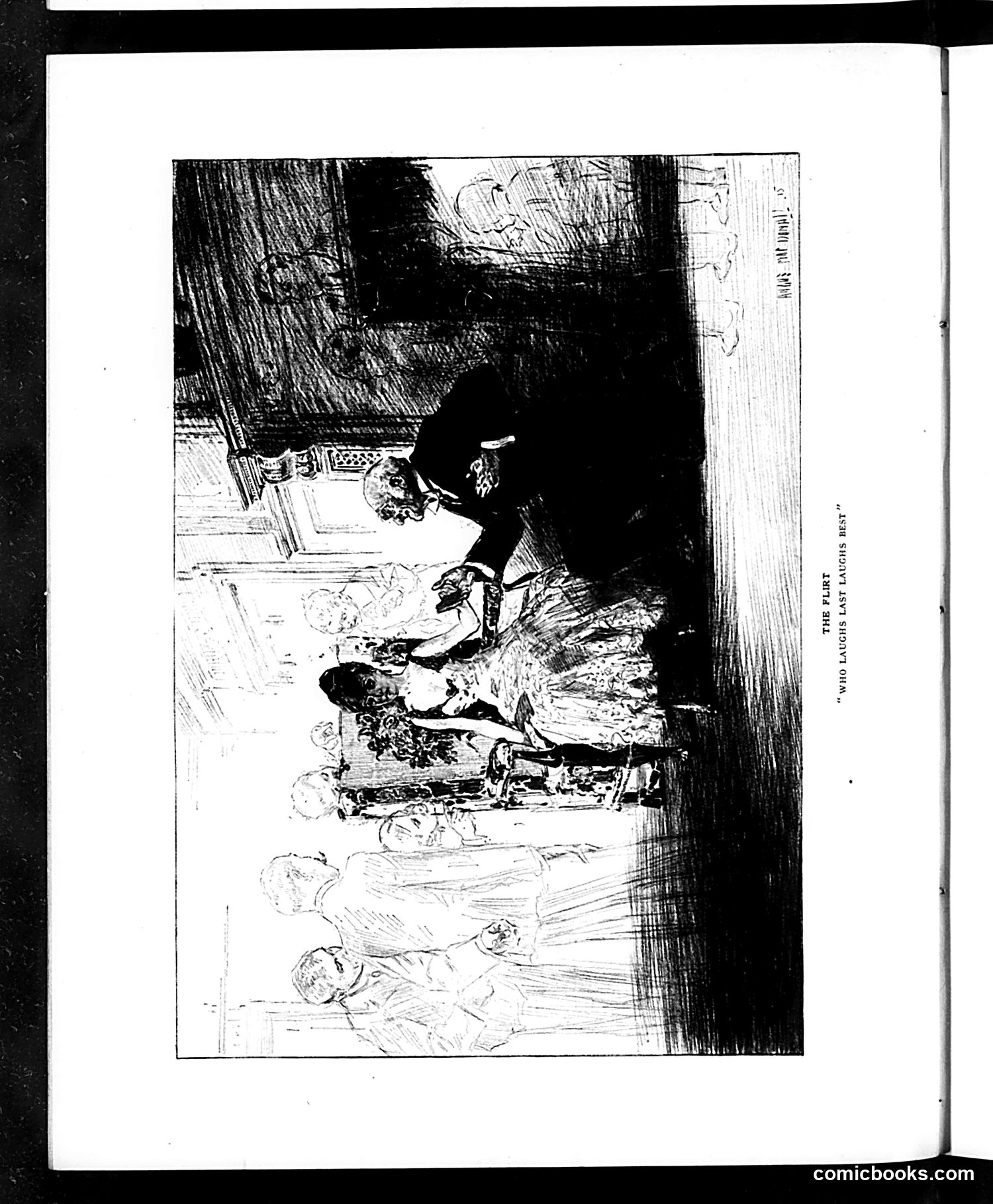
The page shows a single etching or engraving titled "THE FLIRT" with the subtitle "'With Laurels Last Comes Best.'" The image depicts what appears to be a social scene in an interior setting, rendered in a detailed crosshatching style typical of 19th-century satirical illustration. A woman in dark clothing is the central figure, positioned prominently, with several other figures around her in what seems to be a drawing room or parlor. Without additional context about the specific issue of *Life* magazine or the artist's identity, I cannot definitively identify the particular social commentary or individuals being satirized. The title suggests commentary on flirtation or romantic behavior, but the specific historical or political references—if any—remain unclear from the image and text alone.
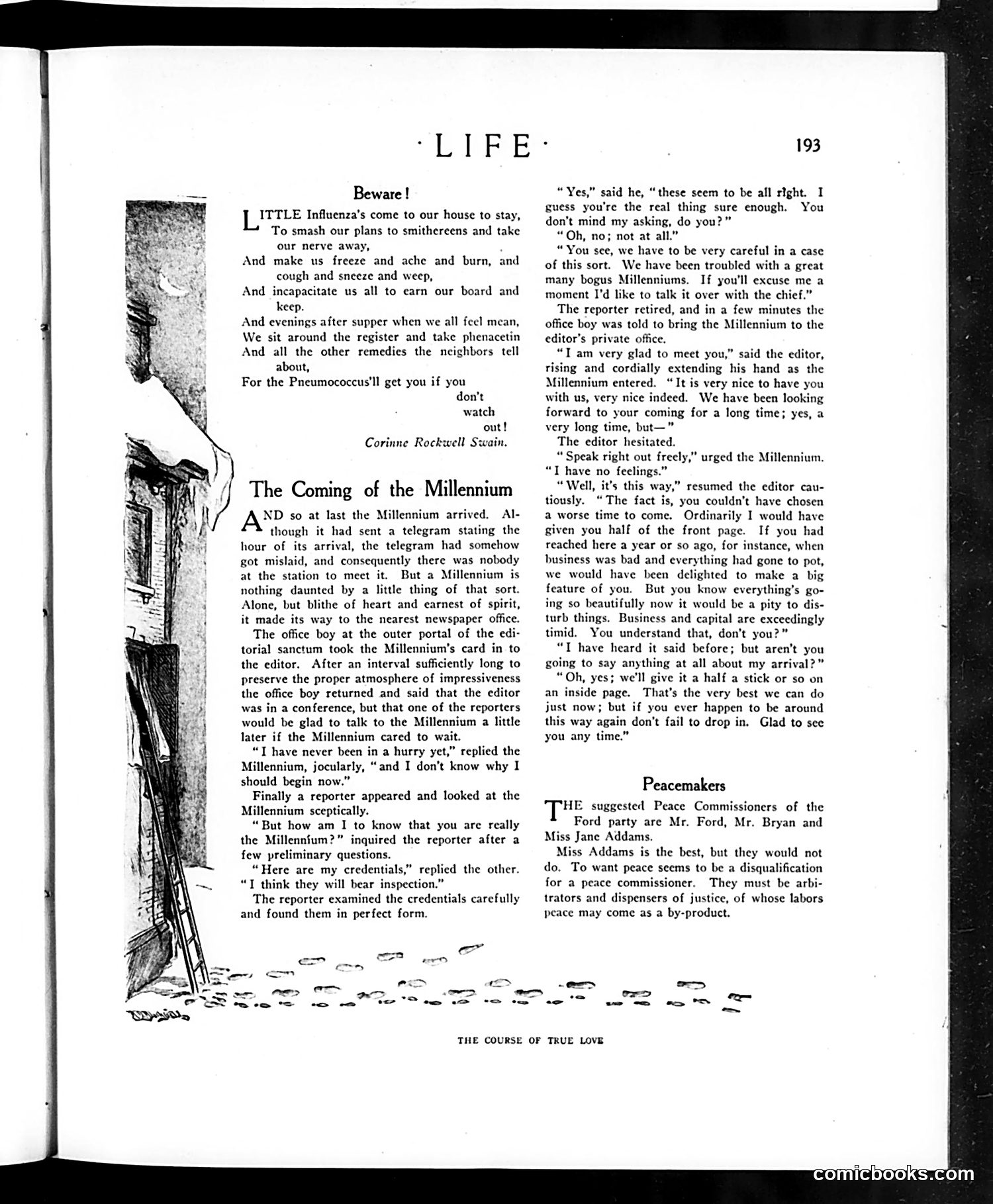
This satirical piece mocks the sensationalism surrounding the approaching year 1900 (the "Millennium"). A young reporter visits a newspaper editor seeking a story about the millennium's arrival. The editor dismisses the reporter's concerns, admitting the public is anxious but refusing to give it major coverage—offering only "half a stick" (minor space) on an inside page. The humor lies in exposing editorial cynicism: despite genuine public anxiety about the new century, editors treat it as manufactured drama unworthy of serious attention. The accompanying poem "Beware!" satirizes common millennial fears (plague, freezing temperatures, financial collapse). The second section, "Peacemakers," appears to reference contemporary peace commission negotiations, though specific figures remain unclear from the text alone.
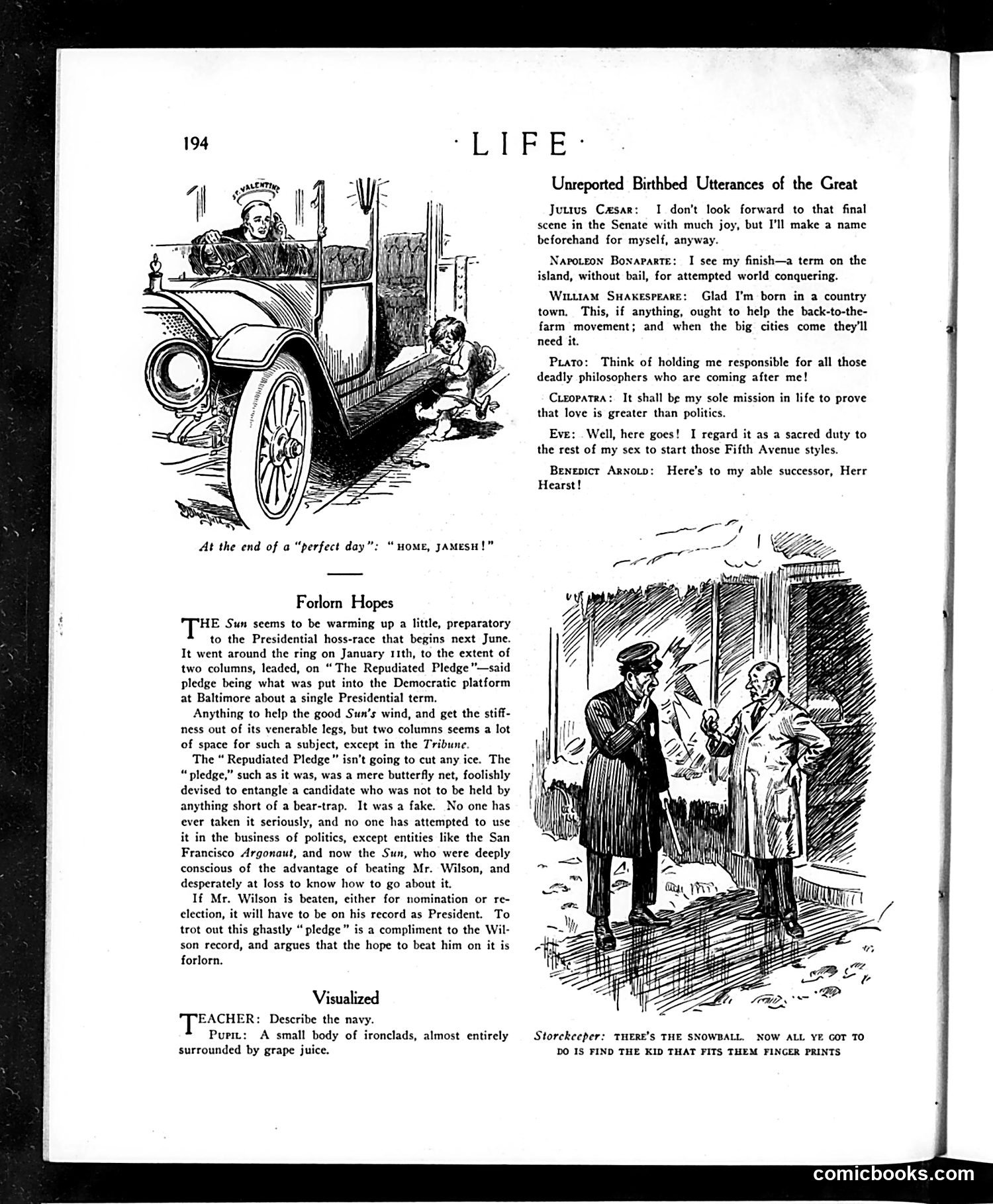
**Top Section - "Unreported Birthbed Utterances":** This satirical piece imagines what famous historical and literary figures might say at life's end. The quotes mock their legacies: Julius Caesar worries about his reputation; Napoleon accepts island exile; Shakespeare promotes agrarianism; Plato frets about philosophers; Cleopatra prioritizes love over politics; Eve regrets fashion trends; Benedict Arnold toasts his successor. The humor lies in reducing these figures to petty or contradictory final concerns. **"Forlorn Hopes" Section:** Political commentary on the "Repudiated Pledge"—likely referencing a Democratic platform promise (possibly about single presidential terms). The article dismisses the pledge as ineffective political theater, noting only entities like the *San Francisco Argonaut* take it seriously. It suggests the pledge won't prevent Wilson's nomination or reelection. **"Visualized" Section:** A teacher-pupil joke about describing the navy: the pupil defines it as "ironclads surrounded by grape juice"—conflating naval warships with literal grapes.
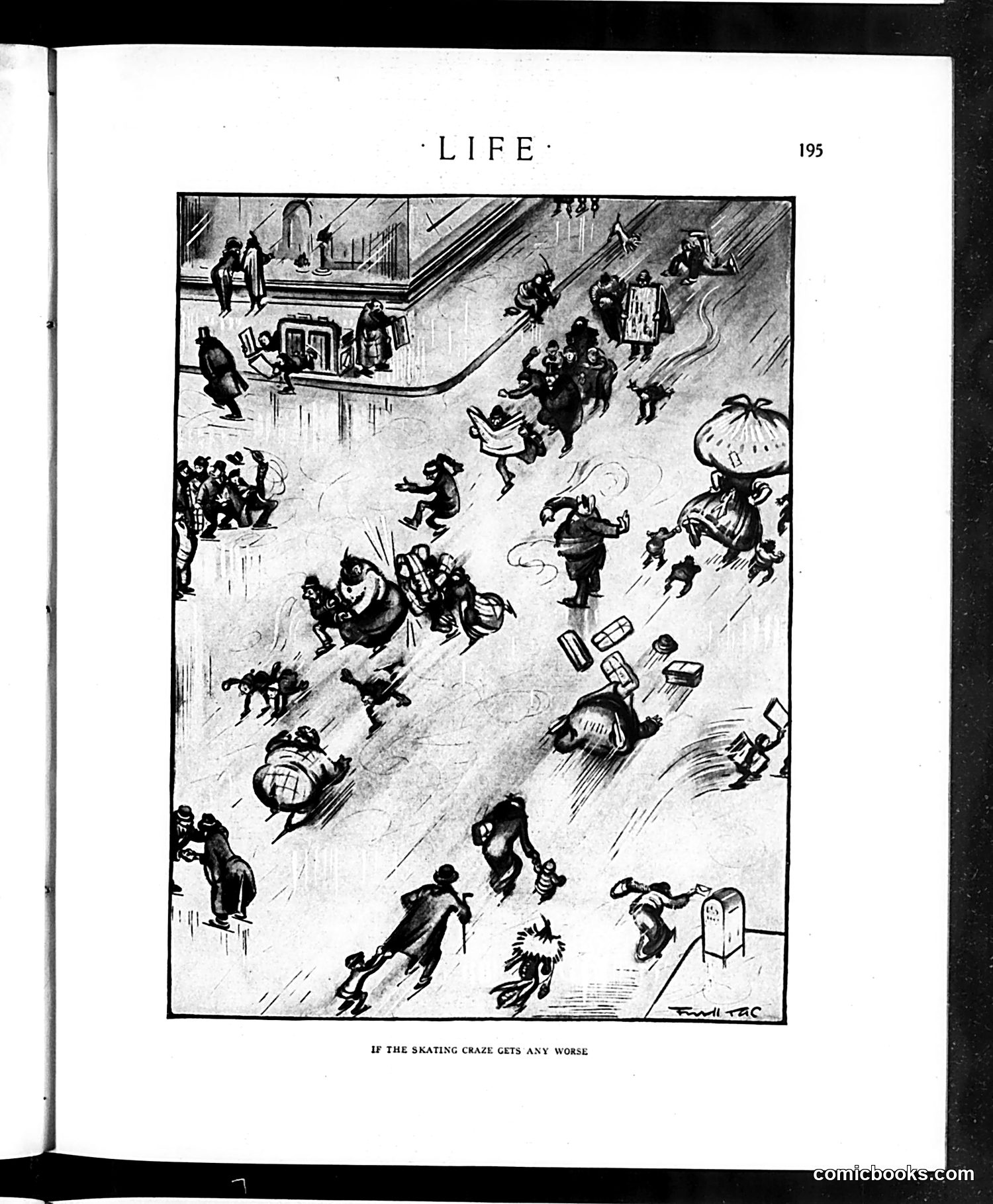
This cartoon satirizes the widespread popularity of roller skating during what appears to be the early 20th century. The illustration depicts a chaotic urban street scene where skating has become so prevalent that it's created mayhem—people of all types (including children, adults, and what appear to be authority figures) are skating recklessly across sidewalks and streets, colliding with pedestrians, disrupting traffic, and causing general pandemonium. The humor lies in the exaggerated consequences of this "craze": the cartoon warns that if skating popularity continues, cities will descend into utter disorder. The signed artist name "Frueh Tac" appears in the lower right. This is typical period satire mocking contemporary fads and their perceived social disruptions.
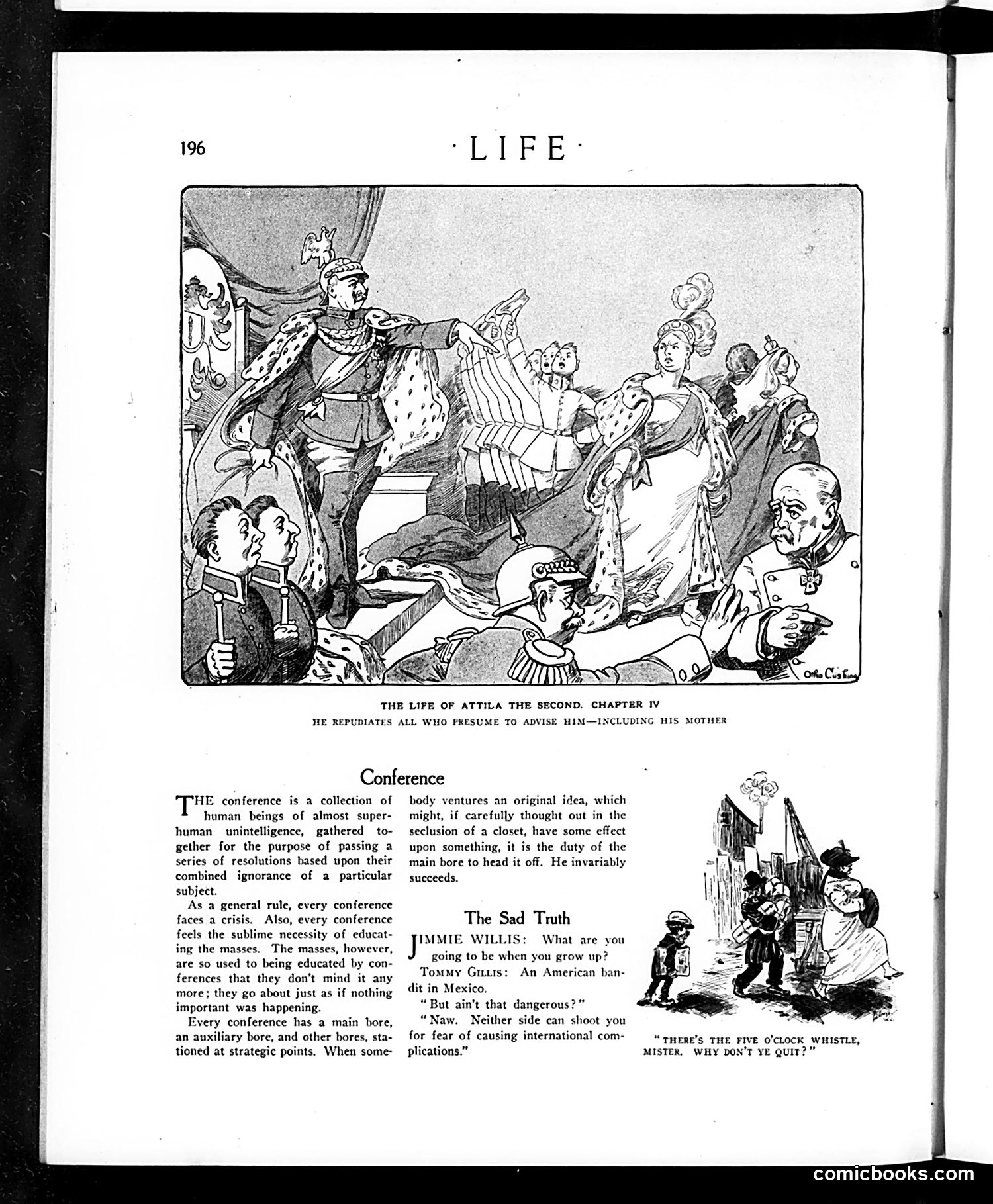
**Top Cartoon:** "The Life of Attila the Second, Chapter IV" depicts a military or autocratic figure rejecting advice from advisors and his mother. The title sarcastically compares the subject to Attila the Hun, suggesting he's a dictatorial leader who brooks no counsel. The specific historical figure remains unclear from the image alone. **"Conference" Essay:** A satirical piece mocking the ineffectiveness of conferences—portrayed as gatherings of unintelligent people producing resolutions based on "combined ignorance." It criticizes how the "main bore" systematically kills original ideas. This reflects early 20th-century American skepticism toward bureaucratic meetings and their actual utility. **"The Sad Truth":** A brief joke about an American bandit operating in Mexico during the Mexican Revolution era. The humor relies on the idea that neither U.S. nor Mexican forces would shoot him for fear of international incidents—satirizing the political tensions between nations and how outlaws might exploit diplomatic complications.
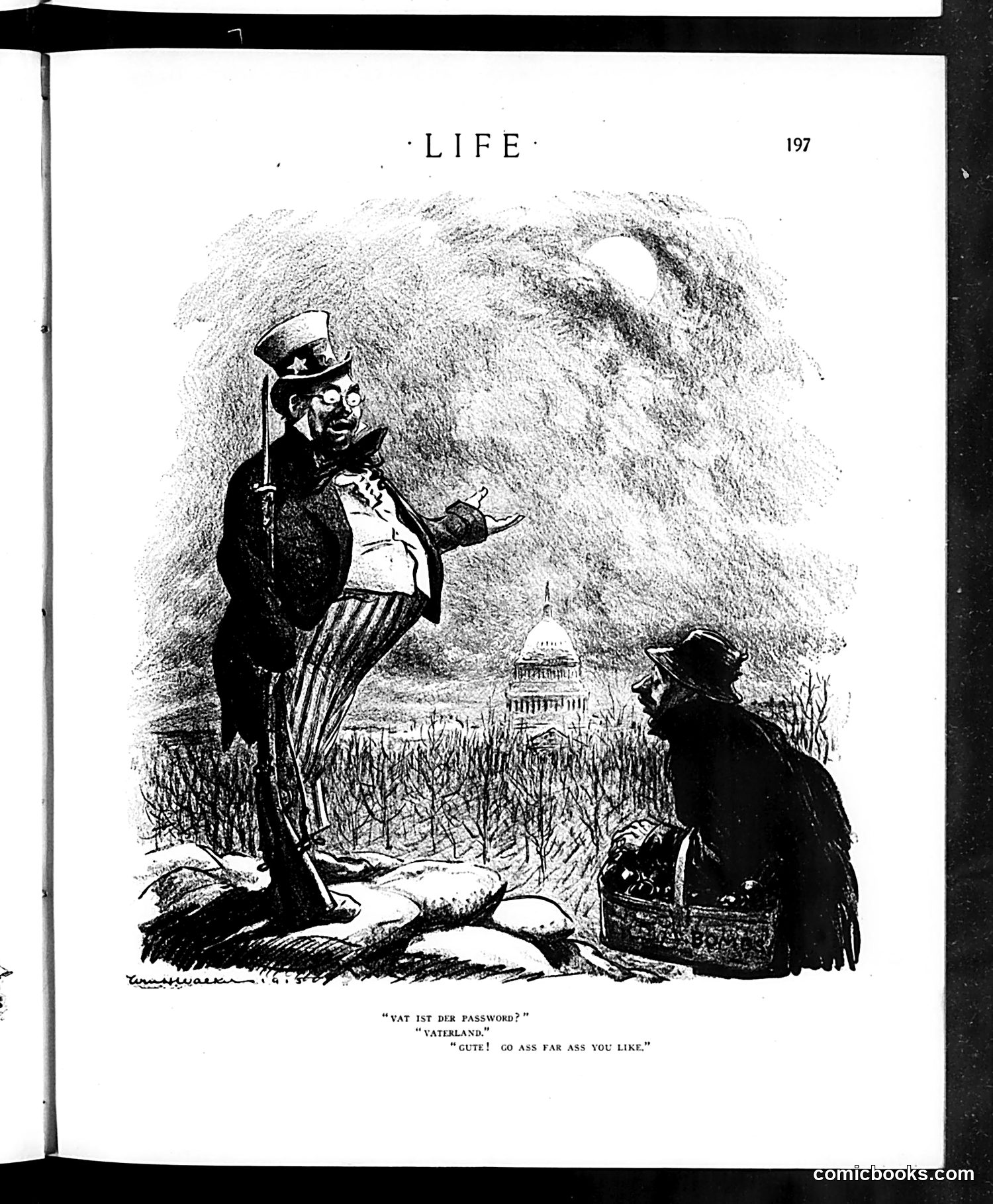
This Life magazine cartoon depicts a figure in Uncle Sam attire (top hat with star, striped pants) confronting another figure near the Capitol building. The dialogue reads: - "Vat ist der password?" ("Vaterland") - "Cute! Go ass far ass you like." The cartoon satirizes concerns about German infiltration or influence in American politics, likely from the World War I era. The figure asking for a "password" in German accent appears to represent a German spy or operative seeking access to American government. Uncle Sam's permissive response ("go as far as you like") mocks American security vulnerabilities or suggests political naivety regarding foreign threats. The satire targets either inadequate security measures or political figures suspected of being too accommodating to German interests during a period of American-German tension.
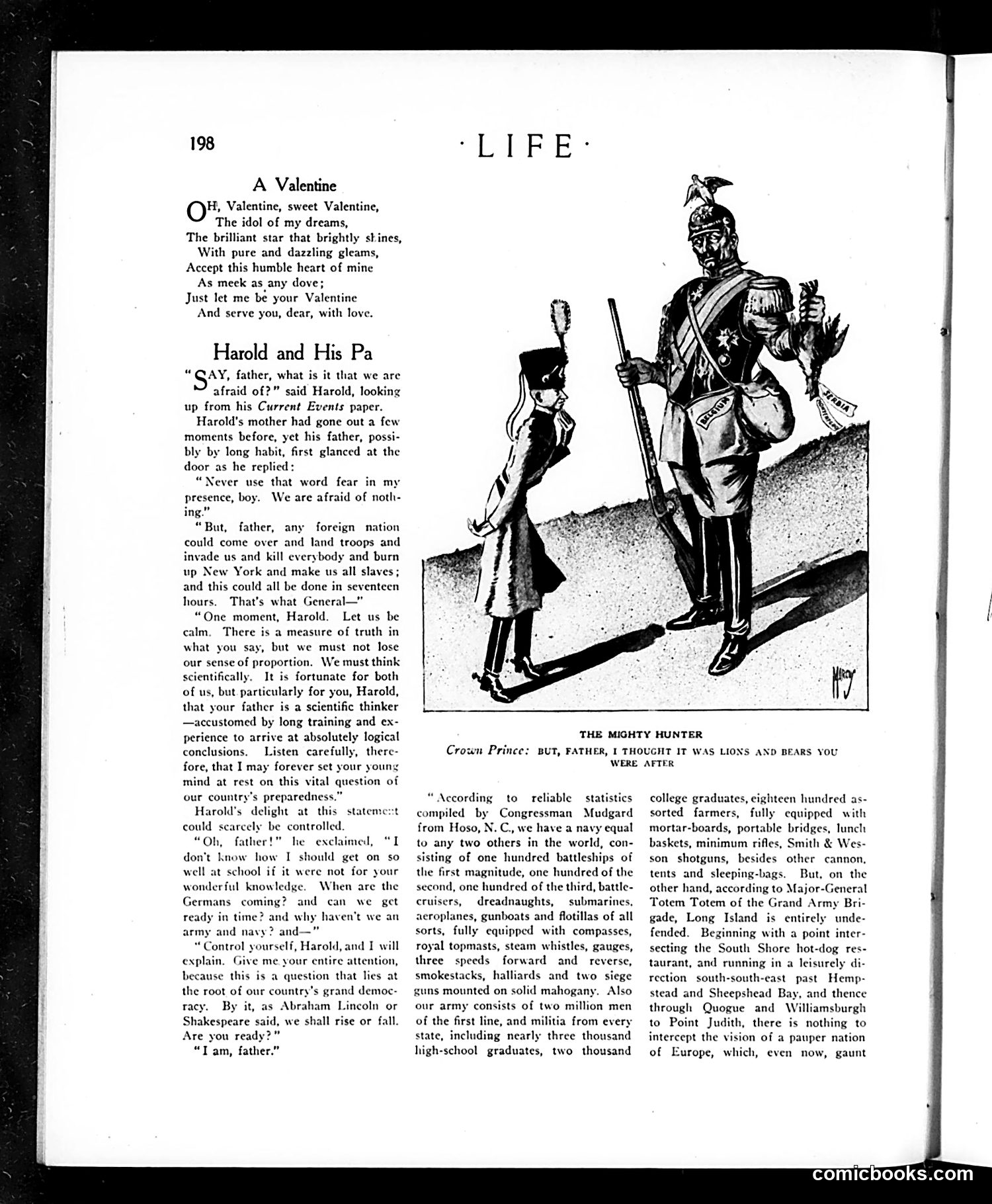
This page contains two satirical pieces about American military preparedness, likely from the WWI era. **"Harold and His Pa"** mocks overconfident patriotism. A father reassures his anxious son about national defense by citing absurdly inflated military statistics (100 battleships of the "first magnitude," etc.) attributed to "Congressman Mudgard." The humor lies in the father's pompous pseudo-logic—he claims scientific thinking while spouting nonsensical numbers. The satire targets politicians and adults who bluster about military readiness without genuine knowledge. **"The Mighty Hunter"** cartoon depicts Germany's Crown Prince with a dead body, captioned that he thought he was hunting "lions and bears." This is darker satire, presenting the Crown Prince as a hunter who's actually killing humans—commentary on German militarism and the human cost of war. Together, these pieces satirize both American complacency (inflated confidence in unproven defenses) and German aggression, reflecting anxieties about potential European conflict spreading to America.
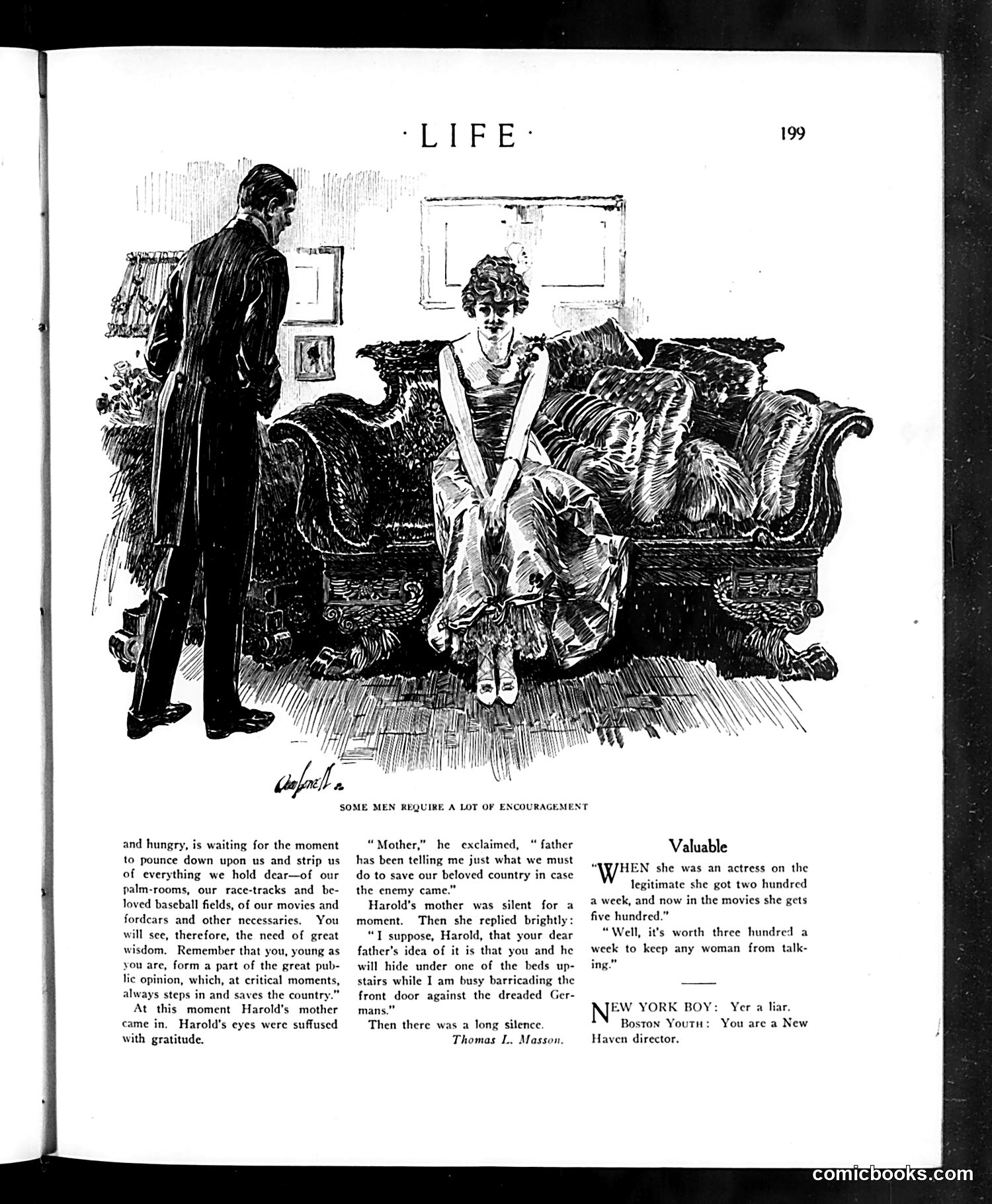
This page contains two separate satirical pieces from Life magazine, likely from World War I era (given references to "the dreaded Germans"). **Main Cartoon: "Some Men Require a Lot of Encouragement"** A father lectures his son Harold about patriotic duty and public opinion's role in "saving the country" from an enemy threat. The satire's punch comes when Harold's mother enters and deflates his newfound patriotic fervor by sardonically suggesting the father's real plan is to hide under beds while *she* barricades the door against Germans. The joke mocks men who inspire others to sacrifice while planning personal cowardice—a common WWI-era criticism of those who promoted war enthusiasm without serving themselves. **Side Jokes** Brief quips mock an actress's salary increase in movies versus theater (suggesting she's paid extra for silence), and a regional insult exchange between New York and Boston boys. The satire targets selective patriotism and masculine hypocrisy during wartime.
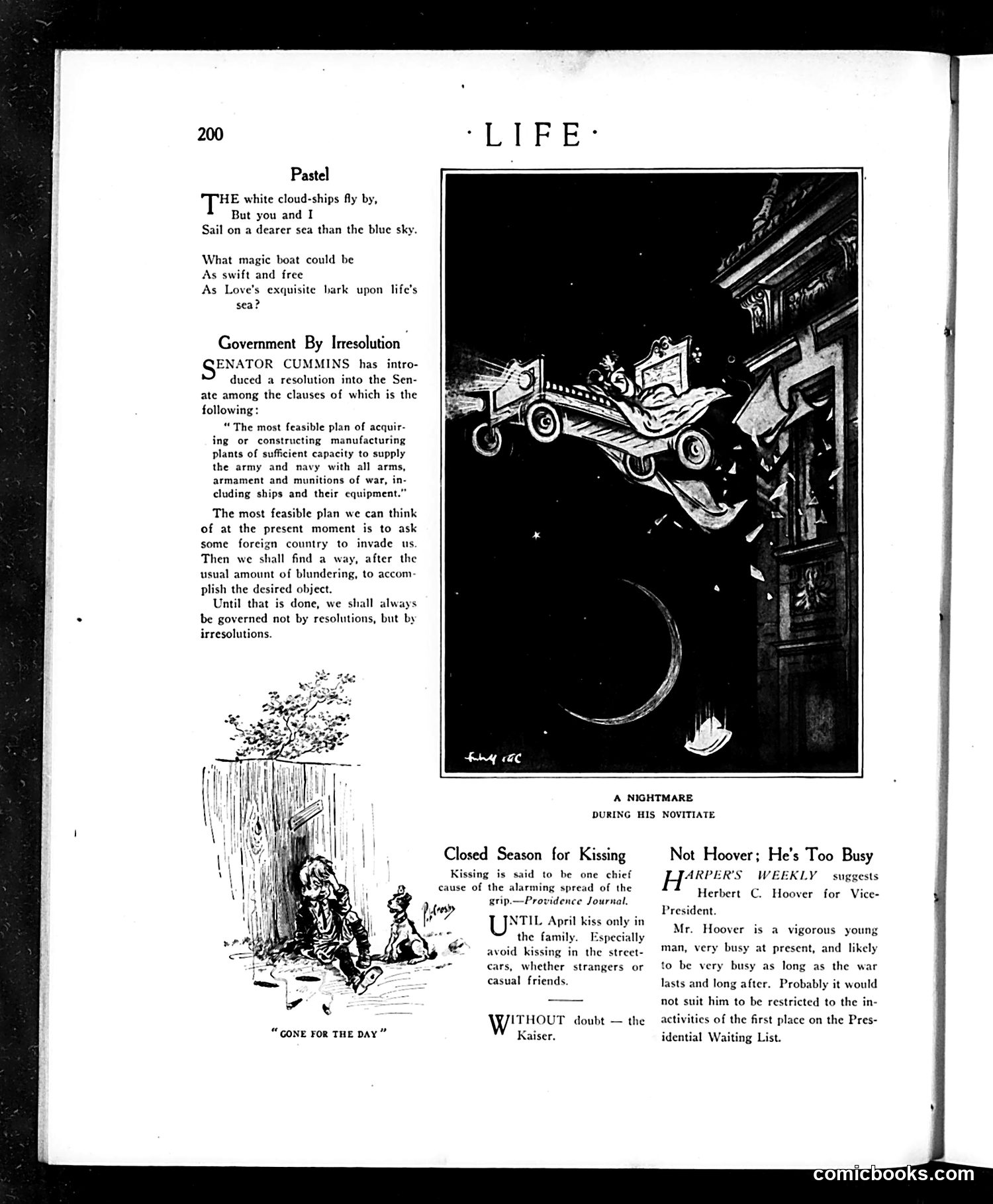
This page from *Life* magazine contains three distinct satirical pieces: 1. **"Government By Irresolution"**: Mocking Senator Cummins's military preparedness resolution. The satire suggests American government is so ineffectual that the only way to achieve military readiness would be to wait for a foreign invasion—then respond with typical bureaucratic "blundering." 2. **"Closed Season for Kissing"**: A brief joke about public health concerns during what appears to be WWI (referenced by "the Kaiser"), suggesting kissing spreads disease and should be restricted to families only. 3. **"Not Hoover; He's Too Busy"**: *Harper's Weekly* satirically suggests Herbert Hoover as Vice President, arguing he's too occupied with wartime activities to accept the ceremonial position—a backhanded compliment implying the Vice Presidency is an idle role. The nightmare illustration depicts someone suspended precariously, likely visualizing anxieties about wartime chaos or incompetent leadership.
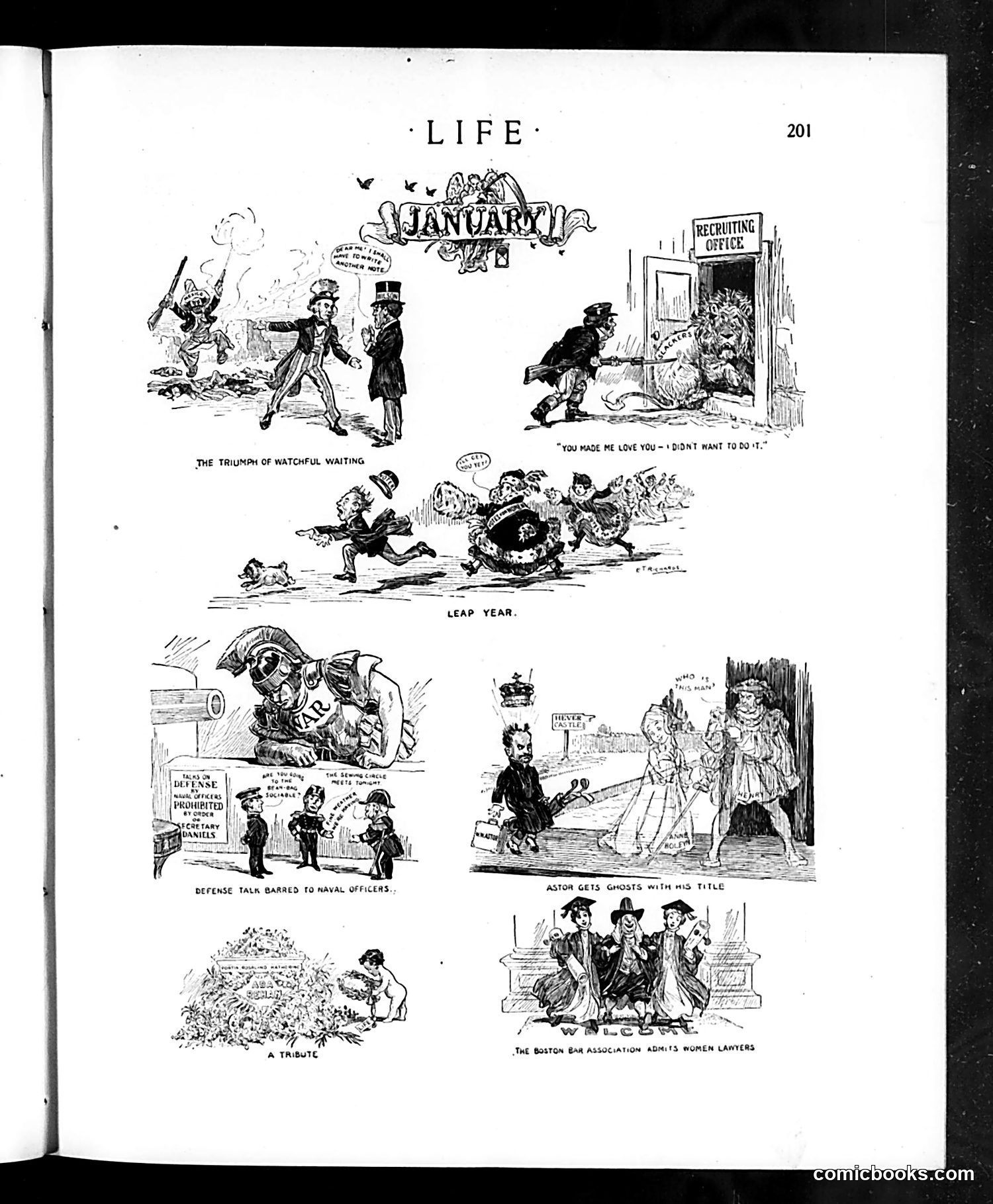
This January issue contains eight satirical cartoons commenting on 1920s American social and political events. **Key cartoons visible:** - **"The Triumph of Watchful Waiting"**: Appears to reference U.S. foreign policy passivity - **"Leap Year"**: Women aggressively pursuing men, satirizing gender role reversals during the women's suffrage era - **"You Made Me Love You"**: Man coerced into a recruiting office, likely commenting on WWI draft reluctance - **"Defense Talk Barrels to Naval Officers"**: Military preparedness discussions - **"Astor Gets Ghosts With His Title"**: Satirizes the wealthy Astor family - **"The Boston Bar Association Admits Women Lawyers"**: The bottom cartoon celebrates—or ironically comments on—women's professional advancement The page demonstrates Life magazine's satirical approach to contemporary social change, particularly women's expanding roles in professional and public life.
This page discusses Secretary of War Lindley M. Garrison's military preparedness plan, which proposes moderate increases to the regular army and a volunteer reserve force—falling short of the "universal, obligatory military training" demanded by the National Security League. The editorial notes that prominent Republican figures (Root, Stimson, Wickersham, Wright, and Bacon) support Garrison's plan, though with "moderate confidence," doubting Congress will authorize even this modest expansion. The cartoons (visible but small) appear to mock preparedness debates. The piece argues that Americans, unaccustomed to such military obligations, will want to debate the issue thoroughly before accepting mandatory training. It suggests Garrison's voluntary approach might work temporarily if Congress backs it, particularly given wartime anxieties—though it questions whether this addresses long-term defense needs or merely short-term emergency response to the ongoing European war.
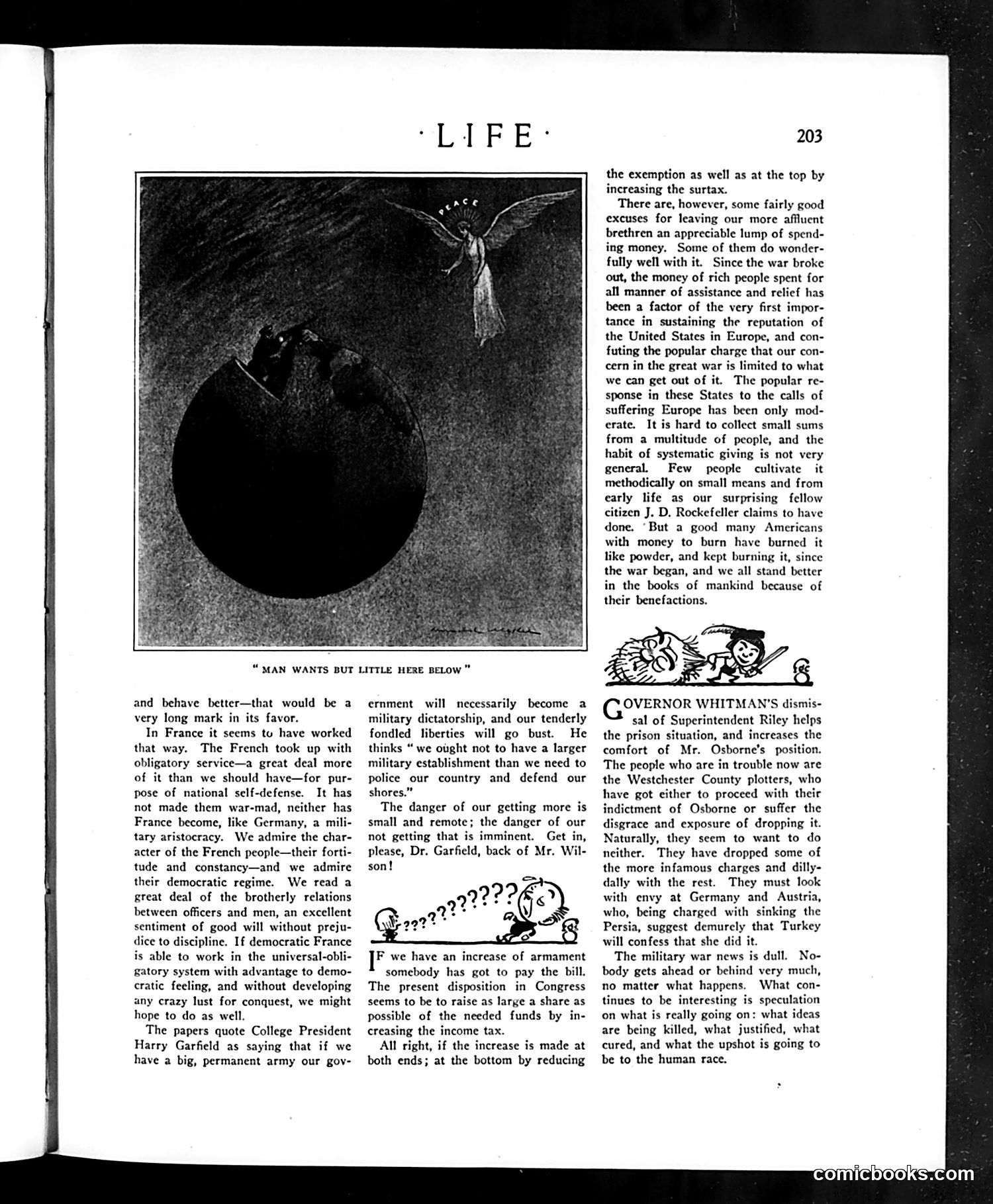
The main cartoon, titled "Man Wants But Little Here Below," depicts a large dark sphere (likely representing Earth or a bomb) with a small figure beneath it—satirizing humanity's modest desires against the scale of warfare and destruction. The text debates military preparedness versus the risk of militarism. It quotes College President Harry Garfield's concern that a large standing army would create military dictatorship, while the author argues defensive armament is necessary. The piece supports France's approach to mandatory military service, claiming it hasn't created militarism there. A secondary cartoon shows a confused figure with question marks, relating to Congress debates over funding military expansion through income tax increases—proposing higher taxes on both wealthy individuals (increased surtax) and lower-income earners (reduced exemptions). The final section discusses Governor Whitman's dismissal of Prison Superintendent Riley, with a cynical comparison to Germany and Austria deflecting blame for sinking the ship Persia by suggesting Turkey confess instead.
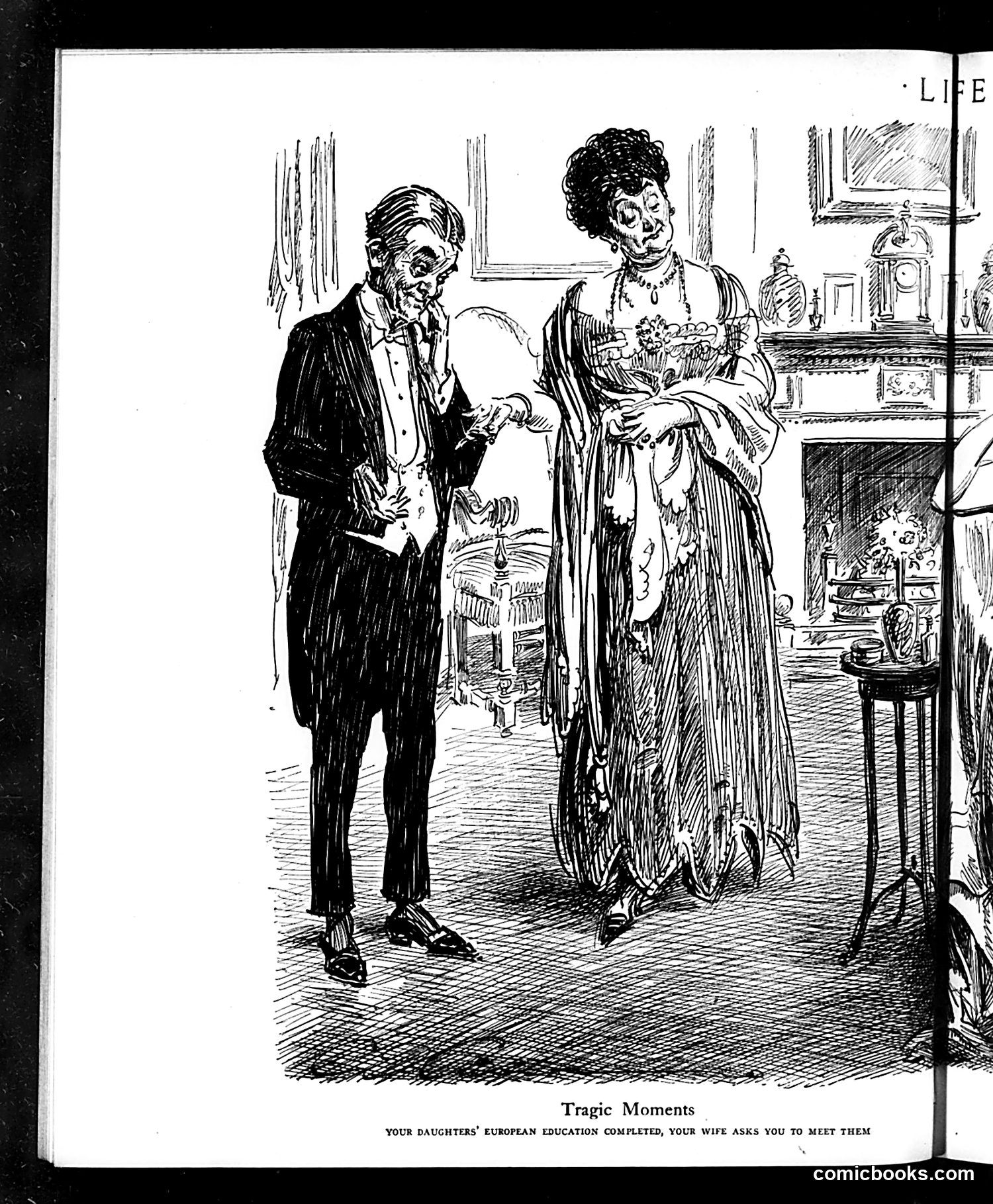
This satirical cartoon mocks the social pretensions of wealthy Americans who send their daughters to Europe for "finishing school" education. The caption's humor lies in the ironic reversal: the father, expecting refined young ladies upon their return, instead encounters his wife requesting he meet them—suggesting the daughters have returned as disappointingly unchanged or perhaps worse. The illustration shows a well-dressed man in formal evening wear appearing anxious or dismayed while conversing with a woman in an ornate gown, set in an elegant interior. The joke critiques both the expense and futility of such European education for American girls, implying that spending considerable money on continental refinement produces no meaningful improvement in his daughters' character or behavior. It reflects early 20th-century American attitudes about class aspiration and gender.
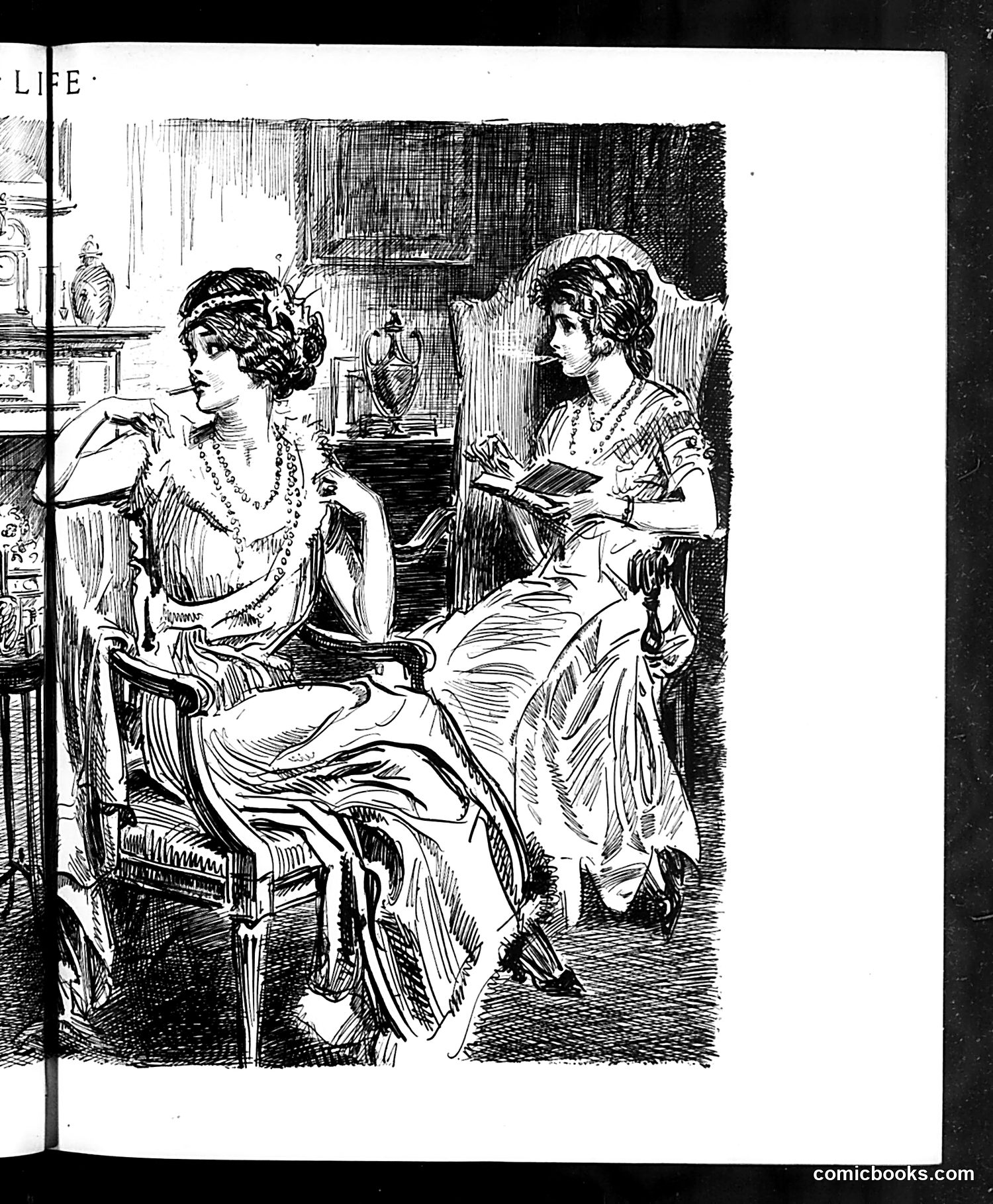
The OCR text is largely unreadable garbled characters, so I must rely on the IMAGE alone. This is a sketch from *Life* magazine showing two well-dressed women in an interior setting. The woman on the left sits pensively, hand to her face, while the woman on the right sits reading a book. The scene depicts what appears to be a leisured, domestic moment between upper-class or middle-class women. Without legible accompanying text, I cannot definitively identify the specific figures, social commentary, or satirical point. The image may address women's roles, leisure activities, education, or social relationships of the period—common *Life* magazine themes—but I cannot assert which without supporting text. To provide accurate historical interpretation, I would need readable OCR text or caption information.
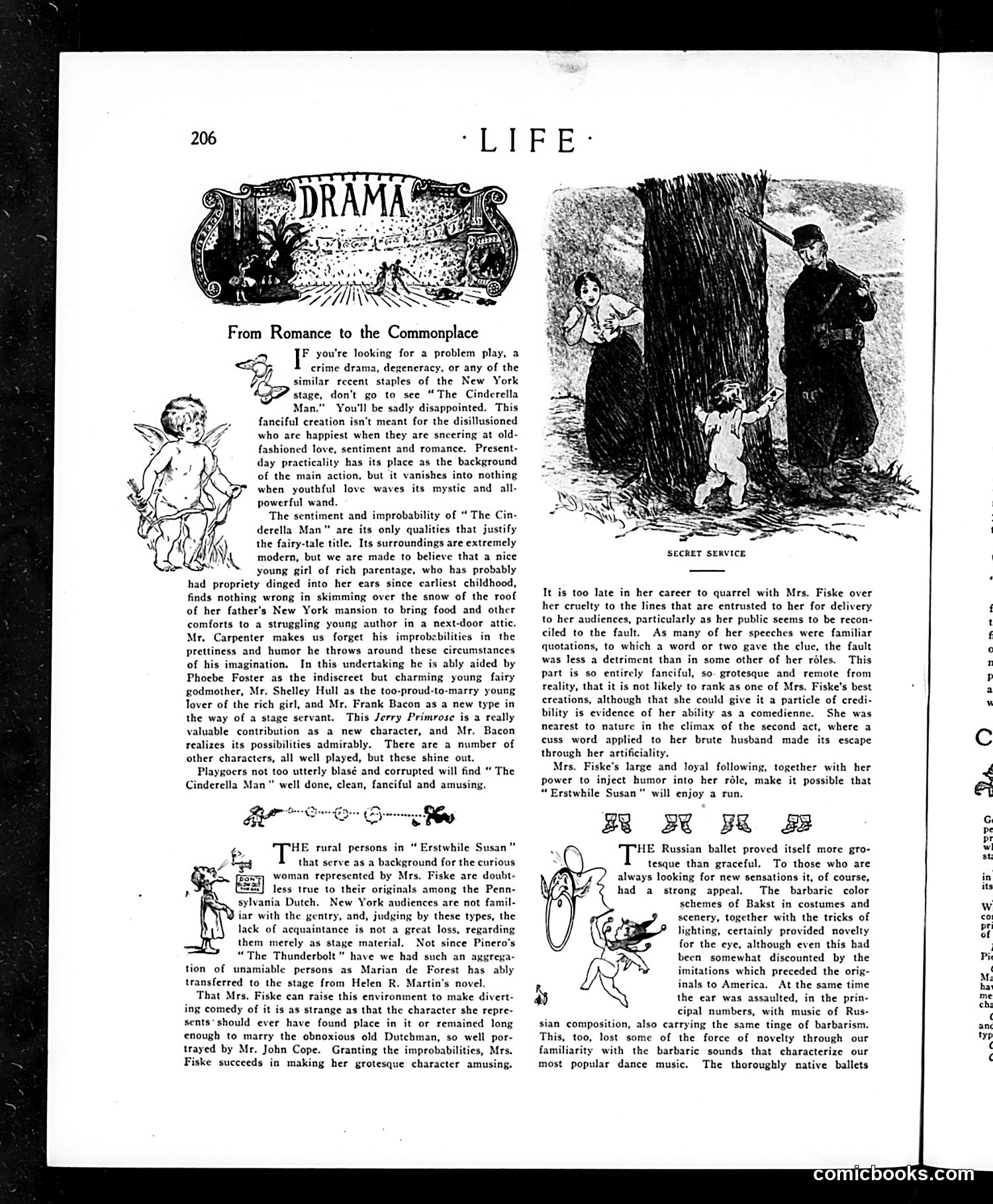
This page reviews three theatrical productions. The main content critiques "The Cinderella Man," a sentimental romantic play featuring Phoebe Foster and Frank Bacon. The reviewer praises it as wholesome entertainment for those not cynical about old-fashioned romance—a notable position given the era's trend toward "problem plays" and social criticism on stage. A secondary review discusses "Erstwhile Susan," starring the renowned actress Mrs. Fiske. The critic acknowledges Fiske's skill but finds the play's rural Pennsylvania Dutch characters unamiable and its premise improbable. The review notes Fiske's reputation for altering her lines, though audiences tolerate this habit. The "Secret Service" review begins at page bottom. The illustrations are decorative theatrical vignettes rather than political cartoons. This represents Life's drama criticism section during a period when theatrical reviews carried cultural weight in American magazines.
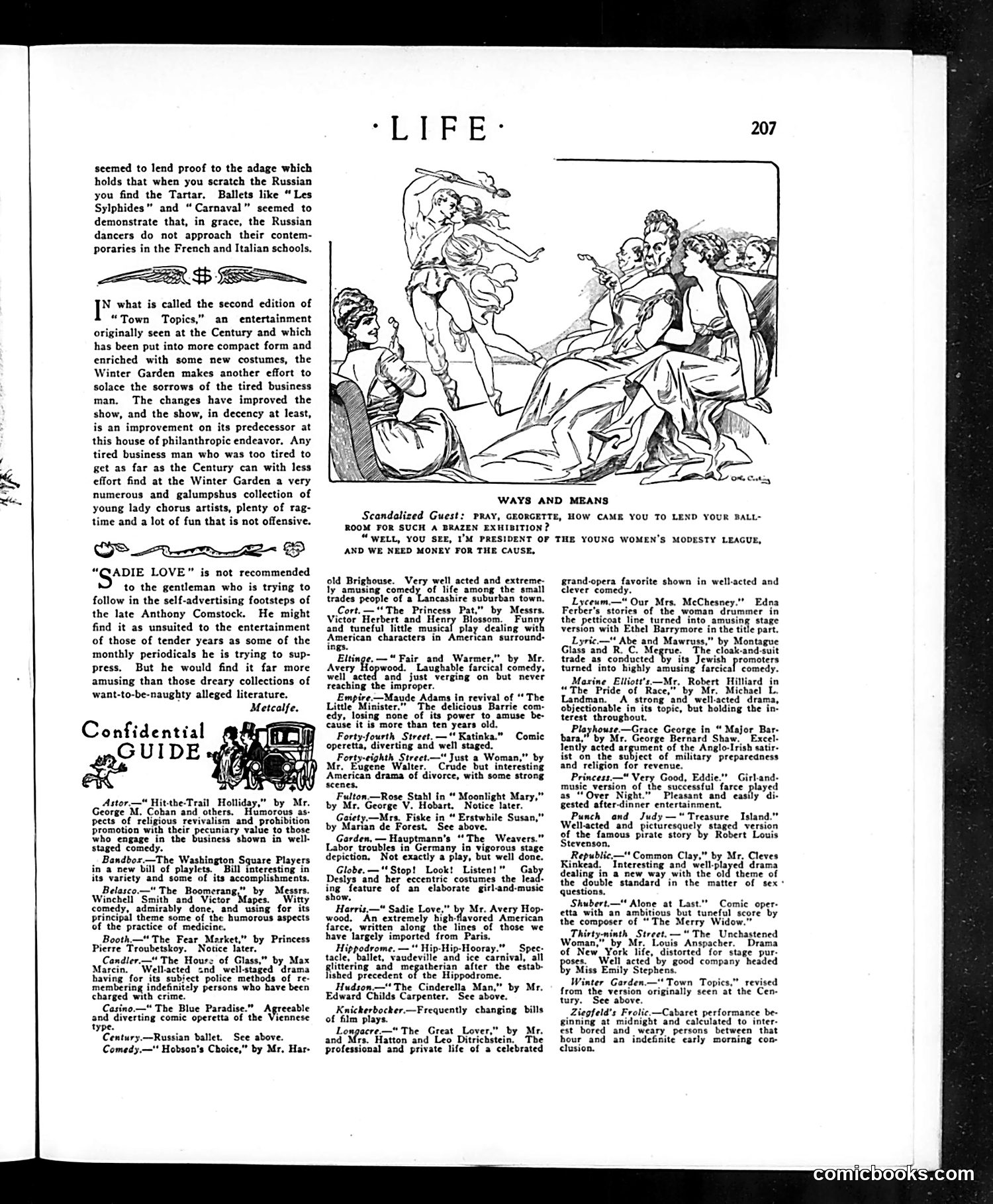
This single-panel cartoon satirizes hypocrisy regarding female morality and fundraising. A scandalized guest questions how the hostess, Georgette, could lend her ballroom "for such a brazen exhibition." Georgette's response reveals the joke: she's president of the "Young Women's Modesty League" and needs money for the cause—meaning she's willing to compromise the very morality she publicly champions to fund an organization supposedly dedicated to protecting it. The humor targets both the pretense of such "modesty leagues" (real organizations that existed in the early 1900s) and the contradiction between public moral posturing and private financial pragmatism. It suggests these organizations were sometimes more concerned with fundraising than actual virtue, and that respectable society women hypocritically participated in or enabled the "brazen" behavior they publicly condemned.
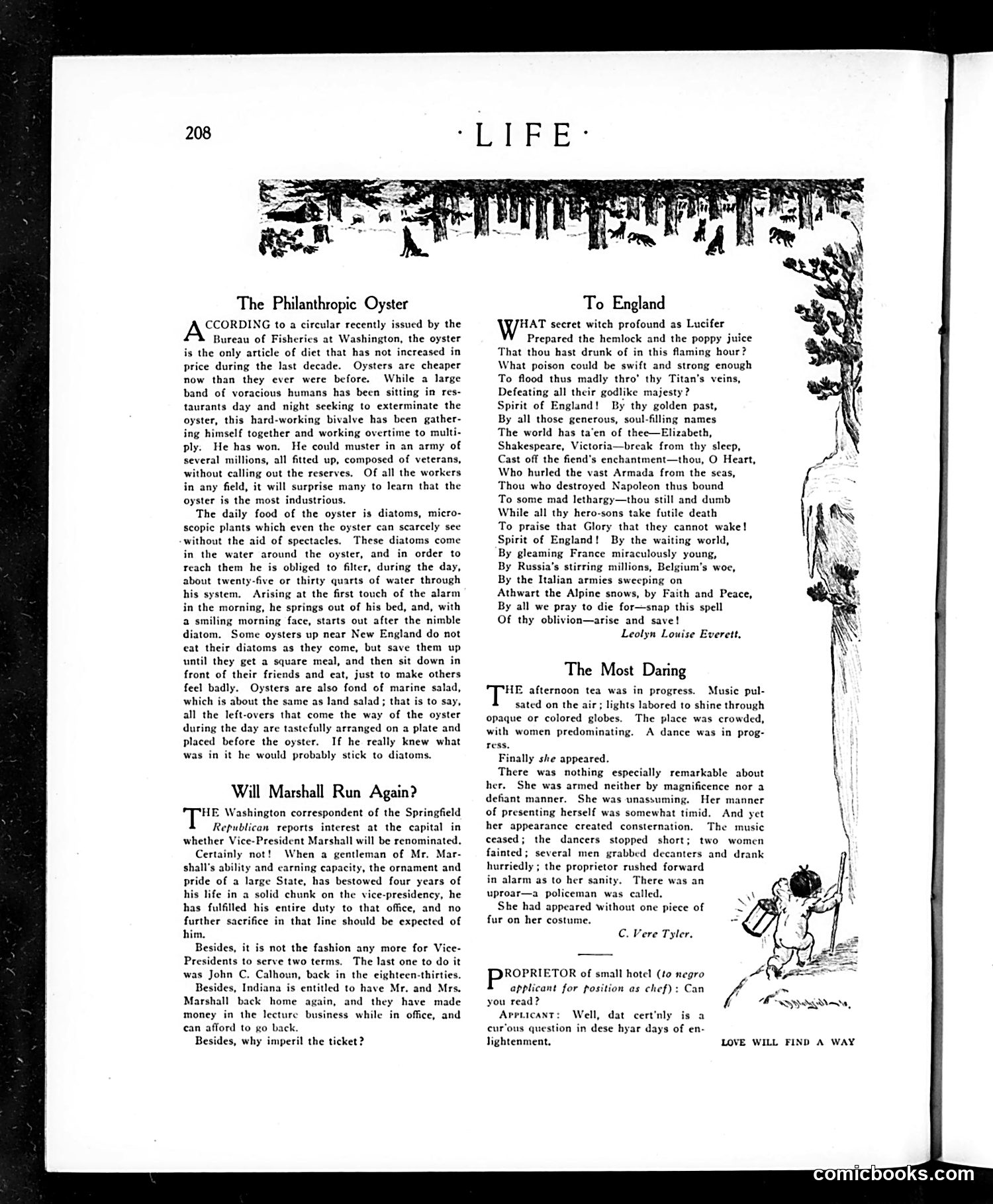
This page contains three distinct pieces of satire and commentary: **"The Philanthropic Oyster"** is humorous filler celebrating oysters as the only food that hasn't increased in price during the last decade. It anthropomorphizes oysters as industrious workers, filtering 25-30 quarts of water daily for microscopic food. The joke mocks human pretension by presenting the oyster's mundane biology as admirable labor. **"Will Marshall Run Again?"** satirizes Vice-President James Sherman Marshall (appearing to reference the 1912 era) through mock-serious argument against his re-nomination. The piece uses repetitive "Besides..." construction for comedic effect, essentially saying: he's done enough, Indiana wants him home, he's made money lecturing—why risk the ticket? It's political humor deflating vice-presidential ambitions. **"To England"** is a serious patriotic poem (not satire) addressing England during World War I, urging the nation to awaken from apparent lethargy and join the war effort alongside France, Russia, and Belgium.
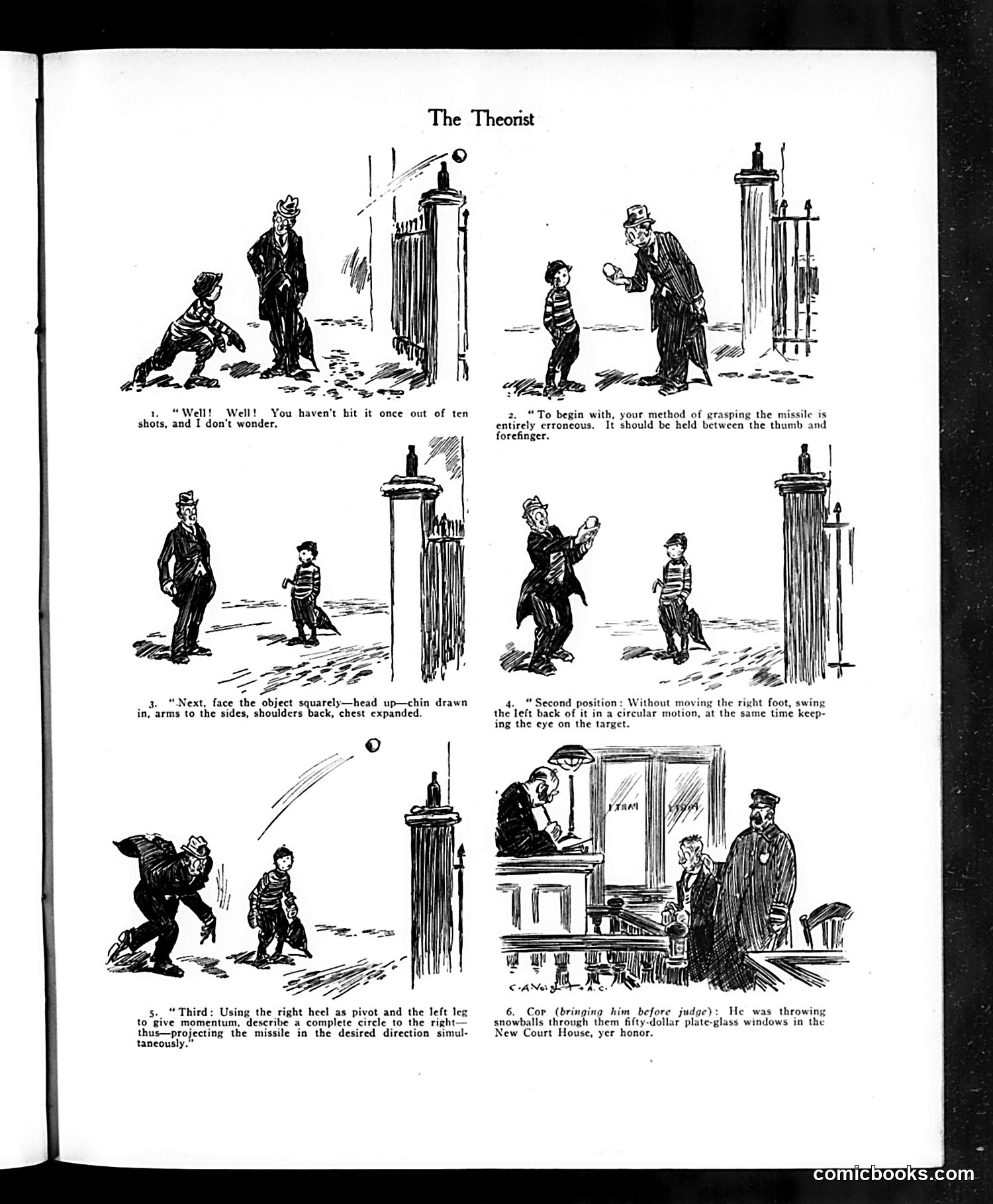
This page satirizes the gap between *theory* and *practice*. An older gentleman (likely representing an academic or armchair expert) meticulously instructs a young boy on the "correct" technique for throwing snowballs, citing proper posture, grip, momentum, and eye-focus with absurd precision. The punchline appears in panel 6: despite all this elaborate instruction, the boy ends up in court anyway, arrested for breaking expensive plate-glass windows at the New Court House. The satire mocks pedantic over-explanation and impractical expertise—the "theorist"'s detailed, methodical approach fails to achieve the actual goal (accurate snowball throwing). The humor derives from the contrast between the lecturer's self-important technicality and the boy's actual outcome: destructive chaos and legal trouble. This reflects broader turn-of-the-century American skepticism toward dry intellectualism disconnected from real-world results.
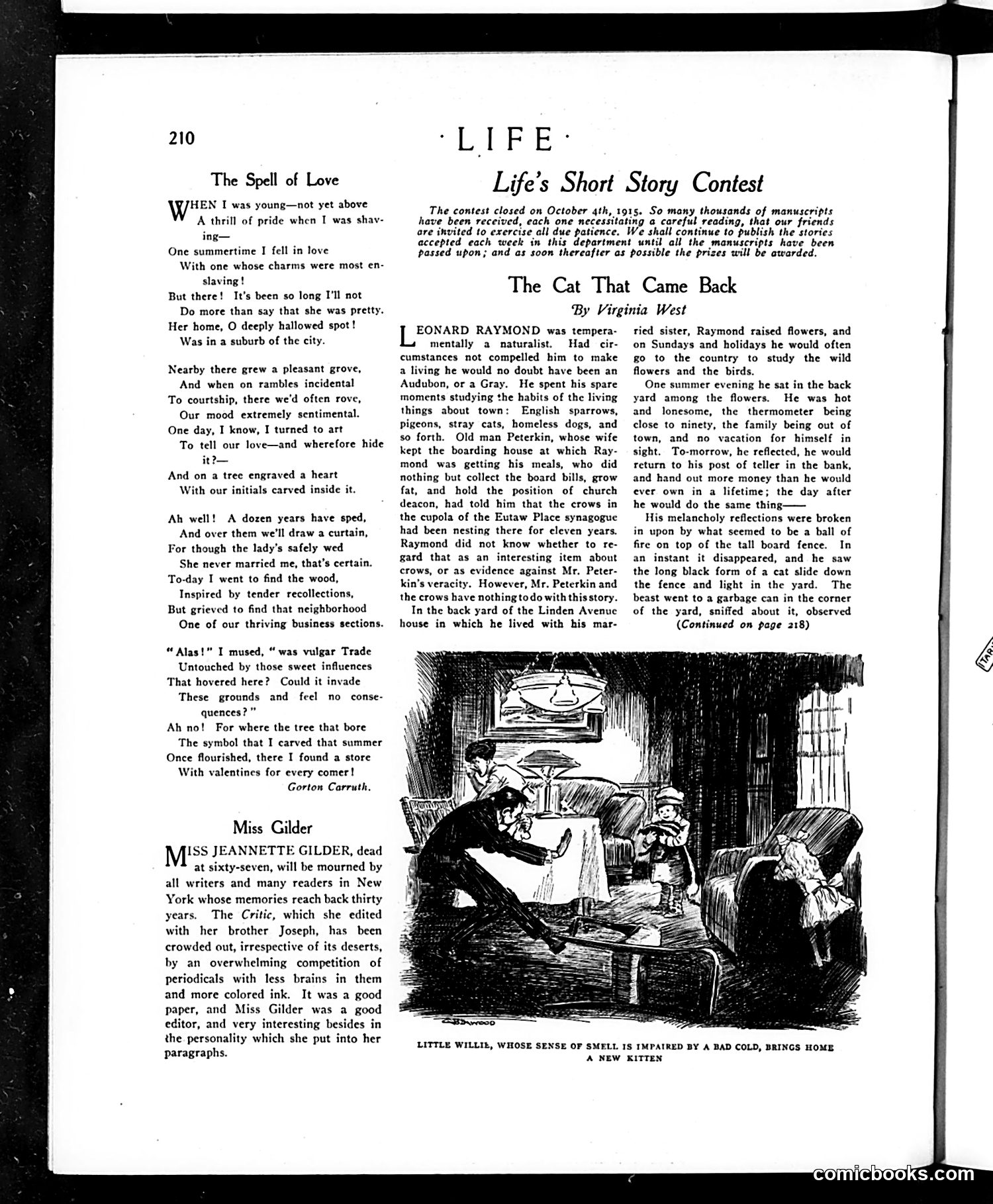
This page contains three distinct literary pieces from Life magazine's 1915 publication: **"The Spell of Love"** (left column): A nostalgic poem by Gorton Carruth about a man who revisits a grove where he once carved a heart with his initials on a tree during a romantic courtship. The poem's ironic conclusion: the tree is gone, replaced by a commercial store selling valentines—a commentary on how commerce and urbanization have replaced romance and sentiment in modern life. **Tribute to Miss Gilder** (lower left): An obituary noting the death of editor Jeannette Gilder, who co-edited *The Critic* literary magazine. The tribute laments that her intellectually superior publication was displaced by competing magazines with "less brains" but "more colored ink"—satirizing how mass-market publications were eclipsing serious literary journals. **"The Cat That Came Back"** (right): The opening of a short story contest entry by Virginia West about Leonard Raymond, an amateur naturalist living in a boarding house. The illustration shows a domestic scene. The page's theme suggests early 20th-century anxieties about modernization displacing tradition and sentiment.
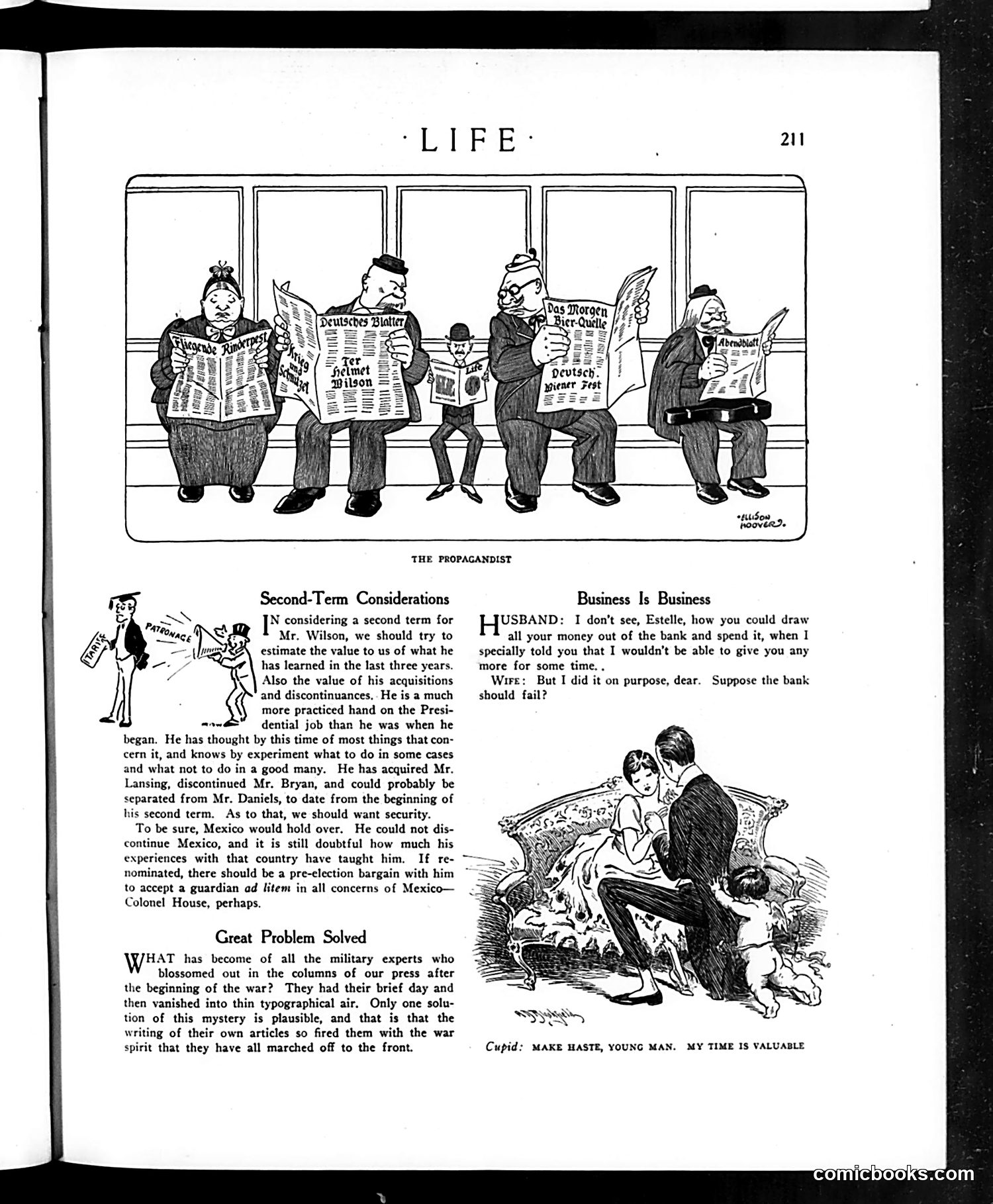
**"The Propagandist" cartoon** depicts five caricatured figures reading German-language newspapers ("Hamburger Blätter," "Das Morgen," etc.). This satirizes German propaganda efforts, likely during WWI, showing how German news sources were disseminating their messaging. **"Second-Term Considerations"** discusses President Wilson's potential re-election, evaluating what he's learned in office. It references his cabinet changes (acquiring Lansing, discontinuing Bryan, potentially Daniels) and his problematic handling of Mexico. The text suggests he needs oversight from Colonel House on Mexican affairs. **"Great Problem Solved"** humorously addresses the disappearance of military "experts" from newspaper columns—suggesting they've enlisted for WWI rather than admitting they had nothing substantive to contribute. **"Business Is Business"** is a domestic comedy sketch about a wife withdrawing bank savings to protect them from potential bank failure, highlighting financial anxiety of the era. The page reflects WWI-era American concerns: German propaganda, Wilson's leadership fitness, military expertise, and economic uncertainty.
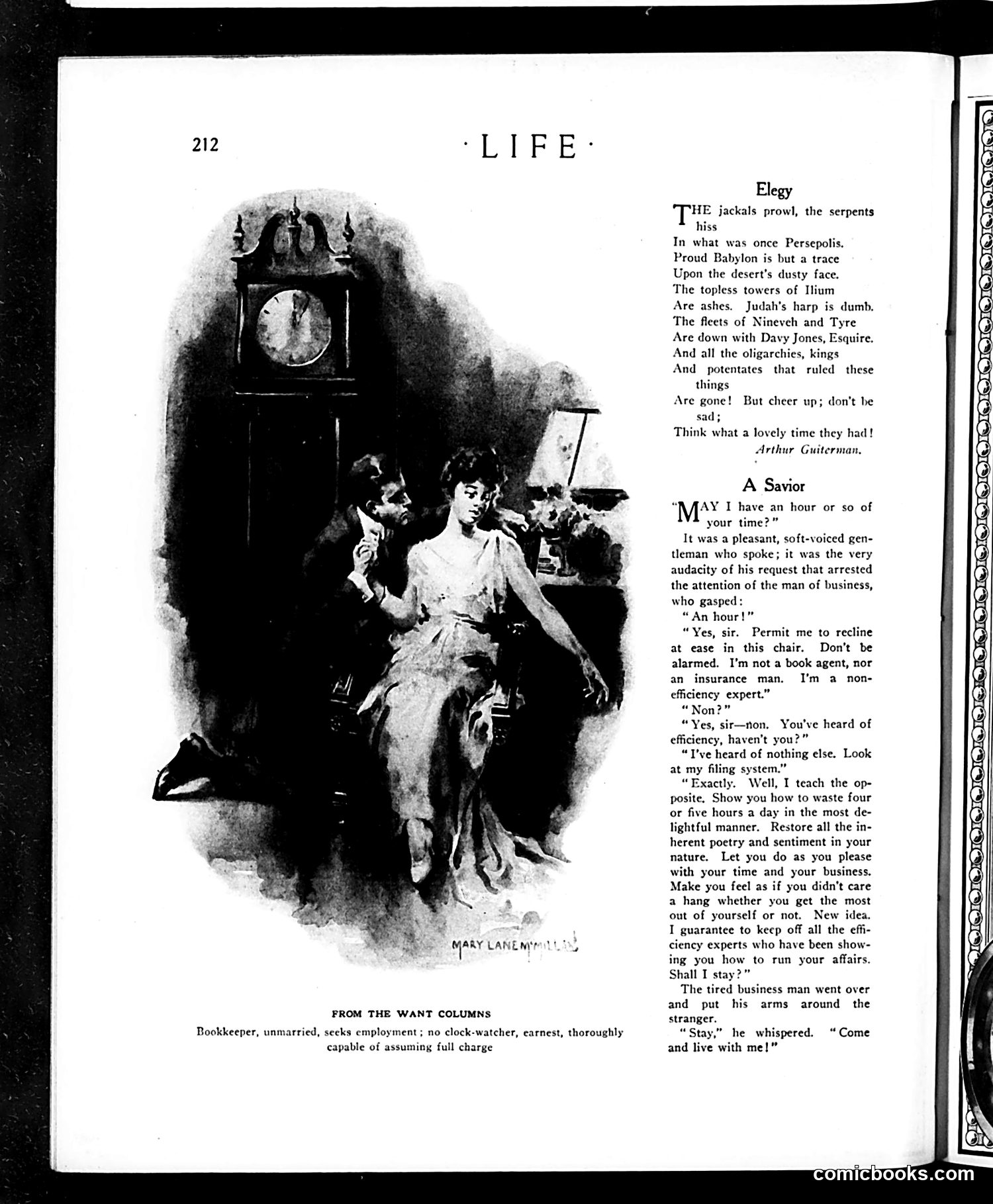
This page contains two satirical pieces reflecting early 20th-century anxieties: **"Elegy"** (poem by Arthur Guiterman): A darkly humorous meditation on the fall of great civilizations—Babylon, Persepolis, Nineveh, Tyre. The poem's ironic twist: don't mourn these collapsed empires; celebrate that their rulers had "a lovely time." The satire targets both nostalgia for lost grandeur and the obliviousness of elites to consequences. **"A Savior"** (illustrated story): This mocks the era's obsession with "efficiency experts"—consultants who promised to optimize business operations. A weary businessman encounters a "non-efficiency expert" offering the opposite: permission to waste time, restore sentiment, and escape relentless productivity demands. The businessman's emotional embrace ("Come and live with me!") satirizes how desperately overworked Americans craved escape from efficiency culture. The illustration shows period dress and interior design; the caption describes a job-seeker offering reliable service—a practical contrast to the story's fantastical savior figure.
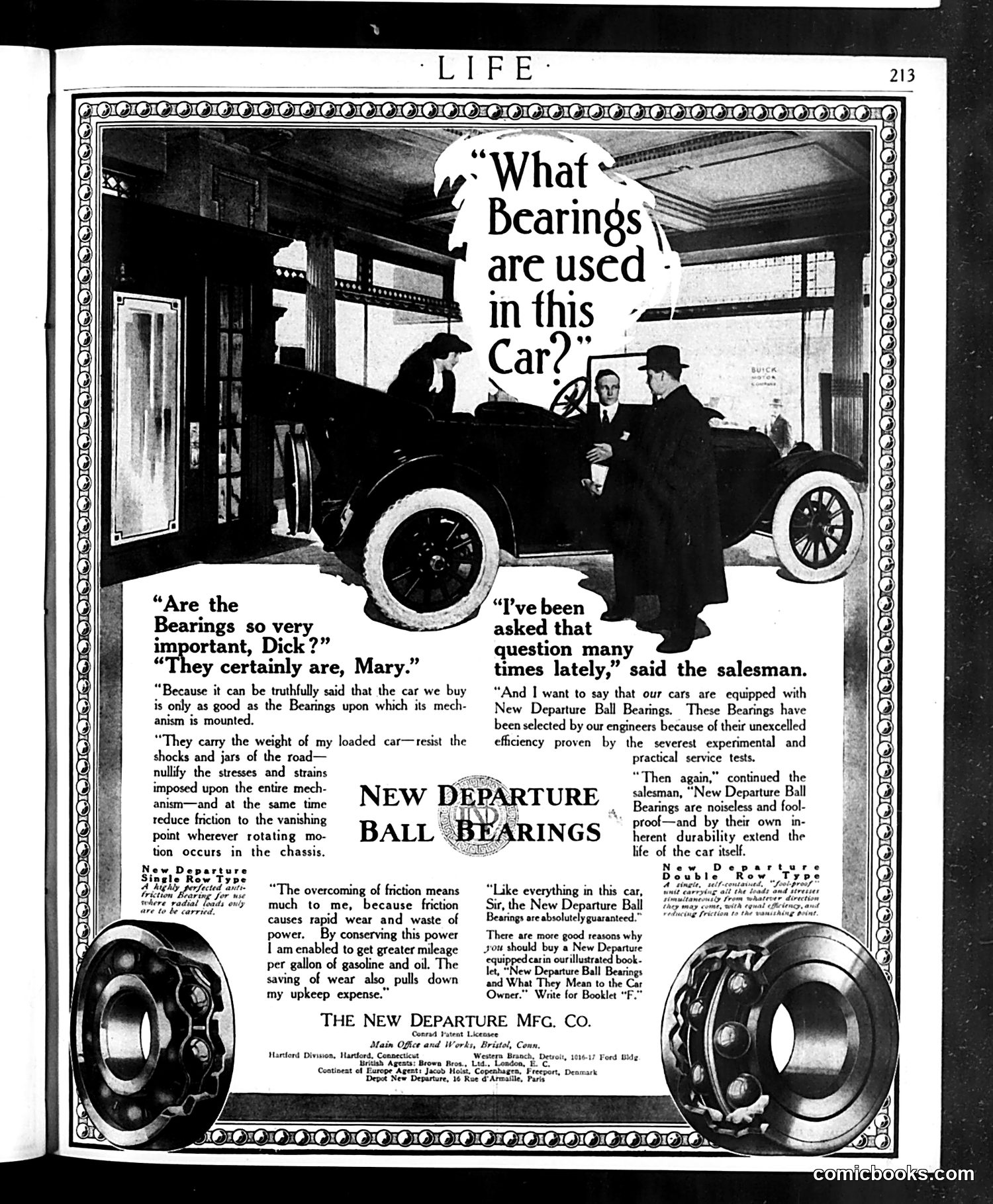
This is primarily **a paid advertisement for New Departure ball bearings**, disguised as editorial content in Life magazine's satirical style. The "cartoon" frames a sales pitch as a dialogue between a salesman and a couple (Dick and Mary) examining a car. The husband questions the wife about bearings' importance; she responds with technical benefits (reducing friction, improving fuel economy, lowering maintenance costs). The salesman then enthusiastically endorses New Departure brand specifically. **What's notable historically:** This represents early 20th-century automotive advertising when ball bearings were genuinely important mechanical innovations that improved car reliability. The "satire" is gentle—Life simply uses humor and domestic conversation to sell a technical product to lay readers unfamiliar with car mechanics. The close-up photographs of actual bearings and the company's contact information (Bristol, Connecticut headquarters) confirm this is genuine product marketing, not political satire. This blended advertorial approach was standard in early 1900s magazines.
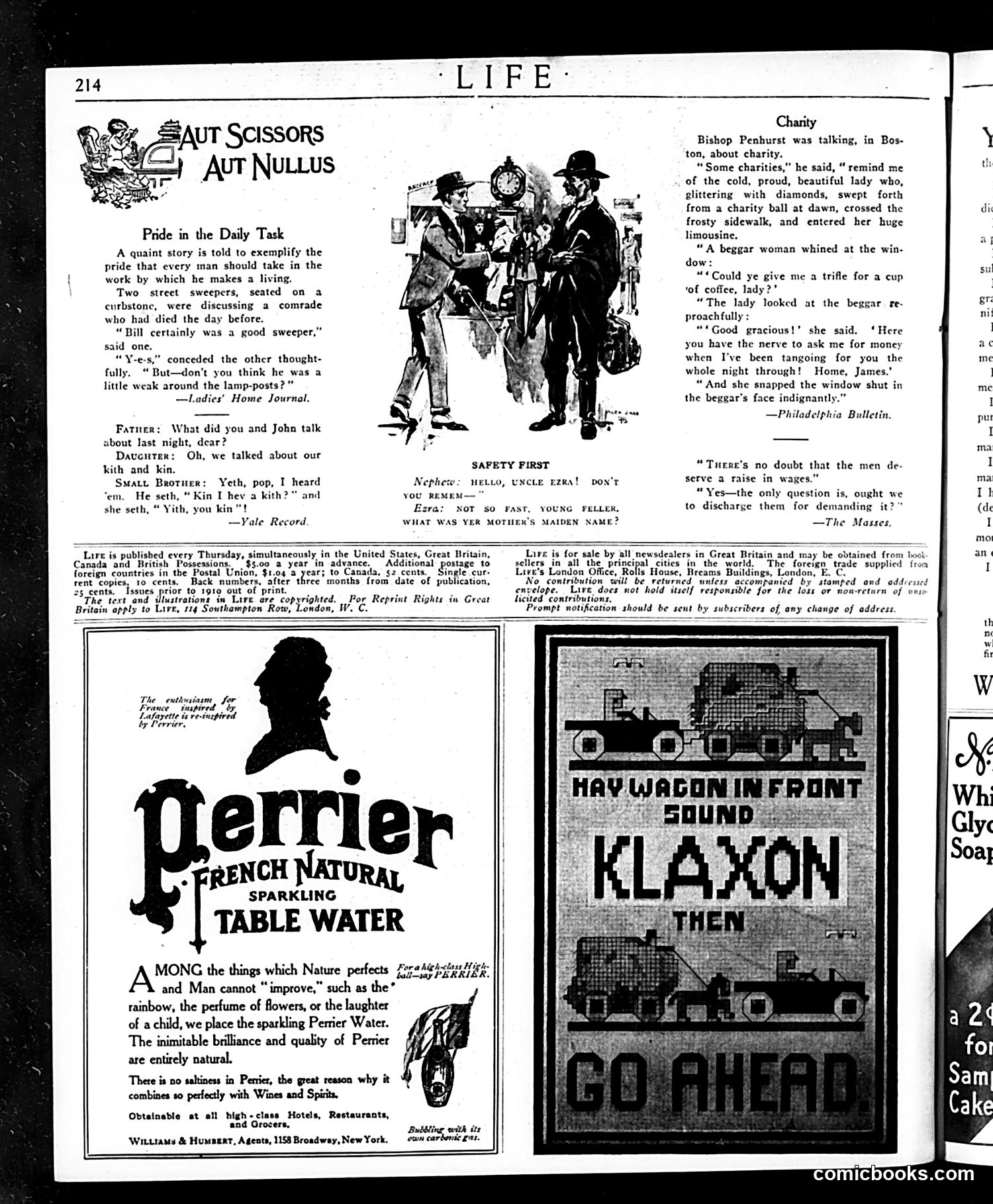
This page from *Life* (an early 20th-century American satirical weekly) contains several humor pieces and advertisements. **"Aut Scissors, Aut Nullus"** presents three short comedic anecdotes mocking pride and social pretension. The "Pride in the Daily Task" piece satirizes working-class dignity through street sweepers debating their deceased colleague's sweeping technique. The other jokes play on mishearings and verbal confusion for comedic effect. **"Safety First"** cartoon depicts an uncle interrogating a young man about his romantic intentions—the "safety" being protective questioning of a suitor's background before allowing courtship. **"Charity"** is a satirical piece criticizing wealthy philanthropists' hypocrisy: a diamond-adorned society woman who dances at charity balls refuses a beggar's modest request, claiming her dancing *was* charity. The final joke criticizes labor exploitation: when workers demand wage increases, management suggests firing them instead. **Advertisements** for Perrier water and other products fill the remaining space—typical of *Life's* revenue model. The magazine's overall tone targets class hypocrisy, courtship customs, and labor relations through gentle satire.
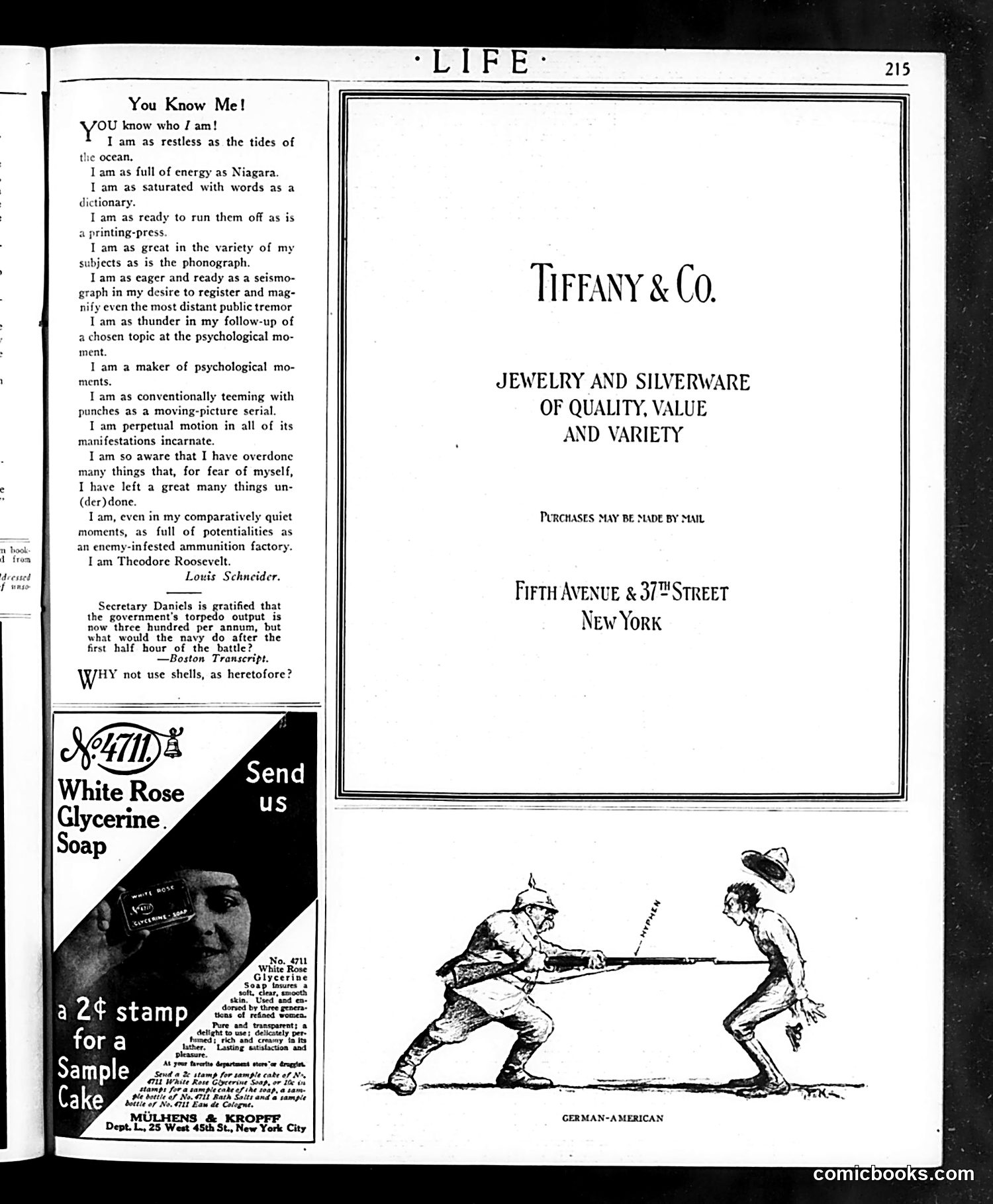
This page combines political satire with advertisements, typical of Life magazine's format. **"You Know Me!" Poem**: A satirical self-portrait attributed to Theodore Roosevelt by cartoonist Louis Schneider. It mocks Roosevelt's well-known hyperactivity, verbosity, and constant need to dominate public discourse—comparing himself to restless ocean tides, Niagara Falls, printing presses, and perpetual motion. The joke is Roosevelt's inability to recognize his own excess; he admits overdoing things but frames it as powerful energy rather than problematic behavior. **Navy Joke**: References Secretary of the Navy Josephus Daniels's claim about torpedo production (300 annually), questioning whether this rate could sustain even half an hour of naval combat—satirizing military preparedness concerns, likely WWI-era anxieties. **Advertisements**: Tiffany & Co. jewelry and White Rose glycerine soap ads are standard period marketing. **Bottom Cartoon**: Labeled "German-American," depicts baseball play—possibly commentary on German-American identity during WWI tensions, though the exact reference remains unclear.
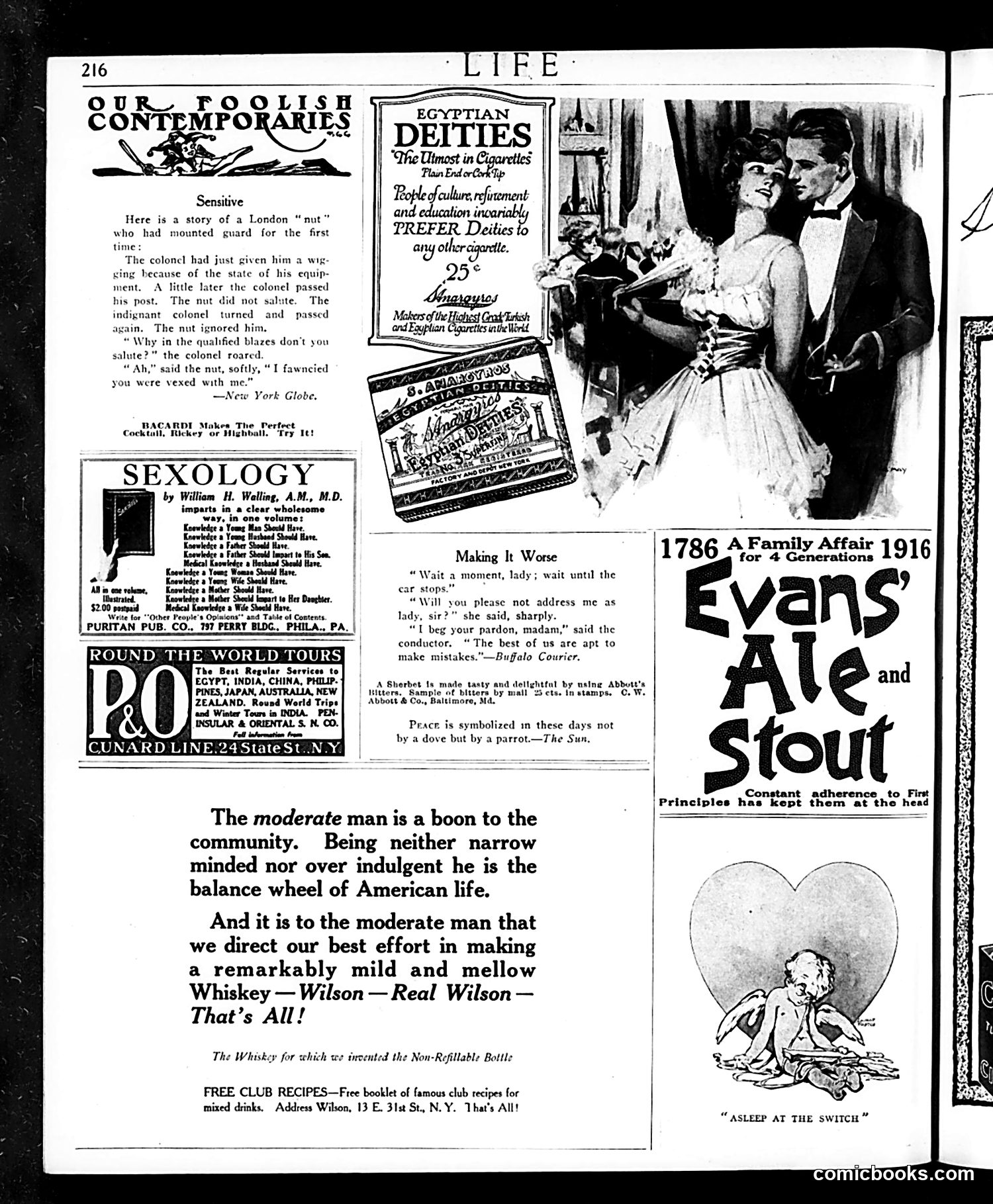
This page mixes humor, advertising, and social commentary typical of early 1900s Life magazine. **The "Sensitive" cartoon** satirizes British military protocol. A new soldier fails to salute his colonel, claiming he thought the colonel was "vexed" (angry) with him. The joke plays on the soldier's overcorrection: he's so anxious about the colonel's earlier rebuke that he misreads the situation entirely—a commentary on rigid military hierarchies and the absurdity of rigid etiquette. **"Making It Worse"** depicts a streetcar conductor's failed attempt at politeness. When he says "lady," a passenger objects sharply. His switch to "madam" still offends, suggesting some people are impossible to please—a jab at social pretension or oversensitivity. The page is largely **advertising**: Egyptian Deities cigarettes, Bacardi rum, a sexology book, world tours, and Wilson whiskey (notably during Prohibition era, marketing "moderate" consumption). The Evans' Ale and Stout ad features a cherub. These ads and jokes reflect 1910s attitudes toward class, military deference, and consumer culture.
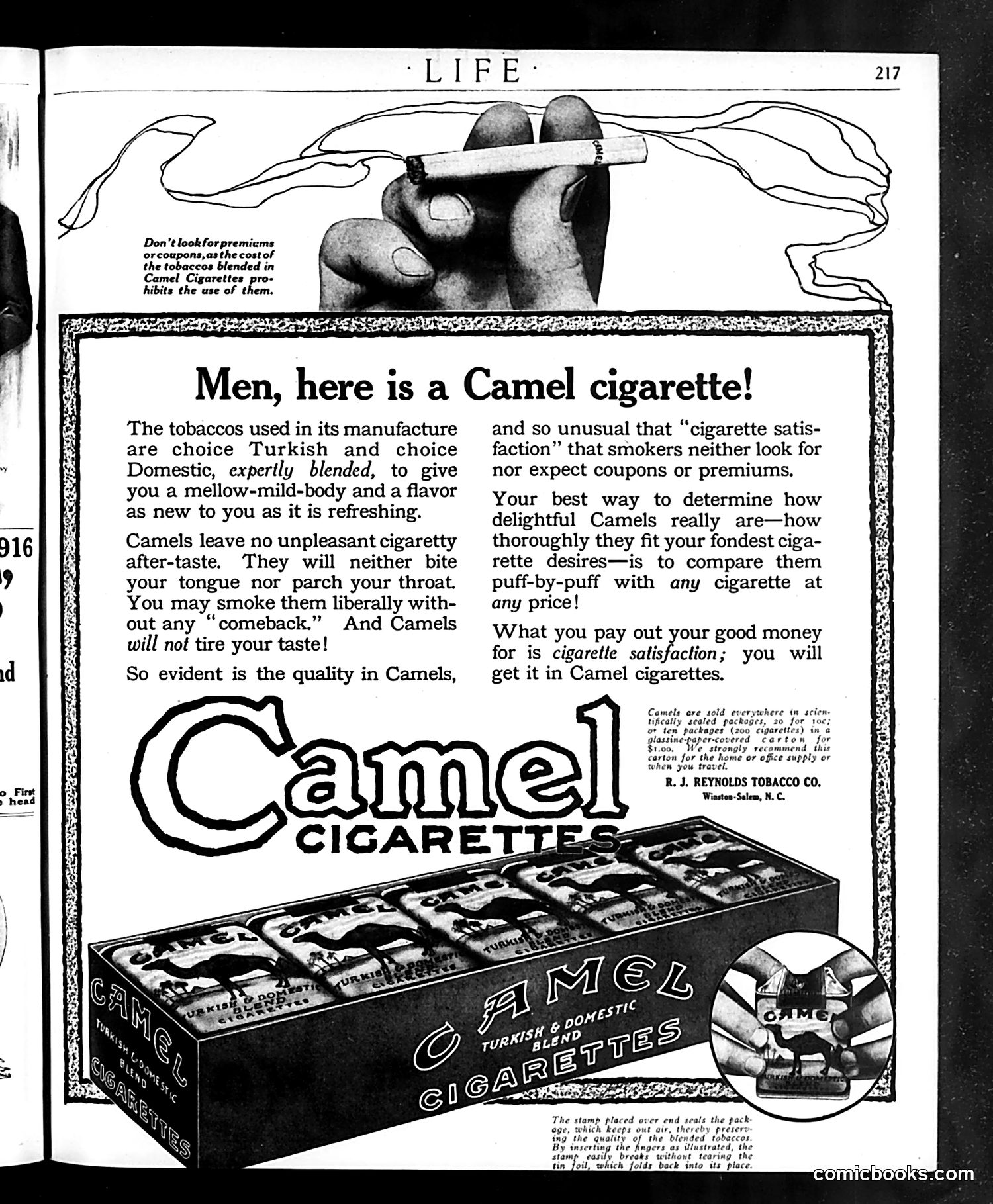
This is a **cigarette advertisement**, not satire or political commentary. It's a straightforward 1910s-era marketing pitch for Camel cigarettes by R.J. Reynolds Tobacco Co. The ad targets men directly, emphasizing that Camel cigarettes contain premium Turkish and domestic tobacco requiring no cheap promotional gimmicks (premiums or coupons). The illustration shows a hand holding a cigarette—a simple product showcase. The sales pitch claims Camels deliver superior "cigarette satisfaction": mild flavor, no unpleasant aftertaste, no tongue-biting, and won't tire the palate. The text argues consumers should compare Camels "puff-by-puff with any cigarette at any price," positioning quality as justifying the price. The box display and detailed packaging notes (tin foil opening method) emphasize product integrity and preservation—a premium positioning strategy. By modern standards, the casual health claims ("mellow-mild") are remarkable—this predates any smoking health warnings by decades.
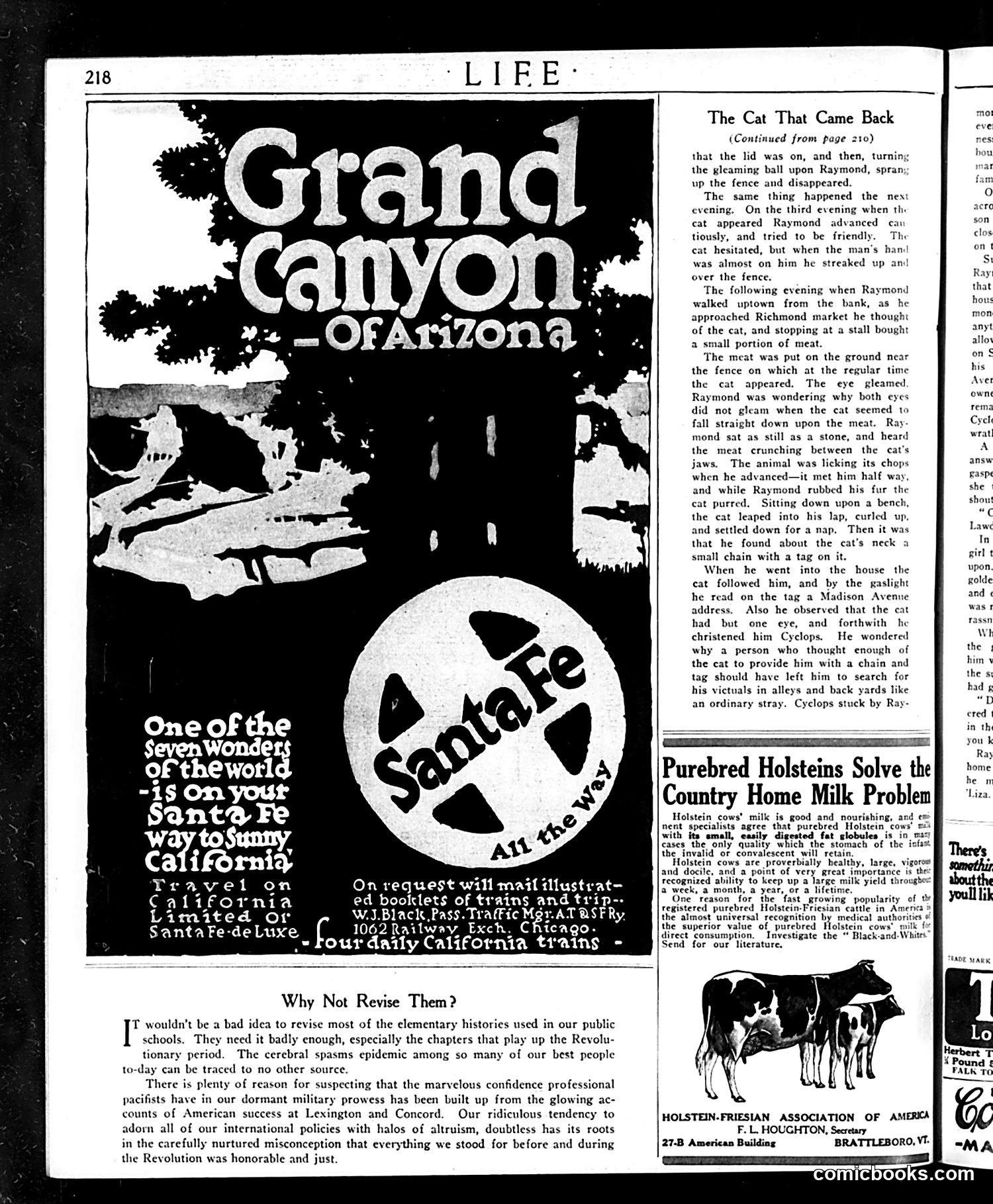
This page from *Life* contains editorial opinion and advertisements. The notable text piece, "Why Not Revise Them?" is editorial satire criticizing American historical education. The author argues that textbook glorification of Revolutionary War victories (Lexington, Concord) has bred dangerous overconfidence in American military power and fostered misplaced idealism about U.S. foreign policy. The piece sarcastically questions whether the Revolution was truly "honorable and just" as portrayed, suggesting sanitized history has caused modern citizens' "cerebral spasms"—poor judgment in international affairs. This reflects early 20th-century pacifist or anti-interventionist sentiment, likely written before or during WWI when America debated military involvement. The author contends flawed historical narratives have made Americans naively confident in military strength and prone to dressing self-interest in moral language. The advertisements—for Santa Fe trains and Holstein dairy cattle—are unrelated commercial content typical of magazine pages.
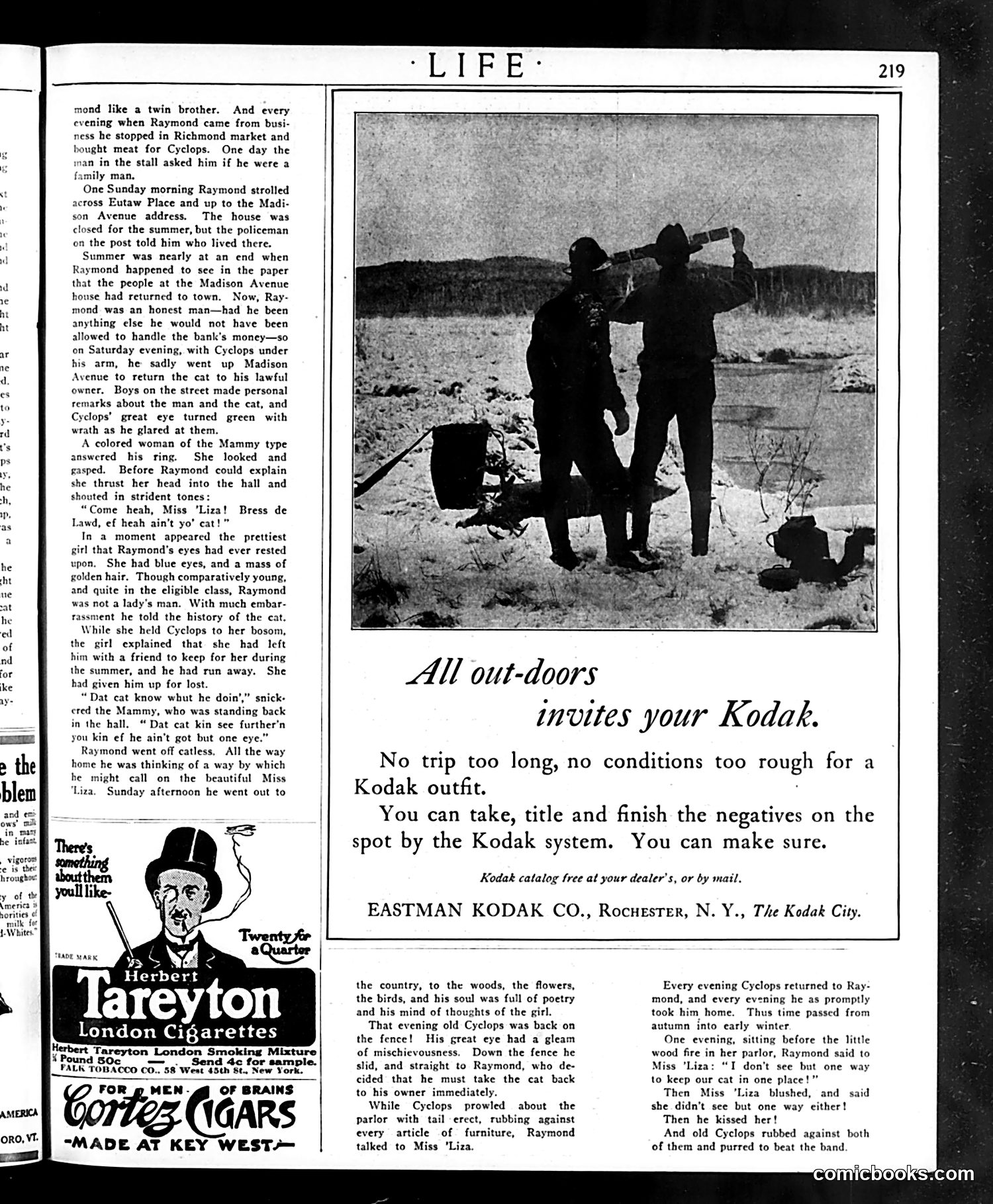
This page contains a serialized short story about a bank employee named Raymond who adopts a one-eyed cat called Cyclops. When Raymond discovers the cat's original owner—an attractive young woman named Miss 'Liza—he begins returning the cat to her each evening, creating a pretext for visits. The cat becomes a matchmaker, repeatedly returning to Raymond, forcing him to call on Miss 'Liza repeatedly until they fall in love. The story plays on the "accidental romance" trope common to early 20th-century sentimental fiction. The humor relies on the cat's agency and the protagonists' bashfulness—Raymond uses the cat as cover for courtship he's too shy to initiate directly. The page also features period cigarette and camera advertisements, typical of Life magazine's commercial content.
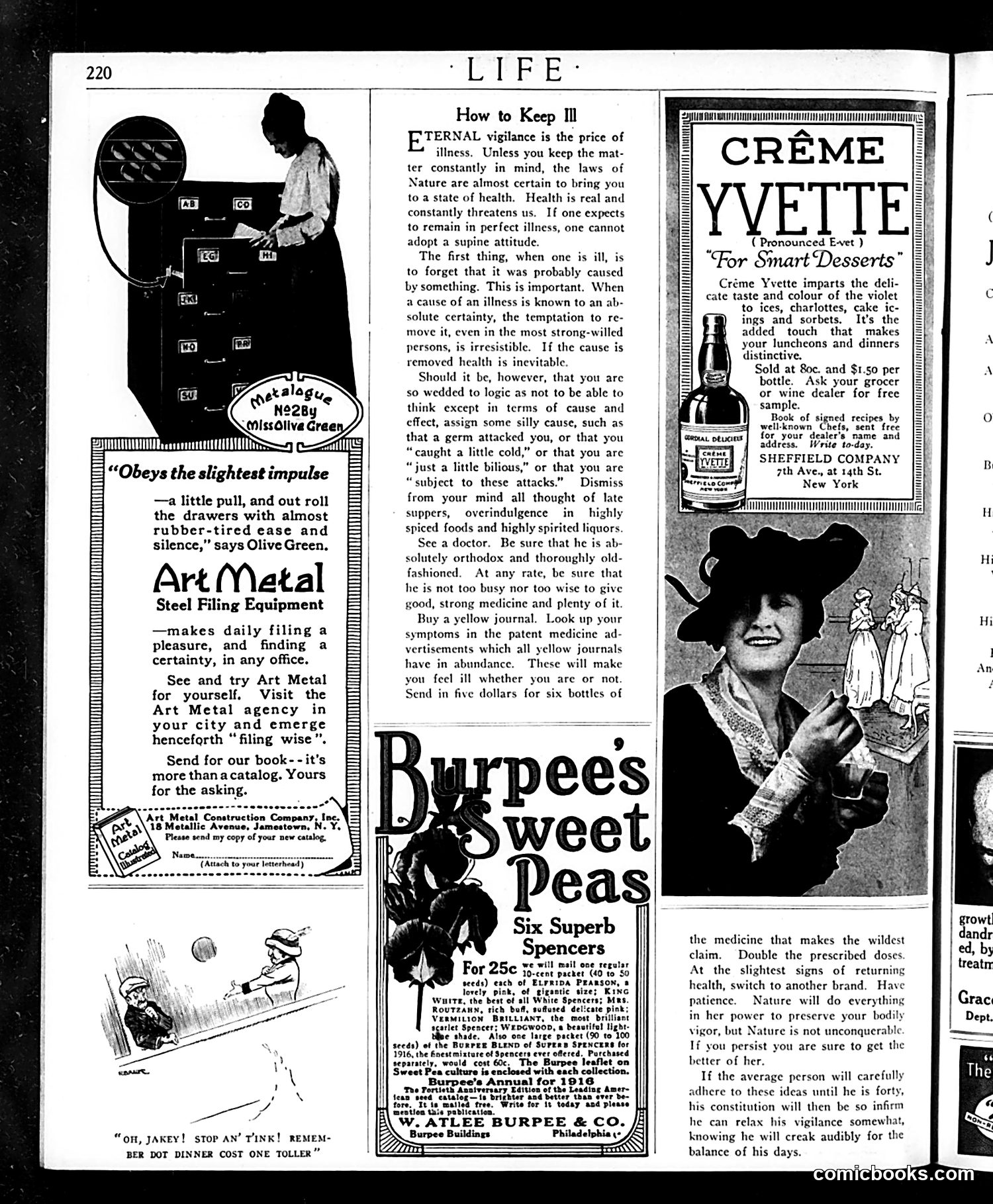
This page contains three main elements: **"How to Keep Ill"** is a satire—likely by Life's editors—that inverts health advice through irony. Readers would recognize it as mocking widespread practices of the era: patent medicine advertisements, overreliance on doctors, sensationalist "yellow journalism," and hypochondria. The satire suggests that by *ignoring* causation, consulting only orthodox physicians, reading medical ads, and switching medicines constantly, one *ensures* illness rather than health. The closing joke—that following this advice leaves one "infirm" by forty—drives home the absurdity of accepting whatever cure-all advertisements promise. **The small cartoon** captioned "Oh, Jakey! Stop an' tink! Remember dot dinner cost one toller" appears to use ethnic dialect and depicts a child or young person. The context suggests commentary on poverty or immigrant struggles—though specifics of the referenced incident are unclear from the image alone. **The advertisements**—for Art Metal filing equipment, Crème Yvette liqueur, and Burpee seeds—are period product promotions, not satirical content.
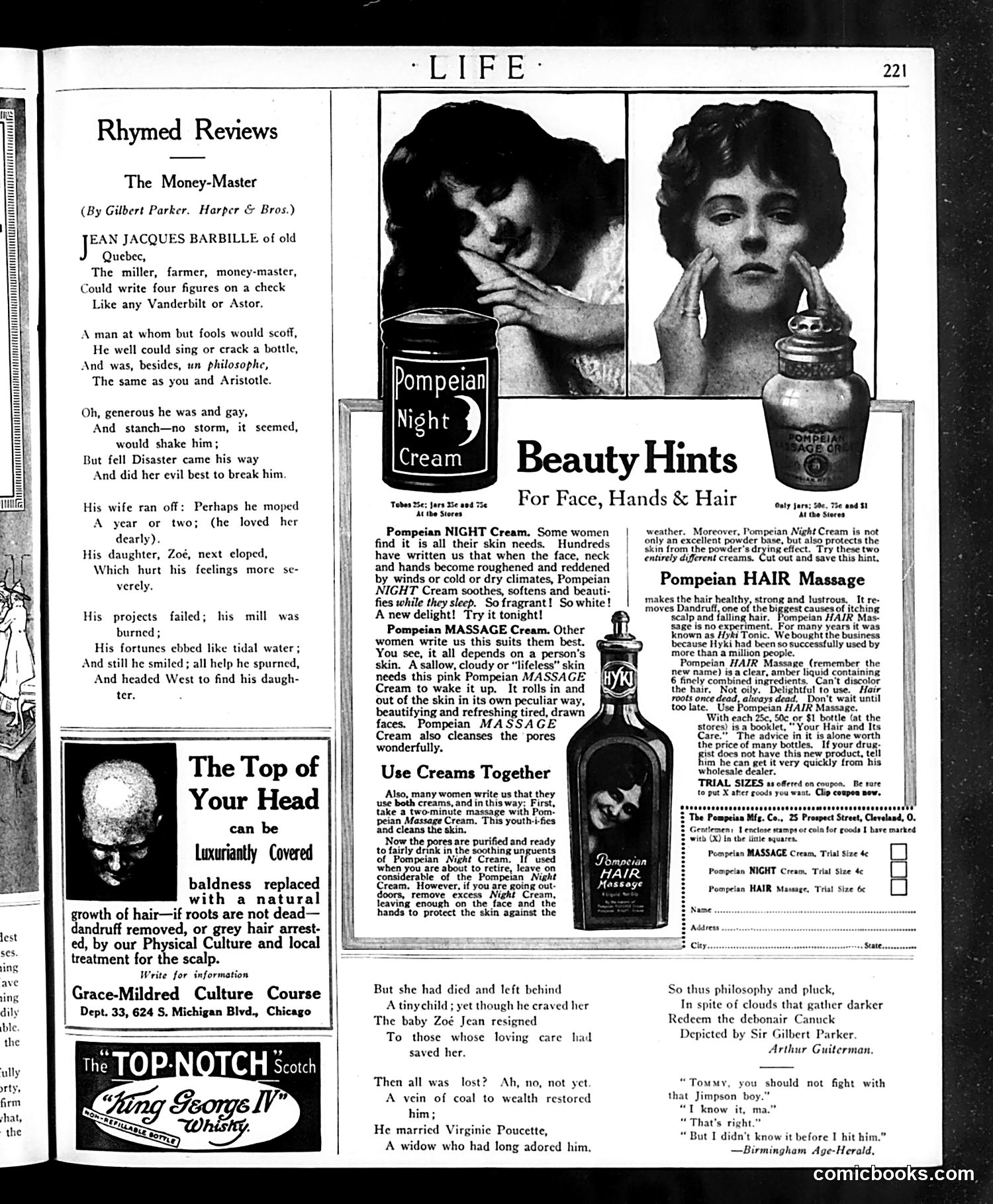
This page combines a **book review in verse** with **period beauty advertisements**, typical of early 20th-century Life magazine. **The Review ("The Money-Master"):** Gilbert Parker's novel is reviewed in rhyming couplets—a satirical convention where serious literature gets humorous treatment. The story concerns Jean Jacques Barbille, a wealthy Quebec businessman ("money-master") who suffers cascading misfortunes: his wife runs away, his daughter elopes, his business fails. The review's tone is gently mocking, reducing a serious novel to domestic comedy. **The Advertisements:** The page is dominated by Pompeian beauty products (night cream, massage cream, hair treatments), with supporting ads for baldness treatment and King George IV whisky. These ads target women worried about aging skin and men about hair loss—common anxieties then as now. **The Satire:** The juxtaposition itself is the joke: serious literary review placed alongside desperate appeals to vanity. This reflects Life's satirical mission—mocking both pretentious culture and consumer anxieties about appearance.
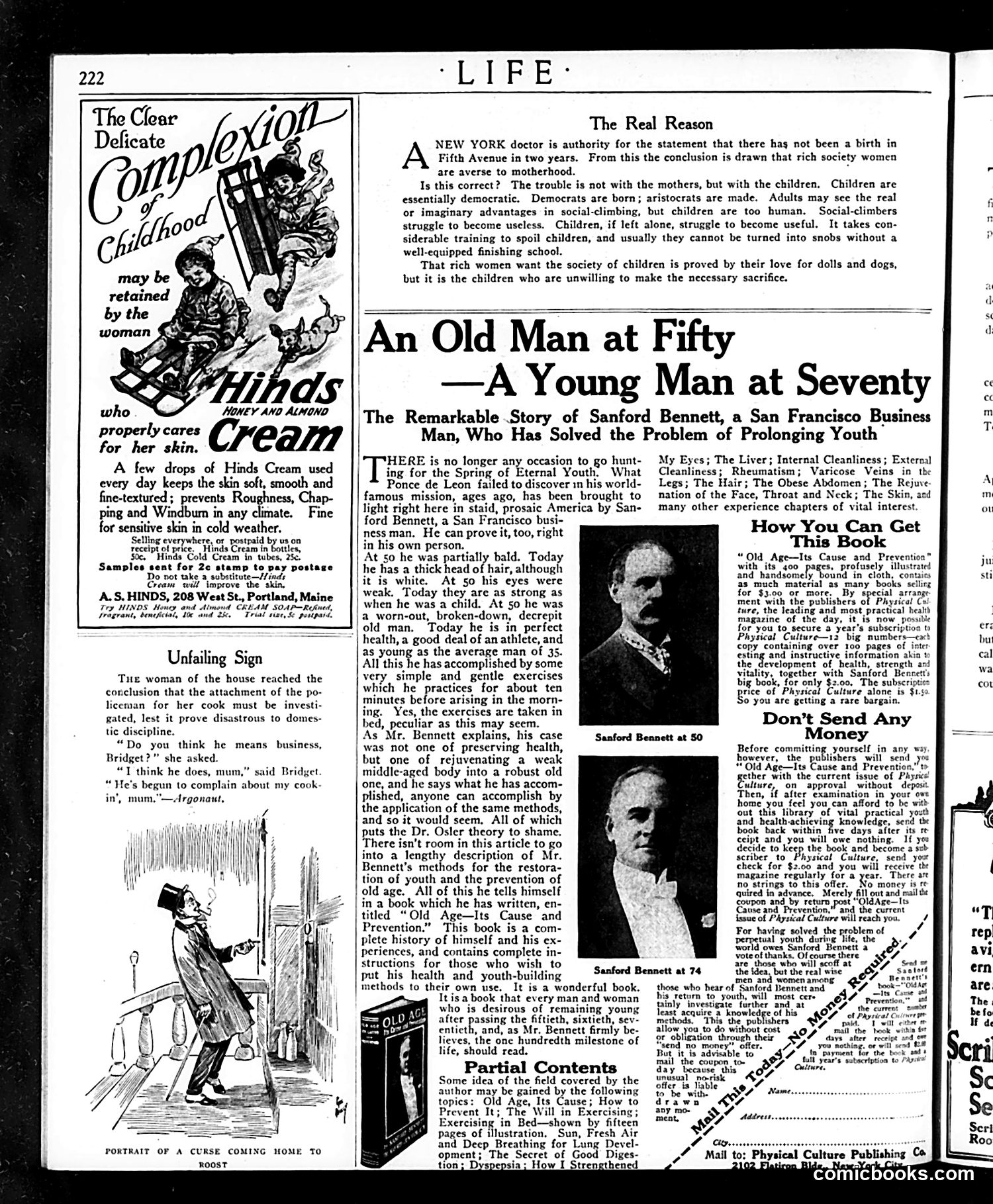
This page mixes advertisements with satirical social commentary and promotional content typical of early 20th-century *Life* magazine. **"The Real Reason" article** satirizes wealthy Fifth Avenue women, claiming they avoid motherhood not from aversion to pregnancy, but because children are naturally "democratic" and "useful"—resistant to becoming aristocratic snobs. The joke: rich women want obedient social accessories (like dolls and dogs), not actual children with independent wills. **"An Old Man at Fifty—A Young Man at Seventy"** profiles Sanford Bennett, a San Francisco businessman claiming physical rejuvenation through simple bedside exercises. This appears partly biographical, partly promotional for his book "Old Age—Its Cause and Prevention." **Left sidebar**: A humorous domestic sketch about a woman investigating whether a policeman's romantic interest in her cook is "serious," revealed when he complains about her cooking—satirizing how men signal commitment through criticism. The advertisements (Hinds Cream, etc.) are period-standard beauty product marketing.
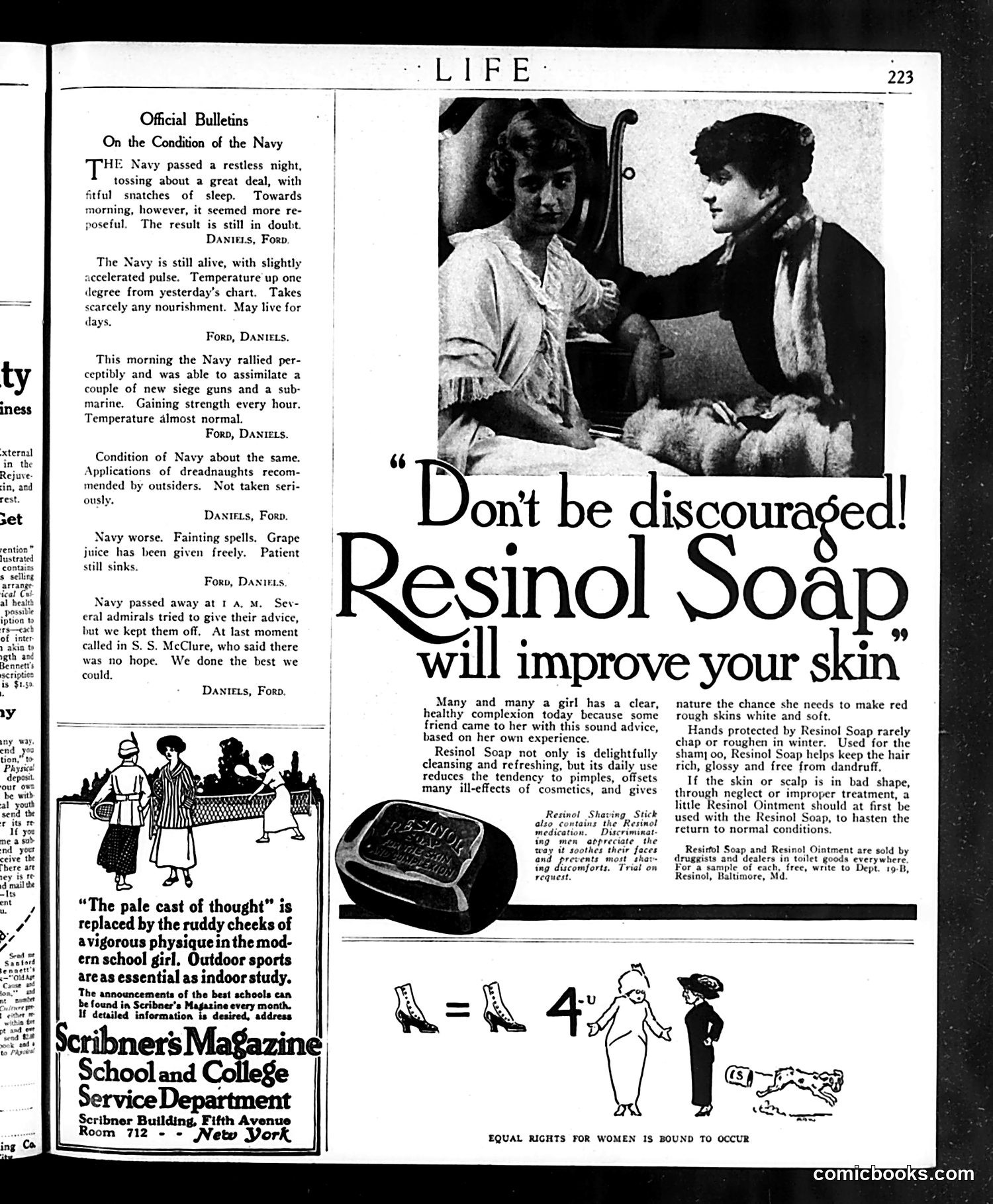
**"Official Bulletins On the Condition of the Navy"** (left column): This is satirical commentary on the U.S. Navy's operational status, written as medical bulletins tracking a patient's declining health. Bylined to "Ford, Daniels" (likely referencing Secretary of the Navy Josephus Daniels and his associates), it humorously reports the Navy "passing away" despite attempts at resuscitation. The joke mocks the Navy's weakness or deteriorating condition during this period—likely referencing World War I-era naval concerns or budget/readiness debates. **Main advertisement**: Resinol Soap marketed to women for skin improvement, promising to cure complexions troubled by cosmetics or neglect. **Bottom cartoon**: Simple equation showing two pairs of shoes plus a male/female figure equals "Equal Rights for Women is Bound to Occur." This appears to be mild satire about women's economic independence and equality—suggesting that when women can afford their own shoes (financial autonomy), gender equality naturally follows.
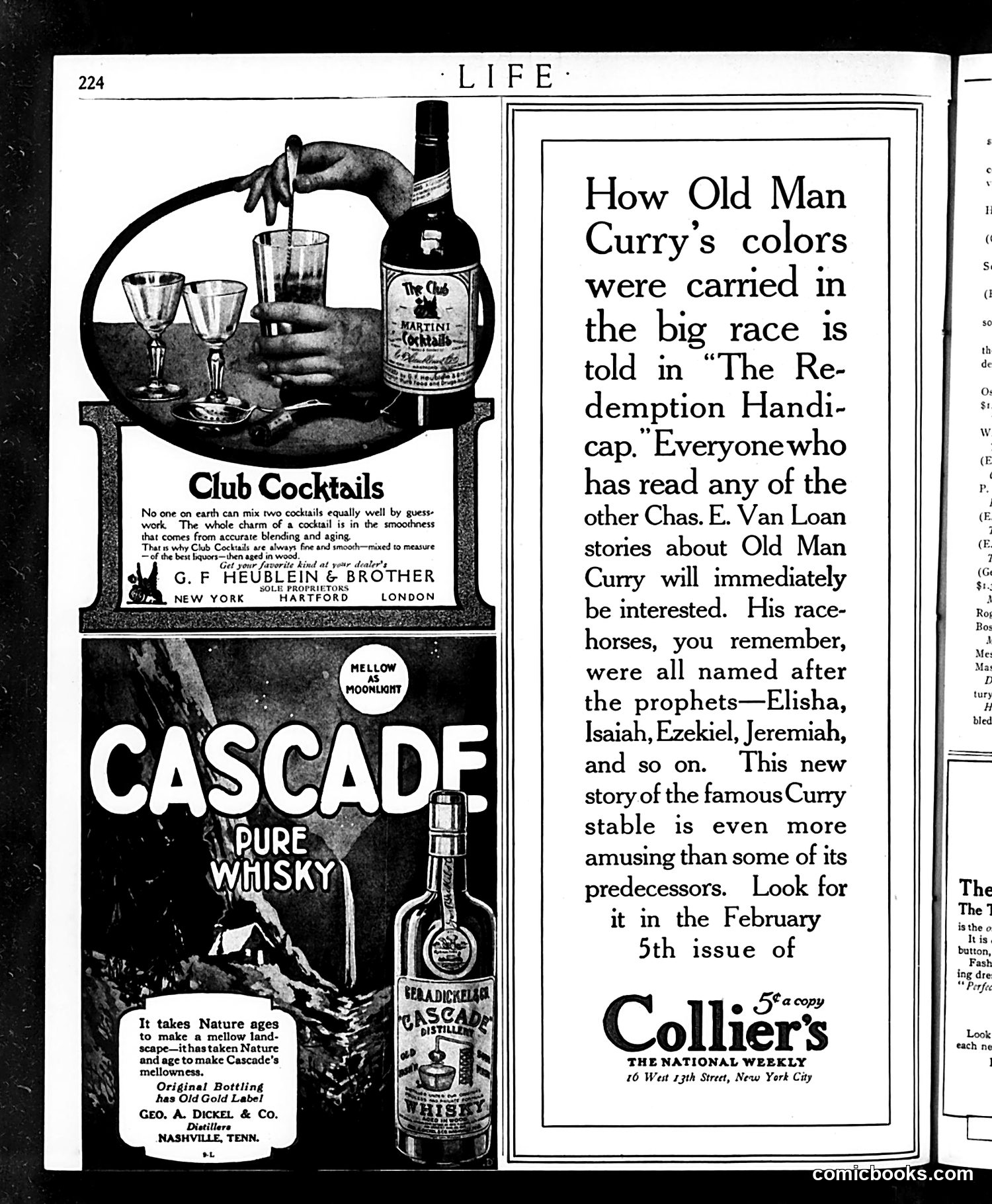
This page consists entirely of **advertisements**, not editorial satire or political cartoons. **Left side:** Two liquor ads—one for Club Cocktails (by G.F. Heublein & Brother) emphasizing precision mixing, and one for Cascade Pure Whisky, highlighting its age and mellowness. **Right side:** An advertisement for *Collier's* magazine promoting an upcoming story called "The Redemption Handicap" by Chas. E. Van Loan, featuring his fictional character Old Man Curry. The ad references Van Loan's popular racehorse stories, noting that Curry's thoroughbreds were named after biblical prophets (Elisha, Isaiah, Ezekiel, Jeremiah, etc.). The ad pitches the new story as entertaining for existing fans. There is **no political or social satire** on this page—it's a straightforward commercial publication showcasing period advertisements and promotional content from the 1920s-30s era.
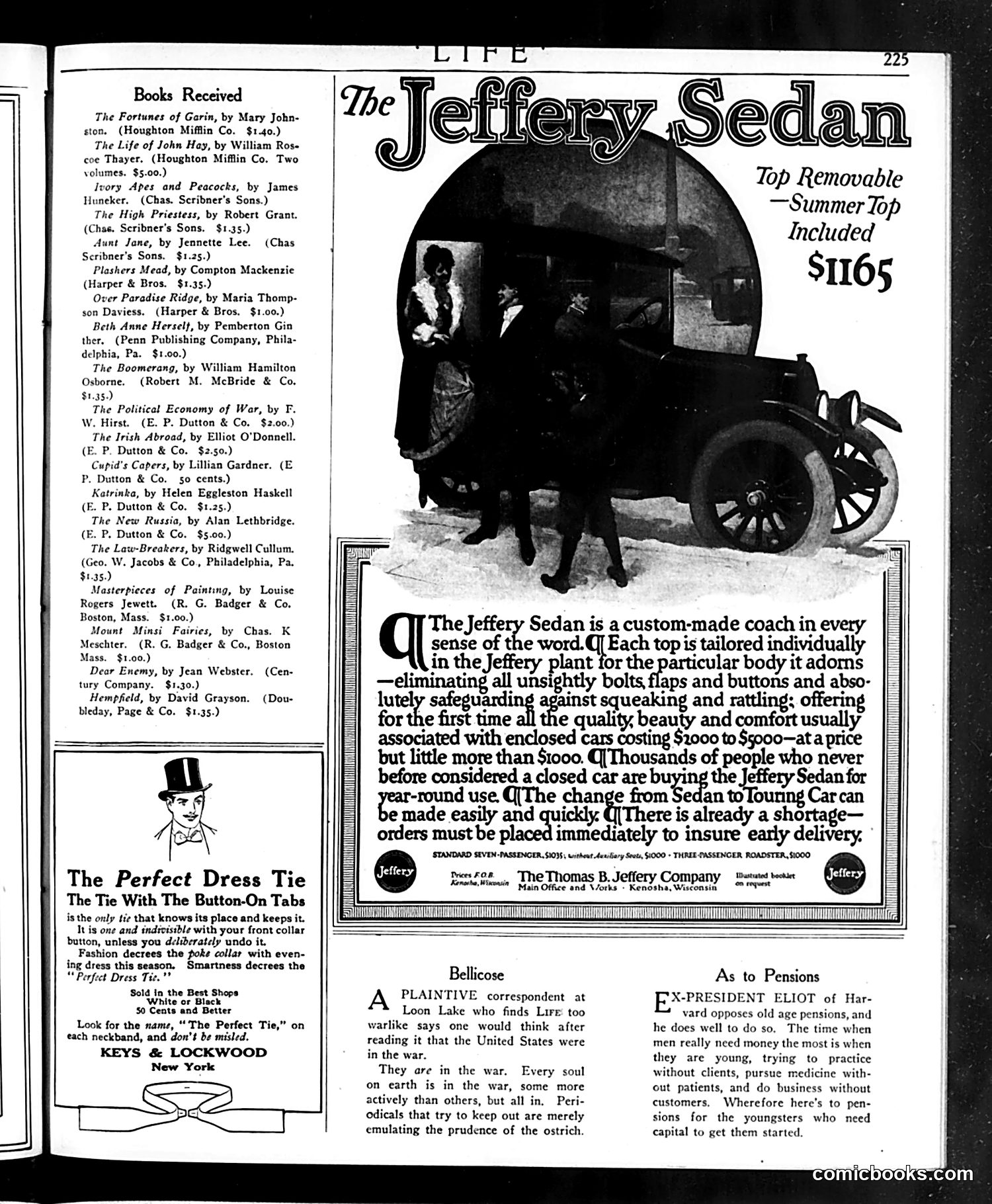
This page is primarily **advertising and book notices** rather than political satire. The main content includes: **Advertisements:** - A "Perfect Dress Tie" ad highlighting a novelty button-tabs design - A large Jeffery Sedan automobile advertisement emphasizing custom construction and a removable summer top at $1,165 **Editorial Content:** Two brief opinion pieces appear at bottom: 1. **"Bellicose"** – A sarcastic response to a correspondent claiming *Life* magazine is too warlike. The editorial argues that America *is* genuinely involved in WWI (the page dates to wartime), so magazines pretending neutrality merely copy "the prudence of the ostrich." 2. **"As to Pensions"** – Satire on ex-President Eliot's opposition to old-age pensions. The writer sarcastically agrees, arguing young people starting careers need money most—so pensions should go to youngsters, not the elderly. The page reflects WWI-era American debates about war involvement and social welfare policy.
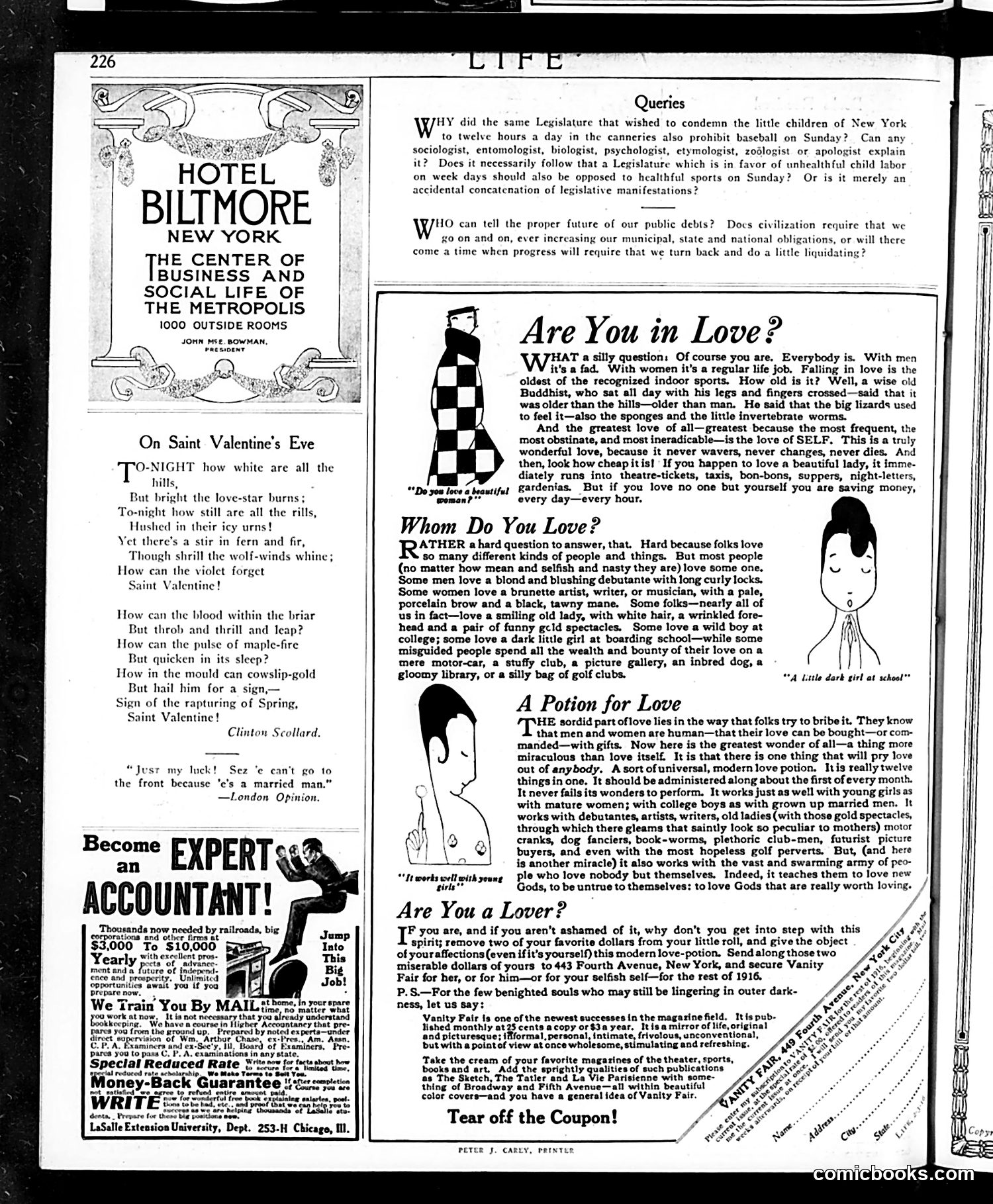
This page combines satirical commentary with period advertisements and romantic content typical of early 20th-century American magazines. **The "Queries" Section** presents sharp social criticism. The first questions a New York legislature's contradiction: prohibiting child labor in canneries while banning Sunday baseball—mocking the arbitrary logic of lawmakers. The second queries public debt policy, questioning whether endless municipal borrowing represents progress. **"Are You in Love?"** is tongue-in-cheek romantic satire. It defines love as universal but notes the most reliable love is self-love, which costs nothing (no theater tickets or gardenias required). This critiques commercial romance and materialism. **The Accountant Advertisement** promises lucrative careers ($3,000-$10,600 yearly—substantial sums then) through mail-order training, typical of era's vocational marketing. The page reflects pre-WWI concerns: legislative hypocrisy, municipal financial anxiety, and commercialized romance—all delivered through Life's characteristic irreverent humor targeting middle-class assumptions.
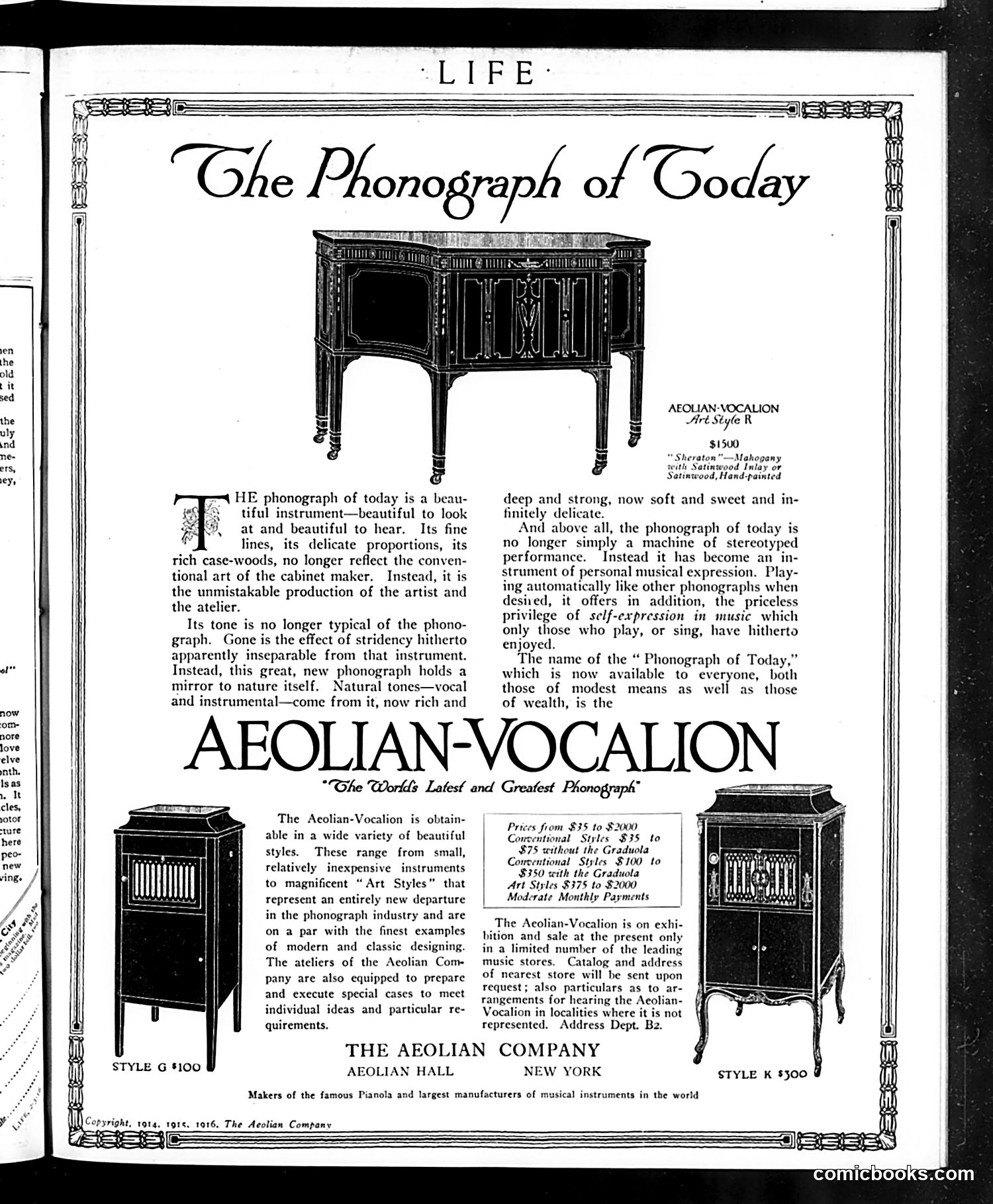
This is primarily a **product advertisement**, not political satire. The Aeolian Company is marketing the Aeolian-Vocalion phonograph across a full magazine page. The ad makes sales claims typical of 1910s luxury goods marketing: the phonograph is now an "artistic" instrument reflecting fine cabinet-making rather than mere mechanical reproduction. It promises natural-sounding tones (addressing a genuine complaint about early phonographs' tinny quality) and positions the device as enabling "self-expression in music"—a democratic appeal suggesting even non-musicians can enjoy personal musical performance. The price range ($35–$2000) and emphasis on "Art Styles" targets both modest and wealthy consumers. The visual hierarchy—displaying three elegant wooden cabinet models—emphasizes aesthetic design as much as technology. This reflects early 20th-century consumer culture: machines were increasingly marketed as artistic, refined objects rather than purely utilitarian tools. There is no satirical content visible here.

This is primarily a **Columbia Graphophone Company advertisement**, not a political cartoon. The page promotes phonograph records featuring performances by renowned musicians of the era—likely the violinist Eugène Ysaÿe and soprano Olive Fremstad (both famous early 20th-century artists, though the OCR text may contain errors). The illustration depicts an elaborate concert or social scene with performers and audience members in period dress, suggesting the "home recital" experience Columbia promises to deliver. The advertisement's rhetoric emphasizes that recorded music could capture the emotional depth and technical precision of live performance—a significant claim in 1916, when phonograph technology was relatively new and skeptics doubted recordings could preserve musical nuance. The sales pitch targets middle-class consumers who could afford both phonographs and records, promising access to elite concert experiences at home.