
Life, 1916-02-03 · page 26 of 48
Life — February 3, 1916 — page 26: what you’re looking at
What you’re looking at
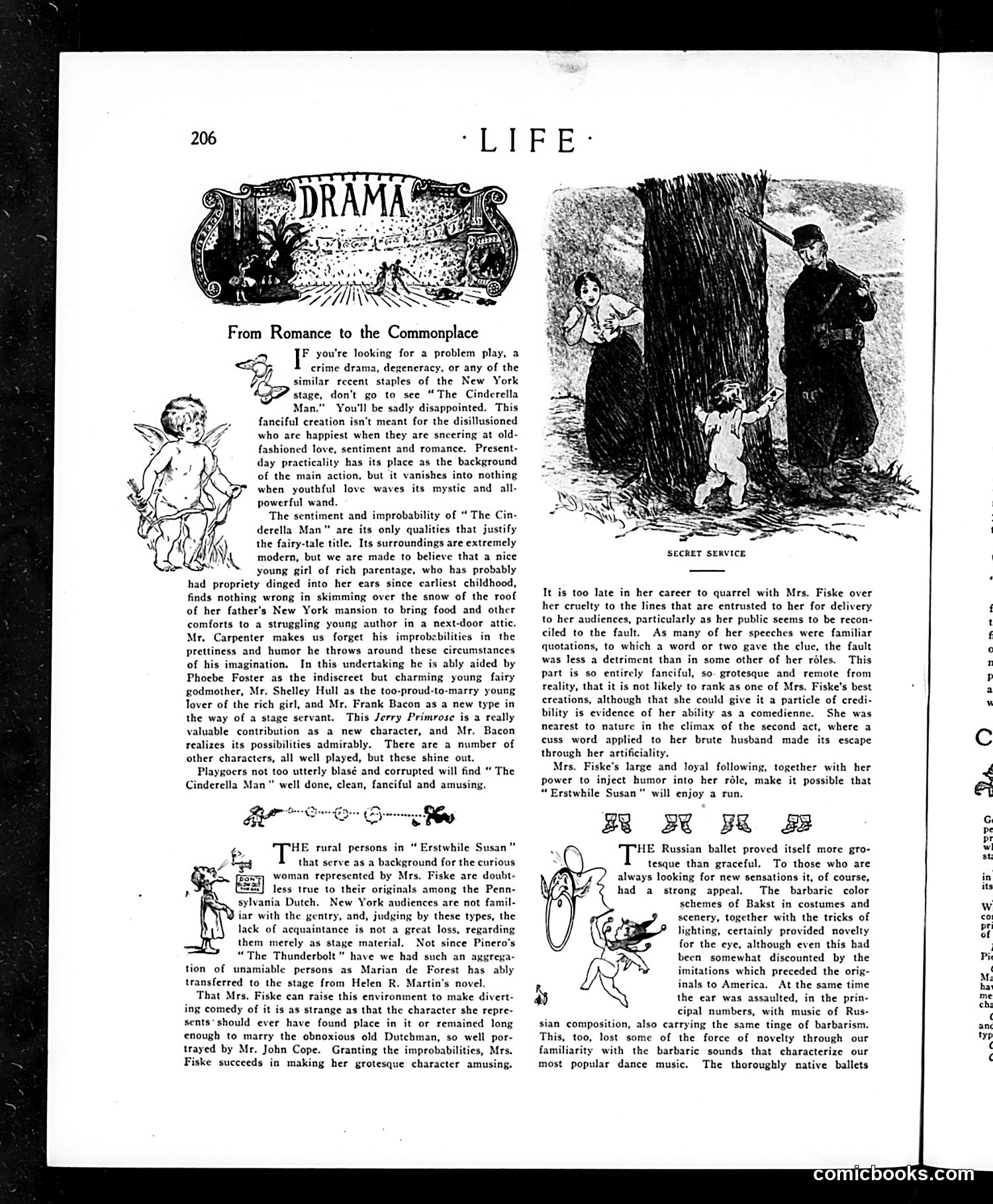
This page reviews three theatrical productions. The main content critiques "The Cinderella Man," a sentimental romantic play featuring Phoebe Foster and Frank Bacon. The reviewer praises it as wholesome entertainment for those not cynical about old-fashioned romance—a notable position given the era's trend toward "problem plays" and social criticism on stage. A secondary review discusses "Erstwhile Susan," starring the renowned actress Mrs. Fiske. The critic acknowledges Fiske's skill but finds the play's rural Pennsylvania Dutch characters unamiable and its premise improbable. The review notes Fiske's reputation for altering her lines, though audiences tolerate this habit. The "Secret Service" review begins at page bottom. The illustrations are decorative theatrical vignettes rather than political cartoons. This represents Life's drama criticism section during a period when theatrical reviews carried cultural weight in American magazines.
📄 Transcribed text from this page (OCR, searchable)
Machine-transcribed from the original scan — historical spelling and the odd misread are preserved.
From Romance to the Commonplace F you're looking for a problem play, a 2 ah crime drama, degeneracy, or any of the GAL__ similar recent staples of the New York AF” stage, don't go to see “The Cinderella Man.” You'll be sadly disappointed. This fanciful creation isn't meant for the disillusioned who are happiest when they are sneering at old- fashioned love, sentiment and romance. Present- day practicality has its place as the background of the main action, but it vanishes into nothing when youthful love waves its mystic and all- powerful wand. The sentiment and improbability of “ The Cin- derella Man” are its only qualities that justify the fairy-tale title. Its surroundings are extremely modern, but we are made to believe that a nice young girl of rich parentage, who has probably had propriety dinged into her ears since carliest childhood, finds nothing wrong in skimming over the snow of the roof of her father’s New York mansion to bring food and other comforts to a struggling young author in a next-door attic. Mr. Carpenter makes us forget his improbebilitics in the prettiness and humor he throws around these circumstances of his imagination. In this undertaking he is ably aided by Phoebe Foster as the indiscreet but charming young fairy godmother, Mr. Shelley Hull as the too-proud-to-marry young lover of the rich girl, and Mr. Frank Bacon as a new type in the way of a stage servant. This Jerry Primrose is a really valuable contribution as a new character, and Mr. Bacon realizes its possibilities admirably. There are a number of other characters, all well played, but these shine out. Playgoers not too utterly blasé and corrupted will find “ The Cinderella Man" well done, clean, fanciful and amusing. a HE rural persons in “ Erstwhile Susan” that serve as a background for the curious seq] Woman represented by Mrs. Fiske are doubt- BSS} less true to their originals among the Penn- sylvania Dutch. New York audiences are not famil- iar with the gentry, and, judging by these types, the lack of acquaintance is not a great loss, regarding them merely as stage material. Not since Pinero’s “The Thunderbolt” have we had such an aggrega- tion of unamiable persons as Marian de Forest has ably transferred to the stage from Helen R. Martin's novel. That Mrs. Fiske can raise this environment to make divert- ing comedy of it is as strange as that the character she repre- sents* should ever have found place in it or remained long enough to marry the obnoxious old Dutchman, so well por- trayed by Mr. John Cope. Granting the improbabilities, Mrs. Fiske succeeds in making her grotesque character amusing. SECRET SERVICE It is too late in her career to quarrel with Mrs. Fiske over her cruelty to the lines that are entrusted to her for delivery to her audiences, particularly as her public seems to be recon- ciled to the fault. As many of her speeches were familiar quotations, to which a word or two gave the clue, the fault was less a detriment than in some other of her réles. This part is so entirely fanciful, so. grotesque and remote from reality, that it is not likely to rank as one of Mrs. Fiske’s best creations, although that she could give it a particle of credi- bility is evidence of her ability as a comedienne. She was nearest to nature in the climax of the second act, where a cuss word applied to her brute husband made its escape through her artificiality. Mrs. ke’s large and loyal following, together with her power to inject humor into her rdle, make it possible that “Erstwhile Susan” will enjoy a run. ZR Sk yk SB HE Russian ballet proved itself more gro- tesque than graceful. To those who are always looking for new sensations it, of course, had a strong appeal, The barbaric color schemes of Bakst in costumes and scenery, together with the tricks of lighting, certainly provided novelty for the eye, although even this had been somewhat discounted by the imitations which preceded the orig- inals to America, At the same time b the ear was assaulted, in the prin- cipal numbers, with music of Rus- sian composition, also carrying the same tinge of barbarism. This, too, 1 some of the force of novelty through our familiarity th the barbaric sounds that characterize our most popular dance music. The thoroughly native ballets comicbooks.com ee ieee a @