
Life, 1916-02-03 · page 23 of 48
Life — February 3, 1916 — page 23: what you’re looking at
What you’re looking at
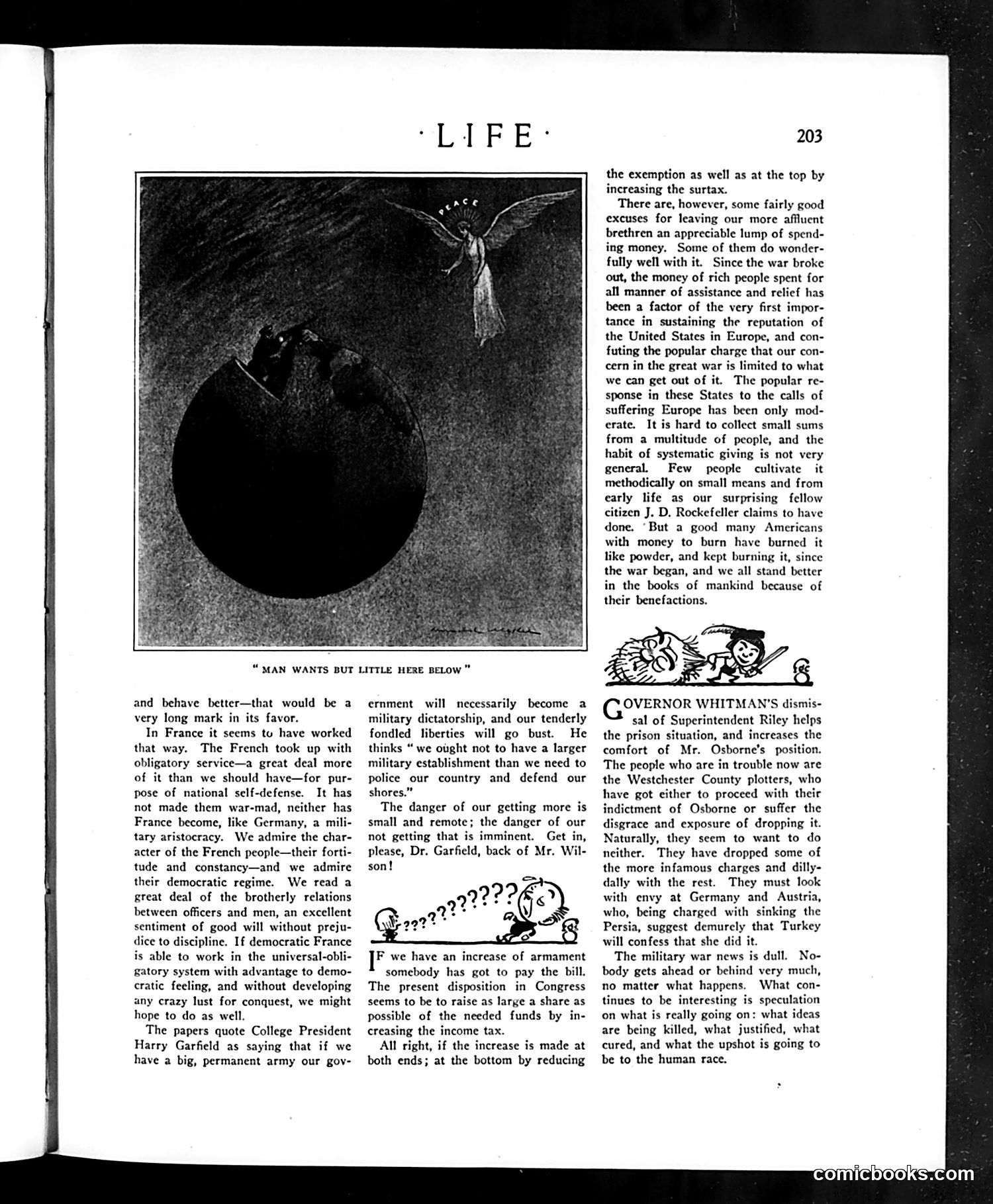
The main cartoon, titled "Man Wants But Little Here Below," depicts a large dark sphere (likely representing Earth or a bomb) with a small figure beneath it—satirizing humanity's modest desires against the scale of warfare and destruction. The text debates military preparedness versus the risk of militarism. It quotes College President Harry Garfield's concern that a large standing army would create military dictatorship, while the author argues defensive armament is necessary. The piece supports France's approach to mandatory military service, claiming it hasn't created militarism there. A secondary cartoon shows a confused figure with question marks, relating to Congress debates over funding military expansion through income tax increases—proposing higher taxes on both wealthy individuals (increased surtax) and lower-income earners (reduced exemptions). The final section discusses Governor Whitman's dismissal of Prison Superintendent Riley, with a cynical comparison to Germany and Austria deflecting blame for sinking the ship Persia by suggesting Turkey confess instead.
📄 Transcribed text from this page (OCR, searchable)
Machine-transcribed from the original scan — historical spelling and the odd misread are preserved.
“MAN WANTS BUT LITTLE HERE BELOW” and behave better—that would be a very long mark in its favor. In France it seems tou have worked that way. The French took up with obligatory service—a great deal more of it than we should have—for pur- pose of national self-defense. It has not made them war-mad, neither has France become, like Germany, a mili- tary aristocracy. We admire the char- acter of the French people—their forti- tude and constancy—and we admire their democratic regime. We read a great deal of the brotherly relations between officers and men, an excellent sentiment of good will without preju- dice to discipline. If democratic France is able to work in the universal-obli- gatory system with advantage to demo- cratic feeling, and without developing any crazy lust for conquest, we might hope to do as well. The papers quote College President Harry Garfield as saying that if we have a big, permanent army our gov- ernment will necessarily become a military dictatorship, and our tenderly fondled liberties will go bust. He thinks “ we ought not to have a larger military establishment than we need to police our country and defend our shores.” The danger of our getting more is small and remote; the danger of our not getting that is imminent. Get in, please, Dr. Garfield, back of Mr. Wil- F we have an increase of armament somebody has got to pay the bill. The present disposition in Congress seems to be to raise as large a share as possible of the needed funds by in- creasing the income tax. All right, if the increase is made at both ends; at the bottom by reducing 203 the exemption as well as at the top by increasing the surtax. There are, however, some fairly good excuses for leaving our more affluent brethren an appreciable lump of spend- ing money. Some of them do wonder- fully well with it. Since the war broke out, the money of rich people spent for afl manner of assistance and relief has been a factor of the very first impor- tance in sustaining the reputation of the United States in Europe, and con- futing the popular charge that our con- cern in the great war is limited to what we can get out of it. The popular re- sponse in these States to the calls of suffering Europe has been only mod- erate. It is hard to collect small sums from a multitude of people, and the habit of systematic giving is not very general. Few people cultivate it methodically on small means and from early life as our surprising fellow citizen J. D, Rockefeller claims to have done. “But a good many Americans with money to burn have burned it like powder, and kept burning it, since the war began, and we all stand better in the books of mankind because of their benefactions. OVERNOR WHITMAN'S dismis- sal of Superintendent Riley helps the prison situation, and increases the comfort of Mr. Osborne’s position. The people who are in trouble now are the Westchester County plotters, who have got either to proceed with their indictment of Osborne or suffer the disgrace and exposure of dropping it. Naturally, they seem to want to do neither. They have dropped some of the more infamous charges and dilly- dally with the rest. They must look with envy at Germany and Austria, who, being charged with sinking the Persia, suggest demurcly that Turkey will confess that she did it. The military war news is dull. No- body gets ahead or behind very much, no matter what happens. What con- tinues to be interesting is speculation on what is really going on: what ideas are being killed, what justified, what cured, and what the upshot is going to be to the human race.