
Life, 1916-02-03 · page 8 of 48
Life — February 3, 1916 — page 8: what you’re looking at
What you’re looking at
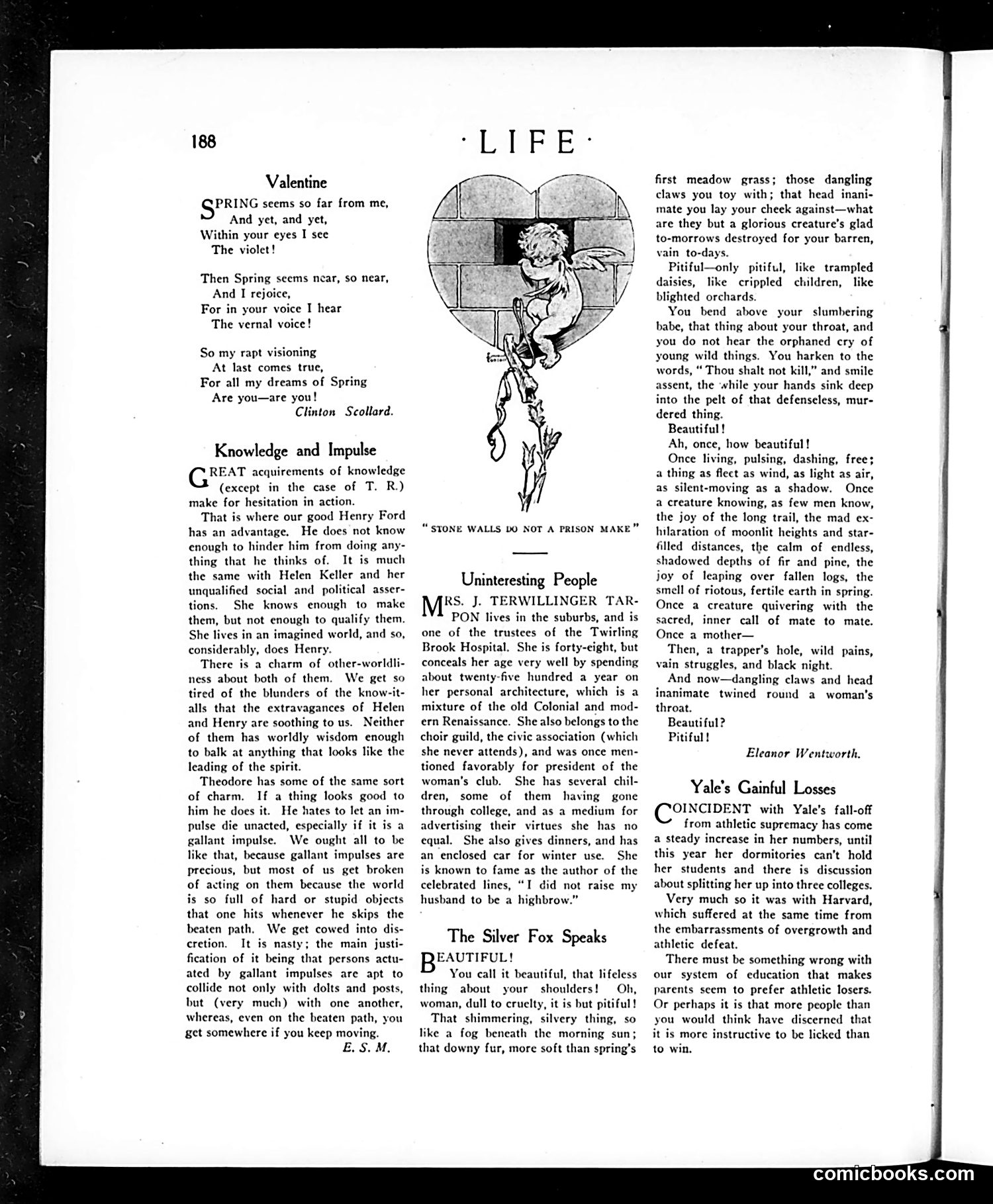
The page contains several literary pieces rather than political cartoons. The central illustration shows a cherub or cupid figure climbing chains within a heart shape—accompanying "Valentine," a poem by Clinton Scollard about Spring and romantic longing. Below are prose sections: "Knowledge and Impulse" discusses Henry Ford's business success despite limited education; "Uninteresting People" satirizes a wealthy suburban woman (Mrs. J. Terwillinger Tarpon) who performs charitable duties perfunctorily; "The Silver Fox Speaks" critiques women's treatment of animals; and "Yale's Gainful Losses" comments on Yale University's athletic struggles. The satire targets upper-class pretension, suggesting wealthy people perform social obligations without genuine commitment or understanding.
📄 Transcribed text from this page (OCR, searchable)
Machine-transcribed from the original scan — historical spelling and the odd misread are preserved.
188 Valentine PRING seems so far from me, And yet, and yet, Within your eyes I see The violet! Then Spring seems near, so near, And I rejoice, The vernal voice! So my rapt visioning At last comes true, For all my dreams of Spring Are you—are you! Clinton Scollard. Knowledge and Impulse GREAT acquirements of knowledge (except in the case of T. R.) make for hesitation in action. That is where our good Henry Ford has an advantage. He does not know enough to hinder him from doing any- thing that he thinks of. It is much the same with Helen Keller and her unqualified social and political asser- tions. She knows enough to make them, but not enough to qualify them. She lives in an imagined world, and so, considerably, does Henry. There is a charm of other-worldli- ness about both of them. We get so tired of the blunders of the know-it- alls that the extravagances of Helen and Henry are soothing to us. Neither of them has worldly wisdom enough to balk at anything that looks like the leading of the spirit. Theodore has some of the same sort of charm. If a thing looks good to him he does it. He hates to let an im- pulse die unacted, especially if it is a gallant impulse. We ought all to be like that, because gallant impulses are precious, but most of us get broken of acting on them because the world is so full of hard or stupid objects that one hits whenever he skips the beaten path. We get cowed into dis- cretion. It is nasty; the main justi- fication of it being that persons actu- ated by gallant impulses are apt to collide not only with dolts and posts, but (very much) with one another, whereas, even on the beaten path, you get somewhere if you keep moving. E.S.M. “STONE WALLS DO NOT A PRISON MAKE” Uninteresting People MES: J. TERWILLINGER TAR- PON lives in the suburbs, and is one of the trustees of the Twirling Brook Hospital. She is forty-eight, but conceals her age very well by spending about twenty-five hundred a year on her personal architecture, which is a mixture of the old Colonial and mod- ern Renaissance. She also belongs to the choir guild, the civic association (which she never attends), and was once men- tioned favorably for president of the woman's club. She has several chil- dren, some of them having gone through college, and as a medium for advertising their virtues she has no equal. She also gives dinners, and has an enclosed car for winter use. She is known to fame as the author of the celebrated lines, “I did not raise my husband to be a highbrow.” The Silver Fox Speaks B AUTIFUL! You call it beautiful, that lifeless thing about your shoulders! Oh, woman, dull to cruelty, it is but pitiful! That shimmering, silvery thing, so like a fog beneath the morning sun; that downy fur, more soft than spring's first meadow grass; those dangling claws you toy with; that head inani- mate you lay your cheek against—what are they but a glorious creature's glad to-morrows destroyed for your barren, vain to-days. Pitiful—only pitiful, like trampled daisies, like crippled children, like blighted orchards. You bend above your slumbering babe, that thing about your throat, and you do not hear the orphaned cry of young wild things. You harken to the words, “ Thou shalt not kill,” and smile assent, the while your hands sink deep into the pelt of that defenseless, mur- dered thing. Beautiful! Ah, once, how beautiful! Once living, pulsing, dashing, free; a thing as flect as wind, as light as air, as silent-moving as a shadow. Once a creature knowing, as few men know, the joy of the long trail, the mad ex- hilaration of moonlit heights and star- filled distances, the calm of endless, shadowed depths of fir and pine, the joy of leaping over fallen logs, the smell of riotous, fertile earth in spring. Once a creature quivering with the sacred, inner call of mate to mate. Once a mother— Then, a trapper’s hole, wild pains, vain struggles, and black night. And now—dangling claws and head inanimate twined round a woman's throat. Beautiful? Pitiful! Eleanor Wentworth. Yale’s Gainful Losses OINCIDENT with Yale’s fall-off from athletic supremacy has come a steady increase in her numbers, until this year her dormitories can't hold her students and there is discussion about splitting her up into three colleges. Very much so it was with Harvard, which suffered at the same time from the embarrassments of overgrowth and athletic defeat. There must be something wrong with our system of education that makes parents seem to prefer athletic losers. Or perhaps it is that more people than you would think have discerned that it is more instructive to be licked than to win, comicbooks.com