
Life, 1916-02-03 · page 27 of 48
Life — February 3, 1916 — page 27: what you’re looking at
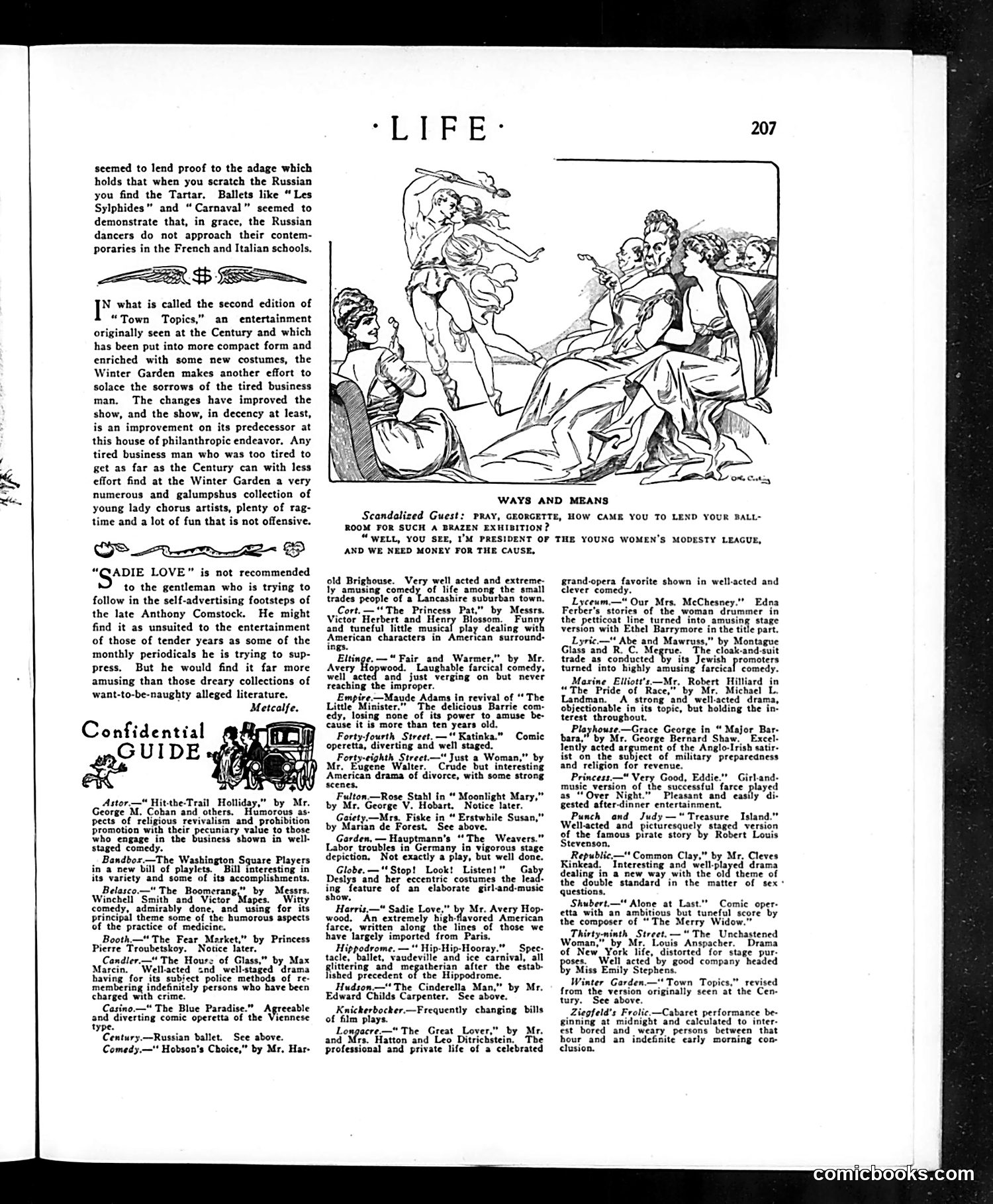
What you’re looking at
This single-panel cartoon satirizes hypocrisy regarding female morality and fundraising. A scandalized guest questions how the hostess, Georgette, could lend her ballroom "for such a brazen exhibition." Georgette's response reveals the joke: she's president of the "Young Women's Modesty League" and needs money for the cause—meaning she's willing to compromise the very morality she publicly champions to fund an organization supposedly dedicated to protecting it. The humor targets both the pretense of such "modesty leagues" (real organizations that existed in the early 1900s) and the contradiction between public moral posturing and private financial pragmatism. It suggests these organizations were sometimes more concerned with fundraising than actual virtue, and that respectable society women hypocritically participated in or enabled the "brazen" behavior they publicly condemned.
📄 Transcribed text from this page (OCR, searchable)
Machine-transcribed from the original scan — historical spelling and the odd misread are preserved.
seemed to lend proof to the adage which holds that when you scratch the Russian you find the Tartar. Ballets like “Les Sylphides" and “Carnaval” seemed to demonstrate that, in grace, the Russian dancers do not approach their contem- poraries in the French and Italian schools, N what is called the second edition of “Town Topics,” an entertainment originally seen at the Century and which has been put into more compact form and enriched with some new costumes, the Winter Garden makes another effort to solace the sorrows of the tired business man. The changes have improved the show, and the show, in decency at least, is an improvement on its predecessor at this house of philanthropic endeavor. Any tired business man who was too tired to get as far as the Century can with less effort find at the Winter Garden a very numerous and galumpshus collection of young lady chorus artists, plenty of rag- time and a lot of fun that is not offensive. OP Aime | “QADIE LOVE” is not recommended to the gentleman who is trying to follow in the self-advertising footsteps of the late Anthony Comstock. He might find it as unsuited to the entertainment of those of tender years as some of the monthly periodicals he is trying to sup- press. But he would find it far more amusing than those dreary collections of want-to-be-naughty alleged literature. Metcalfe. Confidential G aC Astor —" Hitthe-Trail Holliday,” by Mr. George M. Coban and others. Humorous as: pects of religious revivalism and prohibition promotion with their pecuniary value to those who engage in the business shown in well- staged comedy. _ Bandbox.—The Washington Square Players in a new bill of playlets. Bill interesting in its variety and some of its accomplishments, Belasco.—" The Boomerang,” by Messrs. Winchell Smith and Victor Mapes. Witty comedy, admirably done, and using for its principal theme some of the humorous aspects of the practice of medicine. Booth.—" The Fear Market,” by Princess Pierre Troubetskoy. Notice later. Candler." The Hours of Glass,” by Max Marcin, Wellacted and well-staged drama having for its subject police methods of re- membering indefinitely persons who have been charged with crime. i The Blue Paradise." Agrecable ing comic operetta of the Viennese above. Hobson's Choice,” by Mr, Har- WAYS AND MEANS Scandalized Guest: ROOM FOR SUCH A BRAZEN EXHIBITION? PRAY, GEORGETTE, HOW CAME YOU TO LEND YOUR BALL- “WELL, YOU SEE, I'M PRESIDENT OF THE YOUNG WOMEN'S MODESTY LEAGUE, AND WE NEED MONEY FOR THE CAUSE, old Brighouse. Very well acted and extreme- ly amusing comedy of life among the small trades people of a Lancashire suburban town. Cort.—"The Princess Pat,” by Messrs. Victor Herbert and Henry Blossom. Funny and tuneful little musical play dealing wit American characters in American surround- ings. Eltinge.—“ Fair and Warmer,” by Mr. Avery Hopwood. Laughable farcical comedy, well acted ‘and just verging on but never reaching the improper. Empire —Maude Adams in revival of “The Little Minister.” The delicious Barrie com- edy, losing none of its power to amuse be- cause it is more than ten years old. Forty-fourth Street, —" Katinka.” operetta, diverting and well staged. Forty-eighth Street.—" Just a Woman,” by Mr, Eugene Walter, Crude but interesting American drama of divorce, with some strong scenes. Fulton—Rose Stahl in “ Moonlight Mary,” Mr, George V. Hobart. Notice later. Comic Gaiety.—Mrs. Fiske in “ Erstwhile Susan,” by Marian de Forest. See above. Garden, — Hauptmann’s “The Labor troubles in Germany in vigorous stage depiction. Not exactly a play, but well done. Weavers.” Globe. —"* Stop! Look! Listen!" Gaby Deslys and her eccentric costumes the lead- ing feature of an elaborate gitl-and-music show. Harris. —“ Sadie Love,” by Mr. Avery Hop- wood. An extremely high-flavored American farce, written along the lines of those we have largely imported from Pari Hippodrome. —** Hip-Hip-Hooray.” Spec: tacle, ballet, vaudeville and ice carnival, all glittering and megatherian after the estab- lished precedent of the Hippodrome. Hudson.—'' The Cinderella Man,” by Mr. Edward Childs Carpenter. See above. Knickerbocker.—Frequently changiny of film plays. Longacre—" The Great Lover," by Mr. and Mrs. Hatton and Leo Ditrichstein. The professional and private life of a celebrated bills grand-opera favorite shown in well.acted and clever comedy. Lyceum.—" Our Mrs. McChesney.” Edna Ferber's stories of the woman drummer in the petticoat line turned into amusing stage version with Ethel Barrymore in the title part. Lyric" Abe and Mawruss,” by Montague Glass and R. C. Megrue. The cloak-and-suit trade as conducted by its Jewish promoters turned into highly amusing farcical comedy. Marine Elliott's—Mr. Robert Hilliard in “The Pride of Race,” by Mr. Michael L. Landman. A strong and well-acted drama, objectionable in its topic, but holding the in- terest throughout Playhouse —Grace George in ‘* Major Bar- bara,” by Mr. George Bernard Shaw. Excel- lently acted argument of the Anglo-Irish satir- ist_on the subject of military preparedness and religion for revenue. Princess. Very Good, Eddie.” Girl-and- music version of the successful farce played as “Over Night.’ Pleasant and easily di- gested after-dinner entertainment. Punch and Judy —“ Treasure Island.” Wellacted “and picturesquely staged version of the famous pirate story by Robert Louis Stevenso: Republic —" Common Clay,” by Mr, Cleves Kinkead. Interesting and well-played drama dealing in a new way with the old theme of the double standard” in the matter of sex * Questions, Shubert.—"* Alone at Last.” Comic oper- etta with an ambitious but tuneful score by the composer of “The Merry Widow.” “The Unchastened Anspacher. Drama torted for stage pi ‘good company ‘headed y Miss Emily Stephens: Winter Garden.—* Town Topics revised from the version originally seen at the Cen- tury. See above. Ziegfeld’s Frolic —Cabaret performance be- ginning at midnight and calculated to inter- est bored and weary persons between that hour and an indefinite early morning com clusion.