
Life, 1916-02-03 · page 22 of 48
Life — February 3, 1916 — page 22: what you’re looking at
What you’re looking at
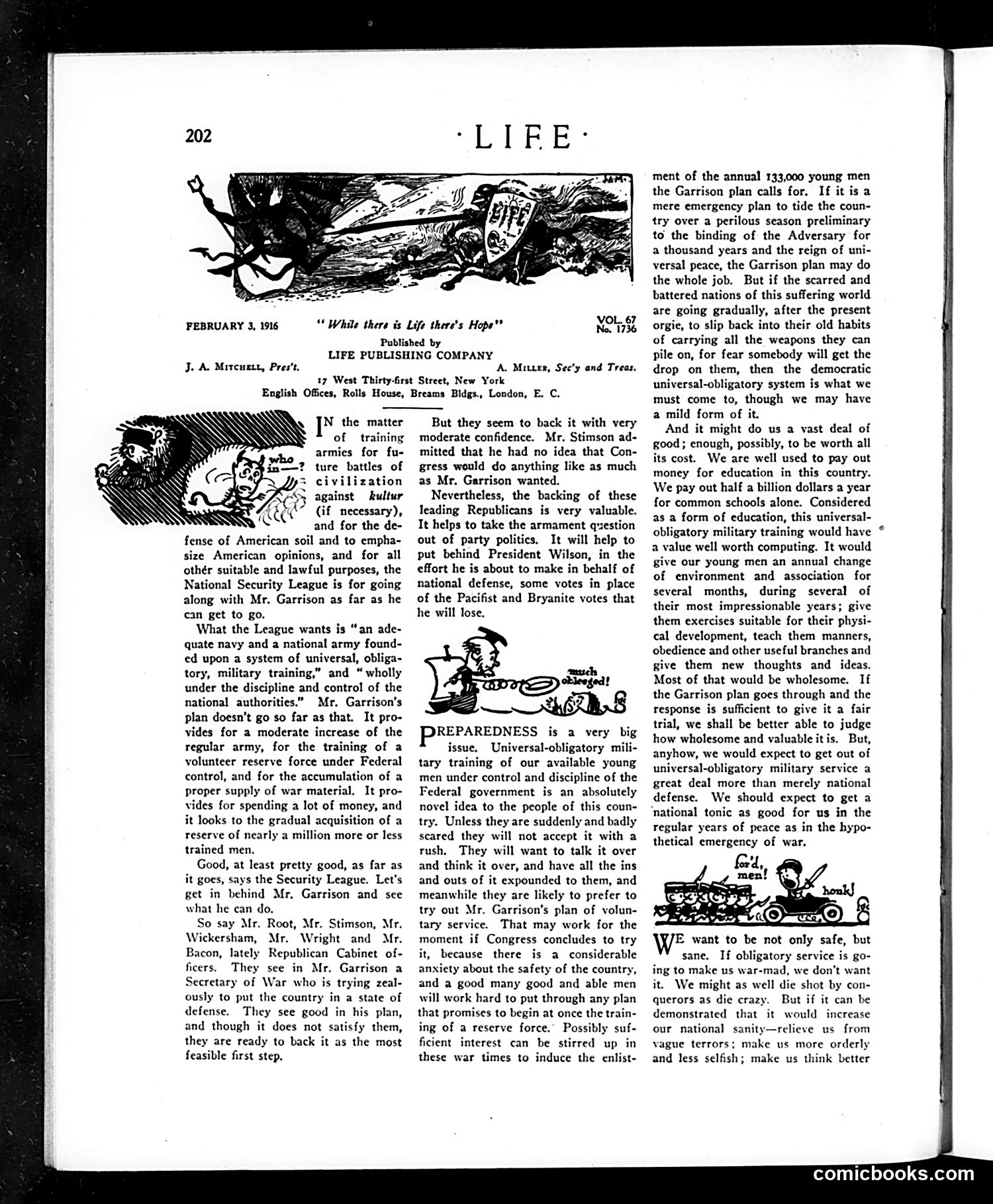
This page discusses Secretary of War Lindley M. Garrison's military preparedness plan, which proposes moderate increases to the regular army and a volunteer reserve force—falling short of the "universal, obligatory military training" demanded by the National Security League. The editorial notes that prominent Republican figures (Root, Stimson, Wickersham, Wright, and Bacon) support Garrison's plan, though with "moderate confidence," doubting Congress will authorize even this modest expansion. The cartoons (visible but small) appear to mock preparedness debates. The piece argues that Americans, unaccustomed to such military obligations, will want to debate the issue thoroughly before accepting mandatory training. It suggests Garrison's voluntary approach might work temporarily if Congress backs it, particularly given wartime anxieties—though it questions whether this addresses long-term defense needs or merely short-term emergency response to the ongoing European war.
📄 Transcribed text from this page (OCR, searchable)
Machine-transcribed from the original scan — historical spelling and the odd misread are preserved.
FEBRUARY 3, 1916 ‘* While there is Life there’s Hope” Published by LIFE PUBLISHING COMPANY J. A. Mircuett, Pres’t. A. Mittrr, Sec’y and Treas. 17 West Thirty-first Street, New York English Offices, Rolls House, Breams Bldgs, London, E. C. ANY IX the matter SS of training armies for fu- ture battles of civilization against kultur (if. necessary), and for the de- fense of American soil and to empha- size American opinions, and for all othér suitable and lawful purposes, the National Security League is for going along with Mr. Garrison as far as he can get to go. What the League wants is “an ade- quate navy and a national army found- ed upon a system of universal, obliga- tory, military training,” and “wholly under the discipline and control of the national authorities.” Mr. Garrison's plan doesn’t go so far as that. It pro- vides for a moderate increase of the regular army, for the training of a volunteer reserve force under Federal control, and for the accumulation of a proper supply of war material. It pro- vides for spending a lot of money, and it looks to the gradual acquisition of a reserve of nearly a million more or less trained men. Good, at least pretty good, as far as it goes, says the Security League. Let's get in behind Mr. Garrison and see what he can do. So say Mr. Root, Mr. Stimson, Mr. Wickersham, Mr. Wright and Mr. Bacon, lately Republican Cabinet of- ficers. They see in Mr. Garrison a Secretary of War who is trying zeal- ously to put the country in a state of defense. They see good in his plan, and though it does not satisfy them, they are ready to back it as the most feasible first step. But they seem to back it with very moderate confidence. Mr. Stimson ad- mitted that he had no idea that Con- gress would do anything like as much as Mr. Garrison wanted. Nevertheless, the backing of these leading Republicans is very valuable. It helps to take the armament question out of party politics. It will help to put behind President Wilson, in the effort he is about to make in behalf of national defense, some votes in place of the Pacifist and Bryanite votes that he will lose, oSiceged! — REPAREDNESS is a very big issue. Universal-obligatory mili- tary training of our available young men under control and discipline of the Federal government is an absolutely novel idea to the people of this coun- try. Unless they are suddenly and badly scared they will not accept it with a rush, They will want to talk it over and think it over, and have all the ins and outs of it expounded to them, and meanwhile they are likely to prefer to try out Mr. Garrison's plan of volun- tary service. That may work for the moment if Congress concludes to try it, because there is a considerable anxiety about the safety of the country, and a good many good and able men will work hard to put through any plan that promises to begin at once the train- ing of a reserve force.’ Possibly suf- ficient interest can be stirred up in these war times to induce the enlist- ment of the annual 133,000 young men the Garrison plan calls for. If it isa mere emergency plan to tide the coun- try over a perilous season preliminary to the binding of the Adversary for a thousand years and the reign of uni- versal peace, the Garrison plan may do the whole job. But if the scarred and battered nations of this suffering world are going gradually, after the present orgie, to slip back into their old habits of carrying all the weapons they can pile on, for fear somebody will get the drop on them, then the democratic universal-obligatory system is what we must come to, though we may have a mild form of it. And it might do us a vast deal of good; enough, possibly, to be worth all its cost. We are well used to pay out money for education in this country. We pay out half a billion dollars a year for common schools alone. Considered as a form of education, this universal- obligatory military training would have a value well worth computing. It would give our young men an annual change of environment and association for several months, during several of their most impressionable years; give them exercises suitable for their physi- cal development, teach them manners, obedience and other useful branches and give them new thoughts and ideas. Most of that would be wholesome. If the Garrison plan goes through and the response is sufficient to give it a fair trial, we shall be better able to judge how wholesome and valuable itis. But, anyhow, we would expect to get out of universal-obligatory military service a great deal more than merely national defense. We should expect to get a ‘national tonic as good for us in the regular years of peace as in the hypo- thetical emergency of war. WE want to be not only safe, but sane. If obligatory service is go- ing to make us war-mad, we don’t want it. We might as well die shot by con- querors as die crazy. But if it can be demonstrated that it would increase our national sanity—relieve us from vague terrors; make us more orderly and less selfish; make us think better e comicbooks.com