
Life, 1916-02-03 · page 13 of 48
Life — February 3, 1916 — page 13: what you’re looking at
What you’re looking at
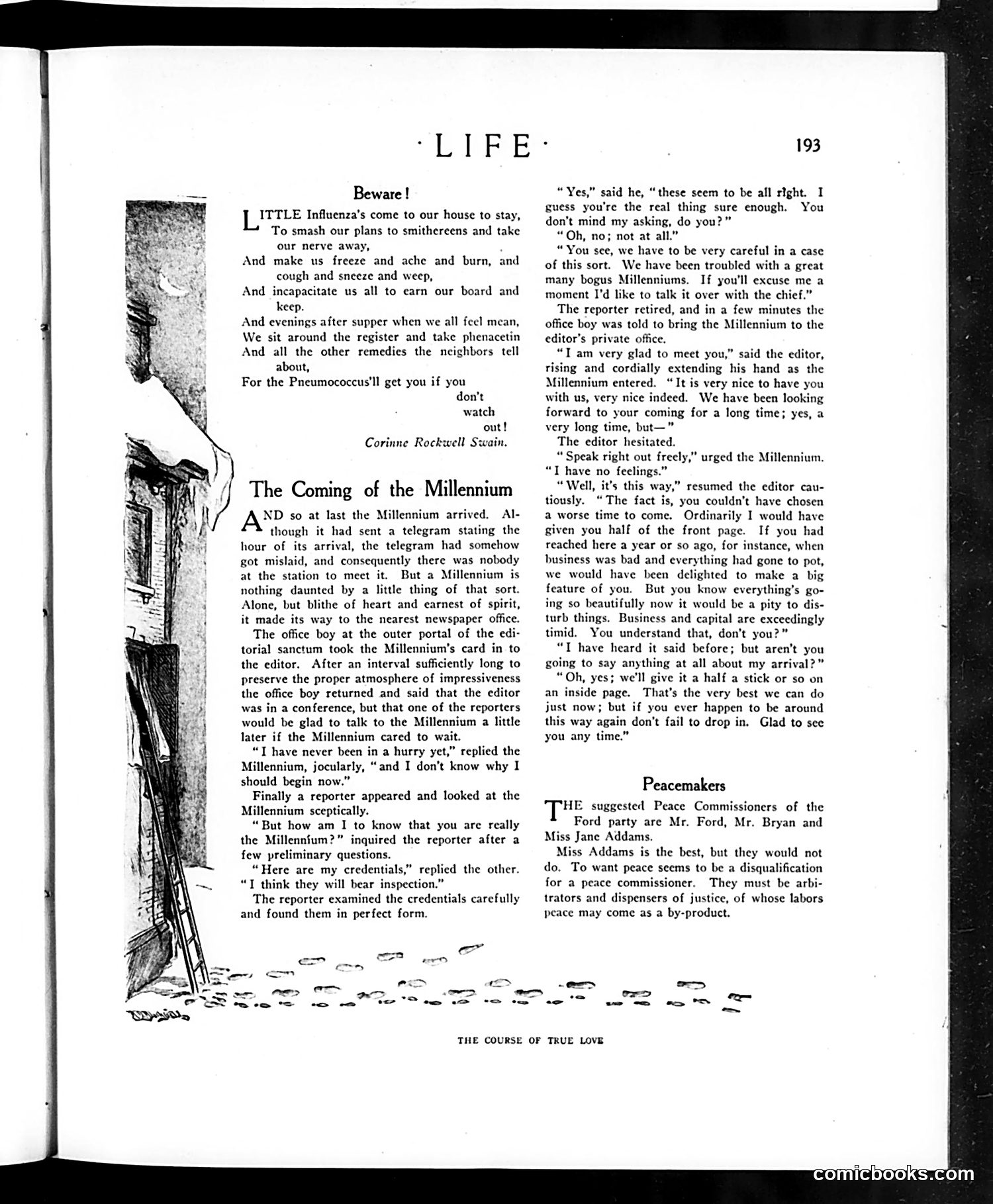
This satirical piece mocks the sensationalism surrounding the approaching year 1900 (the "Millennium"). A young reporter visits a newspaper editor seeking a story about the millennium's arrival. The editor dismisses the reporter's concerns, admitting the public is anxious but refusing to give it major coverage—offering only "half a stick" (minor space) on an inside page. The humor lies in exposing editorial cynicism: despite genuine public anxiety about the new century, editors treat it as manufactured drama unworthy of serious attention. The accompanying poem "Beware!" satirizes common millennial fears (plague, freezing temperatures, financial collapse). The second section, "Peacemakers," appears to reference contemporary peace commission negotiations, though specific figures remain unclear from the text alone.
📄 Transcribed text from this page (OCR, searchable)
Machine-transcribed from the original scan — historical spelling and the odd misread are preserved.
*“LIFE- 193 Beware ! | Pe Influenza’s come to our house to stay, To smash our plans to smithereens and take our nerve away, And make us freeze and ache and burn, and cough and sneeze and weep, And incapacitate us all to earn our board and keep. And evenings after supper when we all feel mean, We sit around the register and take phenacetin And all the other remedies the neighbors tell about, For the Pneumococcus'll get you if you don’t watch out! Corinne Rockwell Swain. The Coming of the Millennium ND so at last the Millennium arrived. Al- though it had sent a telegram stating the hour of its arrival, the telegram had somehow got mislaid, and consequently there was nobody at the station to meet it. But a Millennium is nothing daunted by a little thing of that sort. Alone, but blithe of heart and earnest of spirit, it made its way to the nearest newspaper office. The office boy at the outer portal of the edi- torial sanctum took the Millennium’'s card in to the editor. After an interval sufficiently long to preserve the proper atmosphere of impressiveness the office boy returned and said that the editor was in a conference, but that one of the reporters would be glad to talk to the Millennium a little later if the Millennium cared to wait. “T have never been in a hurry yet,” replied the Millennium, jocularly, “and I don’t know why I should begin now.” Finally a reporter appeared and looked at the Millennium sceptically. “But how am I to know that you are really the Millennium?” inquired the reporter after a few preliminary questions. “Here are my credentials,” replied the other. “T think they will bear inspection.” The reporter examined the credentials carefully and found them in perfect form. - = reo "Se oS “Yes,” said he, “these seem to be all right. I guess you're the real thing sure enough. You don’t mind my asking, do you?” “Oh, no; not at all.” “You see, we have to be very careful in a case of this sort. We have been troubled with a great many bogus Millenniums. If you'll excuse me a moment I'd like to talk it over with the chief.” The reporter retired, and in a few minutes the office boy was told to bring the Millennium to the editor’s private office. “Tam very glad to meet you,” said the editor, rising and cordially extending his hand as the Millennium entered. “It is very nice to have you with us, very nice indeed. We have been looking forward to your coming for a long time; yes, a very long time, but—” The editor hesitated. “ Speak right out freely,” urged the Millennium. “T have no feelings.” “Well, it’s this way,” resumed the editor cau- tiously. “The fact is, you couldn’t have chosen a worse time to come. Ordinarily I would have given you half of the front page. If you had reached here a year or so ago, for instance, when business was bad and everything had gone to pot, we would have been delighted to make a big feature of you. But you know everything’s go- ing so beautifully now it would be a pity to dis- turb things. Business and capital are exceedingly timid. You understand that, don't you?” “TI have heard it said before; but aren't you going to say anything at all about my arrival?” “Oh, yes; we'll give it a half a stick or so on an inside page. That's the very best we can do just now; but if you ever happen to be around this way again don’t fail to drop in. Glad to see you any time.” Peacemakers THE suggested Peace Commissioners of the Ford party are Mr. Ford, Mr. Bryan and Miss Jane Addams. Miss Addams is the best, but they would not do. To want peace seems to be a disqualification for a peace commissioner. They must be arbi- trators and dispensers of justice, of whose labors peace may come as a by-product. THE COURSE OF TRUE LOVE