
Life, 1916-02-03 · page 46 of 48
Life — February 3, 1916 — page 46: what you’re looking at
What you’re looking at
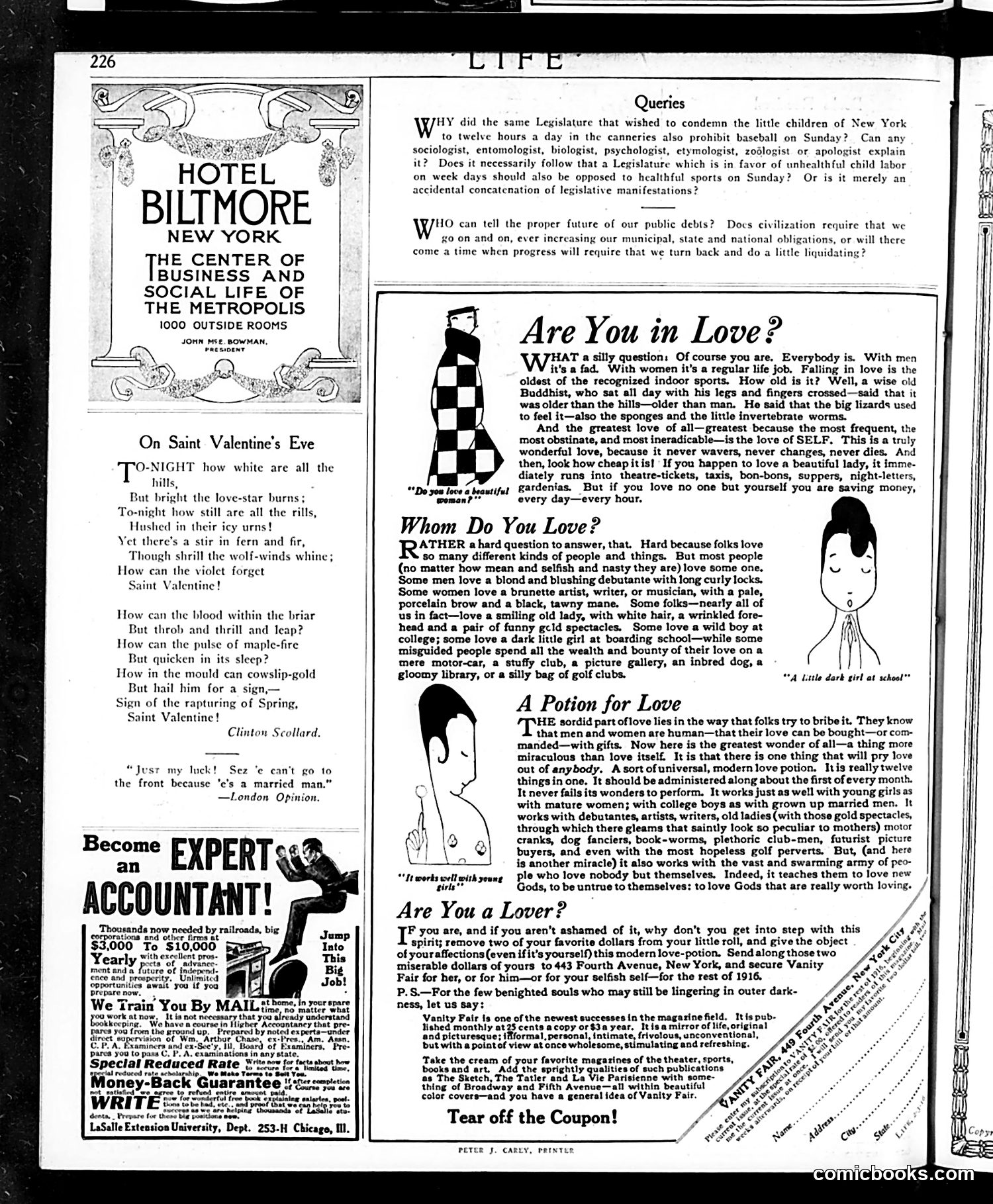
This page combines satirical commentary with period advertisements and romantic content typical of early 20th-century American magazines. **The "Queries" Section** presents sharp social criticism. The first questions a New York legislature's contradiction: prohibiting child labor in canneries while banning Sunday baseball—mocking the arbitrary logic of lawmakers. The second queries public debt policy, questioning whether endless municipal borrowing represents progress. **"Are You in Love?"** is tongue-in-cheek romantic satire. It defines love as universal but notes the most reliable love is self-love, which costs nothing (no theater tickets or gardenias required). This critiques commercial romance and materialism. **The Accountant Advertisement** promises lucrative careers ($3,000-$10,600 yearly—substantial sums then) through mail-order training, typical of era's vocational marketing. The page reflects pre-WWI concerns: legislative hypocrisy, municipal financial anxiety, and commercialized romance—all delivered through Life's characteristic irreverent humor targeting middle-class assumptions.
📄 Transcribed text from this page (OCR, searchable)
Machine-transcribed from the original scan — historical spelling and the odd misread are preserved.
&, 1° HOTEL & _ BILTMORE NEW YORK HE CENTER OF BUSINESS AND SOCIAL LIFE OF THE METROPOLIS 1000 OUTSIDE ROOMS JONN MSE. BOWMAN, “ a fi Zoe On Saint Valentine's Eve 'O-NIGHT how white are all the hills, But bright the love-star burns; To-night how still are all the rills, Hushed in their icy urns! Yet there's a stir in fern and fir, Though shrill the wolf-winds whine; How can the violet forget Saint Valentine! How can the blood within the briar But throb and thrill and leap? How can the pulse of maple-fire But quicken in its sleep? How in the mould can cowslip-gold But hail him for a sign,— Sign of the rapturing of Spring, Saint Valentine! Clinton Scollard. “Just my luck! Sez ‘e can't go to the front because 'e’s a married man.” —London Opinion. Become EXPERT ACCOUNTANT! ‘Thousands now needed by railroads, big Shoes ee acters $3,000. To ‘$10,600 early pts of airing ment anda fature of tndepend Exew and prosper, United opportunities await’ you if you prepare now,” We Train You By MAIL fires zecr rare aay understand pares You to pass Special Reduced Rate S'%2r7" {xr inushat bow ecial rctocod rein ecbolrsipy_ We Bake Tore te Bei Vow, Money-Back Guarantee faces: WRITE wo 2ne ee eet LaSalle Extension University, Dept. 253-H Chicago, Ill. Queries HY did the same Legislature that wished to condemn the little children of New York to twelve hours a day in the canneries also prohibit baseball on Sunda: Can any sociologist, entomologist, biologist, psychologist, ctymologist, zodlogist or apologist explain it? Does it necessarily follow that a Legislature which is in favor of unhealthful child labor on week days should also be opposed to healthful sports on Sunday? Or is it merely an accidental concatenation of legislative manifestations? HO can tell the proper future of our public debts? Docs civilization require that we go on and on, ever increasing our municipal, state and national obligations, or will there come a time when progress will require that we turn back and do a little liquidating? Are You in Love? wmta silly question: Of course you are. Everybody is. With men it's a fad. With women it’s a regular life job. Falling in love is the oldest of the recognized indoor sports. How old is it? Well, a wise old Buddhist, who sat all day with his legs and fingers crossed—said that it was older than the hills—older than man. He said that the big lizards used to feel it—also the sponges and the little invertebrate worms. And the greatest love of all—greatest because the most frequent, the most obstinate, and most ineradicable—is the love of SELF. This is a truly wonderful love, because it never wavers, never changes, never dies. And then, look how cheap itis! If you happen to love a beautiful lady, it imme- diately runs into theatre-tickets, taxis, bon-bons, suppers, night-letters, gardenias, But if you love no one but yourself you are saving money, every day—every hour. Whom Do You Love? FRATHER a hard question to answer, that. Hard because folks love so many different kinds of people and things. But most people (no matter how mean and selfish and nasty they are) love some one. Some men love a blond and blushing debutante with long curly locks, Some women love a brunette artist, writer, or musician, with a pale, porcelain brow and a black, tawny mane. Some folks—nearly all of us in fact—love a smiling old lady, with white hair, a wrinkled fore- head and a pair of funny gcld spectacles. Some love a wild boy at college; some love a dark little girl at boarding school—while some misguided people spend all the wealth and bounty of their love on a mere motor-car, a stuffy club, a picture gallery, an inbred dog, gloomy library, or a silly bag of golf clubs. A Potion for Love (THE sordid partoftove lies in the way that folks try to bribe it. They know that men and women are human—that their love can be bought—or com- manded—with gifts. Now here is the greatest wonder of all—a thing more miraculous than love itself. It is that there is one thing that will pry love out of anybody. A sort of universal, modern love potion. Itis really twelve things in one. It should be administered along about the first of every month. It never fails its wonders to perform. It works just as well with young girls as with mature women; with college boys as with grown up married men. It works with debutantes, artists, writers, old ladies (with those gold spectacles, through which there gleams that saintly look so peculiar to mothers) motor cranks, dog fanciers, book-worms, plethoric club-men, futurist picture buyers, and even with the most hopeless golf perverts. But, (and here is another miracle) it also works with the vast and swarming army of peo- ple who love nobody but themselves, Indeed, it teaches them to love new Gods, to be untrue to themselves: to love Gods that are really worth loving. **De you love a beautiful woman?” "A Little dark girl at school” “It works well with youn tirls”* Are You a Lover? JF 700 ate, and if you aren't ashamed of it, why don’t you get into step with this spirit; remove two of your favorite dollars from your little roll, and give the object of youraffections (even ifit’s yourself) this modern love-potion. Send along those two miserable dollars of yours to 443 Fourth Avenue, New York, and secure Vanity Fair for her, or for him—or for your selfish self—for the rest of 1916. P.S.—For the few benighted souls who may still be lingering in outer dark- ness, let us Say: Vanity Fair ts one of the newest successes in the magazinefield. Itis pub- lished monthly at 25 cents acopy or$3a year. Itisamirror of life, original and picturesque; (formal, personal, intimate, frivolous, unconventional, but with a point of view at once wholesome, stimulating and refreshing. Take the cream of your favorite magazines of the theater, spo! ks and art. ‘Aad the sprightly 8 of such publicatic as The Sketch, The Tatler and thing of Broadway and Fifth A color covere—and you have a Tear off the Coupon! isienne with some- within beautiful of Vanity Fair. PETER J. CAREY, PRINTER