
A complete issue · 52 pages · 1915
Life — October 28, 1915
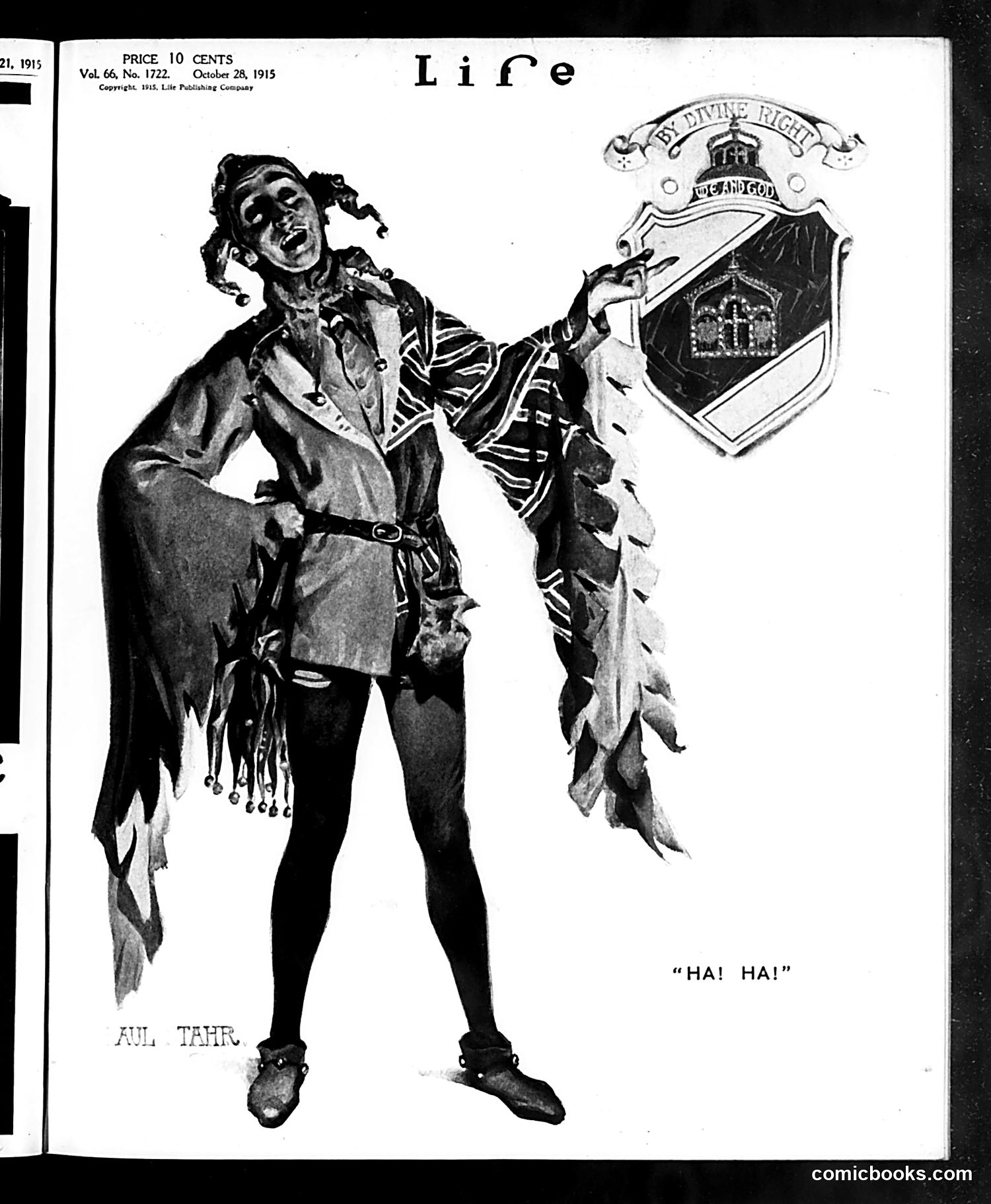
This is a satirical illustration labeled "HAI HAI" featuring a figure identified as "AUL TAHR" (likely Paul Tahar or similar). The character is depicted in theatrical costume—wearing a ornate military jacket with fringe and holding what appears to be a feathered fan or plume—striking an exaggerated, dramatic pose. The "By Divine Right" shield in the upper right suggests this mocks someone claiming authority through hereditary privilege or autocratic power. The theatrical costume and exaggerated posturing indicate this is likely ridiculing a political or military figure of 1915, possibly related to European conflicts of that era. The overall tone suggests satire of pompous, theatrical displays of power or authority. The specific identity remains unclear without additional context.
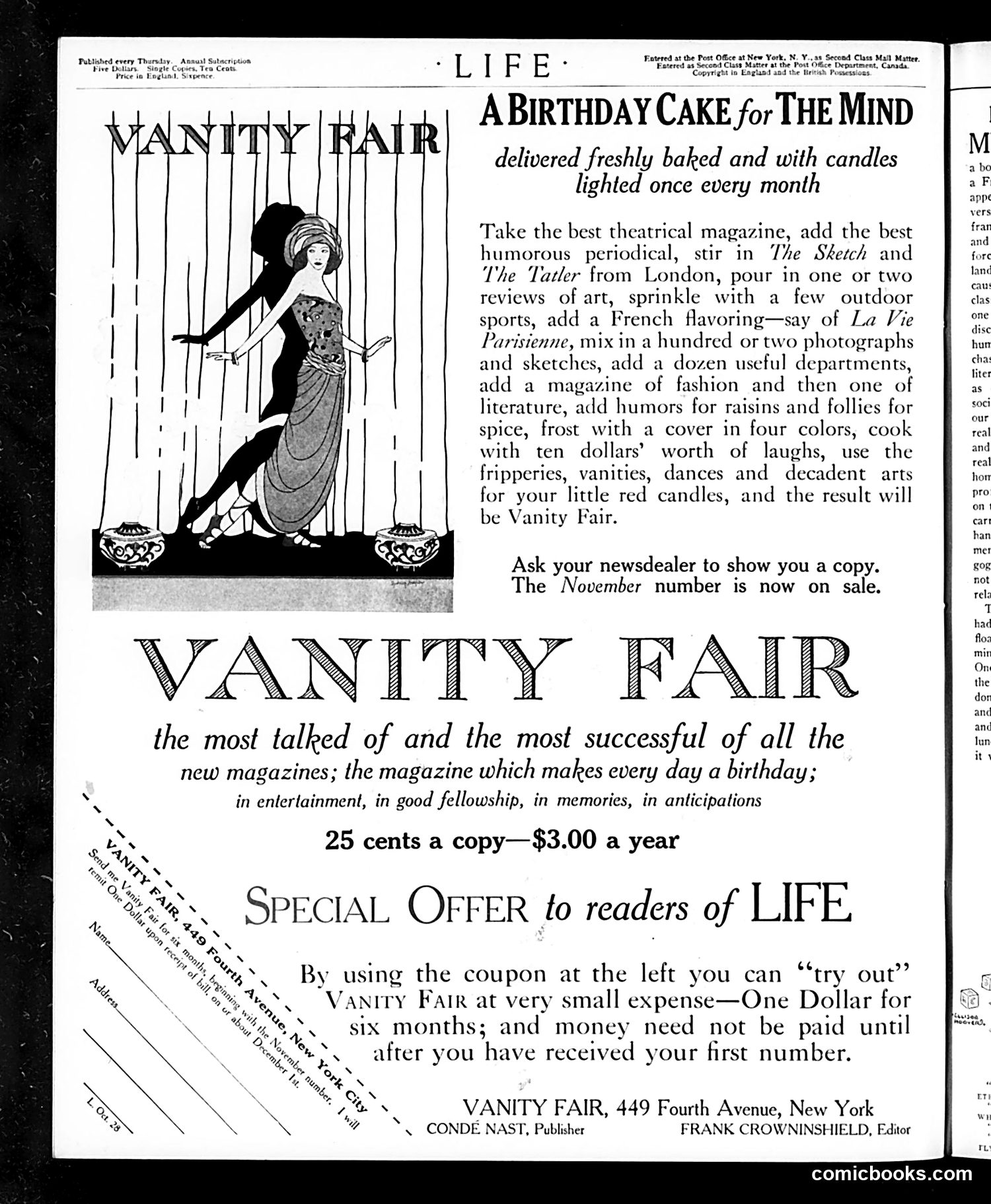
This page is primarily **advertising for Vanity Fair magazine**, not political satire. The "Vanity Hair" cartoon on the left appears to be decorative branding rather than commentary—it shows a stylized woman in an Art Deco fashion illustration style typical of 1920s periodical design. The main text uses an extended metaphor comparing Vanity Fair to a "birthday cake for the mind," humorously listing its contents: theatrical reviews, humor pieces, fashion coverage, photographs, and social commentary. The recipe-like description suggests the magazine combines entertainment and sophistication. The advertisement emphasizes Vanity Fair as "the most successful of all new magazines," offering readers of *Life* a promotional trial subscription: one dollar for six months. The tone is lighthearted and aspirational rather than satirical.
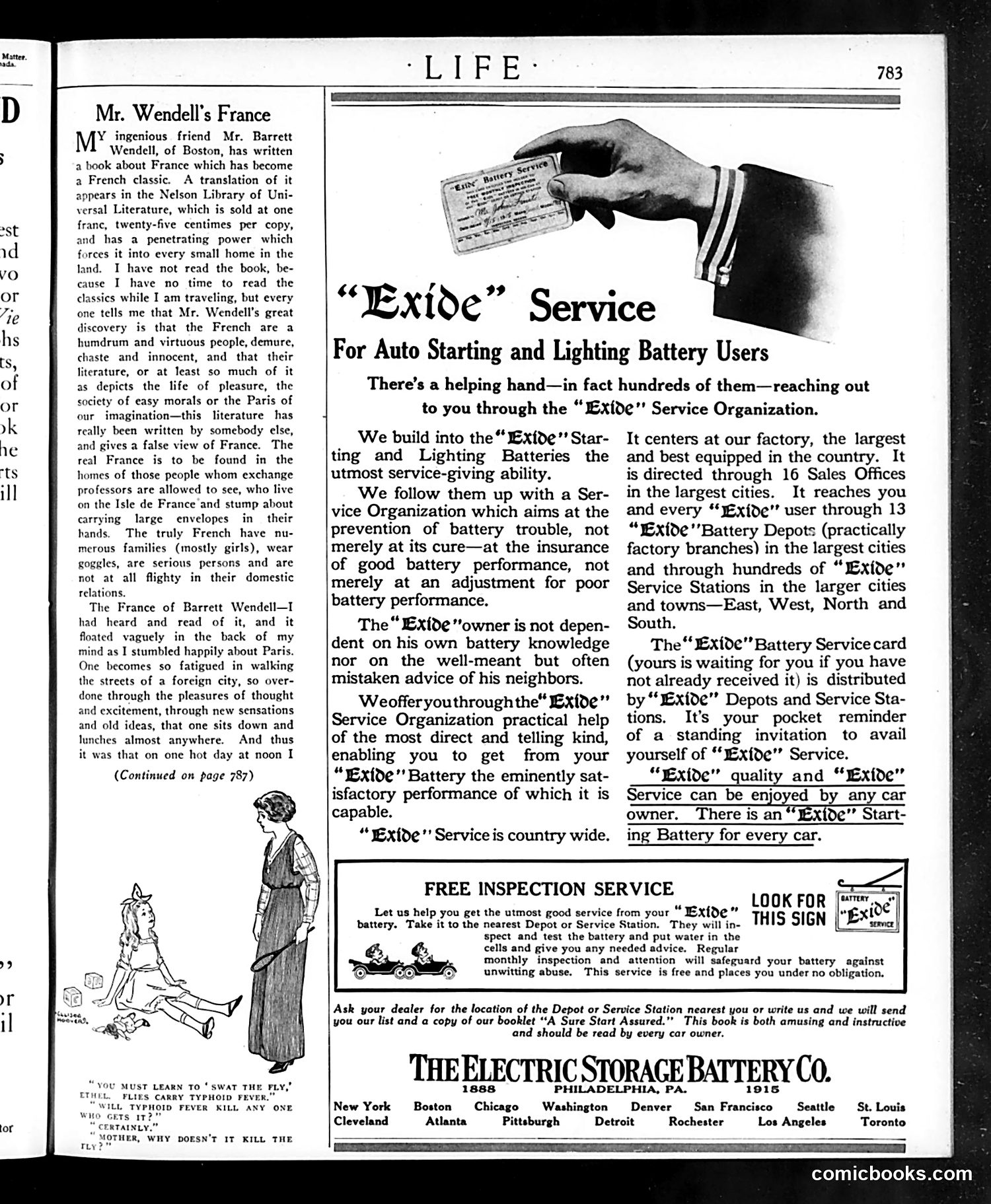
This page is primarily **advertising**, not satire or political commentary. The dominant content is a full-page advertisement for "Exide" automobile batteries and their service network, published by The Electric Storage Battery Co. in 1916. The small cartoon at bottom left appears to be unrelated filler—showing figures in what seems a domestic scene with text about disease prevention ("You must learn to 'swat the fly'..."). The advertisement's imagery (a hand holding a battery service card) and lengthy text promote Exide's battery inspection and maintenance service, emphasizing reliability and convenience for early automobile owners. The left column contains a book review about France by Barrett Wendell, unconnected to the advertising. This is fundamentally a **commercial product promotion**, not political satire.
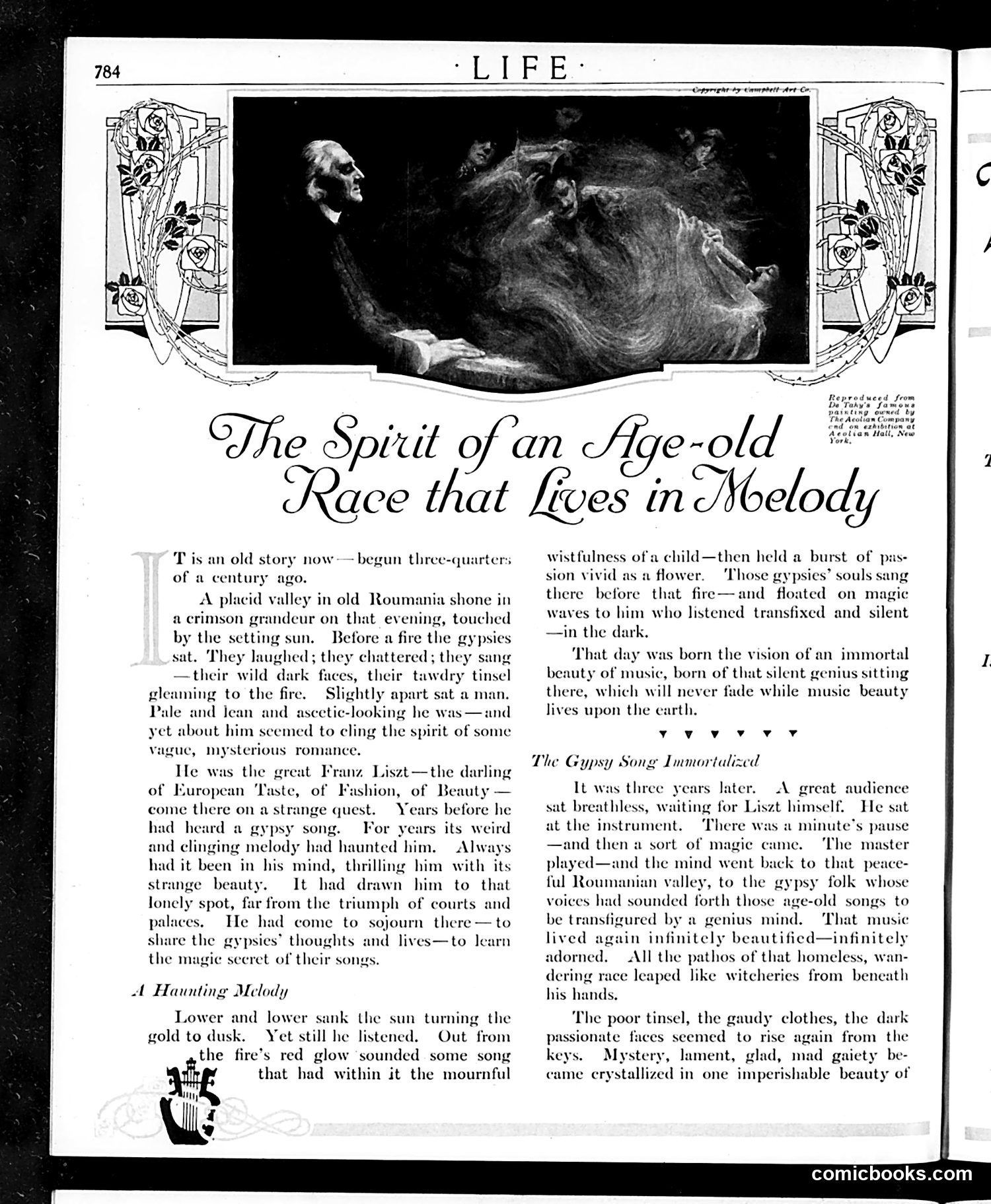
This page is **not a political cartoon** but rather a **literary or cultural article** titled "The Spirit of an Age-old Race that Lives in Melody." The article tells a romanticized story about **Franz Liszt**, the famous 19th-century Hungarian composer and pianist, encountering Romani (gypsy) musicians in Romania. The narrative describes how Liszt heard their traditional songs and was inspired to create his own compositions based on their music. The accompanying photograph shows what appears to be Liszt at a piano. The article celebrates the artistic exchange between Liszt and Romani folk culture, presenting their music as an "age-old" spiritual tradition. This reflects early 20th-century attitudes that exoticized non-Western and marginalized peoples as repositories of authentic artistic inspiration.
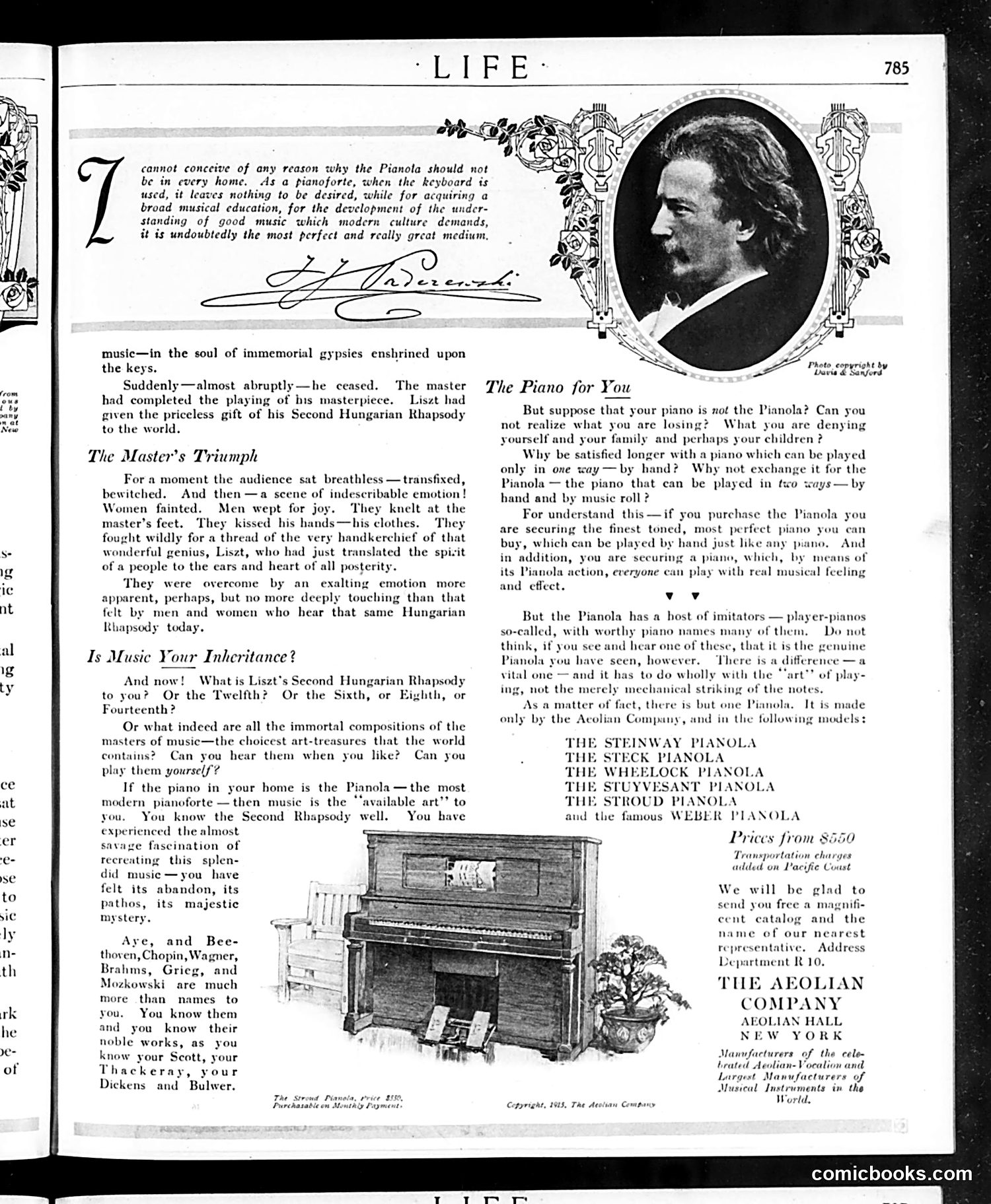
This page is primarily **advertising for the Pianola player-piano**, not political satire. The top features a portrait (likely a famous composer or musician endorsing the product) alongside text promoting the Pianola's superiority over competitors. The accompanying article discusses whether owning a piano is a cultural inheritance, referencing Liszt's Second Hungarian Rhapsody and classical composers like Beethoven and Chopin. It argues that the Pianola democratizes access to great music by allowing mechanized playback. The central image shows the Pianola piano itself. The advertisement lists competing brands (Steinway, Steck, Wheelock models) and emphasizes the Pianola's uniqueness, with pricing starting at $550. The Aeolian Company (manufacturer) is highlighted as the source for more information. This reflects early-20th-century marketing positioning technology as culturally elevating.
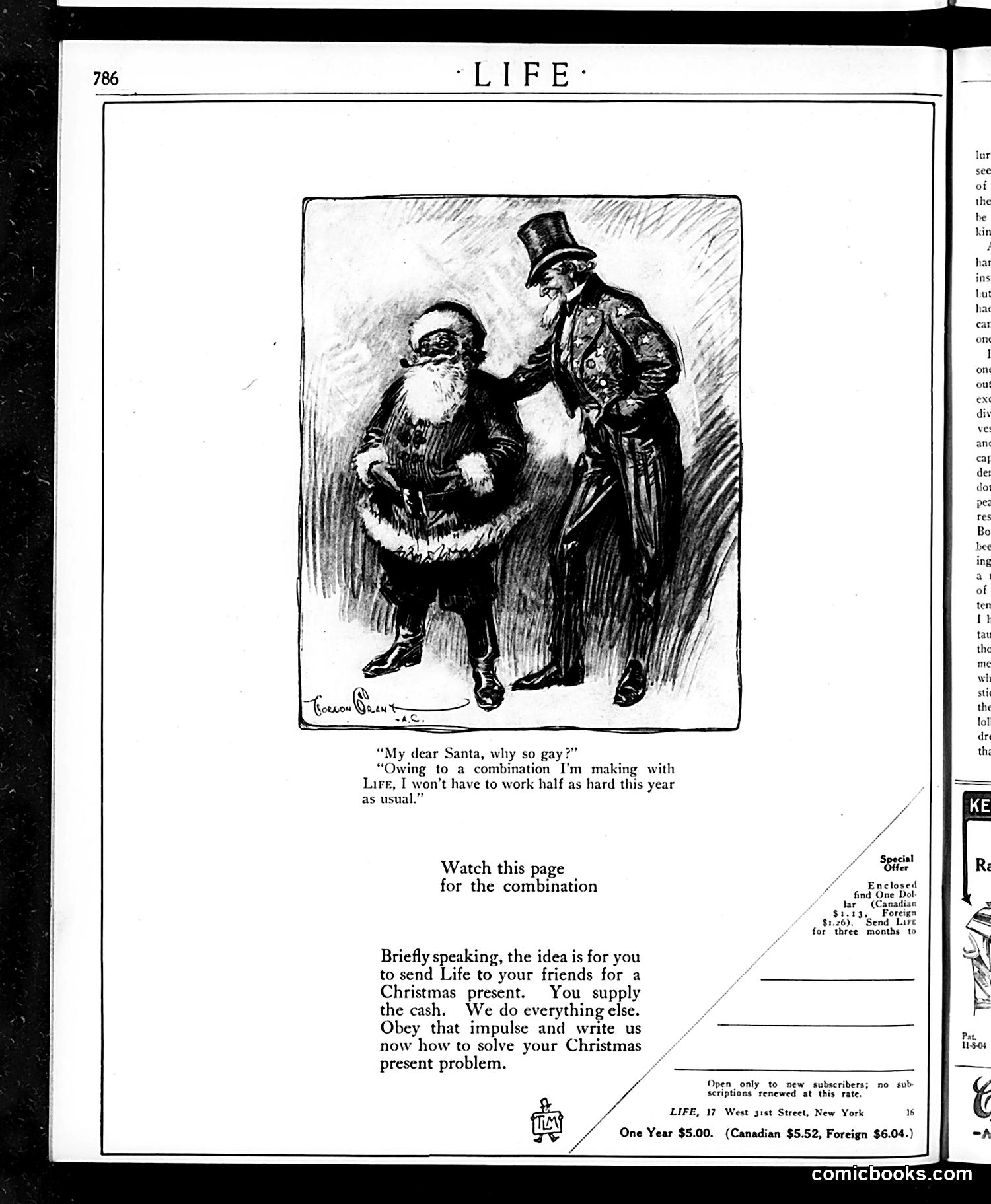
This is a Christmas-themed advertisement disguised as satirical cartoon content. The illustration shows two figures—one appearing to be Santa Claus and another in formal dress with a top hat—in conversation. The "joke" plays on Santa's traditional reluctance: Santa tells the well-dressed man he's happy because making a combination subscription deal with *Life* magazine means "I won't have to work half as hard this year as usual." The advertisement then pitches *Life* subscriptions as ideal Christmas gifts, positioning the magazine as solving the gift-giving problem. The text encourages readers to "send Life to your friends for a Christmas present"—you provide money, and *Life* handles the rest. This appears to be a mid-20th century marketing strategy blending humor with product promotion.
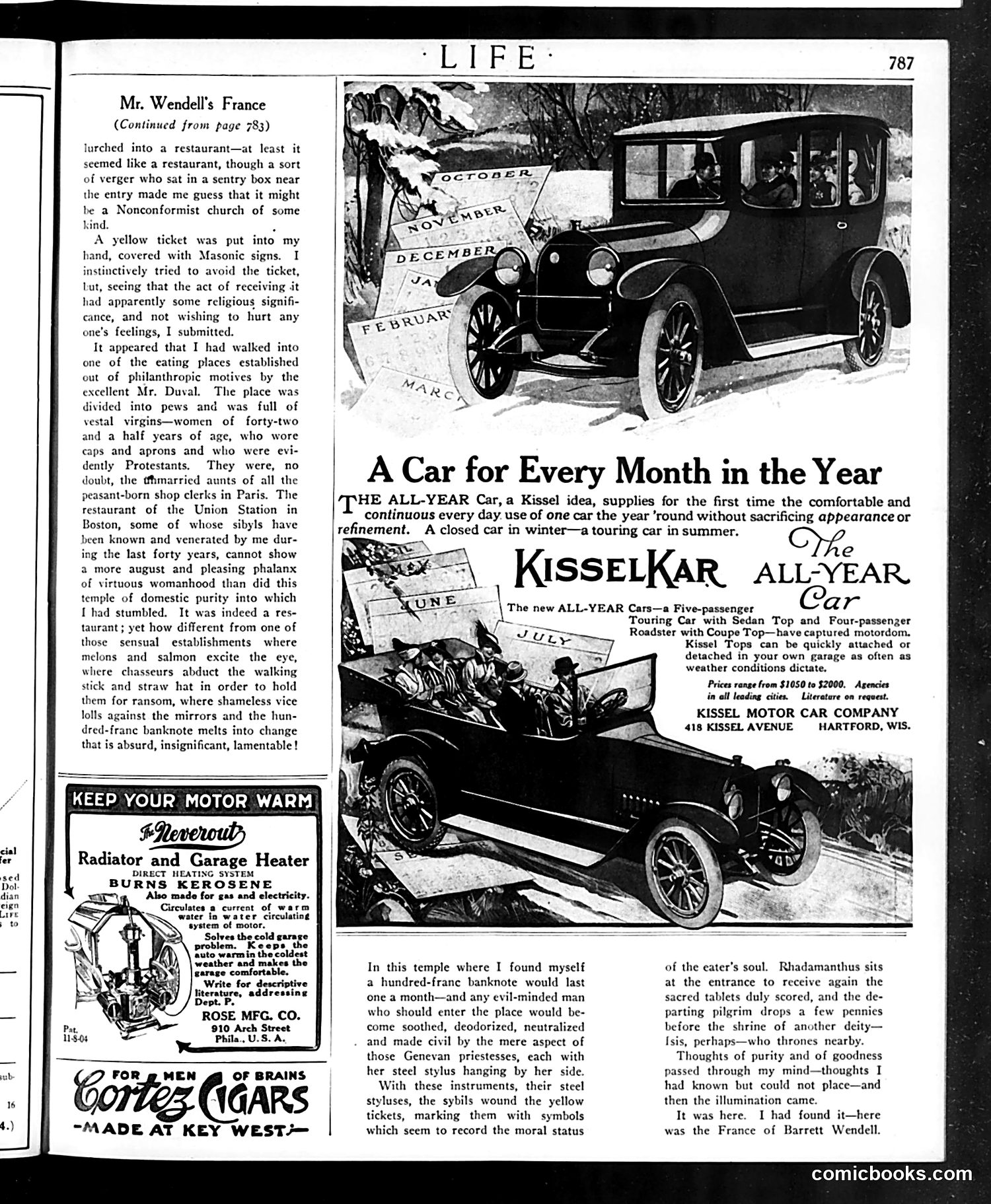
This page is primarily **advertising**, not political satire. The main content is a Kissel Motor Car Company advertisement promoting their "All-Year Car" — a vehicle with interchangeable tops for different seasons (closed sedan for winter, open touring car for summer). The left column contains the conclusion of an article titled "Mr. Wendell's France," a travel narrative describing the author's visit to a Parisian philanthropic restaurant. The text describes encountering General priestesses and discusses the spiritual atmosphere of the establishment. The page also includes smaller advertisements for a Peveroux radiator heater and Cortez cigars. There is no political cartoon or satire present—this is a standard magazine page mixing editorial content with period automotive and consumer product advertising.
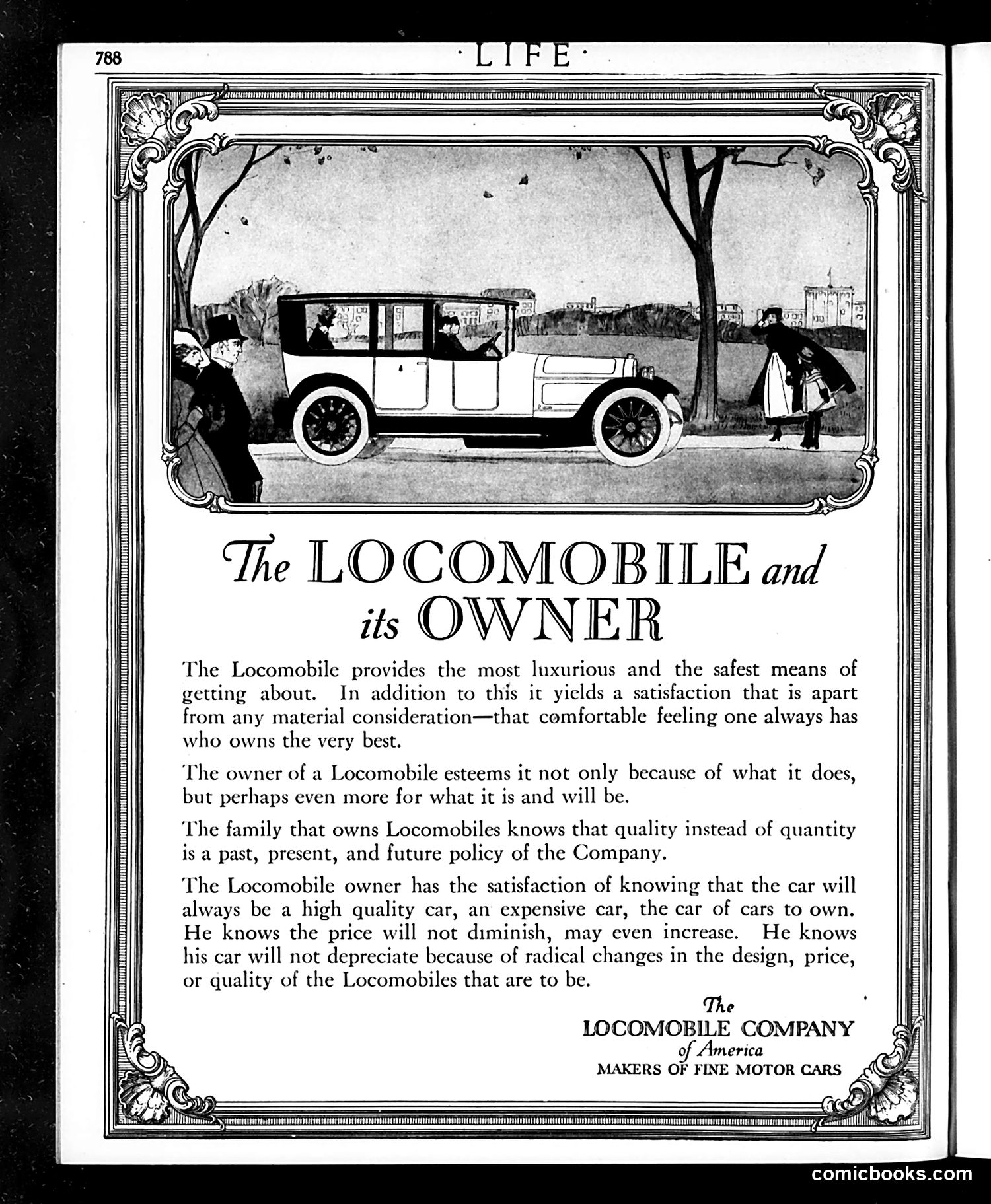
This is a **luxury automobile advertisement**, not satire or political commentary. The Locomobile Company of America marketed their vehicles as premium products for wealthy owners. The ad emphasizes exclusivity and permanence: Locomobile owners needn't worry about their cars losing value through design changes or depreciation. The text promises that quality—not quantity—is the company's "past, present, and future policy." The illustration shows an elegant automobile with well-dressed passengers and pedestrians in what appears to be a park or countryside setting, reinforcing the car's association with refinement and leisure. This reflects early 1900s automotive marketing targeting the affluent class, emphasizing craftsmanship and investment value rather than practical transportation features.
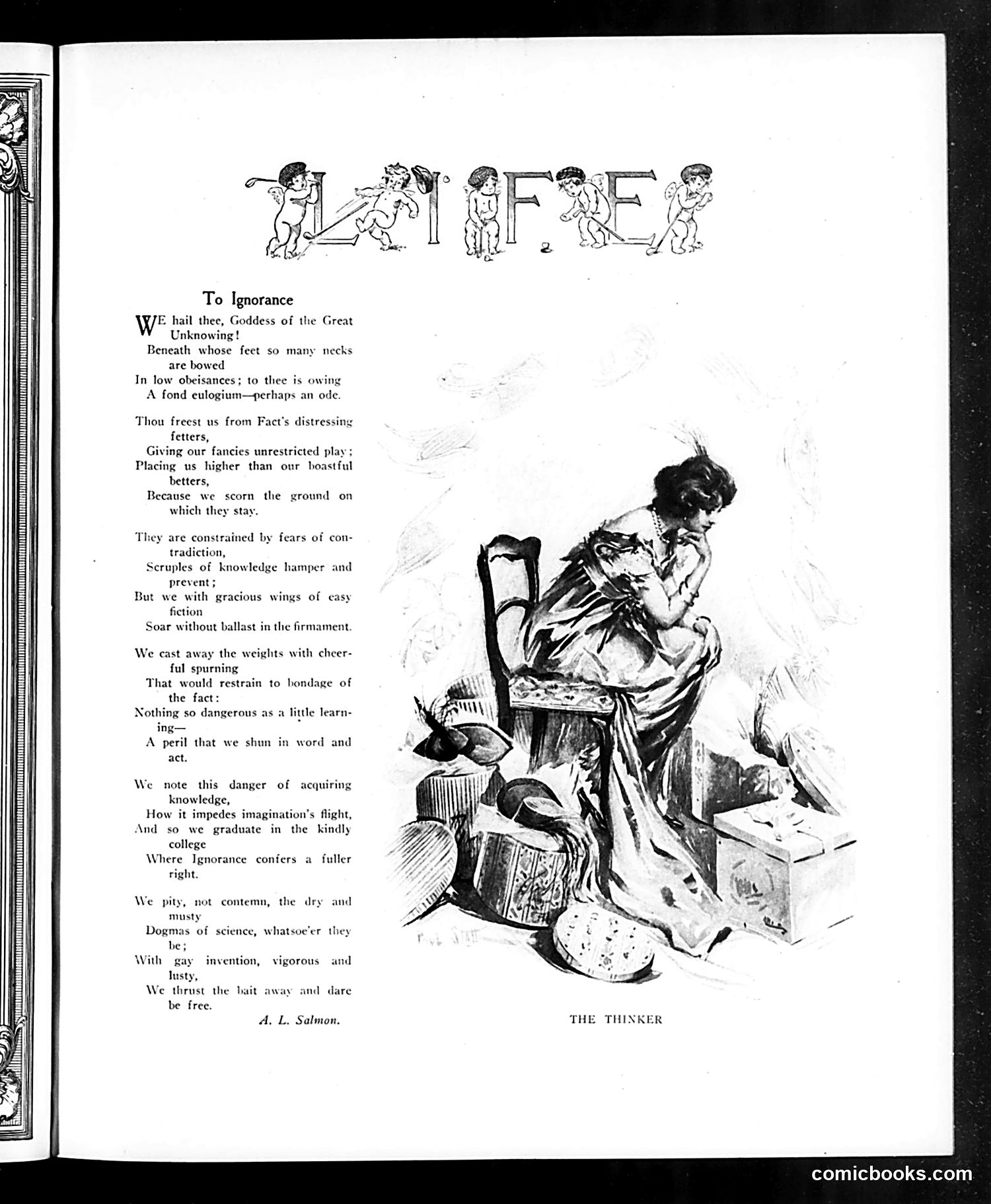
This page features a poem titled "To Ignorance" by A. L. Salmon, accompanied by an illustration labeled "THE THINKER." The poem is a mock-heroic celebration of ignorance as a liberating force. It praises ignorance for freeing people from "Fact's distressing fetters" and allowing imagination to "soar without ballast." The verse argues that knowledge constrains creativity and that ignorance enables freedom of thought and action. The accompanying illustration depicts a person in classical dress reclining on books and papers, appearing to contemplate or daydream—embodying the poem's theme of unfettered imagination. The satire targets anti-intellectualism: the poem ironically celebrates willful ignorance as superior to rigorous knowledge, mocking contemporary attitudes that dismiss scientific expertise or factual learning as obstacles to creative freedom. This likely critiques broader cultural trends of the era dismissing scholarship or evidence-based thinking.
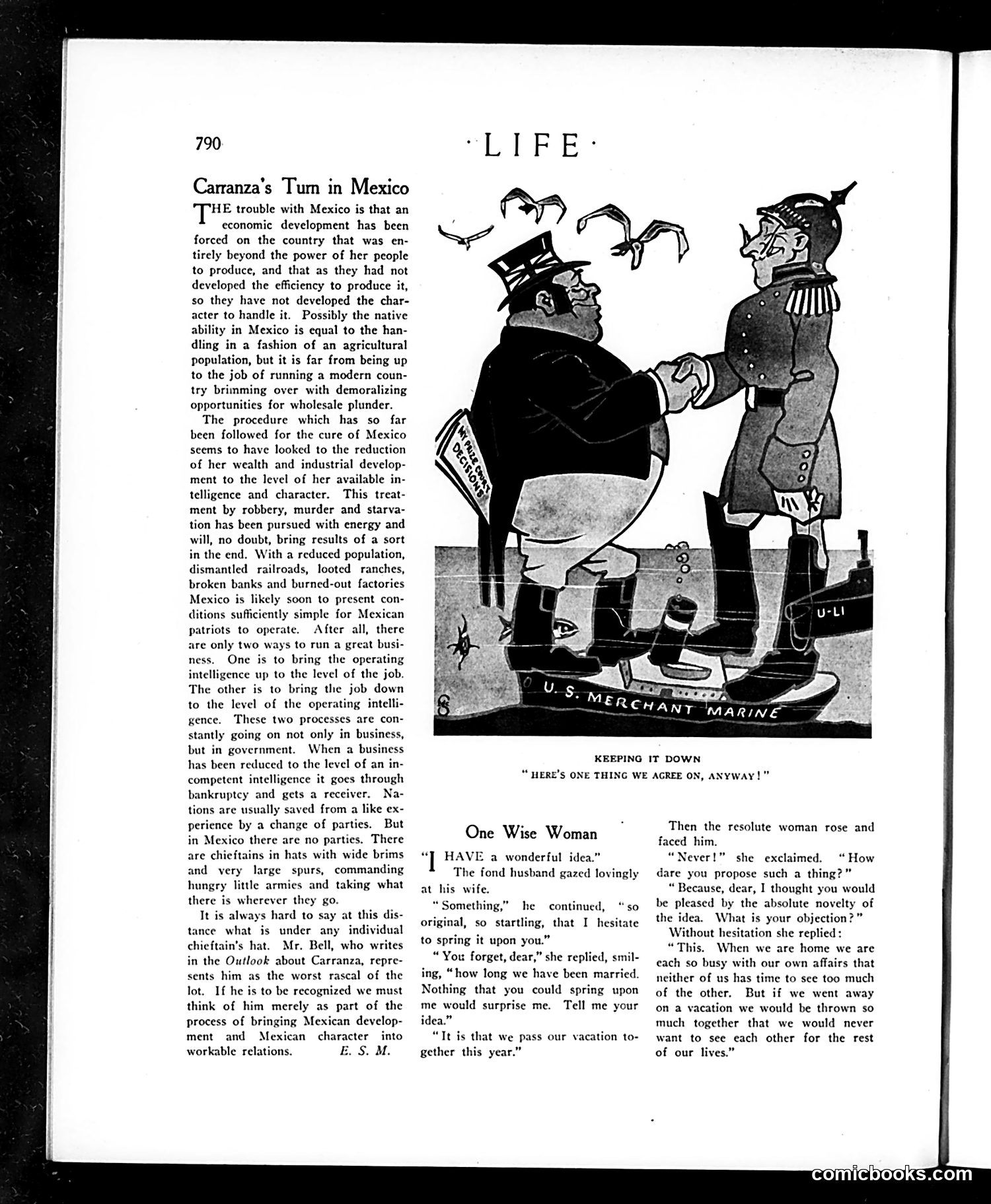
The main cartoon depicts a caricatured Mexican military figure (likely representing Carranza or Mexican leadership generally) being forcefully restrained by a U.S. Merchant Marine soldier. The exaggerated facial features and military garb suggest ethnic stereotyping common to early 20th-century American satire. The caption—"HERE'S ONE THING WE AGREE ON, ANYWAY!"—indicates both nations ostensibly agree on suppressing something, though the specific reference appears unclear without additional historical context about U.S.-Mexico relations during this period. The accompanying article discusses Mexico's economic and political instability, suggesting American anxiety about Mexican development and governance capacity. The satire implies paternalistic American intervention was justified by Mexican "incompetence."
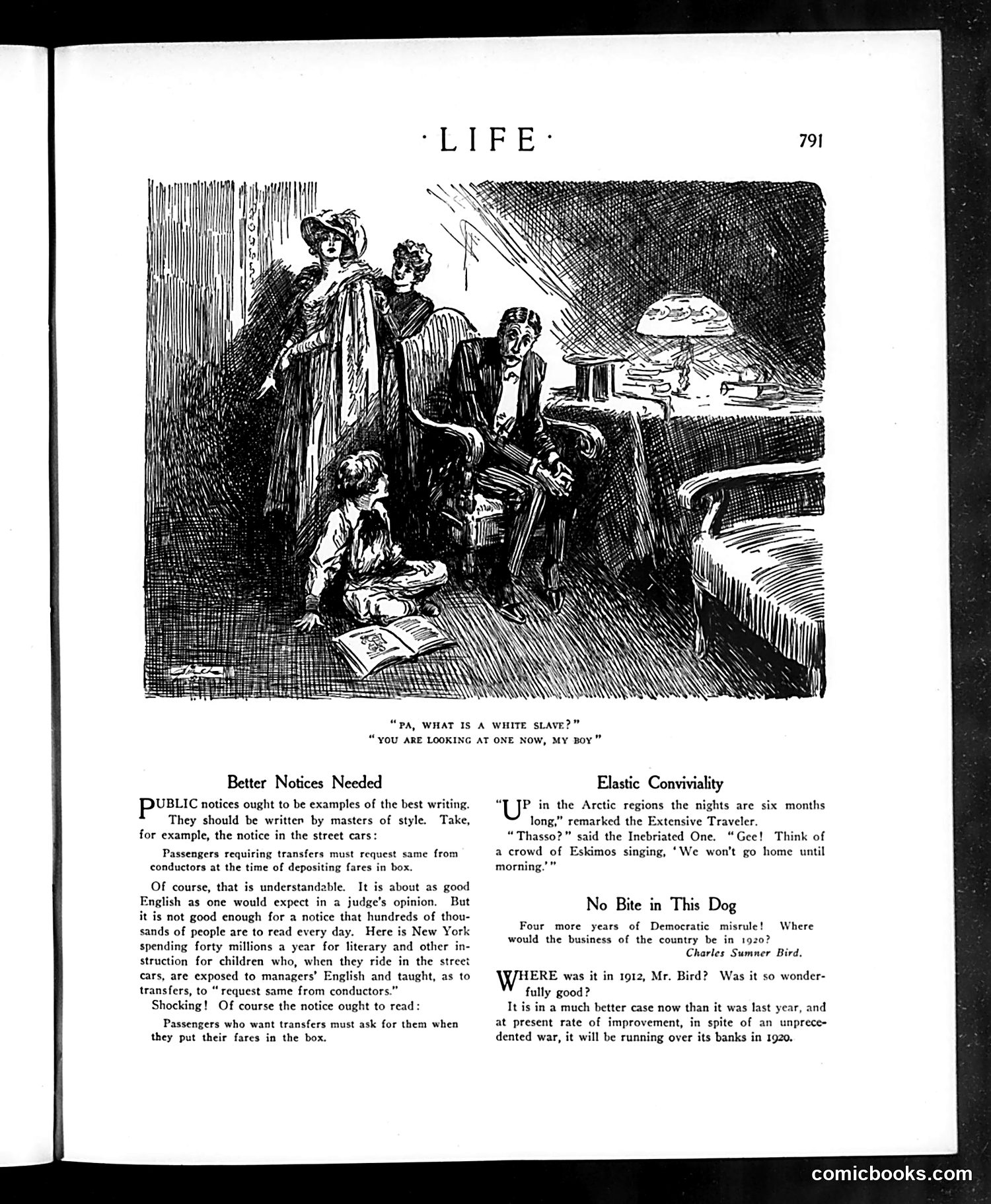
The main cartoon depicts an interior scene where a young child sits on the floor examining what appears to be illustrated material, while adults stand nearby. The caption reads: "Pa, what is a white slave?" / "You are looking at one now, my boy" This satirical cartoon addresses **child labor exploitation**—a major Progressive Era social issue. The "white slave" reference indicates the child worker in the scene, suggesting that industrial child labor in America paralleled transatlantic slavery in its exploitation. The father's bitter response implies resigned acceptance of this social injustice. The accompanying text sections discuss unrelated topics: public notice writing standards, Arctic travel observations, and 1912 economic predictions. The cartoon's darker social commentary contrasts sharply with the lighter surrounding content.
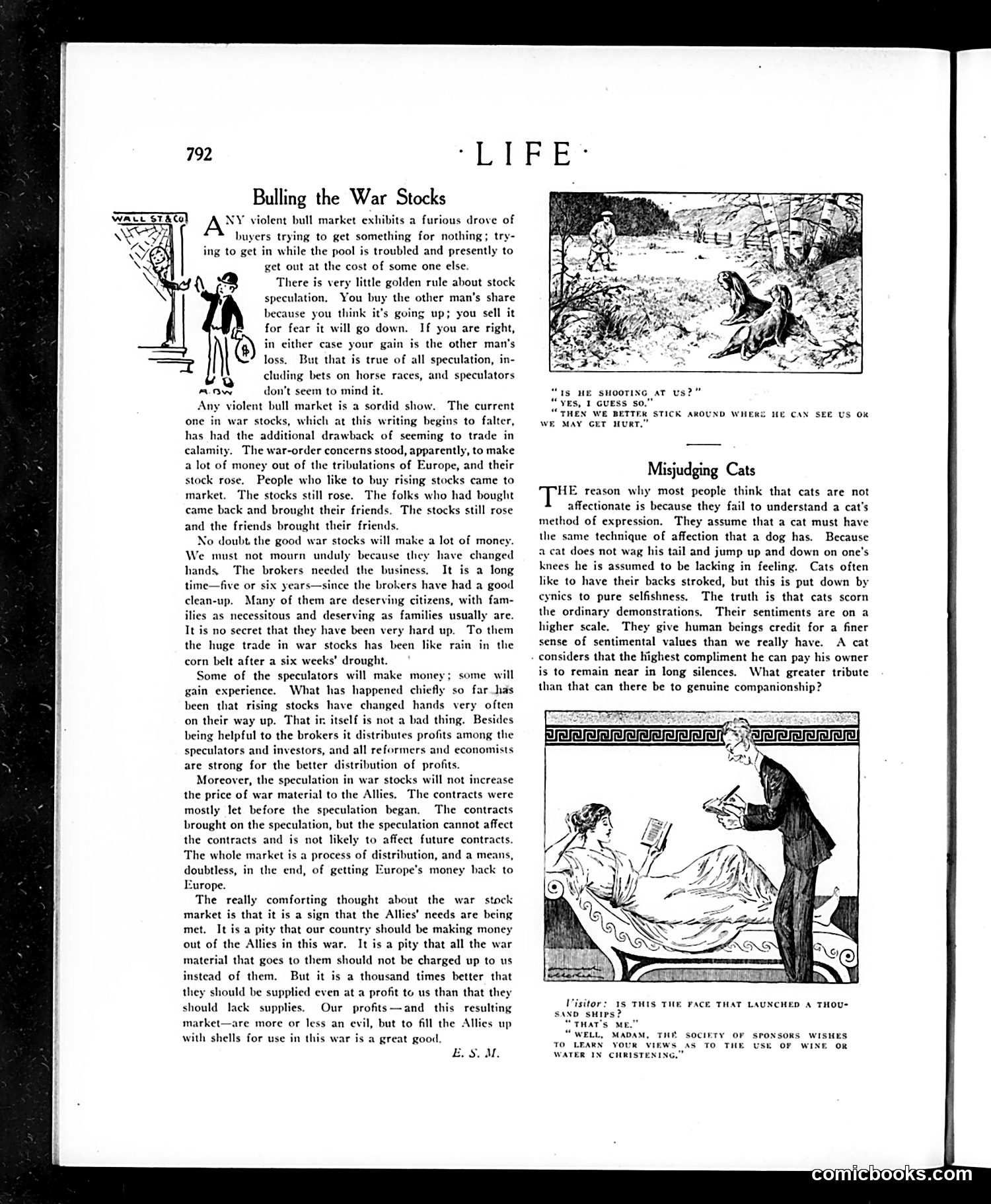
**"Bulling the War Stocks"** (Left column): This article critiques stock market speculation during wartime. The accompanying Wall Street illustration shows a figure promoting rising war-related stocks. The piece argues that while some speculators will profit, the real benefit should accrue to the Allies through cheaper war materials rather than enriching American middlemen. The author (E.S.M.) suggests wartime profiteering is morally questionable, though inevitable. **"Misjudging Cats"** (Right column): A humorous essay explaining that cats show affection differently than dogs—they prefer silence and back-stroking over tail-wagging enthusiasm. The accompanying classical-style cartoon depicts a visitor being judged by a cat, satirizing humans' misinterpretation of feline behavior as coldness when it actually represents refined sentiment. Both pieces use light satire to comment on human misunderstandings—of profit motives and animal nature.
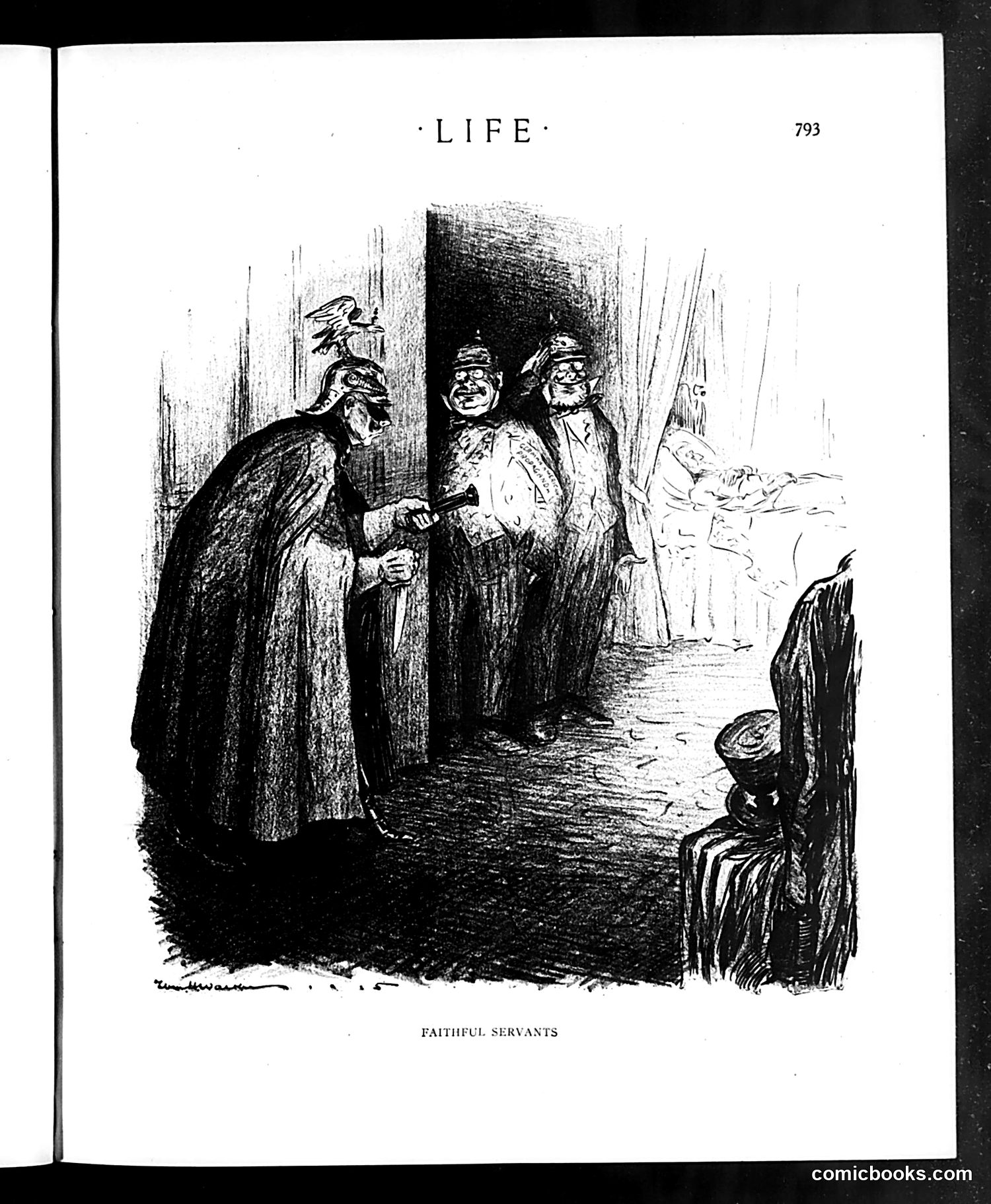
This satirical cartoon depicts what appears to be a military or political authority figure (left, wearing a cape and feathered hat) addressing three subordinates. The title "Faithful Servants" suggests ironic commentary on loyalty and obedience. The sketch's style and composition suggest it's critiquing hierarchical power dynamics—specifically, how those in authority demand unwavering loyalty from subordinates. The cape and theatrical dress of the figure on the left suggest pomposity or inflated self-importance, which the cartoonist mocks. Without additional context about the specific issue date, identifying the exact historical figures or events referenced is uncertain. However, the satire appears to target either military command structures or political subordination during this era of Life magazine publication.
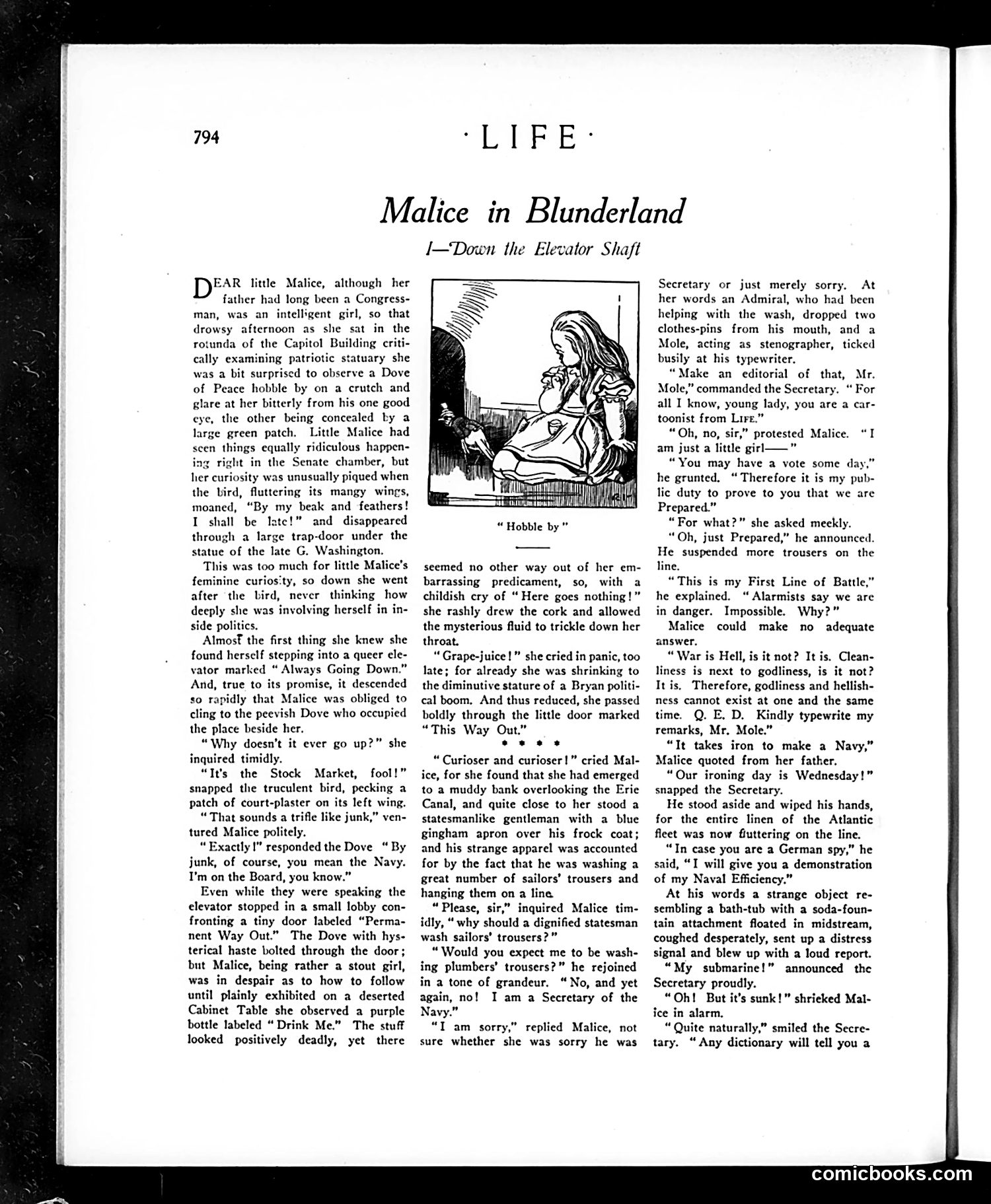
This satirical story parodies *Alice in Wonderland*, following a young girl named Malice through absurdist encounters in wartime Washington D.C. The illustration shows her in an elevator. The narrative mocks government bureaucracy and WWI-era politics. Malice meets a condescending male Secretary figure (likely representing government officials) who dismisses her concerns, insists she's "just a little girl," and lectures her about patriotic duty and naval preparedness. When she questions military logic and mentions German spies, he patronizes her further. The satire critiques how authorities dismissed women's valid observations while demanding patriotic compliance, and skewers the absurdity of wartime government pronouncements—suggesting those in power speak nonsense that wouldn't survive dictionary scrutiny.
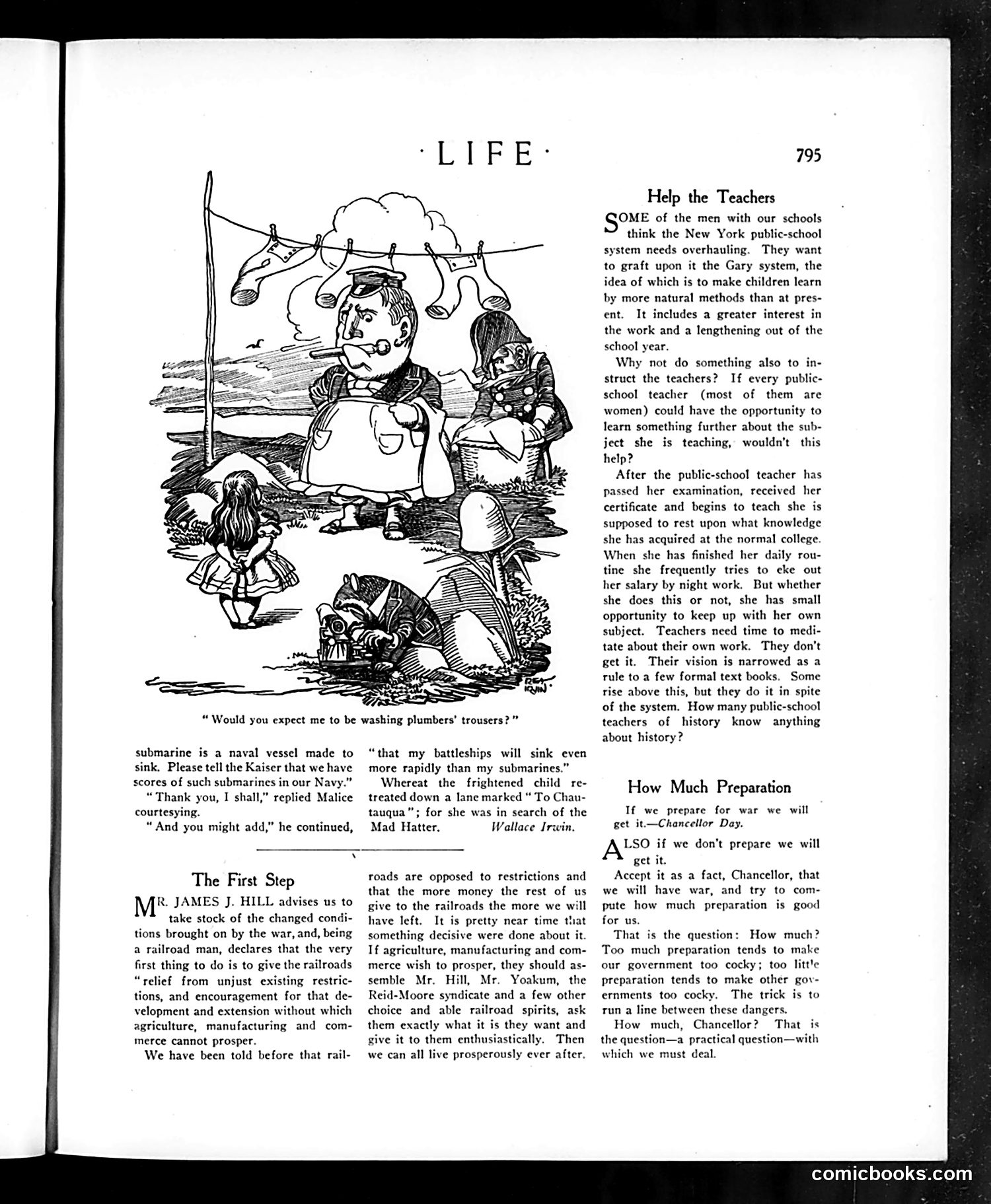
**The Main Cartoon** depicts a woman (likely representing a teacher) surrounded by children, with the caption "Would you expect me to be washing plumbers' trousers?" The illustration satirizes public-school teachers' low status and poor compensation. **The Satire's Point:** The adjacent article "Help the Teachers" argues that educators—mostly women—deserve better training and higher pay. The cartoon's absurd question highlights the irony: society expects teachers to educate children but compensates them so poorly they might as well do manual labor like washing clothes. **Historical Context:** This reflects early-20th-century concerns about teacher professionalization and gender-based wage discrimination in American education. **Other Content:** The page includes articles on railroad policy and military preparedness, typical of Life's mix of social commentary and politics.
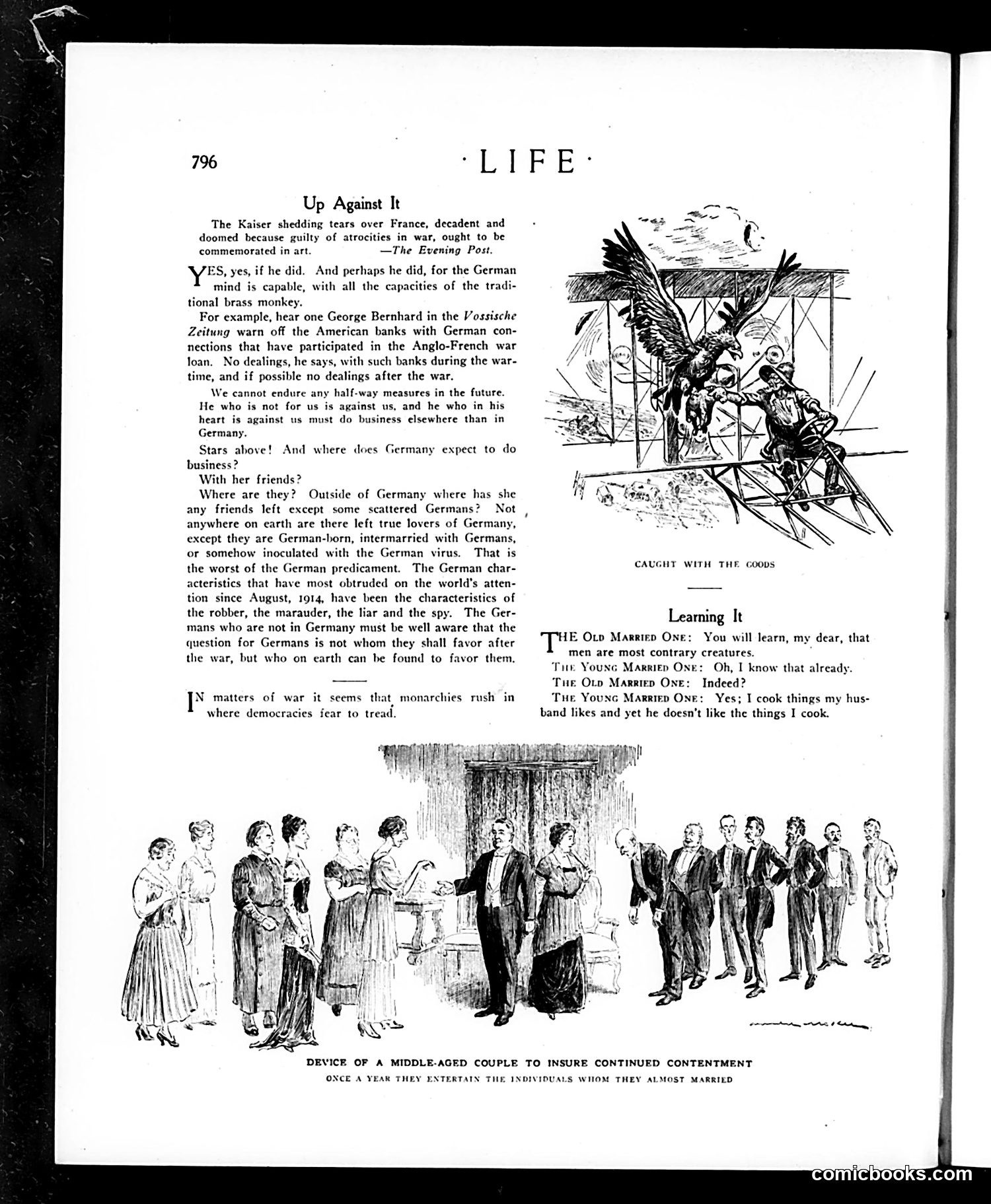
This page contains two satirical pieces from *Life* magazine's post-WWI period. **"Up Against It"** attacks Germany's international isolation and hypocrisy. The article mocks the idea that Kaiser Wilhelm II shed tears over French atrocities—sarcastically suggesting Germans are emotionally capable of crocodile tears. It then cites George Bernard Shaw's warning to American banks against dealing with German firms, using this to illustrate Germany's predicament: having alienated the world through documented brutality (robbery, lying, espionage) "since August, 1914" (war's start), Germany now has no friends except Germans themselves. The satire's point: Germany's own wartime conduct has destroyed its postwar business prospects and diplomatic relationships. **"Learning It"** is a domestic humor cartoon about marriage. An older married couple offers newlyweds the cynical advice that husbands are "contrary creatures," illustrated by the wife's complaint that her husband dislikes the foods she cooks despite her preparing his favorites. The bottom caption reveals their marital strategy: annually entertaining people they "almost married"—implying this nostalgic fantasy maintains their marriage's contentment.
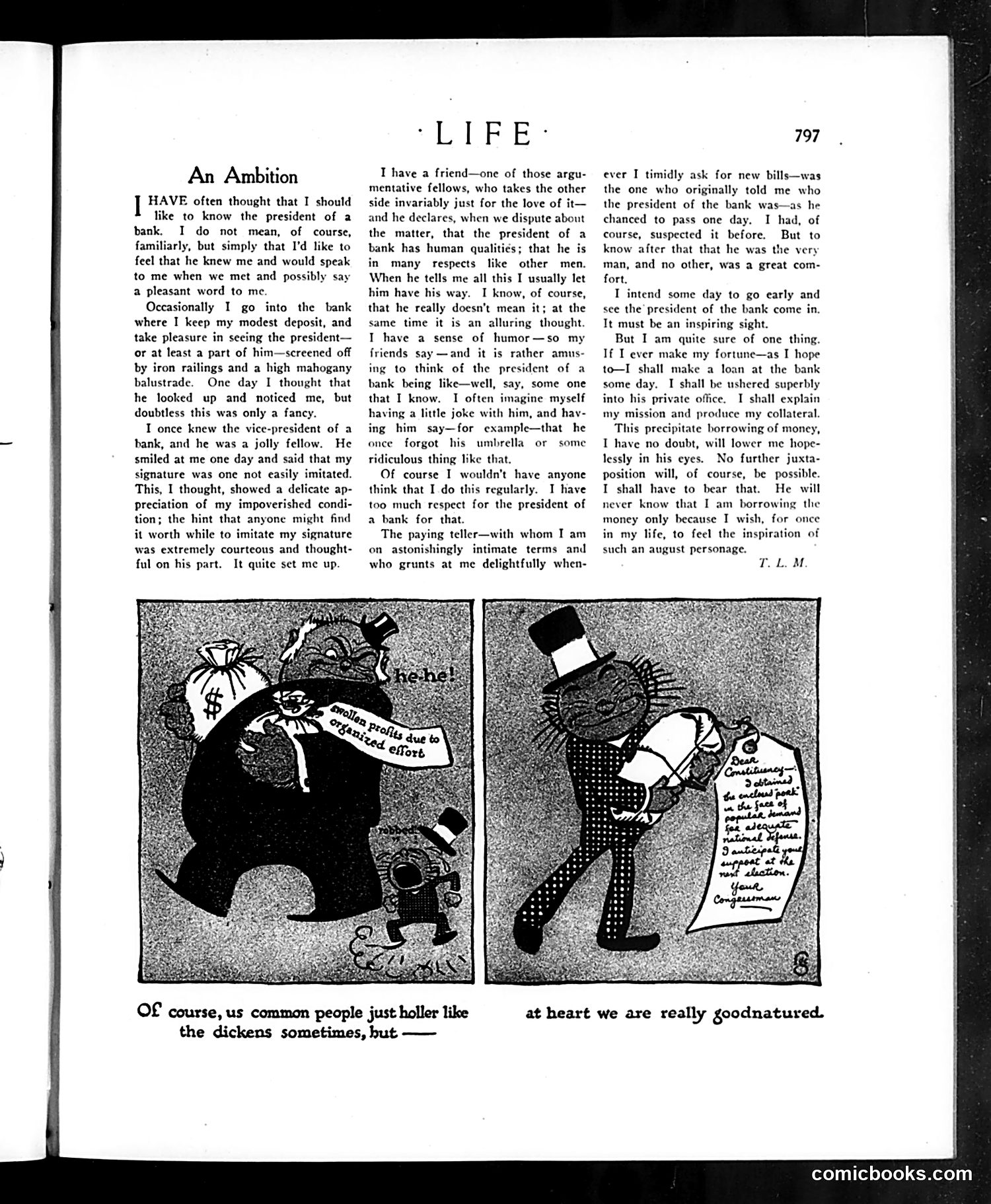
This satirical essay and accompanying cartoons mock the class divide between ordinary depositors and bank presidents in early 20th-century America. **The Text:** The author describes his fantasy of knowing a bank president—someone so elevated and isolated behind "iron railings and a high mahogany balustrade" that he seems almost inhuman. The narrator admits his absurd dream: to someday borrow money *solely* to have an excuse to enter the president's private office and experience proximity to this "august personage." **The Cartoons:** - Left panel: Shows a banker with a money bag and umbrella labeled with complaints about "small favils due to organized efforts"—depicting how common people view bankers as aloof and dismissive. - Right panel: A figure clutching a formal letter, apparently soliciting the banker with desperation. **The Satire:** The humor lies in exposing the ridiculous deference ordinary citizens showed toward wealthy elites, and how bankers were perceived as fundamentally different creatures. The essay's self-aware tone suggests this reverence was both common and absurd—hence the final caption: "at heart we are really goodnatured" (i.e., despite the pretense of class difference).
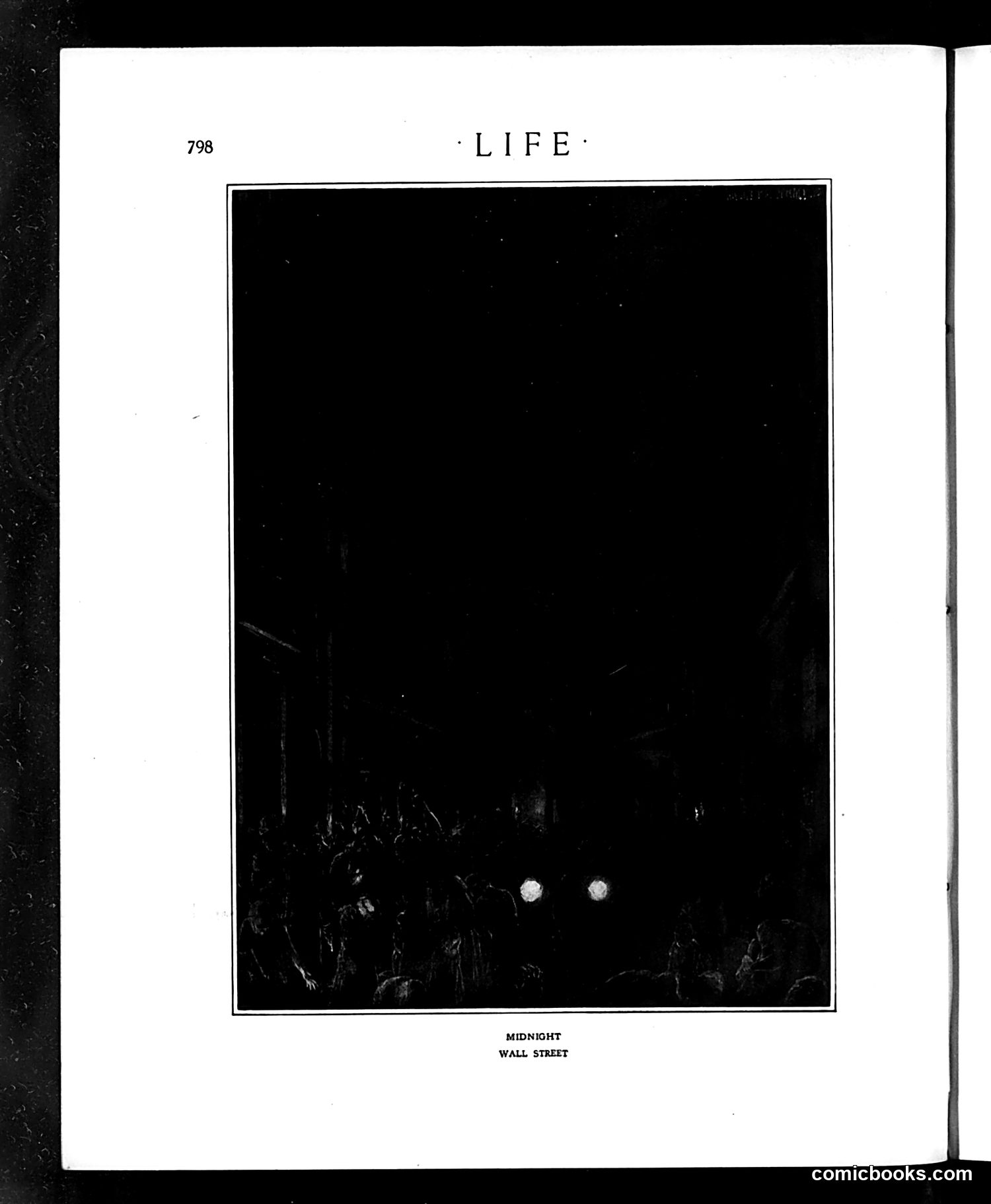
This page from *Life* magazine shows a stark nighttime scene labeled "Midnight Wall Street." The image is predominantly black, depicting Wall Street at night with barely visible figures and what appear to be two glowing lights (possibly streetlamps or windows) in the darkness below. The satire likely comments on the mysterious, secretive, or shadowy nature of Wall Street financial dealings—suggesting that important financial activities occur hidden from public view, literally in darkness. The caption's emphasis on "midnight" reinforces the implication of clandestine activity. Without additional context about the publication date, the specific historical moment referenced remains unclear, though Wall Street critique was common in early 20th-century American satire.
This page contains the opening of a short story (not a political cartoon) from Life's fiction contest, published around 1916-1920 based on the format. **The Story's Context:** Set during the American intervention at Vera Cruz, Mexico, the narrative follows Lieutenant Lawrence and his marines hunting for hidden machine-guns and a traitor named Fernando Diaz. The plot involves La Pava, described as an "Azteca" woman who is simultaneously "a scout, a spy, a harlot—a patriot." **What It Reflects:** The story engages with American military involvement in Mexico during the Mexican Revolution era. La Pava represents a romanticized "exotic" female character—beautiful, dangerous, and morally ambiguous—common in early 20th-century American fiction. The narrative portrays Mexican characters with period stereotypes ("sefior," stock revolutionary scenarios) while depicting American soldiers as the moral authority figure. **The Satire/Meaning:** Unclear if this story itself is satirical or straightforward adventure fiction. It appears to be a dramatic tale of wartime intrigue rather than satire, though the framing suggests readers should find the romantic complications entertaining.
This page contains two distinct stories with no cartoons. The upper portion concludes a serialized adventure narrative involving characters named Lawrence, La Pava, and Fernando Diaz—appearing to be a dramatic tale set during a conflict (likely the Mexican Revolution, based on references to "machine guns," "teniente," and Mexican characters). The main feature is "Mother's Birthday Present" by Carrie Seever, a humorous short story about seven-year-old Lizzie saving thirty-five cents to buy her mother a birthday gift. The joke targets street-corner con artists: a smooth-talking vendor operates a classic scam, claiming to sell valuable items (watches, umbrellas) for five cents with each piece of chewing gum purchased. Young Lizzie, innocent and eager, becomes captivated by his pitch. The satire mocks both the gullibility of working-class consumers and the prevalence of street hustlers preying on them. The story's humor derives from the contrast between Lizzie's earnest desire to give a meaningful gift and the vendor's obviously fraudulent scheme.
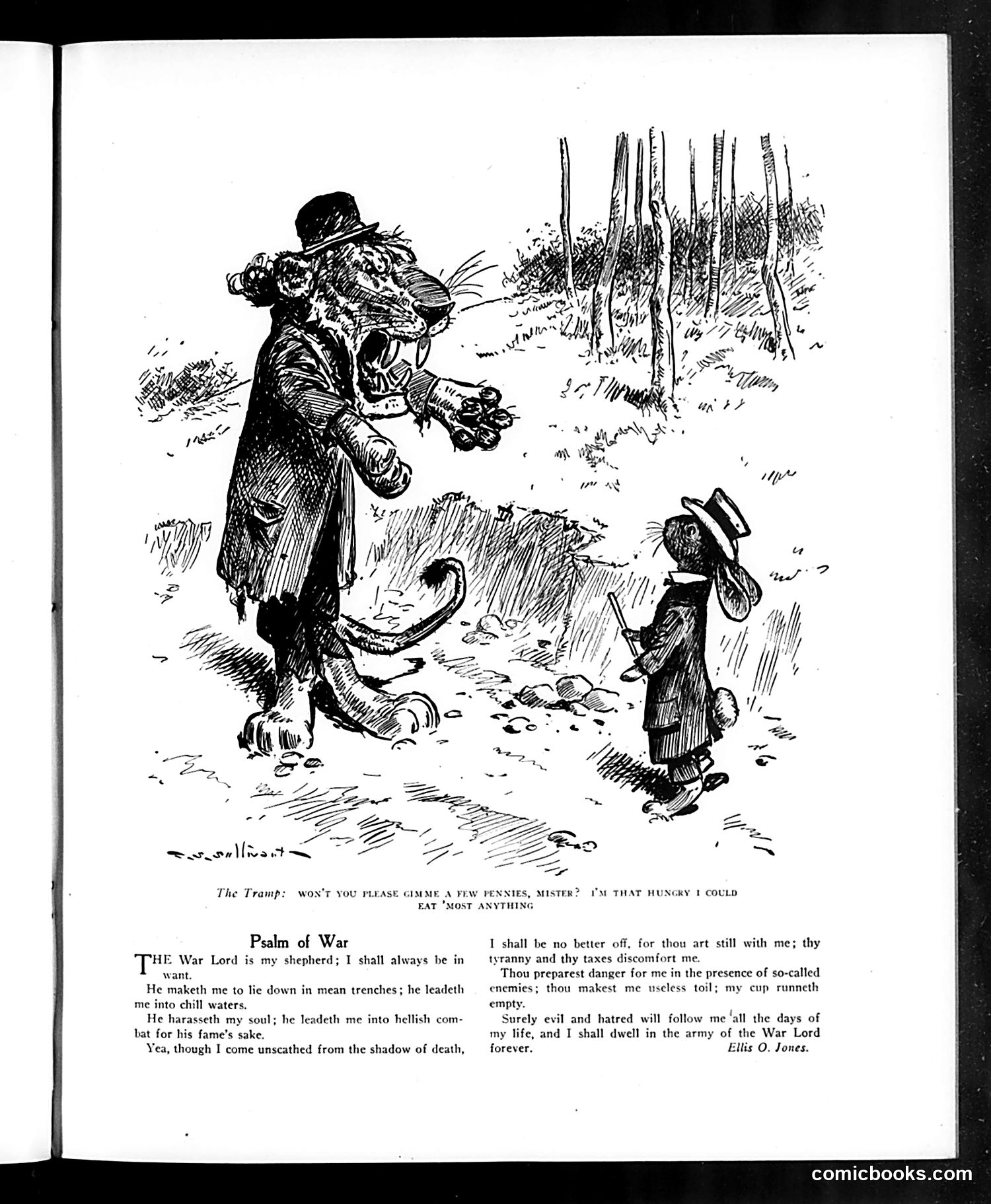
This page satirizes the human cost of war on ordinary soldiers and the poor. The cartoon shows a ragged tramp encountering a similarly destitute soldier, both begging for pennies. The accompanying text is a dark parody of Psalm 23, rewritten as a "Psalm of War" where the "War Lord" replaces God as a malevolent shepherd. Instead of comfort and provision, the War Lord offers trenches, combat, poverty, and endless suffering. The satire suggests that soldiers sacrifice their lives and health for leaders' ambitions, only to return home impoverished and broken. By pairing the soldier-beggar with the civilian tramp, the cartoon implies war creates widespread destitution. The "Psalm of War" emphasizes the bitter irony: soldiers who survive combat gain nothing—no wealth, no security, only continued hardship and "tyranny and taxes." This appears to be anti-war commentary, likely from WWI-era Life magazine, criticizing how war benefits leaders while destroying the lives of common people.
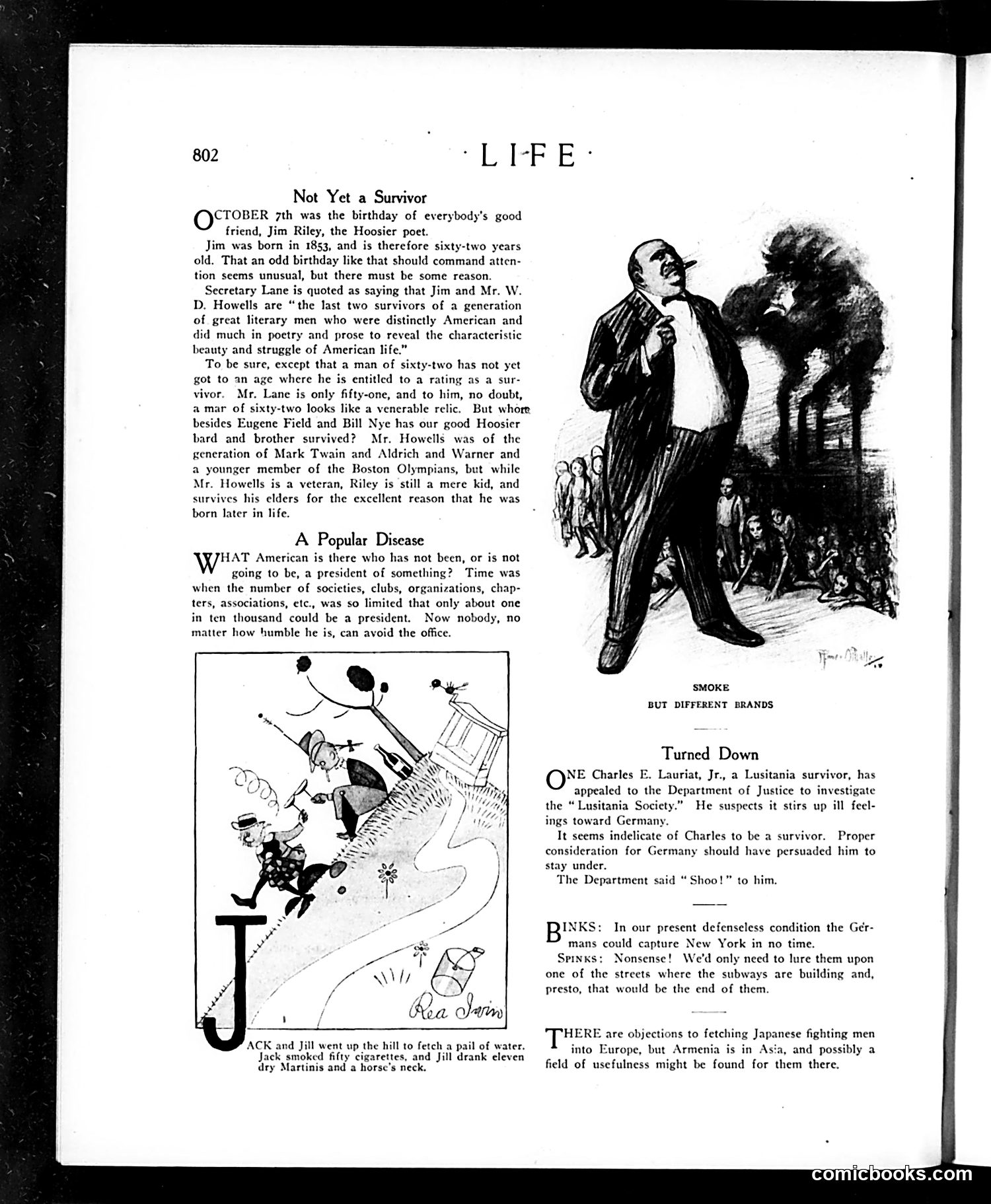
This page from *Life* contains satirical commentary on American public figures and social issues circa 1915. **"Not Yet a Survivor"** mocks Secretary of Interior Lane's claim that poet Jim Riley and author W.D. Howells are "last survivors" of great American literary men. The satire: Riley (born 1853, age 62) hasn't lived long enough to legitimately claim "survivor" status—he's simply younger than the predecessors he outlived through natural longevity, not exceptional achievement. **"A Popular Disease"** lampoons Americans' obsession with holding titles. The cartoon shows a man overwhelmed by organizational presidencies—depicting how proliferation of clubs and societies means nearly everyone now holds some "president" position, rendering the title meaningless. **"Turned Down"** ridicules Charles Lauriat Jr., a *Lusitania* disaster survivor who complained to the Justice Department about a "Lusitania Society" stirring anti-German sentiment. The satire suggests his complaint is absurd—surviving a German U-boat sinking should logically inspire German criticism, yet he wants to suppress it. The page includes light political banter about German invasion fears and Japanese soldiers.
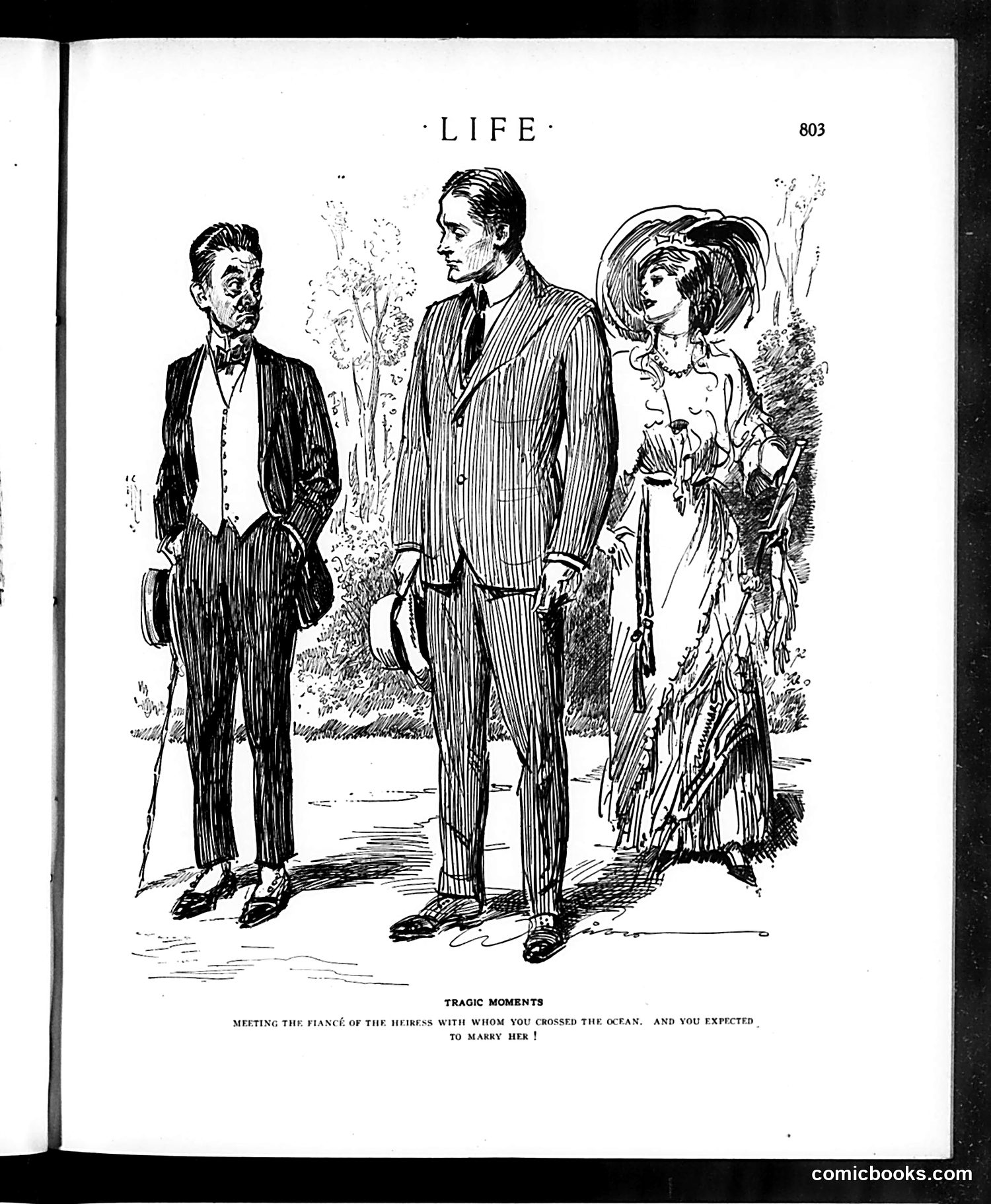
This illustration depicts a romantic comedy scenario titled "Tragic Moments." The caption reads: "Meeting the fiancée of the heiress with whom you crossed the ocean, and you expected to marry her!" The cartoon shows three figures—two men and a woman—in an awkward encounter. The humor relies on a romantic misunderstanding common to turn-of-the-century satire: a man apparently traveled across the Atlantic with intentions to marry a wealthy heiress, only to discover she's already engaged to someone else. The "tragedy" is ironic—there's no genuine catastrophe, just social embarrassment. The finely-dressed men and elaborately-dressed woman suggest upper-class social circles where such romantic entanglements and transatlantic courtships were satirical fodder for humor magazines. The joke mocks romantic presumption and the complications of Gilded Age courtship customs.
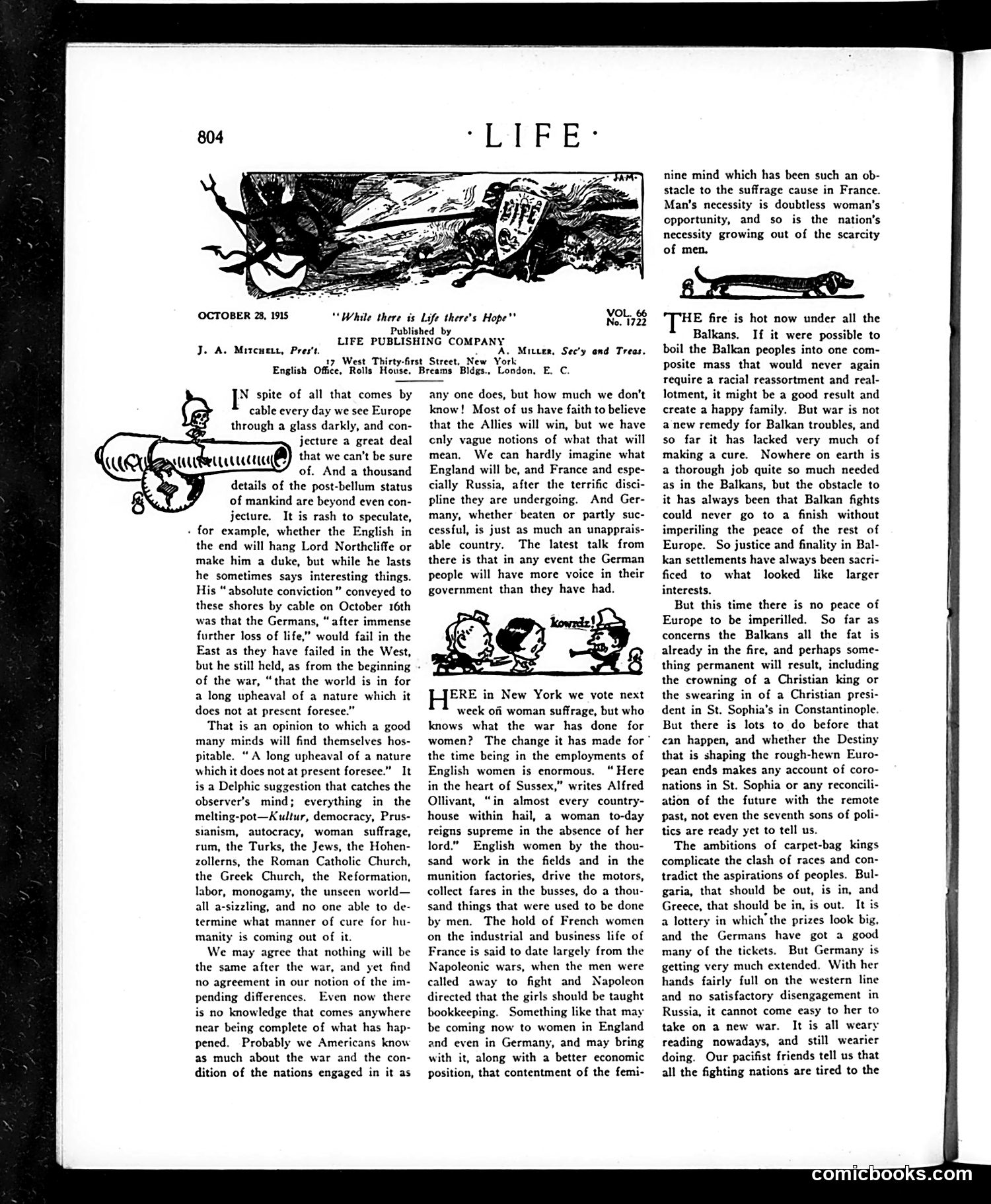
This editorial page discusses World War I's uncertain outcomes and social upheaval. The author references **Lord Northcliffe**, a British newspaper magnate, who reportedly stated Germans will fail militarily but that the war represents a transformative "upheaval of a nature which it does not at present foresee." The piece catalogs everything in flux—"Kultur, democracy, Prussianism, autocracy, woman suffrage"—suggesting radical social reorganization is inevitable but unknowable. Notably, it addresses **women's wartime employment** in England and France, observing women now work in fields, munition factories, and transport—traditionally male roles. The author suggests this economic necessity may paradoxically advance women's suffrage by demonstrating female capability and value, though he frames this somewhat cynically as "Man's necessity is doubtless woman's opportunity." The cartoon (by J.A. Mitchell) appears symbolic but is difficult to interpret precisely from the image alone.
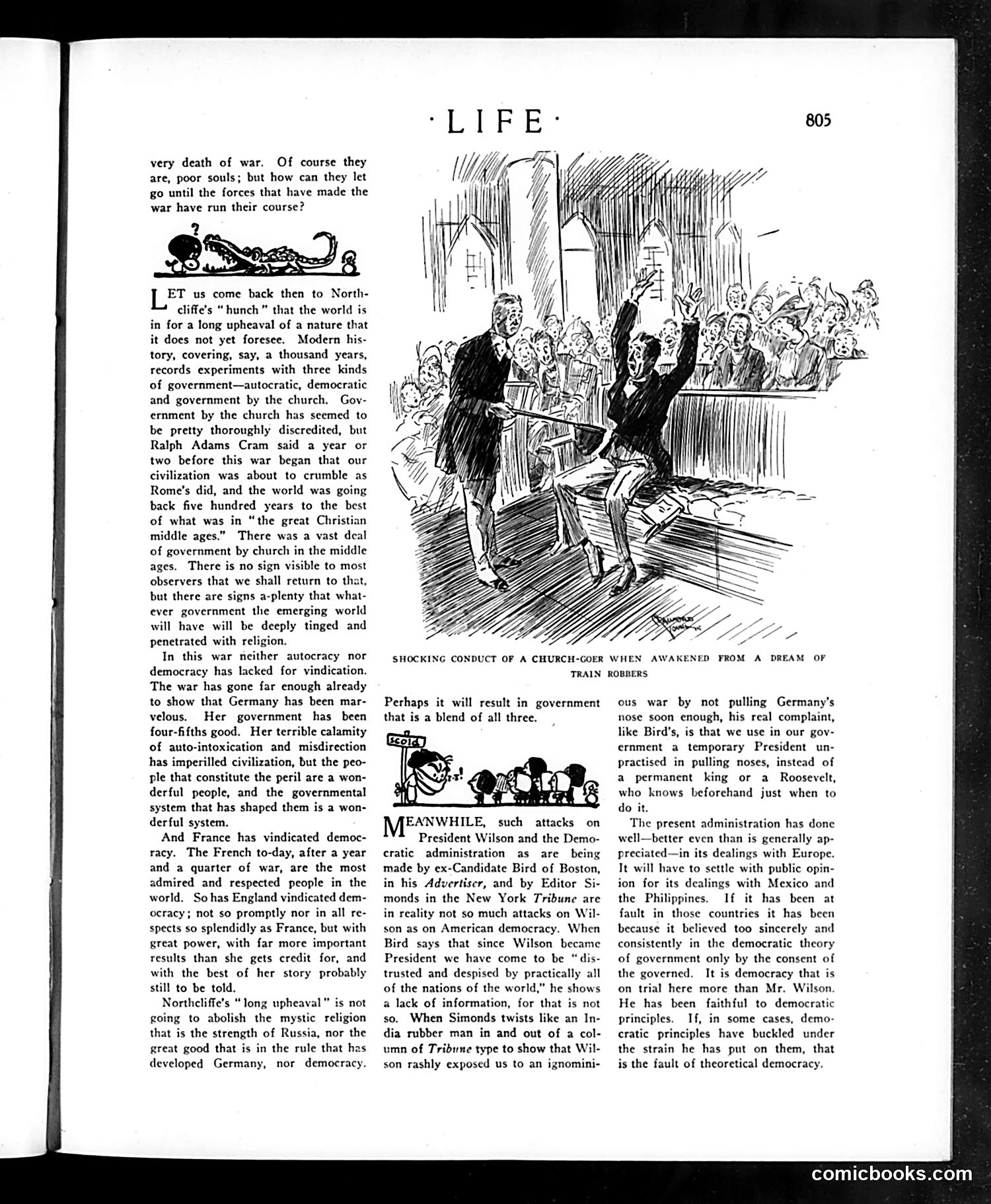
This cartoon satirizes the hypocrisy of religious people. It depicts a well-dressed church-goer who, jolted awake from dreaming about train robbers, is caught mid-violent outburst—striking or attacking someone in shock. The humor lies in the contrast: a respectable, pious churchgoer is shown behaving with shocking brutality the moment civilized restraint is removed by surprise. The accompanying essay discusses democracy versus autocracy during World War I (before U.S. entry). The cartoonist appears to use this image to illustrate the article's broader point about human nature and governance: that beneath surface respectability—whether religious or democratic—violence and base instincts lurk, requiring institutional frameworks to contain them.
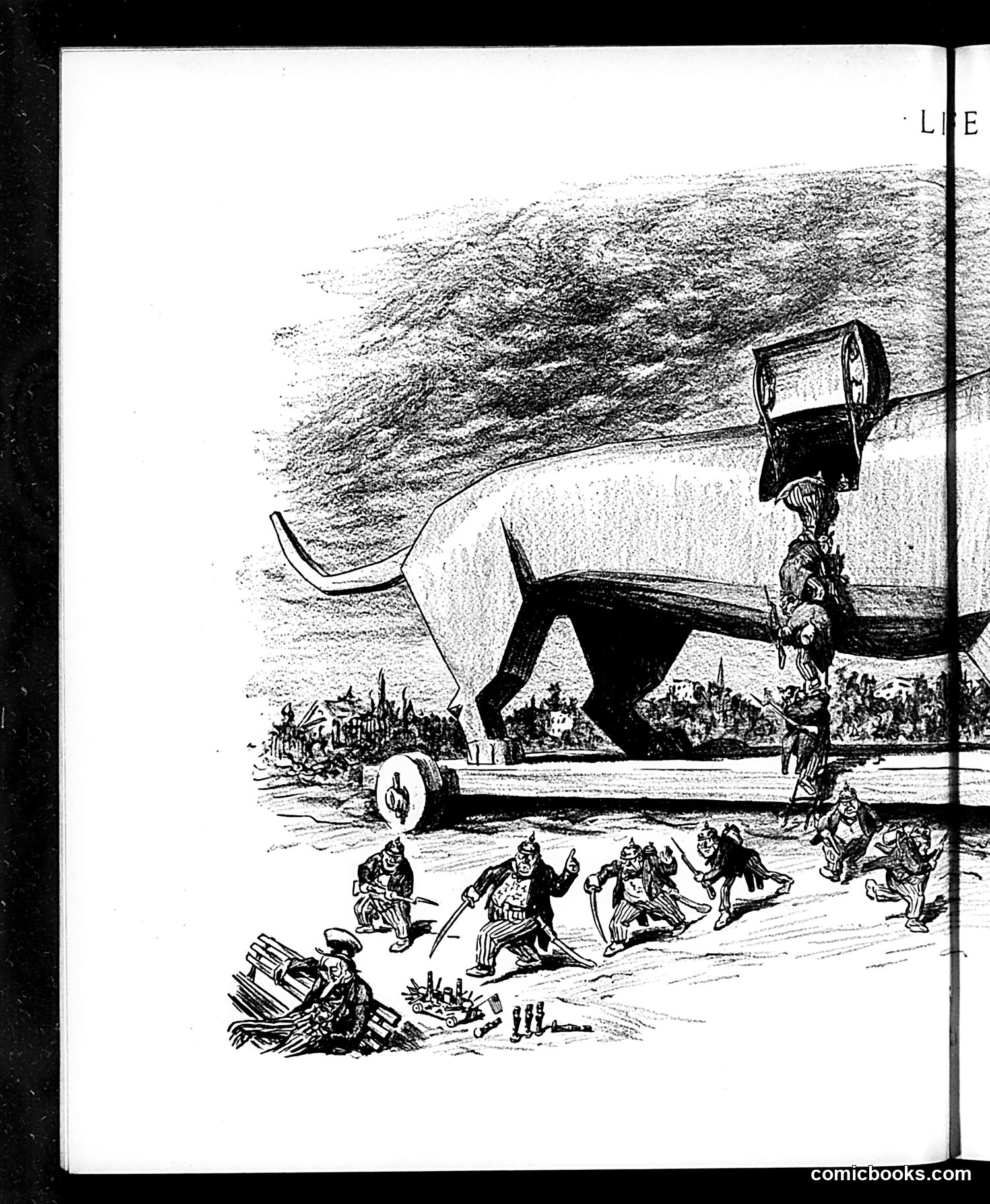
This appears to be a satirical cartoon depicting a giant dog or beast towering over a cityscape, with tiny human figures below appearing to flee or react in panic. The creature is harnessed or controlled by a figure on a platform above, suggesting the image critiques the manipulation or control of power by an authority figure over common people. The scale disparity—enormous beast versus tiny humans—emphasizes themes of power imbalance and human vulnerability. The cityscape in the background suggests this concerns urban populations or civilization itself. Without clearer identifying marks or accompanying text visible in the image, I cannot definitively identify which specific political figure or event this references. The style and composition suggest early-to-mid 20th century satirical commentary on authoritarianism or monopolistic control, but the precise target remains unclear from the image alone.
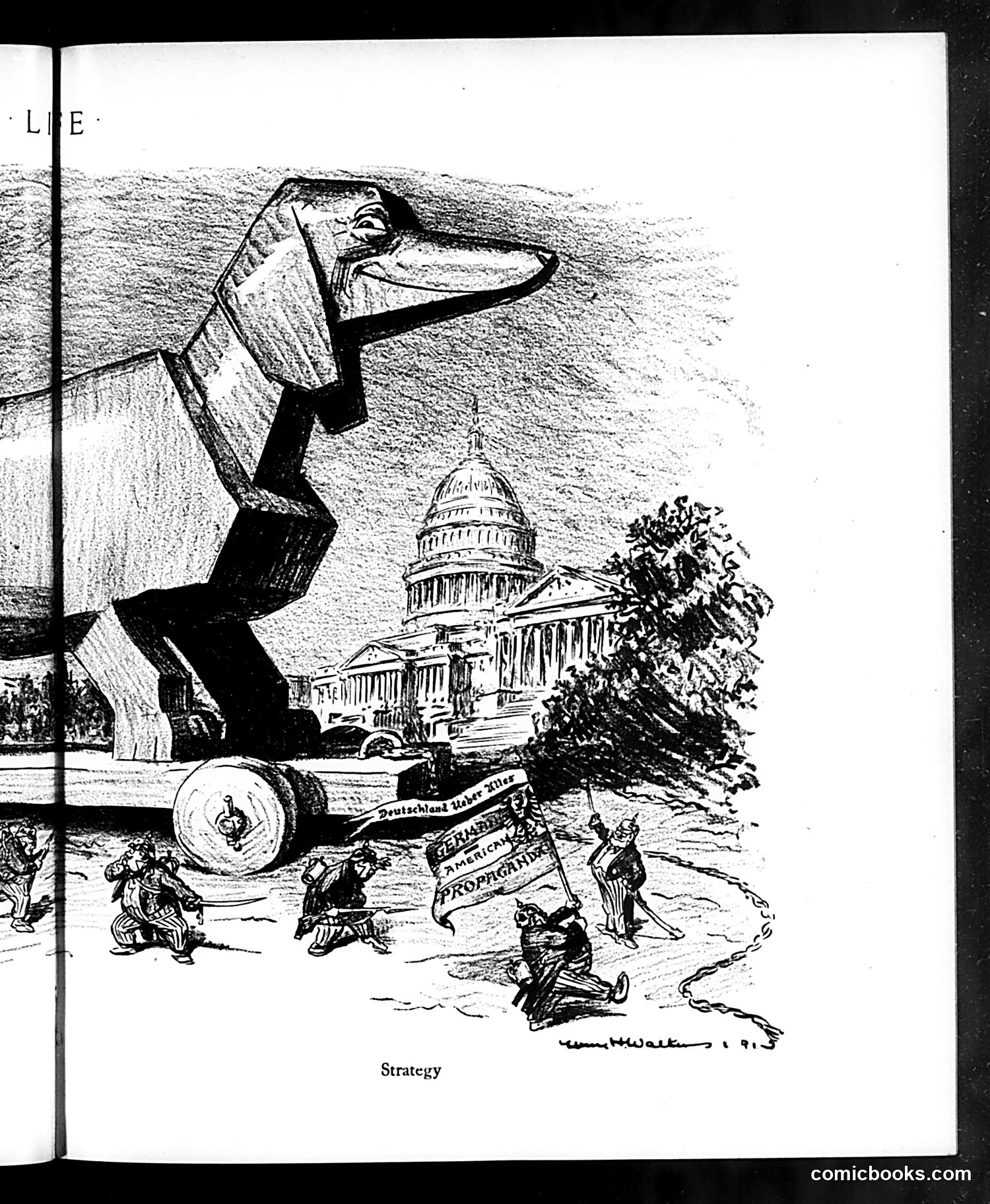
This cartoon, titled "Strategy," depicts a large horse (likely representing Germany, given the visible text "Deutschland" on the wheel) being pulled by a Trojan horse-style device toward the U.S. Capitol Building. Small figures below appear to represent American political or military forces, with what looks like an "American Propaganda" flag visible. The satire warns of German infiltration tactics—suggesting that Germany employs deceptive "strategy" to influence American politics and policy. The Trojan horse metaphor conveys that Germany's approach appears benign on the surface but conceals dangerous intent. This likely dates to the World War I or interwar period, when American isolationism and German propaganda activities were prominent political concerns.
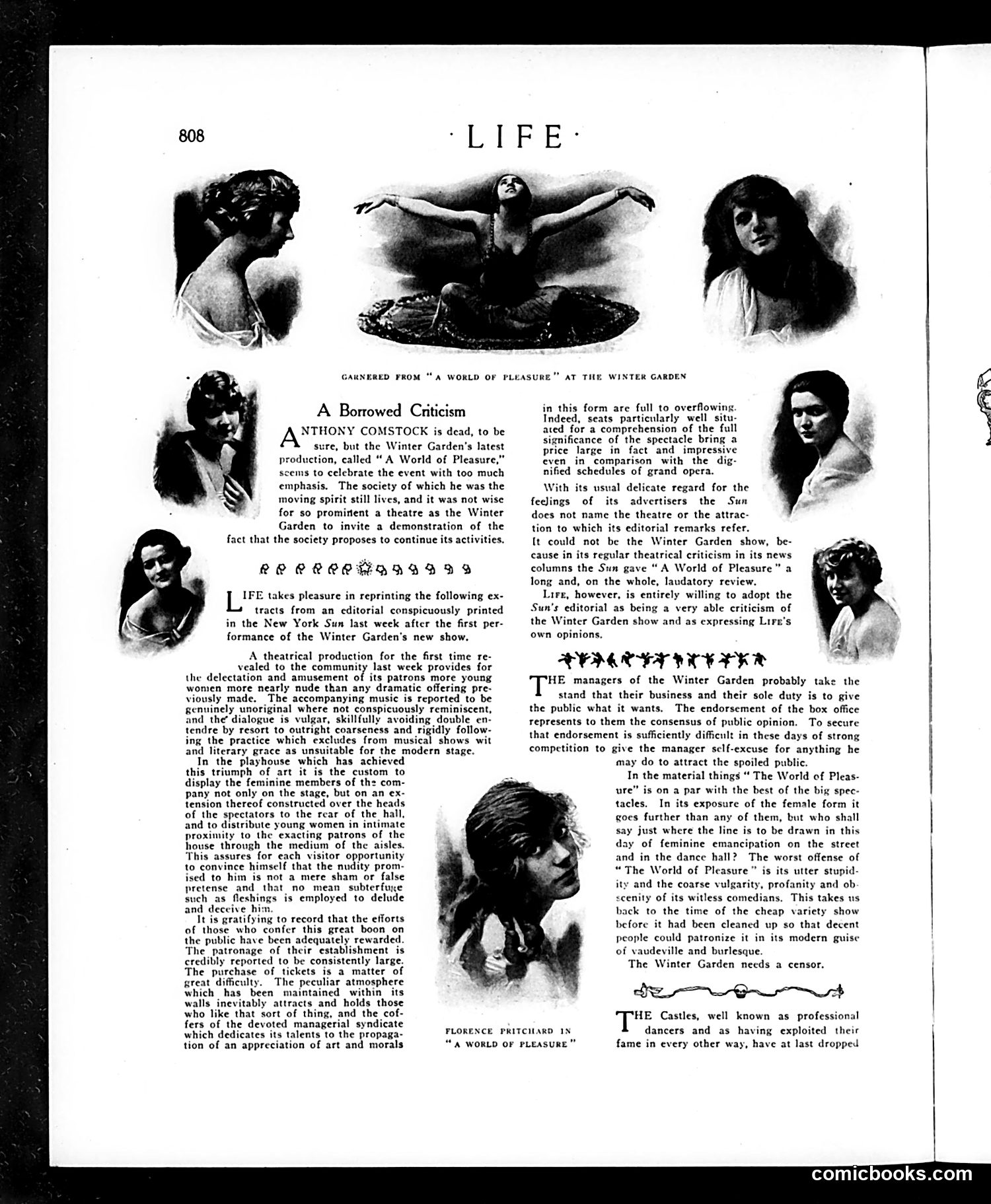
This page critiques the Winter Garden theatre's production "A World of Pleasure" by reprinting and endorsing a New York Sun editorial. The central targets are: **The Production itself**: Criticized for excessive female nudity, vulgar dialogue, and stupidity—representing a descent into cheap variety show standards rather than legitimate theatre. **Anthony Comstock's legacy**: The opening reference notes Comstock (a real anti-obscenity crusader) is dead, yet the morality society he led continues opposing such productions. **Theatre management's defense**: Life sarcastically notes managers claim they merely give audiences what they want, using box office success as moral cover. **The larger issue**: The piece argues "The Winter Garden needs a censor"—advocating for industry standards, not legal prohibition. The included photographs appear to be female performers from the show, illustrating the visual spectacle being criticized. This represents Progressive-era tensions between commercialism, artistic merit, and public morality in entertainment.
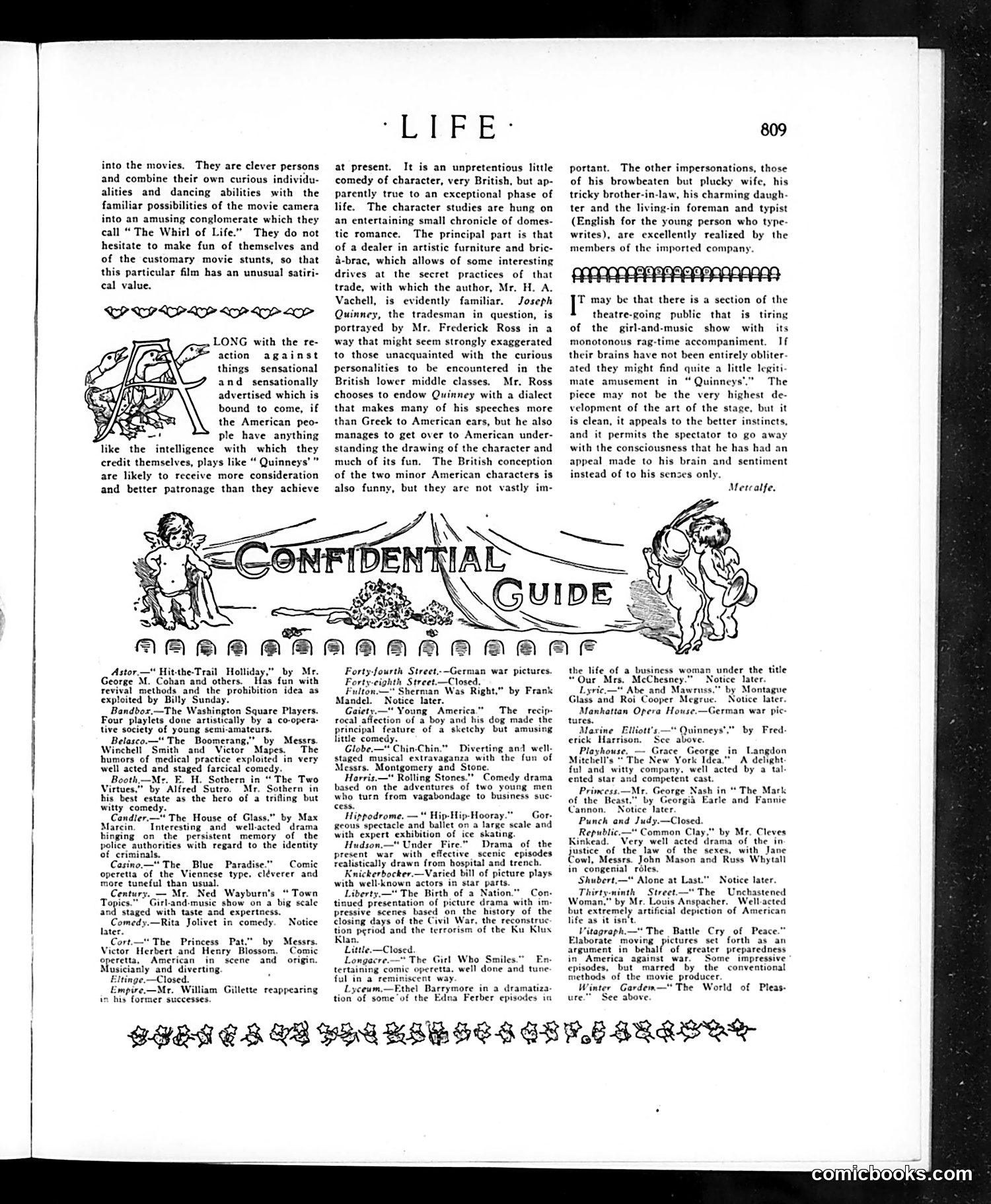
This page reviews theatrical productions, not political cartoons. The "Confidential Guide" section (marked by decorative cherubs) lists current Broadway shows with brief critiques. The main review discusses *"Quinney,"* a British comedy about a furniture dealer in the lower-middle class. Critic Metcalfe praises it as an antidote to sensational "girl-and-music shows" with "monotonous rag-time accompaniment"—reflecting early 1910s anxieties about lowbrow entertainment. He applauds the play for appealing to "brain and sentiment" rather than mere "senses." The review notes Frederick Ross's exaggerated British dialect may confuse American audiences unfamiliar with "curious personalities" of the British lower classes, while finding the minor American characters "funny." Other notices reference Billy Sunday's revival methods (*"Hit-the-Trail Holliday"*) and medical practice farces, representing typical theater fare of the period.
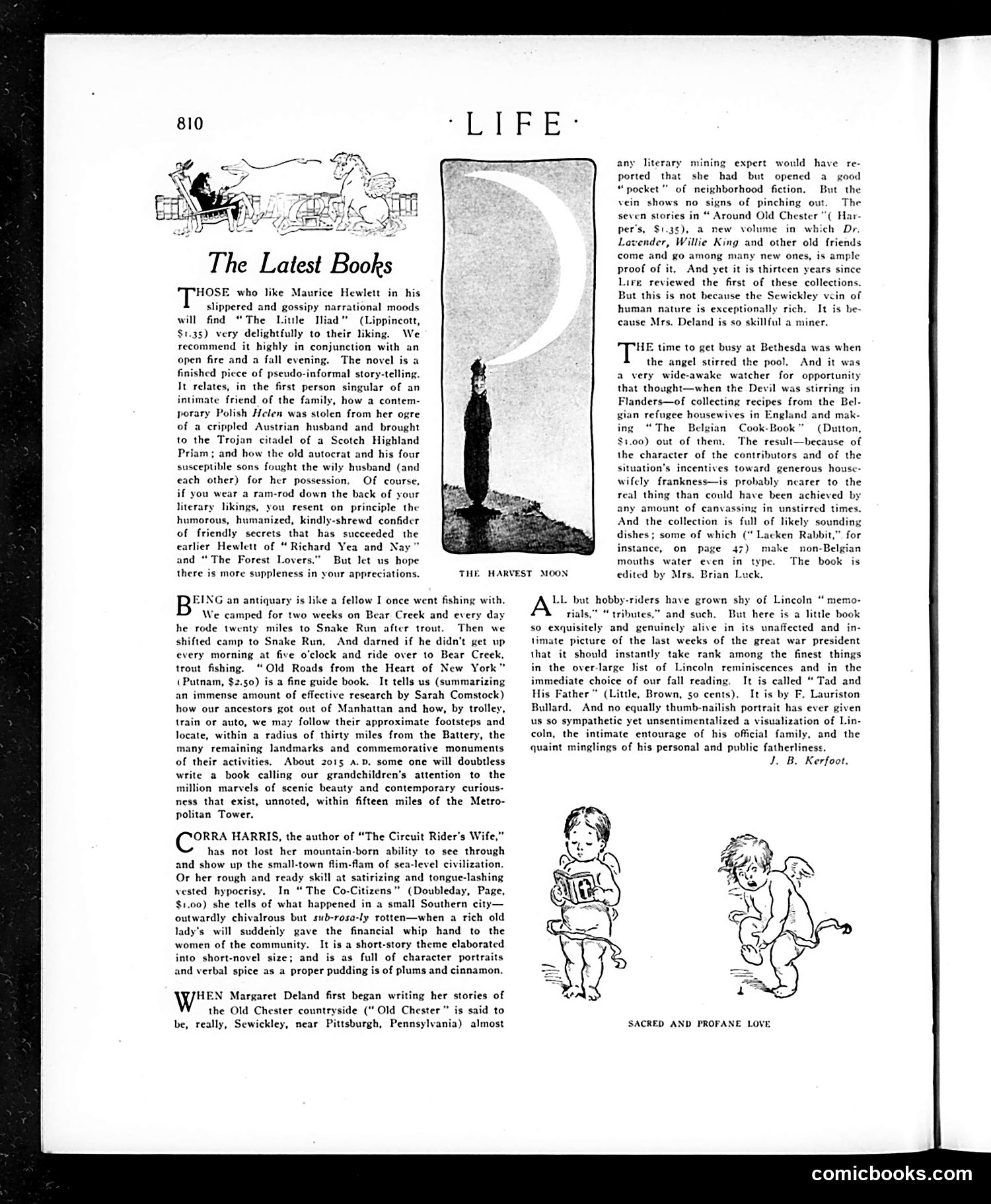
This is a book review section from Life magazine (a satirical literary publication, not the photo magazine). The page discusses contemporary fiction and includes illustrations. The text reviews several novels: Maurice Hewlett's "The Little Iliad" (a romantic drama about a Polish Helen figure stolen from an Austrian husband), a guide to historic sites near New York, Corra Harris's "The Co-Citizens" (satirizing Southern hypocrisy when a wealthy widow's will shifts power to town women), and Margaret Deland's "Around Old Chester" stories (set in a fictionalized Pennsylvania town). **The cartoons** at bottom right labeled "Sacred and Profane Love" appear to show cherubs or putti—classical religious imagery—illustrating contrasting types of love, likely commenting on themes in the reviewed literature. The satirical tone mocks literary pretension while championing readable fiction that reveals human character and small-town social dynamics.
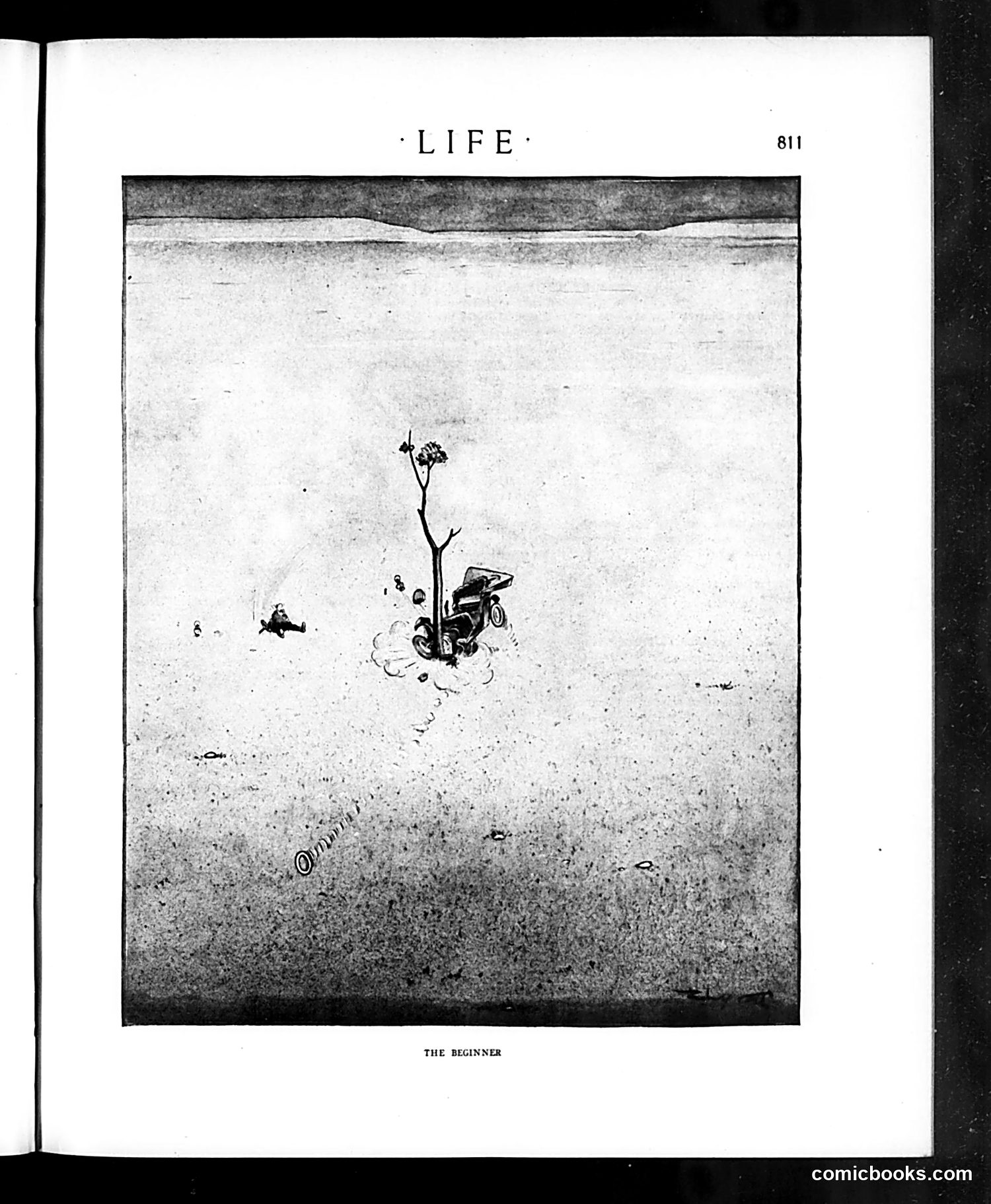
This satirical illustration depicts a motorcyclist who has crashed in a barren desert landscape, with a single struggling plant growing nearby. The image suggests a commentary on inexperience or incompetence—the title "The Beginner" implies the rider is a novice whose poor skills have resulted in disaster. The stark, empty terrain emphasizes isolation and failure. The solitary plant may symbolize fledgling growth or hope amid destruction, or conversely, the desolation that greets amateur attempts. Without additional context about the publication date or specific events referenced, the cartoon appears to be a general satirical commentary on the dangers or difficulties faced by inexperienced people attempting risky activities—in this case, motorcycle riding.
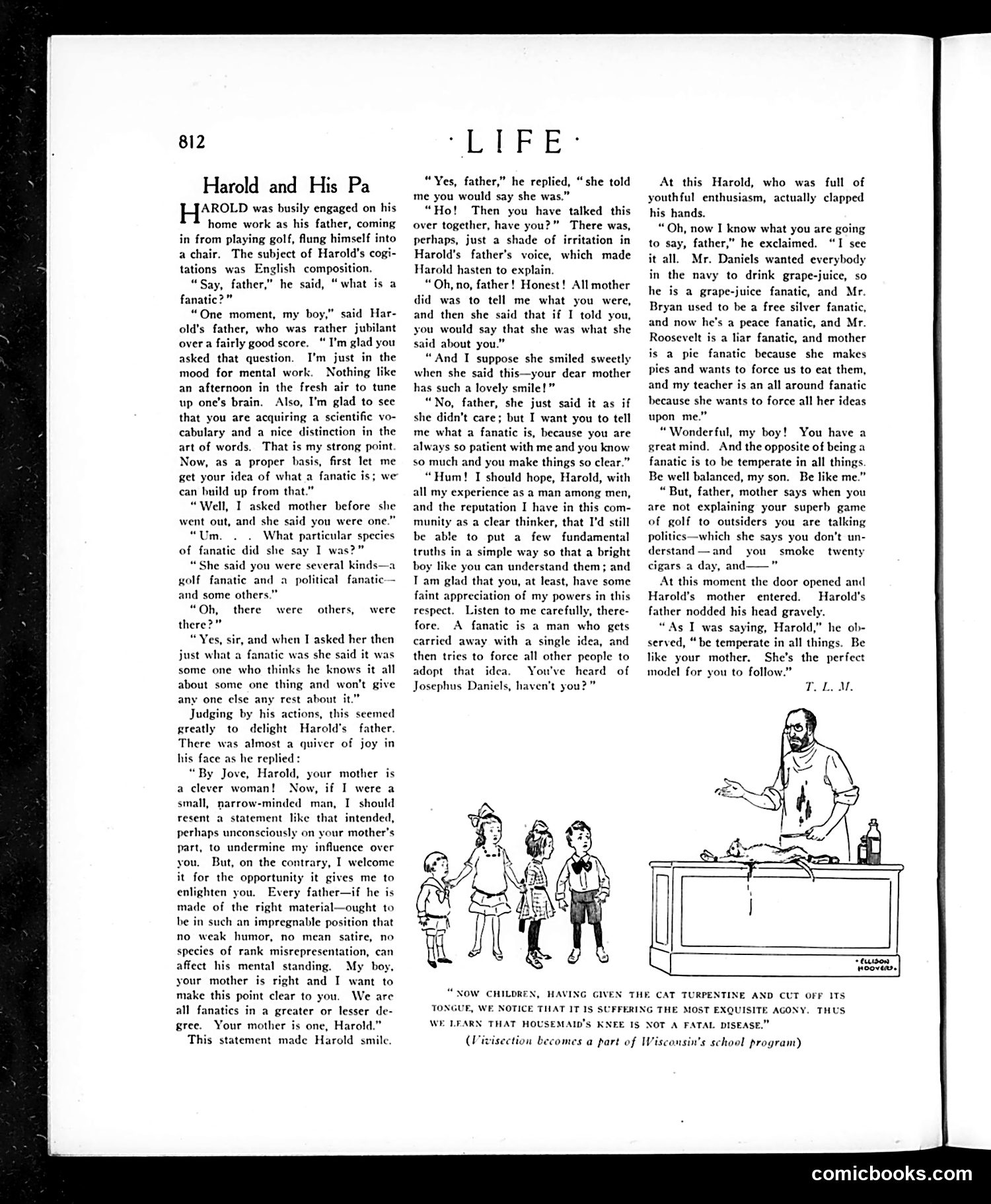
This is a humorous domestic dialogue satirizing parental hypocrisy and self-deception. Harold asks his father to define "fanatic," and his mother has already told the boy that his father *is* one—a golf fanatic and political fanatic who won't listen to anyone else. The father, oblivious to the trap, launches into a self-congratulatory lecture about fanatics being people obsessed with single ideas they force on others. He then references Josephus Daniels (Secretary of the Navy under Wilson, famous for prohibiting alcohol in the navy) as an example—seemingly unaware that this perfectly describes *himself*. The satire works through dramatic irony: the father's pompous explanation of fanaticism inadvertently proves the mother's point, while he believes he's demonstrating his superior wisdom. The joke is that adults often lecture children while missing obvious truths about themselves, and that mothers are cleverly manipulative. The bottom cartoon appears unrelated—a separate vignette about a cat's tongue and housemaid's knee.
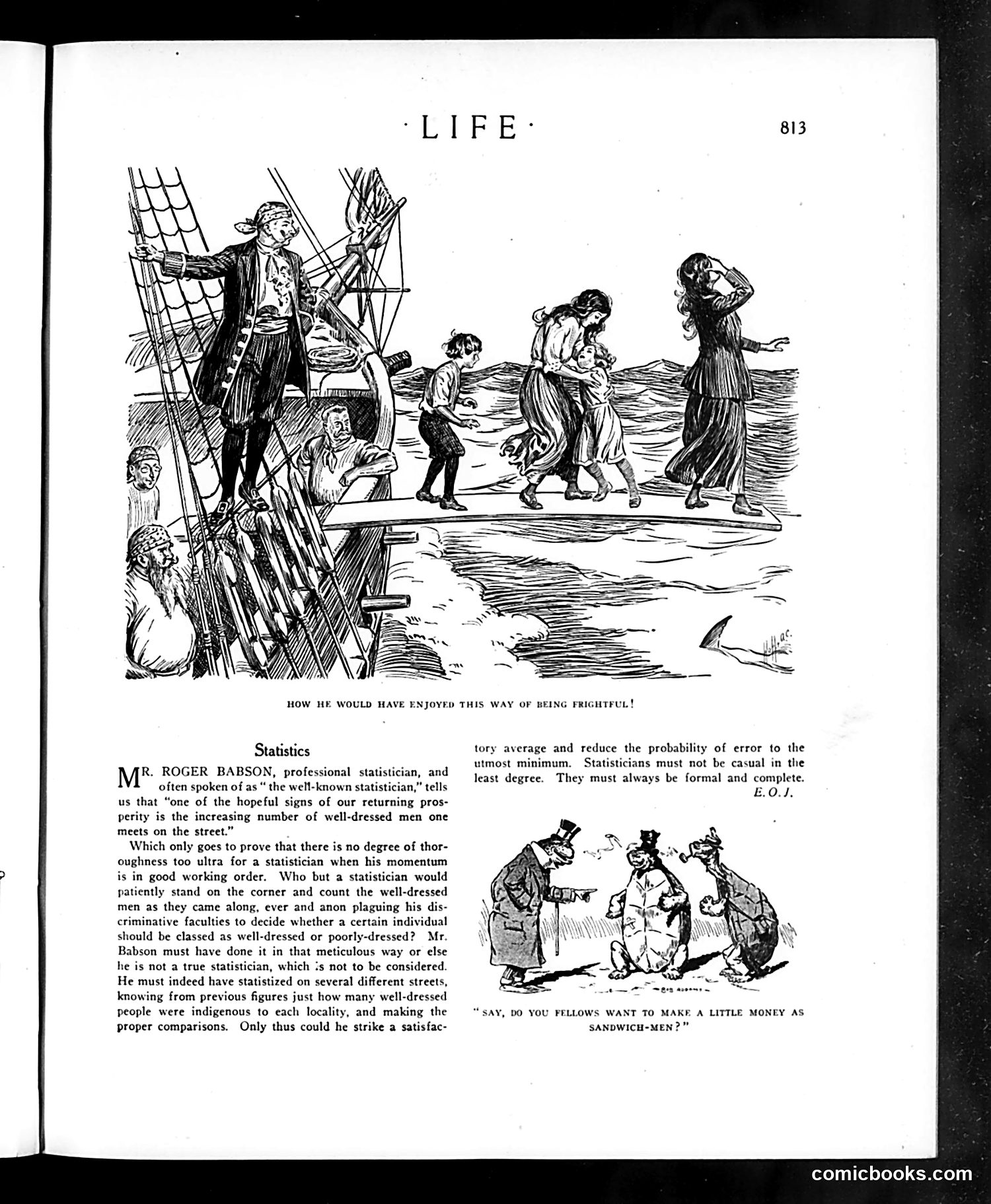
This page satirizes professional statistician Roger Babson's claim that increasing numbers of well-dressed men on streets signal economic recovery. Life magazine ridicules the absurdity of this metric by suggesting it requires obsessive, impractical counting and categorization—a statistician standing on corners obsessively judging whether each passerby qualifies as "well-dressed" enough. The top cartoon shows a ship's captain pointing dramatically (caption: "How he would have enjoyed this way of being frightful!"), likely referencing a historical figure or contemporary news story, though the specific reference is unclear. The bottom cartoon depicts working-class men discussing becoming "sandwich-men"—people who wore advertising boards front and back. The satire suggests that if economic prosperity merely meant seeing more well-dressed people on streets, perhaps they were simply unemployed men hired to wear suits while advertising products—a superficial and hollow measure of genuine economic improvement.
This page contains readers' letters addressing WWI and American values, with no visible cartoons. **Key content:** - **"Where Is Romance?"** (Cleveland, OH): A reader asks whether young Americans possess romantic spirit and adventurousness, or are bound by convention. This reflects anxiety about American character during the war era. - **"A Letter from France"** (French): A patriotic correspondent praises Life's pro-France coverage, asserting French determination to win. - **"All Patriots in France"**: Describes a French ammunition factory manager whose workers labor 12-18 hours daily without complaint, contrasting French sacrifice with English miners' strikes—a wartime propaganda point about Allied commitment. - **"An Old Friend Comes Back"**: A reader resumes subscription, having initially quit over Life's criticism of his profession (likely medicine or military affairs). He now supports Life's anti-German stance. **Context**: The page reflects 1915 American attitudes—admiration for Allied sacrifice, suspicion of strikes as unpatriotic, and debate over American values during the pre-intervention period.
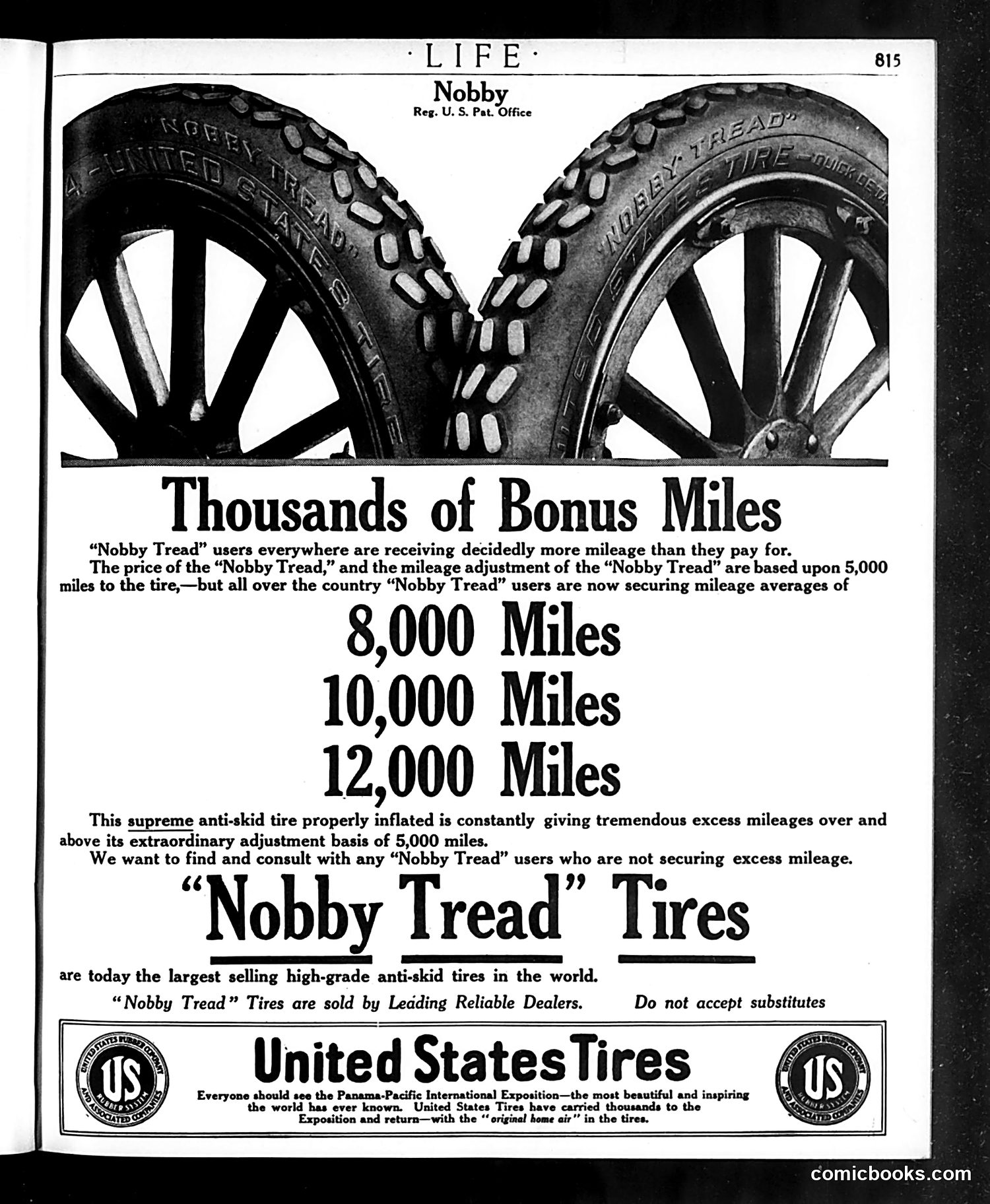
This is a **full-page advertisement**, not a cartoon or satire. It promotes "Nobby Tread" tires made by United States Tires. The ad claims that Nobby Tread tires, engineered to last 5,000 miles, consistently deliver "bonus miles"—users report achieving 8,000, 10,000, or even 12,000 miles. The advertisement emphasizes this as superior value: drivers pay for one standard lifespan but get significantly more actual mileage. The two tire images at top show the distinctive tread pattern. The ad positions Nobby Tread as "the largest selling high-grade anti-skid tires in the world" and explicitly warns: "Do not accept substitutes." The closing paragraph references the Panama-Pacific International Exposition (1915), claiming United States Tires transported thousands of vehicles there while maintaining their original tire quality—a marketing claim suggesting durability and reliability for consumers evaluating tire options during the early automotive era.
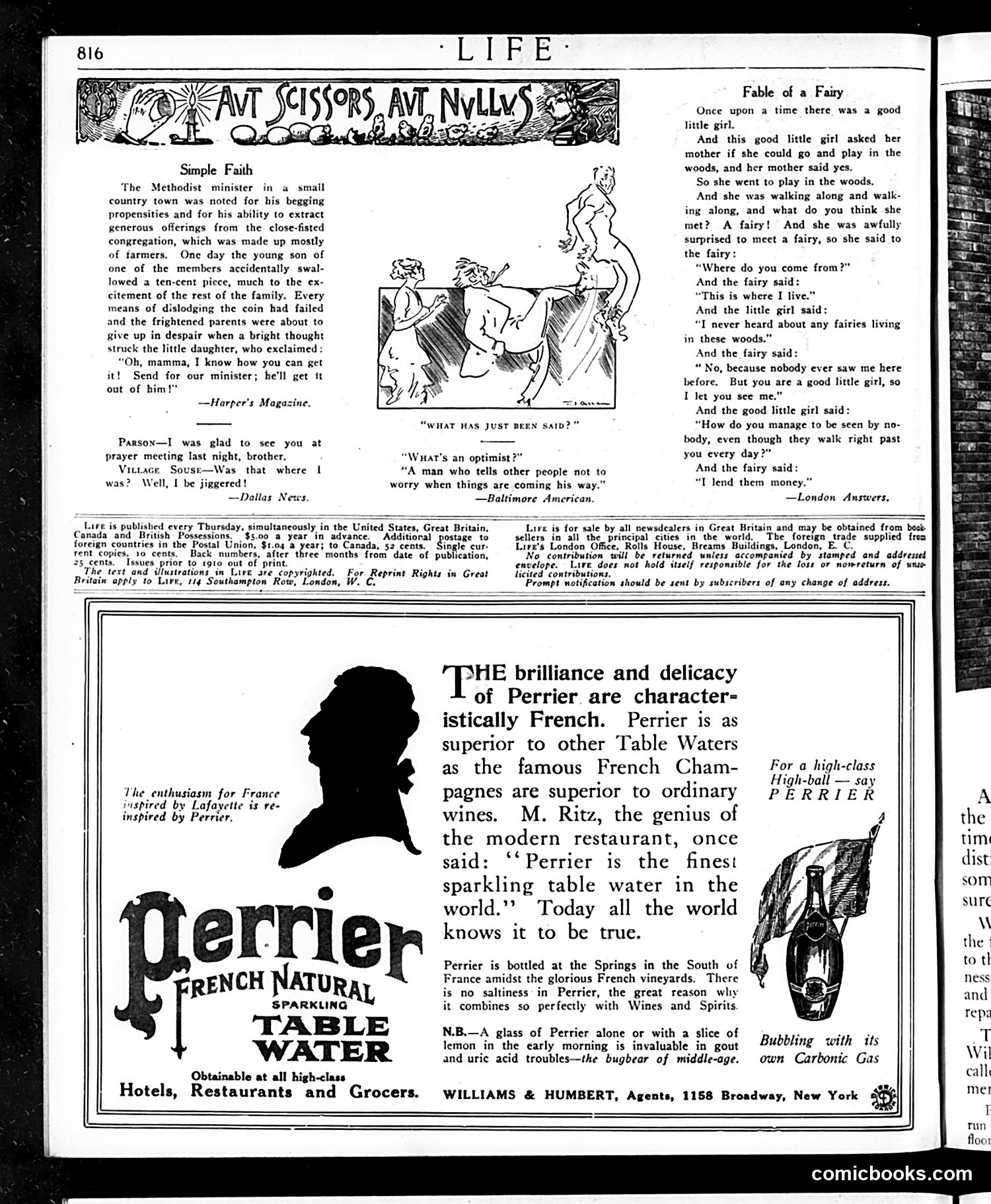
This page contains three separate humor pieces typical of early 20th-century satirical magazines: 1. **"Simple Faith"** (top left): A joke about a Methodist minister known for extracting money from his congregation. When a farmer's child swallows a coin, the daughter suggests fetching the minister because "he'll get it out of him"—a pun implying his talent for extracting donations works on anyone. 2. **"Fable of a Fairy"** (right column): A whimsical short story where a fairy explains she remains unseen because she "lends them money"—a satirical jab at how people ignore fairy tales when pursuing financial gain. 3. **Perrier Advertisement** (bottom): A full-page ad for French sparkling water, featuring a silhouette profile and claims of superiority, invoking French prestige and the famous restaurateur César Ritz's endorsement. The page reflects common early-1900s satirical targets: clergy financial motivations and materialism's dominance over imagination. The Perrier ad represents period advertising's reliance on European sophistication marketing.
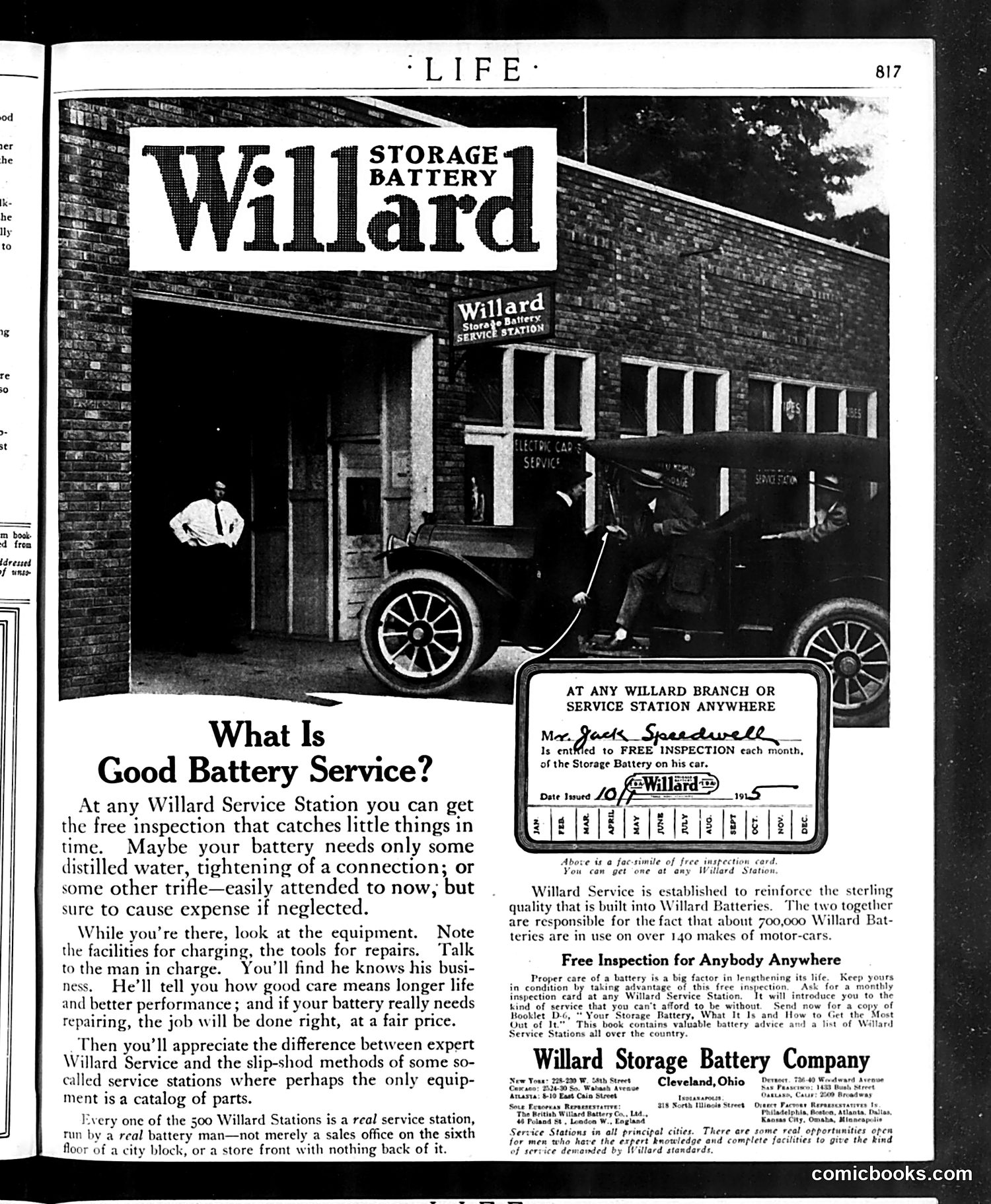
This is a **Willard Storage Battery Company advertisement**, not satire or political commentary. It occupies most of a 1925 *Life* magazine page (page 817). The ad promotes Willard's network of service stations by contrasting "expert" battery maintenance with inferior competitors. The central image shows a Willard service station with a customer's car being serviced—a photograph meant to convey legitimacy and professionalism. The text emphasizes free inspections and preventive care ("catches little things in time"), positioning Willard as a trustworthy alternative to fly-by-night "slip-shod" operators who are merely "sales offices" with nothing behind them. An inspection card is shown promising monthly free battery checks. **For modern readers**: This reflects early automotive culture when car owners relied on specialized service networks. The ad's emphasis on expertise, facilities, and fair pricing addresses consumer anxieties about being cheated—concerns that clearly existed in the 1920s auto industry.
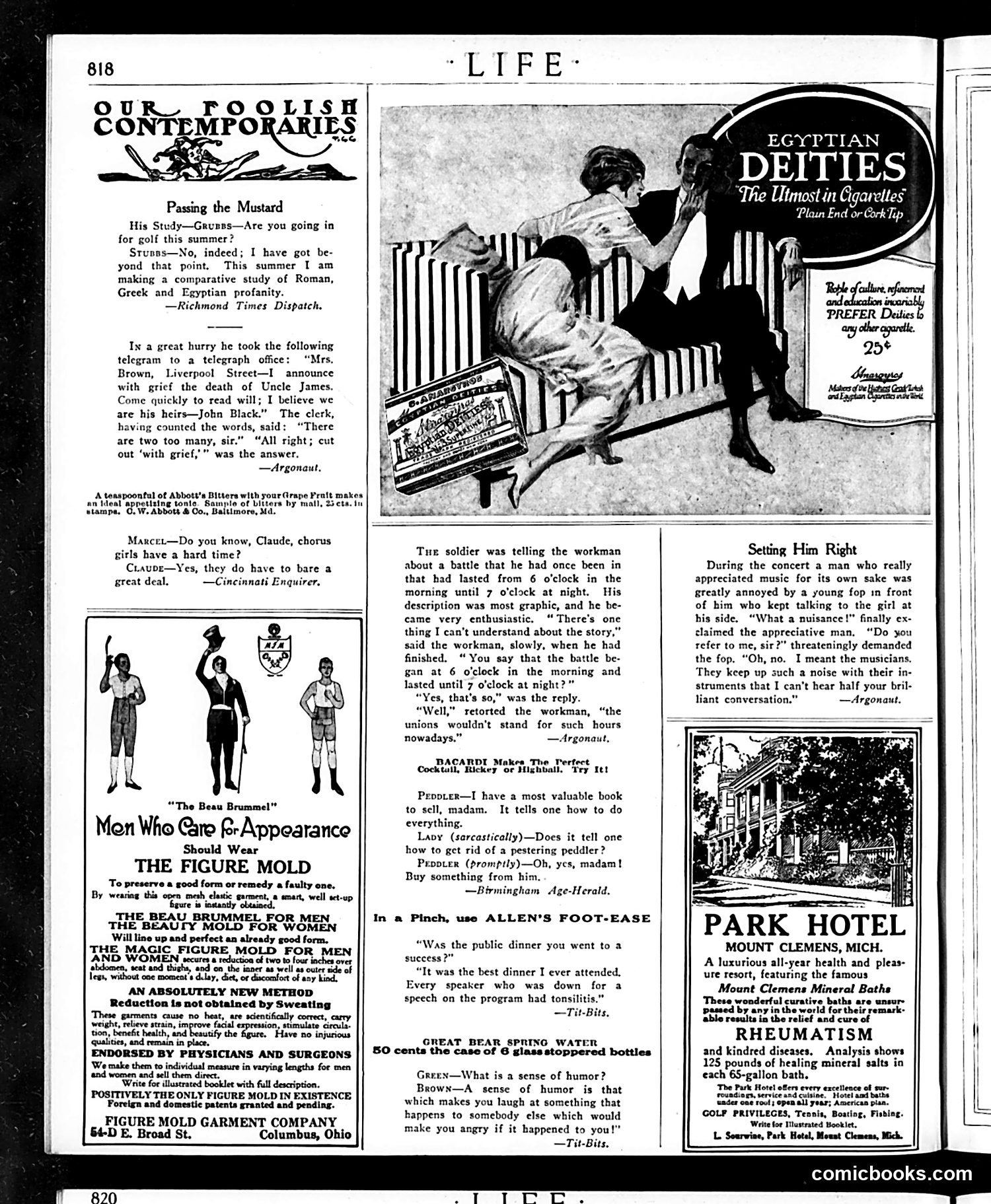
This page collects brief satirical jokes mocking contemporary social attitudes and behaviors. The cartoons and quips target: **"Passing the Mustard"**: Satirizes intellectuals who adopt pretentious scholarly pursuits (studying "Egyptian profanity") to appear cultured, when they've simply tired of golf. **The telegram joke**: Mocks penny-pinching practicality—a man announcing his uncle's death cuts the phrase "with grief" to save money on telegram costs, reducing human emotion to expense. **Chorus girls joke**: A mild double entendre about chorus girls having to "bare a great deal." **The soldier/workman exchange**: Satirizes union labor consciousness—a workman finds a soldier's battle story implausible not because of military details, but because no union would tolerate such working hours (6am-7pm). **The peddler joke**: Plays on persistent salesmen and women's shopping habits. The page also advertises corsets ("Figure Mold"), cigarettes, and other period products. The humor reflects early 20th-century class attitudes, gender stereotypes, and labor politics.
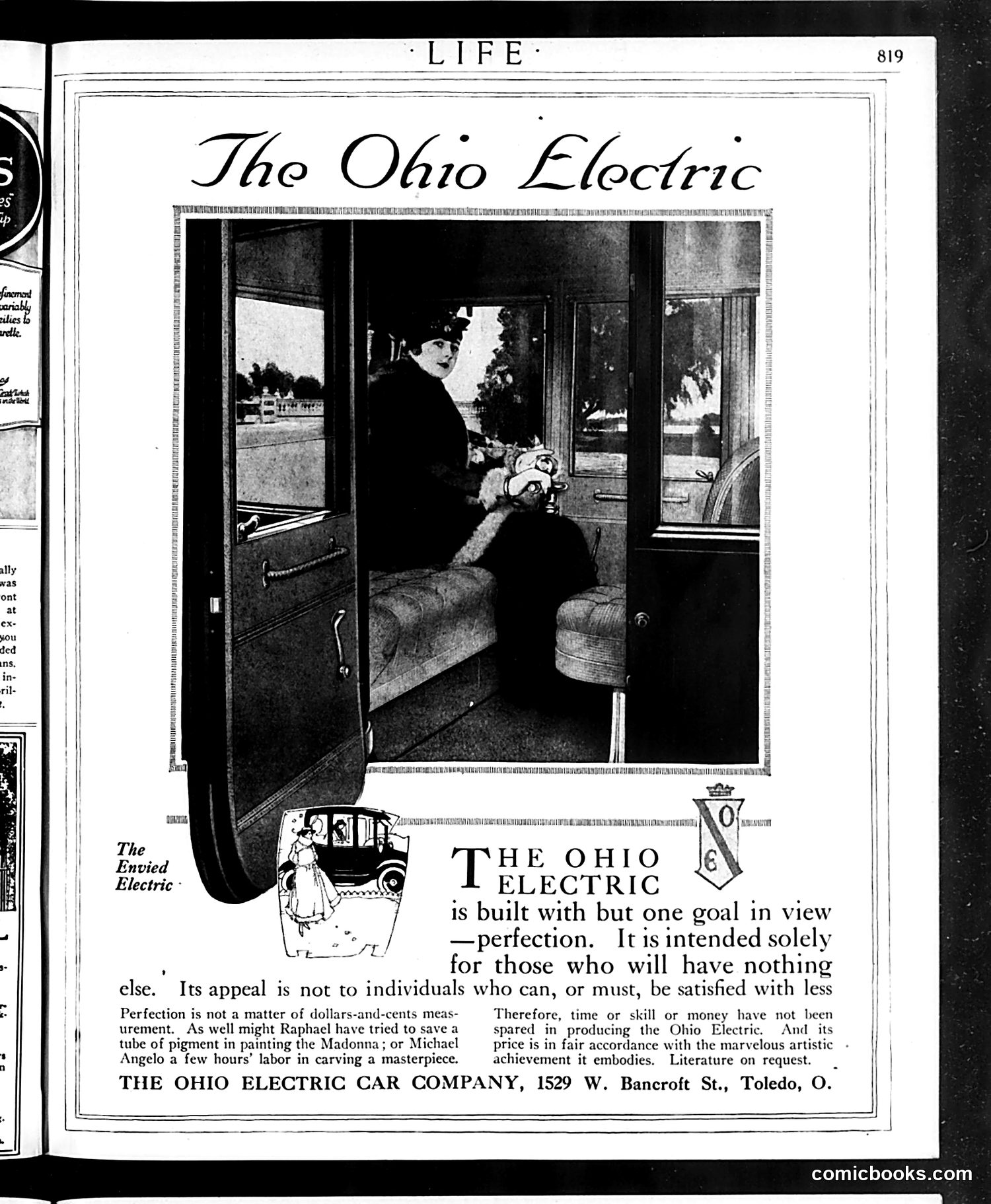
This is a **luxury car advertisement**, not satire. The page promotes the Ohio Electric automobile by positioning it as a premium product for discerning buyers who demand perfection. The ad uses classical art references—comparing the car's craftsmanship to Raphael's Madonna painting and Michelangelo's sculpture—to justify its high price. The photograph shows a well-dressed woman inside the vehicle, emphasizing elegance and comfort. The key pitch: this car isn't for budget-conscious consumers ("those who will have nothing else"), but for wealthy individuals willing to pay premium prices for superior quality. The rhetoric explicitly rejects cost-cutting, arguing that perfection cannot be rushed or cheapened. This reflects early 1900s marketing strategy, when electric cars were luxury items marketed to the affluent, before gasoline vehicles dominated the market.
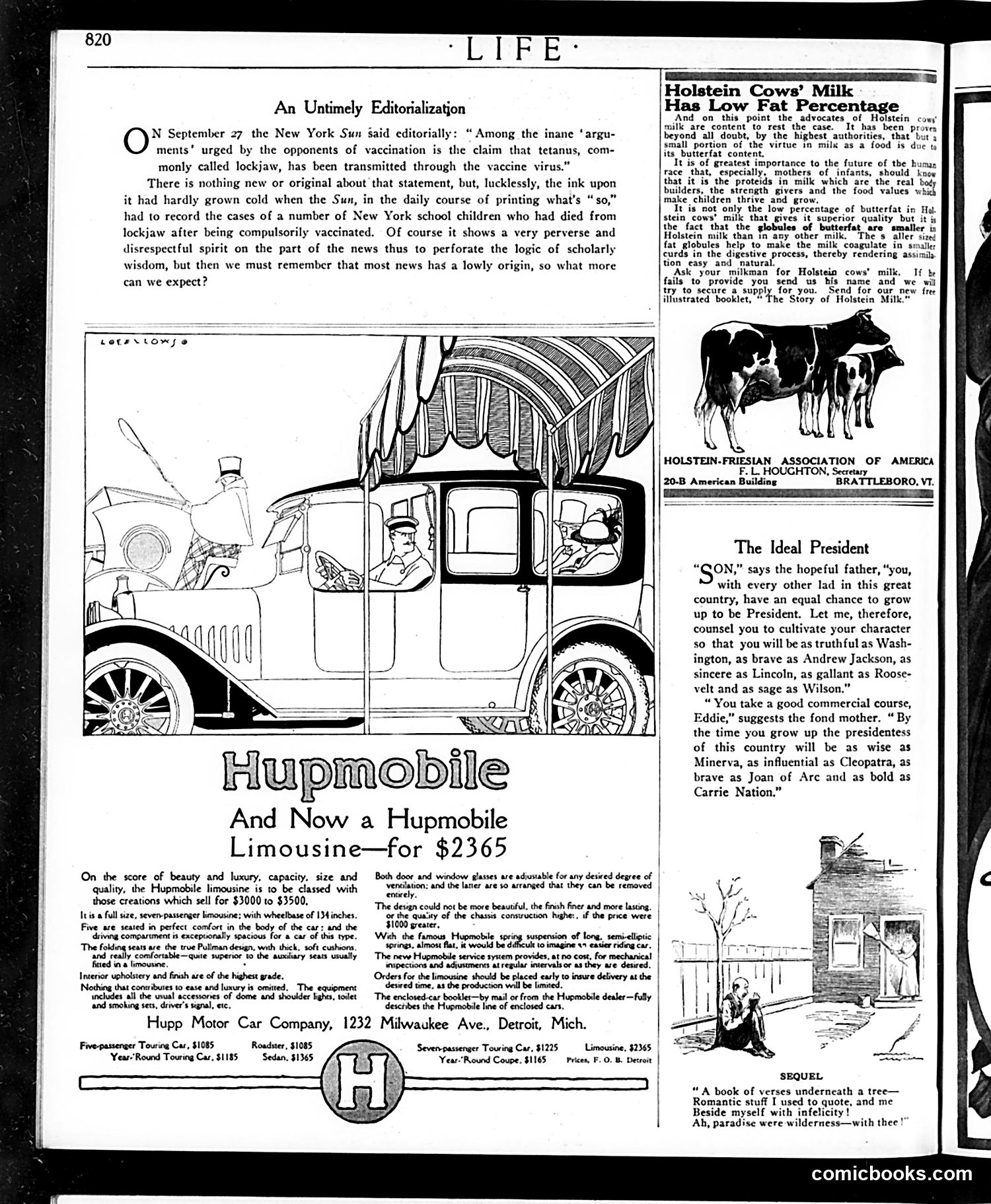
This page contains three distinct items: **"An Untimely Editorialization"** is a brief satire criticizing the New York Sun's editorial logic. The Sun published an anti-vaccination argument claiming tetanus could be transmitted through vaccines, then immediately reported actual cases of children dying from lockjaw (tetanus) after mandatory vaccination. The satire mocks the newspaper's scholarly pretensions being undermined by inconvenient facts—the irony being that real events contradicted their editorial position within days. The remaining content is advertising: a Holstein dairy association promoting milk's protein content over butterfat, and a Hupmobile automobile advertisement featuring a limousine priced at $2,365. There's also a brief humorous piece titled "The Ideal President" imagining a father and mother advising their son on presidential qualities, suggesting future female presidents might be compared to historical figures like Cleopatra and Joan of Arc.
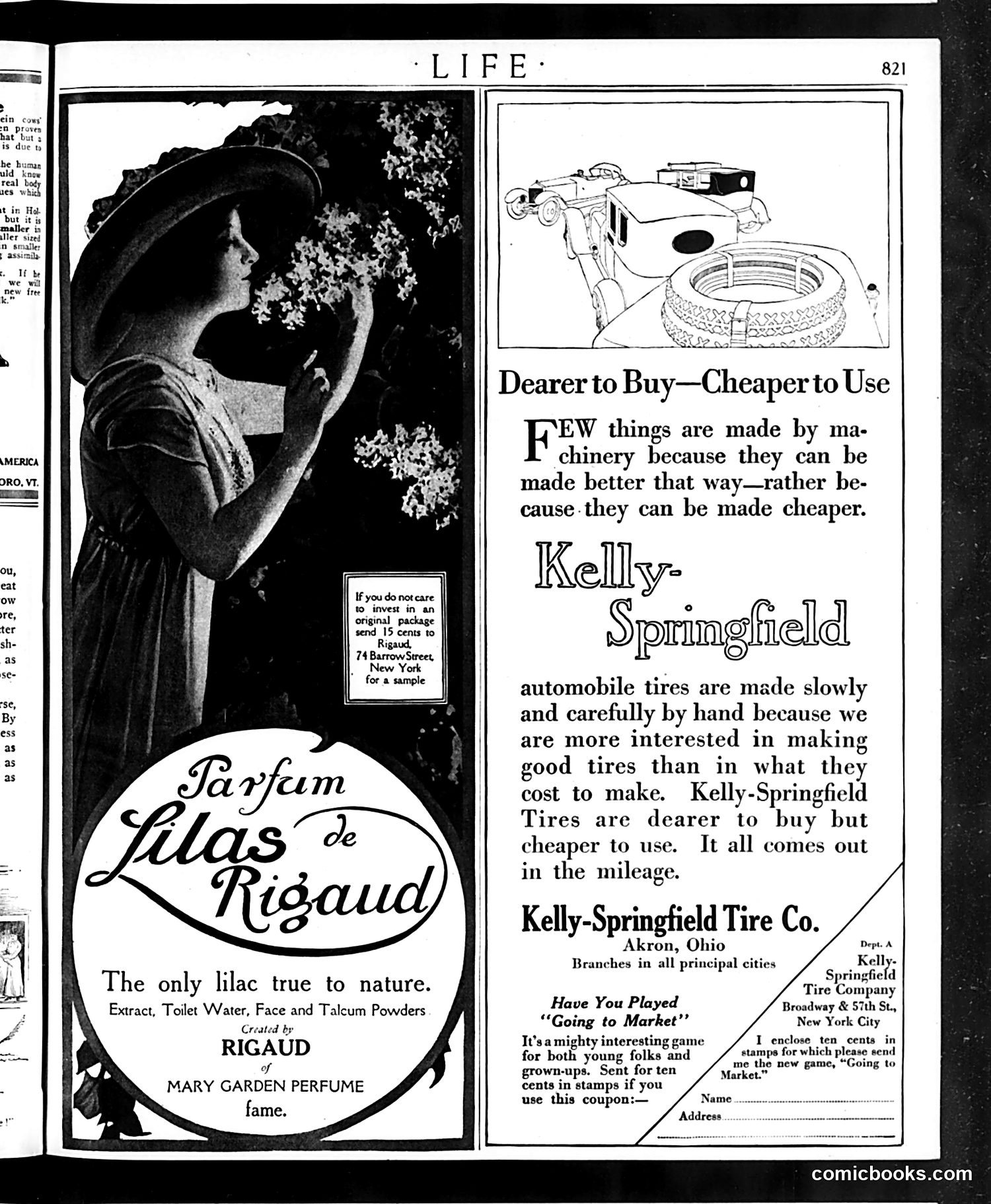
This page contains **two separate advertisements**, not political cartoons. **Left side:** A perfume ad for "Lilas de Rigaud" by the Mary Garden Perfume company, featuring a romantic photograph of a woman with lilacs. The copy claims it's "the only lilac true to nature" and lists extract, toilet water, face and talcum powders. **Right side:** A Kelly-Springfield Tire Company advertisement emphasizing quality over cost-cutting. The ad argues that their tires, though more expensive upfront ("dearer to buy"), save money long-term through superior mileage ("cheaper to use"). It includes a small game offer ("Going to Market") redeemable for ten cents in stamps. Both ads reflect early 20th-century marketing strategies: the perfume ad appeals to romantic femininity and natural beauty, while the tire ad positions premium pricing as a mark of superior craftsmanship—a common pitch when mass production was still new and consumers questioned whether machines could match hand-made quality.
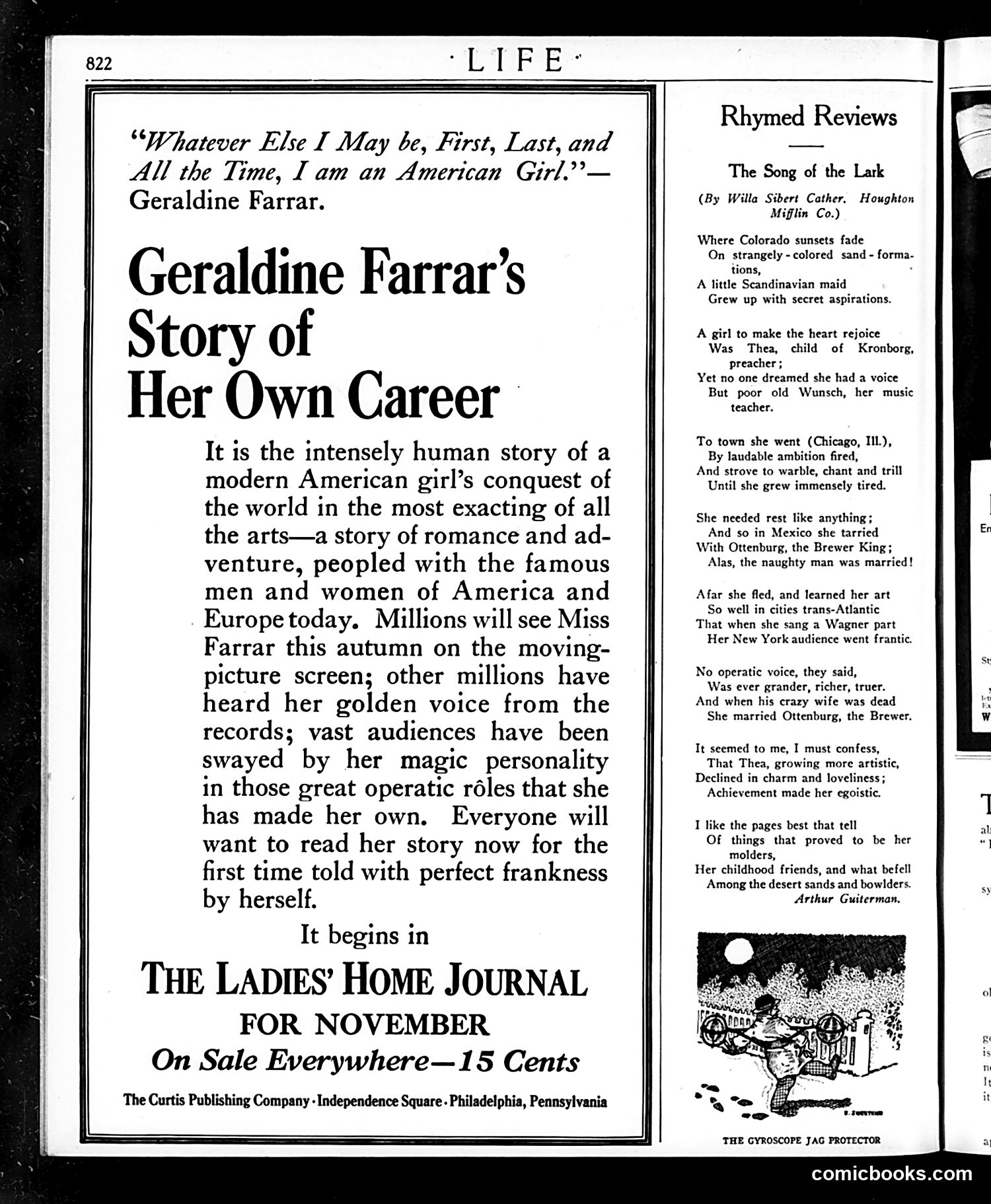
This page combines **advertising** (left) and **literary criticism** (right). The **left side** advertises Geraldine Farrar's autobiography, serializing in *The Ladies' Home Journal*. Farrar was a famous American opera singer and early film star. The ad emphasizes her "American Girl" identity and upcoming movie appearance, appealing to millions of fans. The **right side** reviews Willa Cather's novel *The Song of the Lark*—which notably features a protagonist inspired by Farrar herself. The rhymed review (by Arthur Guiterman) summarizes the plot: a Scandinavian-American girl from Colorado becomes an opera singer, has an affair with a married brewer, and eventually marries him. Guiterman critiques that her artistic success made her "egoistic," preferring her earlier, more charming self. The juxtaposition is notable: Farrar's self-promoting autobiography runs alongside a fictional account (based on her life) that questions whether ambition and achievement enhance or diminish a woman's character.
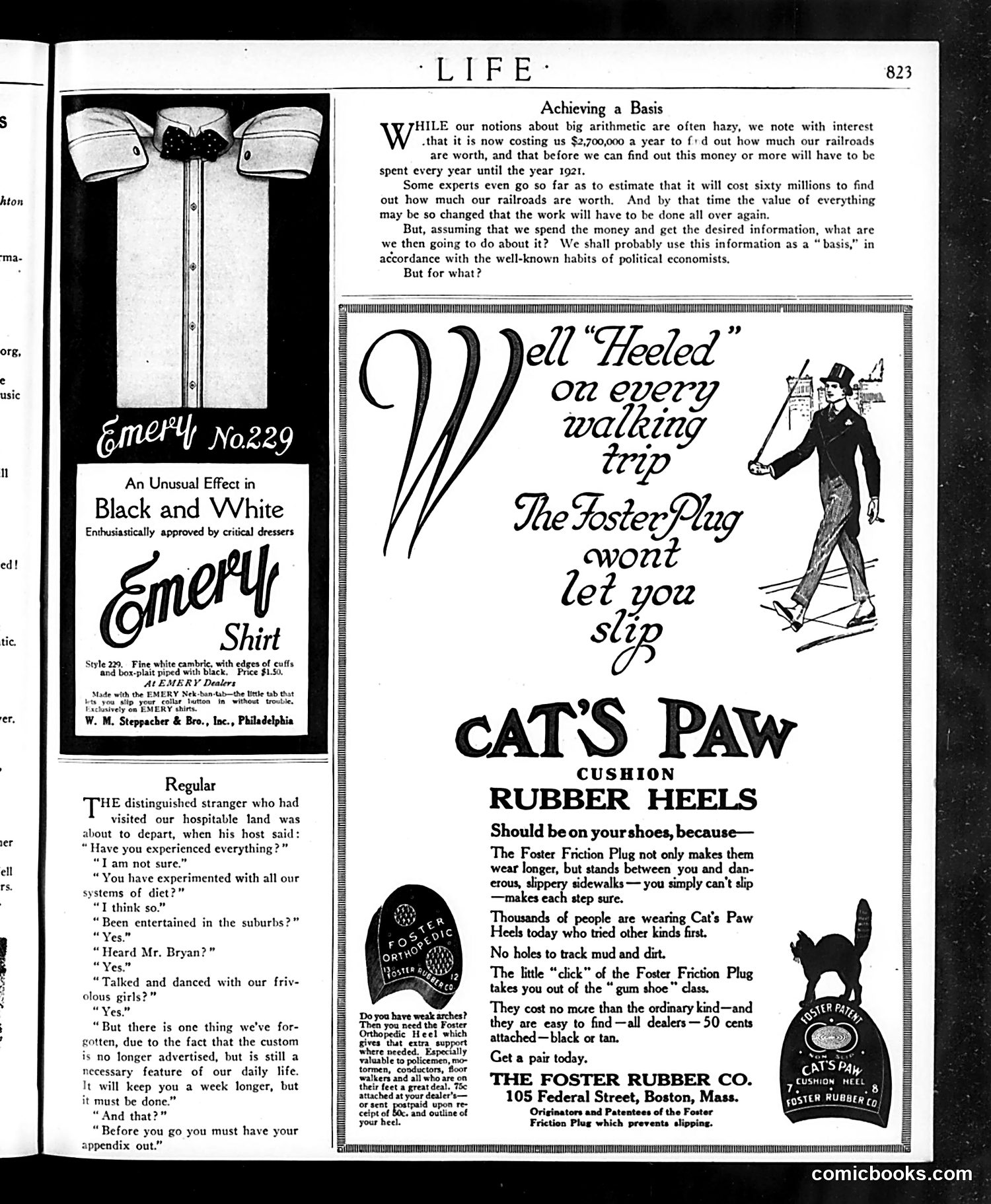
This page combines editorial satire with advertising. The main content is a **political-economic critique** titled "Achieving a Basis." It mocks the railroad industry's massive spending ($2.7 million annually, potentially $60 million total by 1921) to determine railroad valuations, only to use that data as an arbitrary economic "basis"—a jab at political economists' circular reasoning and waste of public resources. The humor lies in questioning whether gathering expensive information serves any actual purpose beyond justifying further bureaucratic decisions. The page also includes two advertisements: an **Emery shirt** with a comedic anecdote about a foreign visitor being told he must have an appendectomy before leaving America—satirizing American over-enthusiasm for unnecessary surgery as a cultural trait. Below is a **Cat's Paw rubber heels advertisement** featuring a well-dressed gentleman, emphasizing safety on slippery surfaces.
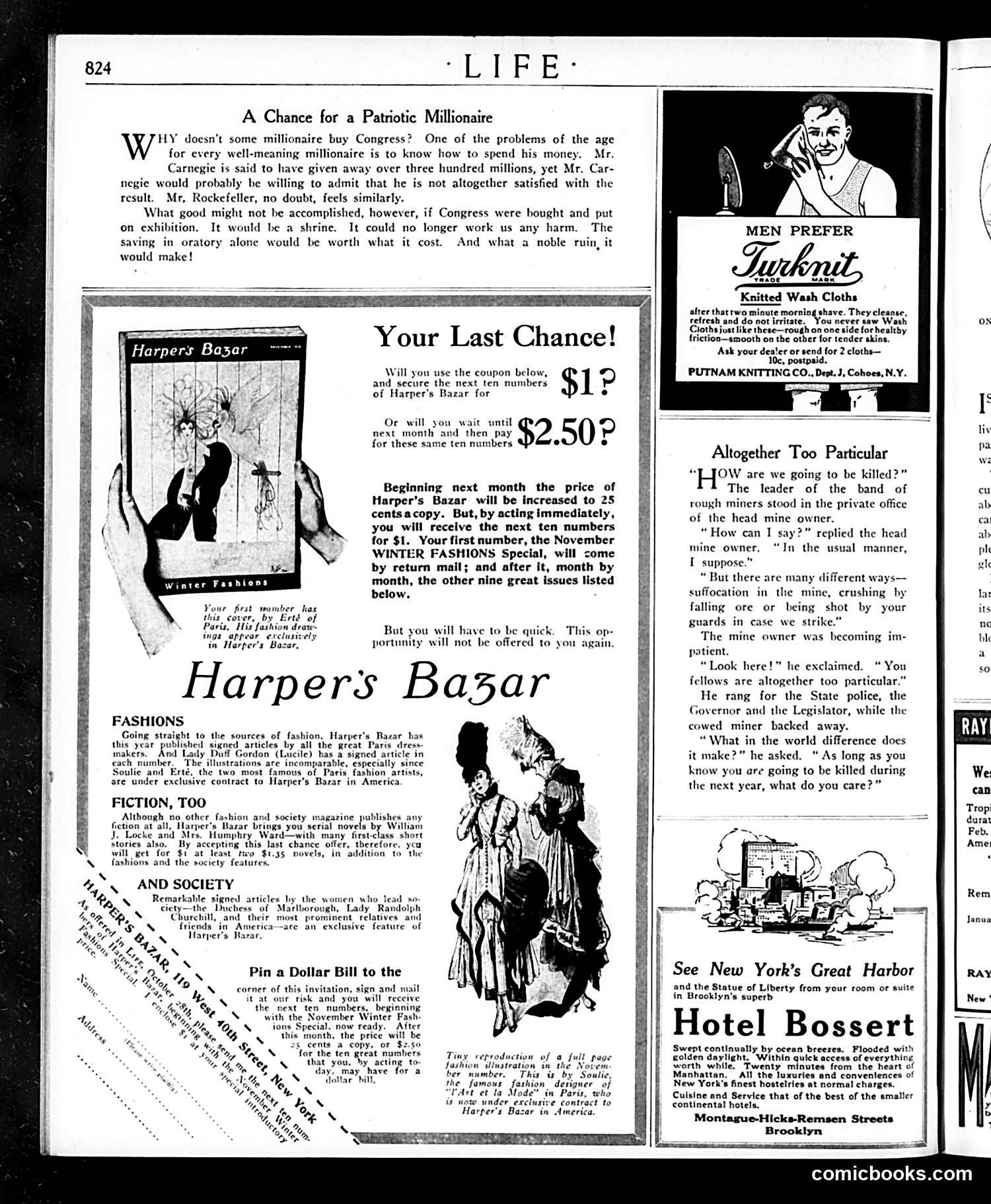
This page contains two distinct elements: **Top article ("A Chance for a Patriotic Millionaire"):** A satirical piece suggesting wealthy industrialists like Carnegie and Rockefeller "buy Congress" and put it "on exhibition" like a museum piece. The joke is that removing Congress from power would save money ("saving in oratory alone would be worth what it cost") and prevent harm. This reflects Progressive-era skepticism about whether legislators actually served the public interest versus wealthy interests. **Bottom story ("Altogether Too Particular"):** A dark comic dialogue between striking miners and a mine owner. When workers ask how they'll be killed during their strike, the owner replies "in the usual manner." When miners list possibilities (suffocation, crushing, being shot by guards), the owner calls them "altogether too particular"—satirizing callous disregard for workers' safety and lives. The owner's response to labor organizing is to summon police and government officials. Both pieces critique the wealthy and their relationship to power and workers.
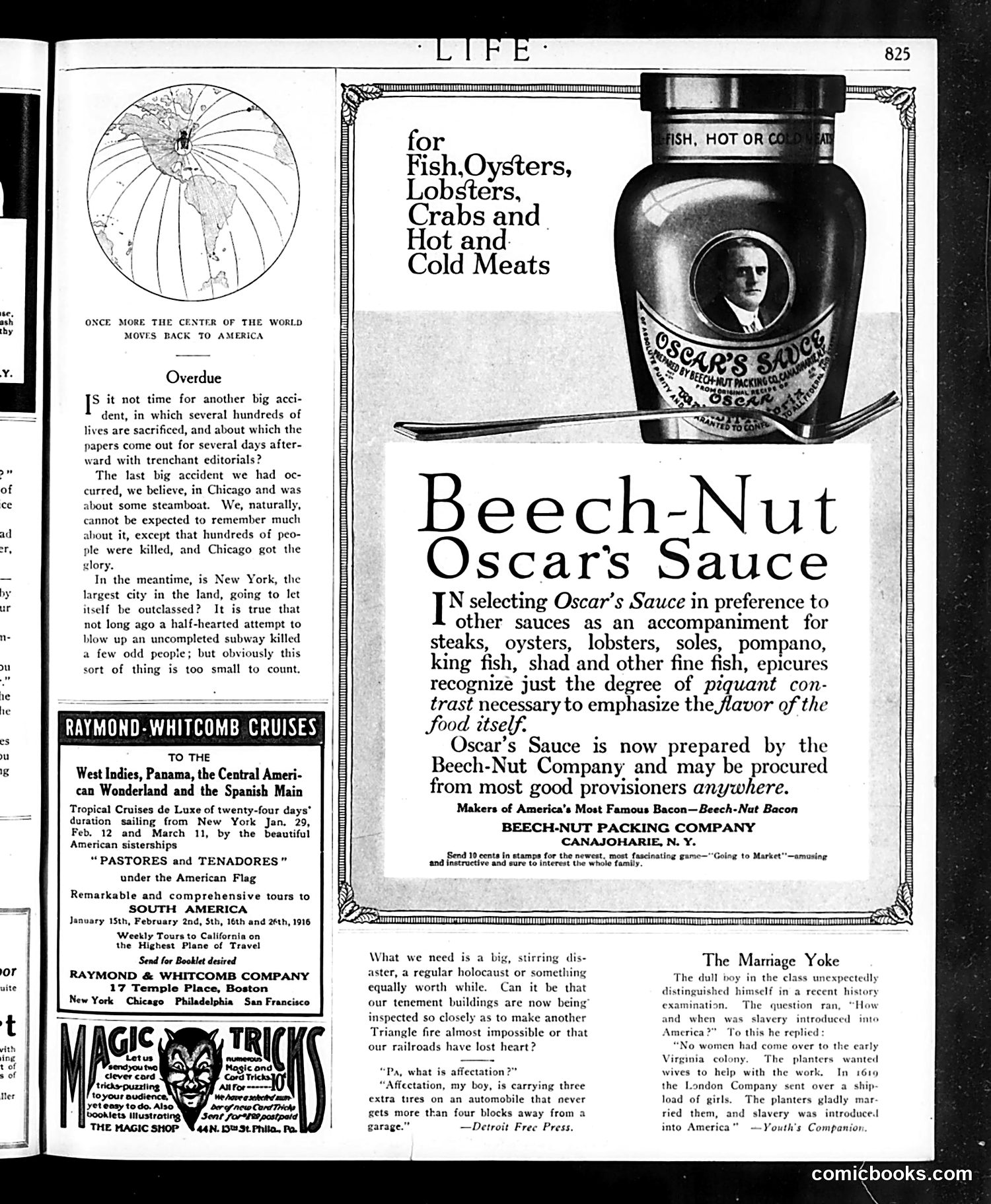
This page is primarily **advertising** from a 1916 *Life* magazine, with a brief satirical editorial column. The main "Overdue" column is **dark satire** mocking New York City's competitive desire for major disasters. The author sarcastically suggests that New York should experience a catastrophic accident to rival a previous Chicago steamboat disaster that killed hundreds. He dismisses a recent subway explosion as insufficient tragedy, implying cities compete for notoriety through human suffering. This satirizes American media sensationalism and civic pride taken to absurd extremes. The page otherwise features cruise advertisements, a Beech-Nut sauce ad, and a brief humor piece about affectation. The final section, "The Marriage Yoke," is a historical "joke" explaining slavery's introduction to Virginia through the arrival of English women in 1610—presenting forced labor as a natural consequence of marriage, which reveals the casual racism of early 20th-century *Life* magazine humor.
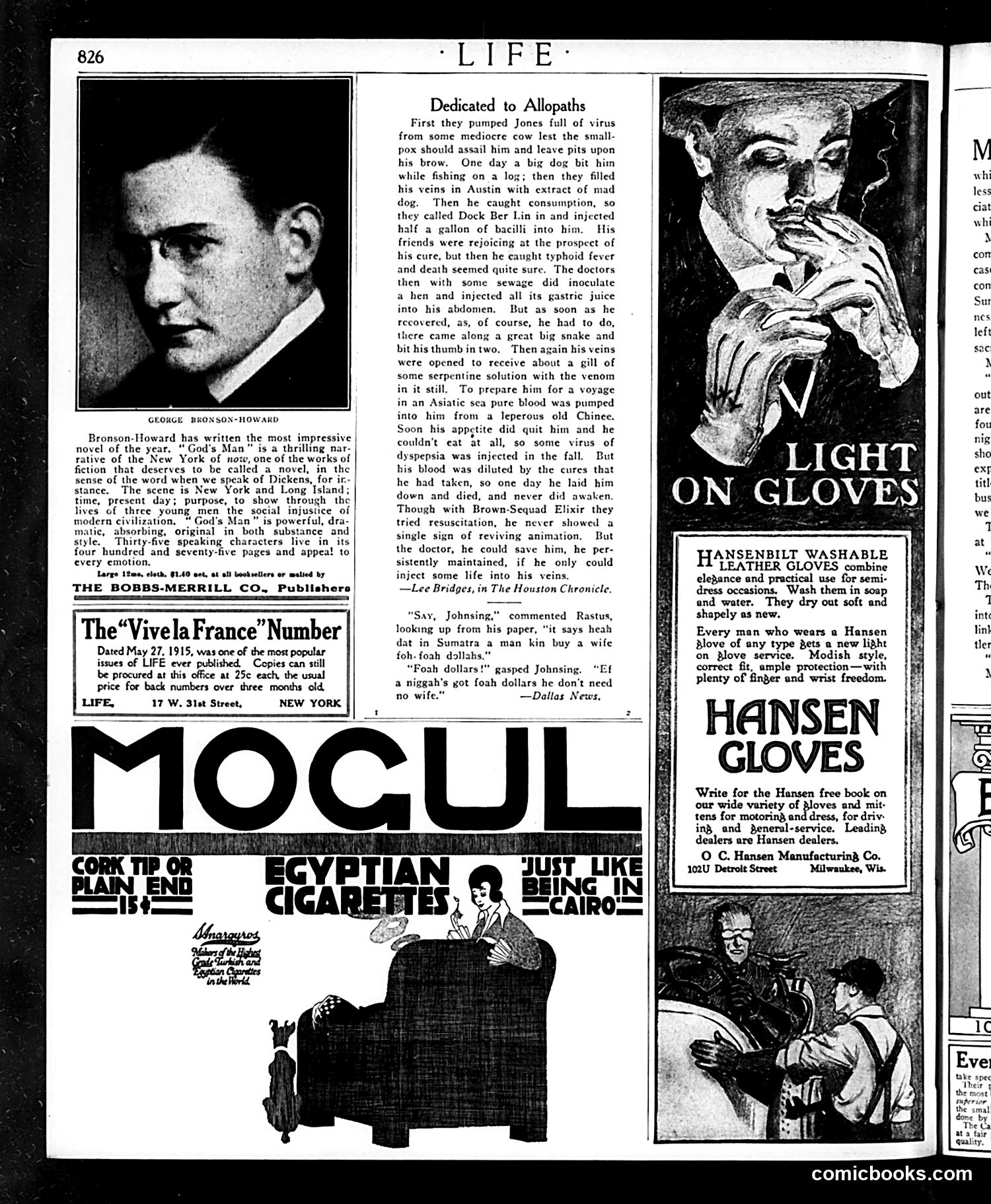
This page contains two distinct pieces of satire: **Left side:** A mock-serious poem satirizes early 20th-century medical practices—specifically vaccination and experimental treatments. The narrative follows "Jones," who receives increasingly extreme inoculations (cowpox vaccine, rabies treatment, tuberculosis bacilli, typhoid serum, etc.), each causing new ailments. He eventually dies, yet doctors insist they could have saved him with one more injection. The satire targets the medical establishment's overconfidence in experimental treatments and their tendency to treat symptoms by introducing more pathogens—reflecting genuine contemporary skepticism about aggressive medical interventions that were poorly understood. **Right side:** A brief racist joke (using period dialect) about marriage prices in Sumatra, presenting it as humorous that men would need money to "buy" wives. This reflects the casual xenophobia and misogyny common in early 20th-century American humor. The page is primarily **advertising** (Mocul cigars, Hansen gloves) with literary promotion for novelist Bronson-Howard.
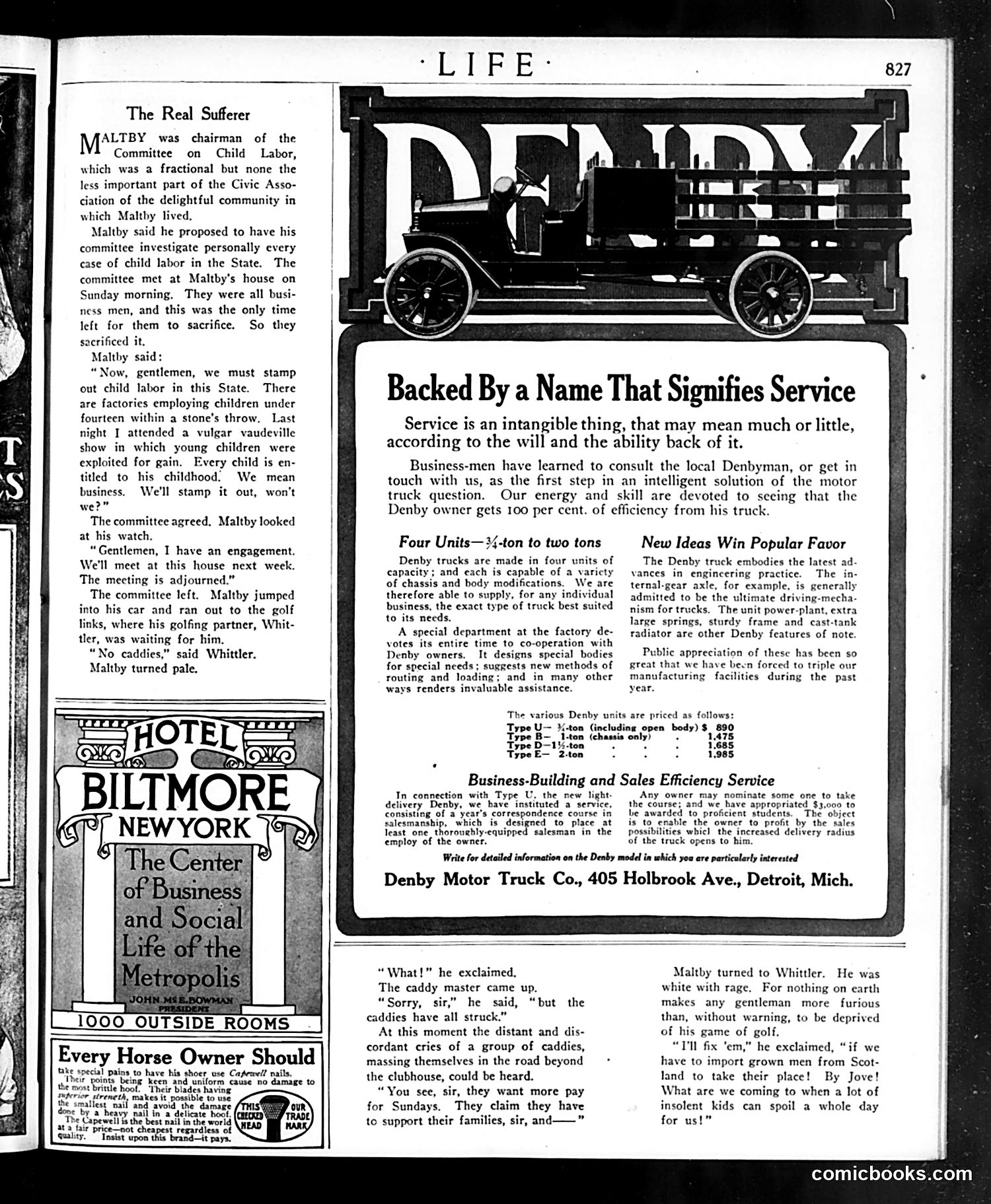
This short story satirizes the moral contradiction of progressive reformers. Maltby, chairman of a Child Labor committee, passionately denounces child labor exploitation and insists the committee investigate factories. However, the punchline reveals his actual hypocrisy: he abandons the urgent meeting to play golf—and complains when he learns there are "no caddies" available. The joke is that caddies are typically children, meaning Maltby himself directly profits from child labor while crusading against it. The satire targets not just Maltby but the broader reformist class: wealthy businessmen who champion social causes only when convenient, then ignore those same principles in their personal lives. His insistence the committee meet on Sunday morning—the only time he'll "sacrifice"—further mocks the shallow nature of his commitment. The page also contains substantial advertising for Denby Motor Trucks, which is unrelated to the satirical content.
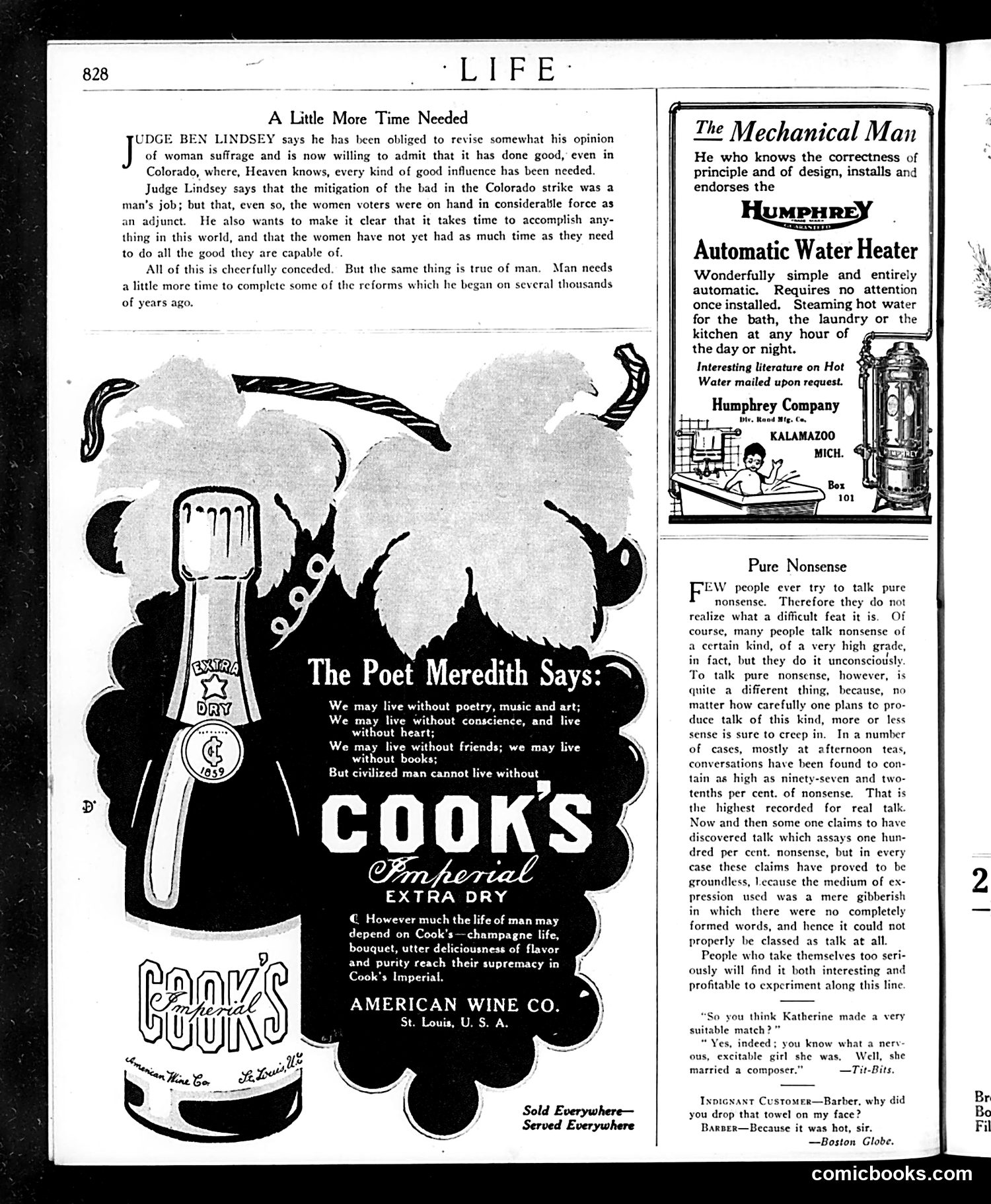
**Main Editorial Cartoon:** The page's central feature critiques women's suffrage through Judge Ben Lindsey's statement. Lindsey, a real Colorado judge, initially opposed women voting but revised his position after observing women voters' positive influence during a Colorado labor strike. The editorial sarcastically agrees men also "need a little more time" to complete reforms begun "several thousands of years ago"—implying men's glacial progress toward social improvement justifies giving women the vote now rather than waiting. **Advertisement Context:** The page is dominated by a Cook's Imperial Champagne ad featuring a Meredith quote about civilization's necessities, and smaller ads for Humphrey water heaters and humor pieces about "pure nonsense" and barber shop humor. These advertisements and filler content were typical of Life's mixed editorial-commercial format. The satire's point: women deserve voting rights immediately; men's historical record of reform doesn't warrant further delay.
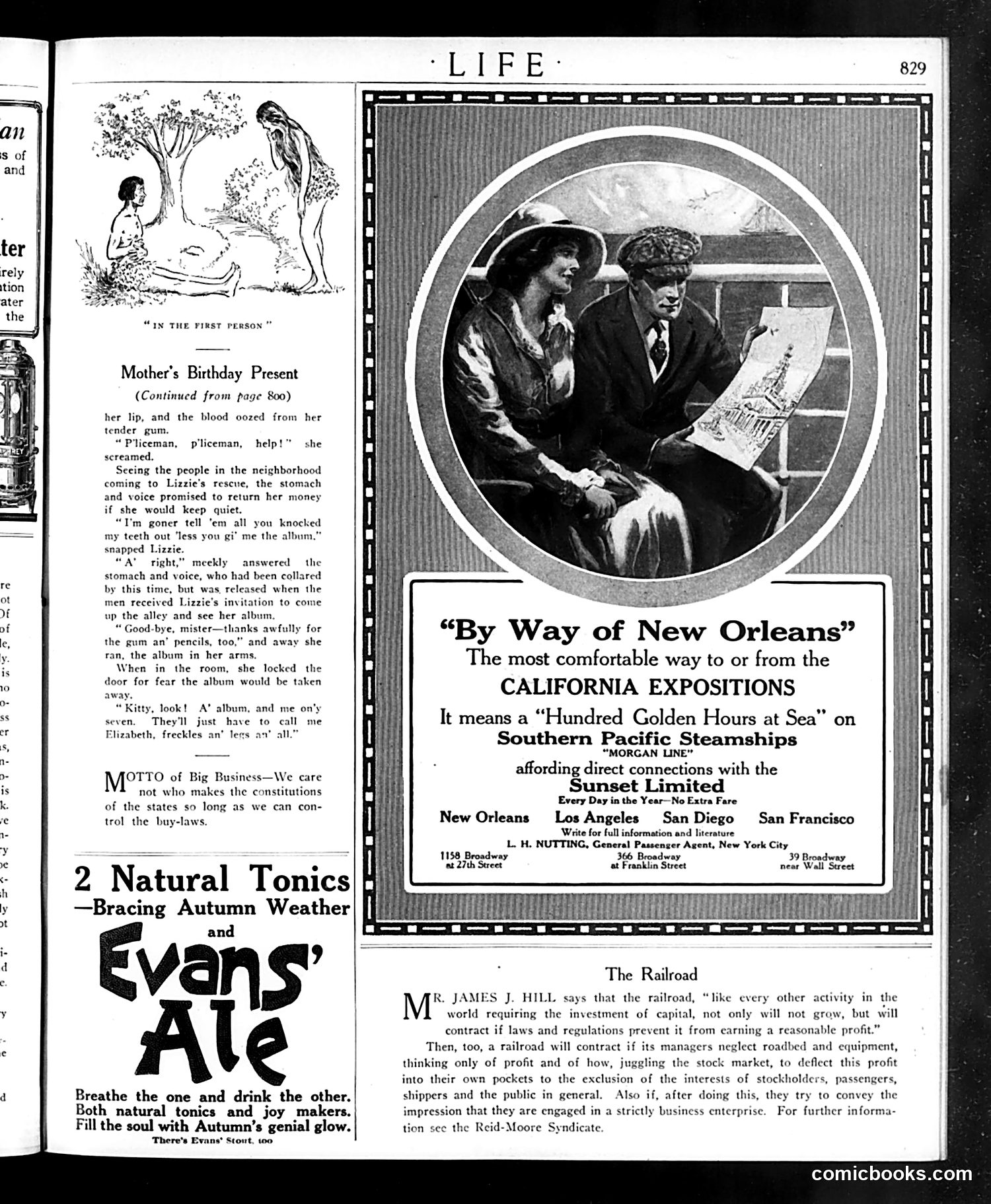
This page combines satirical commentary with period advertising. The main story, "Mother's Birthday Present," depicts a working-class girl named Lizzie being exploited—a man extracts her tooth to coerce her into showing him her album. The narrative critiques urban poverty and predatory behavior toward vulnerable children. Below, a "MOTTO of Big Business" sardonically observes that corporations don't care who writes state constitutions, only that they control local laws—a jab at corporate influence over legislation. The editorial piece on "The Railroad" quotes James J. Hill's claim that regulations prevent railroad profits, then satirically counters that mismanagement and stock-market manipulation by railroad executives—prioritizing personal enrichment over infrastructure and public welfare—are the real problems. Advertisements fill the remaining space, including Evans' Ale and California Exposition steamship travel, typical of the era's commercial content.
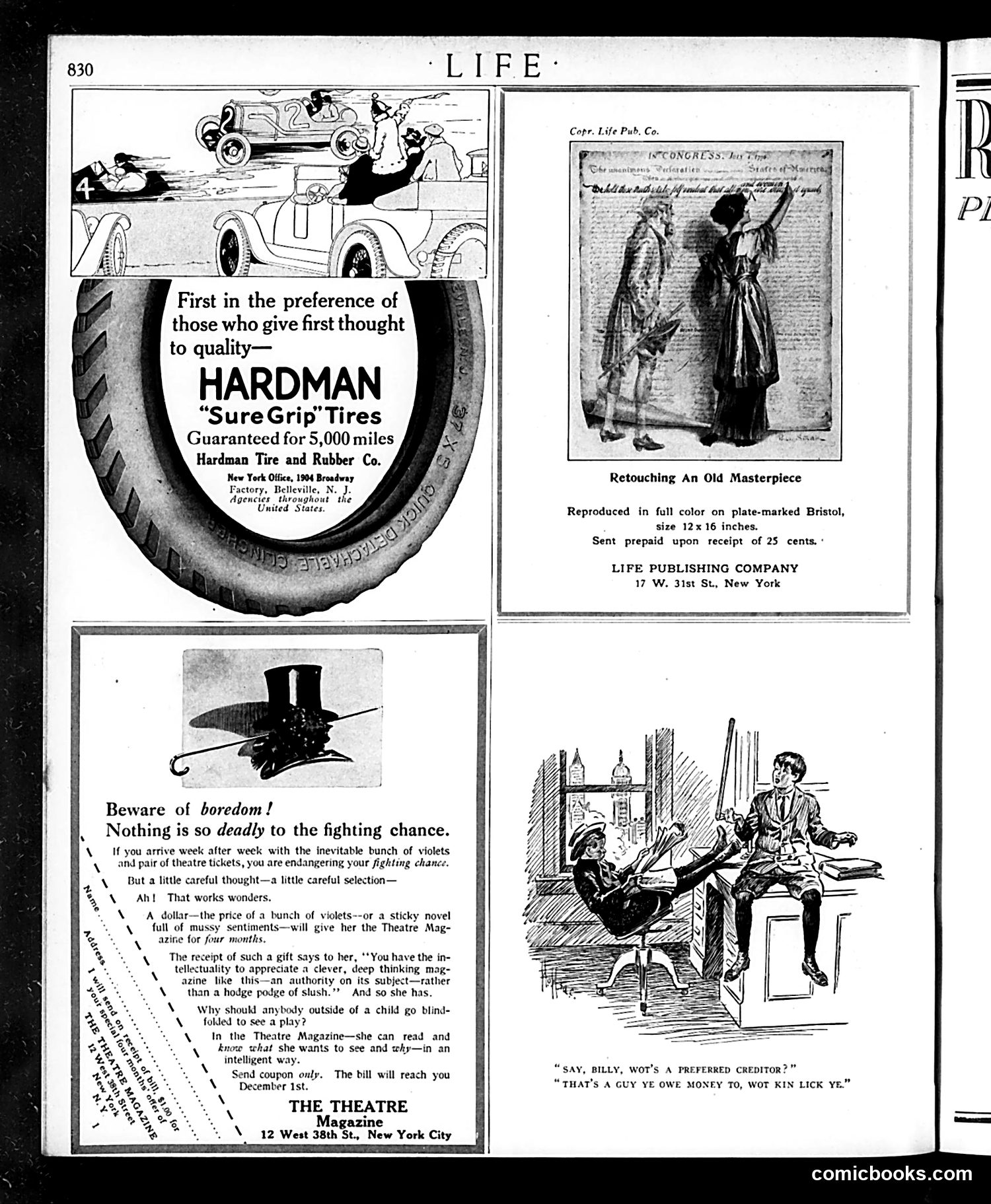
This page mixes commercial ads with satirical humor typical of *Life* magazine's format. **Upper left**: A Hardman Tires advertisement featuring early automobiles and racing imagery, emphasizing durability ("guaranteed for 5,000 miles"). **Center left**: An ad for *The Theatre Magazine* satirizes dating rituals. It warns against boring courtship tactics—merely bringing violets and theater tickets shows lack of thought. The pitch suggests that gifting a *Theatre Magazine* subscription instead demonstrates intellectual sophistication and respect for her intelligence, positioning the magazine as cultured authority rather than "hodge podge of slush." **Right side**: Two unrelated items—a reproduction service for an old painting ("Retouching An Old Masterpiece") and a cartoon depicting two working-class boys discussing financial terminology. The cartoon's humor relies on crude street-dialect definition: a "preferred creditor" is someone you owe money to who can physically intimidate you. The page reflects early 20th-century attitudes about courtship, class, and advertising.
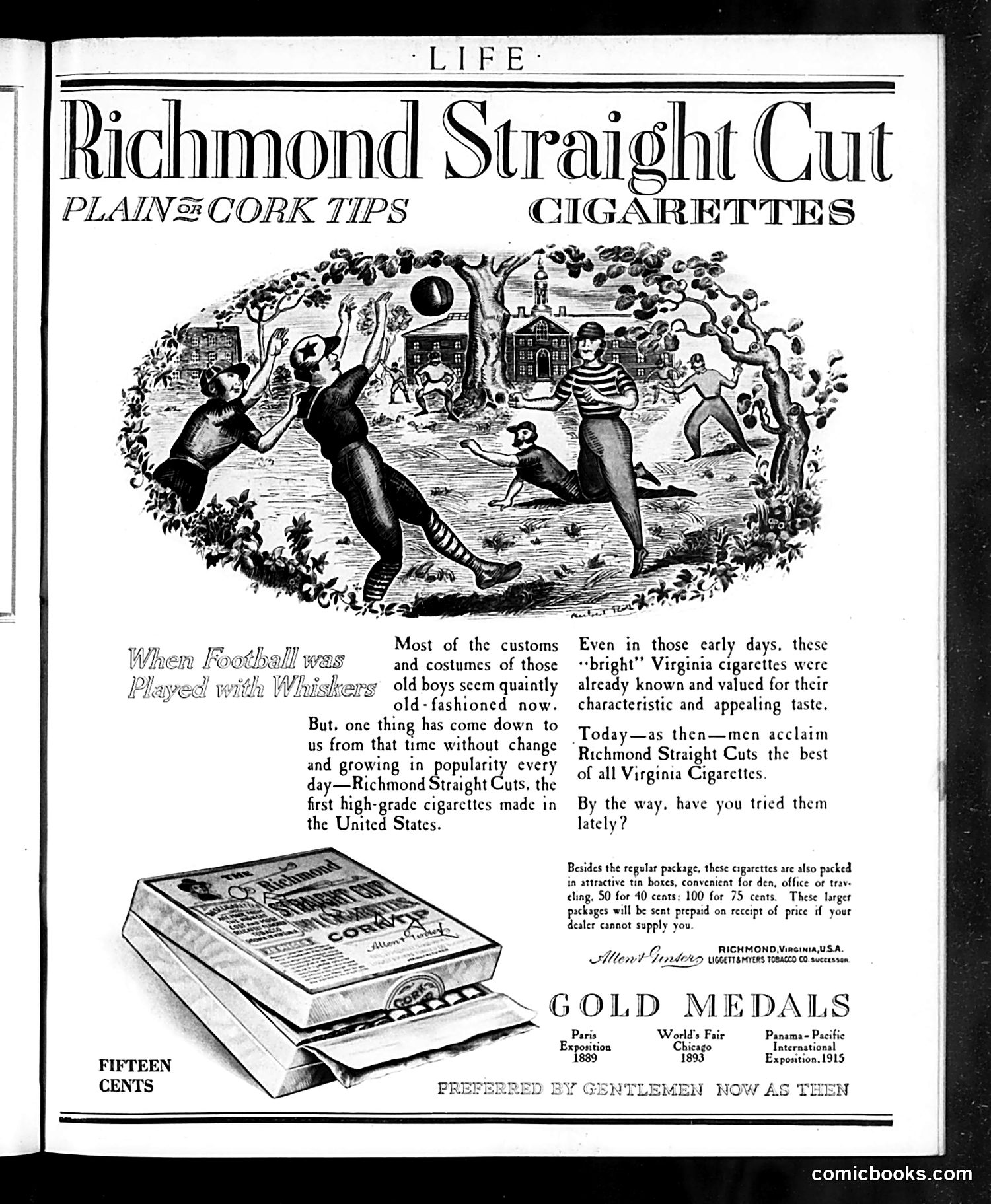
This is primarily a **cigarette advertisement**, not political satire. The page uses a historical framing device to market Richmond Straight Cut cigarettes. The illustration depicts a **colonial-era football scene** with men in period dress playing an early form of football. The advertisement's hook is nostalgic: it claims that while old customs have changed, Richmond Straight Cuts—"the first high-grade cigarettes made in the United States"—have remained popular since that era, implying continuous tradition and quality. The text emphasizes the product's "bright Virginia" tobacco and appeal to men. It lists gold medals from major expositions (Paris 1889, Chicago 1893, Panama-Pacific 1915) to establish prestige and superiority over competitors. The phrase "Preferred by Gentlemen Now as Then" connects the product to gentlemanly status across time periods. This is straightforward period advertising using historical imagery and achievement credentials—not commentary or satire.
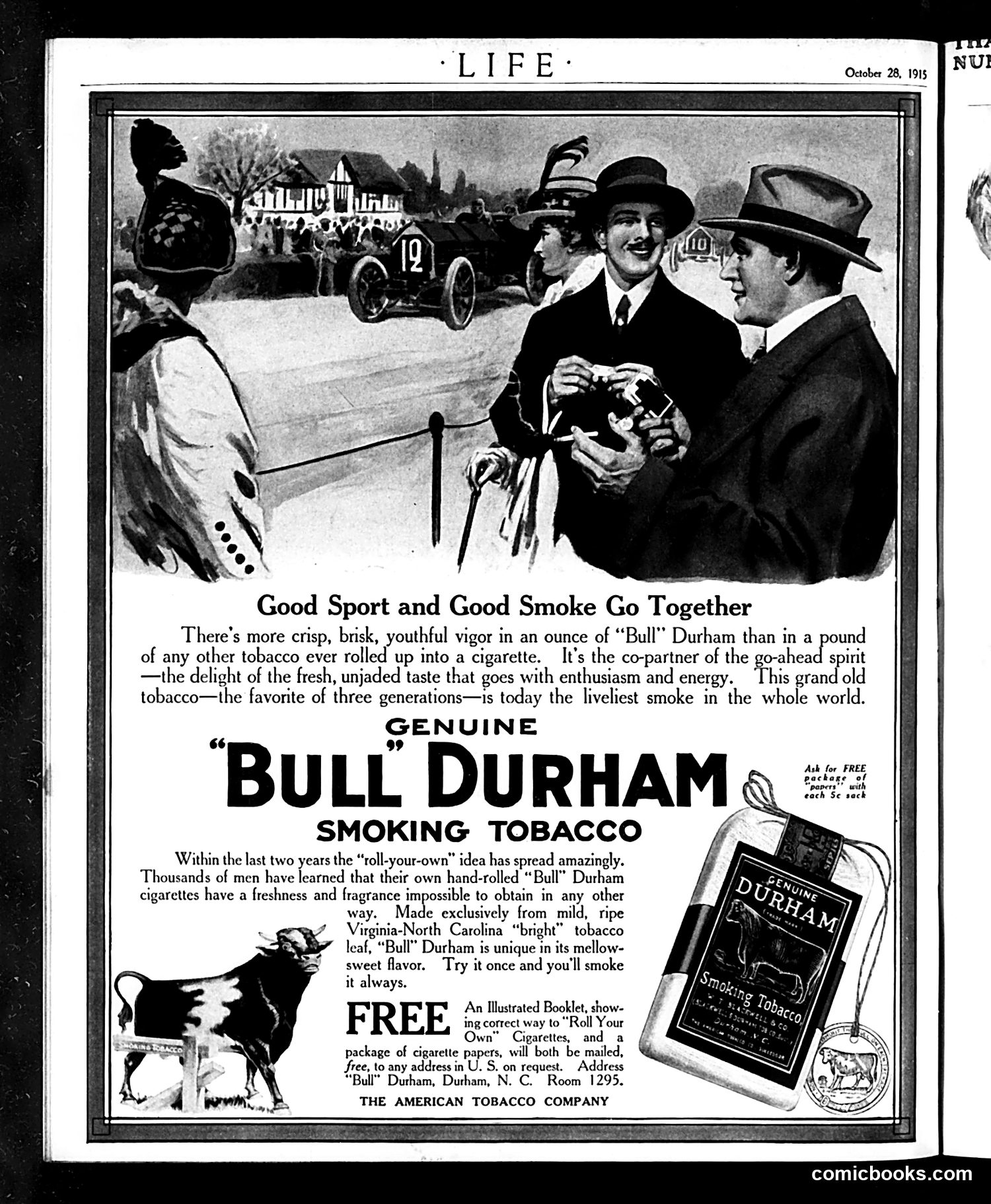
This is a **tobacco advertisement**, not satire or political commentary. It appears in *Life* magazine from October 28, 1915. The image shows well-dressed men at what appears to be a sporting event (racing cars visible in background), with the headline "Good Sport and Good Smoke Go Together." This associates Bull Durham tobacco with leisure, masculinity, and affluence. The advertisement promotes "roll-your-own" cigarettes using Bull Durham tobacco—positioning this as a novel, superior practice. The copy emphasizes freshness, quality Virginia-North Carolina tobacco, and offers a free instructional booklet on hand-rolling cigarettes. **Modern context**: This predates mass-market factory cigarettes' dominance and reflects early-20th-century marketing linking tobacco to active, healthy masculinity and good sportsmanship—claims that would later be recognized as misleading health advertising. The "free sample" offer was standard promotional practice of the era.