
Life, 1915-10-28 · page 25 of 52
Life — October 28, 1915 — page 25: what you’re looking at
What you’re looking at
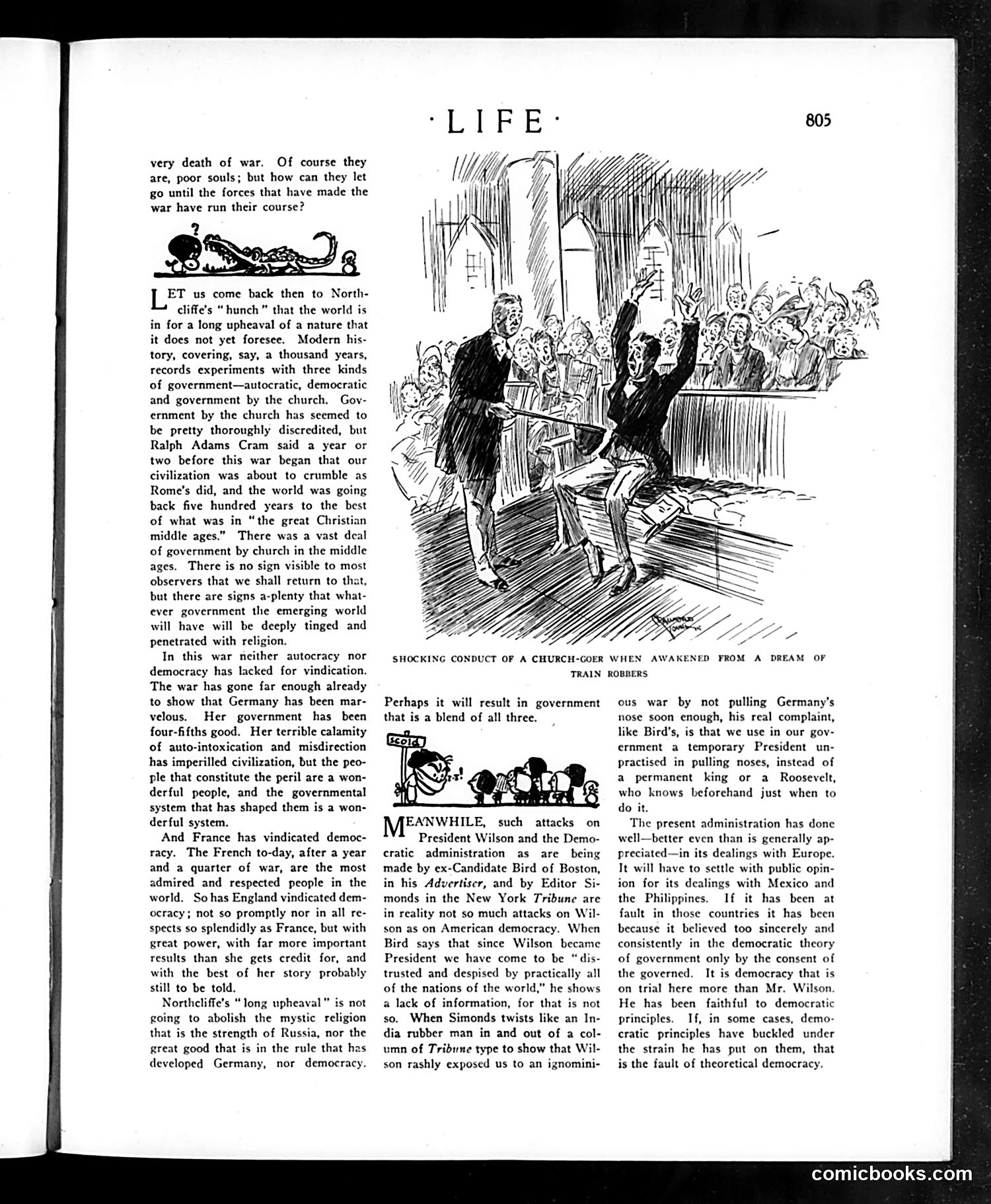
This cartoon satirizes the hypocrisy of religious people. It depicts a well-dressed church-goer who, jolted awake from dreaming about train robbers, is caught mid-violent outburst—striking or attacking someone in shock. The humor lies in the contrast: a respectable, pious churchgoer is shown behaving with shocking brutality the moment civilized restraint is removed by surprise. The accompanying essay discusses democracy versus autocracy during World War I (before U.S. entry). The cartoonist appears to use this image to illustrate the article's broader point about human nature and governance: that beneath surface respectability—whether religious or democratic—violence and base instincts lurk, requiring institutional frameworks to contain them.
📄 Transcribed text from this page (OCR, searchable)
Machine-transcribed from the original scan — historical spelling and the odd misread are preserved.
very death of war. Of course they are, poor souls; but how can they let go until the forces that have made the war have run their course? ET us come back then to North- cliffe’s “hunch” that the world is in for a long upheaval of a nature that it does not yet foresee. Modern his- tory, covering, say, a thousand years, records experiments with three kinds of government—autocratic, democratic and government by the church. Gov- ernment by the church has seemed to be pretty thoroughly discredited, but Ralph Adams Cram said a year or two before this war began that our civilization was about to crumble as Rome's did, and the world was going back five hundred years to the best of what was in “the great Christian middle ages.” There was a vast deal of government by church in the middle ages. There is no sign visible to most observers that we shall return to that, but there are signs a-plenty that what- ever government the emerging world will have will be deeply tinged and penetrated with religion. In this war neither autocracy nor democracy has lacked for vindication. The war has gone far enough already to show that Germany has been mar- velous. Her government has been four-fifths good. Her terrible calamity of auto-intoxication and misdirection has imperilled civilization, but the peo- ple that constitute the peril are a won- derful people, and the governmental system that has shaped them is a won- derful system. And France has vindicated democ- racy. The French to-day, after a year and a quarter of war, are the most admired and respected people in the world. So has England vindicated dem- ocracy; not so promptly nor in all re- spects so splendidly as France, but with great power, with far more important results than she gets credit for, and with the best of her story probably still to be told. Northcliffe’s “long upheaval” is not going to abolish the mystic religion that is the strength of Russia, nor the great good that is in the rule that has developed Germany, nor democracy. SHOCKING CONDUCT OF A CHURCH-GOER WHEN AWAKENED FROM A DREAM OF TRAIN ROBBERS Perhaps it will result in government that is a blend of all three. EANWHILE, such attacks on President Wilson and the Demo- cratic administration as are being made by ex-Candidate Bird of Boston, in his Advertiser, and by Editor Si- monds in the New York Tribune are in reality not so much attacks on Wil- son as on American democracy. When Bird says that since Wilson became President we have come to be “dis- trusted and despised by practically all of the nations of the world,” he shows a lack of information, for that is not so. When Simonds twists like an In- dia rubber man in and out of a col- umn of Tribune type to show that Wil- son rashly exposed us to an ignomini- ous war by not pulling Germany's nose soon enough, his real complaint, like Bird’s, is that we use in our gov- ernment a temporary President un- practised in pulling noses, instead of a permanent king or a Roosevelt, who knows beforehand just when to do it. The present administration has done well—better even than is generally ap- preciated—in its dealings with Europe. It will have to settle with public opin- ion for its dealings with Mexico and the Philippines. If it has been at fault in those countries it has been because it believed too sincerely and consistently in the democratic theory of government only by the consent of the governed. It is democracy that is on trial here more than Mr. Wilson. He has been faithful to democratic principles. If, in some cases, demo- cratic principles have buckled under the strain he has put on them, that is the fault of theoretical democracy. comicbooks.com