
Life, 1915-10-28 · page 24 of 52
Life — October 28, 1915 — page 24: what you’re looking at
What you’re looking at
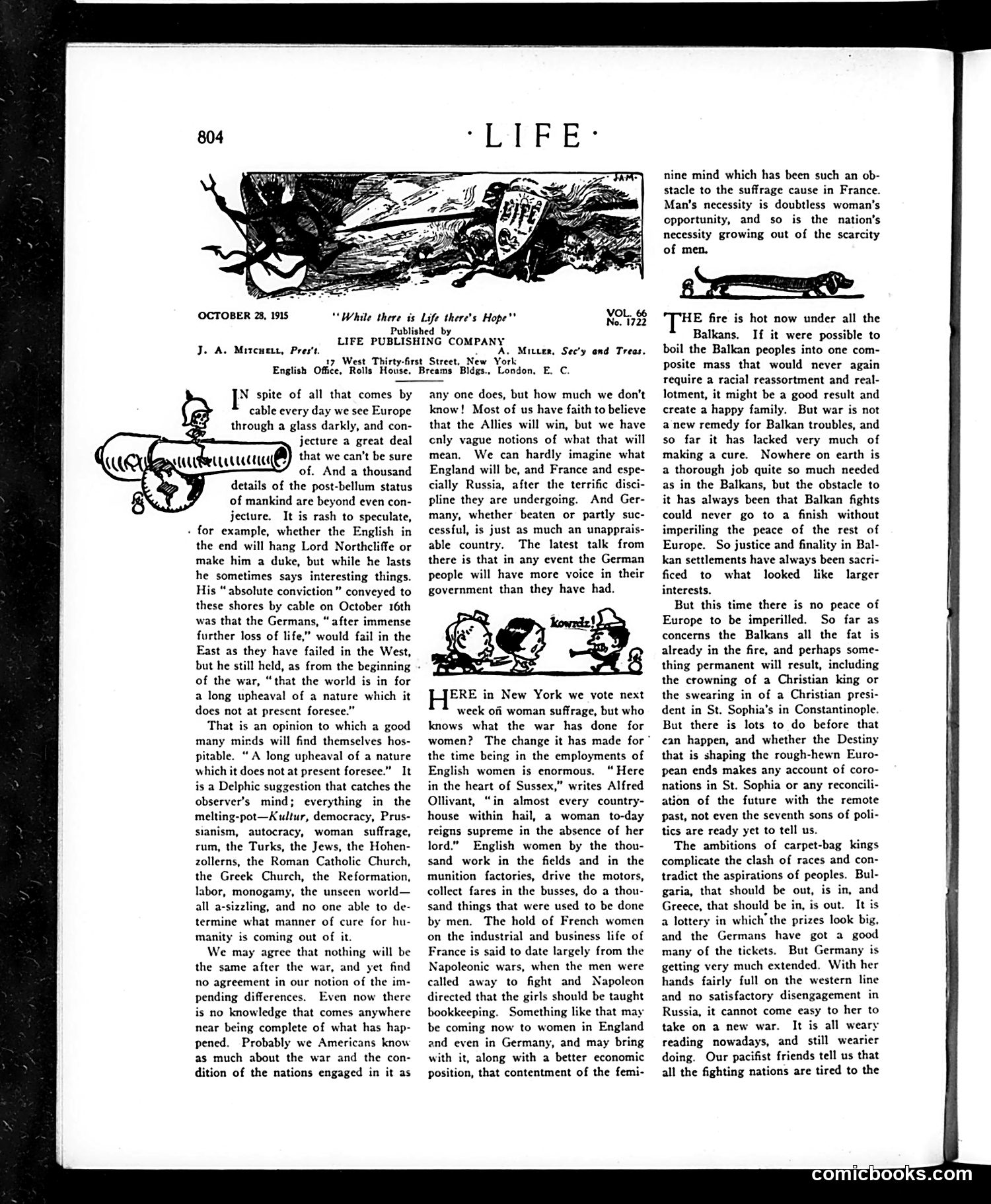
This editorial page discusses World War I's uncertain outcomes and social upheaval. The author references **Lord Northcliffe**, a British newspaper magnate, who reportedly stated Germans will fail militarily but that the war represents a transformative "upheaval of a nature which it does not at present foresee." The piece catalogs everything in flux—"Kultur, democracy, Prussianism, autocracy, woman suffrage"—suggesting radical social reorganization is inevitable but unknowable. Notably, it addresses **women's wartime employment** in England and France, observing women now work in fields, munition factories, and transport—traditionally male roles. The author suggests this economic necessity may paradoxically advance women's suffrage by demonstrating female capability and value, though he frames this somewhat cynically as "Man's necessity is doubtless woman's opportunity." The cartoon (by J.A. Mitchell) appears symbolic but is difficult to interpret precisely from the image alone.
📄 Transcribed text from this page (OCR, searchable)
Machine-transcribed from the original scan — historical spelling and the odd misread are preserved.
OCTOBER 28, 1915 “While there is Life there's Hope" Published by LIFE PUBLISHING COMPANY J. A. Mitcuent, Pres’t. t Thirty-first Street, A. Mitter, Sec’y and Treas. New York 7 West English Office, Rolla House, Breams ‘Bldgs, London, E. C. N spite of all that comes by cable every day we see Europe through a glass darkly, and con- jecture a great deal that we can’t be sure of. And a thousand details of the post-bellum status of mankind are beyond even con- jecture, It is rash to speculate, + for example, whether the English in the end will hang Lord Northcliffe or make him a duke, but while he lasts he sometimes says interesting things. His “ absolute conviction” conveyed to these shores by cable on October 16th was that the Germans, “after immense further loss of life,” would fail in the East as they have failed in the West, but he still held, as from the beginning - of the war, “that the world is in for a long upheaval of a nature which it does not at present foresee.” That is an opinion to which a good many minds will find themselves hos- pitable. “ A long upheaval of a nature which it does not at present foresee.” It is a Delphic suggestion that catches the observer’s mind; everything in the melting-pot—Kultur, democracy, Prus- sianism, autocracy, woman suffrage, rum, the Turks, the Jews, the Hohen- zollerns, the Roman Catholic Church, the Greek Church, the Reformation, labor, monogamy, the unseen world— all a-sizzling, and no one able to de- termine what manner of cure for hu- manity is coming out of it. We may agree that nothing will be the same after the war, and yet find no agreement in our notion of the im- pending differences. Even now there is no knowledge that comes anywhere near being complete of what has hap- pened. Probably we Americans know as much about the war and the con- dition of the nations engaged in it as any one does, but how much we don't know! Most of us have faith to believe that the Allies will win, but we have enly vague notions of what that will mean. We can hardly imagine what England will be, and France and espe- cially Russia, after the terrific disci- pline they are undergoing. And Ger- many, whether beaten or partly suc- cessful, is just as much an unapprais- able country. The latest talk from there is that in any event the German people will have more voice in their government than they have had. ERE in New York we vote next week off woman suffrage, but who knows what the war has done for women? the time being in the employments of English women is enormous. “Here in the heart of Sussex,” writes Alfred Ollivant, in almost every country- house within hail, a woman to-day reigns supreme in the absence of her lord.” English women by the thou- sand work in the fields and in the munition factories, drive the motors, collect fares in the busses, do a thou- sand things that were used to be done by men. The hold of French women on the industrial and business life of France is said to date largely from the Napoleonic wars, when the men were called away to fight and Napoleon directed that the girls should be taught bookkeeping. Something like that may be coming now to women in England and even in Germany, and may bring with it, along with a better economic position, that contentment of the femi- The change it has made for * nine mind which has been such an ob- stacle to the suffrage cause in France. Man's necessity is doubtless woman's opportunity, and so is the nation’s necessity growing out of the scarcity of men. Pr a al E fire is hot now under all the Balkans. If it were possible to boil the Balkan peoples into one com- posite mass that would never again require a racial reassortment and real- lotment, it might be a good result and create a happy family. But war is not anew remedy for Balkan troubles, and so far it has lacked very much of making a cure. Nowhere on earth is a thorough job quite so much needed as in the Balkans, but the obstacle to it has always been that Balkan fights could never go to a finish without imperiling the peace of the rest of Europe. So justice and finality in Bal- kan settlements have always been sacri- ficed to what looked like larger interests. But this time there is no peace of Europe to be imperilled. So far as concerns the Balkans all the fat is already in the fire, and perhaps some- thing permanent will result, including the crowning of a Christian king or the swearing in of a Christian presi- dent in St. Sophia's in Constantinople. But there is lots to do before that can happen, and whether the Destiny that is shaping the rough-hewn Euro- pean ends makes any account of coro- nations in St. Sophia or any reconcili- ation of the future with the remote Past, not even the seventh sons of poli- tics are ready yet to tell us. The ambitions of carpet-bag kings complicate the clash of races and con- tradict the aspirations of peoples. Bul- garia, that should be out, is in, and Greece, that should be in, is out. It is a lottery in which’ the prizes look big, and the Germans have got a good many of the tickets. But Germany is getting very much extended. With her hands fairly full on the western line and no satisfactory disengagement in Russia, it cannot come easy to her to take on a new war. It is all weary reading nowadays, and still wearier doing. Our pacifist friends tell us that all the fighting nations are tired to the comicbooks.com