
Life, 1915-10-28 · page 12 of 52
Life — October 28, 1915 — page 12: what you’re looking at
What you’re looking at
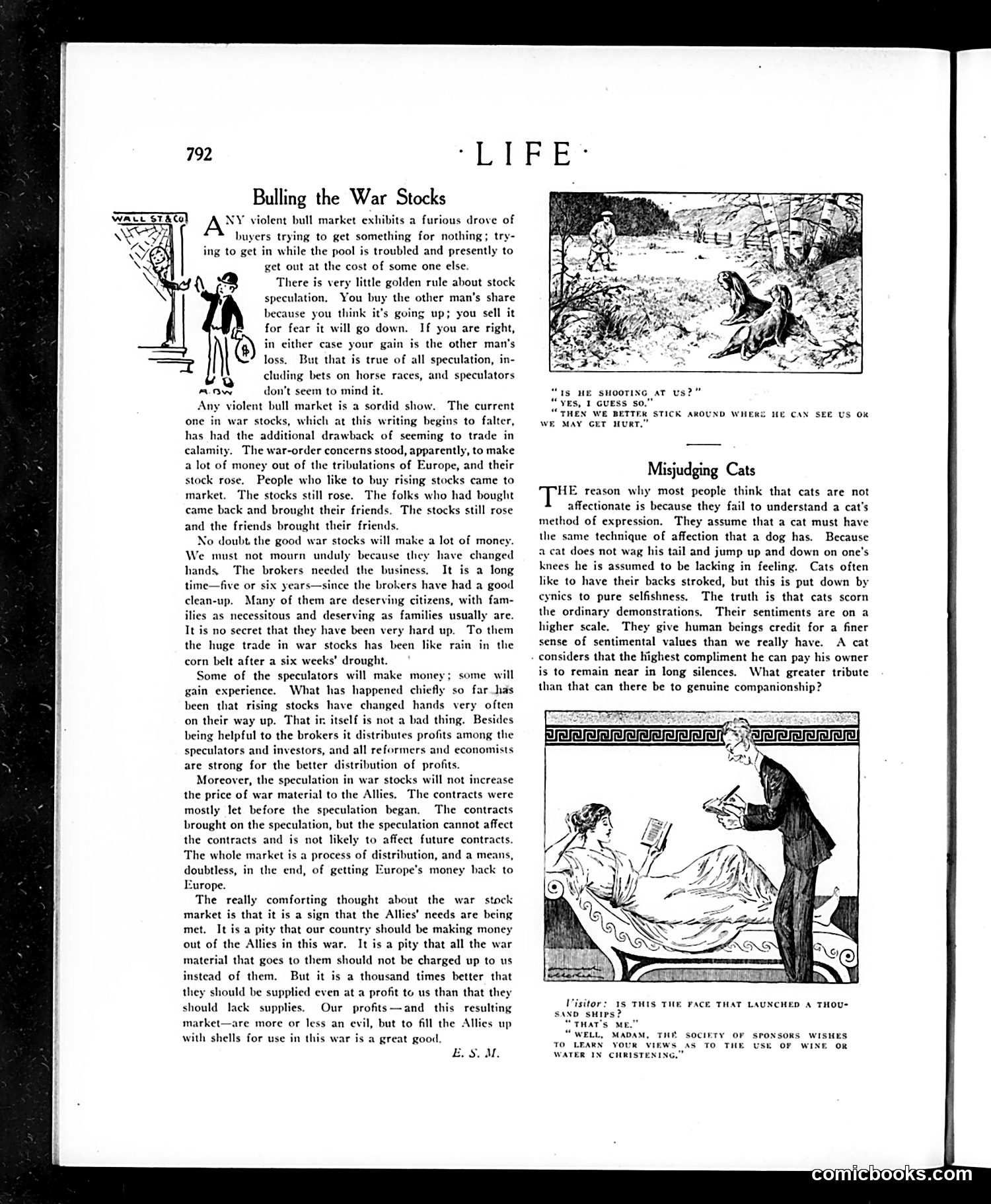
**"Bulling the War Stocks"** (Left column): This article critiques stock market speculation during wartime. The accompanying Wall Street illustration shows a figure promoting rising war-related stocks. The piece argues that while some speculators will profit, the real benefit should accrue to the Allies through cheaper war materials rather than enriching American middlemen. The author (E.S.M.) suggests wartime profiteering is morally questionable, though inevitable. **"Misjudging Cats"** (Right column): A humorous essay explaining that cats show affection differently than dogs—they prefer silence and back-stroking over tail-wagging enthusiasm. The accompanying classical-style cartoon depicts a visitor being judged by a cat, satirizing humans' misinterpretation of feline behavior as coldness when it actually represents refined sentiment. Both pieces use light satire to comment on human misunderstandings—of profit motives and animal nature.
📄 Transcribed text from this page (OCR, searchable)
Machine-transcribed from the original scan — historical spelling and the odd misread are preserved.
WALL STAC) 792 Bulling the War Stocks VY violent bull market exhibits a furious drove of buyers trying to get something for nothing; try- ing to get in while the pool is troubled and presently to get out at the cost of some one else. There is very little golden rule about stock speculation, You buy the other man’s share because you think it’s going up; you sell it for fear it will go down. If you are right, in either case your gain is the other man’s loss, But that is true of all speculation, in- cluding bets on horse races, and speculators don’t seem to mind it. Any violent bull market is a sordid show. The current one in war stocks, which at this writing begins to falter, has had the additional drawback of seeming to trade in calamity. The war-order concerns stood, apparently, to make a lot of money out of the tribulations of Europe, and their stock rose, People who like to buy rising stocks came to market. The stocks still rose. The folks who had bought came back and brought their friends. The stocks still rose and the friends brought their friend No doubt the good war stocks will make a lot of money. We must not mourn unduly because they have changed hands The brokers needed the busine: It is a long time—five or six years—since the brokers have had a good clean-up. Many of them are deserving citizens, with fam- ilies as necessitous and deserving as families usually are. It is no secret that they have been very hard up. To them the huge trade in war stocks has been like r: in the corn belt after a six weeks’ drought. Some of the speculators will make money; some will gain experience. What has happened chiefly so far has been that rising stocks have changed hands very often on their way up. That self is not a bad thing. Besides. being helpful to the brokers it distributes profits among the speculators and investors, and all reformers and economists are strong for the better distribution of profits. Moreover, the speculation in war stocks will not increase the price of war material to the Allies. The contracts were mostly let before the speculation began. The contracts brought on the speculation, but the speculation cannot affect the contracts and is not likely to affect future contracts. The whole market is a process of distribution, and a means, doubtless, in the end, of getting Europe's money back to Europe. The really comforting thought about the war stock market is that it is a sign that the Allies’ needs are being met. It is a pity that our country should be making money out of the Allies in this war. It is a pity that all the war material that goes to them should not be charged up to us instead of them. But it is a thousand times better that they should be supplied even at a profit to us than that they should lack supplies. Our profits—and this resulting market—are more or less an evil, but to fill the Allies up with shells for use in this war is a great good, ELS. M. ES, I GU! “THEN WE BETTER STICK AROUND WHERE ME CAN SEE US Ok WE MAY GET HURT.” Misjudging Cats HE reason why most people think that cats are not affectionate is because they fail to understand a cat's method of expression. They assume that a cat must have the same technique of affection that a dog has. Because a cat does not wag his tail and jump up and down on one's knees he is assumed to be lacking in feeling. Cats often like to have their backs stroked, but this is put down by cynics to pure selfishness. The truth is that cats scorn the ordinary demonstrations, Their sentiments are on a higher scale, They give human beings credit for a finer sense of sentimental values than we really have. A cat considers that the highest compliment he can pay his owner is to remain near in long silences. What greater tribute than that can there be to genuine companionship? Visitor: 18 THIS THE PACE THAT LAUNCHED A THOU- SAND SHIP: “THAT's ME.” “WELL, MADAM, THM SOCIETY OF SPONSORS WISHES TO LEARN YOUR VIEWS AS TO THE USE OP WINE OR WATER IN CHRISTENING,