
Life, 1915-10-28 · page 4 of 52
Life — October 28, 1915 — page 4: what you’re looking at
What you’re looking at
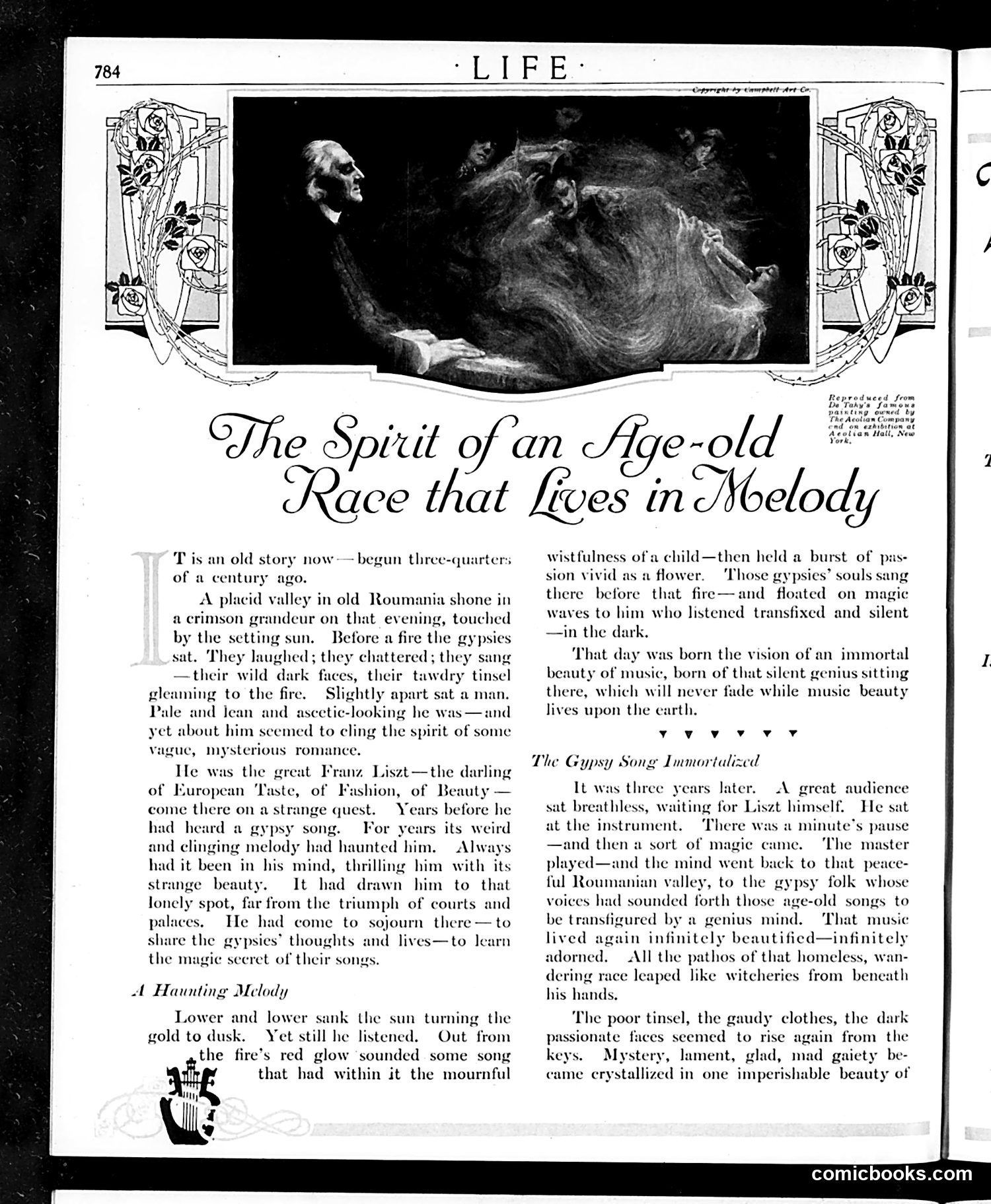
This page is **not a political cartoon** but rather a **literary or cultural article** titled "The Spirit of an Age-old Race that Lives in Melody." The article tells a romanticized story about **Franz Liszt**, the famous 19th-century Hungarian composer and pianist, encountering Romani (gypsy) musicians in Romania. The narrative describes how Liszt heard their traditional songs and was inspired to create his own compositions based on their music. The accompanying photograph shows what appears to be Liszt at a piano. The article celebrates the artistic exchange between Liszt and Romani folk culture, presenting their music as an "age-old" spiritual tradition. This reflects early 20th-century attitudes that exoticized non-Western and marginalized peoples as repositories of authentic artistic inspiration.
📄 Transcribed text from this page (OCR, searchable)
Machine-transcribed from the original scan — historical spelling and the odd misread are preserved.
ocaperrent ty tmnt Art Co She. Spirit of an Aige-old Jeace that -begun three-quarters T is an old story now of a century ago. A placid valley in old Roumania shone in acrimson grandeur on that evening, touched by the setting sun. Before a fire the gypsies sat. They laughed; they chattered; they sang —their wild dark faces, their tawdry tinsel gleaming to the fire. Slightly apart sat a man. Pale and Jean and ascetic-looking he was —and yet about him seemed to cling the spirit of some vague, mysterious romance. Ile was the great Franz Liszt—the darling of European ‘Taste, of hion, of Beauty — come there on a strange quest. Years before he had heard a gypsy song. For years its weird and clinging melody had haunted him, Always had it been in his mind, thrilling him with its strange beauty. It had drawn him to that lonely spot, far from the triumph of courts and palaces. Tle had come to sojourn there — to share the gypsies’ thoughts and lives—to learn the magic secret of their songs. «lf Haunting Melody Lower and lower sank the sun turning the gold to dusk. Yet still he listened. Out from the fire’s red glow sounded some song ad that had within it the mournful ih (ves in Sbelody wistfulness ofa child—then held a burst of pas- sion vivid as a flower. ‘Those gypsies’ souls sang there before that fire—and floated on magic waves to him who listened transfixed and silent —in the dark. That day was born the vision of an immortal beauty of music, born of that silent genius sitting there, which will never fade while music beauty lives upon the earth. yvwvvvy The Gypsy Song Immortalized It was three years later. sat breathless, waiting for Liszt himself. He sat at the instrument. ‘There was a minute’s pause —and then a sort of magic came. ‘The master played—and the mind went back to that peace- ful Roumanian valley, to the gypsy folk whose voices had sounded forth those age-old songs to be transfigured by a genius mind. That music lived again infinitely beautified—infinitely adorned. All the pathos of that homeless, wan- dering race leaped like witcheries from beneath his hands. A great audience The poor tinsel, the gaudy clothes, the dark ionate faces seemed to rise again from the y , lament, glad, mad gaiety be- came crystallized in one imperishable beauty of comicbooks.com