
Life, 1915-10-28 · page 30 of 52
Life — October 28, 1915 — page 30: what you’re looking at
What you’re looking at
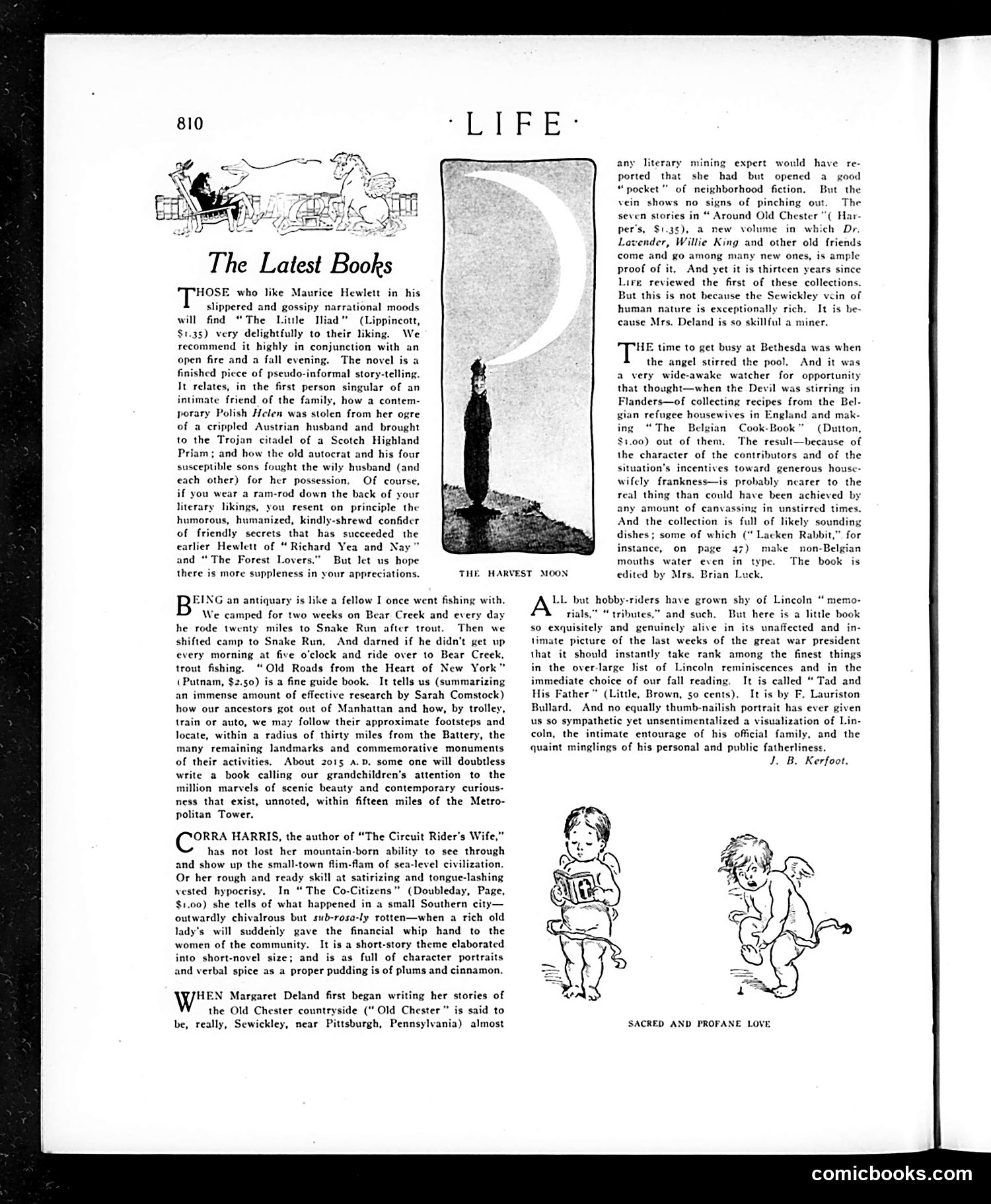
This is a book review section from Life magazine (a satirical literary publication, not the photo magazine). The page discusses contemporary fiction and includes illustrations. The text reviews several novels: Maurice Hewlett's "The Little Iliad" (a romantic drama about a Polish Helen figure stolen from an Austrian husband), a guide to historic sites near New York, Corra Harris's "The Co-Citizens" (satirizing Southern hypocrisy when a wealthy widow's will shifts power to town women), and Margaret Deland's "Around Old Chester" stories (set in a fictionalized Pennsylvania town). **The cartoons** at bottom right labeled "Sacred and Profane Love" appear to show cherubs or putti—classical religious imagery—illustrating contrasting types of love, likely commenting on themes in the reviewed literature. The satirical tone mocks literary pretension while championing readable fiction that reveals human character and small-town social dynamics.
📄 Transcribed text from this page (OCR, searchable)
Machine-transcribed from the original scan — historical spelling and the odd misread are preserved.
The Latest Books HOSE who like Maurice Hewlett in his slippered and gossipy narrational moods will find “The Lite Miad"” (Lippincott, $1.35) very delightfully to their liking. We recommend it highly in conjunction with an open fire and a fall evening. The novel is a finished picce of pseudo-informal story-telling. It relates, in the first person singular of an intimate friend of the family, how a contem- porary Polish Helen was stolen from her ogre of a crippled Austrian husband and brought to the Trojan citadel of a Scotch Highland Priam; and how the old autocrat and his four susceptible sons fought the wily husband (and each other) for her possession, Of course, if you wear a ram-rod down the back of your literary likings, you resent on principle the humorous, humanized, kindly-shrewd confider of friendly secrets that has succeeded th earlier Hewlett of “Richard Yea and Nay and “The Forest Lovers.” But let us hope there is more suppleness in your appreciations. THE HARVEST MOON NG an antiquary is like a fellow I once went fishing with. We camped for two weeks on Bear Creek and every day he rode twenty miles to Snake Run after trout. Then we shifted camp to Snake Run, And darned if he didn’t get up every morning at five o'clock and ride over to Bear Creek, trout fishing. “Old Roads from the Heart of New York” (Putnam, $2.50) is a fine guide book. It tells us (summarizing an immense amount of effective research by Sarah Comstock) how our ancestors got out of Manhattan and how, by trolley, train or auto, we may follow their approximate footsteps and locate, within a radius of thirty miles from the Battery, the many remaining landmarks and commemorative monuments of their activities. About 2015 a.p. some one will doubtless write a book calling our grandchildren’s attention to the million marvels of scenic beauty and contemporary curious- ness that exist, unnoted, within fifteen miles of the Metro- politan Tower. ORRA HARRIS, the author of “The Circuit Rider's Wife,” has not lost her mountain-born ability to see through and show up the small-town flim-flam of sea-level civilization. Or her rough and ready skill at satirizing and tongue-lashing vested hypocrisy. In “The Co-Citizens” (Doubleday, Page, $1.00) she tells of what happened in a small Southern city— outwardly chivalrous but sub-rosa-ly rotten—when a rich old lady’s will suddenly gave the financial whip hand to the women of the community. It is a short-story theme elaborated into short-novel size; and is as full of character portraits and verbal spice as a proper pudding is of plums and cinnamon. Wwe Margaret Deland first began writing her stories of the Old Chester countryside (‘Old Chester” is said to be, really, Sewickley, near Pittsburgh, Pennsylvania) almost any literary mining expert would have re- ported that she had but opened a good “pocket of neighborhood fiction, But the vein shows no signs of pinching out. The seven stories in “ Around Old Chester "( Har pers, $1.35), a new volume in which Dr. Lavender, Willie King and other old friends come and go among many new ones, is amp! proof of it. And yet it is thirteen years since Lire reviewed the first of these collections. But this is not because the Sewickley vcin of human nature is exceptionally rich. It is be- cause Mrs. Deland is so skillful a miner. T! time to get busy at Bethesda was when the angel stirred the pool. And it was a very wide-awake watcher for opportunity that thought—when the Devil was stirring Flanders—of collecting recipes from the Bel- gian refugee housewives in England and mak ing “The Belgian Cook-Book” (Dutton, $1.00) out of them. The result—because of the character of the contributors and of the situation’s incentives toward generous house- wifcly frankness—is probably nearer to the real thing than could have been achieved by any amount of canvassing in unstirred times. And the collection is full of likely sounding some of which (“Lacken Rabbit,” for on page 47) make non-Belgian mouths water even in type. The book is edited by Mrs, Brian 1 A but hobby-riders have grown shy of Lincoln “ memo- rials,” and such. But here is a little book so exquisitely and genuinely alive in its unaffected and in- timate picture of the last weeks of the great war president that it should instantly take rank among the finest things in the over-large list of Lincoln reminiscences and in the immediate choice of our fall reading. It is called “ Tad and His Father” (Little, Brown, so cents). It is by F. Lauriston Bullard. And no equally thumb-nailish portrait has ever given us so sympathetic yet unsentimentalized a visualization of Lin- coln, the intimate entourage of his official family, and the quaint minglings of his personal and public father! tributes,” SACRED AND PROFANE LOVE comicbooks.com