
Life, 1915-10-28 · page 15 of 52
Life — October 28, 1915 — page 15: what you’re looking at
What you’re looking at
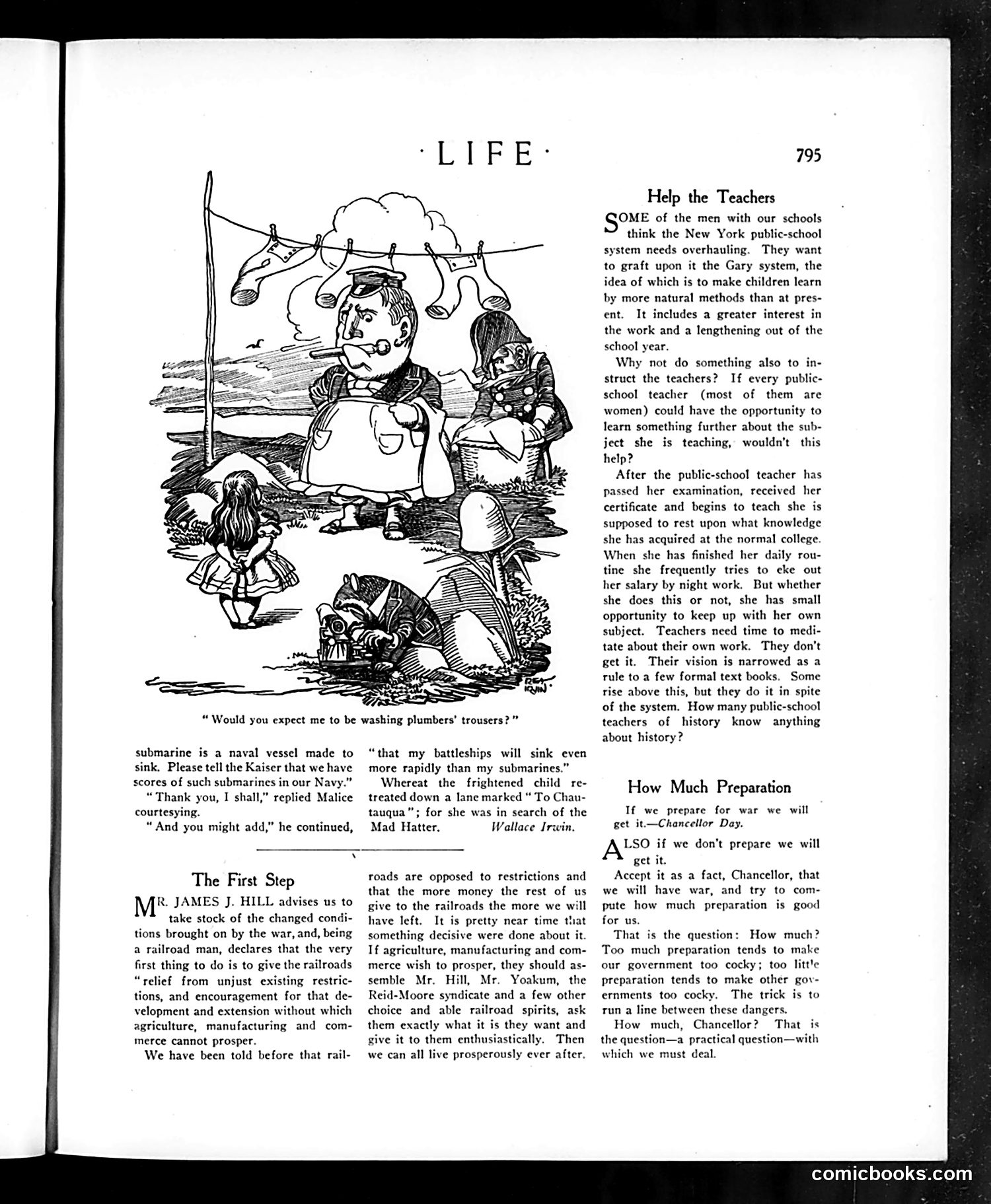
**The Main Cartoon** depicts a woman (likely representing a teacher) surrounded by children, with the caption "Would you expect me to be washing plumbers' trousers?" The illustration satirizes public-school teachers' low status and poor compensation. **The Satire's Point:** The adjacent article "Help the Teachers" argues that educators—mostly women—deserve better training and higher pay. The cartoon's absurd question highlights the irony: society expects teachers to educate children but compensates them so poorly they might as well do manual labor like washing clothes. **Historical Context:** This reflects early-20th-century concerns about teacher professionalization and gender-based wage discrimination in American education. **Other Content:** The page includes articles on railroad policy and military preparedness, typical of Life's mix of social commentary and politics.
📄 Transcribed text from this page (OCR, searchable)
Machine-transcribed from the original scan — historical spelling and the odd misread are preserved.
“Would you expect me to be washing plumbers’ trousers?” submarine is a naval vessel made to sink, Please tell the Kaiser that we have scores of such submarines in our Navy.” “Thank you, I shall,” replied Malice courtesying. “And you might add,” he continued, “that my battleships will sink even more rapidly than my submarines.” Whereat the frightened child re- treated down a lane marked “ To Chau- tauqua”; for she was in search of the Mad Hatter, Wallace Irwin. v The First Step M* JAMES J. HILL advises us to take stock of the changed condi- tions brought on by the war, and, being a railroad man, declares that the very first thing to do is to give the railroads “relief from unjust existing restric- tions, and encouragement for that de- velopment and extension without which agriculture, manufacturing and com- merce cannot prosper. We have been told before that rail- roads are opposed to restrictions and that the more money the rest of us give to the railroads the more we will have left. It is pretty near time that something decisive were done about it. If agriculture, manufacturing and com- merce wish to prosper, they should as- semble Mr. Hill, Mr. Yoakum, the Reid-Moore syndicate and a few other choice and able railroad spirits, ask them exactly what it is they want and give it to them enthusiastically. Then we can all live prosperously ever after. 795 Help the Teachers OME of the men with our schools think the New York public-school system needs overhauling. They want to graft upon it the Gary system, the idea of which is to make children learn by more natural methods than at pres- ent. It includes a greater interest in the work and a lengthening out of the school year. Why not do something also to in- struct the teachers? If every public- school teacher (most of them are women) could have the opportunity to learn something further about the sub- ject she is teaching, wouldn't this help? After the public-school teacher has passed her examination, received her certificate and begins to teach she is supposed to rest upon what knowledge she has acquired at the normal college. When she has finished her daily rou- tine she frequently tries to eke out her salary by night work. But whether she does this or not, she has small opportunity to keep up with her own subject. Teachers need time to medi- tate about their own work. They don’t get it. Their vision is narrowed as a rule to a few formal text books. Some rise above this, but they do it in spite of the system. How many public-school teachers of history know anything about history? How Much Preparation If we prepare for war we will get it—Chancellor Day. A? if we don’t prepare we will get it. Accept it as a fact, Chancellor, that we will have war, and try to com- pute how much preparation is good for us. That is the question: How much? Too much preparation tends to make our government too cocky; too little preparation tends to make other gov- ernments too cocky. The trick is to tun a line between these dangers. How much, Chancellor? That is the question—a practical question—with which we must deal. comicbooks.com