
A complete issue · 52 pages · 1915
Life — October 21, 1915
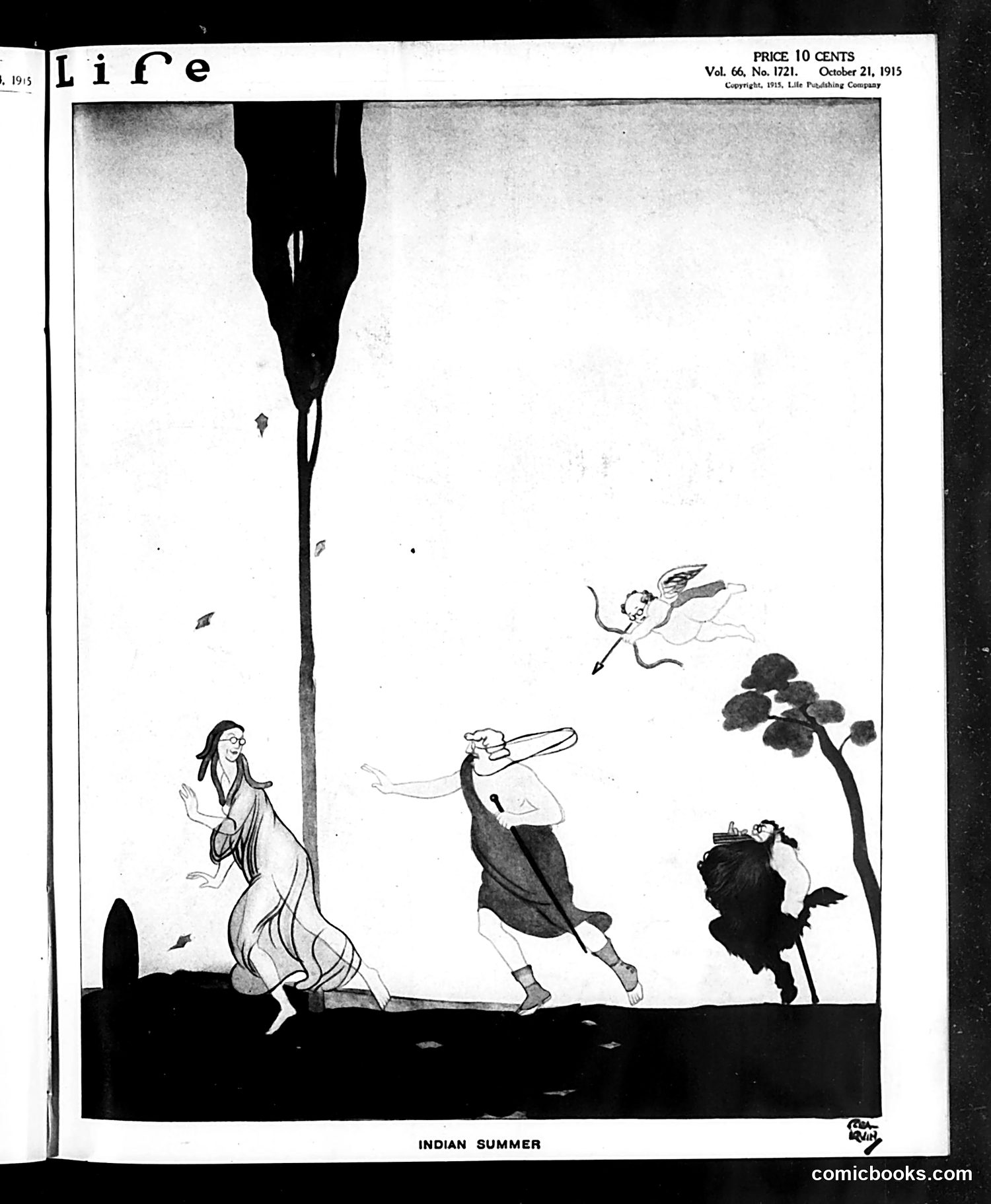
This cartoon satirizes the concept of "Indian Summer"—the warm spell occurring in autumn. The title plays on this meteorological term literally, depicting Native Americans experiencing unexpected summer heat. The illustration shows figures in distress from intense sun: a woman shielding herself, a man swinging at the heat as if it were a tangible threat, another figure near a wilted plant, and an angel or cupid above (likely representing summer itself). The exaggerated poses convey comedic panic about the weather phenomenon. The humor relies on a pun—"Indian Summer" as both weather terminology and a literal depiction of Native Americans dealing with summer conditions. This reflects early 20th-century attitudes toward Native Americans as subjects of casual ridicule in mainstream American media.
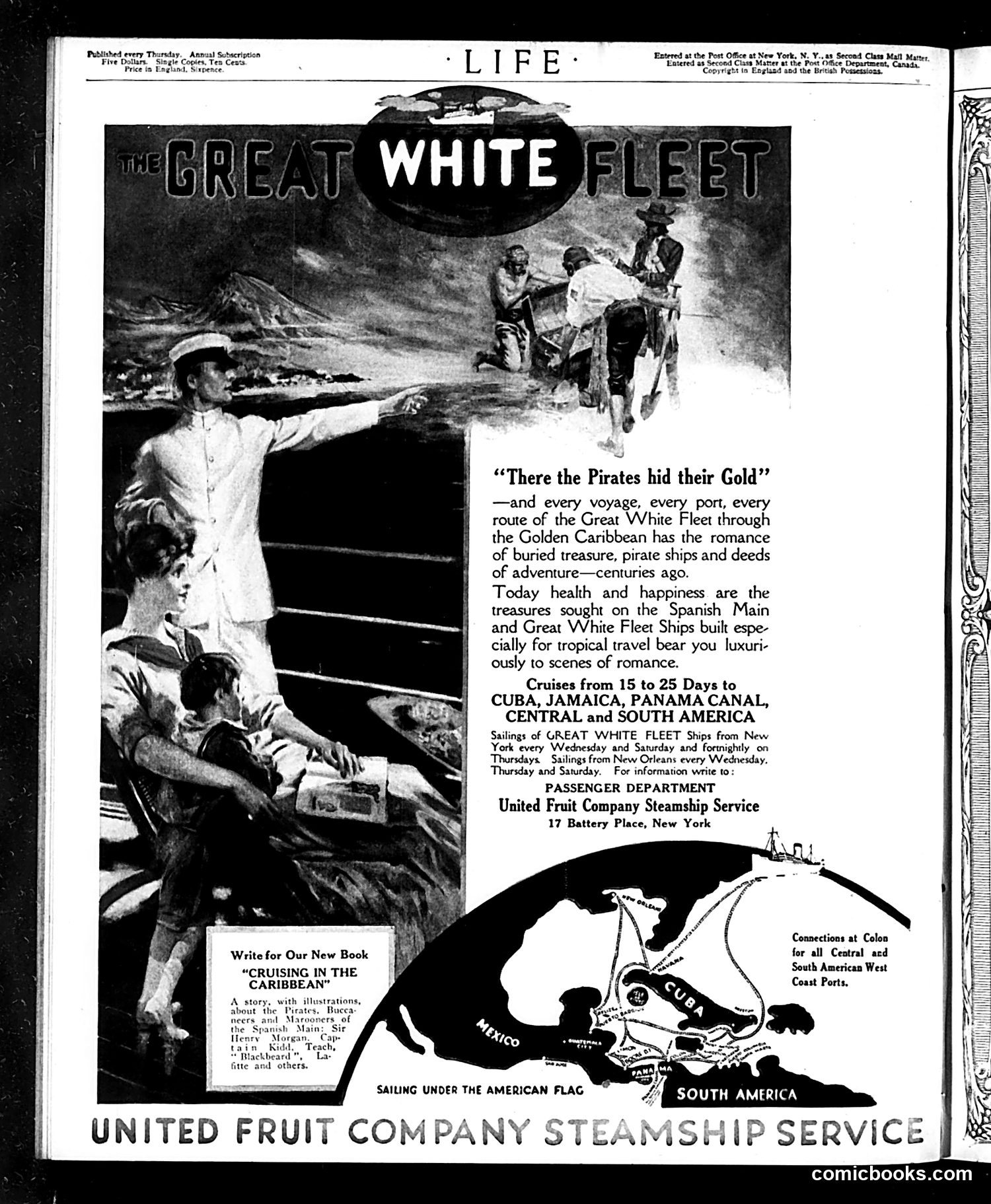
This page is primarily **advertising, not satire or political commentary**. It promotes the Great White Fleet cruise service operated by the United Fruit Company Steamship Service from New York. The advertisement uses romantic imagery of Caribbean piracy and adventure—showing figures examining maps and treasure—to appeal to leisure travelers seeking exotic vacations. The headline "There the Pirates hid their Gold" evokes historical adventure while marketing modern cruises to Cuba, Jamaica, Panama Canal, and South America. The "pirate" figures are not caricatures of real people but generic romantic archetypes designed to sell tropical travel experiences. The accompanying map shows cruise routes from New York and New Orleans. This represents early 20th-century travel marketing that capitalized on colonial-era adventure narratives to attract affluent American tourists.
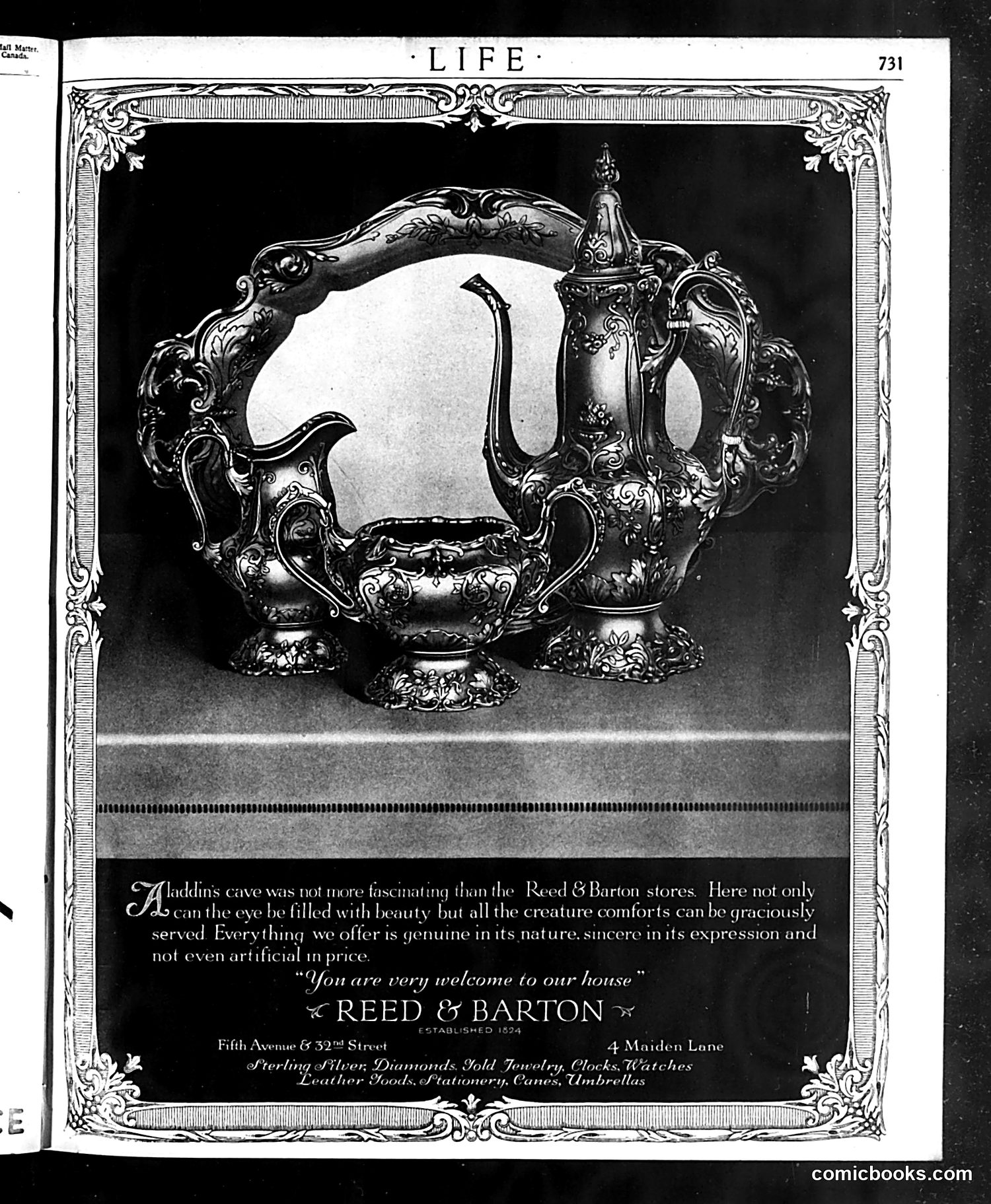
This page is **primarily an advertisement**, not a political cartoon. It features Reed & Barton, a luxury goods company established in 1824, showcasing an ornate silver serving vessel with elaborate decorative handles and a lid. The ad uses the metaphor of "Aladdin's cave" to compare Reed & Barton stores to a treasure trove of luxury items. The text emphasizes authenticity and quality—"genuine in its nature, sincere in its expression"—while claiming items are "not even artificial in price," likely meaning they're worth their cost. The ad lists their Fifth Avenue and Maiden Lane locations and product categories: sterling silver, diamonds, jewelry, clocks, watches, leather goods, stationery, canes, and umbrellas. This is straightforward luxury retail marketing from the Life magazine era.
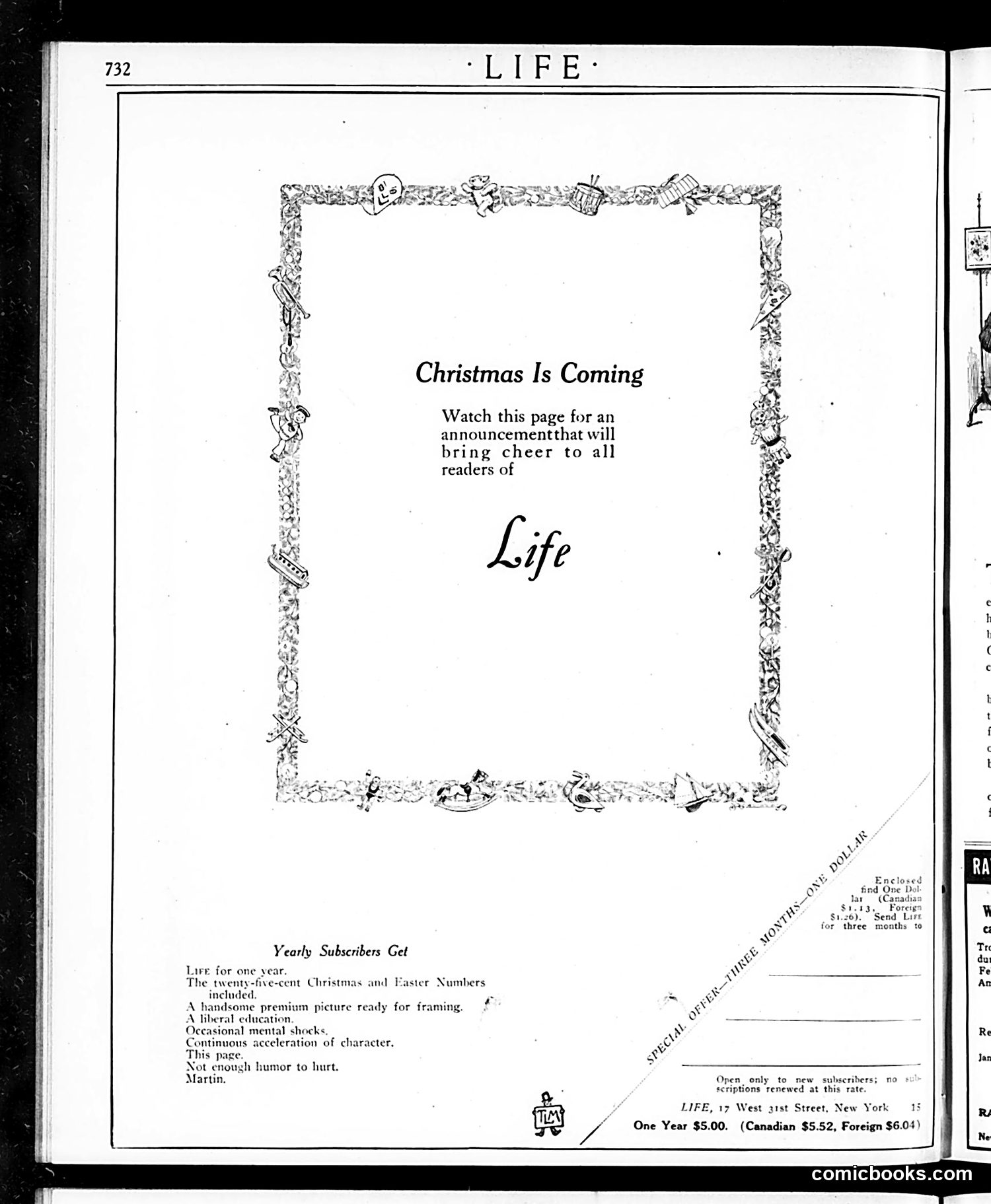
This is primarily a **subscription advertisement**, not political satire. The page announces "Christmas Is Coming" and promotes a yearly subscription to *Life* magazine for $5.00 (Canadian $5.52, Foreign $6.04). The decorative border features Christmas imagery (holly, stockings, ornaments, toys), establishing seasonal context. The "Yearly Subscribers Get" section lists benefits: one year of the magazine, special 25-cent Christmas and Easter numbers, art suitable for framing, humor that doesn't offend, and "continuous acceleration of character." The ornamental frame and festive design are meant to appeal to holiday gift-giving, positioning a *Life* subscription as an attractive present. This appears to be from an era when magazine subscriptions were common luxury gifts. No identifiable political figures or satirical commentary are evident on this page.
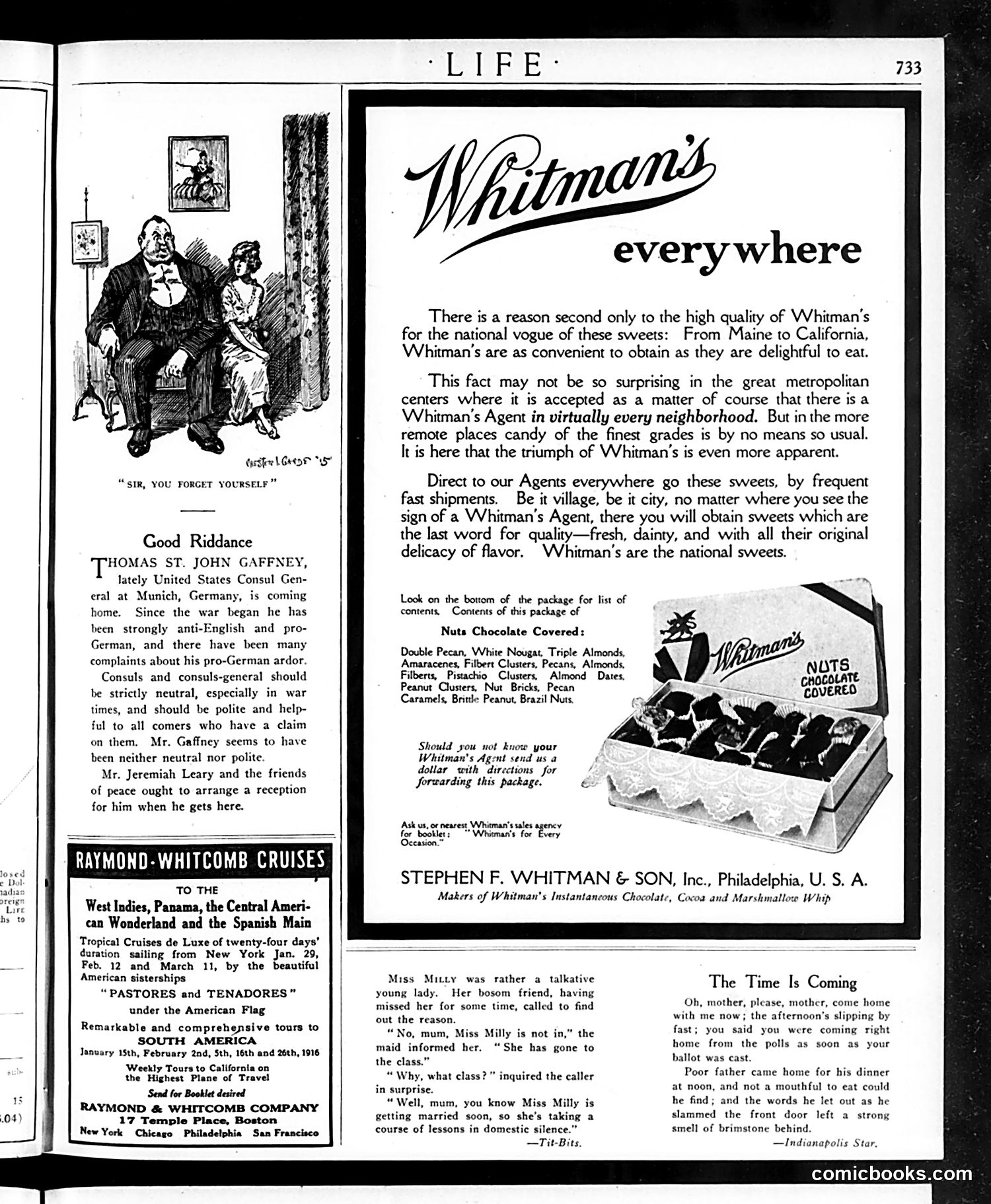
This page is primarily **advertising**, not satire or political commentary. The left column contains a brief news item about Thomas St. John Gaffney, a U.S. consul general in Munich, Germany, returning home. The text suggests he should remain neutral "especially in war times"—likely referencing World War I tensions, though the specific context is unclear. Below that is a cruise ship advertisement. The dominant content is a **Whitman's chocolate advertisement** featuring a product box and detailed copy emphasizing nationwide distribution through agents. A small illustration at the top left ("Sir, You Forget Yourself") appears to be unrelated filler, showing a man and woman in period dress—its meaning or source is unclear from this page alone. This is characteristic of *Life*'s mixed editorial-advertising format of the era.
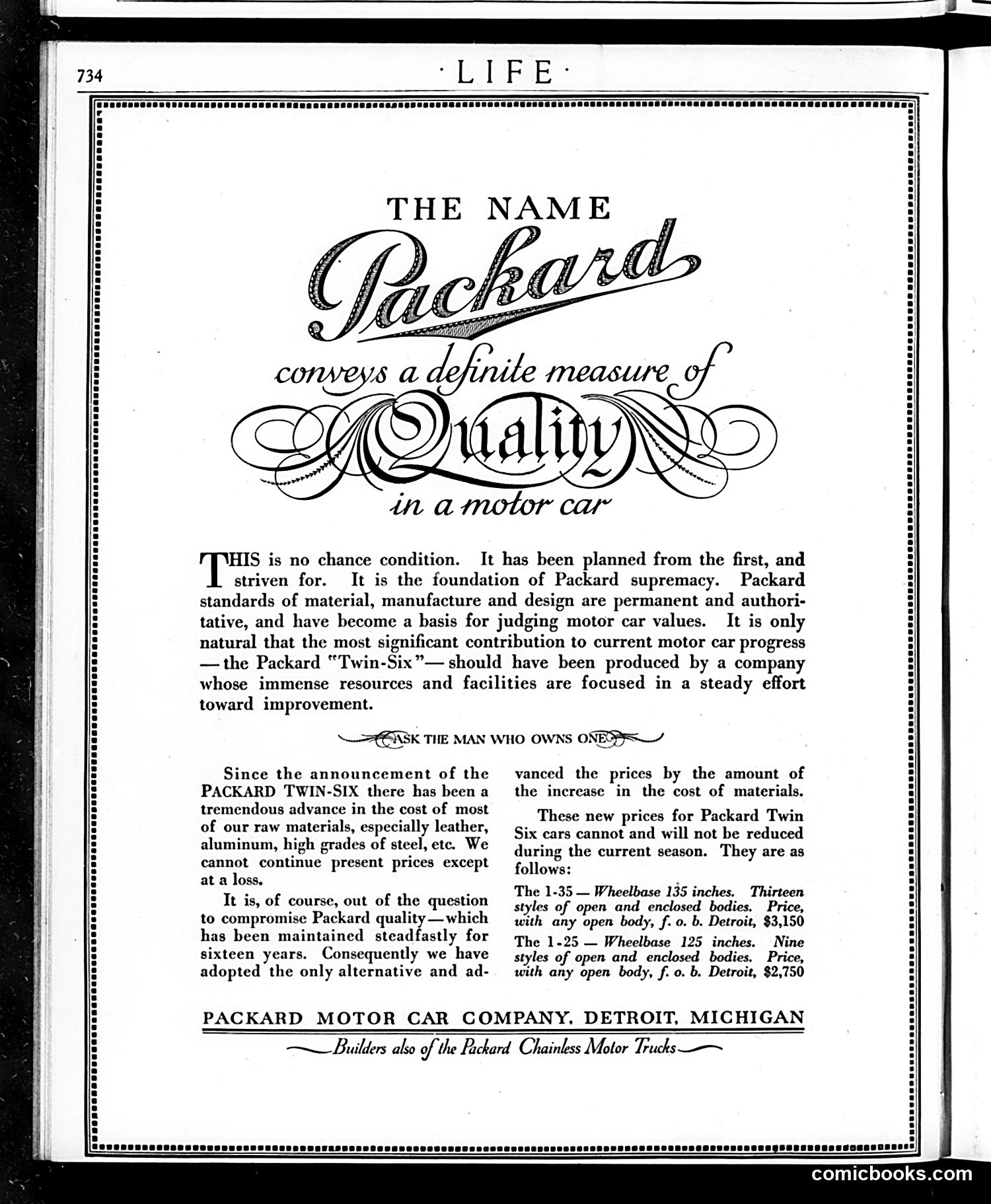
This page is a Packard automobile advertisement, not political satire or a cartoon. It appears in Life magazine and promotes the Packard Twin-Six motor car. The ad emphasizes that the Packard name represents "quality" and claims this wasn't accidental but "planned from the first." The company justifies a price increase—they've raised prices for the 1-35 model (wheelbase 135 inches, $3,150) and 1-25 model (wheelbase 125 inches, $2,750)—by citing rising material costs for leather, aluminum, and steel. The ad asserts Packard maintains quality standards established over sixteen years, positioning the price hike as necessary rather than exploitative. The subheading "Ask the man who owns one" was apparently Packard's actual slogan.
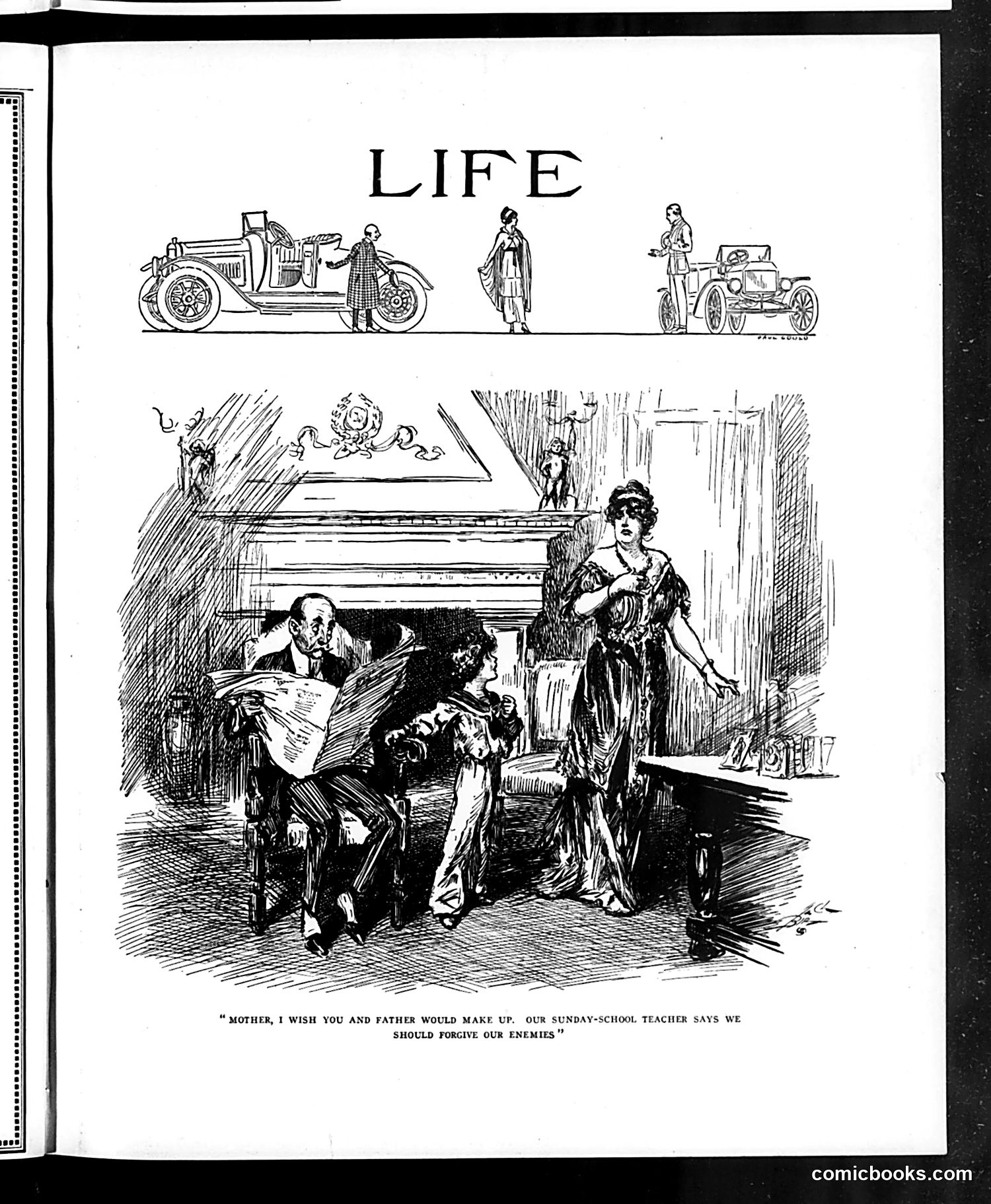
This satirical page contrasts two visions of "Life." The top section shows automobiles and fashionable figures—symbols of modern wealth and leisure. The bottom illustration depicts a domestic quarrel: a man reads a newspaper while a woman stands nearby with children, suggesting family discord. The caption reveals the joke's moral critique: a child asks his mother to reconcile with the father, claiming their Sunday-school teacher says they should "forgive our enemies." The satire targets hypocrisy—wealthy Americans enjoying modern luxuries (cars, fashions) while failing basic Christian values like forgiveness within their own families. The cartoon mocks the gap between professed religious principles and actual domestic behavior among the comfortable classes.
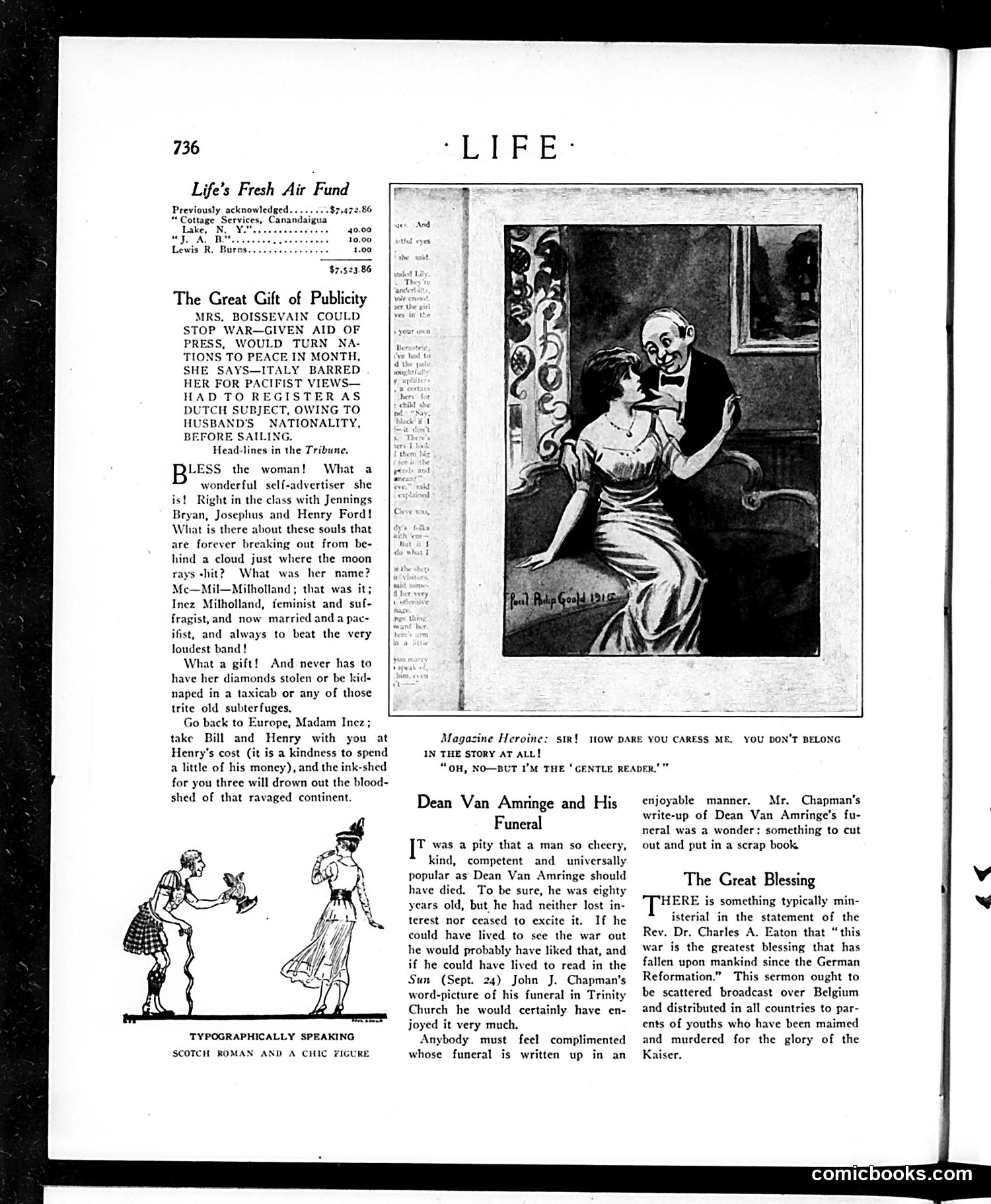
This Life magazine page contains three distinct content sections: 1. **"Life's Fresh Air Fund"** - A fundraising appeal listing donations, appearing to be charitable work. 2. **"The Great Gift of Publicity"** - A satirical piece praising a woman (Mrs. Boissevain) who uses press attention to advocate for pacifism and anti-war positions. The satire mock-celebrates her as a "self-advertiser" comparable to Bryan, Josephus, and Ford—public figures who gained fame through self-promotion. The piece ironically suggests her activism is primarily about personal publicity rather than genuine conviction. 3. **Lower sections** include a small cartoon labeled "Typographically Speaking" showing figures in period dress, plus articles about Dean Van Amringe's funeral and "The Great Blessing" regarding Rev. Charles Eaton's wartime sermon broadcast. The page reflects WWI-era debates over pacifism versus patriotism, mocking activists while covering cultural/religious responses to the war.
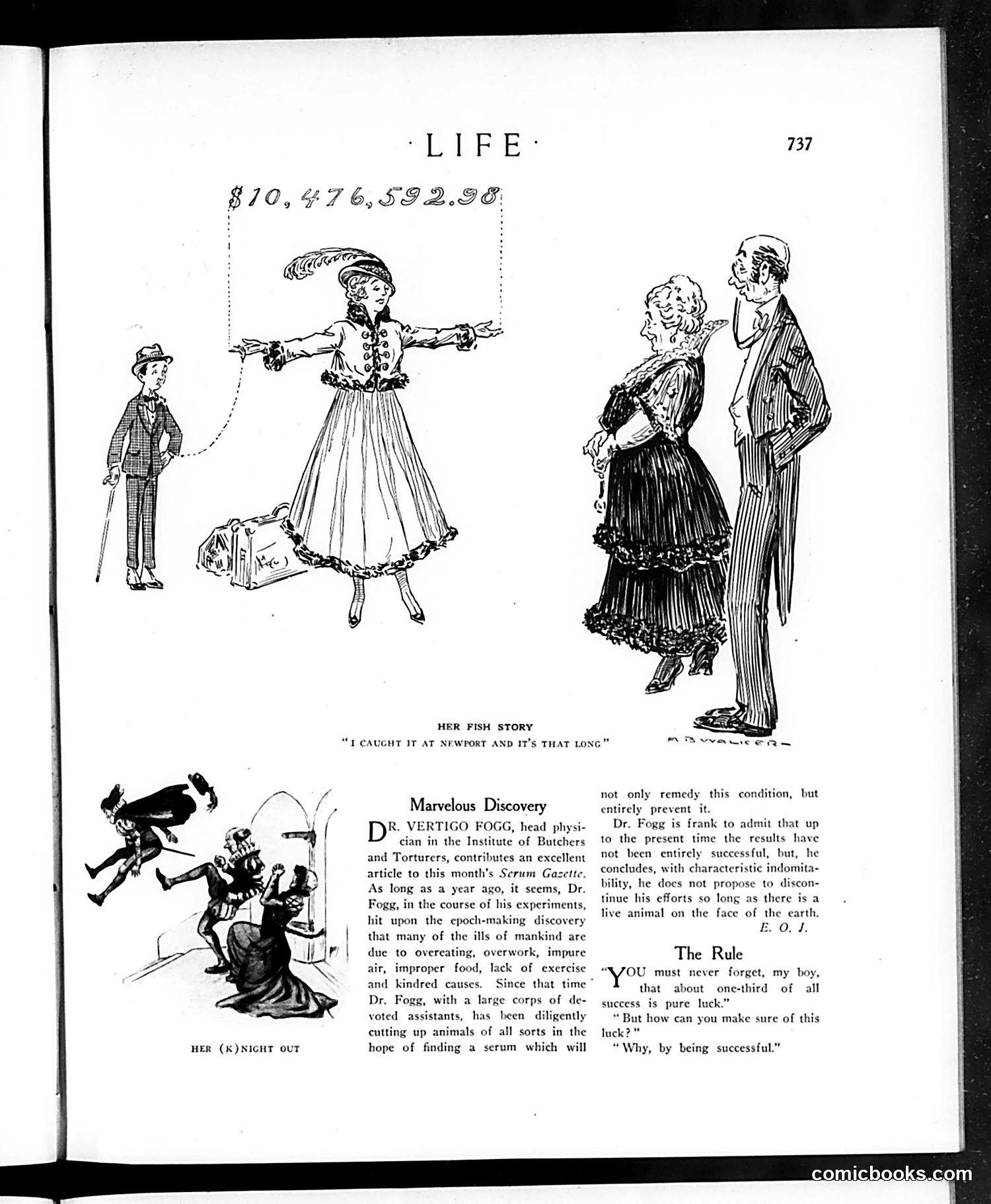
This page contains satirical illustrations and brief humorous pieces typical of Life's social commentary. **Top cartoon** ("Her Fish Story"): Shows a woman telling an exaggerated tale—arms spread wide—to a small man with a cane, while luggage sits nearby. The joke plays on the stereotype of women embellishing stories, particularly about fishing achievements. **Bottom left** ("Her (K)Night Out"): A woman appears to be in some kind of chaotic situation with multiple figures, satirizing women's evening activities or social outings, though the exact reference is unclear. **"The Rule"** section: A brief dialogue between a boy and man about luck and success—seemingly a morality piece rather than political satire. The page's overall tone reflects early 20th-century gender-based humor common to Life magazine.
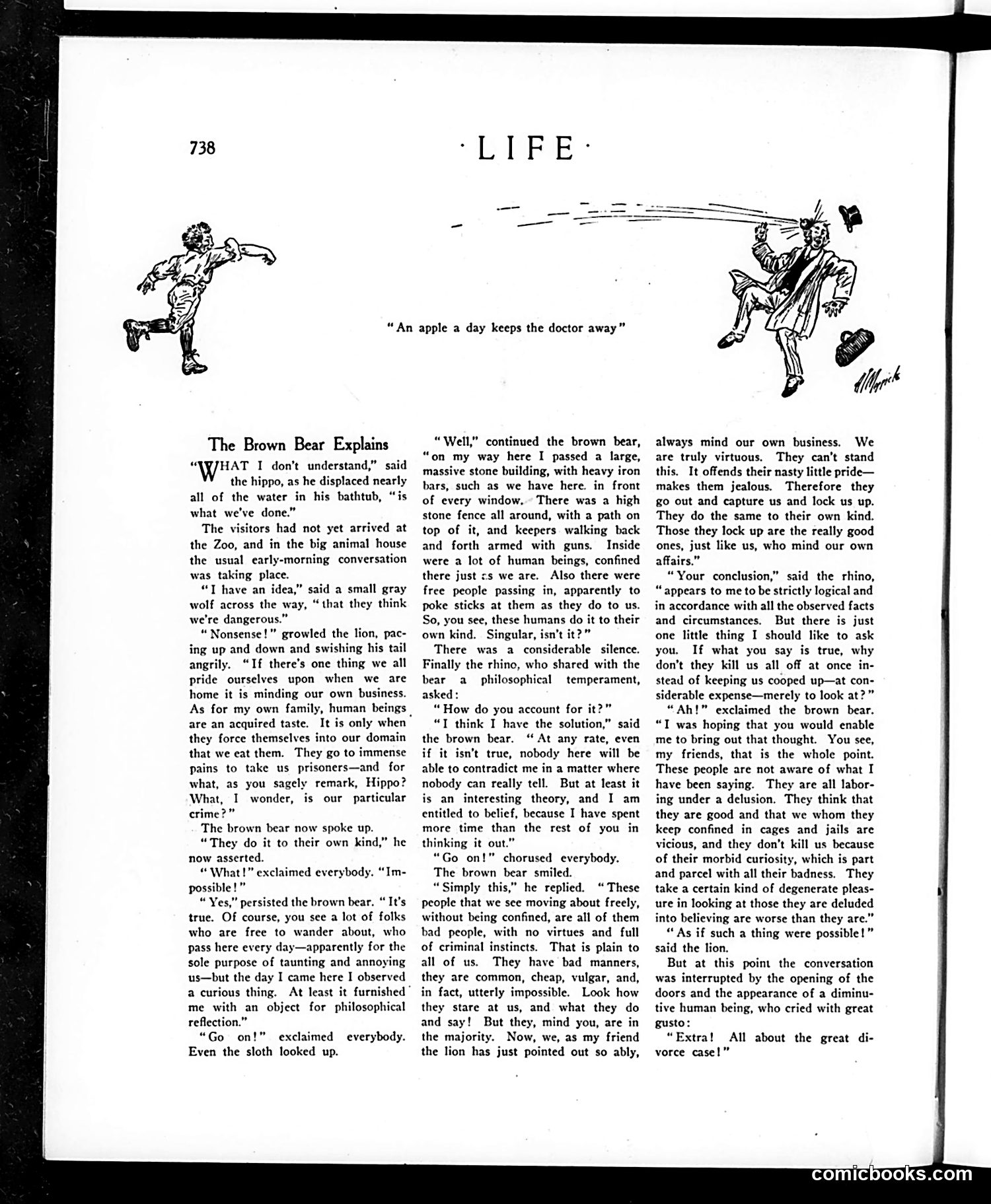
This is a satirical fable featuring zoo animals debating human nature. A brown bear defends humans against criticism from other animals (a hippo, lion, and rhino), arguing that humans are actually virtuous despite appearing cruel and confined. The bear's defense is deeply ironic: he claims humans are good because they're laboring under society's constraints, yet he also admits they invented prisons and use humans as objects for entertainment and "philosophical reflection." The satire targets both human self-deception about morality and contemporary attitudes toward confinement and class hierarchy. By having the bear rationalize human flaws as unavoidable social necessity, the cartoon mocks self-justifying arguments for inequality and exploitation—relevant to early 20th-century debates about labor, incarceration, and social order.
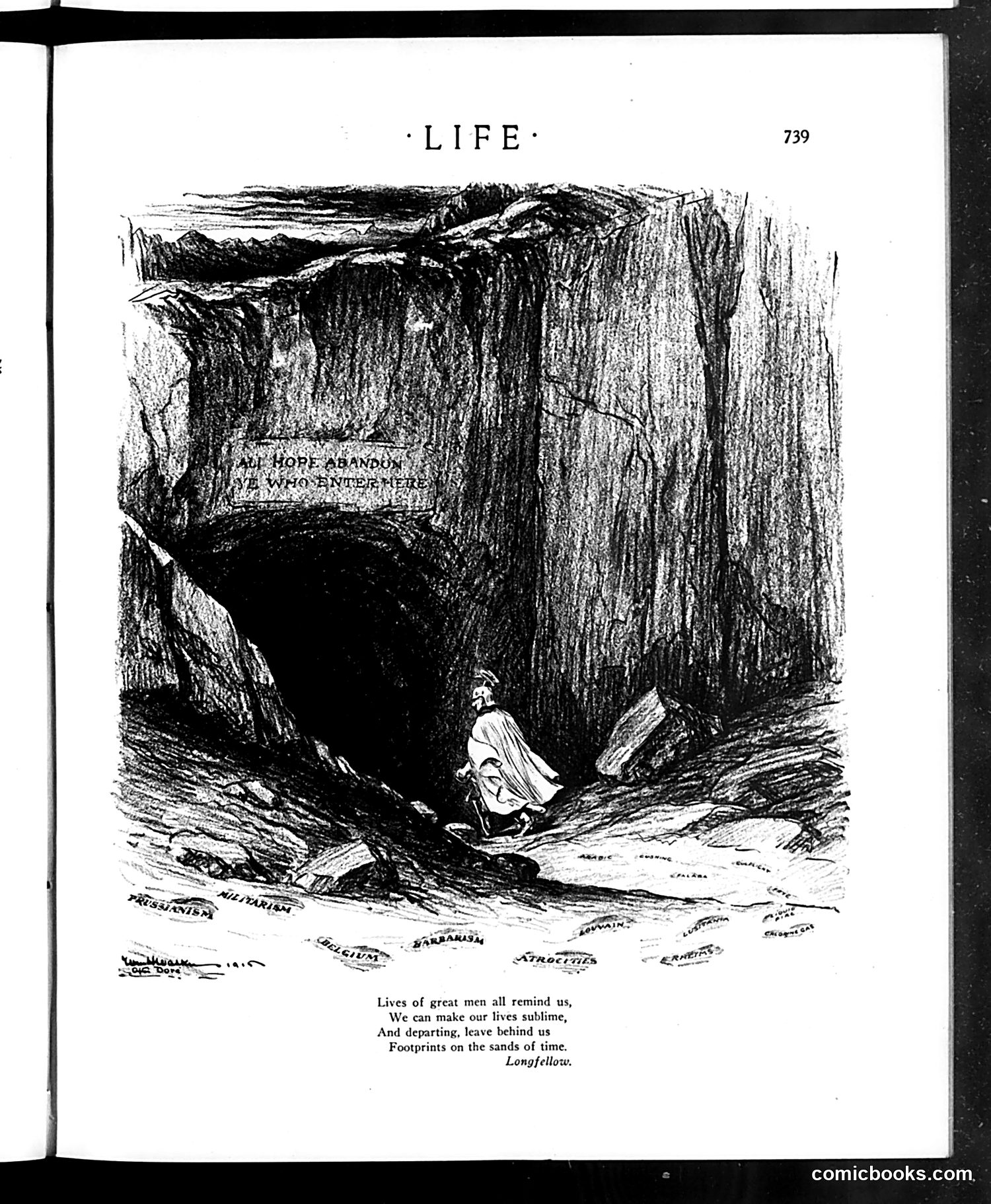
This page from *Life* magazine (page 739) presents a satirical illustration with a moral lesson. The sketch depicts a solitary figure in tattered clothing standing in a cave entrance, beneath a sign reading "HOPE ABANDONED" (likely referencing Dante's "Abandon all hope, ye who enter here"). The cave walls are labeled with various human vices and failures: "DESPAIR," "MISFORTUNE," "BARBARIANISM," "IGNORANCE," "ATROCITIES," and "CRUELTY" among others—representing moral and social evils. The accompanying Longfellow quote advocates for inspiring lives that leave positive "footprints on the sands of time," contrasting sharply with the hopelessness depicted. The cartoon satirizes humanity's tendency toward vice while advocating for moral aspiration and legacy-building through virtuous living.
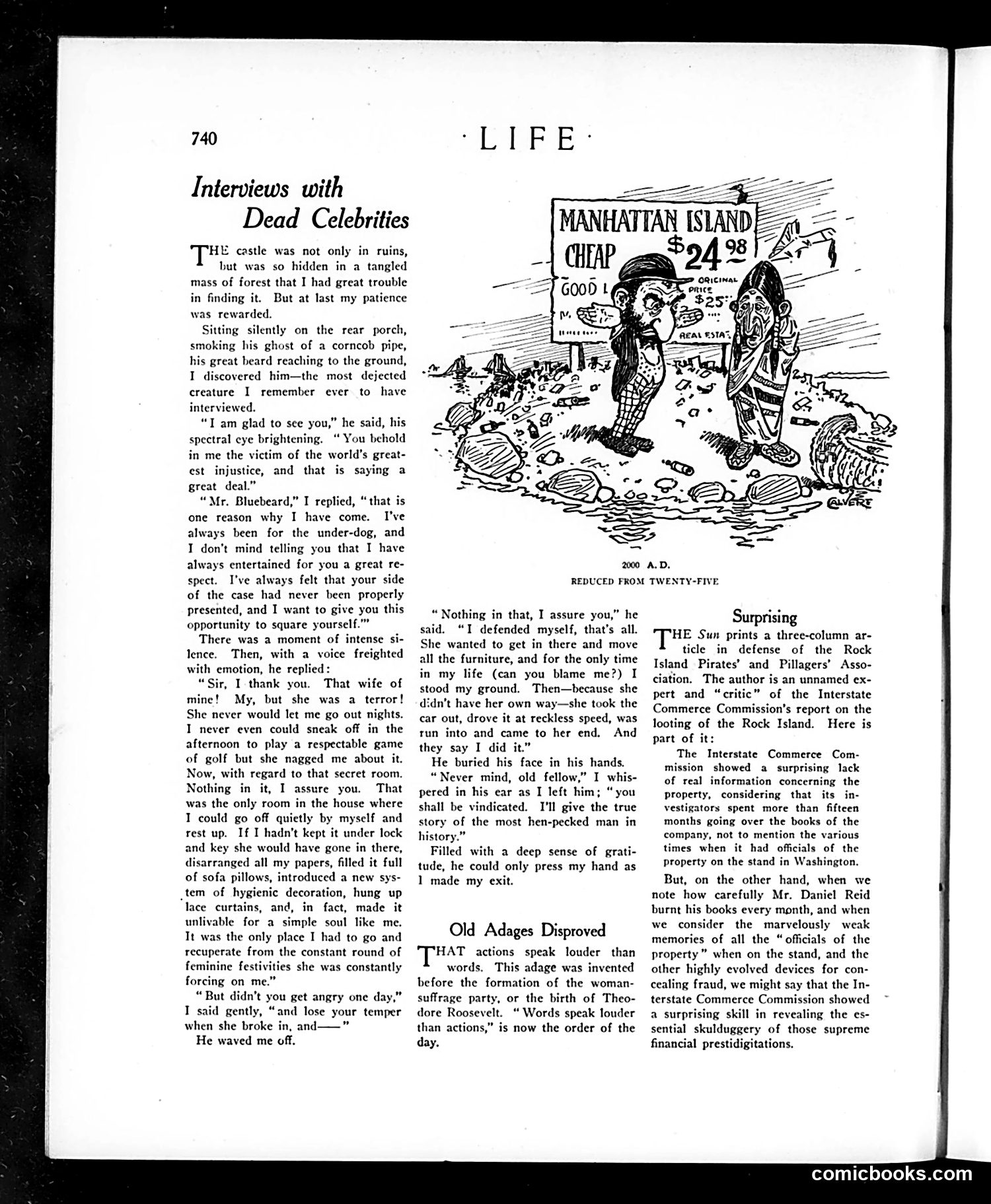
This page contains two distinct pieces: **Left column:** A satirical dialogue titled "Interviews with Dead Celebrities," featuring a conversation between the narrator and the ghost of someone referred to as "Mr. Bluebeard." The ghost complains about his reputation, claiming his wife was "a terror" who drove him to madness, and that he's been unfairly blamed for her death. The satire appears to mock historical revisionism and self-serving justifications. **Right section:** A cartoon labeled "Manhattan Island Cheap" showing what appears to be Native Americans or indigenous figures selling land, with a sign advertising "$24.98" and text reading "Reduced from Twenty-Five" and "300 A.D." The illustration satirizes the famous (or infamous) purchase of Manhattan, likely mocking both the absurdly low historical price and present-day real estate markups.
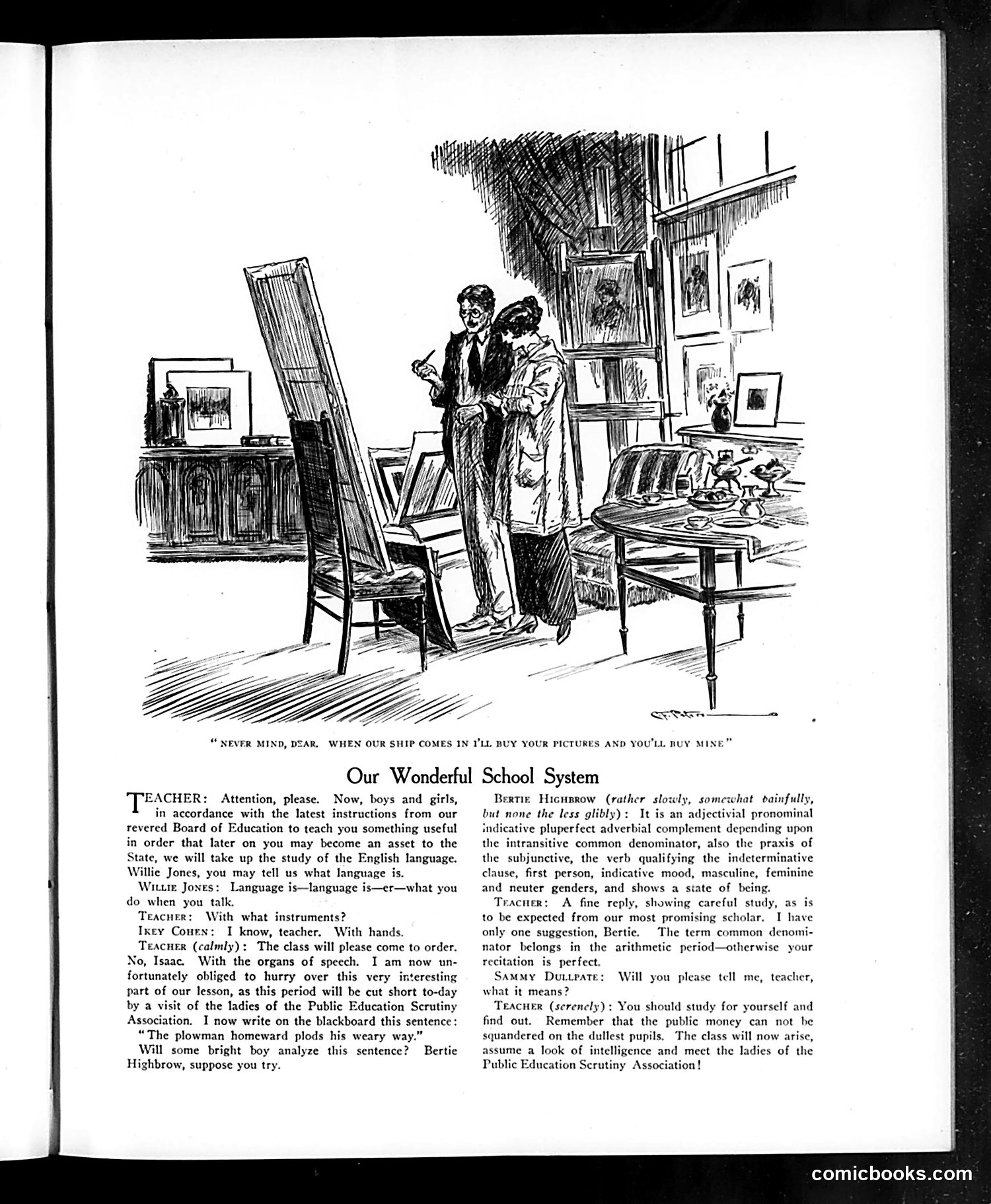
This satirical sketch mocks early 20th-century educational pedagogy. A teacher demonstrates grammar instruction to students while two adult visitors (labeled as part of the "Public Education Scrutiny Association") observe. The humor lies in the absurdity of the lesson: the teacher uses tortured, overly-complex grammatical terminology to explain simple concepts, exemplified by the sentence "The plowman homeward plods his weary way." The satire targets educational pretension—the inflation of simple ideas into incomprehensible jargon. The caption's opening joke about buying ship paintings suggests priorities are misaligned. The piece critiques how schools obscure rather than clarify knowledge, performing sophistication for inspectors rather than genuinely educating children. It reflects contemporary concerns about educational reform and bureaucratic inefficiency.
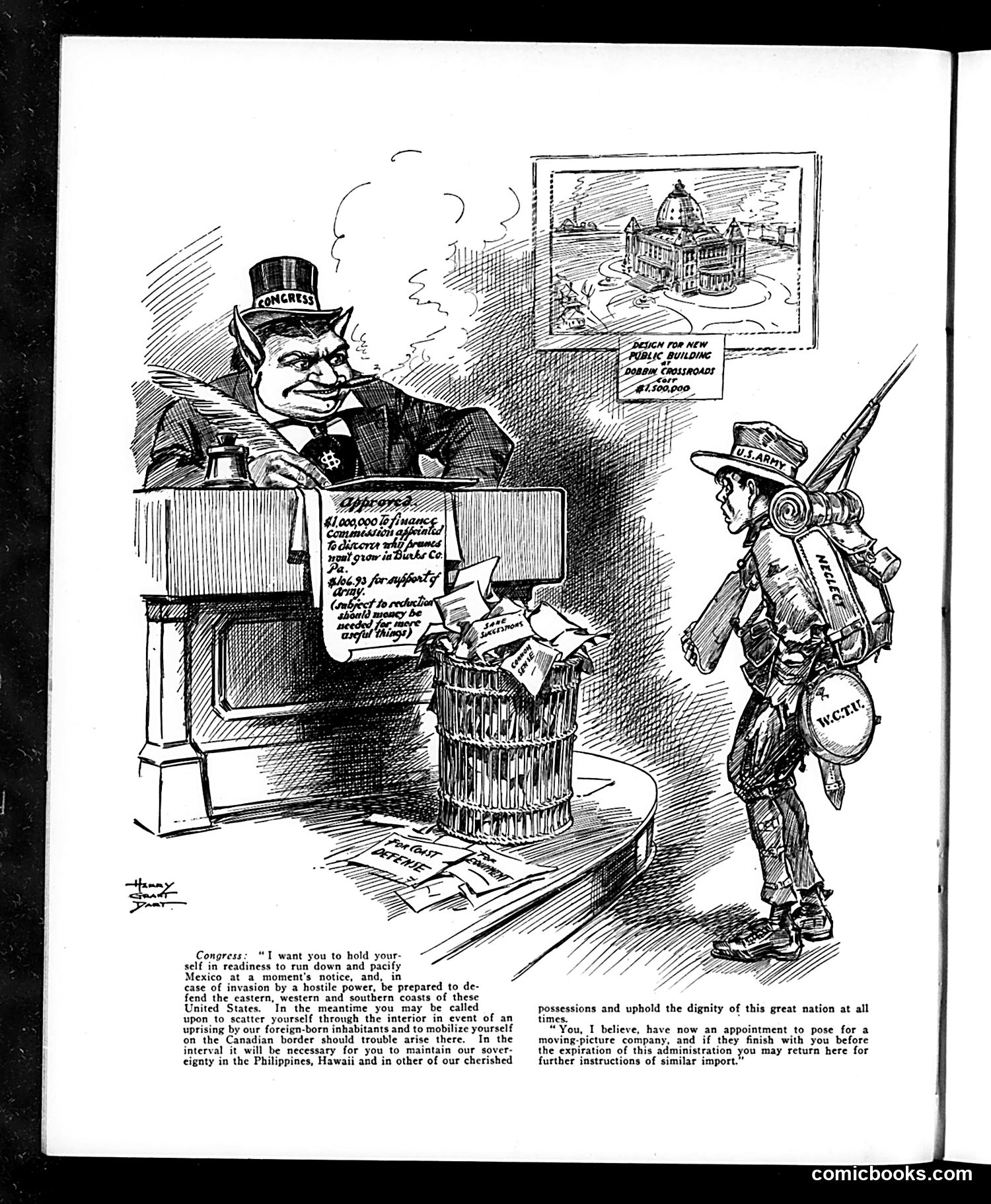
This political cartoon depicts Congress (caricatured as a devilish figure wearing a "Congress" top hat) issuing military orders to a U.S. Army soldier. Congress instructs the soldier to prepare for potential invasion and defend American coasts, with detailed instructions about mobilizing forces across the eastern, western, and southern territories, defending the Canadian border, and preparing for possible uprisings by "foreign-born inhabitants." The satire critiques Congress's militaristic approach and apparent paranoia about invasion and internal subversion. The soldier appears burdened by these extensive, detailed orders. A sketch of a Capitol building appears in the upper right, likely referencing the sketch Congress wants for a public building. The cartoon suggests Congress is overreaching with military preparations and suspicious attitudes toward immigrants.
This page features Life magazine's short story contest results. The main story printed is "When 'Kultur' Was Beaten" by Lieutenant X, depicting a WWI trench combat scene between French and German forces. The narrative focuses on a French officer (Corporal Dupin) who encounters a wounded German officer and shows him mercy rather than revenge, despite the German's earlier brutality. The story appears designed to illustrate French moral superiority during WWI by contrasting Dupin's humanity against German "kultur" (culture/militarism). A second story, "Presumption of Innocence" by Lyman Bryson, begins at page bottom. The content reflects American pro-Allied sentiment during or immediately after World War I, using fiction to reinforce propaganda about national character differences.
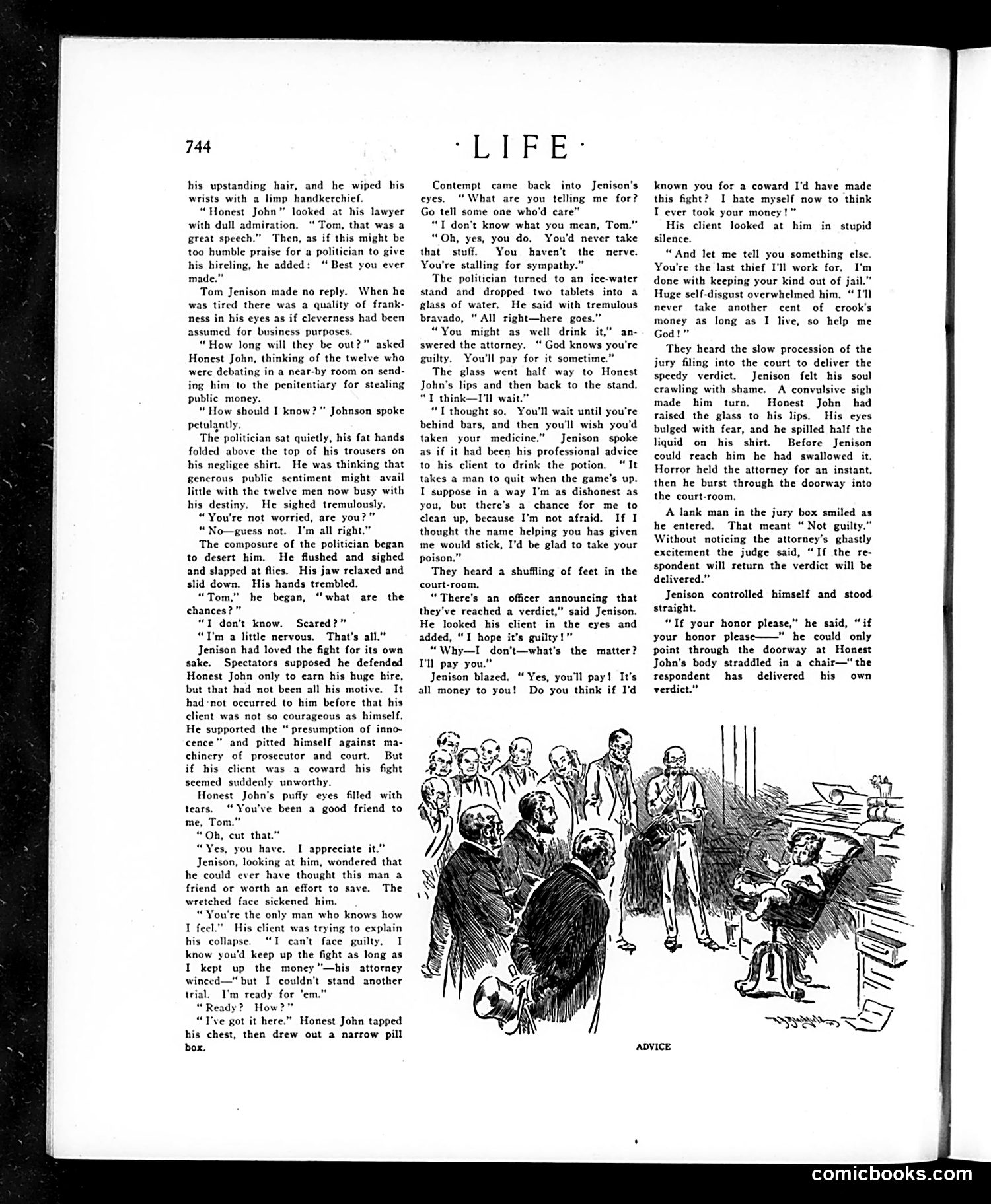
This page depicts a dramatic courtroom scene from a story titled "Advice" (visible in the illustration caption). The narrative concerns **Honest John**, a corrupt politician accused of stealing public money, and his defense attorney **Tom Jenison**. The satire pivots on a moral reversal: Jenison, initially defending his client professionally, becomes disgusted upon discovering Honest John is a coward. When the politician contemplates suicide via poison pills rather than face trial, Jenison's contempt crystallizes. He declares he'd take the poison himself if his name weren't now tainted by association with this dishonorable man. The cartoon's "advice" is therefore bitterly ironic—it exposes how a lawyer's professional duty to defend the guilty conflicts with personal integrity. Jenison realizes too late that some clients aren't worth saving. The illustration shows the jury returning with their verdict, the climactic moment when Honest John's fear becomes irrelevant. The piece satirizes both political corruption and the legal system's moral compromises.
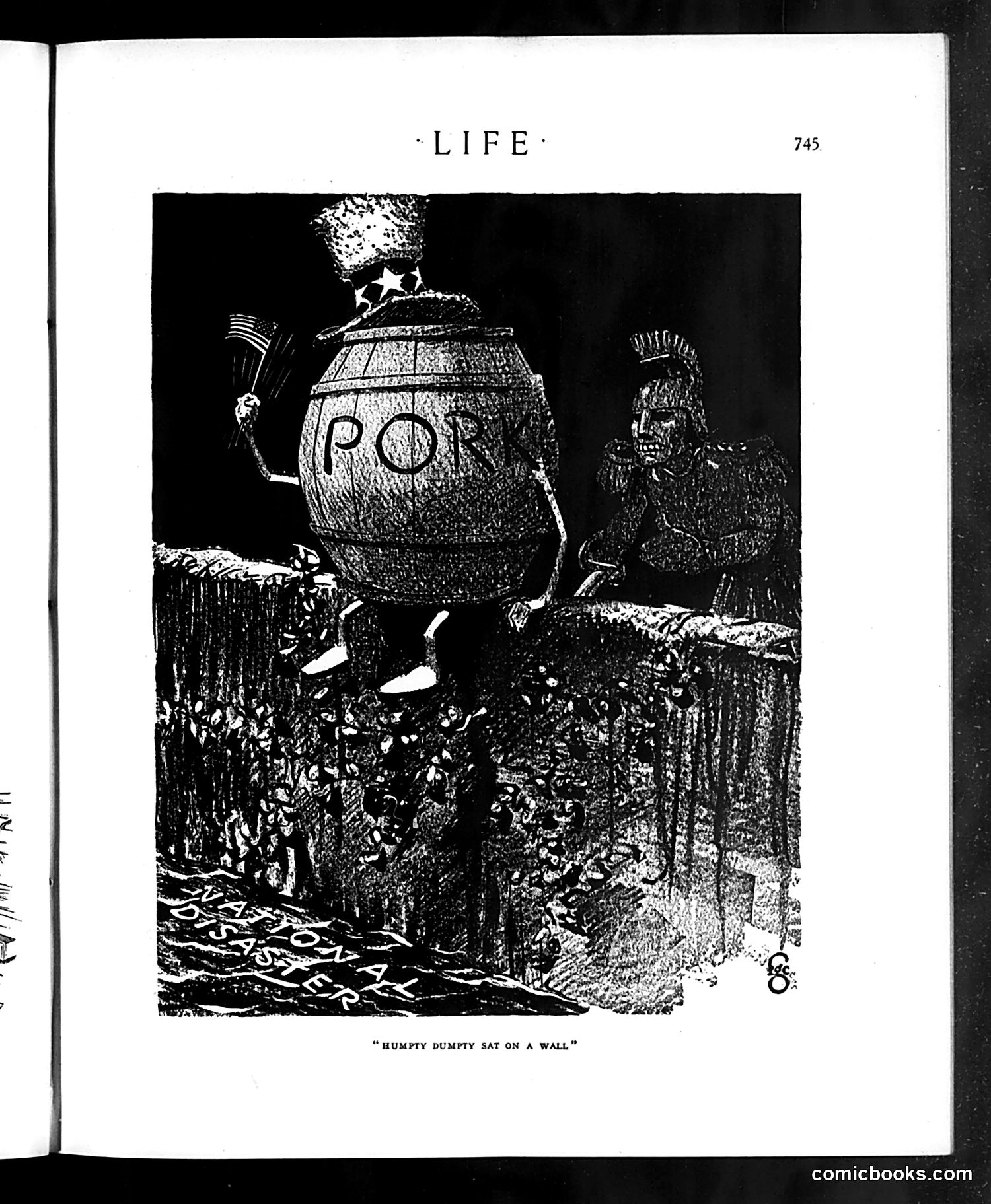
This political cartoon adapts the classic nursery rhyme to satirize a contemporary political figure or institution. The egg-shaped character labeled "POR" (likely an acronym for a political entity or person) sits precariously on a wall, while two figures flank it—one appears to be holding an American flag. The composition suggests the subject is in an unstable or precarious position, vulnerable to collapse. The satire uses the nursery rhyme's famous ending ("all the king's horses and all the king's men / couldn't put Humpty together again") to mock the idea that once something falls or fails, it cannot be restored. The cartoon likely comments on a contemporary political crisis, scandal, or failing institution that the magazine's readers would have immediately recognized, though the specific reference is unclear without additional historical context about *Life* magazine's publication date.
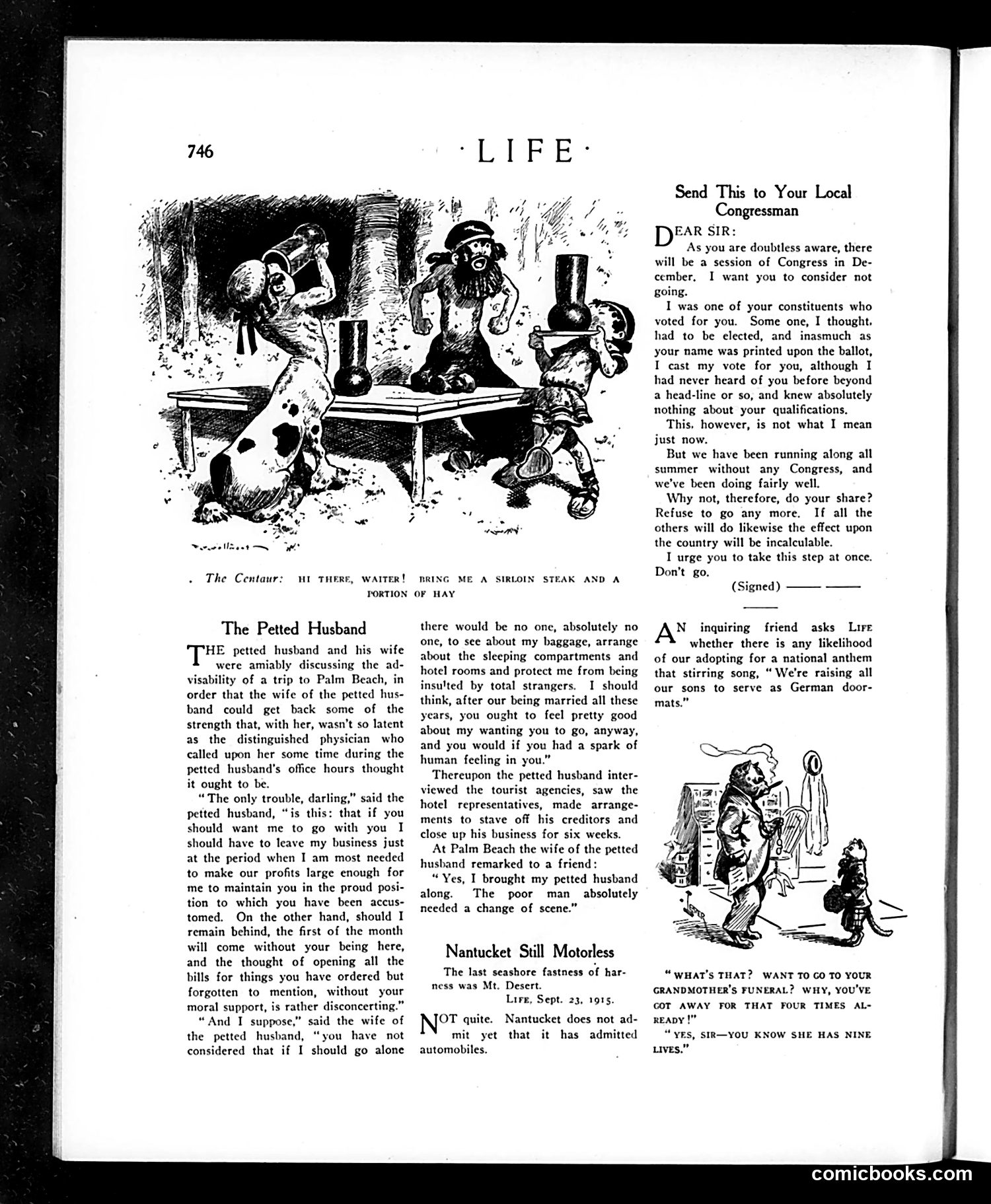
This page contains three satirical pieces mocking American social dynamics during the pre-WWI era: **"The Petted Husband"** satirizes role-reversal marriages where the husband is financially dependent and emotionally manipulated. The wife uses guilt and helplessness to prevent her husband from attending to business, then takes him on vacation anyway—but tells friends *he* needed the trip. The satire targets both emasculated husbands and domineering wives who claim fragility while wielding power. **"Send This to Your Local Congressman"** is a mock-sincere letter sardonically urging representatives to skip the upcoming Congressional session, since the country "ran along fairly well" without them all summer. This reflects widespread Progressive-era cynicism about governmental ineffectiveness. **"The Centaur"** cartoon depicts what appears to be mythological creatures at a table, with a waiter serving. The caption suggests absurdist humor (ordering "sirloin steak and hay"). The final joke mocks a woman claiming to attend her grandmother's funeral repeatedly—implying she's lying to escape obligations, while her interlocutor notes the grandmother has nine lives (or nine siblings).
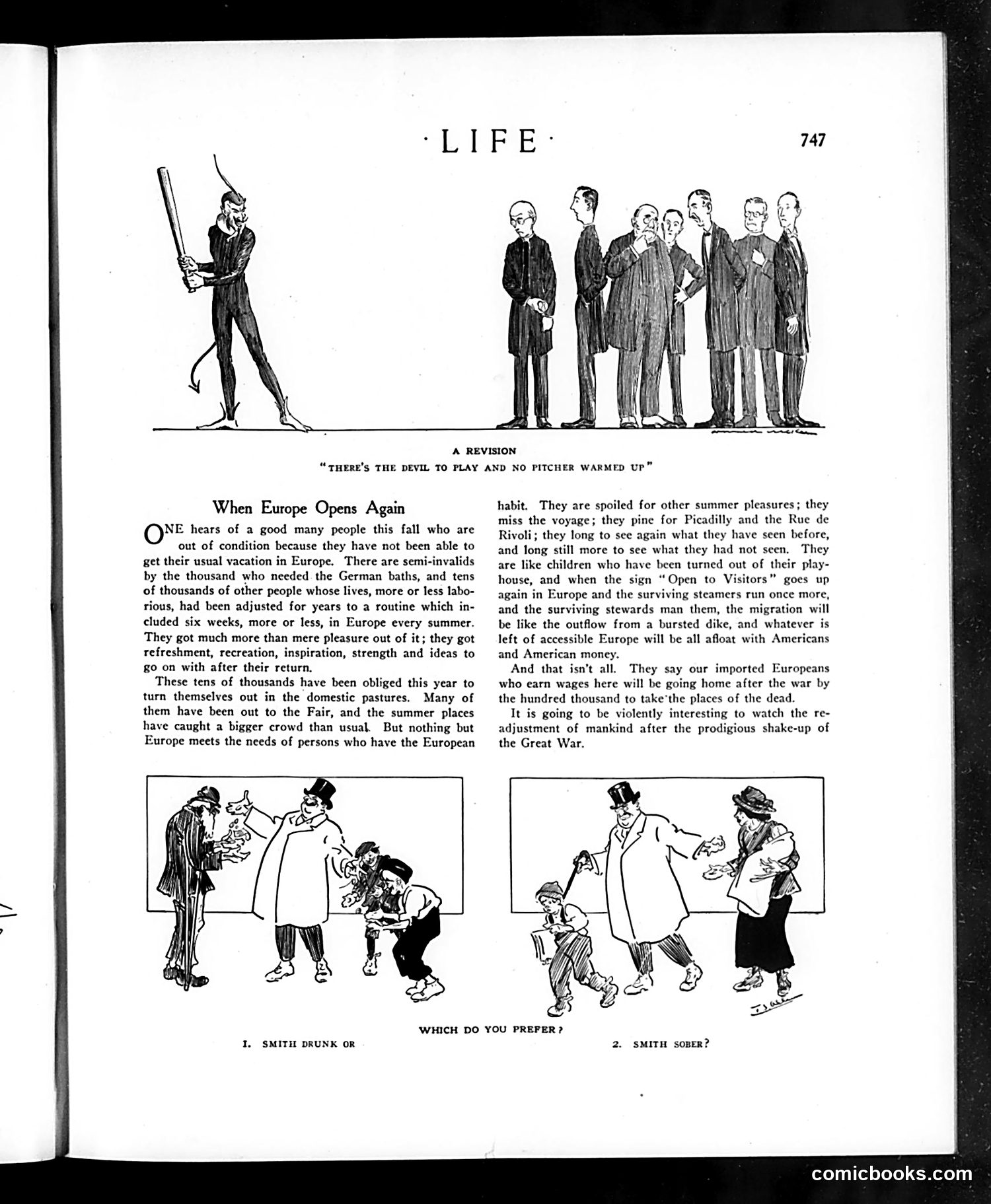
This satirical piece from *Life* magazine (appears to be post-WWI, based on "after the Great War" references) mocks American travelers desperate to resume European vacations after wartime disruptions. **Main cartoon (top):** Shows a devil-like figure with a baseball bat confronting well-dressed gentlemen—a sports reference ("no pitcher warmed up") suggesting chaos when European travel resumes. The title references an old saying about disorder. **Key satire:** The article ridicules wealthy Americans who've become so dependent on European tourism that domestic alternatives (the Fair, summer homes) feel inadequate. It suggests these "spoiled" travelers will flood Europe when steamships resume service, treating the continent like a playground while wielding American wealth. **Bottom comics:** Present a crude choice between "Smith drunk" versus "Smith sober"—likely commenting on how European vacations function as escapism, or contrasting personality types among the leisure class. **Historical context:** This reflects post-WWI anxieties about American wealth, European reconstruction, and shifting demographics (immigrants returning to replace war casualties).
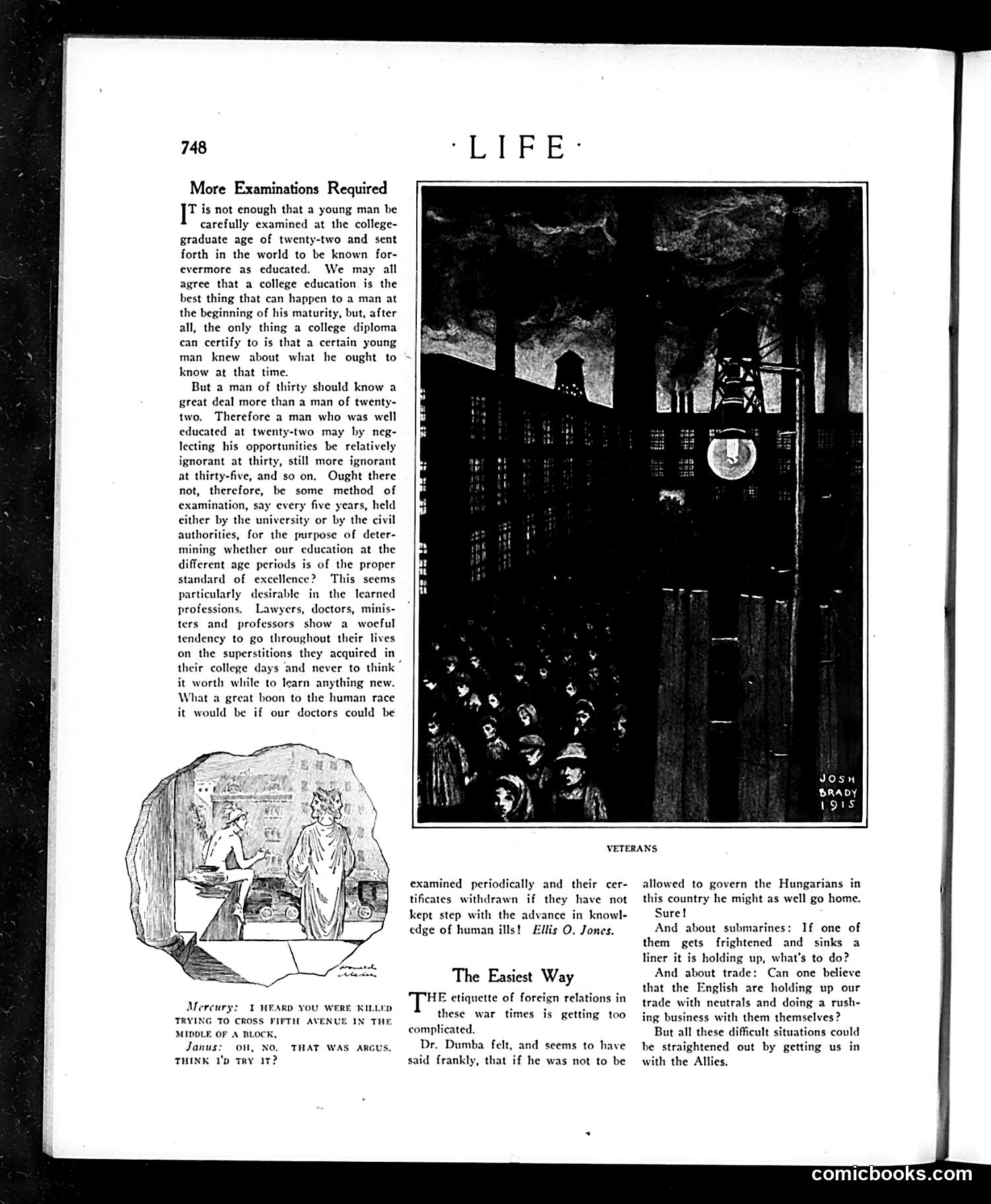
This page contains two separate satirical pieces from Life magazine during World War I era. **"More Examinations Required"** argues that professionals—particularly doctors, lawyers, and ministers—should face periodic re-examination throughout their careers to ensure they've kept current with advancing knowledge. The satire criticizes how educated professionals coast on outdated college training and resist learning new information. **The small cartoon** (Mercury and Janus/Argus) is a classical mythology joke: Mercury reports hearing someone was killed crossing Fifth Avenue mid-block, and Janus suggests he'd try it anyway—but Mercury clarifies the victim was Argus (the hundred-eyed giant), implying even someone with exceptional vision couldn't safely navigate NYC traffic. **"The Easiest Way"** mocks American diplomatic complications during WWI. It sarcastically references Dr. Dumba (Austria-Hungary's ambassador, who was actually recalled in 1915) and suggests the "solution" to all wartime foreign-relations problems—submarine attacks, trade disputes, neutrality issues—is simply for America to join the Allies. The satire criticizes muddled diplomatic thinking.
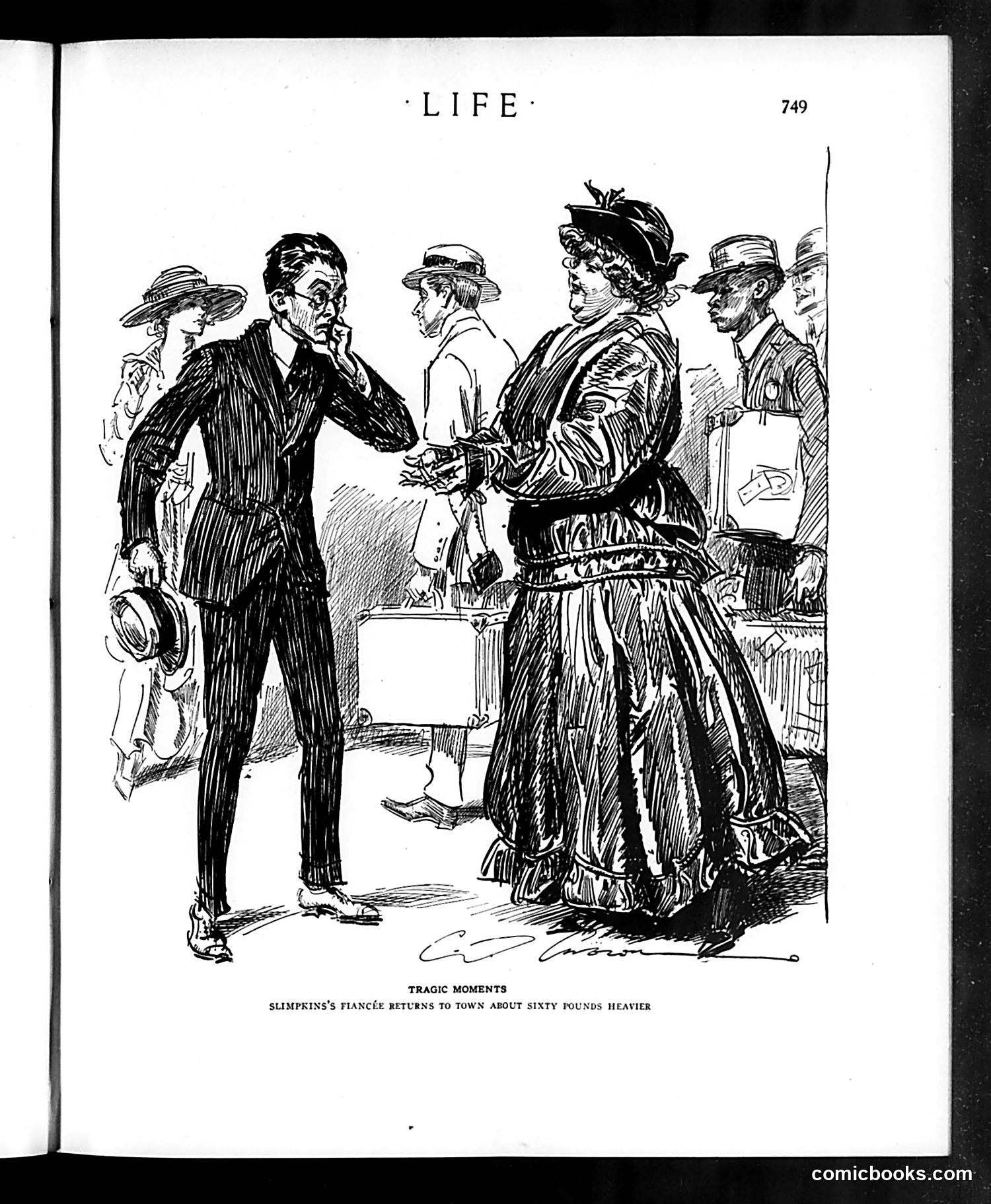
This is a satirical cartoon titled "Tragic Moments" depicting a social encounter between a well-dressed man and woman in what appears to be a public setting, surrounded by onlookers. The caption refers to "Slimpkins's fiancée returns to town about sixty pounds heavier." The humor relies on body-shaming satire common to early 20th-century magazines—the woman's noticeably fuller figure is the apparent "joke," with the man's shocked expression suggesting dismay at his fiancée's weight gain during her absence. The cartoon mocks both the woman's appearance and, implicitly, the superficiality of the man's commitment. The gathered crowd emphasizes the public nature of this "tragic" social embarrassment. This reflects period attitudes toward women's bodies and marriage expectations, though such humor would be considered offensive today.
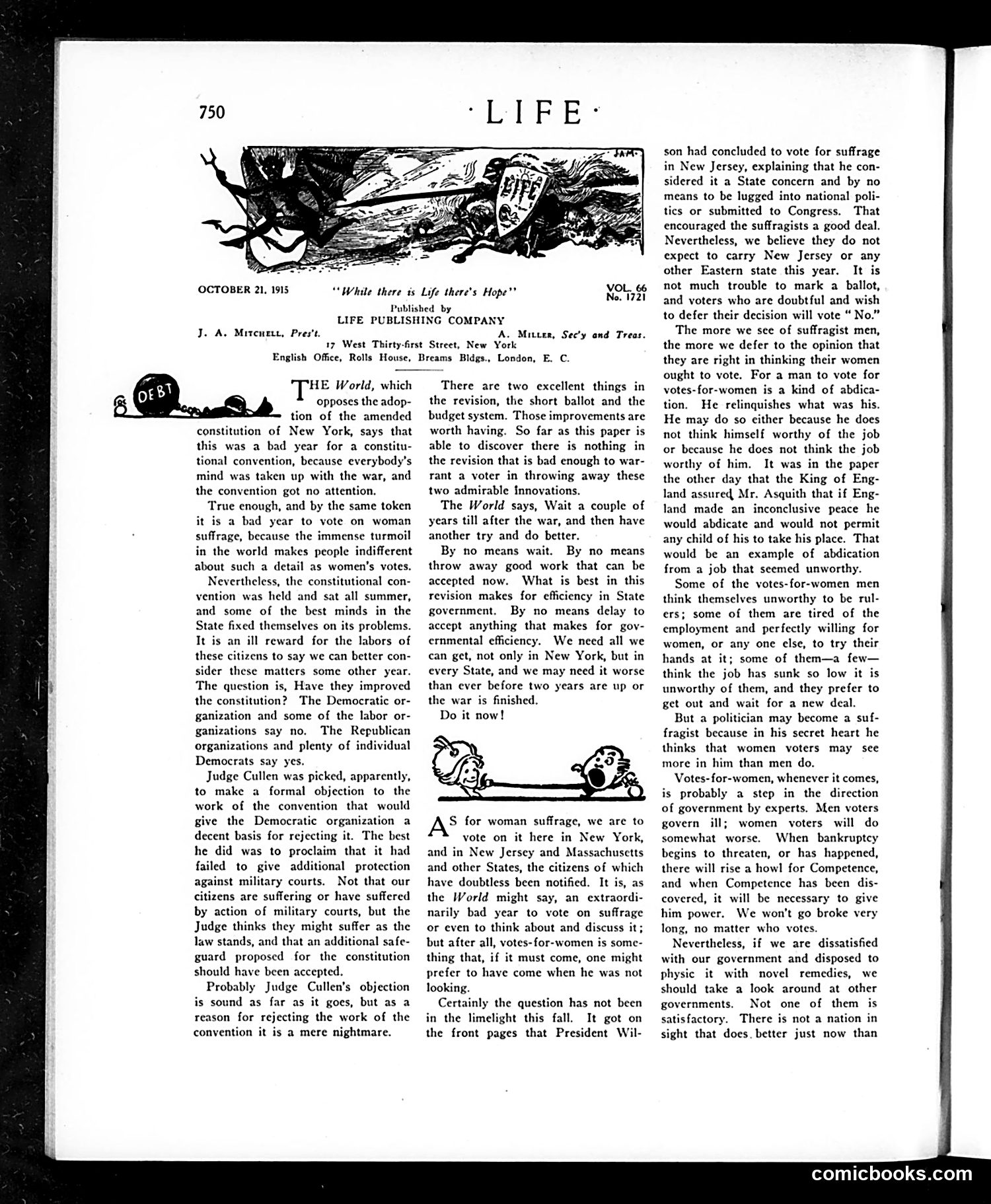
**The Cartoon:** The masthead illustration shows a skeletal figure (Death or Despair) lying prone with a gravestone marked "LIFE," captioned "While there is Life there's Hope"—a dark visual pun on the magazine's title. **The Context:** This page discusses New York's 1915 constitutional convention and the concurrent women's suffrage referendum. Life magazine supports *both* the revised constitution (praising its "short ballot" and "budget system") and women's suffrage, though it acknowledges these are "bad year[s]" to debate such issues—World War I monopolizes public attention. **The Satire:** Life ridicules opponents' logic: delaying votes until after the war is absurd ("a mere nightmare"). Judge Cullen's objection to the constitution on military-court grounds is dismissed as pretextual. The magazine also mocks President Wilson's vote for New Jersey suffrage while claiming it's a "State concern"—a transparent dodge. **Modern Translation:** Life argues against using wartime distraction as an excuse to postpone important democratic decisions.
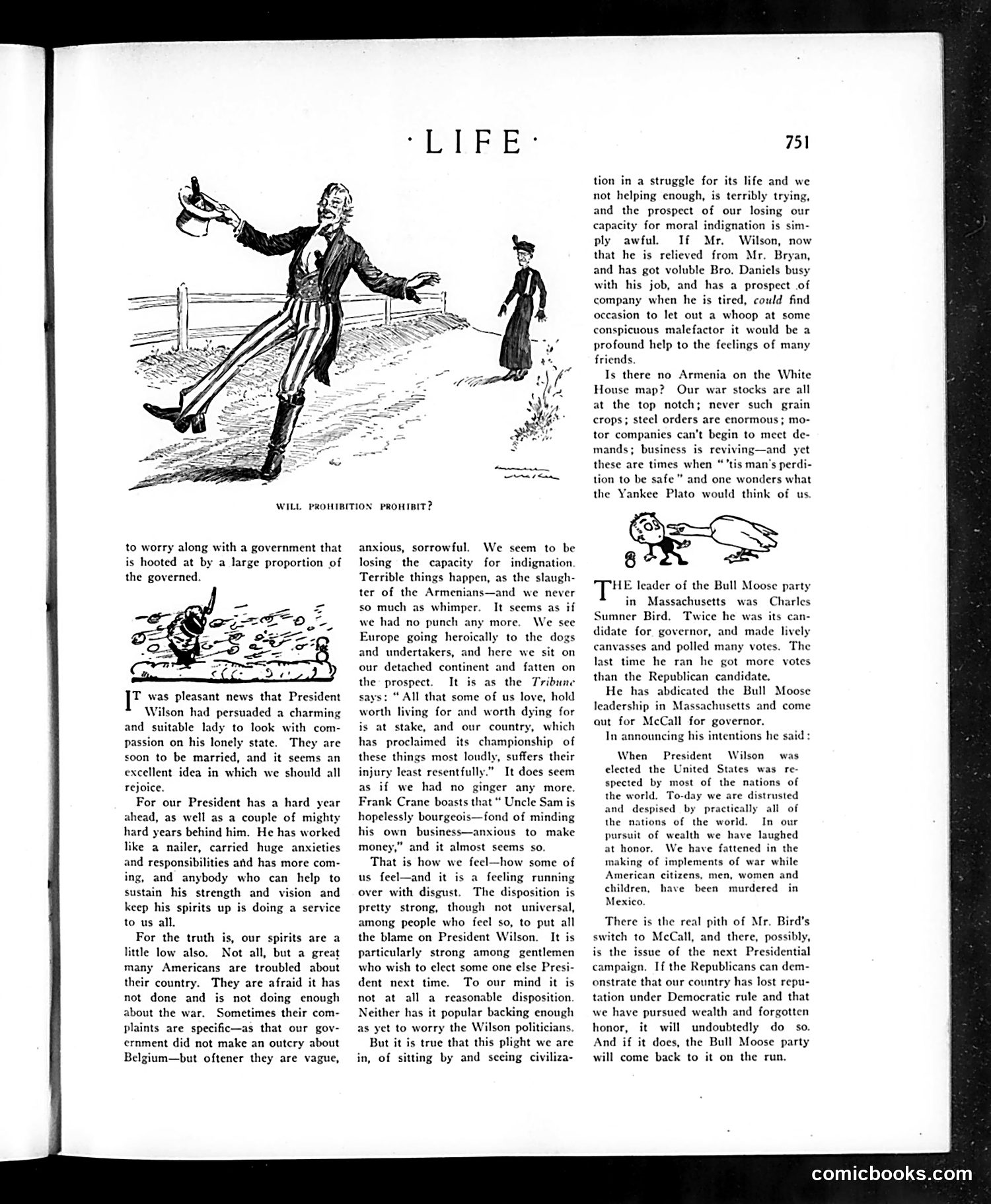
This *Life* magazine page satirizes American passivity during World War I. The cartoon "Will Prohibition Prohibit?" depicts President Wilson gesturing helplessly while a small figure (likely representing a conscientious citizen or advocate) walks away—illustrating the author's frustration that Wilson isn't doing enough to condemn wartime atrocities. The accompanying text criticizes Americans' moral numbness to European suffering, particularly the Armenian genocide. The author argues that despite prosperity (war stocks, grain crops, steel orders booming), the nation has lost its "capacity for indignation." Wilson receives particular blame from political opponents seeking his defeat, though the author defends him somewhat. The piece suggests that American business interests and isolationism are making the country "hopelessly bourgeois"—caring only for profit while civilization struggles. The reference to Wilson's remarriage is presented as potentially helpful to his morale during these trying times.
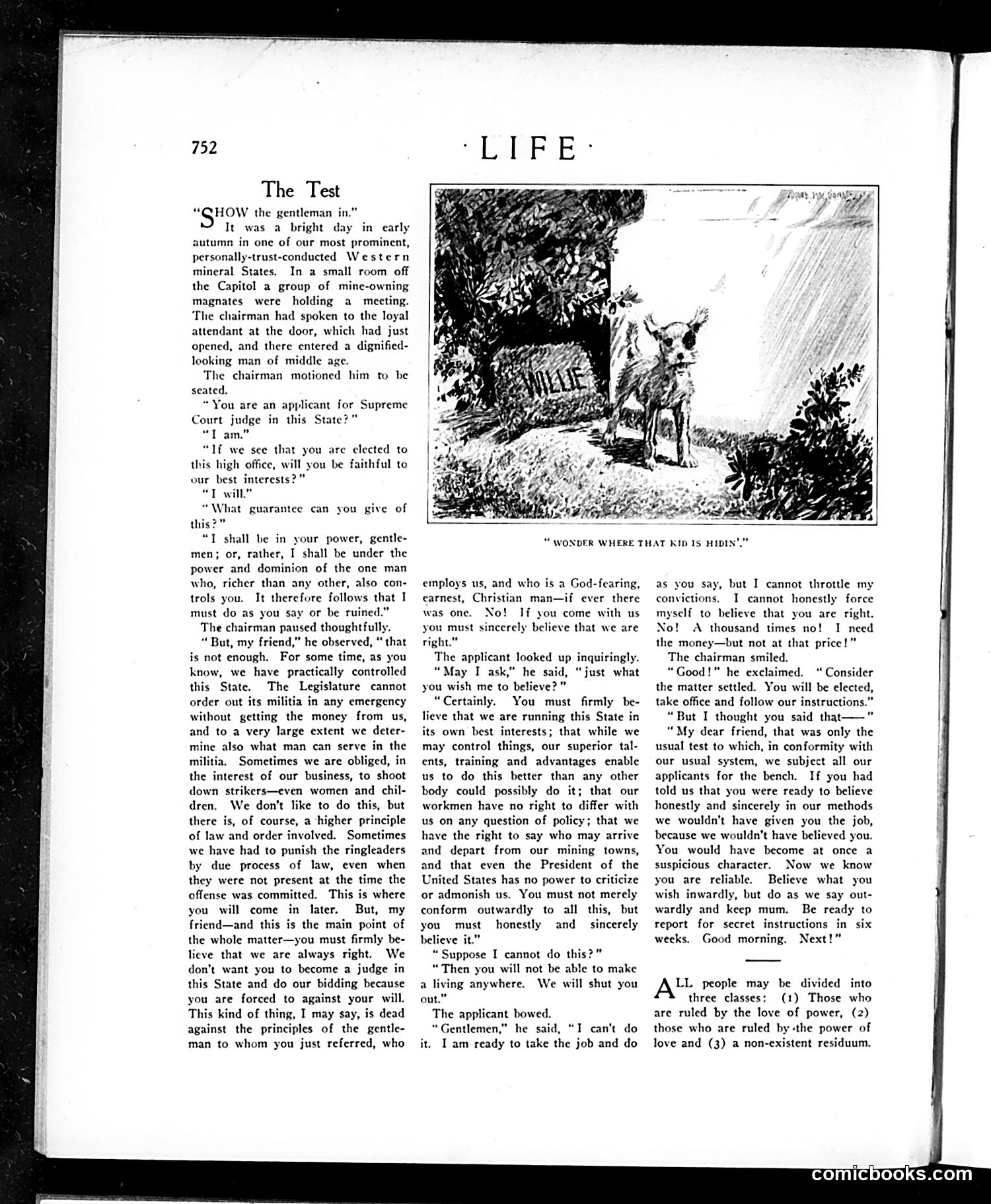
This satirical story exposes how wealthy mining magnates control state government, particularly the judiciary, in early 20th-century Western states. A group of mine owners interviews a Supreme Court judge candidate, demanding he pledge absolute loyalty to their interests and believe them always right—even when they shoot strikers or bend legal process. The candidate initially agrees under duress. However, when pressed to *sincerely believe* their superiority rather than merely obey, he refuses: "I cannot throttle my convictions." The chairman then declares him hired anyway—revealing the "test" was designed to identify men of principle who can be trusted *despite* knowing they're compromised. The satire's point: the magnates prefer judges who understand the corruption frankly rather than true believers. It's a damning critique of how economic power corrupts judicial independence and rule of law.
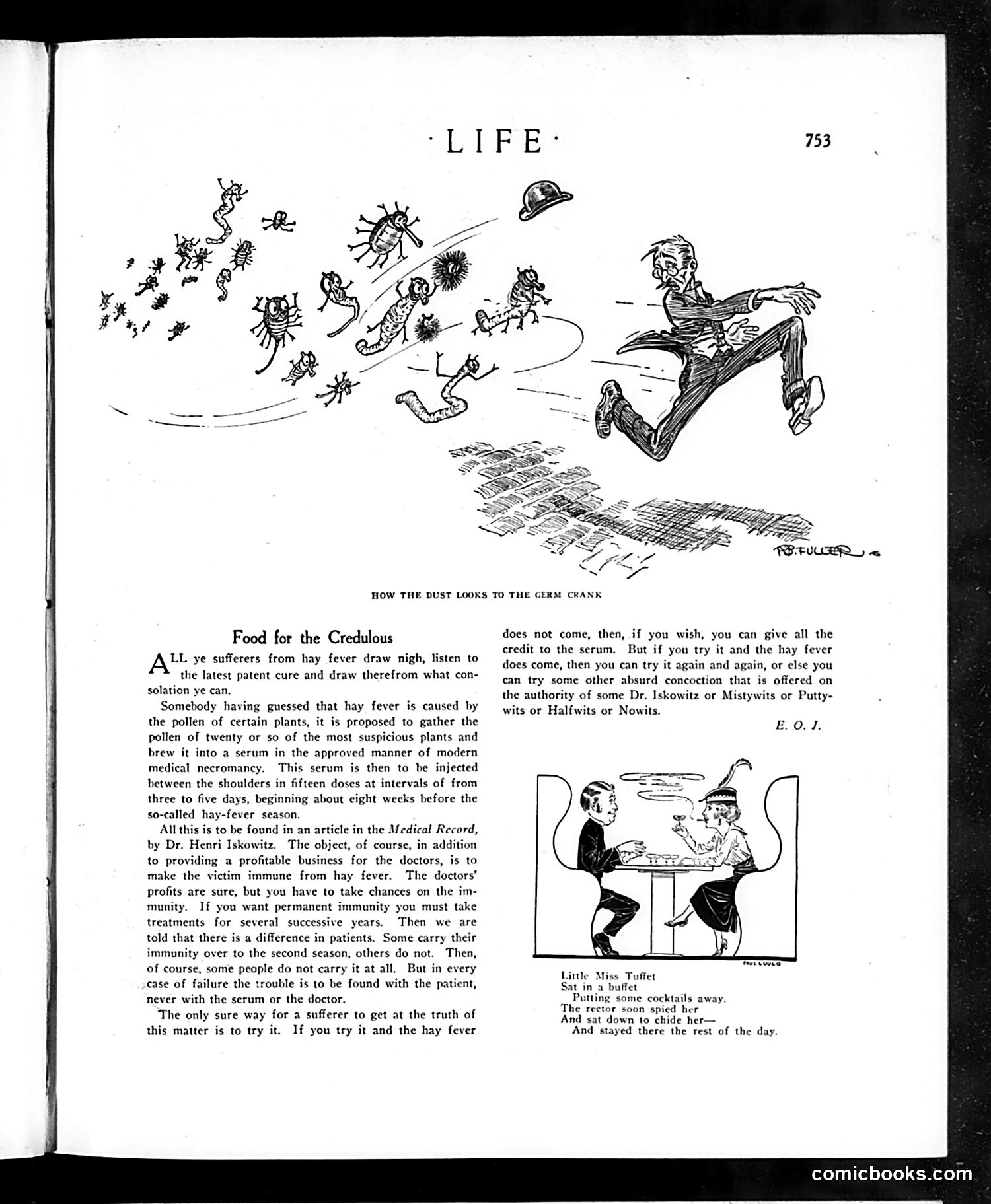
**Top Cartoon ("How the Dust Looks to the Germ Crank"):** A man frantically kicks away from swirling germs and dust particles. This illustrates the article's satire about germ theory and hay fever "cures." **Article ("Food for the Credulous"):** This is sharp satire attacking a proposed hay fever treatment—injecting pollen serum developed by Dr. Henri Iskowitz. The author mockingly calls it "medical necromancy" (quackery) that profits doctors while offering patients false hope. The satire's bite: if the treatment works, credit the serum; if it fails, blame the patient—never the doctor or medicine. The author sarcastically suggests trying it repeatedly or switching to other dubious remedies by doctors with ridiculous names like "Halfwits or Nowits." **Bottom Cartoon:** A clergyman sits with a woman in a buffet, initially to scold her cocktail-drinking but stays all day—implying he becomes charmed or distracted. The page mocks both medical quackery and credulous patients who fall for pseudoscientific treatments.
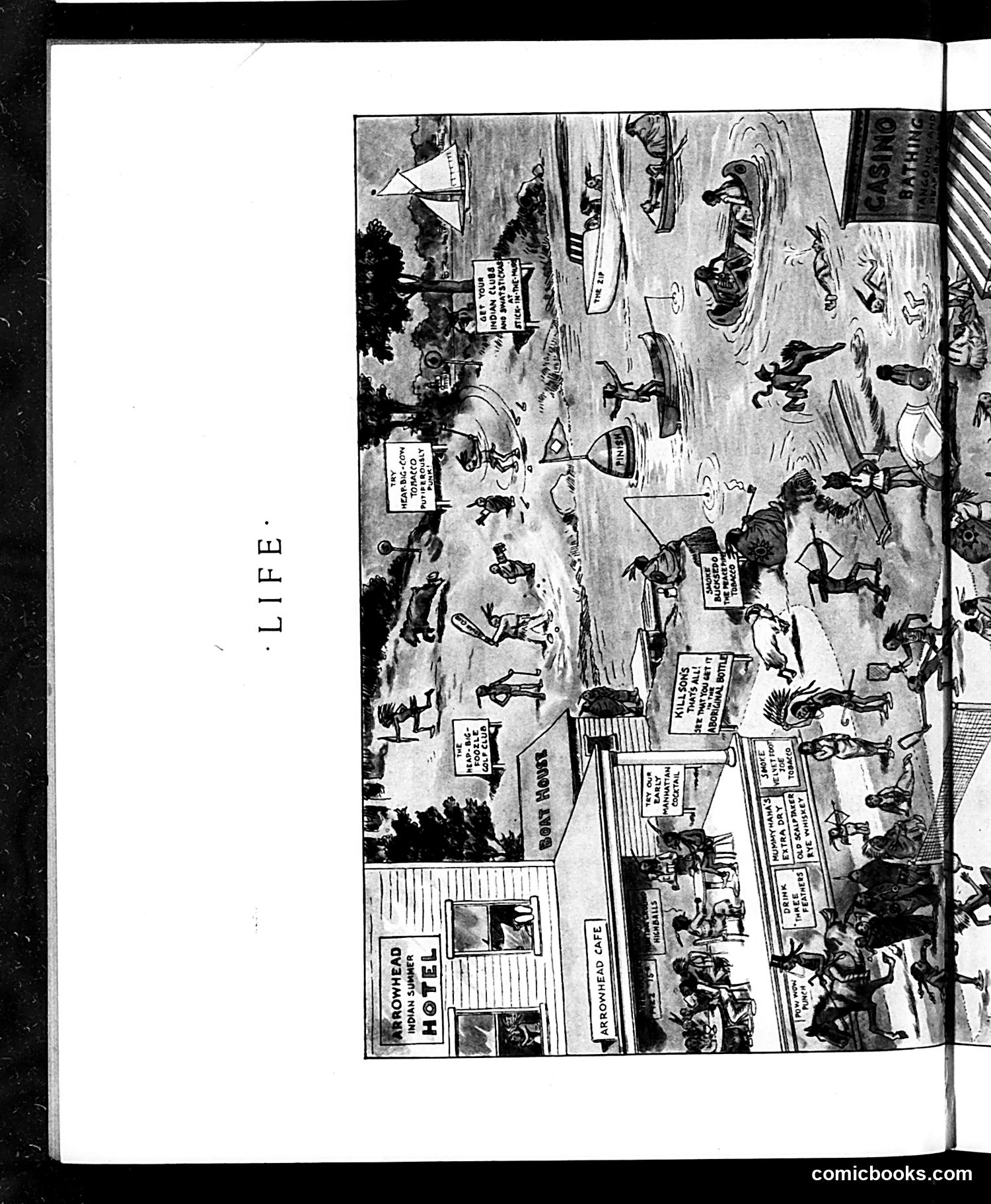
This page appears to be a title page or section divider from *Life* magazine, displaying only the word "LIFE" vertically on the left side. The right side contains what seems to be a rotated or sideways comic strip or illustrated sequence showing multiple figures in various scenes with dialogue bubbles and captions. However, the OCR text provided is essentially unreadable—appearing as random letters and symbols rather than coherent text. Without legible captions or dialogue, I cannot reliably identify the specific figures, political references, or satirical point being made. The image quality and orientation make detailed interpretation impossible. To properly analyze this cartoon's meaning, clearer OCR text or a correctly oriented image would be necessary.
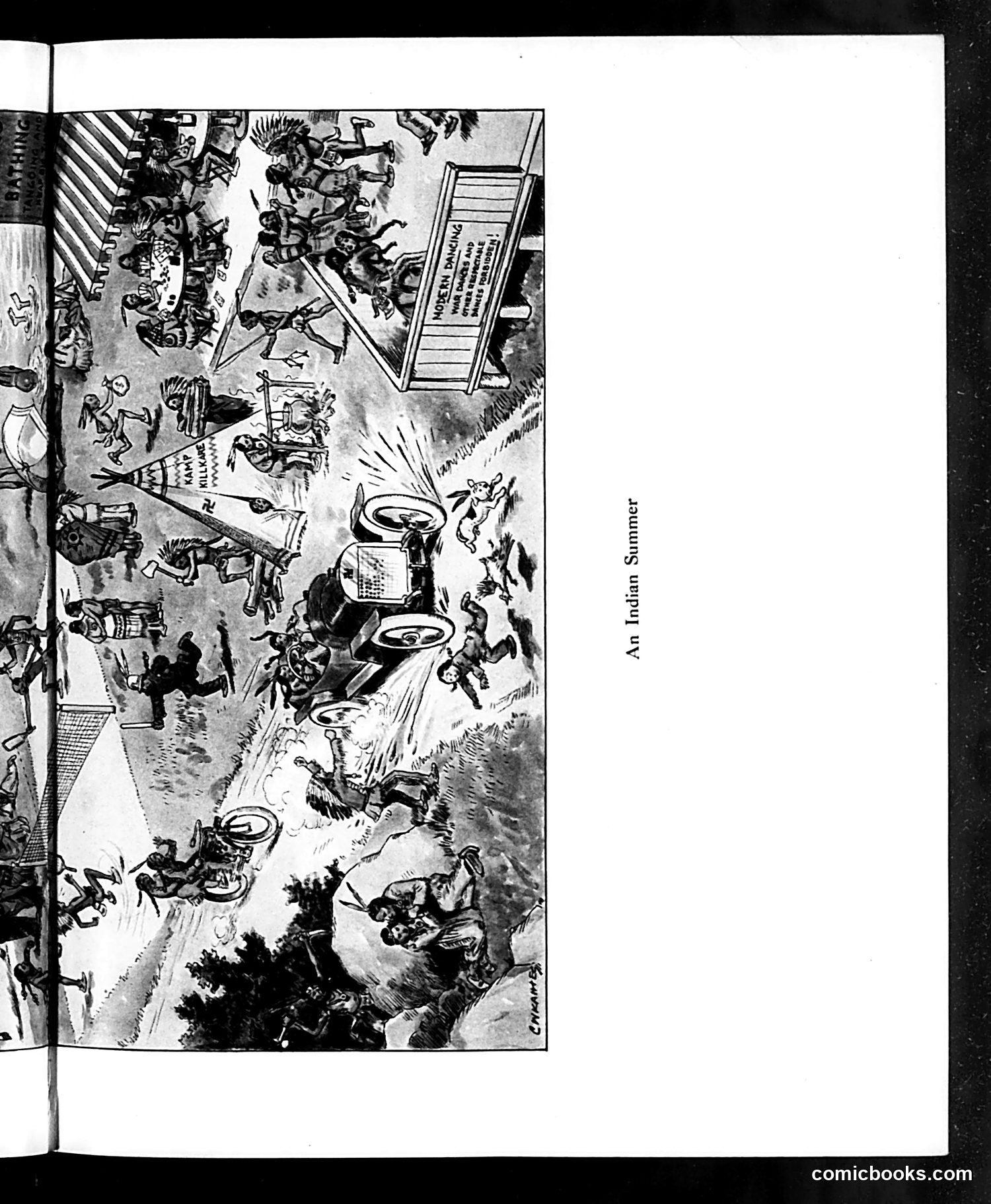
This satirical illustration depicts a Native American summer scene, likely from the late 19th or early 20th century. The cartoon shows Indigenous figures engaged in various activities around what appears to be a village or encampment, with structures visible in the background and natural landscape elements like vegetation. The title "An Indian Summer" is a pun—the phrase refers both to a warm autumn period and, here, literally depicts Native Americans during summer. The illustration appears to use stereotypical depictions common to the era's satirical humor, presenting Indigenous life as subject matter for comedic illustration in *Life* magazine's satirical tradition. Without clearer historical context, the specific satirical message remains unclear, though it likely reflects period attitudes toward Native Americans.
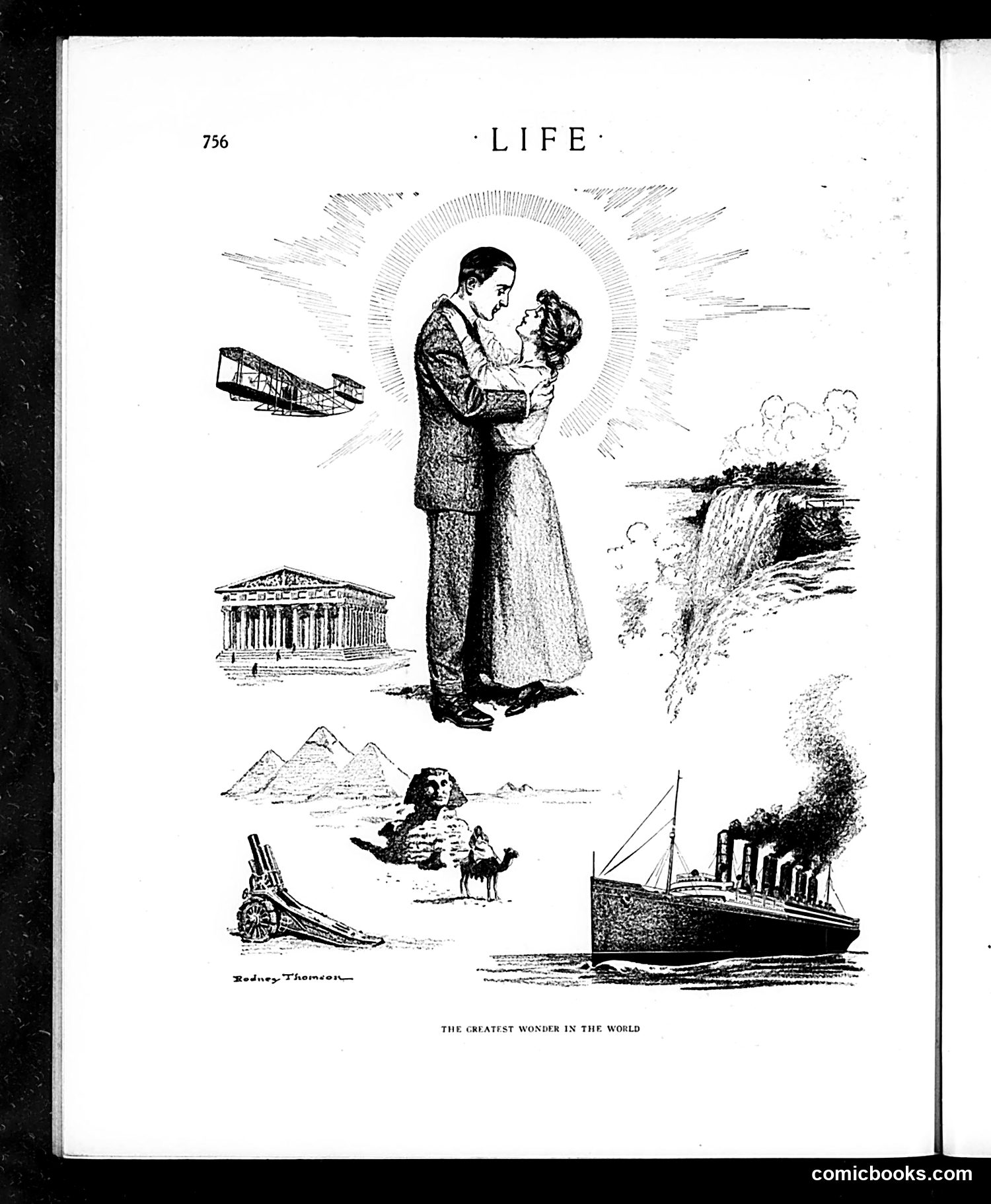
This Life magazine illustration by Rodney Thomson uses romantic imagery to satirize modern progress. A couple embraces within a glowing halo—traditionally suggesting divine or sacred love—while surrounded by symbols of contemporary achievement: an airplane, Greek temple, Egyptian pyramids, Niagara Falls, a cannon, a steamship, and what appears to be the Sphinx. The caption "THE GREATEST WONDER IN THE WORLD" ironically juxtaposes intimate human connection against humanity's material and technological accomplishments. The satire suggests that while moderns celebrate engineering marvels and historical monuments, genuine human love remains the true marvel—though the coupling of romance with these worldly symbols also mocks the era's tendency to conflate progress with meaning.
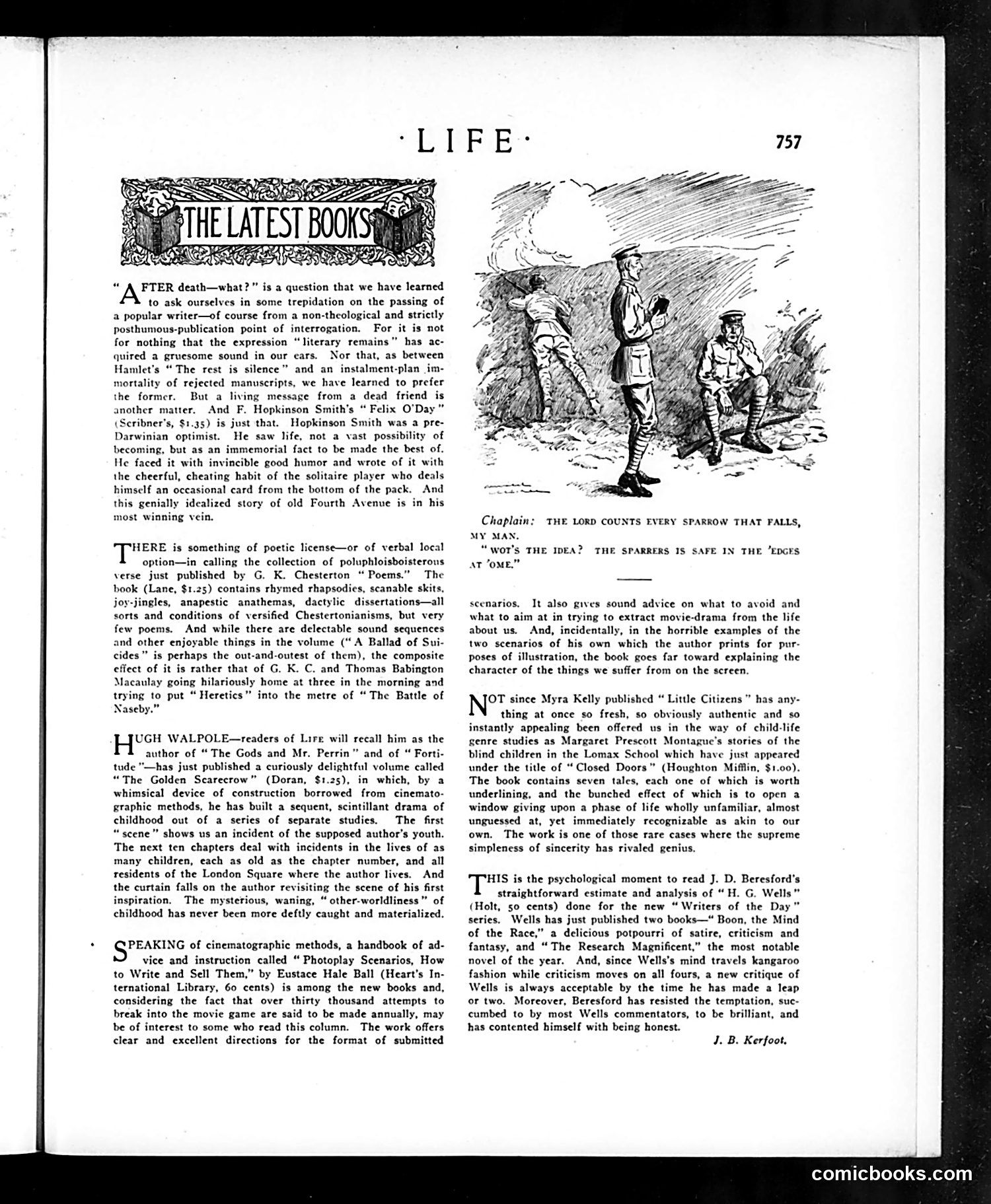
This page from *Life* magazine is primarily a book review column titled "The Latest Books," featuring literary criticism rather than political cartooning. The single illustration depicts a **Chaplain character** (likely from a literary work) speaking to soldiers, with the caption quoting: "The Lord counts every sparrow that falls, my man. 'Wot's the idea? The sparrers is safe in the 'edges at 'ome.'" This appears to reference **trench warfare during World War I**, where soldiers discuss divine providence and safety—the Chaplain's pious sentiment contrasts with the soldier's sardonic, working-class British dialect response. The satire targets the disconnect between religious comfort offered to combat troops and battlefield reality. The reviews discuss books by F. Hopkinson Smith, G.K. Chesterton, and Hugh Walpole, offering no additional political content beyond this single cartoon commentary on wartime faith and soldier skepticism.
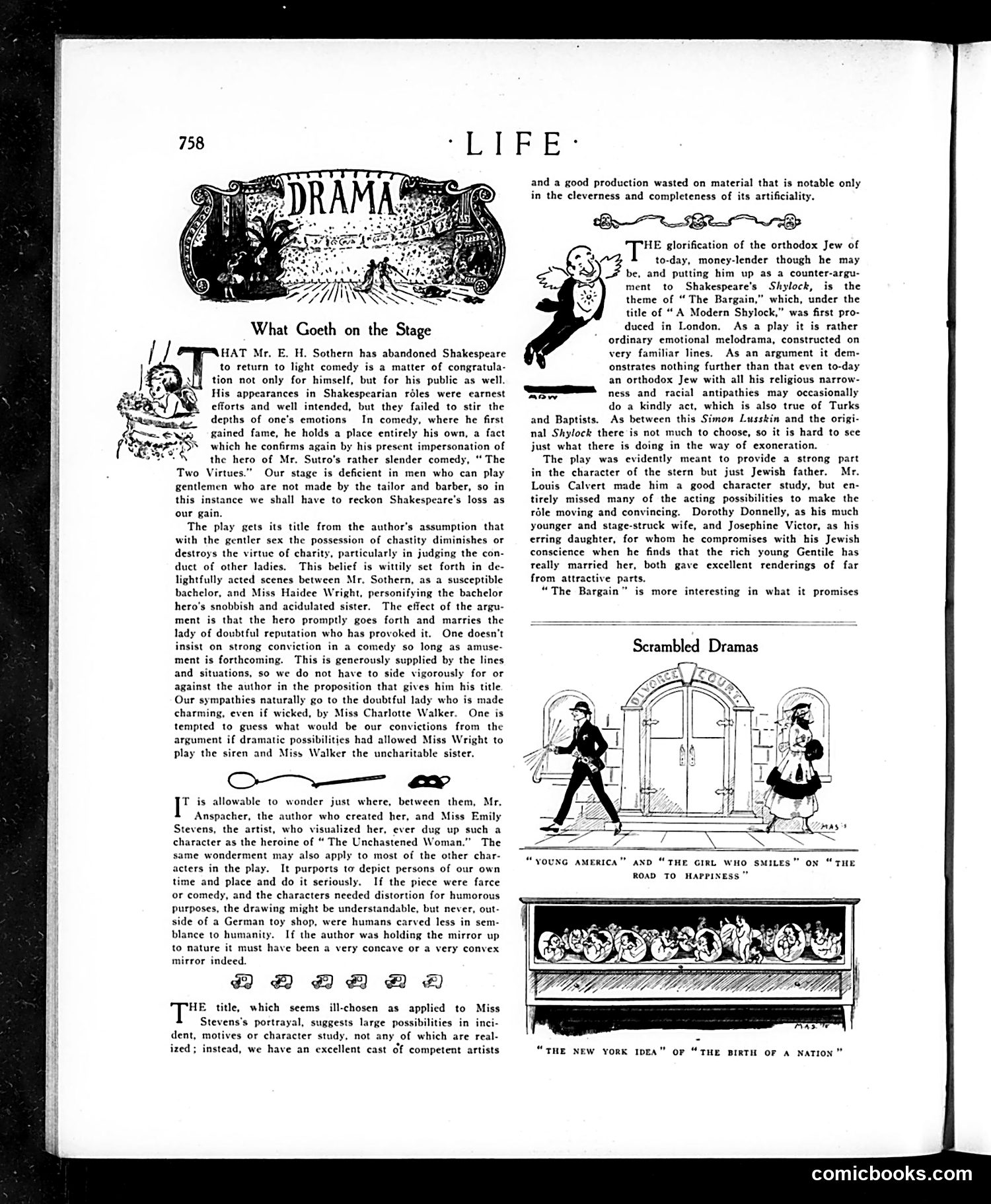
This page reviews three theatrical productions. The main critiques address: **"The Two Virtues"** — E.H. Sothern plays a bachelor in a comedy about whether chastity diminishes charity in women. The reviewer approves of Sothern abandoning Shakespeare for light comedy, where he excels. **"The Unchastened Woman"** — The critic finds the characters unrealistic and poorly drawn, comparing them unfavorably to actual humans—suggesting the playwright failed to create believable modern people despite attempting serious drama rather than farce. **"The Bargain"** (also titled "A Modern Shylock") — This appears to present a sympathetic Orthodox Jewish money-lender as a counter-example to Shakespeare's *Shylock*. The reviewer dismisses this as ordinary melodrama that proves nothing—that doing one kind act doesn't overcome deeper prejudices. The small illustrations show stage scenes from productions. The page represents typical early 20th-century theater criticism blending plot summary with moral and artistic judgment.
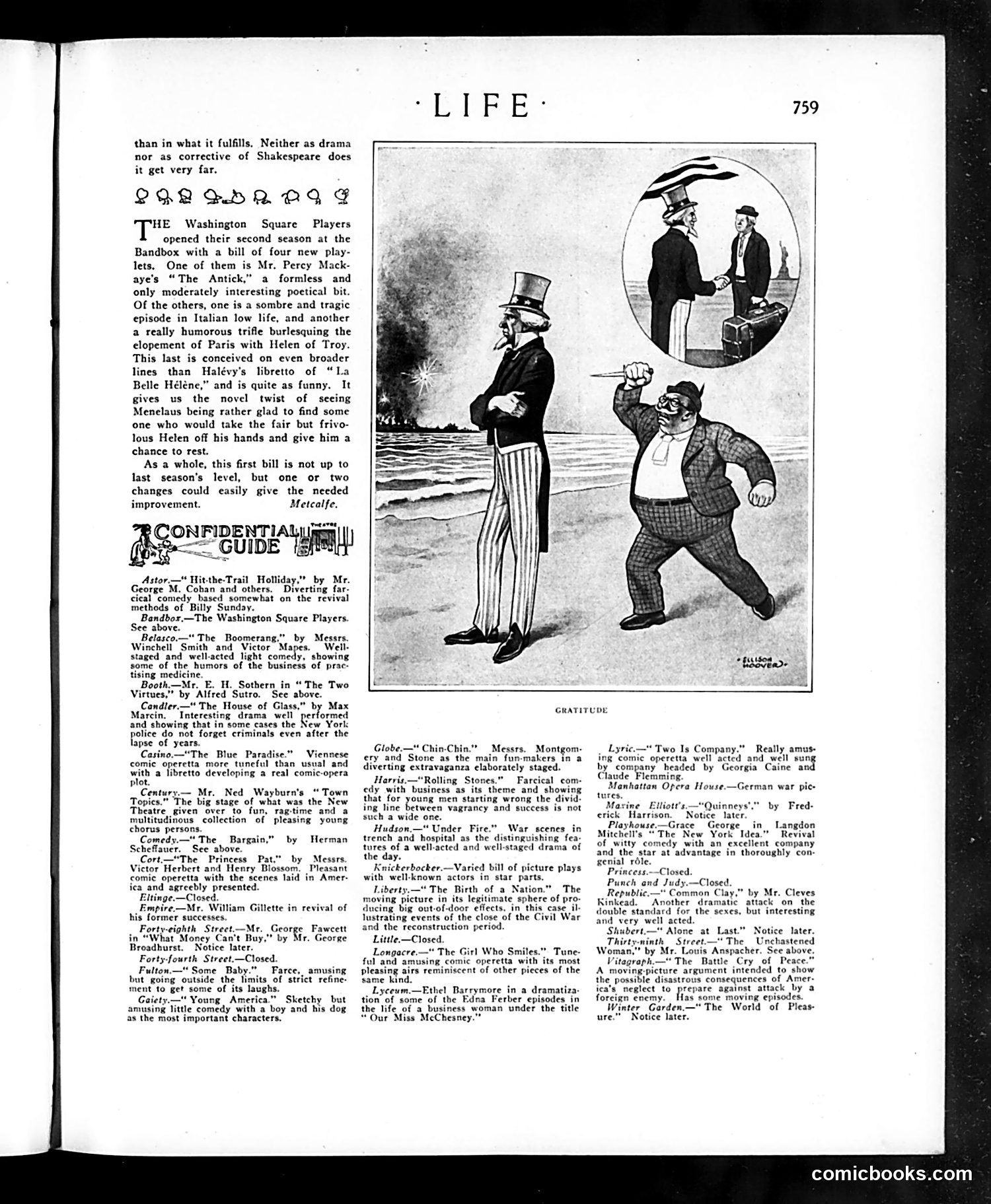
This political cartoon satirizes the relationship between labor and capital during the Progressive Era. The central figure—a well-dressed gentleman in top hat and striped trousers (representing a capitalist or industrialist)—stands beside the ocean holding a large umbrella. Below him, a working-class man in worn clothing appears to be drowning or struggling in the water. The title "Gratitude" conveys bitter irony: the cartoon suggests that wealthy employers expect workers to be grateful for minimal protection or assistance—represented by the umbrella—while leaving them essentially helpless and vulnerable (in deep water). The satire critiques the paternalistic attitude of the wealthy toward labor: that providing any small benefit warrants worker submission and thankfulness, regardless of exploitative conditions. This reflects broader Progressive-era debates about workers' rights, fair wages, and corporate responsibility.
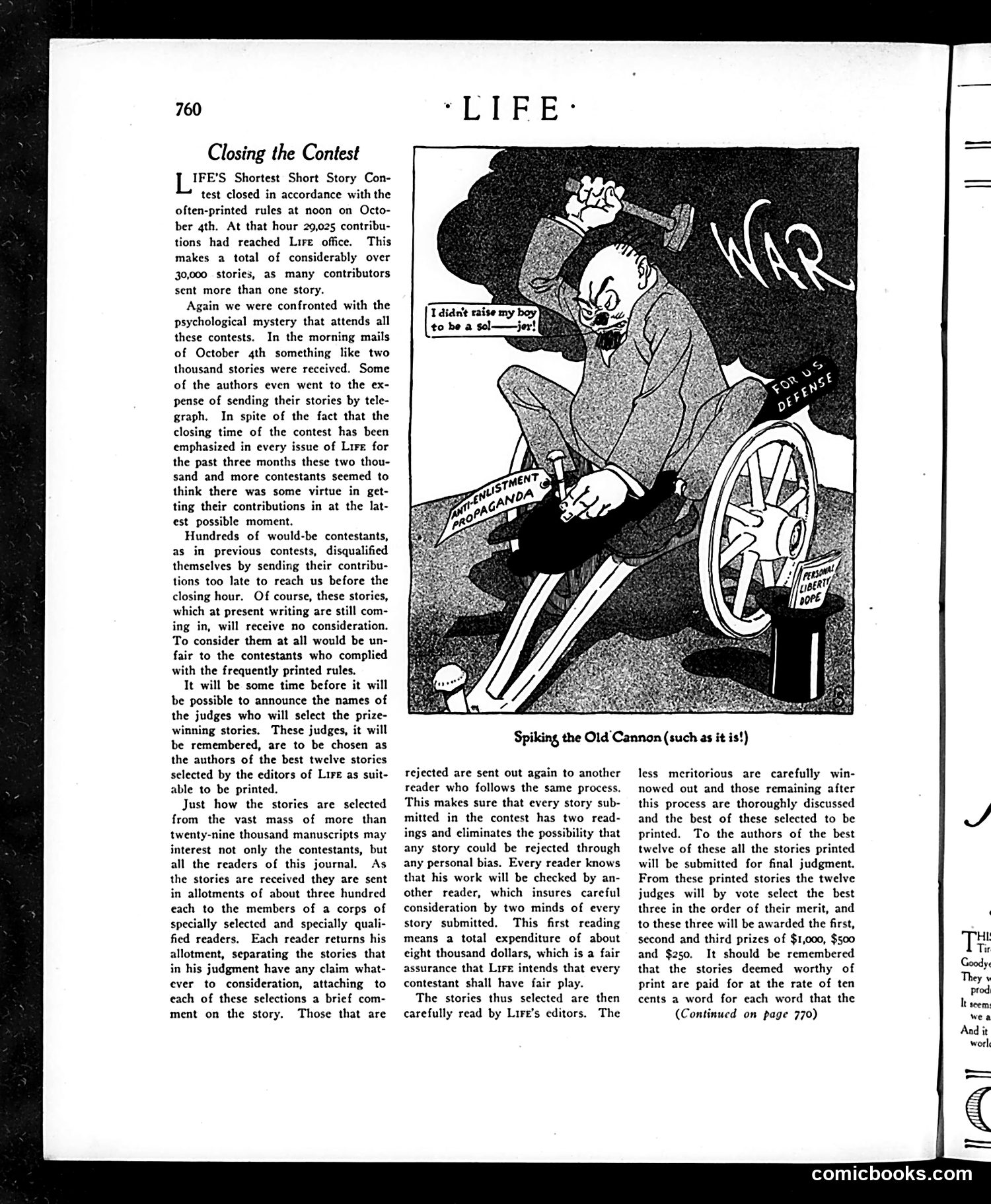
This cartoon satirizes the common idiom "I didn't raise my boy to be a soldier"—a popular phrase and song title from the World War I era expressing maternal opposition to military service. The cartoon depicts a woman literally "spiking" (disabling) a cannon by driving a spike through it, weaponizing the domestic sentiment into direct action against war machinery. The visual pun transforms the sentimental phrase into active sabotage. The accompanying text describes Life magazine's short story contest closing procedures—not directly related to the cartoon's anti-war message. The cartoon likely comments on contemporary anxieties about military conscription or war preparation during this period, using dark humor to mock both pacifist sentiment and its impotence against military institutions. The woman's determined expression suggests frustrated defiance against forces beyond civilian control.
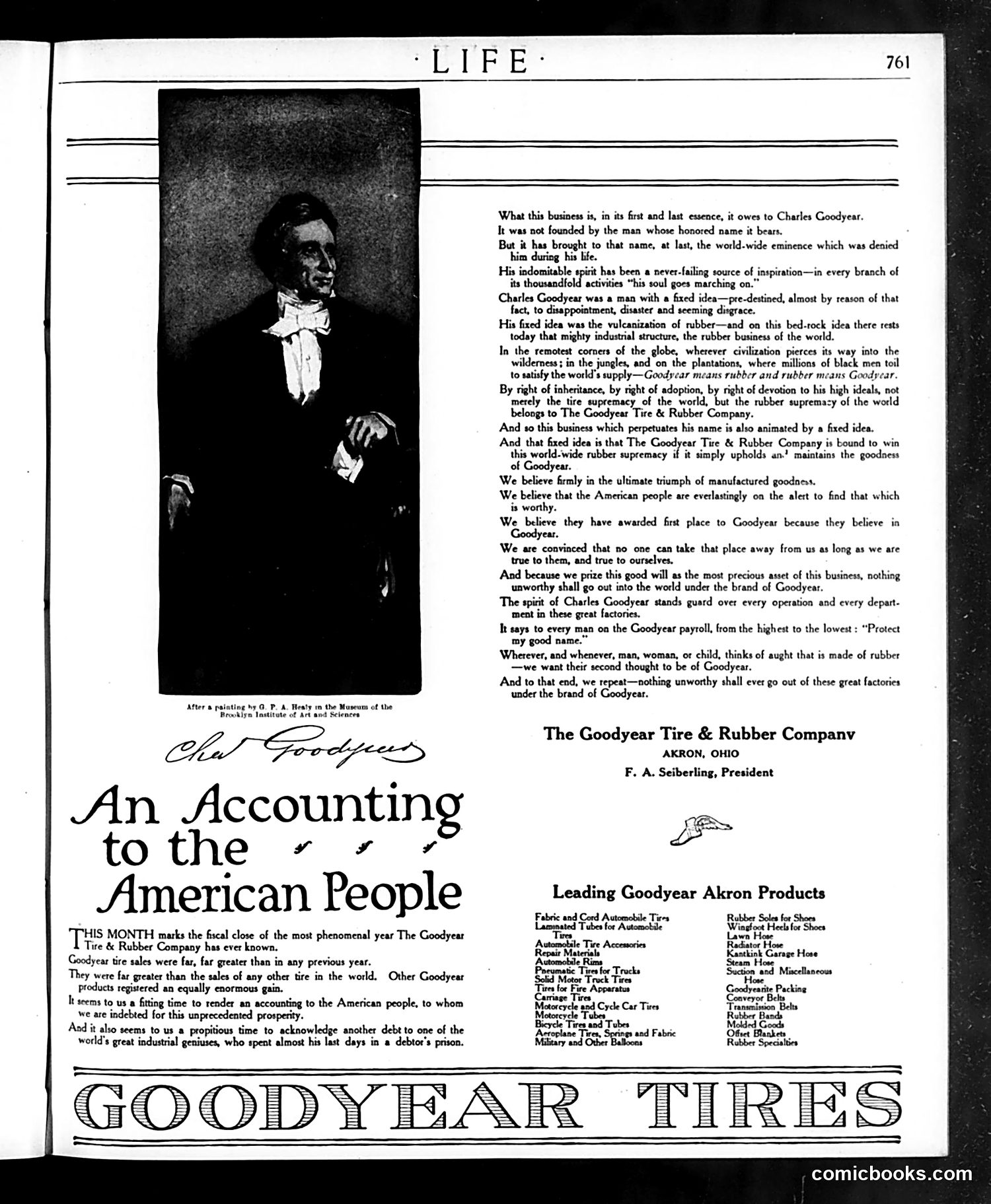
This is primarily a **corporate advertisement** for Goodyear Tire & Rubber Company, not political satire. The page features a portrait (after a painting by G.P.A. Healy) of **Charles Goodyear**, the 19th-century inventor of vulcanization—the process that made rubber practical and durable. The text is a hagiographic corporate message crediting Goodyear's "fixed idea" (vulcanization) as the foundation of the modern rubber industry. The company uses his legacy to establish its own credibility and moral authority, essentially claiming to inherit his spirit and values. The "accounting to the American people" is Goodyear's fiscal report for a record year, positioned as fulfilling a debt to both Goodyear (the historical figure) and the American public who made their success possible. This represents **corporate mythmaking**—using a historical innovator's reputation to market contemporary products and build brand loyalty.
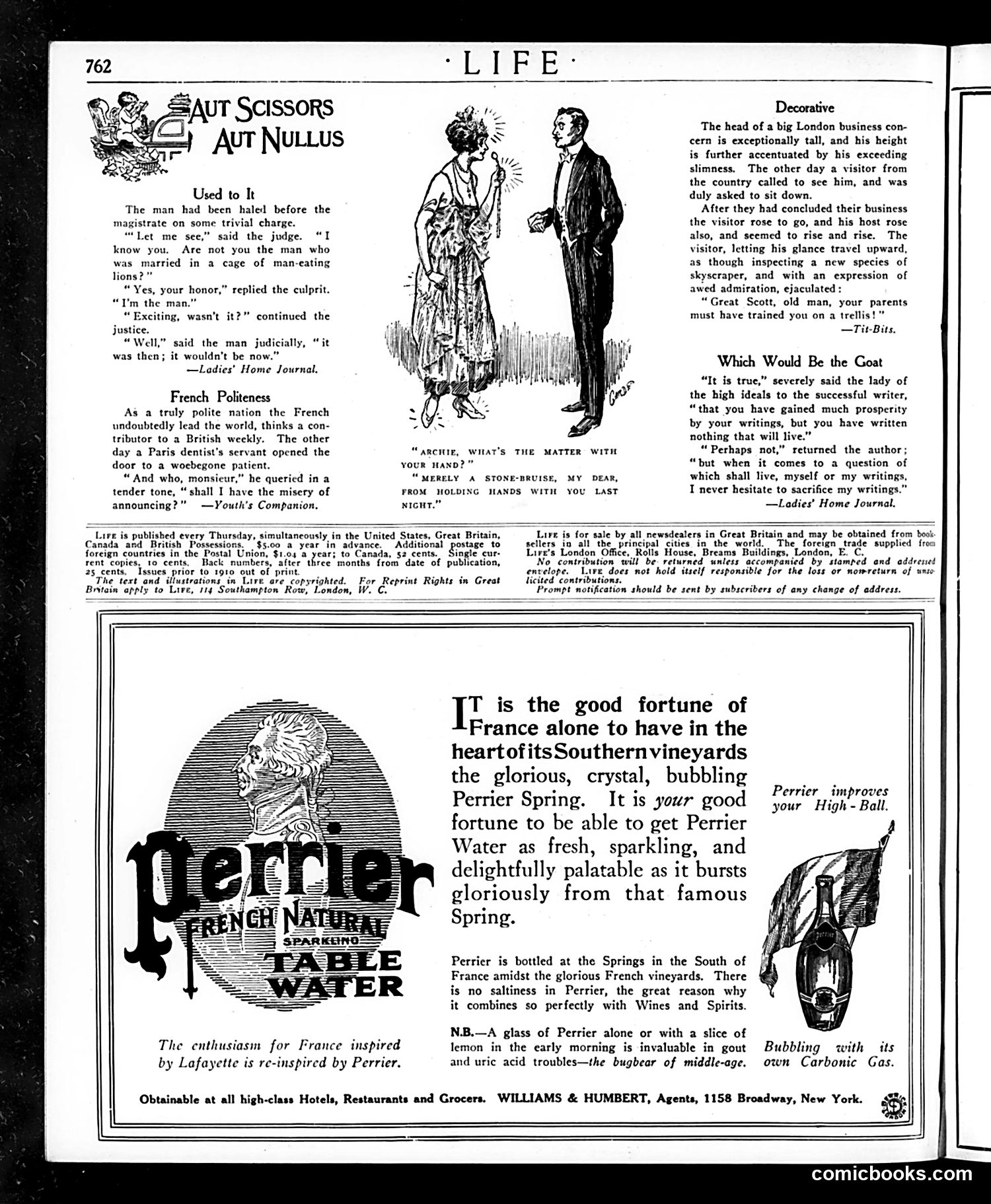
This page contains three brief satirical anecdotes and a Perrier water advertisement. The cartoons mock social conventions through humorous exchanges: 1. **"Aut Scissors"**: A man married in a cage of man-eating lions tells a judge the experience was exciting then, "but it wouldn't be now"—satirizing how extraordinary events lose their thrill over time. 2. **"French Politeness"**: A Parisian dentist's servant greets a patient by asking who caused his injury, then apologizes for the stone-bruise the patient received from "molding hands with you last night"—mocking exaggerated French courtesy that somehow blames the victim while remaining polite. 3. **"Which Would Be the Coat"**: An author tells a woman criticizing his work that when choosing between his writings surviving or himself surviving, he'll sacrifice his writings—humorous self-deprecation about artistic priorities versus personal survival. The page is primarily advertising space, with Perrier water dominating the lower half.
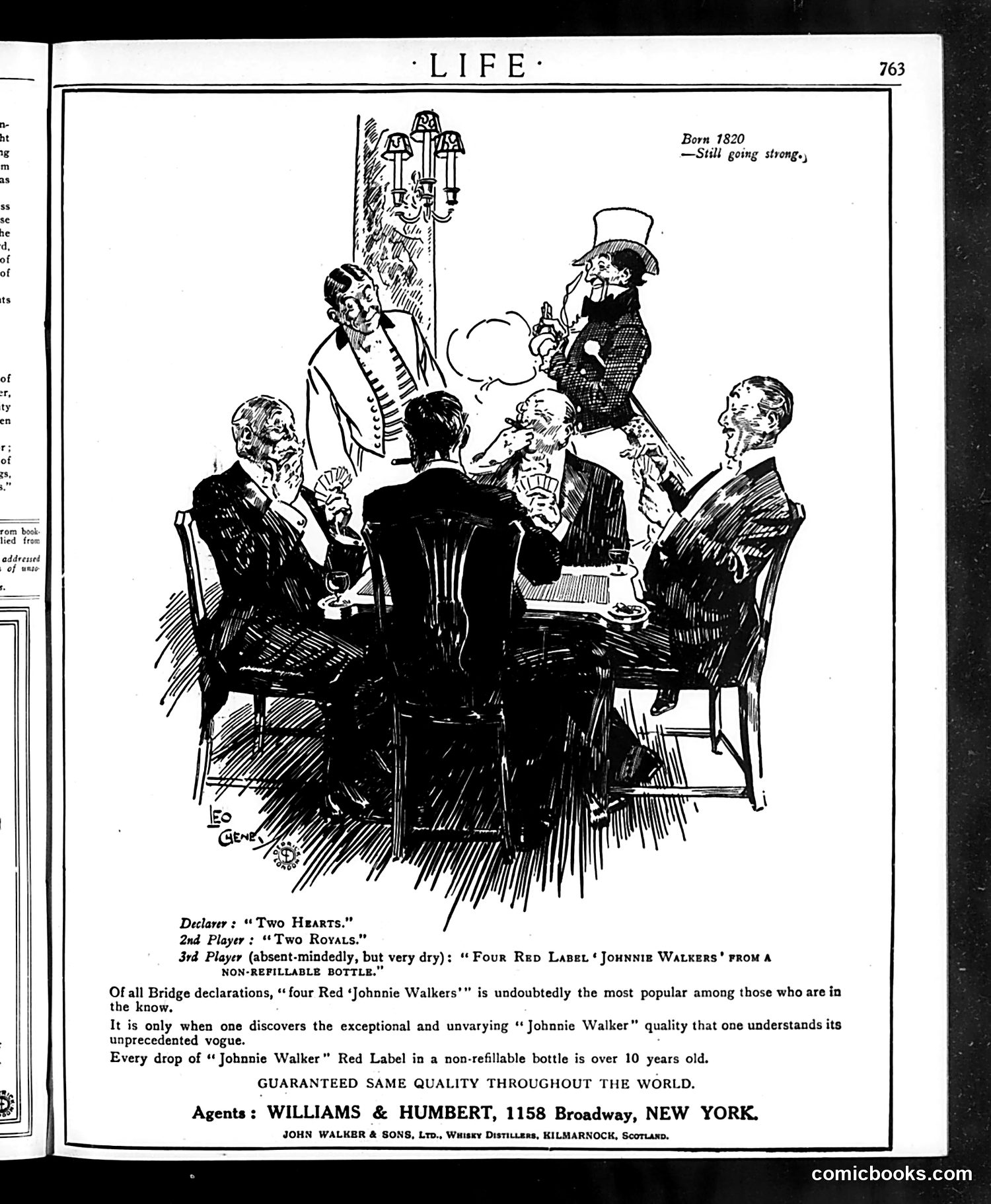
This is **advertising content disguised as editorial humor**—a common practice in early 20th-century magazines. The cartoon depicts gentlemen playing bridge (a popular card game among the wealthy) where one player absent-mindedly declares "Four Red Label Johnnie Walkers' from a non-refillable bottle" instead of a legitimate card bid. The joke: the player is so accustomed to drinking Johnnie Walker scotch that it's on his mind even during cards. The ad then pivots to earnest marketing copy praising the whisky's quality and 10-year aging process. The "Born 1820—Still going strong" caption refers to Johnnie Walker's founding date, personifying the brand as a vigorous centenarian. This represents **early-century advertising strategy**: wrapping product promotion in satirical humor to make it seem like editorial content rather than a sales pitch. The bridge-playing setting targets the upper-class demographic who would consume this magazine and afford premium scotch.
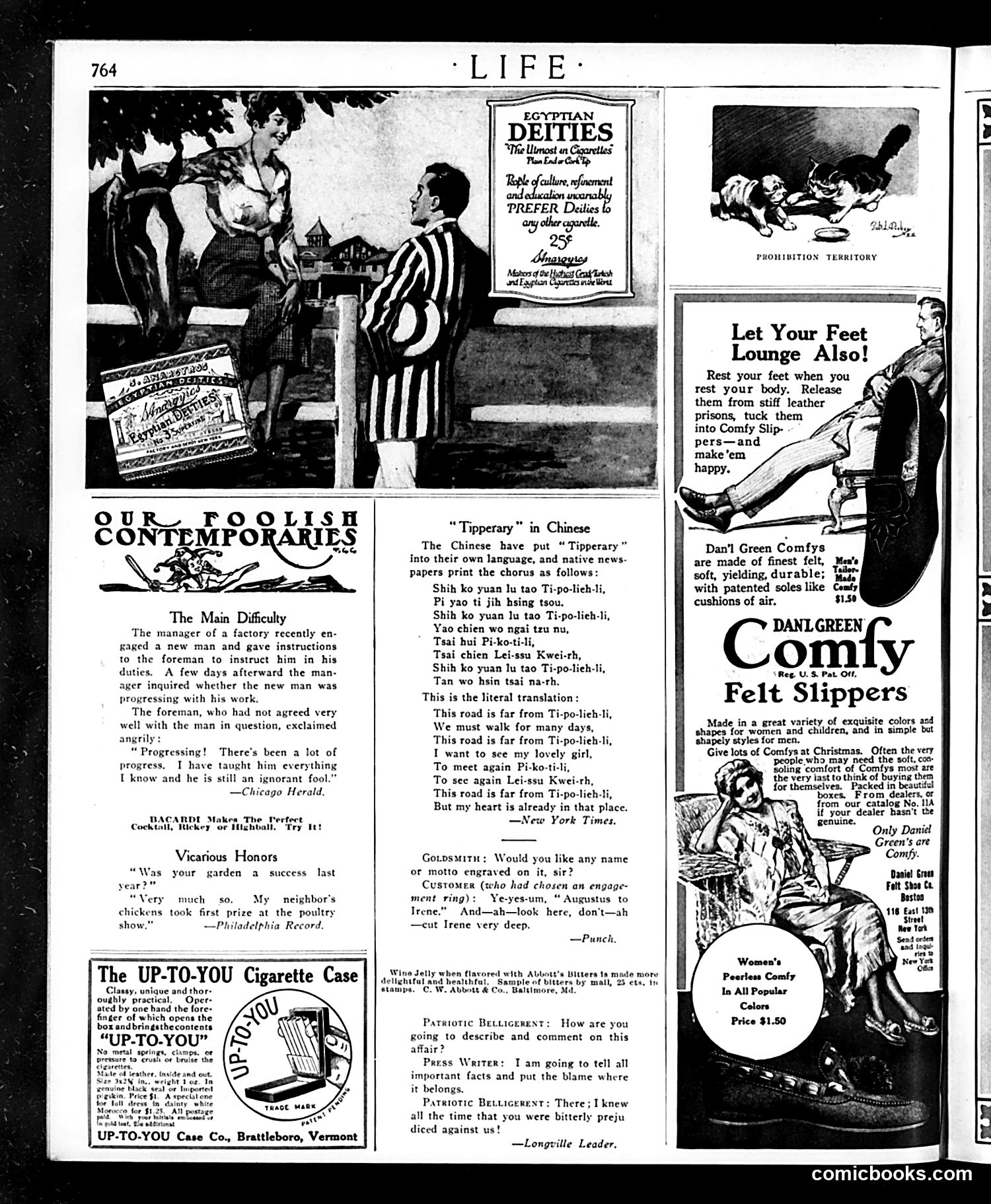
This is primarily an **advertising and humor page** from Life magazine, likely from around World War I (given the "Tipperary" reference—a famous WWI song). The main content includes: **Humor pieces:** Brief jokes about workplace frustration, gardening pride, and journalistic bias—typical satirical fare mocking human nature. **Cultural note:** A piece on "Tipperary in Chinese" documents how the popular WWI marching song was translated and adopted in China, showing global reach of the conflict's culture. **One political joke:** A "Patriotic Belligerent" criticizes a press writer for reporting facts fairly and assigning blame objectively—the belligerent interprets honest journalism as prejudice against his side. This satirizes how wartime propaganda expects media loyalty over truth. **Remainder:** Full-page advertisements for cigarette cases, slippers, rum, and other consumer goods—standard Life magazine fare mixing content and commerce. No recognizable political figures or caricatures appear.
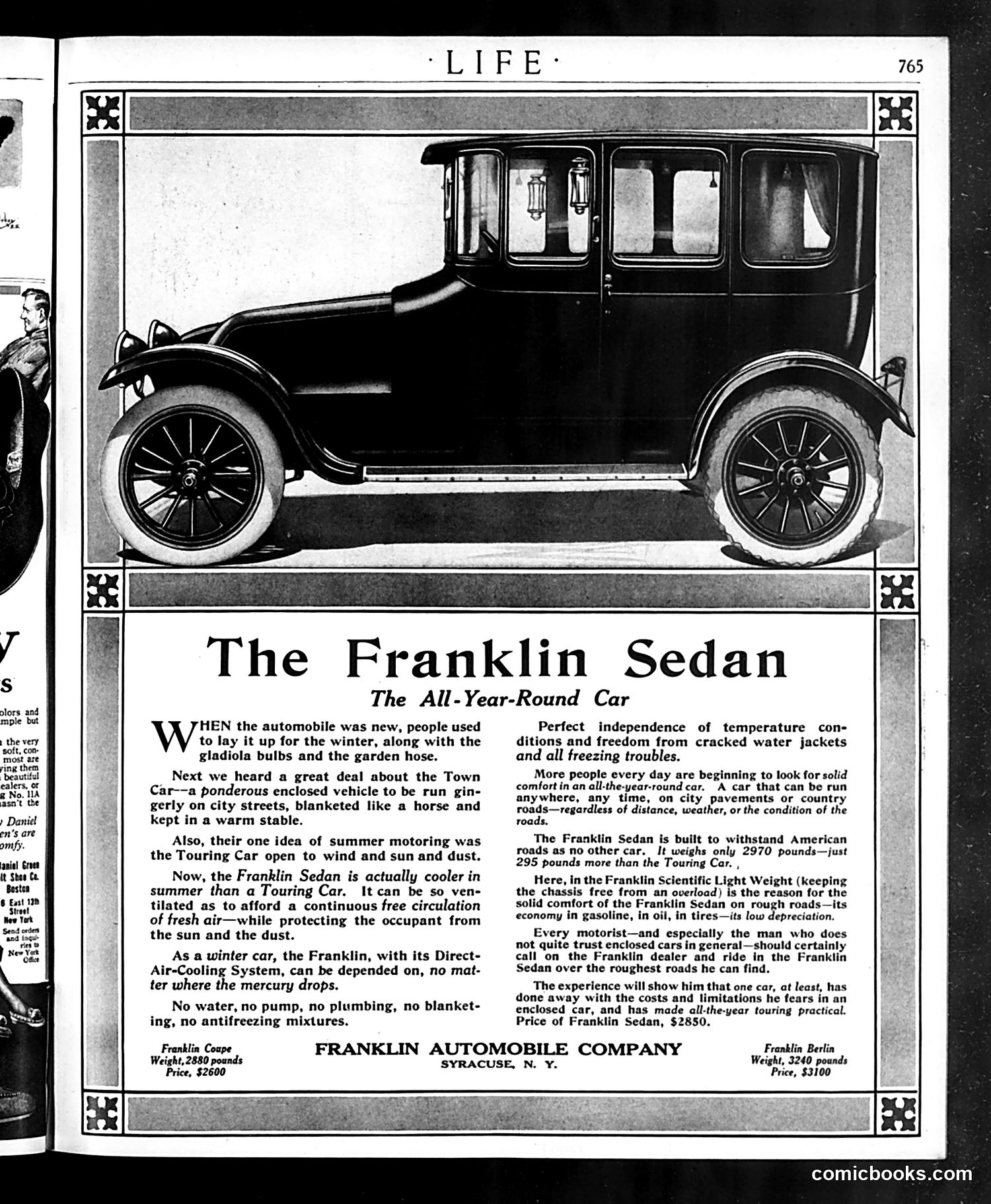
This page is primarily a **product advertisement**, not a political cartoon. It promotes the Franklin Sedan automobile, manufactured in Syracuse, New York. The ad addresses practical concerns of early 1920s motorists: automobiles required seasonal storage (winterized like horses), and owners debated between open touring cars and enclosed town cars. Franklin's innovation was year-round usability—its air-cooling system eliminated water-freezing problems and offered summer ventilation without the dust exposure of open cars. The text positions the Franklin as solving the era's automobile limitations: no water pumps, anti-freeze mixtures, or seasonal layups needed. At $2,850, it's marketed as combining luxury comfort with practical durability on American roads. This reflects a transitional moment when automobiles shifted from seasonal luxury to practical year-round transportation—a genuine selling point rather than satire.
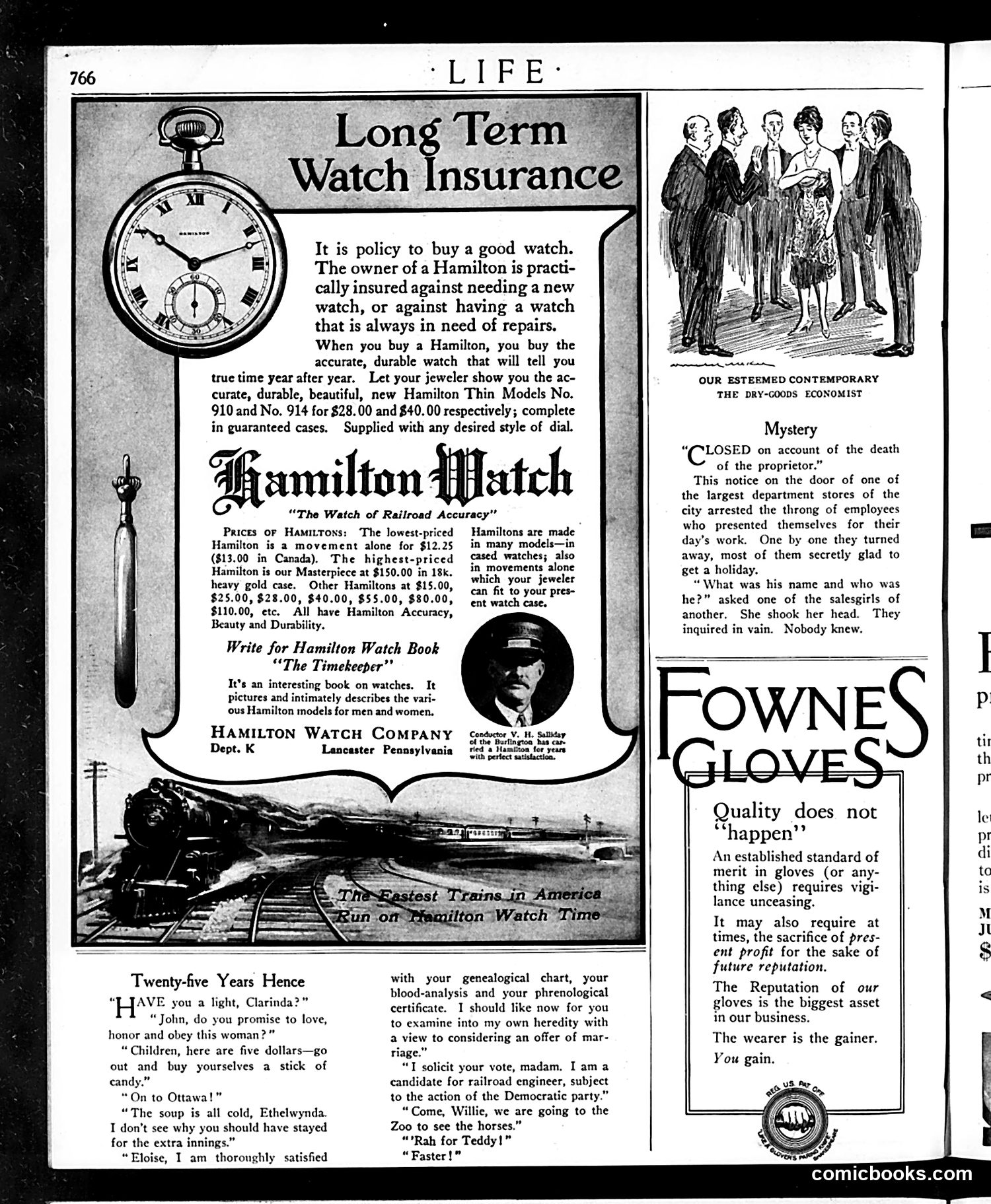
This page is primarily **advertising** rather than editorial satire. The dominant content is a Hamilton Watch Company advertisement promoting their timepieces as reliable and durable—"the watch of railroad accuracy"—with various models priced from $12.25 to $150. The small satirical section titled "Mystery" mocks corporate indifference: a large department store closes due to the proprietor's death, yet employees arriving for work are secretly relieved to get a holiday. Nobody even knows who the dead owner was. The joke critiques how impersonal large retail businesses had become—the proprietor was so removed from daily operations that his death meant nothing to his staff. Below that, "Fownes Gloves" advertises quality merchandise, emphasizing that reputation and established standards matter in business. The page's bottom section contains fragmentary dialogue appearing to satirize social pretension and political ambition (references to genealogy, phrenology, railroad engineers, and "Teddy" [likely Theodore Roosevelt]), though context is incomplete. Overall: mostly advertising with minor social satire about corporate anonymity and class aspiration.
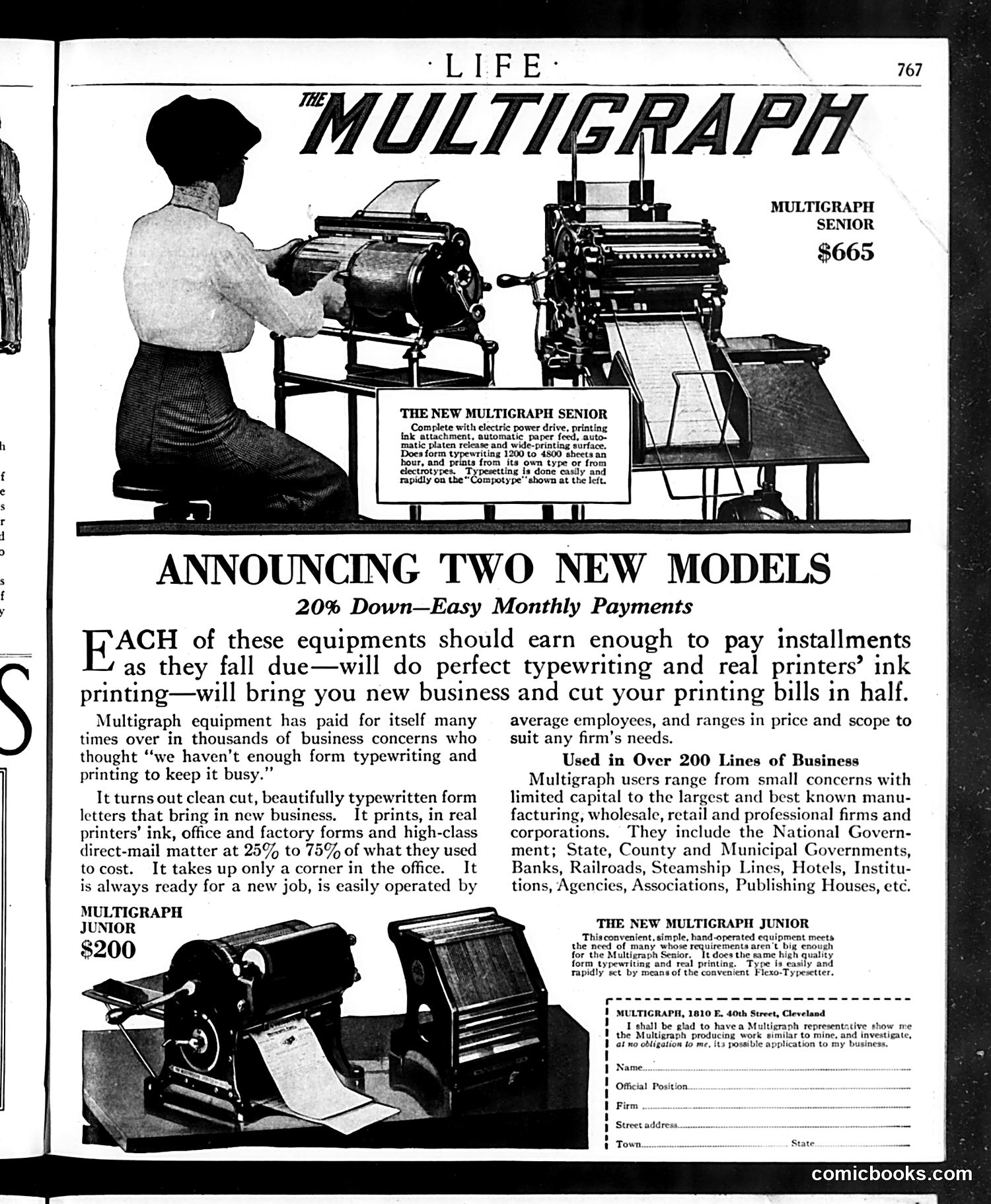
This is **not a cartoon or satire**—it's a straightforward **product advertisement** for Multigraph office equipment, appearing in Life magazine (likely 1920s-30s based on styling and typography). The page announces two new copying/printing machine models: the Multigraph Senior ($665) and Junior ($200). The image shows a woman operator using the equipment at her desk. **The "pitch":** These machines will pay for themselves by enabling small businesses to produce professional typewritten letters, forms, and direct-mail materials in-house at 25-75% cost savings. The ad emphasizes the machines are simple to operate, space-efficient, and already used by major corporations, government agencies, and banks. **For modern readers:** This represents early office automation marketing—selling labor-saving technology to businesses. The gendered imagery (woman operator) reflects period workplace norms. The financing offer ("20% down, easy monthly payments") shows early consumer credit marketing targeting small business owners.
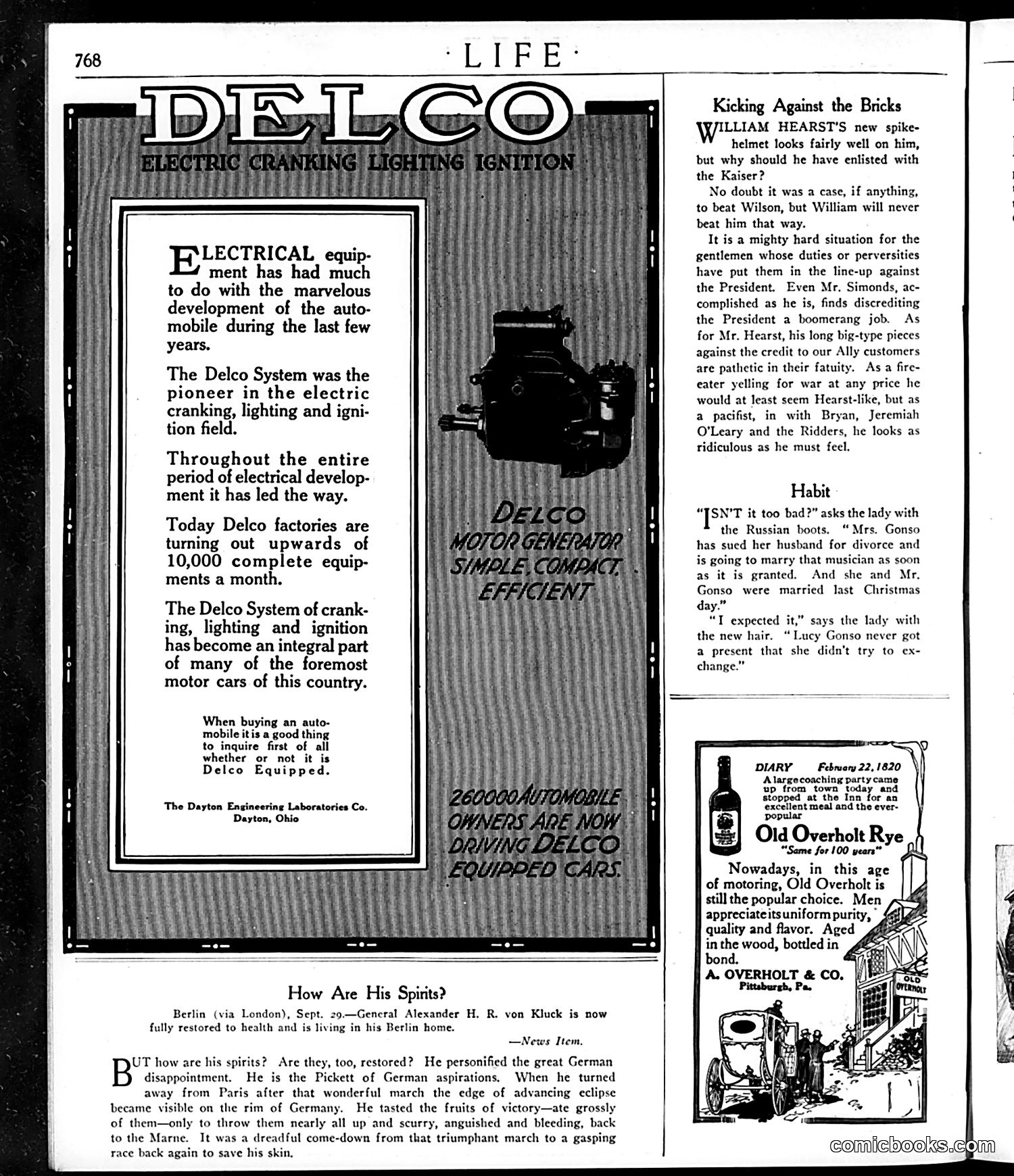
This page mixes advertisements with political satire typical of Life's editorial voice. **"How Are His Spirits?"** critiques General Alexander von Kluck, a German WWI commander. The piece sarcastically questions whether his "spirits" have recovered along with his health. It compares him to Pickett (the failed Confederate general), suggesting von Kluck embodied German military disappointment—he advanced victoriously toward Paris, then retreated humiliated to the Marne. The satire emphasizes his fall from triumph to desperate survival, portraying him as symbolizing Germany's failed war ambitions. **"Kicking Against the Bricks"** attacks William Randolph Hearst for his pacifist stance. Life mocks him for adopting anti-war positions (allied with Bryan and others against President Wilson) while wearing military regalia—calling it ridiculous and hypocritical. The implication: Hearst's pacifism contradicts his bellicose public persona and weakens credibility compared to outright war advocacy. The remaining content is period advertising (Delco auto equipment, Old Overholt whiskey) and a gossip item about a woman repeatedly exchanging gifts.
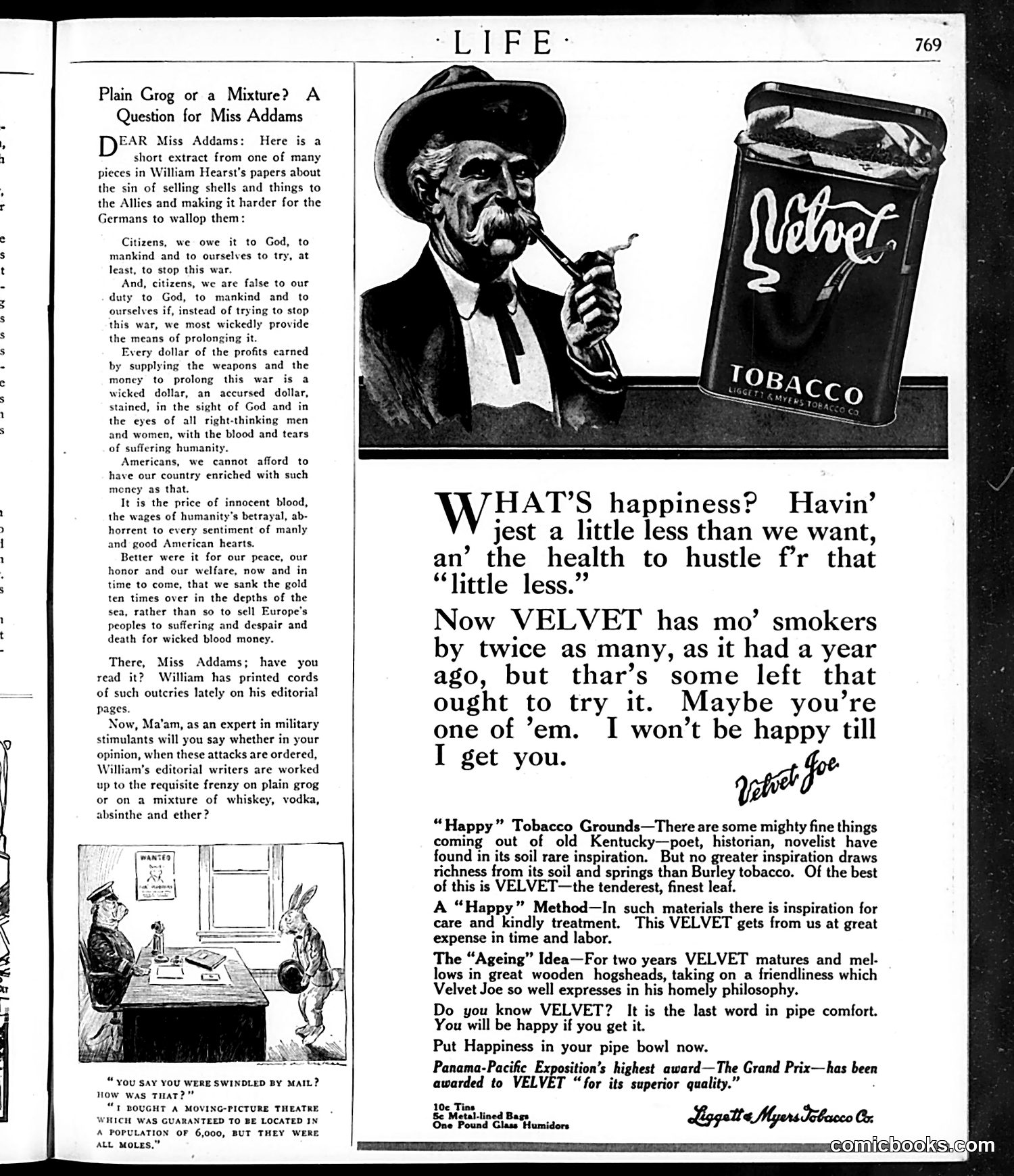
This page contains **editorial satire targeting William Randolph Hearst** alongside a **tobacco advertisement**. ## The Editorial Section (Left) "Miss Addams" refers to **Jane Addams**, the famous progressive reformer and pacifist. The author quotes extensively from Hearst's newspapers condemning American arms sales to the Allies during WWI, calling such profits "blood money." The satire's point: The author mocks Hearst's **hypocrisy**. The closing question sarcastically asks whether Hearst's editorial writers must be intoxicated ("plain grog or a mixture of whiskey, vodka, absinthe") to produce such fervent moral outrage—implying their passionate pacifism is artificially stimulated and insincere, likely masking pro-German sympathies. ## The Advertisement (Right) A **Velvet tobacco ad** featuring "Velvet Joe," a folksy character promoting pipe tobacco. The messaging emphasizes contentment with modest pleasures and Kentucky heritage. This appears incidental to the page's primary satirical purpose. The cartoon below shows a mail-fraud victim, providing additional satirical commentary on consumer deception.
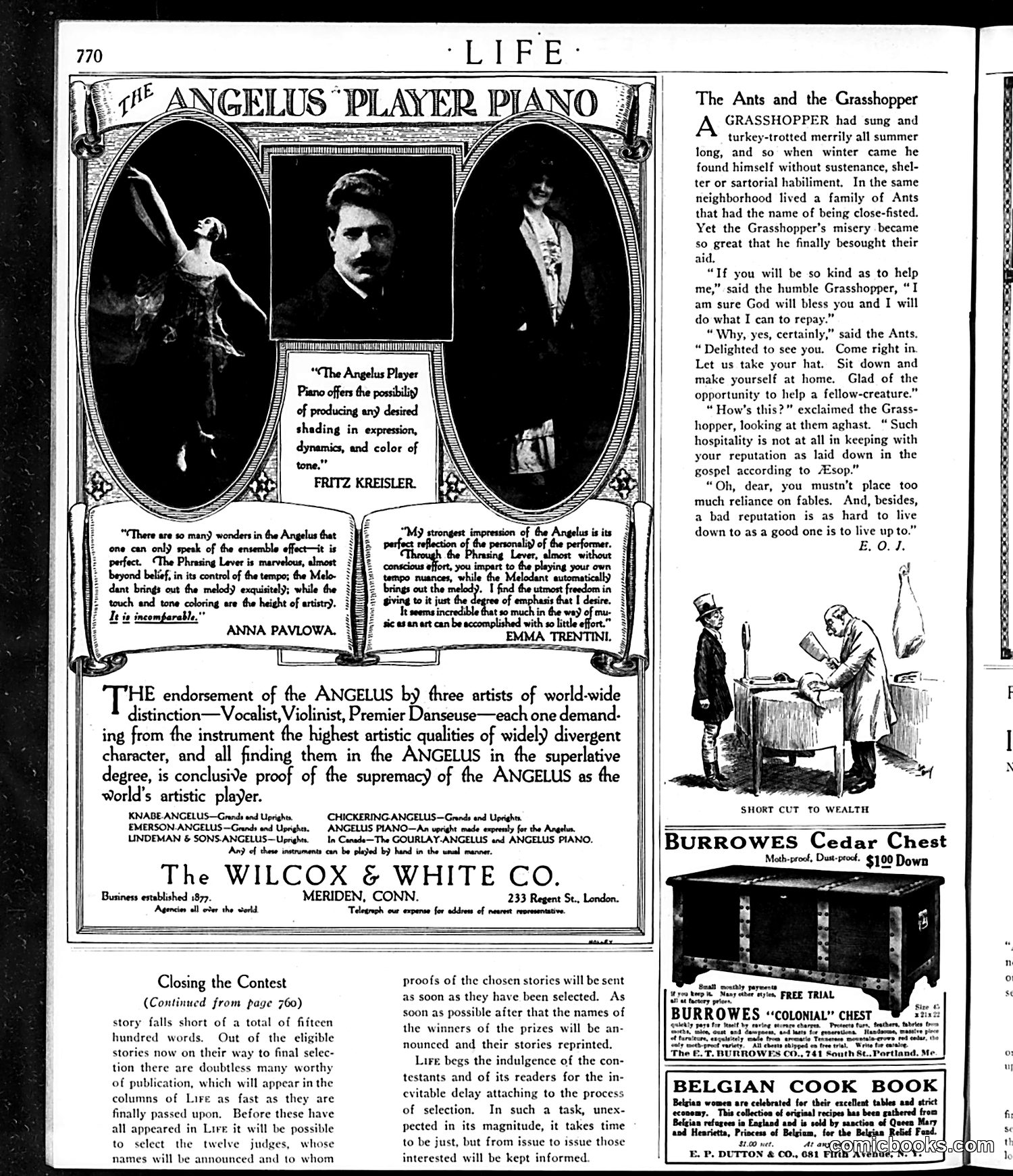
This page contains primarily **advertisements and filler content**, not political satire. The main feature is an ad for the **Angelus Player Piano**, endorsing it through testimonials from three "world-wide" artists (a vocalist, violinist, and "premier danseuse"). The pitch emphasizes the piano's artistic capabilities—its ability to produce nuanced expression and dynamics. Below that is a brief **Aesop's fable adaptation**: "The Ants and the Grasshopper." The modern twist: when the starving Grasshopper appeals to the famously stingy Ants, they respond with unexpected kindness and hospitality. The Grasshopper expresses shock, citing "the gospel according to Aesop." The Ants reply that bad reputations are "as hard to live down as a good one is to live up to"—a gentle moral about defying stereotypes. The remainder consists of other advertisements (cedar chests, a Belgian cookbook for relief fundraising) and a notice about Life magazine's ongoing story contest. No clear political satire is evident here.
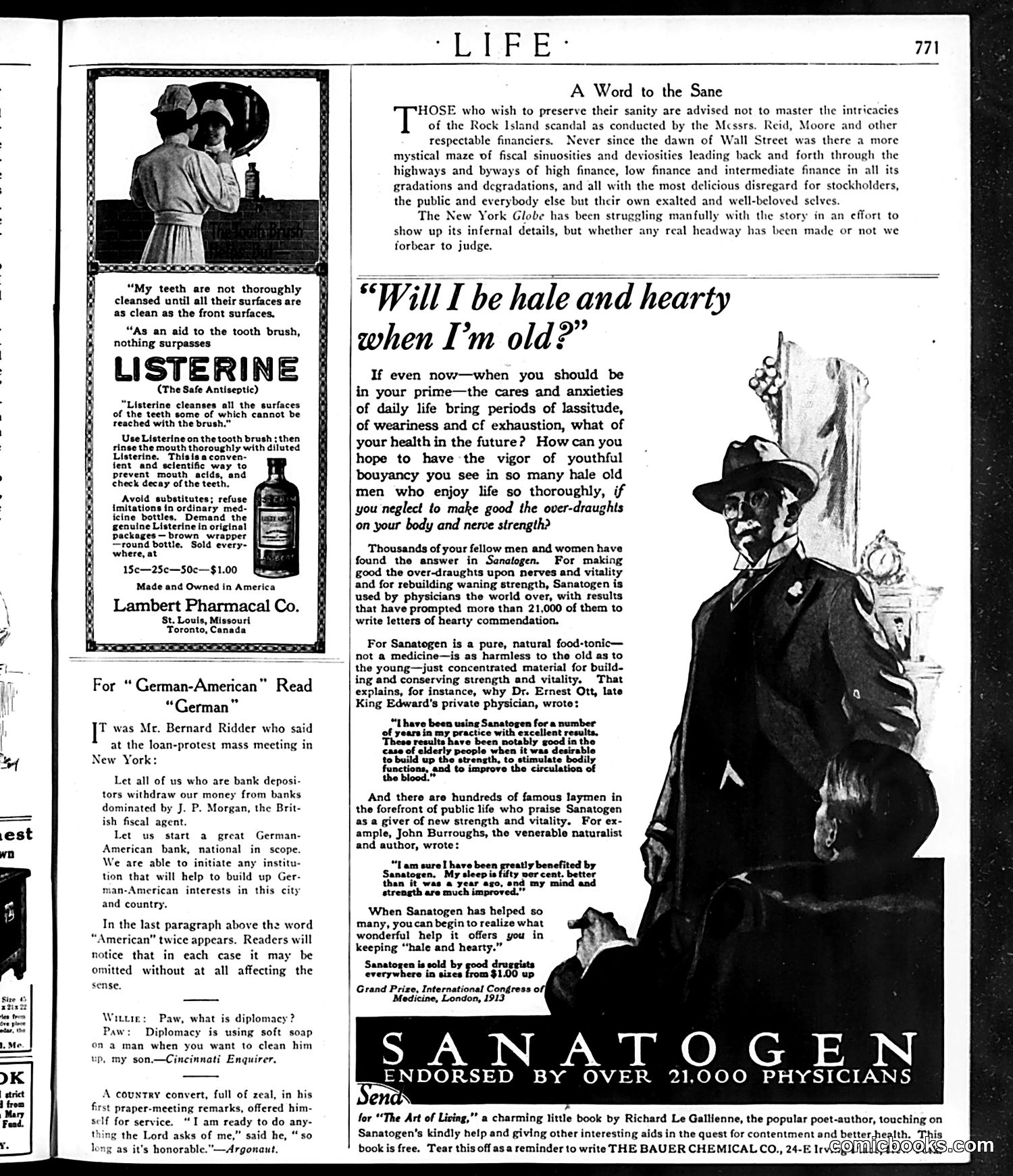
This Life magazine page combines satirical commentary with period advertising. **"A Word to the Sane"** mocks the complexity of the Rock Island railroad scandal involving financiers Reid and Moore—a Byzantine financial scheme so convoluted that even the *New York Globe* struggled to expose its details. The satire suggests ordinary people should avoid trying to understand Wall Street corruption, as it's deliberately obscured. The cartoons and advertisements below are unrelated to this political commentary. They include a Listerine mouthwash ad and a prominent Sanatogen tonic advertisement (endorsed by over 21,000 physicians). Sanatogen was a nutritional supplement marketed as a cure-all for fatigue and weakness, featuring testimonials from King Edward VII's physician and naturalist John Burroughs. **Context:** The page reflects early 1900s concerns about corporate financial fraud and the era's widespread use of patent medicines and tonics promoted through celebrity endorsements—practices now heavily regulated.
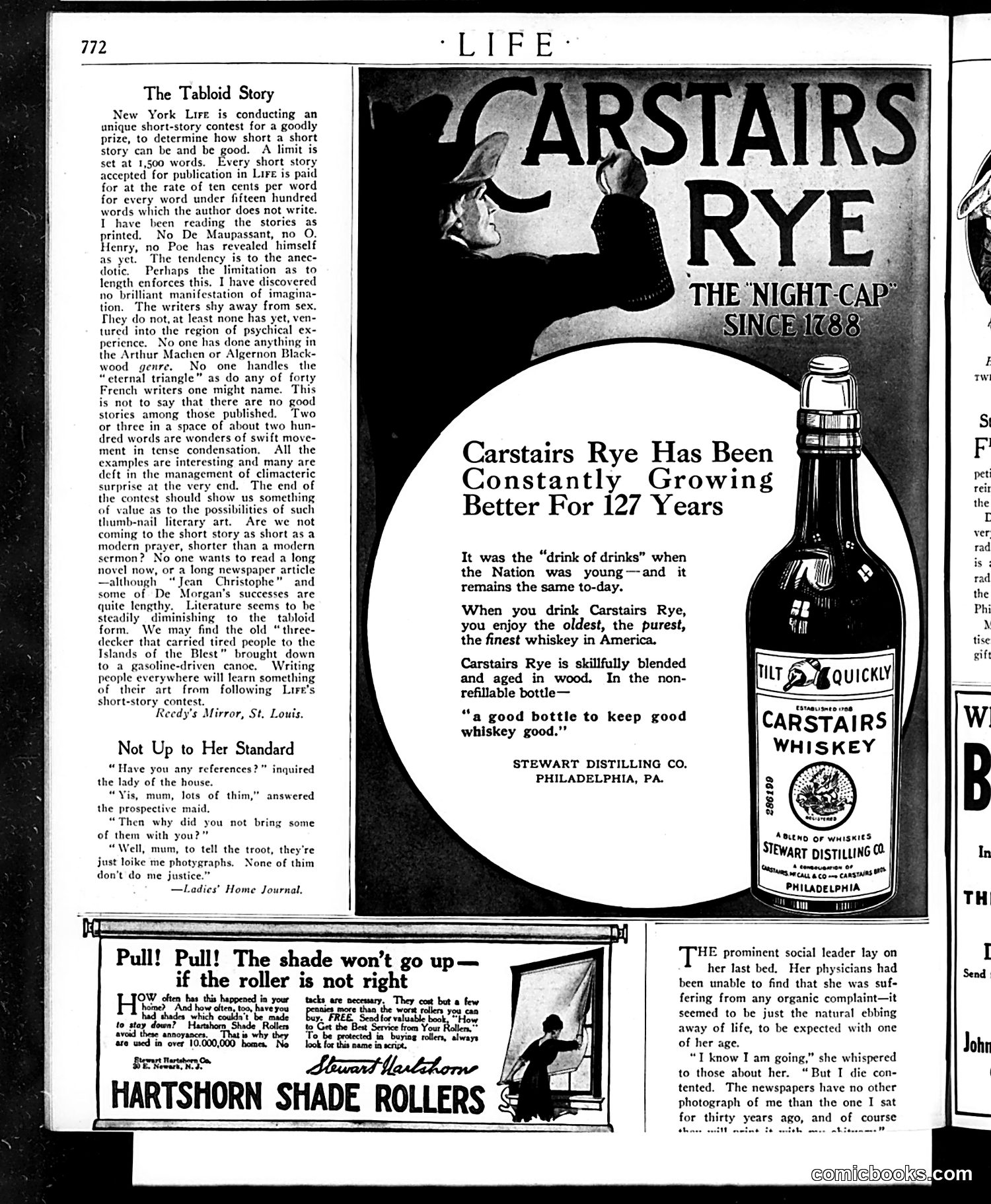
This is primarily an **advertising page** mixed with literary content. The main advertisement is for **Carstairs Rye Whiskey** (made by Stewart Distilling Co., Philadelphia), claiming 127 years of consistent quality—a common Prohibition-era marketing appeal emphasizing heritage and purity. The page's text content includes: 1. **"The Tabloid Story"** — a critique of *New York Life*'s short-story contest, discussing whether brevity produces good literature. The author doubts it, noting writers avoid challenging subjects (sex, psychological themes). 2. **"Not Up to Her Standard"** — a brief humorous anecdote about a maid's poor references, from *Ladies' Home Journal*. 3. **Hartshorn Shade Rollers advertisement** — selling window shade mechanisms. 4. **An untitled social satire** — a wealthy woman on her deathbed, satisfied that newspapers only have one old photograph of her, implying vanity about her appearance. The page reflects early 20th-century magazine content: literary discussion, household product ads, and gentle social humor about class and vanity.
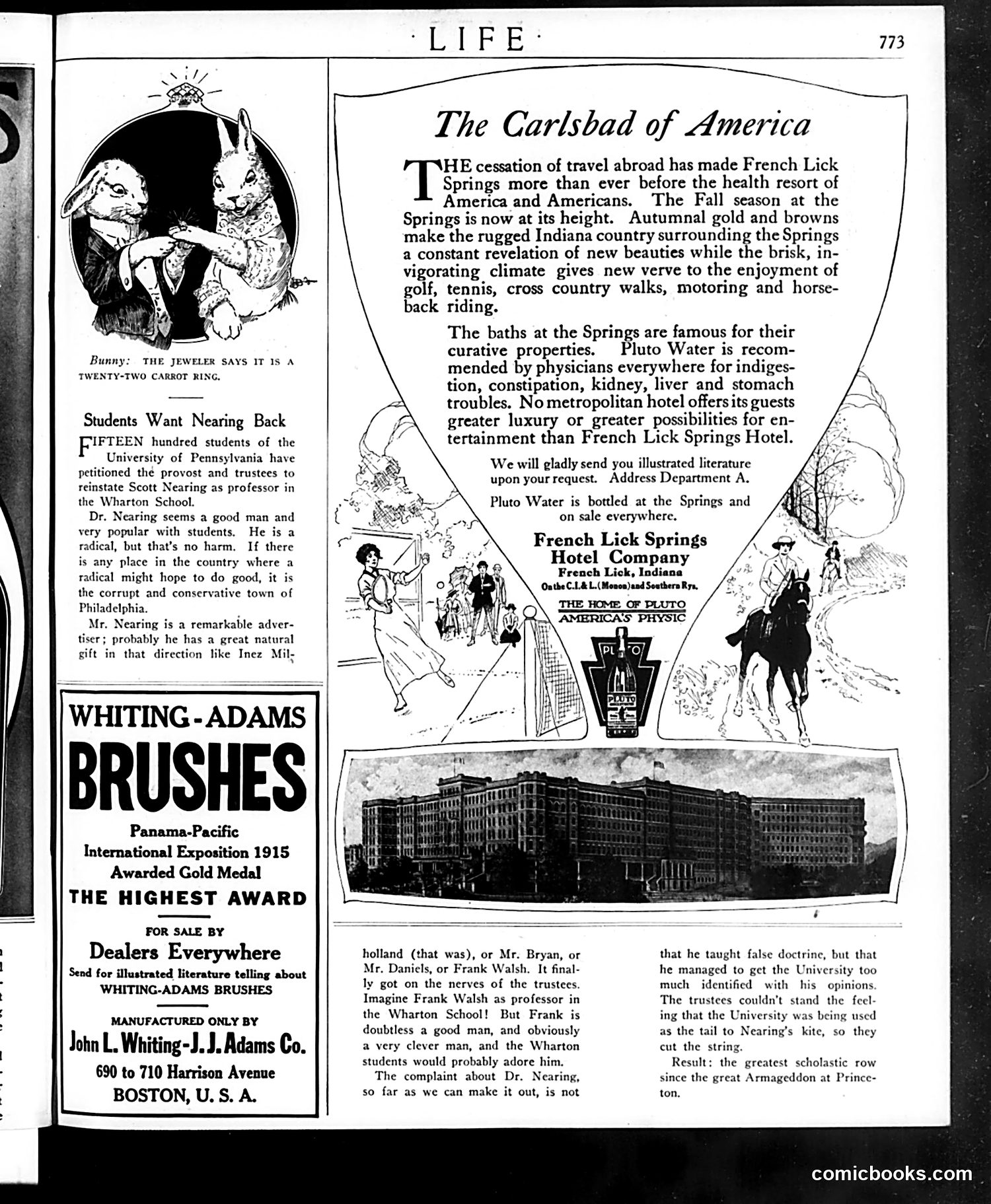
This page mixes advertisements with commentary on academic freedom. The main satirical content addresses **Scott Nearing's dismissal** from the University of Pennsylvania's Wharton School. The article criticizes the university trustees for firing Nearing—described as a "radical" but good teacher—not for teaching false doctrine, but for making the institution too visibly associated with his progressive opinions. The piece sarcastically notes that if radicals like Frank Walsh or William Jennings Bryan were professors, they'd be popular with students. The complaint wasn't ideology itself, but that "the University was being used as the tail to Nearing's kite." The cartoonist calls this "the greatest scholastic row since...Princeton," referencing similar academic controversies. The satire targets institutional cowardice: trustees censoring a respected professor to avoid public controversy rather than confronting his actual ideas. The page also includes period advertisements (French Lick Springs resort, Whiting-Adams brushes) and a pun about a "twenty-two carat ring," unrelated to the main commentary.
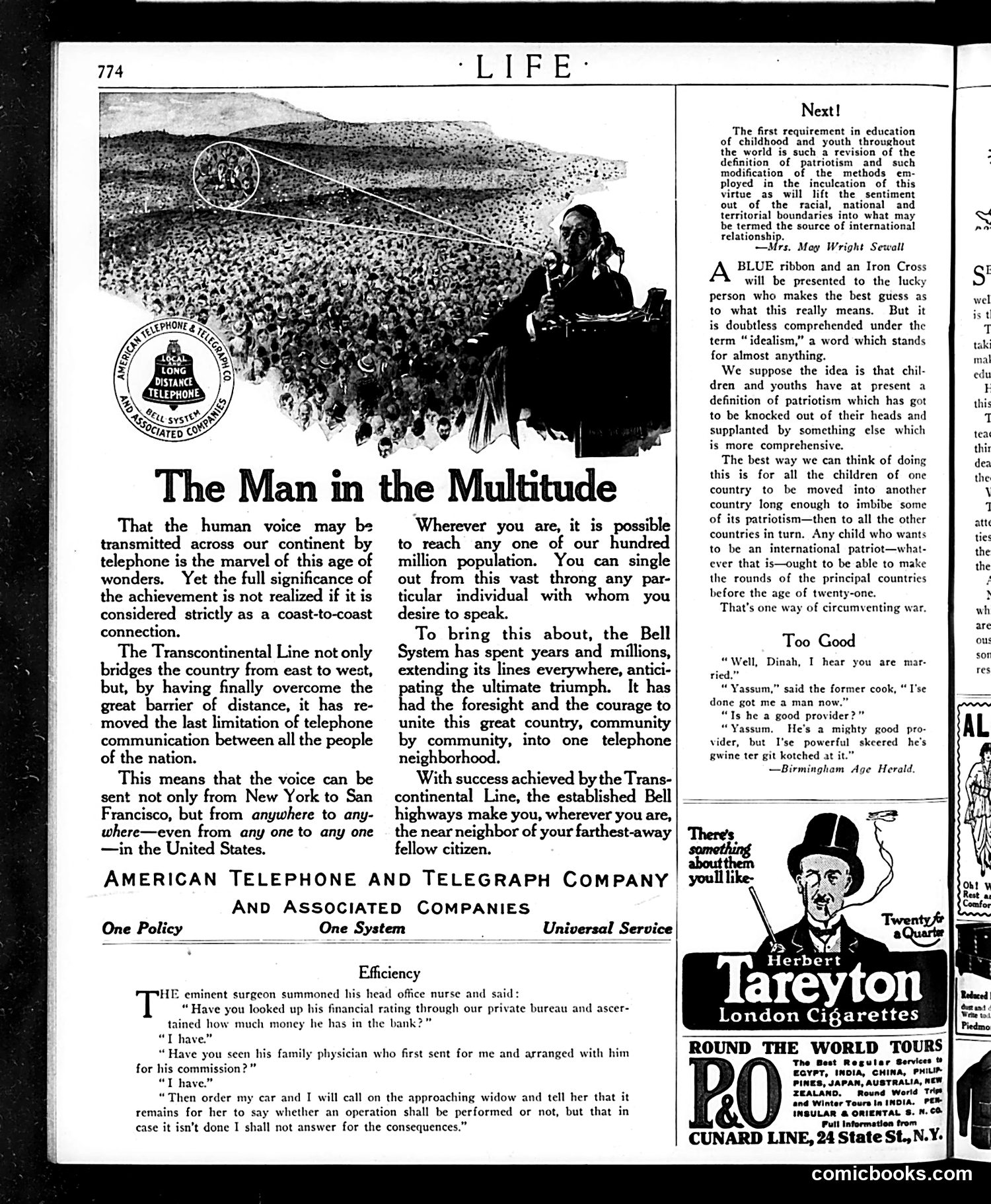
This page contains **advertisements and satirical content**, not political cartoons per se. ## "The Man in the Multitude" A Bell Telephone advertising spread celebrating the Transcontinental Line's technological achievement—enabling voice transmission "from anywhere to anywhere" across America. The image shows a man in a crowd with a telephone operator connecting calls, promoting the idea that telephone infrastructure democratizes communication across class and geography. ## "Efficiency" A satirical vignette mocking physician ethics: a surgeon coldly instructs his nurse to investigate a patient's financial resources and whether the family doctor takes a commission before deciding whether to perform surgery. The joke critiques commercialism in medicine—suggesting doctors' decisions depend on profit rather than patient need. The punchline title "Efficiency" is ironic. ## Supporting Content The page includes a quote about redefining patriotism internationally, a dialect joke ("Too Good"), cigarette and travel tour advertisements, reinforcing typical 1920s magazine content mixing commerce with social commentary and gentle humor.
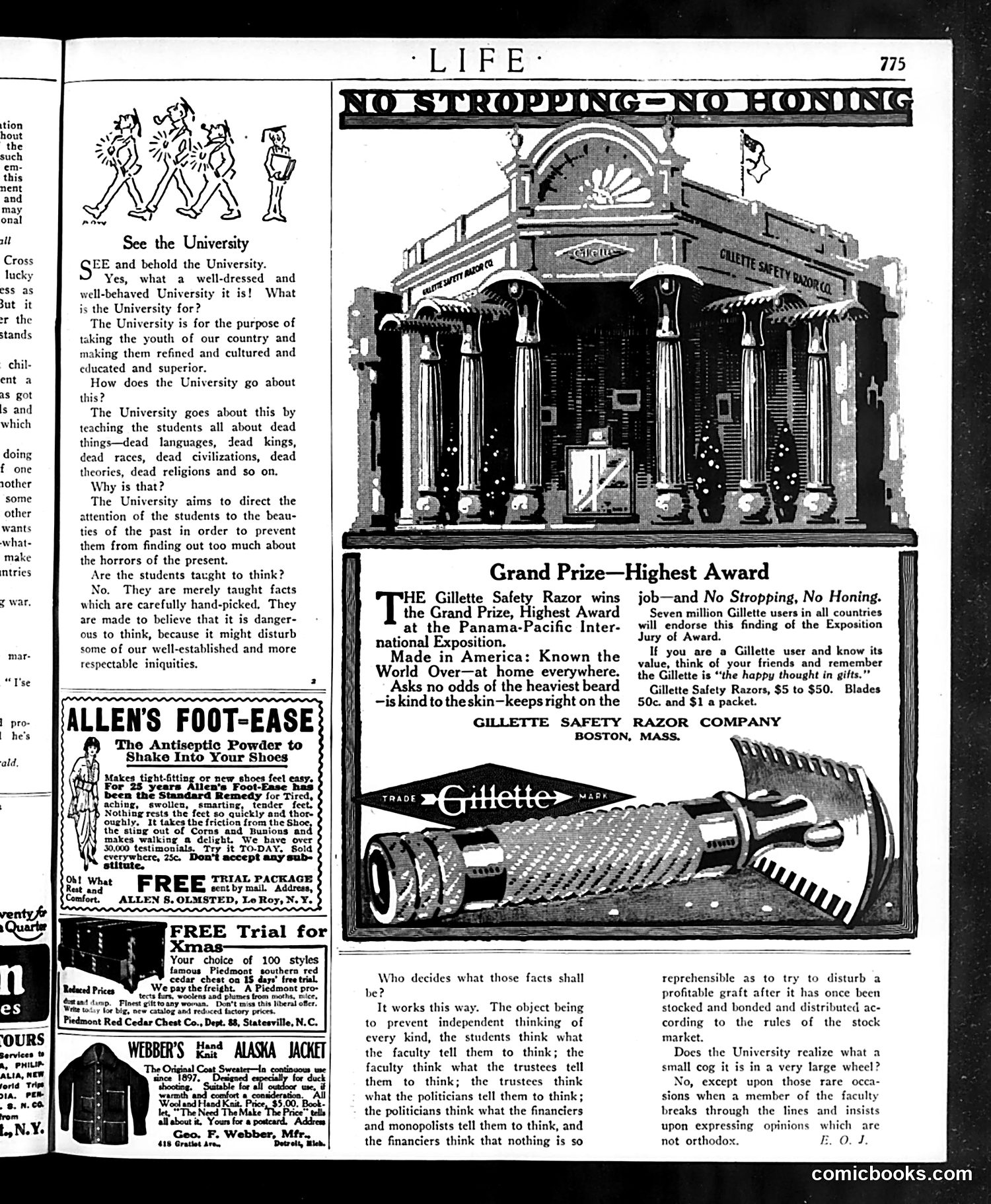
This page contains a satirical essay criticizing American universities as institutions designed to suppress independent thought rather than encourage it. **The Satire:** The text mocks universities for teaching only "dead things"—dead languages, kings, and civilizations—while avoiding present-day problems. The author argues universities deliberately prevent students from thinking critically, instead feeding them "hand-picked facts" filtered through a rigid hierarchy: students believe what faculty say, faculty believe what trustees say, trustees believe what politicians say, and politicians answer to financiers and monopolists. **The Point:** The satire exposes how universities function as tools of the existing power structure, protecting wealthy interests by keeping students ignorant of current social injustices. Independent thought is portrayed as dangerous to the system. The remainder of the page contains period advertisements (Allen's Foot-Ease powder, cedar chests, and Gillette Safety Razors), typical of Life magazine's revenue model. This reflects early 20th-century progressive criticism of higher education as complicit in maintaining economic inequality.
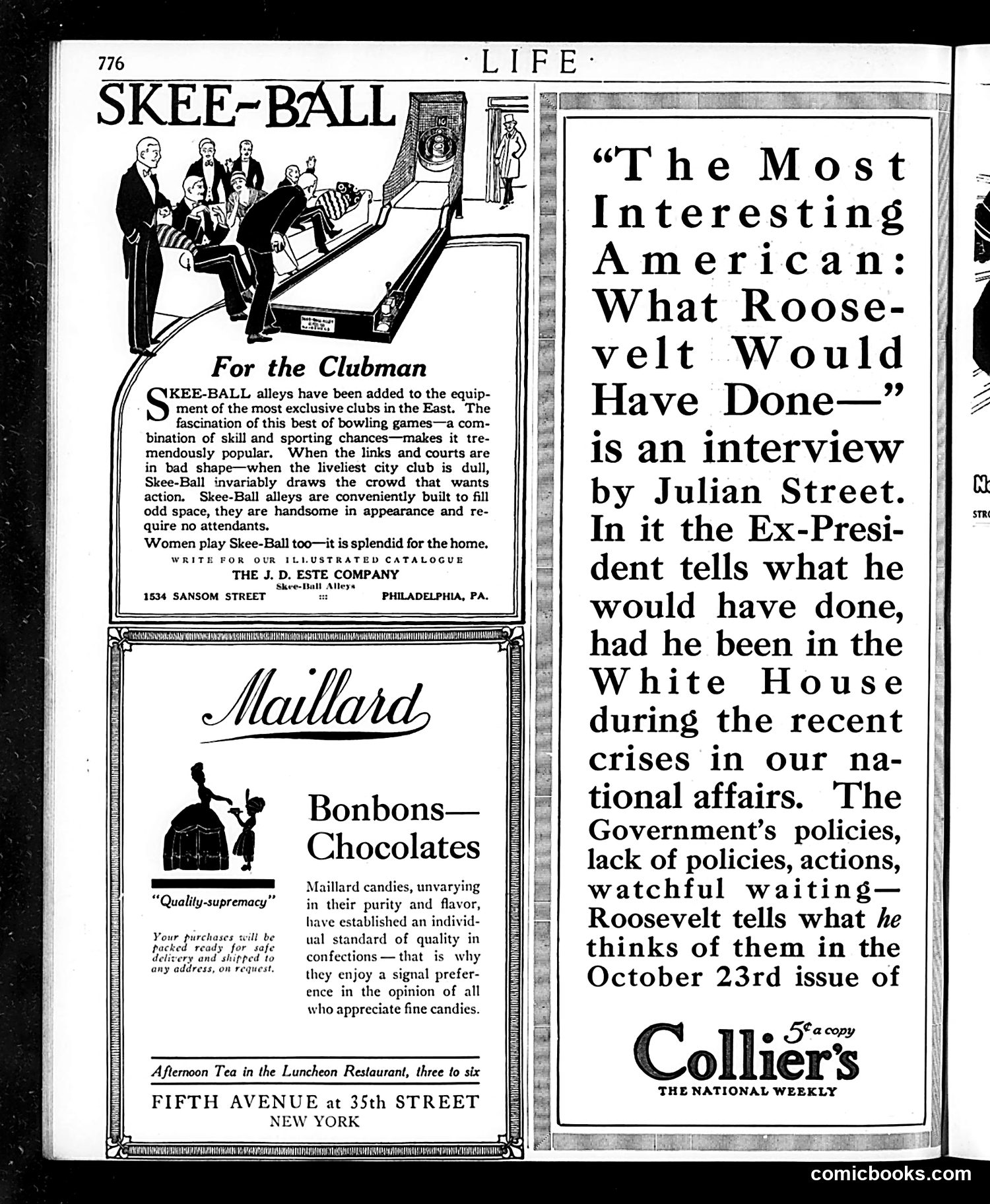
This page is primarily **advertising**, not political satire. It contains three distinct ads: 1. **Skee-Ball** (top left): Promotes a bowling game newly added to exclusive Eastern clubs, marketed as entertainment for both clubmen and home use. 2. **Maillard Chocolates** (center): A quality candy advertisement emphasizing purity and refined taste for discerning consumers. 3. **Collier's Magazine** (right): Advertises an upcoming interview by Julian Street featuring **Theodore Roosevelt** (the "Ex-President"), in which Roosevelt critiques the current administration's handling of national crises—their policies, lack thereof, and "watchful waiting" strategy. This appears to reference President Woodrow Wilson's cautious foreign policy approach during WWI tensions. The Roosevelt interview represents the page's only political content: Roosevelt positioning himself as an alternative voice on national affairs, though the ad doesn't specify which crises or administration he's criticizing.
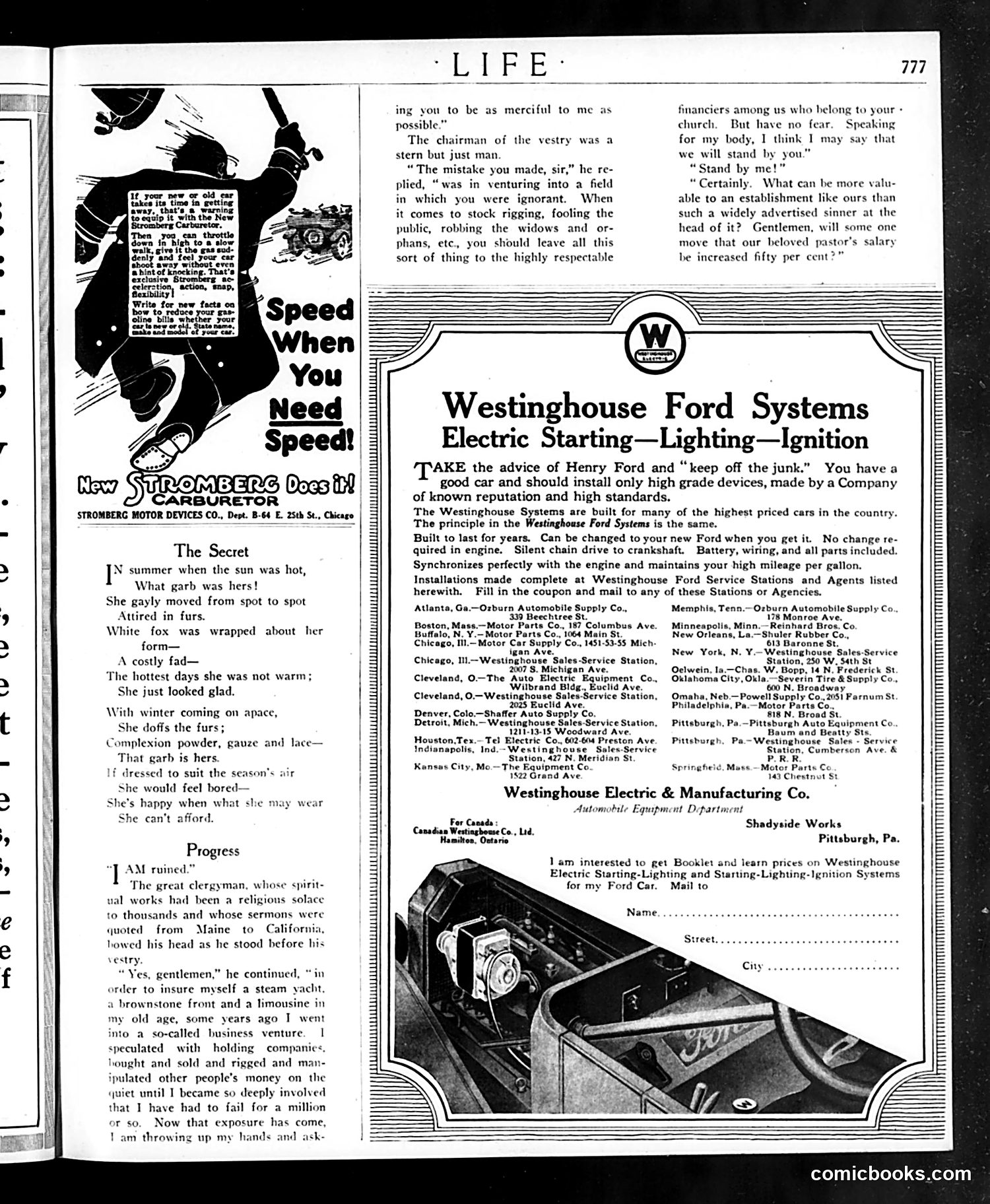
This page contains two satirical pieces critiquing American society. **"Progress"** (the main story) mocks religious hypocrisy. A prominent clergyman confesses to his church vestry that he's financially ruined after illegally manipulating stocks and defrauding widows and orphans to fund a lavish lifestyle (steam yacht, brownstone, limousine). Rather than condemn him, the vestry chairman praises the scandal as excellent publicity for the church and proposes raising his salary. The satire targets corrupt financiers and clergy who enable them—suggesting the church prioritizes wealth and status over morality, and that wealthy sinners receive protection unavailable to ordinary people. The page also includes two lighter pieces: a poem about a woman wearing expensive furs in summer (mocking wasteful fashion), and advertisements for Stromberg motor devices and Westinghouse Ford electrical systems.
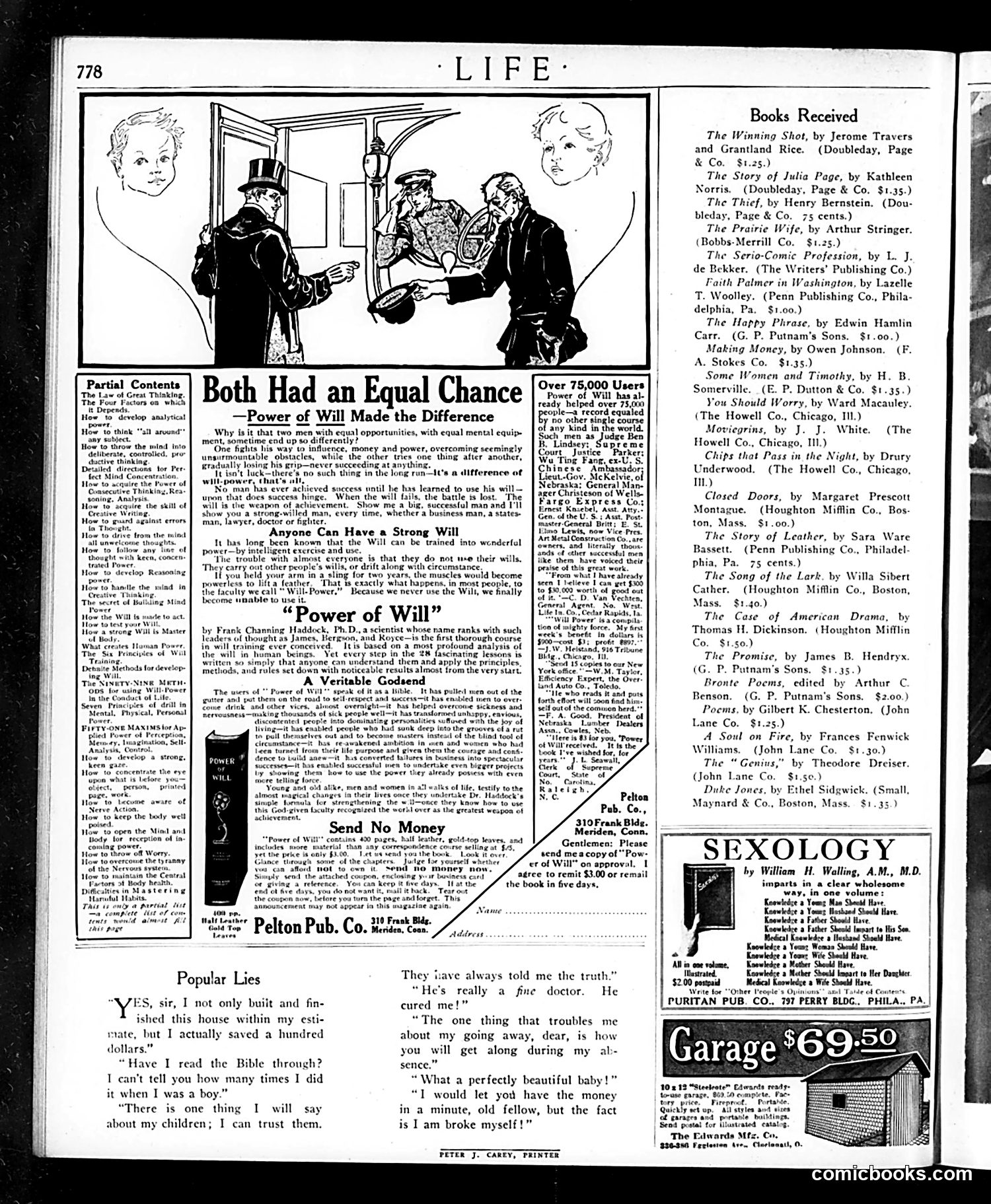
This page consists primarily of **book reviews and advertisements** rather than political cartoons. The main cartoon titled "Both Had an Equal Chance" illustrates a self-help article about willpower by Frank Channing Haddock. It depicts two men with identical opportunities who achieve different outcomes—one succeeds while the other fails—attributed to their use of "will power." The cartoon's message reflects early 20th-century American individualism: success depends not on circumstances but on personal determination and mental discipline. This was characteristic of the era's popular psychology movement. The page also features extensive book advertisements, including a prominent ad for Haddock's "Power of Will" course and other contemporary publications. The "Popular Lies" section at bottom includes a satirical dialogue about trust and financial honesty—typical of Life's light social commentary. The overall page represents mainstream American magazine content from this period, emphasizing self-improvement and moral character.
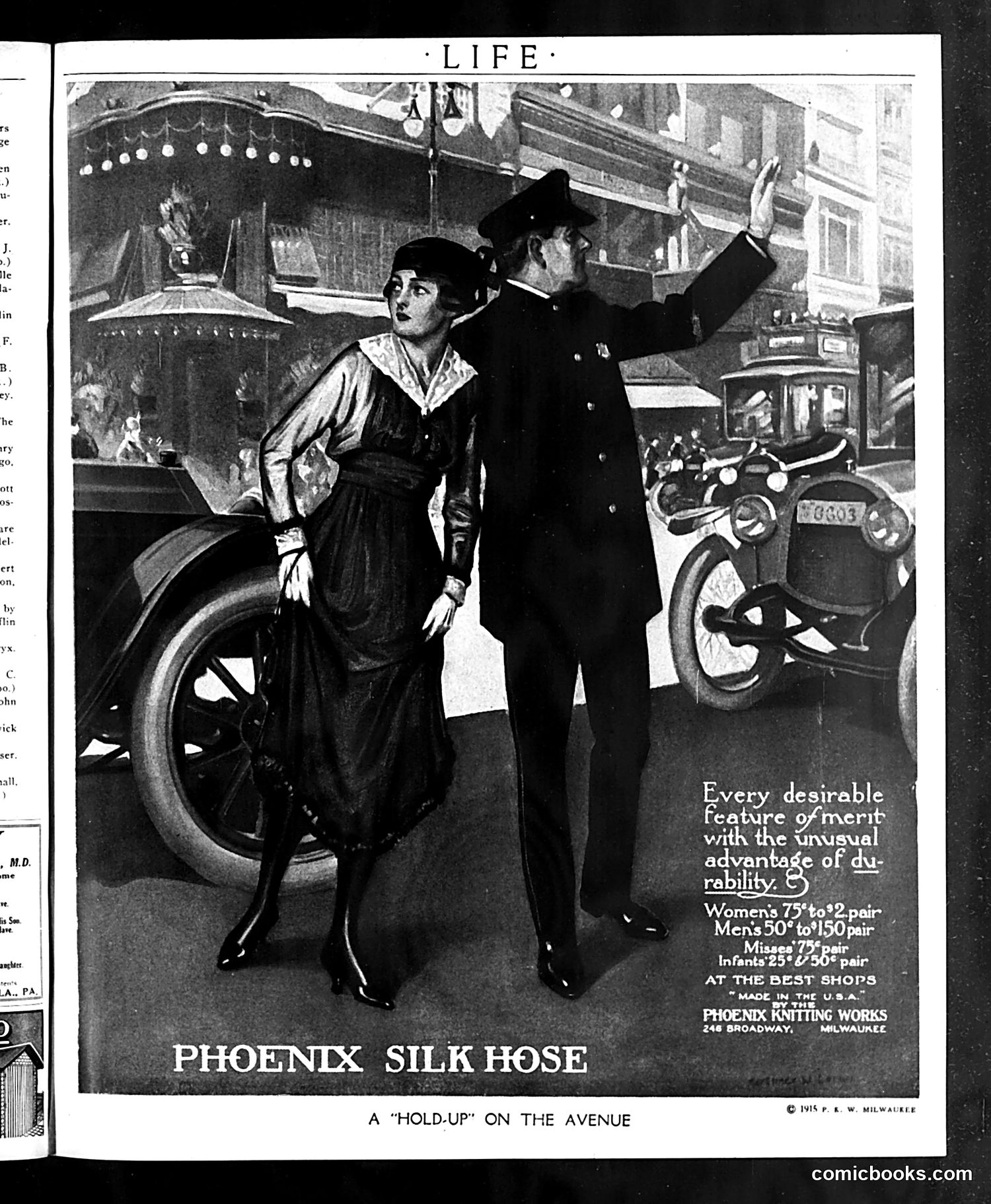
This is a **product advertisement**, not political satire. It promotes Phoenix Silk Hose hosiery from Milwaukee manufacturer Phoenix Knitting Works. The image shows a fashionably dressed couple on an urban avenue (note the theater marquee and automobiles). The caption "A 'HOLD-UP' ON THE AVENUE" uses contemporary slang: a "hold-up" means stopping someone—here, the man is stopping the woman to admire her appearance, highlighting her silk stockings. The ad emphasizes durability and affordability across demographics (women's, men's, children's sizes), with prices listed. The visual appeal of the well-dressed woman showcasing the product was standard advertising strategy of this era (circa 1915, based on copyright mark). The "satire" is merely wordplay on "hold-up"—not political commentary.
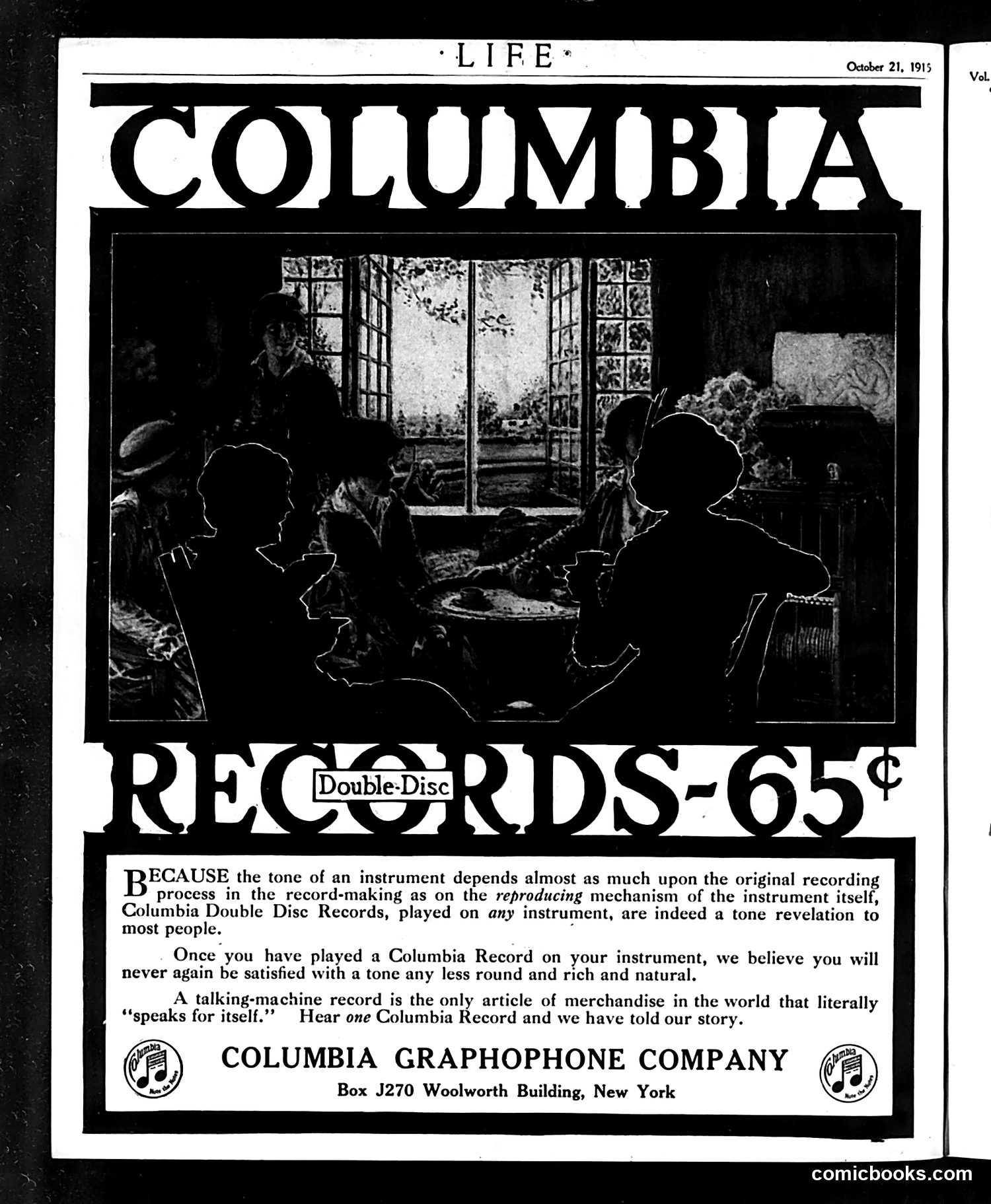
This is a **full-page advertisement**, not political satire. It promotes Columbia Double Disc Records (priced at 65 cents), appearing in *Life* magazine on October 21, 1915. The image shows silhouetted figures gathered around what appears to be a phonograph in an elegant interior, listening to music together—meant to suggest the superior sound quality and social appeal of Columbia records. The advertisement's central claim is that recording quality matters as much as playback equipment. It argues Columbia records sound "round and rich and natural" on any phonograph. The tagline "A talking-machine record is the only article of merchandise in the world that literally 'speaks for itself'" is the copywriter's clever pitch: you need only hear one Columbia record to understand its superiority. This reflects early 20th-century phonograph culture, when recording technology was competitive and sound fidelity was a significant selling point. The elegant dinner-party imagery appeals to middle-class consumers seeking refined entertainment.