
Life, 1915-10-21 · page 22 of 52
Life — October 21, 1915 — page 22: what you’re looking at
What you’re looking at
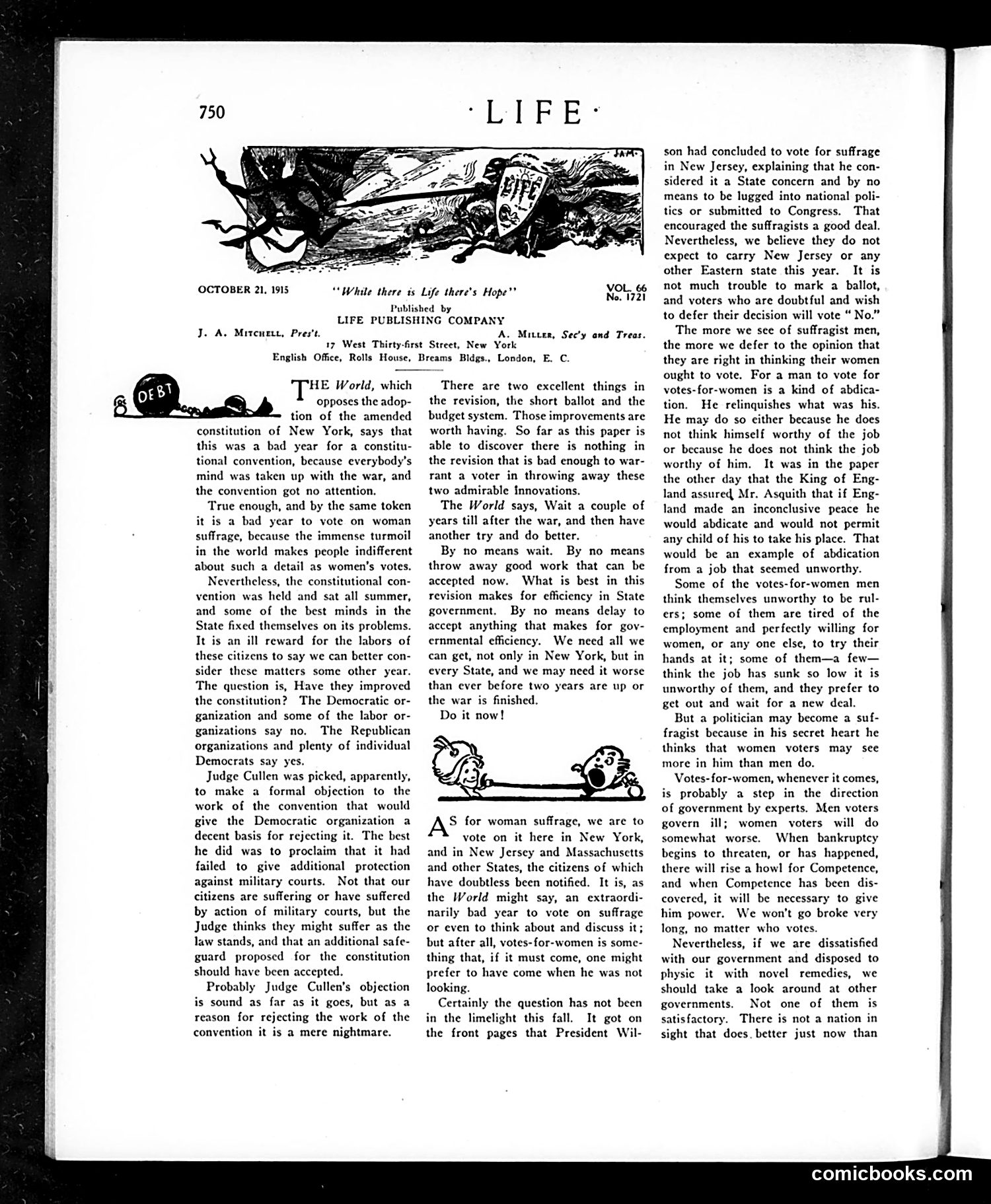
**The Cartoon:** The masthead illustration shows a skeletal figure (Death or Despair) lying prone with a gravestone marked "LIFE," captioned "While there is Life there's Hope"—a dark visual pun on the magazine's title. **The Context:** This page discusses New York's 1915 constitutional convention and the concurrent women's suffrage referendum. Life magazine supports *both* the revised constitution (praising its "short ballot" and "budget system") and women's suffrage, though it acknowledges these are "bad year[s]" to debate such issues—World War I monopolizes public attention. **The Satire:** Life ridicules opponents' logic: delaying votes until after the war is absurd ("a mere nightmare"). Judge Cullen's objection to the constitution on military-court grounds is dismissed as pretextual. The magazine also mocks President Wilson's vote for New Jersey suffrage while claiming it's a "State concern"—a transparent dodge. **Modern Translation:** Life argues against using wartime distraction as an excuse to postpone important democratic decisions.
📄 Transcribed text from this page (OCR, searchable)
Machine-transcribed from the original scan — historical spelling and the odd misread are preserved.
OCTOBER 21, 1915 “While there is Life there's Hope”’ Published by LIFE PUBLISHING COMPANY J. A. Mitenete, Pres't. A. Mutter, Sec’y and Treas. 17 West Thirty-first Street, New York English Office, Rolls House, Breams Bldgs., London, E. C. HE World, which opposes the adop- tion of the amended constitution of New York, says that this was a bad year for a constitu- tional convention, because everybody's mind taken up with the war, and the convention got no attention. True enough, and by the same token it is a bad year to vote on woman suffrage, because the immense turmoil in the world makes people indifferent about such a detail as women’s votes. Nevertheless, the constitutional con- vention was held and sat all summer, and some of the best minds in the State fixed themselves on its problems. It is an ill reward for the labors of these citizens to say we can better con- sider these matters some other year. The question is, Have they improved the constitution? The Democratic or- ganization and some of the labor or- ganizations say no. The Republican organizations and plenty of individual Democrats say yes. Judge Cullen was picked, apparently, to make a formal objection to the work of the convention that would e¢ the Democratic organization a decent basis for rejecting it. The best he did was to proclaim that it had failed to give additional protection against military courts. Not that our citizens are suffering or have suffered by action of military courts, but the Judge thinks they might suffer as the law stands, and that an additional safe- guard proposed for the constitution should have been accepted. Probably Judge Cullen's objection is sound as far as it goes, but as a reason for rejecting the work of the convention it is a mere nightmare. There are two excellent things in the revision, the short ballot and the budget system. Those improvements are worth having. So far as this paper is able to discover there is nothing in the revision that is bad enough to war- rant a voter in throwing away these two admirable {nnovations. The World says, Wait a couple of years till after the war, and then have another try and do better. By no means wait. By no means throw away good work that can be accepted now. What is best in this revision makes for efficiency in State government. By no means delay to accept anything that makes for gov- ernmental efficiency. We need all we can get, not only in New York, but in every State, and we may need it worse than ever before two years are up or the war is finished. Do it now! S for woman suffrage, we are to vote on it here in New York, and in New Jersey and Massachusetts and other States, the citizens of which have doubtless been notified. It is, as the World might say, an extraordi- narily bad year to vote on suffrage or even to think about and discuss it; but after all, votes-for-women is some- thing that, if it must come, one might prefer to have come when he was not looking. Certainly the question has not been in the limelight this fall. It got on the front pages that President Wil- son had concluded to vote for suffrage in New Jersey, explaining that he con- sidered it a State concern and by no means to be lugged into national poli- tics or submitted to Congress. That encouraged the suffragists a good deal. Nevertheless, we believe they do not expect to carry New Jersey or any other Eastern state this year. It is not much trouble to mark a ballot, and voters who are doubtful and wish to defer their decision will vote “ No.” The more we sce of suffragist men, the more we defer to the opinion that they are right in thinking their women ought to vote. For a man to vote for votes-for-women is a kind of abdica- tion. He relinquishes what was his. He may do so either because he does not think himself worthy of the job or because he does not think the job worthy of him. It was in the paper the other day that the King of Eng- land assured Mr. Asquith that if Eng- land made an inconclusive peace he would abdicate and would not permit any child of his to take his place. That would be an example of abdication from a job that seemed unworthy. Some of the votes-for-women men think themselves unworthy to be rul- ers; some of them are tired of the employment and perfectly willing for women, or any one else, to try their hands at it; some of them—a few think the job has sunk so low it is unworthy of them, and they prefer to get out and wait for a new deal. But a politician may become a suf- fragist because in his secret heart he thinks that women voters may see more in him than men do. Votes-for-women, whenever it comes, is probably a step in the direction of government by experts. Men voters govern ill; women voters will do somewhat worse. When bankruptcy begins to threaten, or has happened, there will rise a howl for Competence, and when Competence has been dis- covered, it will be necessary to give him power. We won't go broke very long, no matter who votes. Nevertheless, if we are dissatisfied with our government and disposed to physic it with novel remedies, we should take a look around at other governments. Not one of them is satisfactory. There is not a nation in sight that does. better just now than comicbooks.com