
Life, 1915-10-21 · page 30 of 52
Life — October 21, 1915 — page 30: what you’re looking at
What you’re looking at
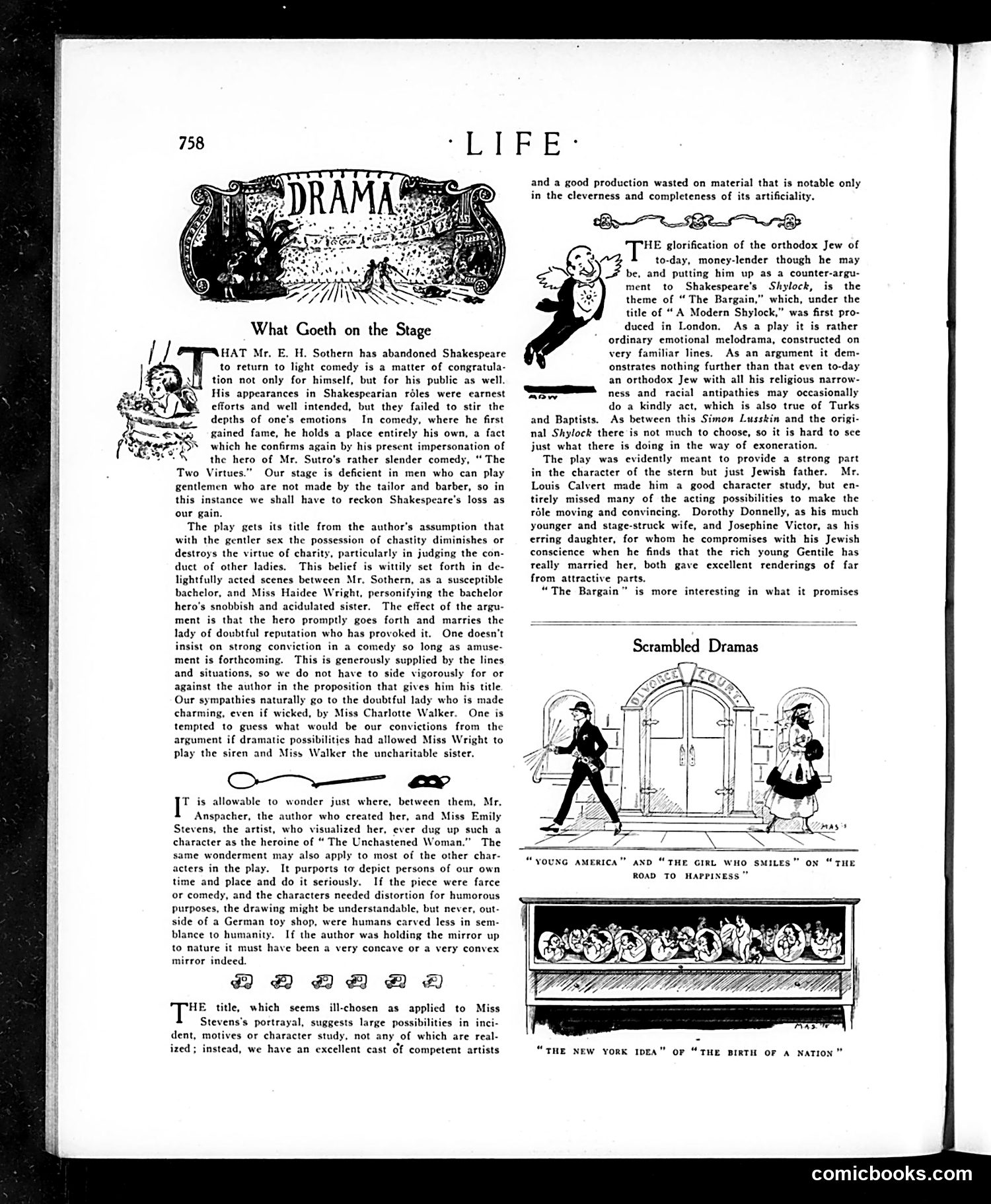
This page reviews three theatrical productions. The main critiques address: **"The Two Virtues"** — E.H. Sothern plays a bachelor in a comedy about whether chastity diminishes charity in women. The reviewer approves of Sothern abandoning Shakespeare for light comedy, where he excels. **"The Unchastened Woman"** — The critic finds the characters unrealistic and poorly drawn, comparing them unfavorably to actual humans—suggesting the playwright failed to create believable modern people despite attempting serious drama rather than farce. **"The Bargain"** (also titled "A Modern Shylock") — This appears to present a sympathetic Orthodox Jewish money-lender as a counter-example to Shakespeare's *Shylock*. The reviewer dismisses this as ordinary melodrama that proves nothing—that doing one kind act doesn't overcome deeper prejudices. The small illustrations show stage scenes from productions. The page represents typical early 20th-century theater criticism blending plot summary with moral and artistic judgment.
📄 Transcribed text from this page (OCR, searchable)
Machine-transcribed from the original scan — historical spelling and the odd misread are preserved.
“E.DP'E * and a good production wasted on material that is notable only in the cleverness and completeness of its artificiality. What Goeth on the Stage HAT Mr. E. H. Sothern has abandoned Shakespeare to return to light comedy is a matter of congratula- tion not only for himself, but for his public as well. His appearances in Shakespearian réles were earnest efforts and well intended, but they failed to stir the depths of one's emotions In comedy, where he first gained fame, he holds a place entirely his own, a fact which he confirms again by his present impersonation of the hero of Mr. Sutro’s rather slender comedy, “ The Two Virtues.” Our stage is deficient in men who can play gentlemen who are not made by the tailor and barber, so in this instance we shall have to reckon Shakespeare's loss as our gain. The play gets its title from the author's assumption that with the gentler sex the possession of chastity diminishes or destroys the virtue of charity, particularly in judging the con- duct of other ladies. This belief is wittily set forth in de- lightfully acted scenes between Mr, Sothern, as a susceptible bachelor, and Miss Haidee Wright, personifying the bachelor hero's snobbish and acidulated sister. The effect of the argu- ment is that the hero promptly goes forth and marries the lady of doubtful reputation who has provoked it. One doesn’t insist on strong conviction in a comedy so long as amuse- ment is forthcoming. This is generously supplied by the lines and situations, so we do not have to side vigorously for or against the author in the proposition that gives him his title Our sympathies naturally go to the doubtful lady who is made charming, even if wicked, by Miss Charlotte Walker. One is tempted to guess what would be our convictions from the argument if dramatic possibilities had allowed Miss Wright to play the siren and Miss Walker the uncharitable sister. O-————"_— = T is allowable to wonder just where, between them, Mr. Anspacher, the author who created her, and Miss Emily Stevens, the artist, who visualized her, ever dug up such a character as the heroine of “ The Unchastened Woman.” The same wonderment may also apply to most of the other char- acters in the play. It purports to depict persons of our own time and place and do it seriously. If the piece were farce or comedy, and the characters needed distortion for humorous purposes, the drawing might be understandable, but never, out- side of a German toy shop, were humans carved less in sem- blance to humanity. If the author was holding the mirror up to nature it must have been a very concave or a very convex mirror indeed. BHA AR AA HE title, which seems ill-chosen as applied to Miss Stevens's portrayal, suggests large possibilities in inci- dent, motives or character study, not any of which are real- instead, we have an excellent cast of competent artists BAR SGI o> HE glorification of the orthodox Jew of to-day, money-lender though he may A be. and putting him up as a counter-argu- ment to Shakespeare's Shylock, is the theme of “ The Bargain,” which, under the title of “‘A Modern Shylock,” was first pro- duced in London. As a play it is rather ordinary emotional melodrama, constructed on very familiar lines. As an argument it dem- onstrates nothing further than that even to-day an orthodox Jew with all his religious narrow- ness and racial antipathies may occasionally do a kindly act, which is also true of Turks and Baptists. As between this Simon Lusskin and the origi- nal Shylock there is not much to choose, so it is hard to sce just what there is doing in the way of exoneration. The play was evidently meant to provide a strong part in the character of the stern but just Jewish father. Mr. Louis Calvert made him a good character study, but en- ely missed many of the acting possibilities to make the réle moving and convincing. Dorothy Donnelly, as his much younger and stage-struck wife, and Josephine Victor, as his erring daughter, for whom he compromises with his Jewish conscience when he finds that the rich young Gentile has really married her, both gave excellent renderings of far from attractive parts. “The Bargain” is more interesting in what it promises THE GIRL WHO SMILES” ON “THE “YOUNG AMERICA” AND ROAD TO HAPPINESS " “THE NEW YORK IDEA” OF “THE BIRTH OF A NATION” comicbooks.com