
Life, 1915-10-21 · page 23 of 52
Life — October 21, 1915 — page 23: what you’re looking at
What you’re looking at
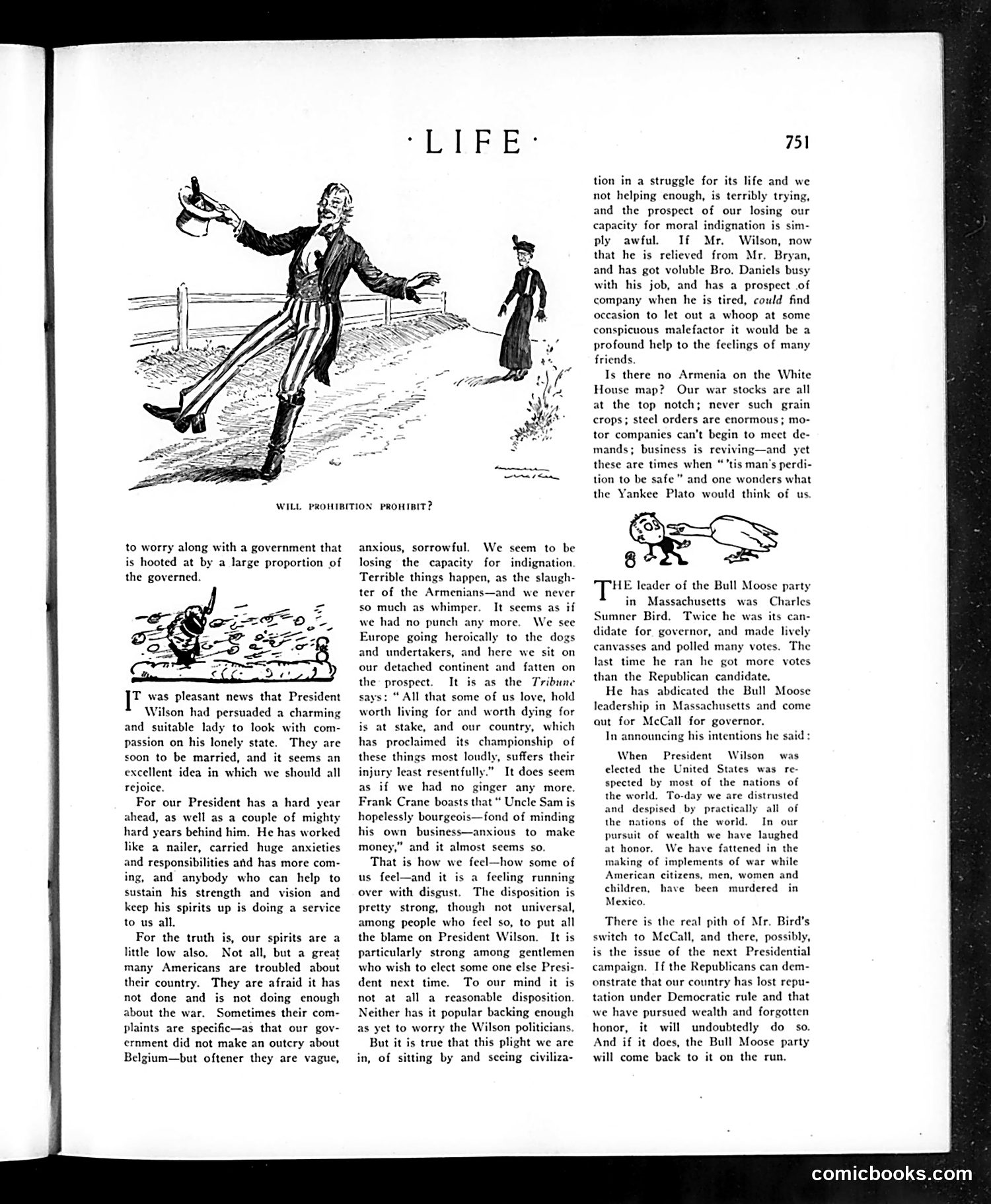
This *Life* magazine page satirizes American passivity during World War I. The cartoon "Will Prohibition Prohibit?" depicts President Wilson gesturing helplessly while a small figure (likely representing a conscientious citizen or advocate) walks away—illustrating the author's frustration that Wilson isn't doing enough to condemn wartime atrocities. The accompanying text criticizes Americans' moral numbness to European suffering, particularly the Armenian genocide. The author argues that despite prosperity (war stocks, grain crops, steel orders booming), the nation has lost its "capacity for indignation." Wilson receives particular blame from political opponents seeking his defeat, though the author defends him somewhat. The piece suggests that American business interests and isolationism are making the country "hopelessly bourgeois"—caring only for profit while civilization struggles. The reference to Wilson's remarriage is presented as potentially helpful to his morale during these trying times.
📄 Transcribed text from this page (OCR, searchable)
Machine-transcribed from the original scan — historical spelling and the odd misread are preserved.
WILL PROHIBITION PROHIBIT? to worry along with a government that is hooted at by a large proportion of the governed. was pleasant news that President Wilson had persuaded a charming and suitable lady to look with com- passion on his lonely state. They are soon to be married, and it seems an excellent idea in which we should all rejoice. For our President has a hard year ahead, as well as a couple of mighty hard years behind him. He has worked like a nailer, carried huge anxieties and responsibilities and has more com- ing, and anybody who can help to sustain his strength and vision and keep his spirits up is doing a service to us all. For the truth is, our spirits are a little low also. Not all, but a great many Americans are troubled about their country. They are afraid it has not done and is not doing enough about the war. Sometimes their com- plaints are specific—as that our gov- ernment did not make an outcry about Belgium—but oftener they are vague, r anxious, sorrowful. We seem to be losing the capacity for indignation Terrible things happen, as the slaugh- ter of the Armenians—and we never so much as whimper. It seems as if we had no punch any more. We see Europe going heroically to the dogs and undertakers, and here we sit on our detached continent and fatten on the prospect. It is as the Tribune s “All that some of us love, hold worth living for and worth dying for is at stake, and our country, which has proclaimed its championship of these things most loudly, suffers their injury least resentfully.” It does seem as if we had no ginger any more. Frank Crane boasts that “ Uncle Sam is hopelessly bourgeois—fond of minding his own business—anxious to make money,” and it almost seems so. That is how we feel—how some of us feel—and it is a feeling running over with disgust. The disposition is pretty strong, though not universal, among people who feel so, to put all the blame on President Wilson. It is particularly strong among gentlemen who wish to clect some one else Presi- dent next time. To our mind it is not at all a reasonable disposition. Neither has it popular backing enough as yet to worry the Wilson politicians. But it is true that this plight we are in, of sitting by and sceing civiliza- 751 tion in a struggle for its life and we not helping enough, is terribly trying, and the prospect of our losing our capacity for moral indignation is sim- ply awful. If Mr. Wilson, now that he is relieved from Mr. Bryan, and has got voluble Bro. Daniels busy with his job, and has a prospect of company when he is tired, could find occasion to let out a whoop at some conspicuous malefactor it would be a profound help to the feelings of many friends. Is there no Armenia on the White House map? Our war stocks are all at the top notch; never such grain crops; steel orders are enormous; mo- tor companies can’t begin to mect de- mands; business is reviving—and yet these are times when “tis man’s perdi- tion to be safe” and one wonders what the Yankee Plato would think of us. HE leader of the Bull Moose party in Massachusetts was Charles Sumner Bird, Twice he was its can- didate for governor, and made lively ses and polled many votes. The last time he ran he got more votes than the Republican candidate. He has abdicated the Bull leadership in Massachusetts a aut for McCall for governor. In announcing his intentions he said : When President Wilson was elected the United States was re- spected by most of the nations of the world. To-day we are distrusted and despised by practically all of the nations of the world. In our pursuit of wealth we have laughed at honor. We have fattened in the making of implements of war while American citizens, men, women and children, have been murdered in Mexico Moose id come There is the real pith of Mr. Bird’s switch to McCall, and there, possibly, is the issue of the next Presidential campaign. If the Republicans can dem- onstrate that our country has lost repu- tation under Democratic rule and that we have pursued wealth and forgotten honor, it will undoubtedly do so. And if it does, the Bull Moose party will come back to it on the run. comicbooks.com