
Life, 1915-10-21 · page 13 of 52
Life — October 21, 1915 — page 13: what you’re looking at
What you’re looking at
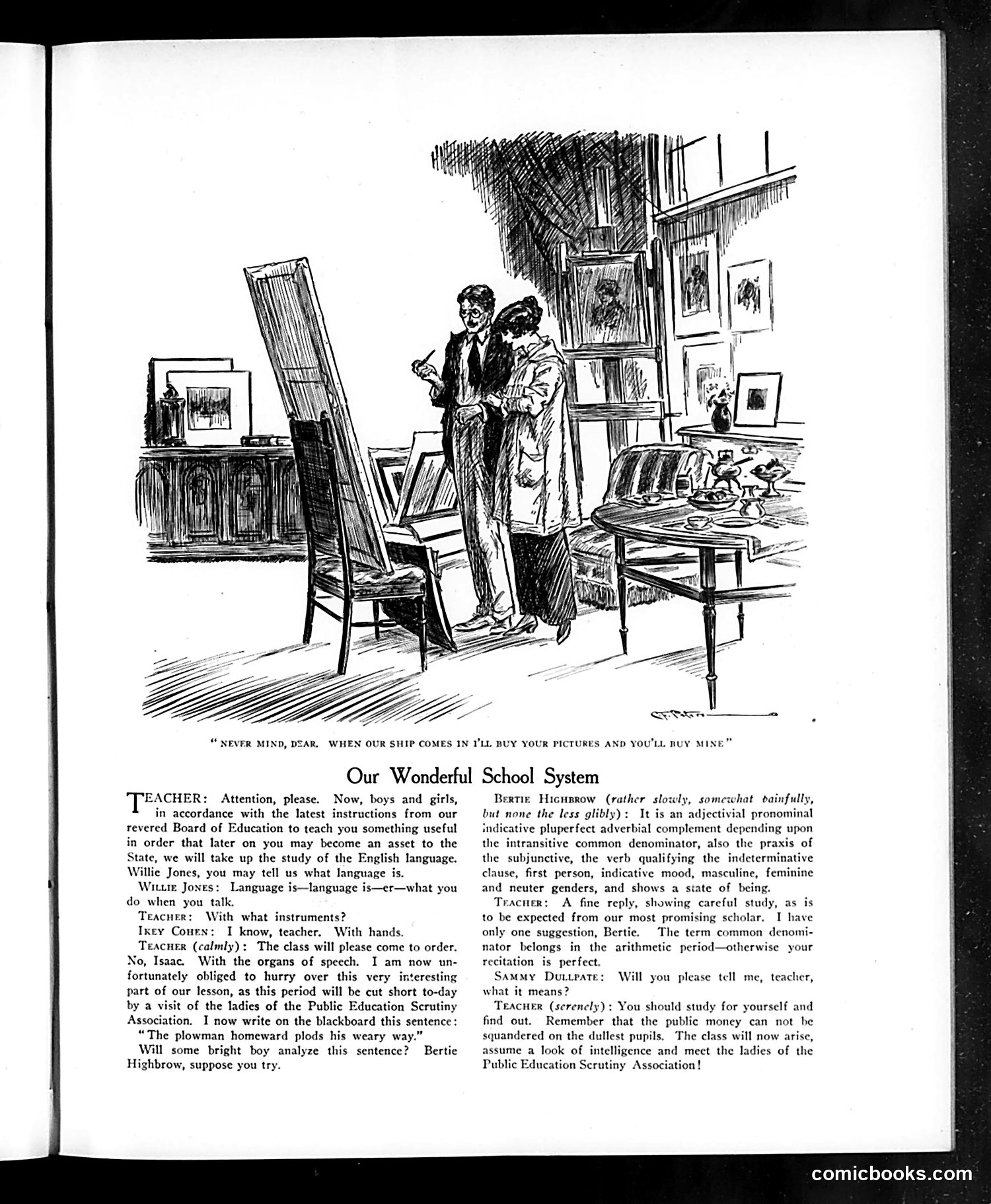
This satirical sketch mocks early 20th-century educational pedagogy. A teacher demonstrates grammar instruction to students while two adult visitors (labeled as part of the "Public Education Scrutiny Association") observe. The humor lies in the absurdity of the lesson: the teacher uses tortured, overly-complex grammatical terminology to explain simple concepts, exemplified by the sentence "The plowman homeward plods his weary way." The satire targets educational pretension—the inflation of simple ideas into incomprehensible jargon. The caption's opening joke about buying ship paintings suggests priorities are misaligned. The piece critiques how schools obscure rather than clarify knowledge, performing sophistication for inspectors rather than genuinely educating children. It reflects contemporary concerns about educational reform and bureaucratic inefficiency.
📄 Transcribed text from this page (OCR, searchable)
Machine-transcribed from the original scan — historical spelling and the odd misread are preserved.
Ques “NEVER MIND, DEAR, WHEN OUR SHIP COMES IN I'LL BUY YOUR PICTURES AND YOU'LL BUY MINE” Our Wonderful School System EACHER: Attention, please. Now, boys and girls, in accordance with the latest instructions from our revered Board of Education to teach you something useful in order that later on you may become an asset to the State, we will take up the study of the English language. Willie Jones, you may tell us what language is. Witte Jones: Language is—language is—er—what you do when you talk. ith what instruments? I know, teacher. With hands. Teacuer (calmly): The class will please come to order. No, Isaac. With the organs of speech. I am now un- fortunately obliged to hurry over this very interesting part of our lesson, as this period will be cut short to-day by a visit of the ladies of the Public Education Scrutiny Association. I now write on the blackboard this sentence: “The plowman homeward plods his weary way.” Will some bright boy analyze this sentence? Highbrow, suppose you try. Bertie Bertie Hicunrow (rather slowly, somewhat dainfully, but none the less glibly): It is an adjectivial pronominal indicative pluperfect adverbial complement depending upon the intransitive common denominator, also the praxis of the subjunctive, the verb qualifying the indeterminative clause, first person, indicative mood, masculine, feminine and neuter genders, and shows a state of being. Tracner: A fine reply, showing careful study, as is to be expected from our most promising scholar, I have only one suggestion, Bertie. The term common denomi- nator belongs in the arithmetic period—otherwise your recitation is perfect. Samay DuLtpate: what it means? Teacuer (serenely): You should study for yourself and find out. Remember that the public money can not be squandered on the dullest pupils, The class will now arise, assume a look of intelligence and mect the ladies of the Public Education Scrutiny Association! Will you please tell me, teacher, comicbooks.com