
Life, 1915-10-21 · page 31 of 52
Life — October 21, 1915 — page 31: what you’re looking at
What you’re looking at
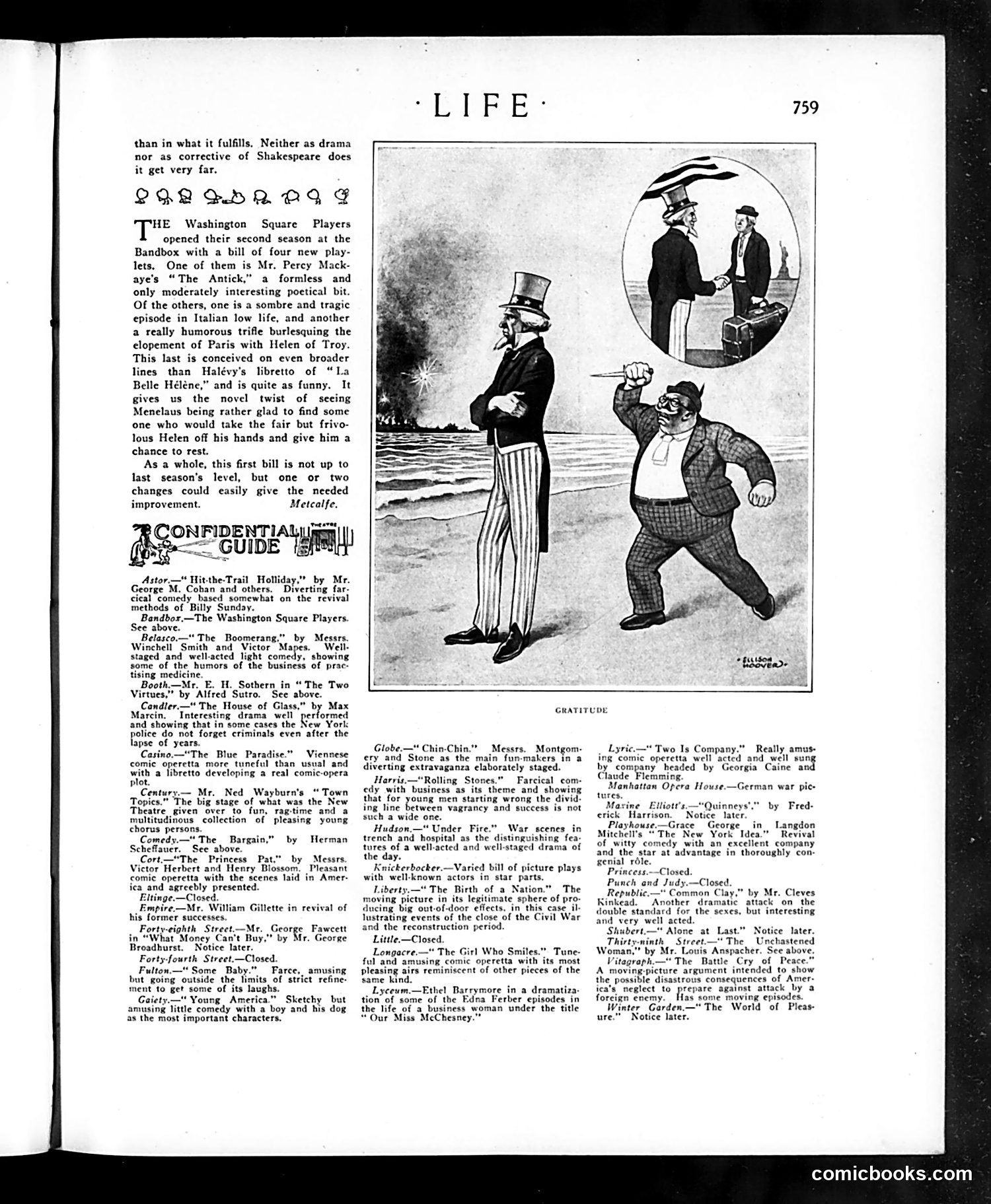
This political cartoon satirizes the relationship between labor and capital during the Progressive Era. The central figure—a well-dressed gentleman in top hat and striped trousers (representing a capitalist or industrialist)—stands beside the ocean holding a large umbrella. Below him, a working-class man in worn clothing appears to be drowning or struggling in the water. The title "Gratitude" conveys bitter irony: the cartoon suggests that wealthy employers expect workers to be grateful for minimal protection or assistance—represented by the umbrella—while leaving them essentially helpless and vulnerable (in deep water). The satire critiques the paternalistic attitude of the wealthy toward labor: that providing any small benefit warrants worker submission and thankfulness, regardless of exploitative conditions. This reflects broader Progressive-era debates about workers' rights, fair wages, and corporate responsibility.
📄 Transcribed text from this page (OCR, searchable)
Machine-transcribed from the original scan — historical spelling and the odd misread are preserved.
than in what it fulfills, Neither as drama nor as corrective of Shakespeare does it get very far. OBB2aAbR Aaa HE Washington Square Players opened their second season at the Bandbox with a bill of four new play- lets. One of them is Mr. Percy Mack- aye’s “The Antick,” a formless and only moderately interesting poetical bit. Of the others, one is a sombre and tragic episode in Italian low life, and another a really humorous trifle burlesquing the elopement of Paris with Helen of Troy. This last is conceived on even broader lines than Halévy’s libretto of “La Belle Héléne,” and is quite as funny. It gives us the novel twist of seeing Menelaus being rather glad to find some one who would take the fair but frivo- lous Helen off his hands and give him a chance to rest. As a whole, this first bill is not up to last. season's level, but one or two changes could easily give the needed improvement. Metcalfe, ONFIDENTIAU gem \e— GUIDE ff Astor. — Hit-the-Trail Holliday,” by Mr. George M. Cohan and others. Diverting far- cical comedy based somewhat on the revival methods of Billy Sunday. Bandbor.—The Washington Square Players. See above. Belasco.—" The Boomerang,” Winchell Smith and Victor Ma Well: staged and well-acted light comedy, showing some of the humors of the business of prac: tising medicine. Boot! r. E. H. Sothern in “The Two Virtues,” by Alfred Sutro. See above. Candter.—" The House of Glass,” by Max Marcin, Interesting drama well ‘performed and showing that in some cases the New York police do not forget criminals even after the lapse of years. Casino.—"The Blue Paradi Viennese comic operetta more tuneful than usual and with a libretto developing a real comic-opera plot. Century.— Mr. Ned Wayburn's “Town Topics.” ‘The big stage of what was the New Theatre given over to fun, ragtime and a multitudinous collection of pleasing young chorus persons. Comedy.—" The Bargain,” Scheffauer. See above. Cort.—"The Princess Pat.” by Messrs. Victor Herbert and Henry Blossom. Pleasant comic operetta with the scenes laid in Amer- ica and agreebly presented. Eltinge,—Closed. Empire.—Mr. William Gillette in revival of his former successes. Forty-eighth Street,—Mr. in “What Money Can't Buy,’ Broadhurst. Notice later. Forty-fourth Street,—Closed. Fulton—" Some Baby.” Farce, but going outside the limits of str ment to get some of its laughs. Gaiety.—" Young America.” Sketchy but amusing little comedy with a boy and his dog as the most important characters. by Messrs. by Herman George Fawcett by Mr. George GraviTui Globe.—* Chin-Chin.” Messrs. Montgom- and Stone as the main fun-makers in a diverting extravaganza elaborately staged. Harris.—"Rolling Stones.” Farcical com: edy with business as its theme and showing that for young men starting wrong the divid- ing line between vagrancy and success is not such a wide one. Hudson.—" Under Fire.” War scenes in trench and hospital as the distinguishing fea- tures of a well-acted and well-staged drama of the day. Knickerbocker.—Varied bill of picture plays with well-known actors in star parts. —“The Birth of a Nation.” The ing picture in its legitimate sphere of pro- ducing big out-of-door effects. in this case il- lustrating events of the close of the Civil War and the reconstruction period. Little.—Closed. Longacre.—" The Girl Who Smiles.” Tune- ful and amusing comic operetta with its most pleasing airs reminiscent of other pieces of the same kind. Lyceum.—Ethel Barrymore in a dramatiza- tion of some of the Edna Ferber episodes. in the life of a business woman under the title “Our Miss McChesney. Lyr Two Is Company.” Really amu ing comic operetta well acted and well suny by company headed by Georgia Caine at Claude Flemming. Manhattan Opera House.—German war pice tures, Marine Elliott’s—“Quinneys'." by erick Harrison. Notice later. Playhouse.—Grace George in| Langdon Mitchell's “The New York Idea.” Revival of witty comedy with an excellent company and the star at advantage in thoroughly con- genial rdle. Princess.—Closed. Punch and Judy.—Closed. Republic.—* Common Clay,” by Mr. Cleves Kinkead. Another dramatic attack ‘on the double standard for the sexes, but interesting and very well acted. Shubert—" Alone at Last.” Notice later. Thirty-ninth Street— The Unchastened Woman," by Mr. Louis Anspacher. See above, Vitagroph,.—* The Battle Cry of Peace.” A moving-picture argument intended to show the possible disastrous consequences of Amer- ica'e neglect to prepare against attack by a foreign enemy. Has some moving episodes. Winter Garden.—" The World of Pleas- ure.” Notice later. Fred- comicbooks.com