
Life, 1915-10-21 · page 29 of 52
Life — October 21, 1915 — page 29: what you’re looking at
What you’re looking at
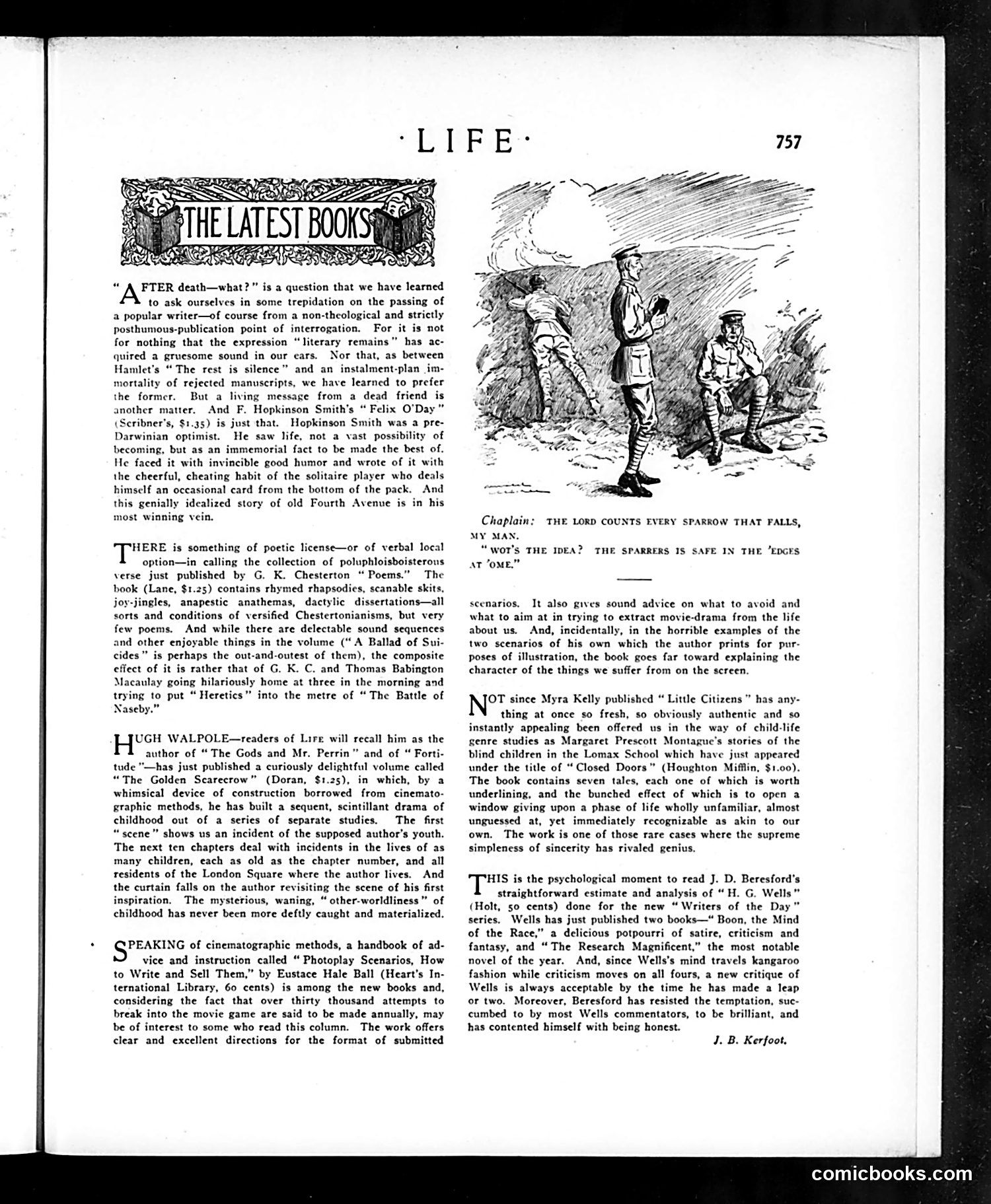
This page from *Life* magazine is primarily a book review column titled "The Latest Books," featuring literary criticism rather than political cartooning. The single illustration depicts a **Chaplain character** (likely from a literary work) speaking to soldiers, with the caption quoting: "The Lord counts every sparrow that falls, my man. 'Wot's the idea? The sparrers is safe in the 'edges at 'ome.'" This appears to reference **trench warfare during World War I**, where soldiers discuss divine providence and safety—the Chaplain's pious sentiment contrasts with the soldier's sardonic, working-class British dialect response. The satire targets the disconnect between religious comfort offered to combat troops and battlefield reality. The reviews discuss books by F. Hopkinson Smith, G.K. Chesterton, and Hugh Walpole, offering no additional political content beyond this single cartoon commentary on wartime faith and soldier skepticism.
📄 Transcribed text from this page (OCR, searchable)
Machine-transcribed from the original scan — historical spelling and the odd misread are preserved.
FTER death—what?” is a question that we have learned to ask ourselves in some trepidation on the passing of a popular writer—of course from a non-thcological and strictly posthumous-publication point of interrogation. For it is not for nothing that the expression “literary remains" has ac- quired a gruesome sound in our ears. Nor that, as between Hamlet's “The rest is silence” and an instalment-plan im- mortality of rejected manuscripts, we have learned to prefer the former. But a living message from a dead friend is another matter. And F, Hopkinson Smith's “Felix O'Day” (Scribner's, $1.3) is just that. Hopkinson Smith was a pre- Darwinian optimist. He saw life, not a vast possibility of becoming, but as an immemorial fact to be made the best of. He faced it with invincible good humor and wrote of it with the cheerful, cheating habit of the solitaire player who deals himself an occasional card from the bottom of the pack. And this genially idealized story of old Fourth Avenue is in his most winning vein, HERE is something of poetic license—or of verbal local option—in calling the collection of poluphloisboisterous verse just published by G. K. Chesterton “ Poems.” The book (Lane, $1.25) contains rhymed rhapsodies, scanable skits, joy-jingles, anapestic anathemas, dactylic dissertations—all sorts and conditions of versified Chestertonianisms, but very few poems. And while there are delectable sound sequences and other enjoyable things in the volume (“A Ballad of Sui- cides” is perhaps the out-and-outest of them), the composite effect of it is rather that of G. K. C. and Thomas Babington Macaulay going hilariously home at three in the morning and trying to put “Heretics” into the metre of “The Battle of Naseby.” UGH WALPOLE—readers of Lire will recall him as the author of “ The Gods and Mr. Perrin” and of “ Forti- tude "—has just published a curiously delightful volume called “The Golden Scarecrow” (Doran, $1.25), in which, by a whimsical device of construction borrowed from cinemato- graphic methods, he has built a sequent, scintillant drama of childhood out of a series of separate studies. The first “scene” shows us an incident of the supposed author’s youth. The next ten chapters deal with incidents in the lives of as many children, each as old as the chapter number, and all residents of the London Square where the author lives. And the curtain falls on the author revisiting the scene of his first inspiration. The mysterious, waning, “ other-worldliness” of childhood has never been more deftly caught and materialized. PEAKING of cinematographic methods, a handbook of ad- vice and instruction called “ Photoplay Scenarios, How to Write and Sell Them,” by Eustace Hale Ball (Heart's In- ternational Library, 60 cents) is among the new books and, considering the fact that over thirty thousand attempts to break into the movie game are said to be made annually, may be of interest to some who read this column. The work offers clear and excellent directions for the format of submitted Chaplain: MY MAN. “wor's THE IDEA? AT ‘OME.” THE LORD COUNTS EVERY SPARROW THAT THE SPARRERS IS SAFE IN THE ’ scenarios, It also gives sound advice on what to avoid and what to aim at in trying to extract movie-drama from the life about us. And, incidentally, in the horrible examples of the two scenarios of his own which the author prints for pur- poses of illustration, the book goes far toward explaining the character of the things we suffer from on the screen. OT since Myra Kelly published “ Little Citizens” has any- thing at once so fresh, so obviously authentic and so instantly appealing been offered us in the way of child-life genre studies as Margaret Prescott Montague’s stories of the blind children in the Lomax School which have just appeared under the title of “Closed Doors” (Houghton Mifflin, $1.00). The book contains seven tales, each one of which is worth underlining, and the bunched effect of which is to open a window giving upon a phase of life wholly unfamiliar, almost unguessed at, yet immediately recognizable as akin to our own. The work is one of those rare cases where the supreme simpleness of sincerity has rivaled genius, HIS is the psychological moment to read J. D. Beresford’s straightforward estimate and analysis of “H. G. Wells” (Holt, 50 cents) done for the new “Writers of the Day” series, Wells has just published two books—“ Boon, the Mind of the Race,” a delicious potpourri of satire, criticism and fantasy, and “The Research Magnificent,” the most notable novel of the year. And, since Wells’s mind travels kangaroo fashion while criticism moves on all fours, a new critique of Wells is always acceptable by the time he has made a leap or two. Moreover, Beresford has resisted the temptation, suc- cumbed to by most Wells commentators, to be brilliant, and has contented himself with being honest. J. B. Kerfoot, comicbooks.com