
Life, 1915-10-21 · page 32 of 52
Life — October 21, 1915 — page 32: what you’re looking at
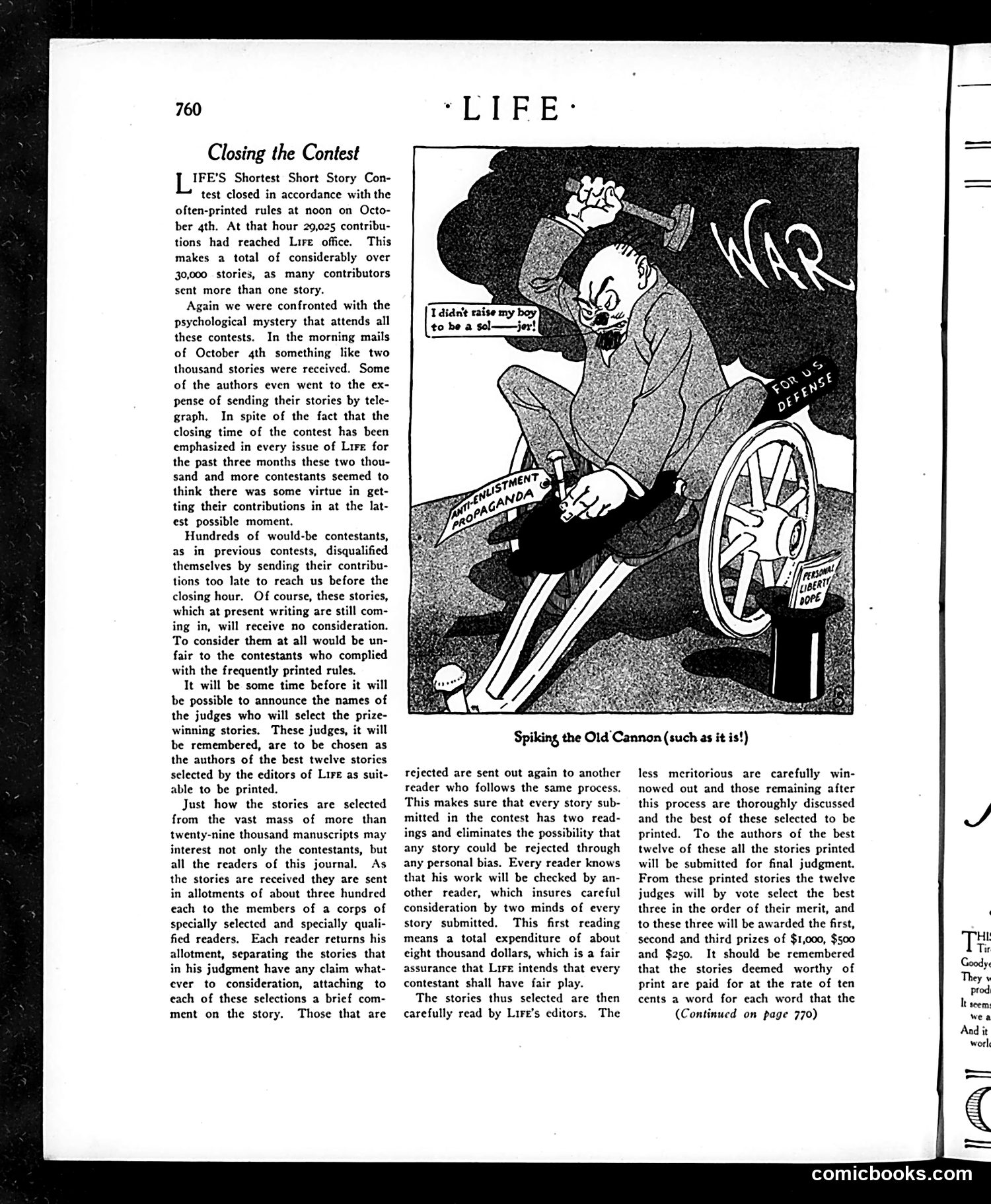
What you’re looking at
This cartoon satirizes the common idiom "I didn't raise my boy to be a soldier"—a popular phrase and song title from the World War I era expressing maternal opposition to military service. The cartoon depicts a woman literally "spiking" (disabling) a cannon by driving a spike through it, weaponizing the domestic sentiment into direct action against war machinery. The visual pun transforms the sentimental phrase into active sabotage. The accompanying text describes Life magazine's short story contest closing procedures—not directly related to the cartoon's anti-war message. The cartoon likely comments on contemporary anxieties about military conscription or war preparation during this period, using dark humor to mock both pacifist sentiment and its impotence against military institutions. The woman's determined expression suggests frustrated defiance against forces beyond civilian control.
📄 Transcribed text from this page (OCR, searchable)
Machine-transcribed from the original scan — historical spelling and the odd misread are preserved.
760 Closing the Contest IFE’S Shortest Short Story Con- test closed in accordance with the often-printed rules at noon on Octo- ber 4th. At that hour 29,025 contribu- tions had reached Lire office. This makes a total of considerably over 30,000 stories, as many contributors sent more than one story. Again we were confronted with the psychological mystery that attends all these contests. In the morning mails of October 4th something like two thousand stories were received. Some of the authors even went to the ex- pense of sending their stories by tele- graph. In spite of the fact that the closing time of the contest has been emphasized in every issue of Lire for the past three months these two thou- sand and more contestants seemed to think there was some virtue in get- ting their contributions in at the lat- est possible moment. Hundreds of would-be contestants, as in previous contests, disqualified themselves by sending their contribu- tions too late to reach us before the closing hour. Of course, these storics, ‘h at present writing are still com- ing in, will receive no consideration. To consider them at all would be un- fair to the contestants who complied with the frequently printed rules. It will be some time before it will be possible to announce the names of the judges who will select the prize- winning stories, These judges, it will be remembered, are to be chosen as the authors of the best twelve stories selected by the editors of Lire as suit- able to be printed. Just how the stories are selected from the vast mass of more than twenty-nine thousand manuscripts may interest not only the contestants, but all the readers of this journal. As the stories are received they are sent in allotments of about three hundred each to the members of a corps of specially selected and specially quali- fied readers. Each reader returns his allotment, separating the stories that in his judgment have any claim what- ever to consideration, attaching to each of these selections a brief com- ment on the story. Those that are T didnt raise my boy Ri to be a sol——jer! Spiking the Old Cannon (such as it is!) rejected are sent out again to another reader who follows the same process. This makes sure that every story sub- mitted in the contest has two read- ings and eliminates the possibility that any story could be rejected through any personal bias. Every reader knows that his work will be checked by an- other reader, which insures careful consideration by two minds of every story submitted. This first reading means a total expenditure of about cight thousand dollars, which is a fair assurance that Lire intends that every contestant shall have fair play. The stories thus selected are then carefully read by Lire’s editors. The less. meritorious are carefully win- nowed out and those remaining after this process are thoroughly discussed and the best of these selected to be printed. To the authors of the best twelve of these all the stories printed will be submitted for final judgment. From these printed stories the twelve judges will by vote select the best three in the order of their merit, and to these three will be awarded the first, second and third prizes of $1,000, $500 and $250. It should be remembered that the stories deemed worthy of print are paid for at the rate of ten cents a word for each word that the (Continued on page 770) \| comicbooks.com