
Life, 1915-10-21 · page 24 of 52
Life — October 21, 1915 — page 24: what you’re looking at
What you’re looking at
This satirical story exposes how wealthy mining magnates control state government, particularly the judiciary, in early 20th-century Western states. A group of mine owners interviews a Supreme Court judge candidate, demanding he pledge absolute loyalty to their interests and believe them always right—even when they shoot strikers or bend legal process. The candidate initially agrees under duress. However, when pressed to *sincerely believe* their superiority rather than merely obey, he refuses: "I cannot throttle my convictions." The chairman then declares him hired anyway—revealing the "test" was designed to identify men of principle who can be trusted *despite* knowing they're compromised. The satire's point: the magnates prefer judges who understand the corruption frankly rather than true believers. It's a damning critique of how economic power corrupts judicial independence and rule of law.
📄 Transcribed text from this page (OCR, searchable)
Machine-transcribed from the original scan — historical spelling and the odd misread are preserved.
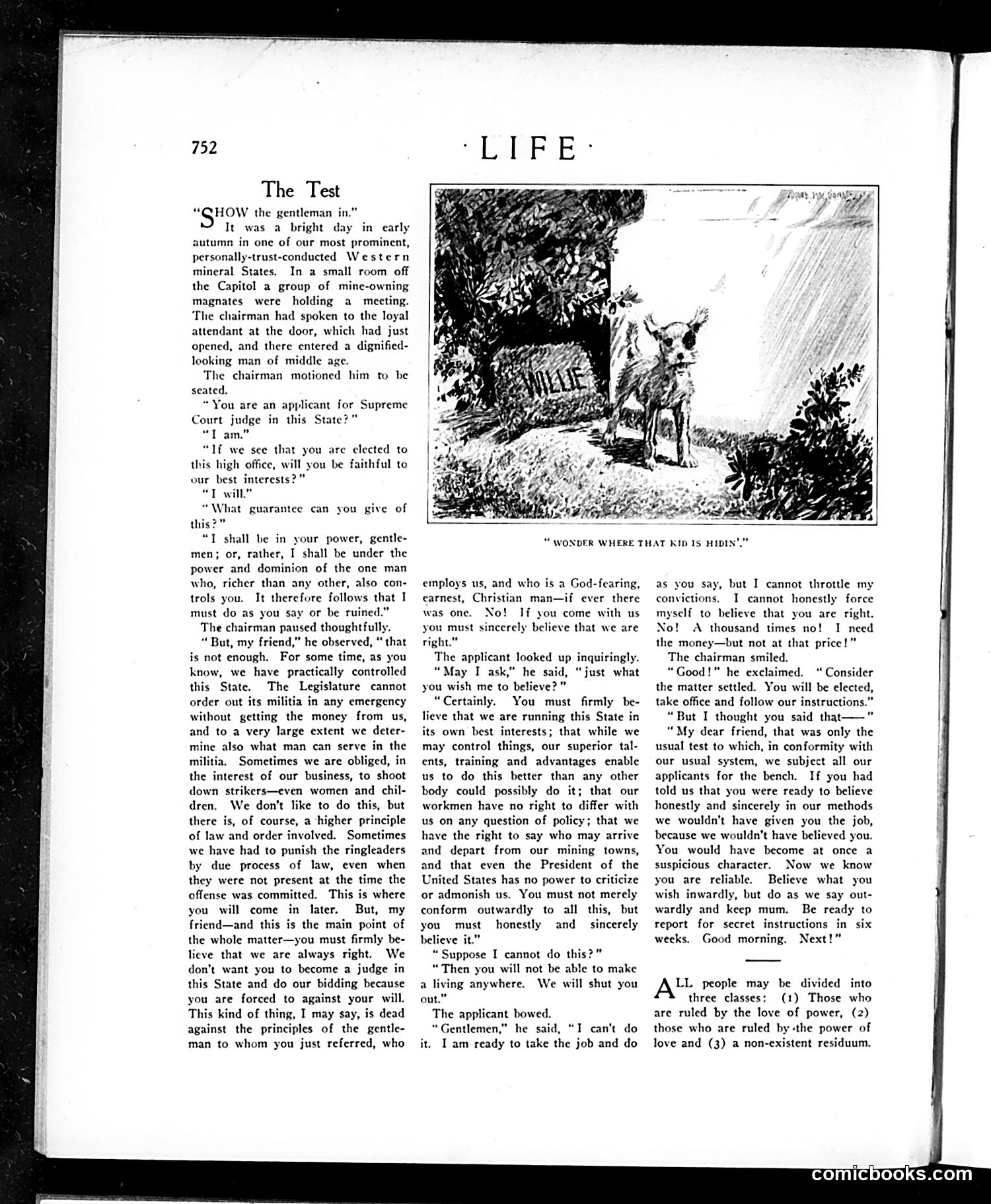
The Test “QHOW the gentleman in.” It was a bright d in carly autumn in one of our most prominent, personally-trust-conducted Western mineral States. In a small room off the Capitol a group of mine-owning magnates were holding a meeting. The chairman had spoken to the loyal attendant at the door, which had just opened, and there entered a dignified- looking man of middle age. The chairman motioned him to be seated. You are an applicant for Supreme Court judge in this State? “Tam.” “If we see that you are clected to this high office, will you be faithful to our best interests?” “T will” “What guarantee can you give of this?” “T shall be in your power, gentle- men; or, rather, I shall be under the power and dominion of the one man who, richer than any other, also con- trols you. It therefore follows that 1 must do as you say or be ruined.” The chairman paused thoughtfully. “ But, my friend,” he observed, “ that is not enough. For some time, as you know, we have practically controlled this State. The Legislature cannot order out its militia in any emergency without getting the money from us, and to a very large extent we deter- mine also what man can serve in the militia. Sometimes we are obliged, in the interest of our business, to shoot down strikers—even women and chil- dren. We don't like to do this, but there is, of course, a higher principle of law and order involved. Sometimes we have had to punish the ringleaders by due process of law, even when they were not present at the time the offense was committed. This is where you will come in later. But, my friend—and this is the main point of the whole matter—you must firmly be- lieve that we are always right. We don’t want you to become a judge in this State and do our bidding because you are forced to against your will. This kind of thing, I may say, is dead against the principles of the gentle- man to whom you just referred, who “WONDER WHERE THAT K1D IS HIDIN employs us, and who is a God-fearing, earnest, Christian man—if ever there was one. No! If you come with us you must sincerely believe that we are right The applicant looked up inquiringly. “May I ask,” he said, “just what you wish me to believe?” “Certainly, You must firmly be- lieve that we are running this State in its own best interests; that while we may control things, our superior tal- ents, training and advantages enable us to do this better than any other body could possibly do it; that our workmen have no right to differ with us on any question of policy; that we have the right to say who may arrive and depart from our mining towns, and that even the President of the United States has no power to criticize or admonish us. You must not merely conform outwardly to all this, but you must honestly and sincerely believe it.” “Suppose I cannot do this?” “Then you will not be able to make a living anywhere. We will shut you out.” The applicant bowed. “Gentlemen,” he said, “I can't do it. I am ready to take the job and do as you say, but I cannot throttle my convictions. I cannot honestly force myself to believe that you are right. No! A thousand times no! I need the money—but not at that price!” The chairman smiled. “Good!” he exclaimed. “ Consider the matter settled. You will be elected, take office and follow our instructions. “But I thought you said that— “My dear friend, that was only the usual test to which, in conformity with our usual system, we subject all our applicants for the bench. If you had told us that you were ready to believe honestly and sincerely in our methods we wouldn't have given you the job, because we wouldn't have believed you. You would have become at once a suspicious character. Now we know you are reliable. Believe what you wish inwardly, but do as we say out- wardly and keep mum. Be ready to report for secret instructions in six weeks. Good morning. Next!” A people may be divided into three classes: (1) Those who are ruled by the love of power, (2) those who are ruled by -the power of love and (3) a non-existent residuum. comicbooks.com