
Life, 1915-10-21 · page 10 of 52
Life — October 21, 1915 — page 10: what you’re looking at
What you’re looking at
This is a satirical fable featuring zoo animals debating human nature. A brown bear defends humans against criticism from other animals (a hippo, lion, and rhino), arguing that humans are actually virtuous despite appearing cruel and confined. The bear's defense is deeply ironic: he claims humans are good because they're laboring under society's constraints, yet he also admits they invented prisons and use humans as objects for entertainment and "philosophical reflection." The satire targets both human self-deception about morality and contemporary attitudes toward confinement and class hierarchy. By having the bear rationalize human flaws as unavoidable social necessity, the cartoon mocks self-justifying arguments for inequality and exploitation—relevant to early 20th-century debates about labor, incarceration, and social order.
📄 Transcribed text from this page (OCR, searchable)
Machine-transcribed from the original scan — historical spelling and the odd misread are preserved.
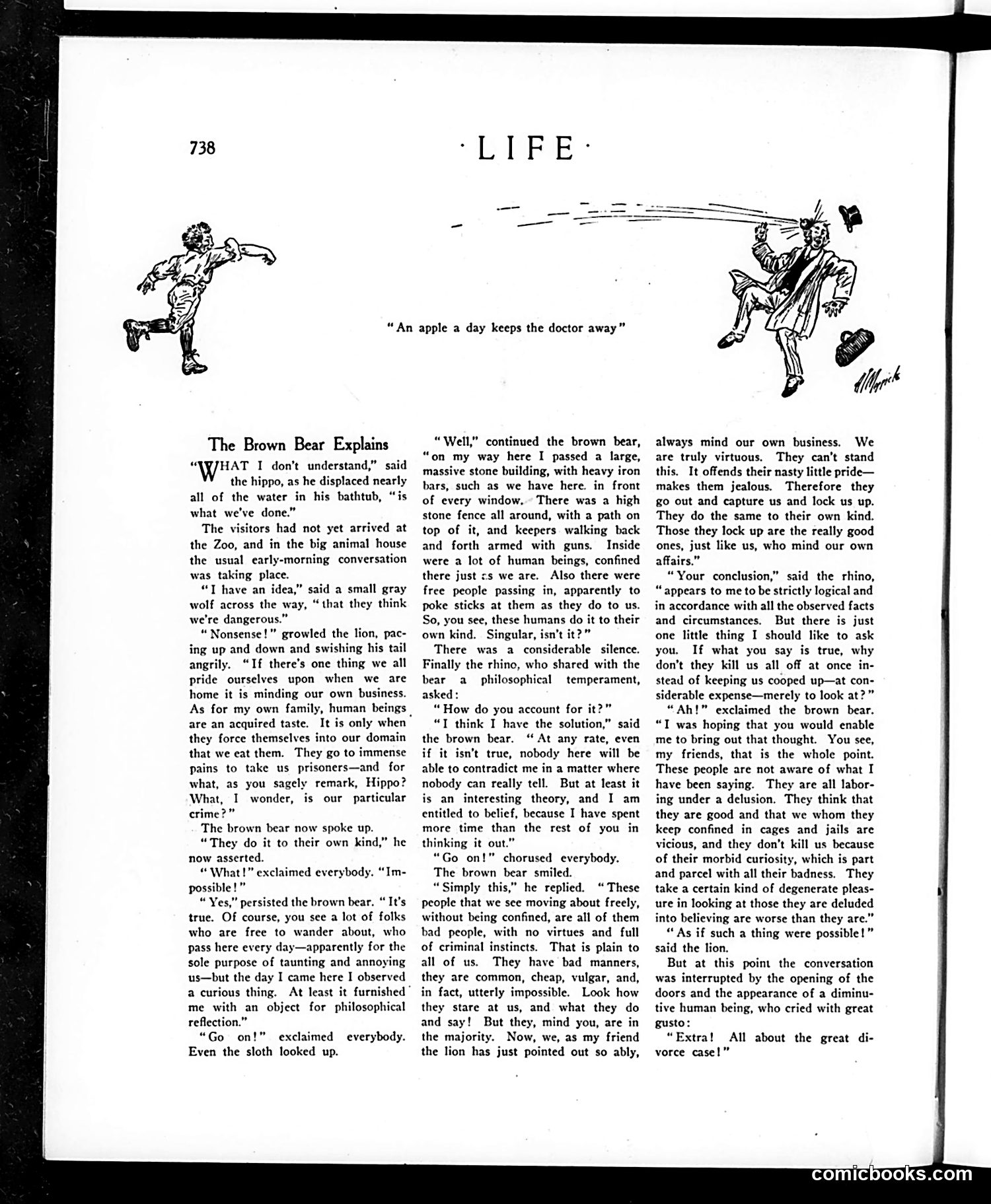
“An apple a day keeps the doctor away” The Brown Bear Explains “YY/HAT I don’t understand,” said the hippo, as he displaced nearly all of the water in his bathtub, “is what we've done.” The visitors had not yet arrived at the Zoo, and in the big animal house the usual early-morning conversation was taking place. “T have an idea,” said a small gray wolf across the way, “that they think we're dangerous.” “Nonsense!” growled the lion, pac- ing up and down and swishing his tail angrily. “If there’s one thing we all pride ourselves upon when we are home it is minding our own business. As for my own family, human beings | are an acquired taste. It is only when they force themselves into our domain that we eat them. They go to immense pains to take us prisoners—and for what, as you sagely remark, Hippo? What, I wonder, is our particular crime?” The brown bear now spoke up. “They do it to their own kind,” he now asserted. “ What!” exclaimed everybody. “Im- possible!” .” persisted the brown bear. true. Of course, you see a lot of folks who are free to wander about, who pass here every day—apparently for the sole purpose of taunting and annoying us—but the day I came here I observed a curious thing. At least it furnished me with an object for philosophical reflection.” “Go on!” exclaimed Even the sloth looked up. everybody. “Well,” continued the brown bear, “on my way here I passed a large, massive stone building, with heavy iron bars, such as we have here. in front of every window. There was a high stone fence all around, with a path on top of it, and keepers walking back and forth armed with guns. Inside were a lot of human beings, confined there just cs we are. Also there were free people passing in, apparently to poke sticks at them as they do to us. So, you see, these humans do it to their own kind. Singular, isn’t it?” There was a considerable silence. Finally the rhino, who shared with the bear a philosophical temperament, asked : “How do you account for it?” “TI think I have the solution,” said the brown bear. “At any rate, even if it isn’t true, nobody here will be able to contradict me in a matter where nobody can really tell. But at least it is an interesting theory, and I am entitled to belief, because I have spent more time than the rest of you in thinking it out.” “Go on!” chorused everybody. The brown bear smiled. “Simply this,” he replied. “These people that we sce moving about freely, without being confined, are all of them bad people, with no virtues and full of criminal instincts. That is plain to all of us. They have bad manners, they are common, cheap, vulgar, and, in fact, utterly impossible. Look how they stare at us, and what they do and say! But they, mind you, are in the majority. Now, we, as my friend the lion has just pointed out so ably, always mind our own business. We are truly virtuous. They can’t stand this. It offends their nasty little pride— makes them jealous. Therefore they go out and capture us and lock us up. They do the same to their own kind. Those they lock up are the really good ones, just like us, who mind our own affairs.” “Your conclusion,” said the rhino, “appears to me to be strictly logical and in accordance with all the observed facts and circumstances. But there is just one little thing I should like to ask you. If what you say is true, why don’t they kill us all off at once in- stead of keeping us cooped up—at con- siderable expense—merely to look at?” “Ah!” exclaimed the brown bear. “T was hoping that you would enable me to bring out that thought. You see, my friends, that is the whole point. These people are not aware of what I have been saying. They are all labor- ing under a delusion, They think that they are good and that we whom they keep confined in cages and jails are vicious, and they don’t kill us because of their morbid curiosity, which is part and parcel with all their badness. They take a certain kind of degenerate pleas- ure in looking at those they are deluded into believing are worse than they are.” “ As if such a thing were possible!” said the lion. But at this point the conversation was interrupted by the opening of the doors and the appearance of a diminu- tive human being, who cried with great gusto: “Extra! All about the great di- vorce case!” comicbooks.com