
A complete issue · 45 pages · 1915
Life — September 30, 1915
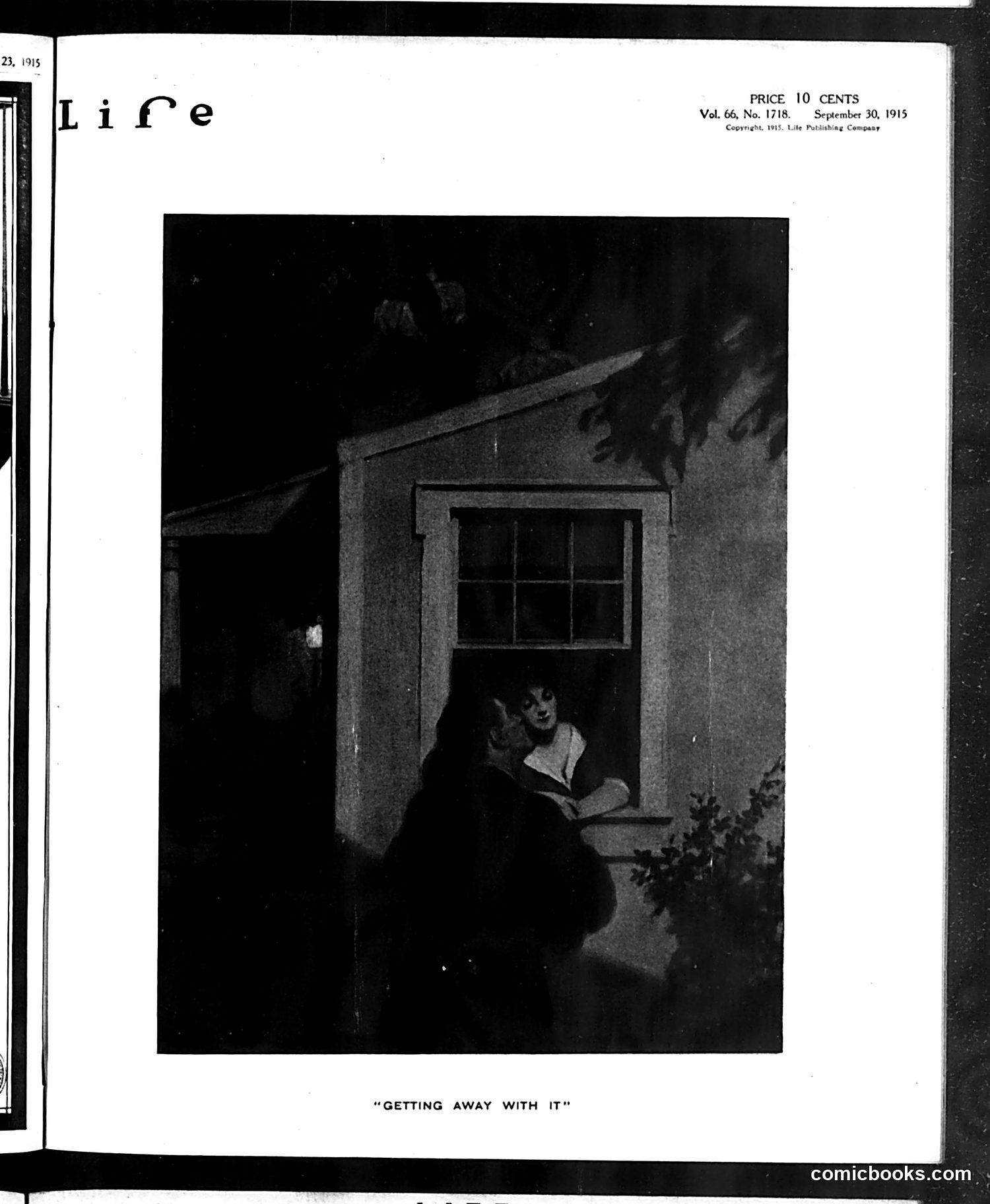
This Life magazine cover from September 30, 1915 shows a nighttime scene of a figure climbing through a window while another person inside appears to be caught or confronted. The caption "Getting Away With It" suggests a humorous commentary on someone successfully committing or escaping with a crime or misdeed. Without additional context from the magazine's contents, the specific reference remains unclear—it could satirize a public figure evading consequences, a social scandal, or a contemporary crime. The image's stark black-and-white photography and dramatic composition emphasize the illicit nature of the act being depicted, typical of Life's satirical approach to exposing hypocrisy or moral failings in early 20th-century American society.
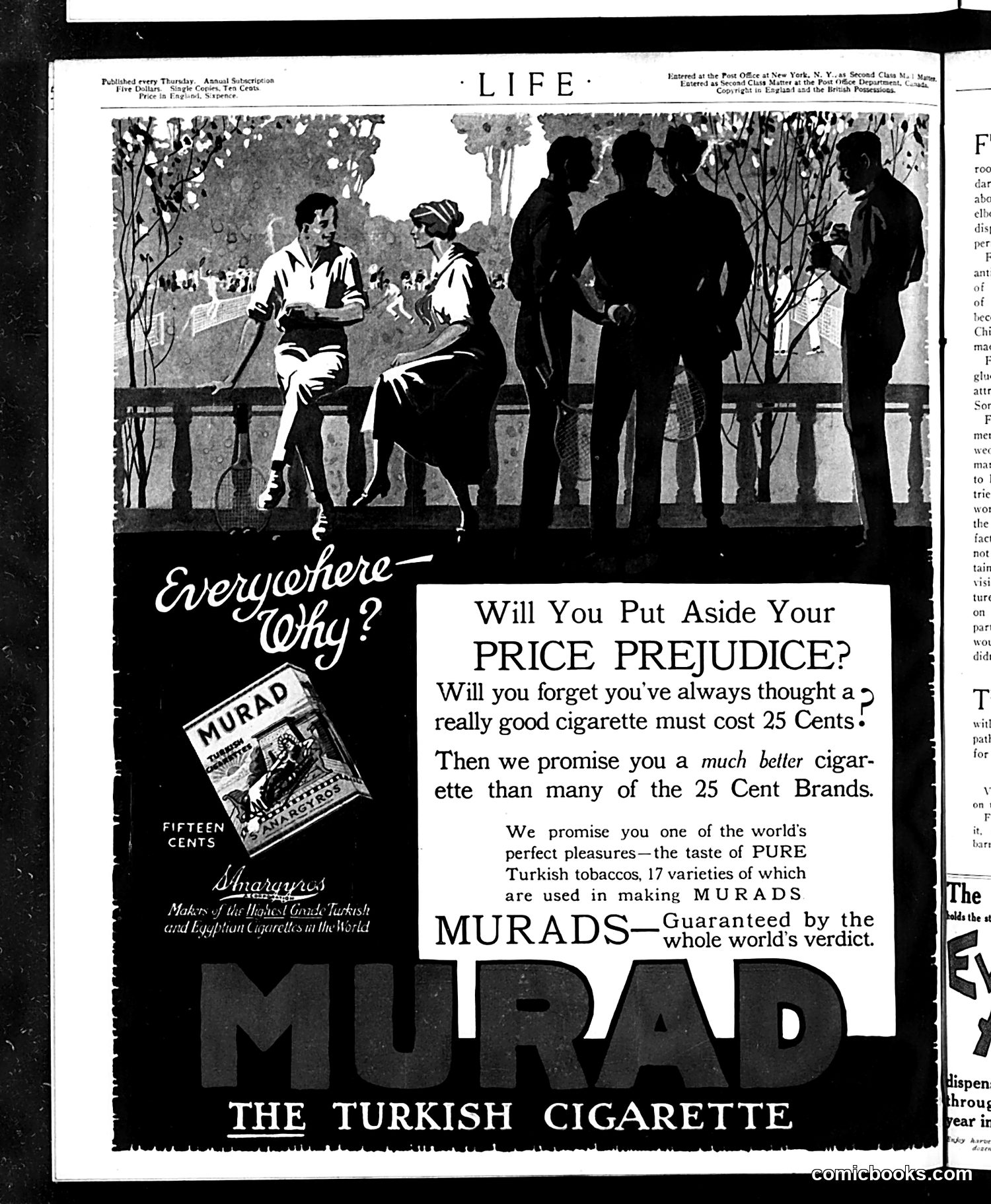
This page is **primarily a cigarette advertisement** for Murads, a Turkish cigarette brand, rather than satirical content. The ad challenges consumer "price prejudice" by arguing that quality needn't cost 25 cents—Murads cost only 15 cents yet claim superiority through use of "17 varieties" of pure Turkish tobacco. The illustration shows well-dressed men in a park setting, depicting aspirational social scenarios where smoking Murads would be appropriate. The phrase "Everywhere—Why?" sarcastically questions why consumers aren't already buying this cheaper alternative if it's truly better quality. This reflects early-20th-century advertising strategy: positioning an affordable product as both economical *and* sophisticated, targeting middle-class consumers skeptical of premium pricing.
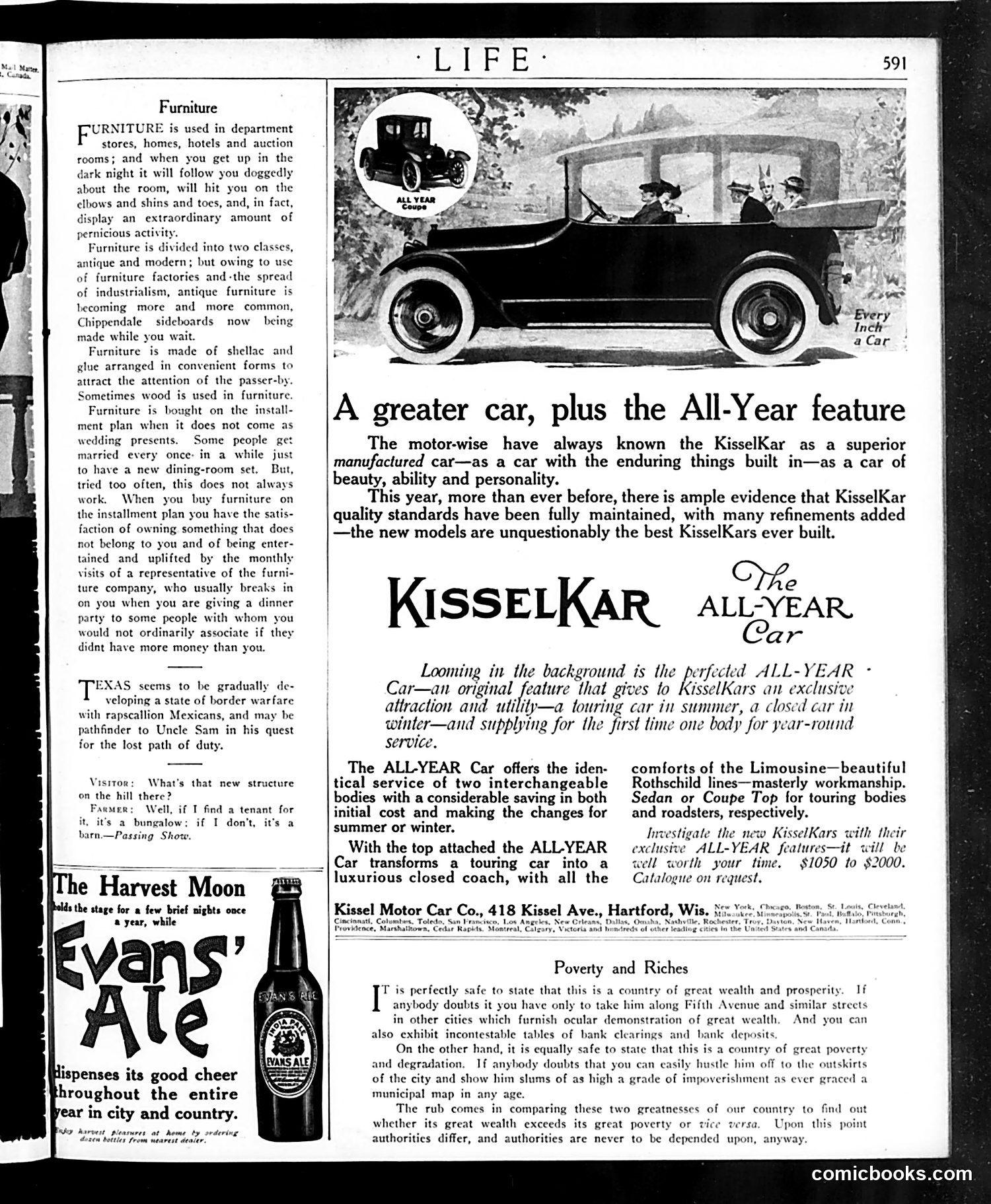
This page is **primarily advertising** rather than satirical content. The dominant feature is a KisselKar automobile advertisement promoting their "All-Year Car" model—a vehicle with interchangeable bodies for different seasons (touring car in summer, closed coach in winter). The only satirical content appears in the left column: a brief humor section titled "The Patron" containing a joke about a man calling a structure on his property a "bungalow" because "if I don't like it, it's a bungalow." This is gentle wordplay mocking real estate terminology. The bottom section, "Poverty and Riches," discusses wealth inequality in American cities—a substantive social commentary rather than cartoon satire. The Evans' Ale advertisement is straightforward commercial messaging, not satirical.
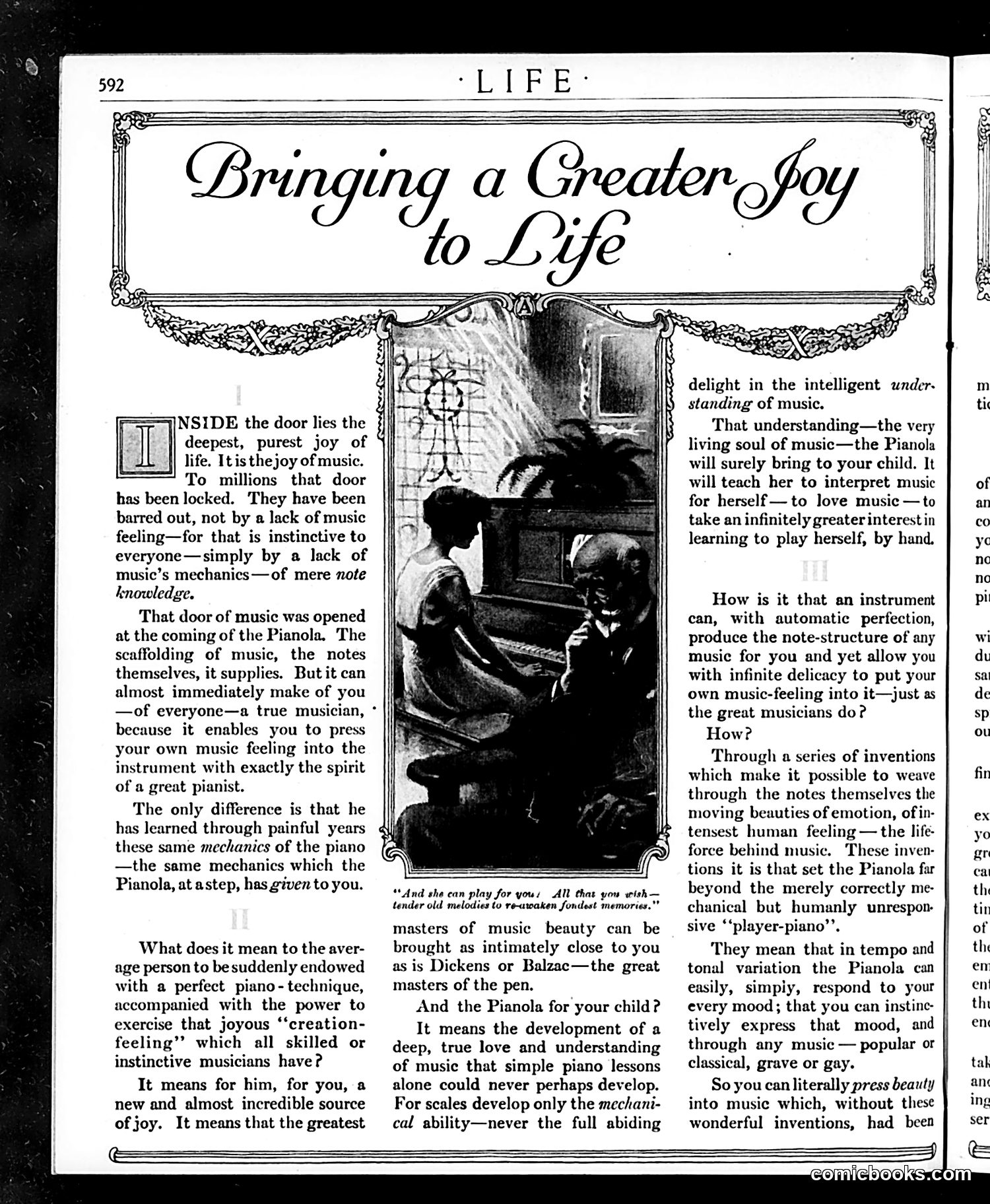
This is **not a political cartoon or satire**—it's a **advertisement for the Pianola player piano**, disguised as editorial content in Life magazine (a common advertising practice of that era). The page promotes the Pianola as a democratizing technology that brings musical sophistication to average households. The central image shows a woman playing the device. The text argues the Pianola enables people without formal training to produce music with "the spirit of a great pianist" by mechanically reproducing recorded performances. The key claim: this invention makes high culture—music by "masters like Dickens or Balzac"—accessible to children and families who couldn't otherwise afford piano lessons or talent. This reflects early 20th-century optimism about technology's ability to elevate middle-class life.
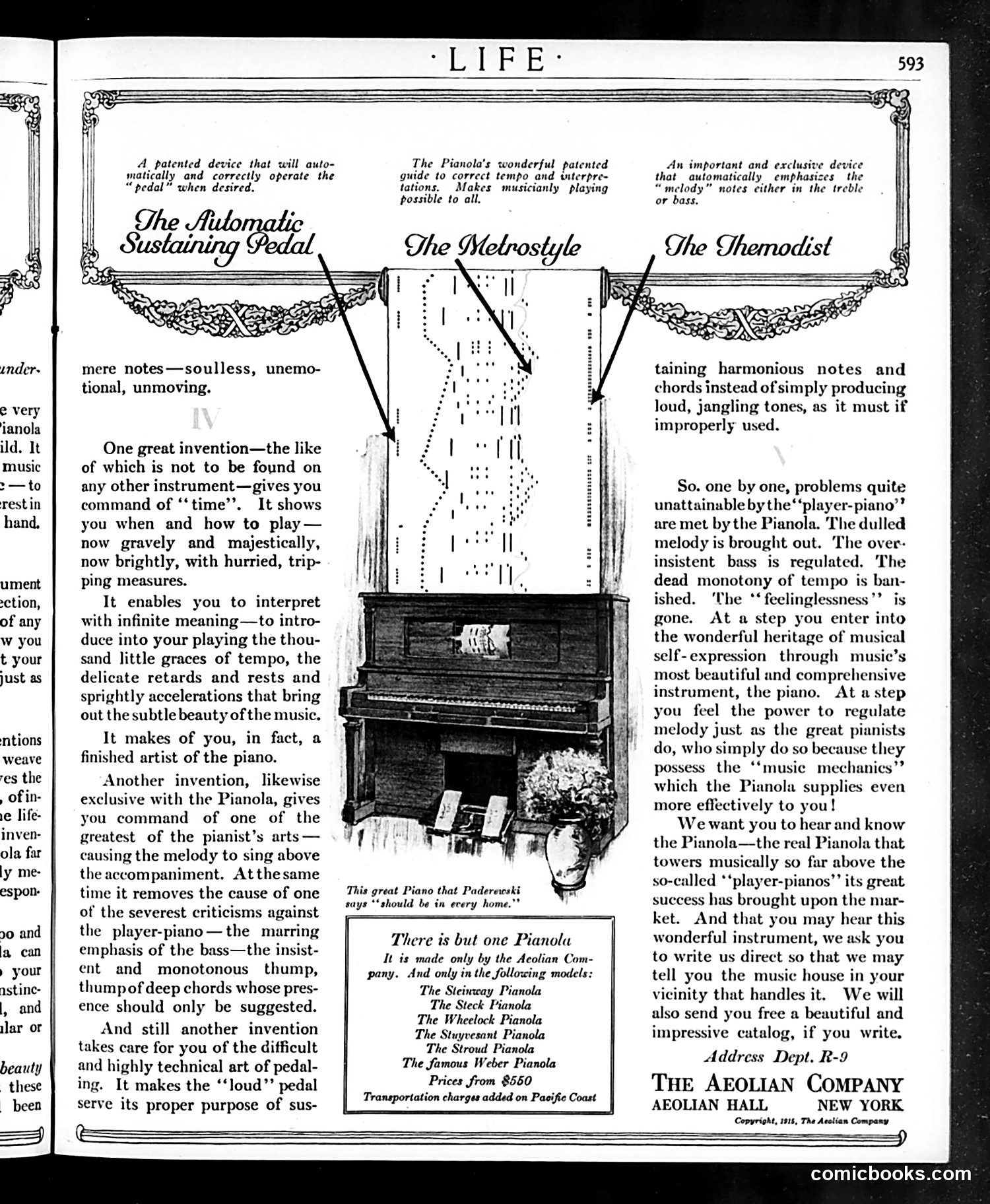
This page is **primarily advertisement**, not political satire or cartoon commentary. The Aeolian Company advertises the **Pianola**, an automatic player-piano device. Three featured innovations are promoted: 1. **The Automatic Sustaining Pedal** — controls timing and dynamics 2. **The Metrostyle** — guides tempo and musical interpretation 3. **The Themodist** — emphasizes melody in treble or bass The advertisement emphasizes that the Pianola democratizes piano performance, allowing non-musicians to "interpret" music like professional pianists through mechanical means. The center image shows an actual Pianola piano. The text celebrates the device's "music mechanics," positioning it as enabling artistic self-expression. Pricing begins at $250 (with transportation charges added for Pacific Coast delivery). This reflects early 20th-century enthusiasm for mechanical music reproduction technology.
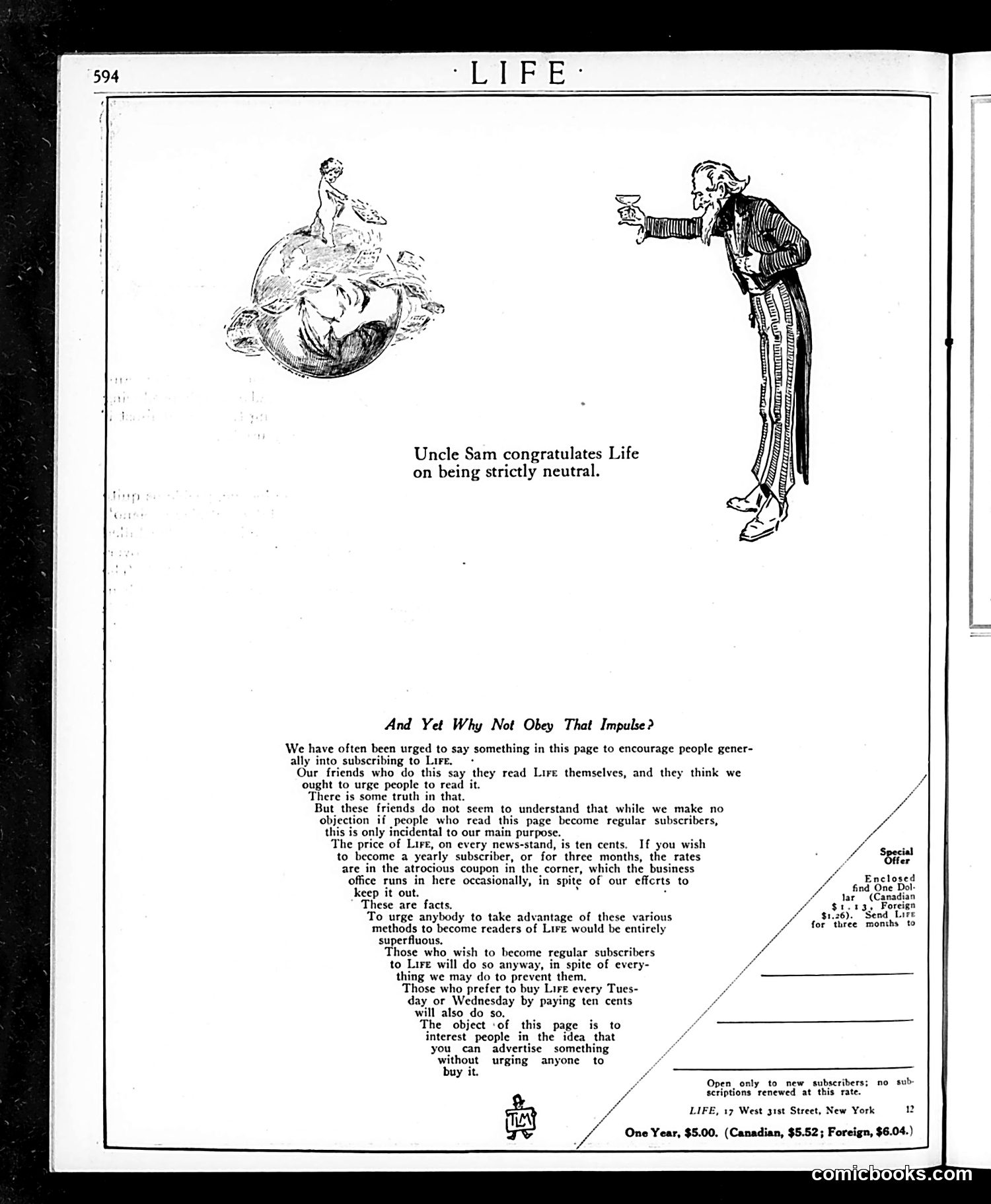
The cartoon depicts Uncle Sam (representing the United States) congratulating the Earth ("Life") on being "strictly neutral." The satire likely references American neutrality policy during World War I (the magazine's era). Uncle Sam, shown as a tall, thin figure with characteristic top hat and goatee, raises a glass in mock celebration while the Earth below is laden with weapons, destruction, and chaos—a visual contradiction mocking the absurdity of American "neutrality" claims. The joke: while officially neutral, the U.S. was actually deeply entangled in the global conflict through arms sales, loans, and diplomatic involvement. The cartoon sarcastically suggests that claiming neutrality while profiting from warfare is laughable. The disconnect between Uncle Sam's cheerful toast and the devastated world below emphasizes the hypocrisy.
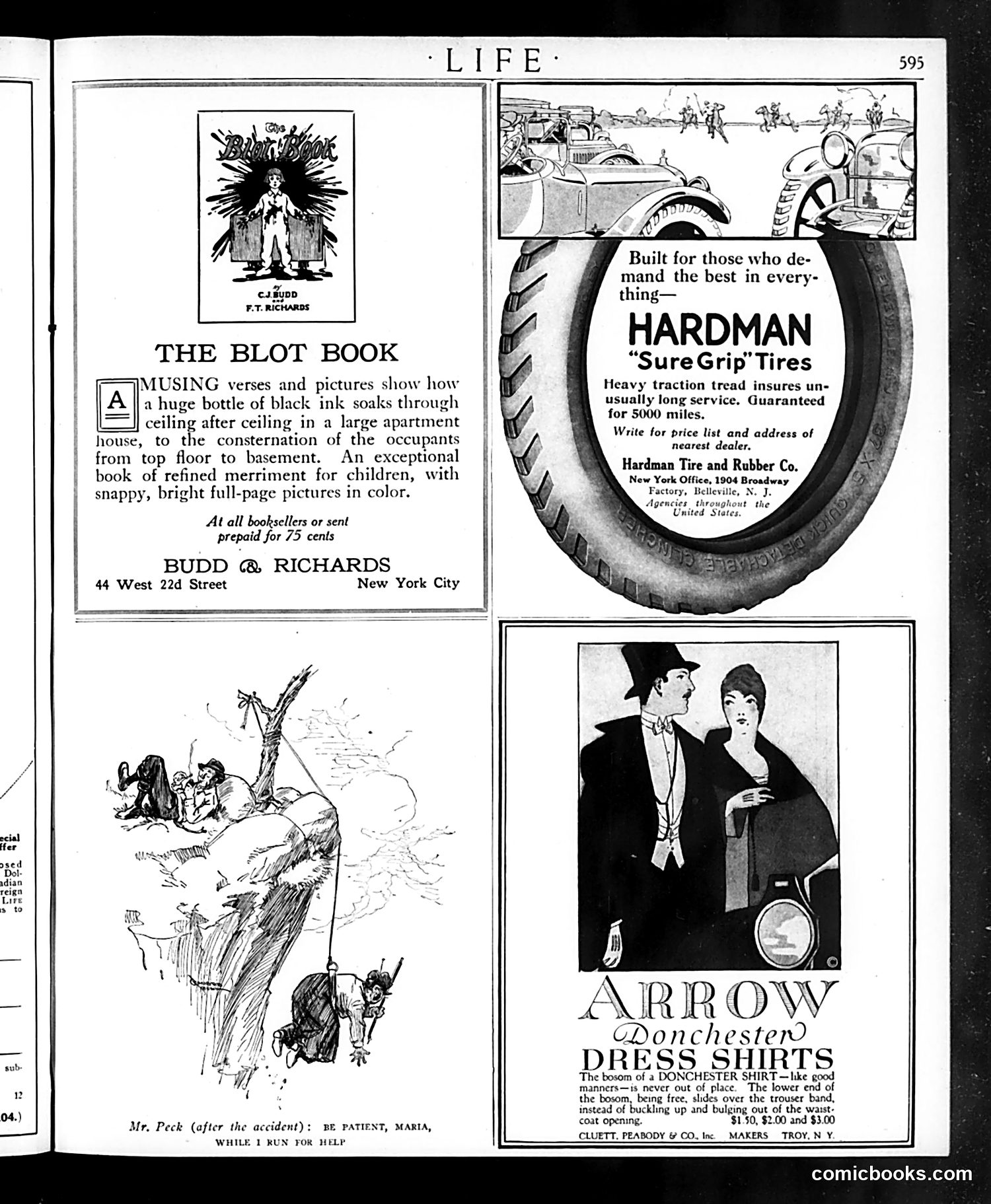
This page is primarily **advertising** with one editorial cartoon. The advertisements include: - **The Blot Book** (top left): A children's book of humorous verses and pictures about ink spills in a house - **Hardman "Sure Grip" Tires** (top right): Automobile tires guaranteed for 5,000 miles - **Arrow Donchester Dress Shirts** (bottom right): Men's formal wear priced $1.50-$3.00 The **cartoon** (bottom left) depicts "Mr. Peck (after the accident)" climbing what appears to be a rope or vine, with the caption "BE PATIENT, MARIA, WHILE I RUN FOR HELP." The joke appears to reference domestic mishap or marital comedy—likely suggesting Mr. Peck has created some household disaster and must now fetch assistance, presented as humorous domestic situation typical of early 20th-century magazine humor.
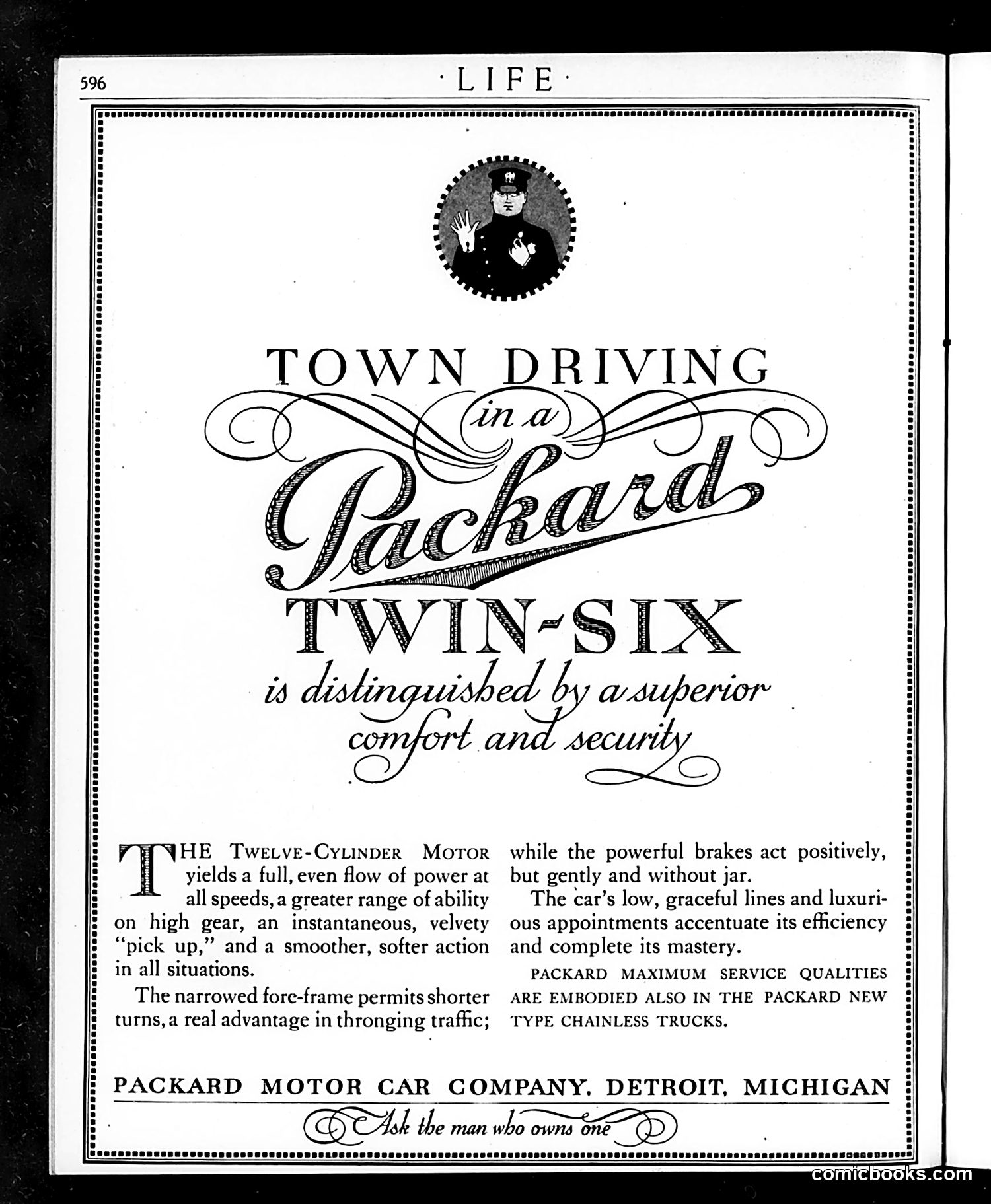
This is **not a cartoon page but an advertisement** for the Packard Motor Car Company's "Twin-Six" automobile model. The small circular illustration at the top shows a figure (appears to be a chauffeur or driver) but serves as a company logo rather than satirical content. The bulk of the page is promotional copy emphasizing the car's engineering features: a twelve-cylinder motor, powerful brakes, smooth acceleration, and a narrowed frame for improved maneuverability in traffic. The tagline promises "superior comfort and security." The page represents **early 1900s automotive advertising** style, using ornate typography and refined language to market luxury cars to wealthy buyers. There is no political satire or social commentary present—this is straightforward commercial advertising from *Life* magazine's revenue model.
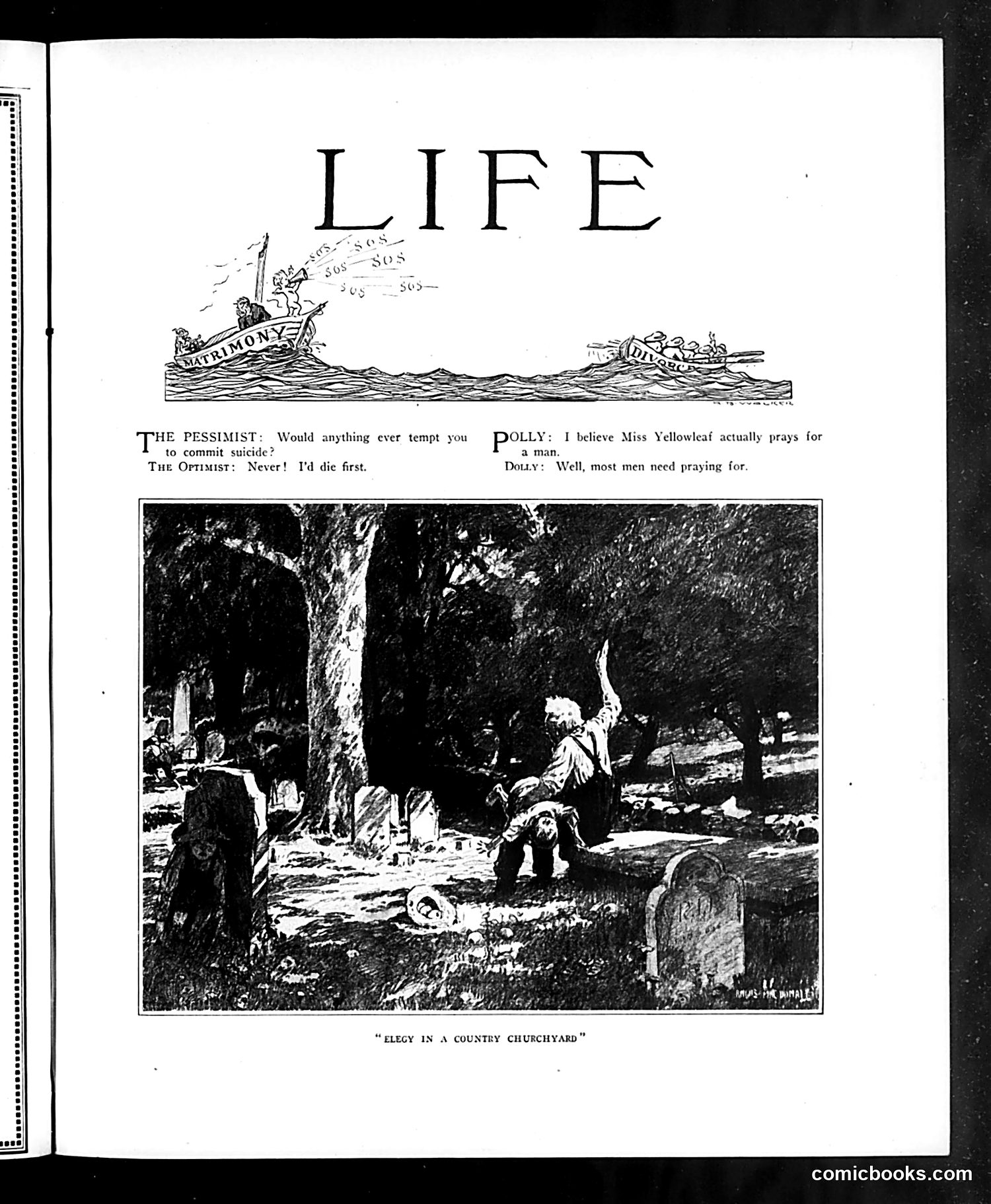
This page from *Life* magazine features satirical dialogue and an illustration titled "Elegy in a Country Churchyard." **The Dialogue:** Two characters—"The Pessimist" and "The Optimist"—exchange cynical banter about suicide and human nature. The Pessimist refuses to commit suicide; the Optimist counters that most men need prayer. A third character, "Polly," mentions "Miss Yellowleaf" praying for a man, prompting the Optimist's sardonic observation that most men require divine intervention. **The Illustration:** The image depicts a rural churchyard with gravestones, featuring figures in period dress among trees—likely depicting a melancholic scene of mortality and spiritual contemplation, complementing the page's meditative, darkly humorous tone about human nature and faith. The overall piece satirizes American attitudes toward religion, morality, and human worth during the early 20th century.
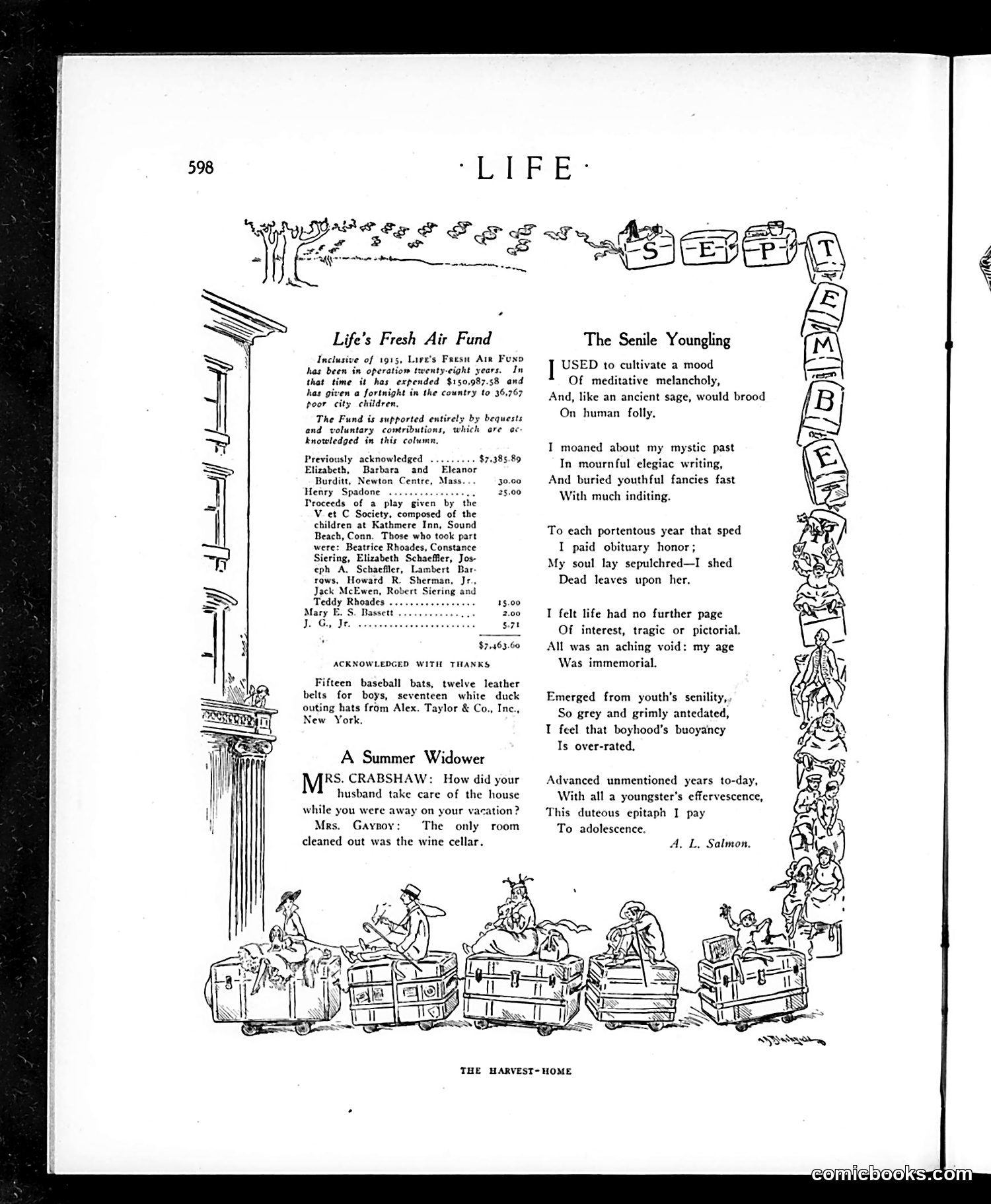
This page contains three distinct items: 1. **Life's Fresh Air Fund** - An announcement about a charitable organization operating for 24 years, listing donors and contributions. 2. **"The Senile Youngling"** - A poem by A.L. Salmon expressing melancholic reflection on aging and lost youth. The speaker laments becoming withdrawn and cynical, mourning "boyhood's buoyancy" and complaining that "advanced unmmentioned years" of adulthood lack the "effervescence" of youth. 3. **"A Summer Widower"** - A humorous brief exchange between Mrs. Cranshaw and Mrs. Gawper about house management during vacation, with the joke being that only the wine cellar went uncleaned. The bottom illustration titled "The Harvest-Home" depicts people with luggage, likely relating to vacation/travel themes. This is primarily literary and humorous content rather than political satire.
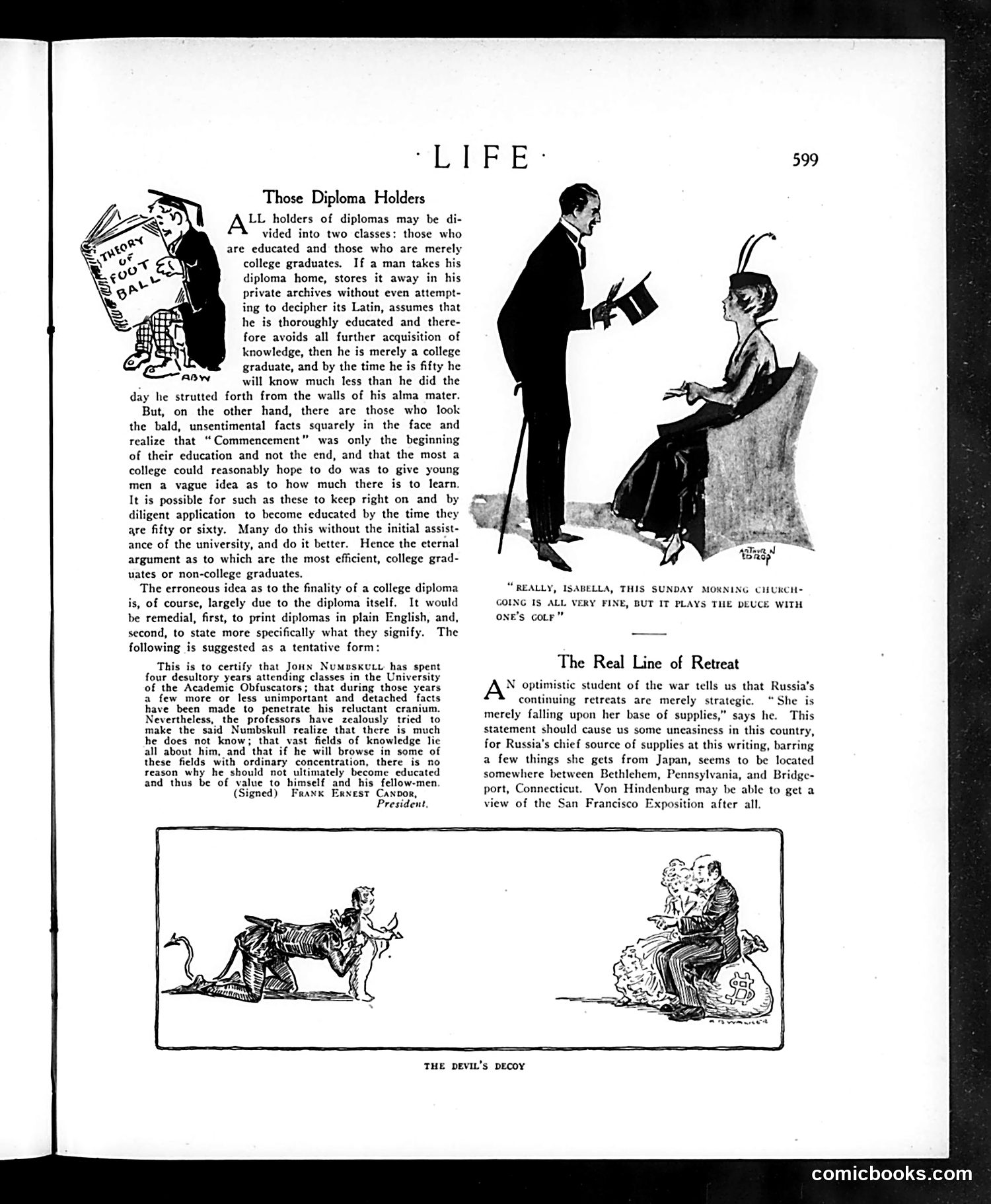
This *Life* magazine page contains two satirical pieces about education and war strategy. **"Those Diploma Holders"** critiques college graduates who treat their diplomas as final achievements rather than starting points for lifelong learning. The cartoon shows a pompous graduate, and the article argues such people stop educating themselves and gradually forget what they learned. **"The Real Line of Retreat"** appears to mock Russia's military situation during what seems to be World War I (references to "the war" and Russian retreats). An optimistic student claims Russia's retreats are merely strategic, but the piece skeptically notes Russia's actual supply problems. The Devil's Decoy illustration below appears to be a separate satirical cartoon about deception or trickery, though its exact meaning is unclear from the image alone.
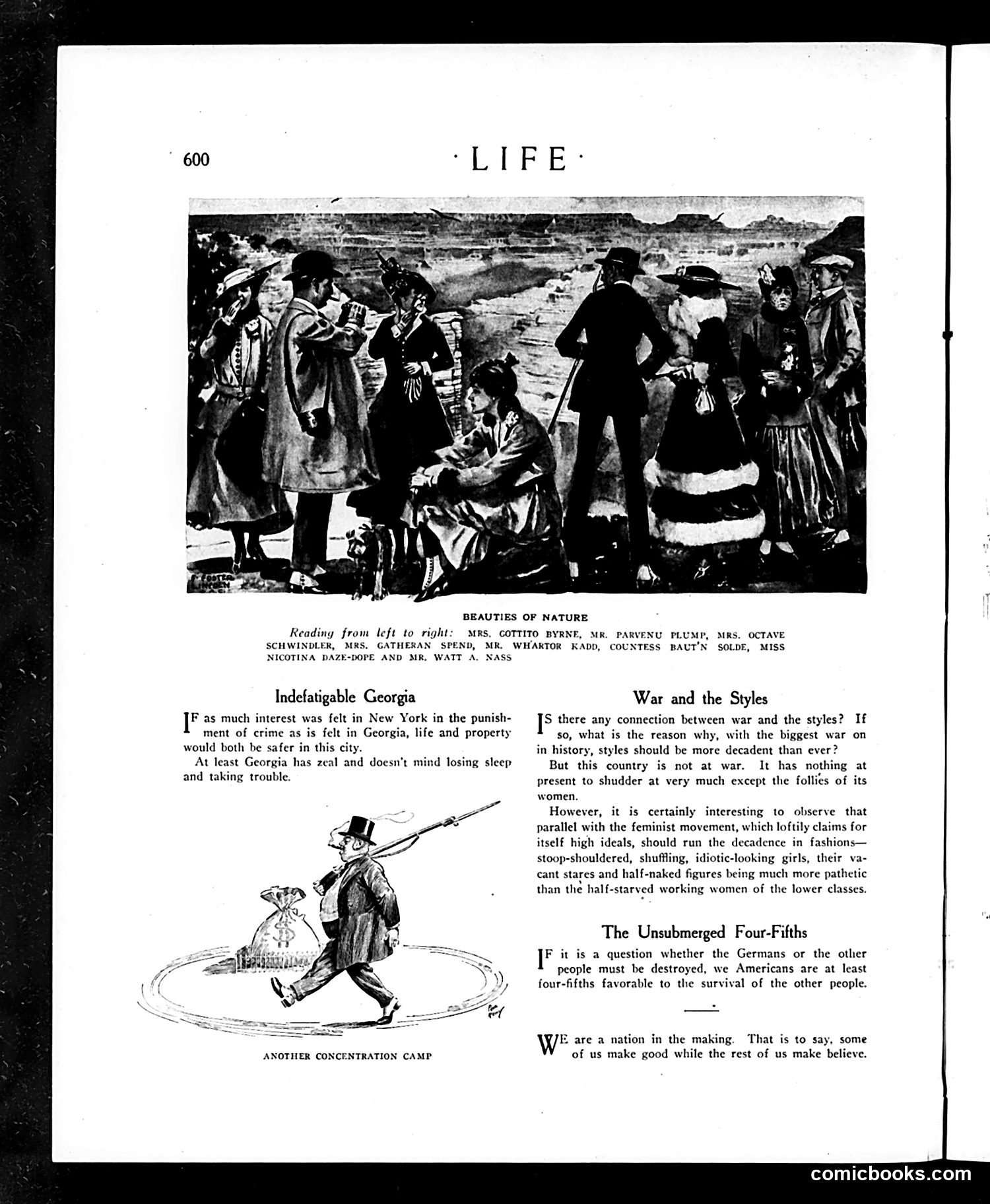
This page contains three distinct pieces of social commentary: **Top photograph**: Captioned "Beauties of Nature," it shows elegantly dressed people gathered outdoors, listing names including Mrs. Cottito Byent and others. The ironic title suggests satire about high society's pretensions. **Left cartoon**: Titled "Another Concentration Camp," depicts a military officer bayoneting what appears to be a small figure or creature within a circle. This references concerns about militarism and authoritarian control, likely criticizing military discipline or wartime policies. **Right text sections** discuss fashion during wartime ("War and the Styles"), noting the irony that while soldiers suffered, women's fashion remained frivolous. "The Unsubmerged Four-Fifths" appears to address class divisions and survival, suggesting commentary on economic inequality during the period. The overall tone critiques wartime contradictions between military sacrifice and civilian excess.
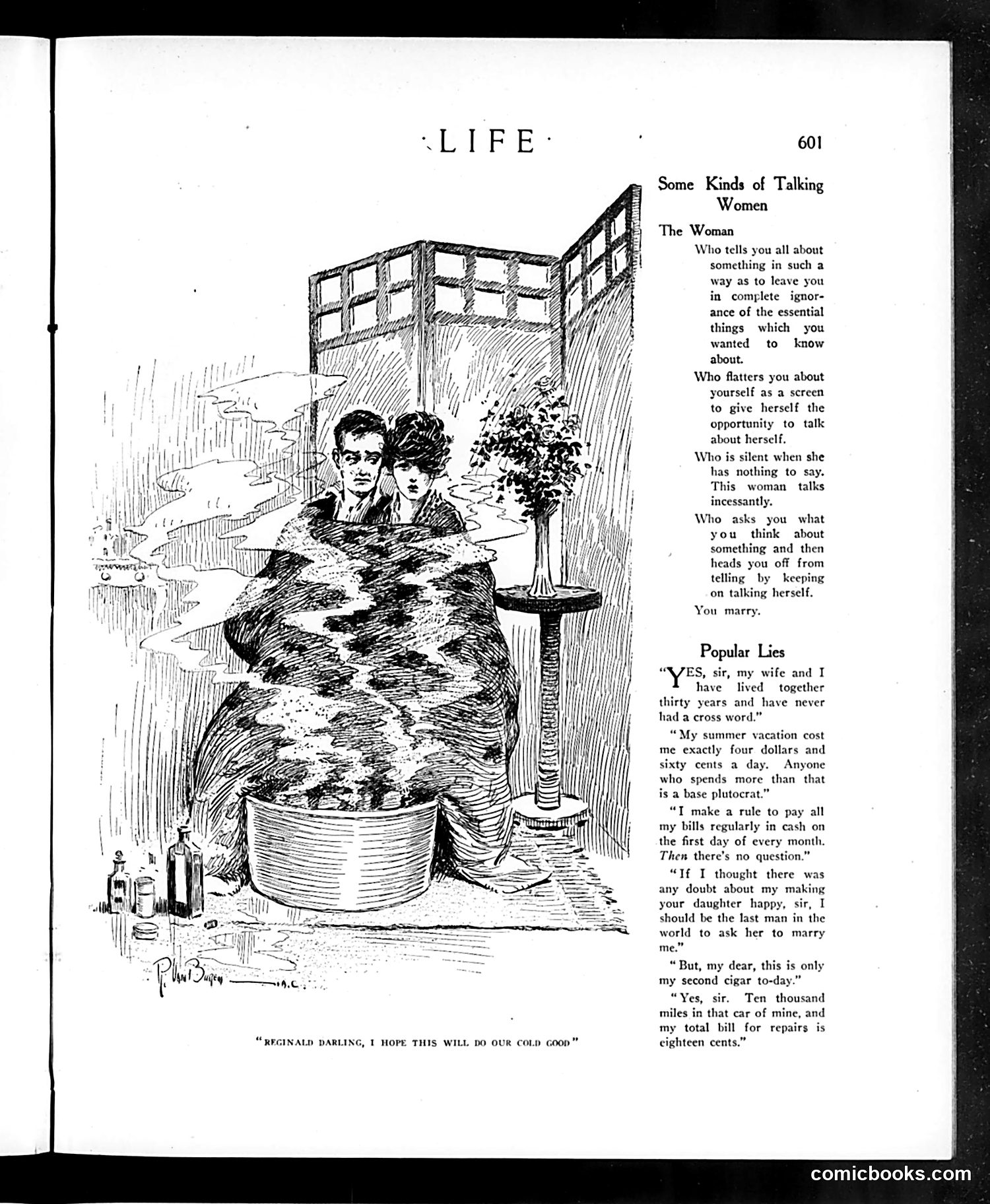
This page satirizes gender dynamics and marriage through two sections: **Main Illustration**: Shows a couple in a bathtub together, with the caption "REGINALD DARLING, I HOPE THIS WILL DO OUR COLD GOOD." The cartoon mocks marital compromises and domestic intimacy during illness—suggesting couples share close quarters even when unwell. **"Some Kinds of Talking Women"**: A typology mocking female conversational habits. It describes the woman who monopolizes discussion, uses flattery to redirect focus to herself, remains silent when having nothing to say (but talks incessantly anyway), and asks questions only to keep talking about herself. **"Popular Lies"**: Satirizes common marital boasts—husbands claiming decades without arguments, wives claiming financial prudence—exposing the gap between domestic mythology and reality. The overall tone critiques both marital pretense and female chattiness.
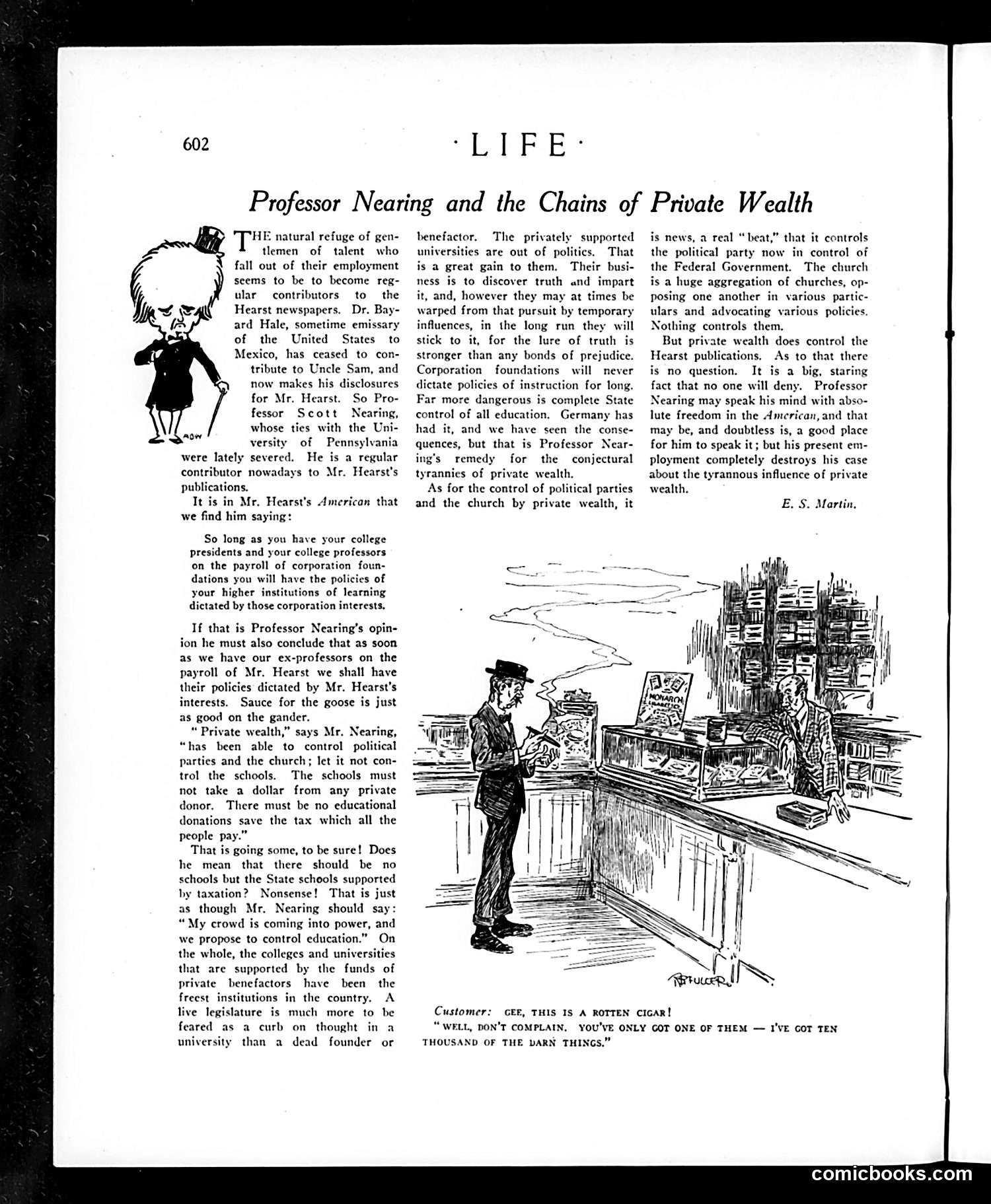
This page critiques how **private wealth influences educational institutions**. The article discusses Professor Nearing's views on corporate foundations controlling college policies. The text argues that accepting donations from wealthy benefactors compromises academic independence—college presidents and professors become beholden to corporate interests rather than pursuing truth freely. The cartoon illustrates this concern: a well-dressed man (representing a wealthy donor or corporate interest) inspects what appears to be educational materials or policies, while a customer complains about receiving only "ten thousand of the darn things" of inferior quality. The satire suggests that when schools depend on private wealth, they become mere commercial enterprises serving donor interests rather than genuine educational institutions committed to truth and intellectual freedom.
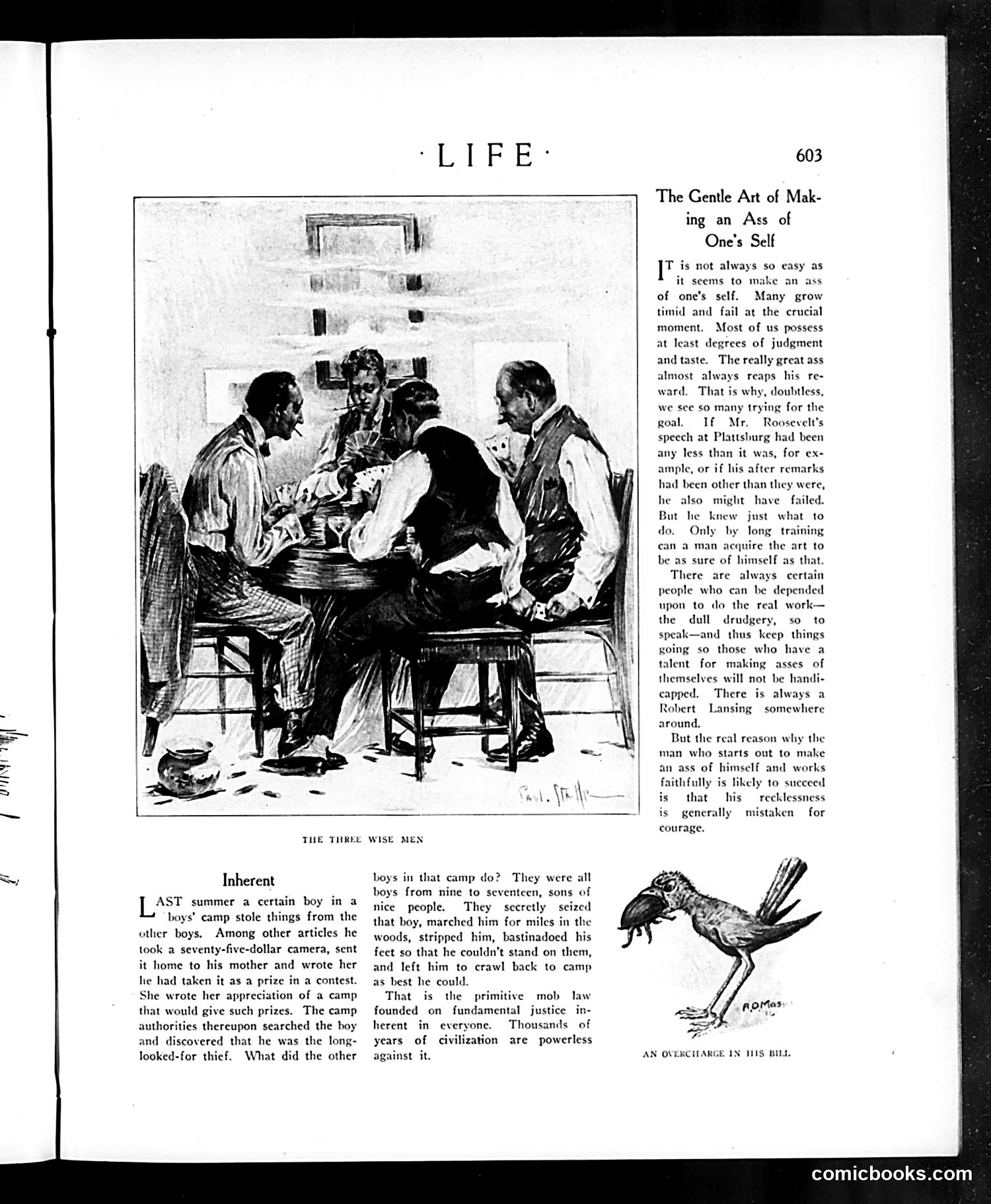
**Main Illustration: "The Three Wise Men"** The sketch depicts three men around a table in what appears to be casual discussion or negotiation. The caption references "The Gentle Art of Making an Ass of One's Self," suggesting satire about self-sabotage or foolish behavior. **Article Content: "Inherent"** The text describes a boy at summer camp who stole a valuable camera from other campers. When discovered, he was subjected to "primitive mob law" — stripped and beaten by the other boys. The article uses this anecdote to comment on fundamental human nature and justice, arguing that thousands of years of civilization cannot suppress inherent mob instincts. The satire critiques both the boy's theft and the mob's violent response as expressions of base human nature.
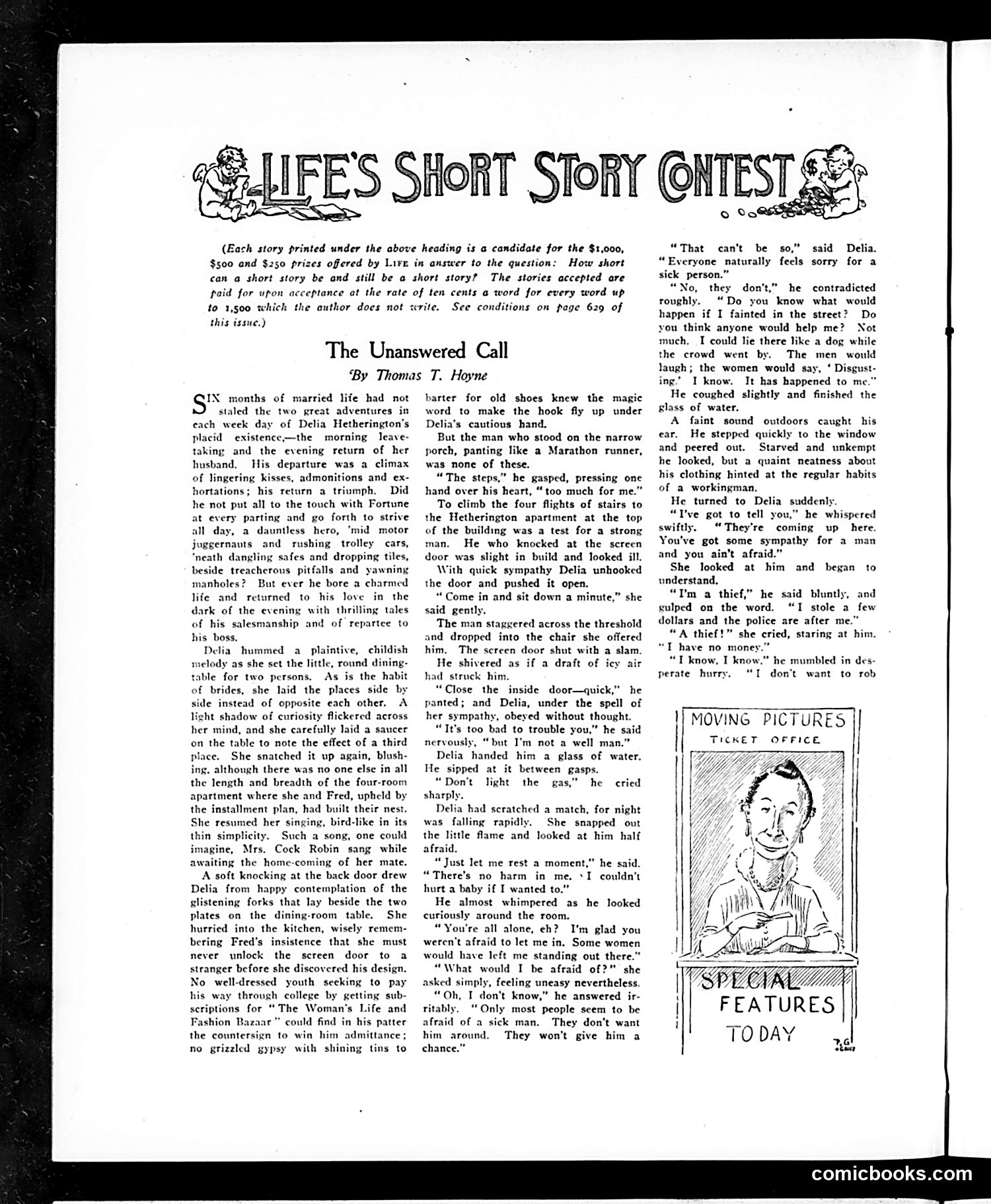
This page presents Life magazine's short-story contest, seeking submissions under 1,500 words at ten cents per word. The featured story, "The Unanswered Call" by Thomas T. Hoyne, depicts a domestic scenario: Delia Hetherington, a devoted newlywed, is interrupted while preparing dinner by a disheveled, gasping stranger at her back door. The narrative appears to be building toward a morality tale common to early 20th-century fiction—testing the protagonist's virtue and judgment. The man's suspicious behavior (demanding darkness, avoiding light) and his cryptic admission of being "not a well man" suggest either illness or criminal intent. Delia's naive sympathy and her husband's warning about admitting strangers sets up dramatic tension. The story illustrates period anxieties about urban danger, social vulnerability, and female propriety—themes that would have resonated with Life's contemporary audience.
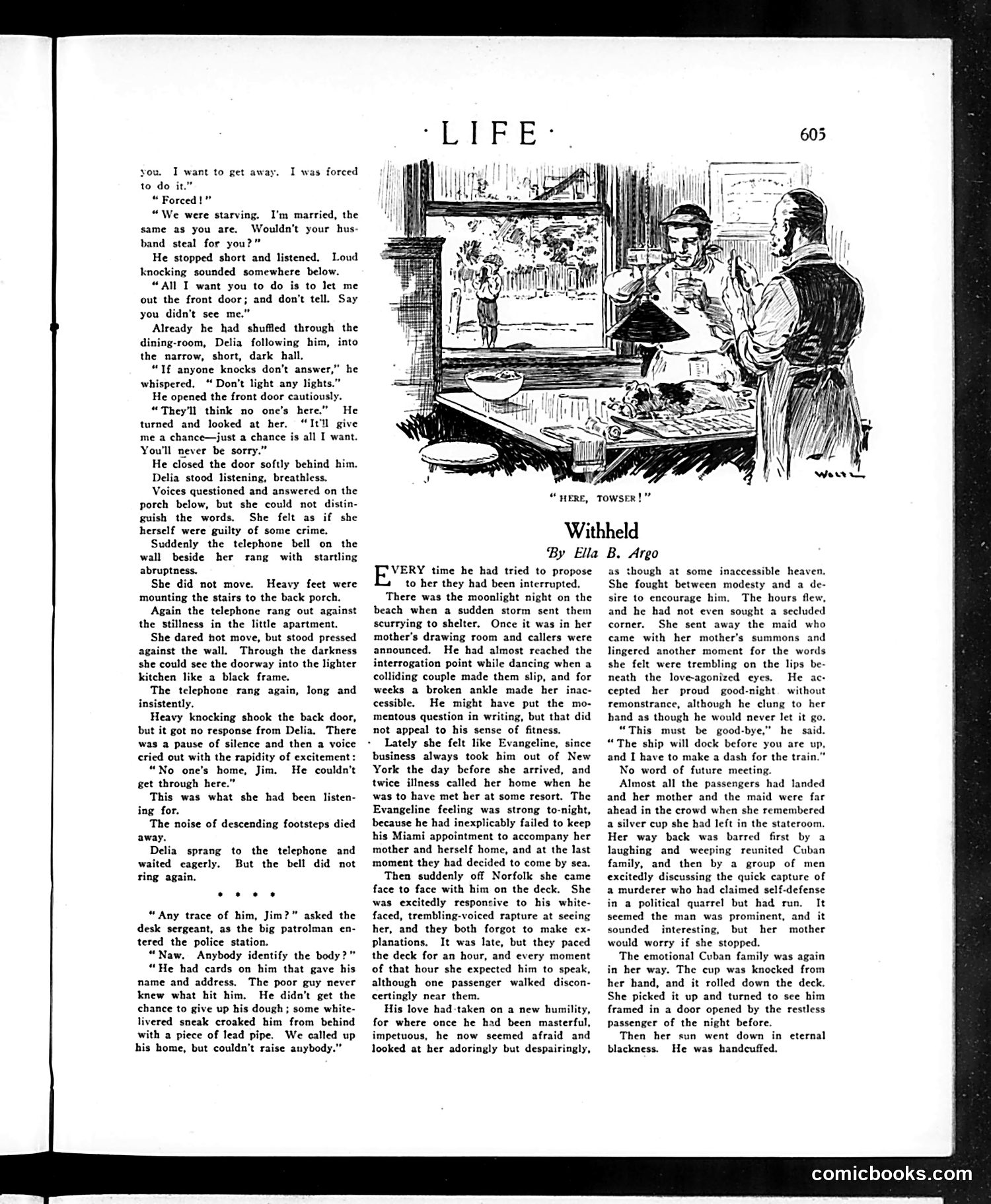
This *Life* magazine page contains two separate stories. The top illustration captioned "HERE, TOWSER!" depicts a domestic drama: a woman (Delia) helps a desperate man escape her home as police arrive, then receives a suspicious phone call. The accompanying dialogue reveals the man stole to feed his starving family—a Depression-era social commentary on poverty forcing crime. The police find his victim (a murder by "lead pipe"), creating tension around whether Delia will be implicated. The second story, "Withheld" by Ella B. Argo, is a romantic narrative about a couple repeatedly interrupted before a marriage proposal, now finally reunited aboard a ship off Norfolk. The title suggests the proposal remains "withheld"—unstated, despite their reunion. Both stories reflect early 20th-century magazine fiction conventions: melodrama, class struggle, and romantic tension. The juxtaposition offers contrasting life struggles—desperation versus romantic frustration.
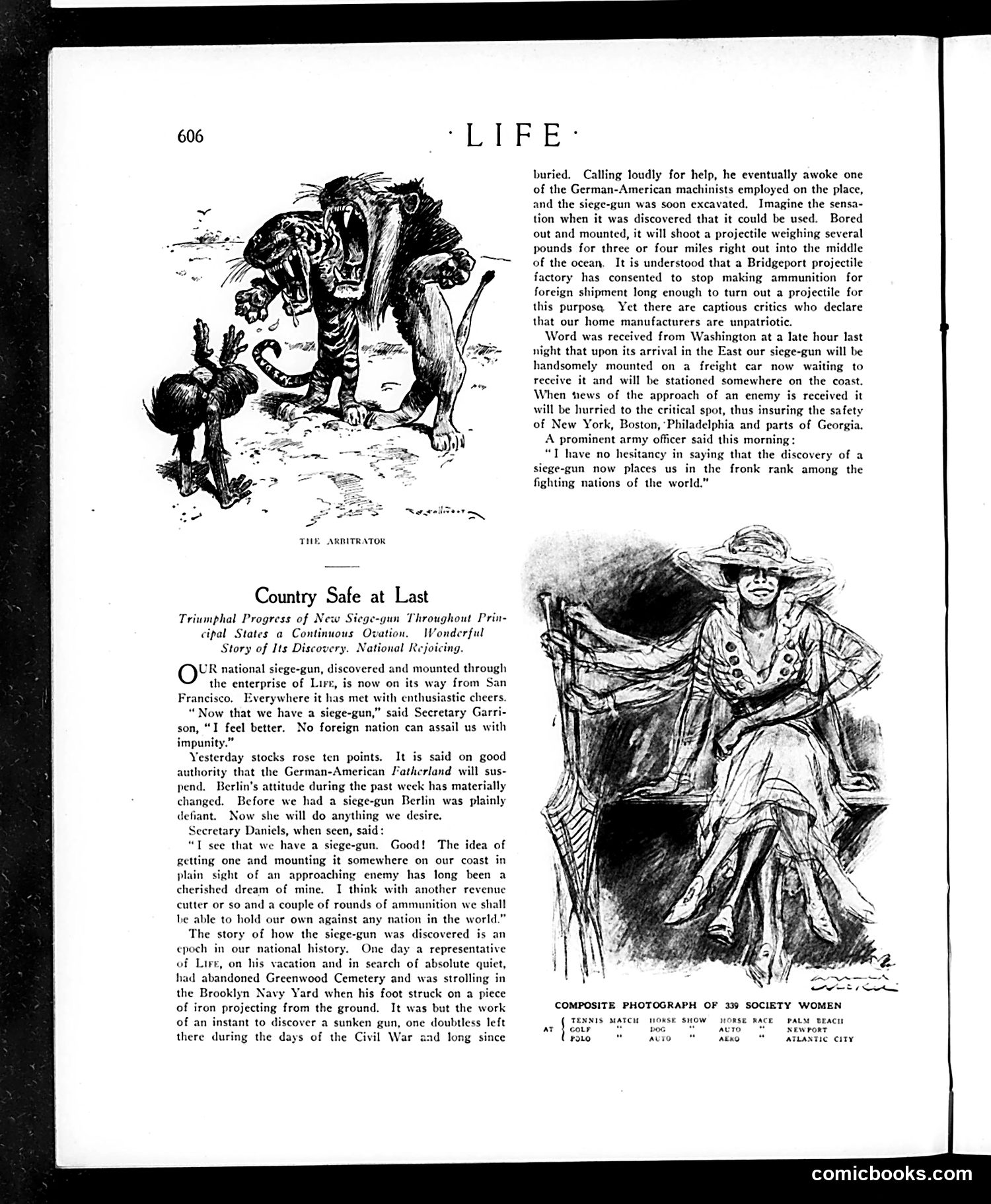
This is heavy political satire mocking American unpreparedness for war and blind faith in military solutions. The article humorously describes discovering an old Civil War cannon buried in Brooklyn Navy Yard, which is then hailed as a transformative national defense asset. The joke: Secretary of War Garrison and Navy Secretary Daniels express absurd confidence that *one ancient gun* will terrify Germany into submission and make America invincible. Stock markets rise. Berlin supposedly abandons defiance. The satire ridiculously suggests this single weapon solves America's military vulnerability. The "Arbitrator" cartoon (left) appears to depict a figure settling disputes—possibly commenting on America's self-deception about military strength. The piece satirizes both military leadership's incompetence and the public's gullible patriotism during the pre-WWI period when America faced genuine debates about military readiness and intervention. The satire highlights how easily people accept reassuring but absurd claims about national security.
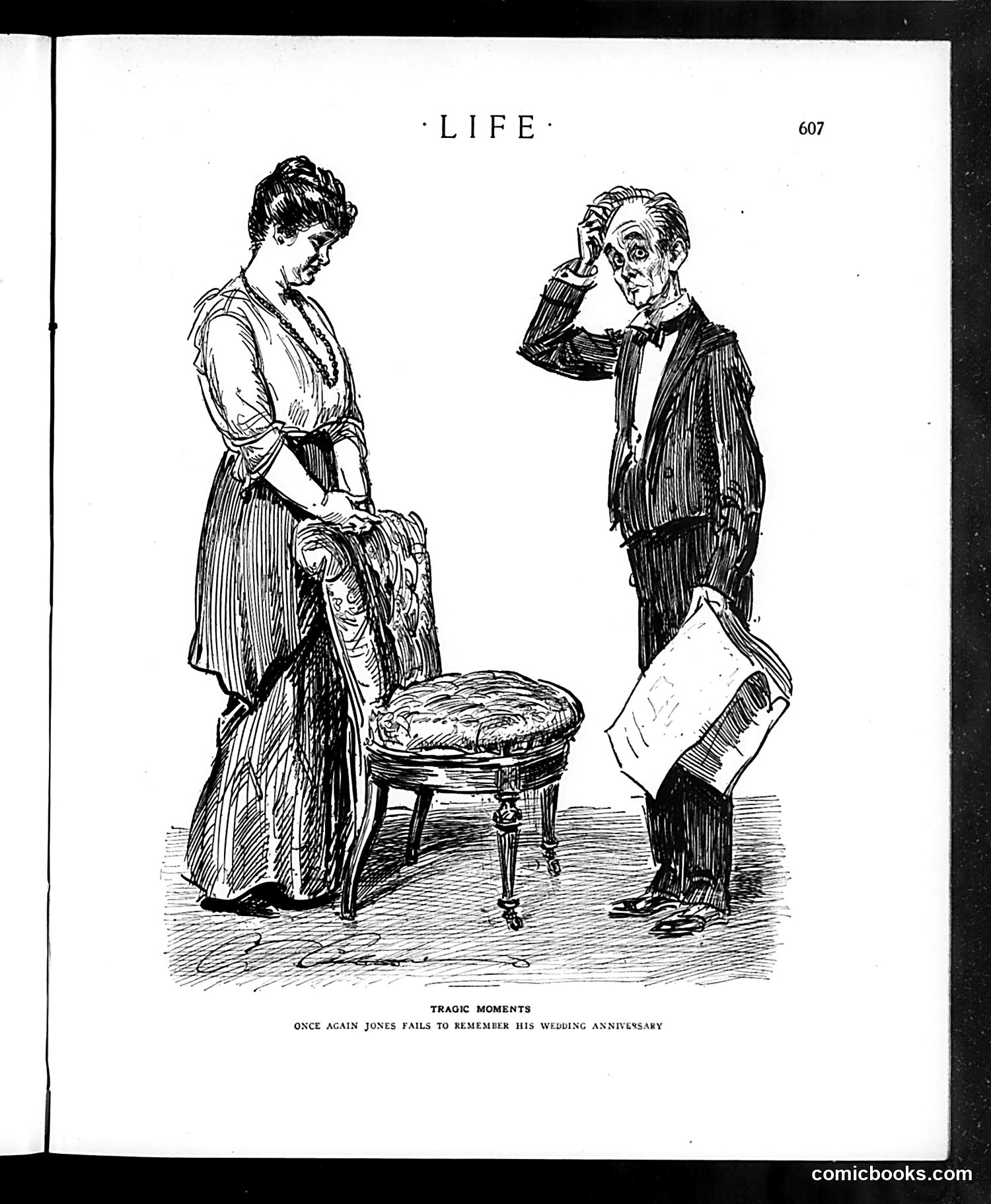
This is a domestic humor cartoon titled "Tragic Moments." The scene depicts a married couple in what appears to be a tense moment: a woman stands near a chair with a disappointed expression, while a man holds a newspaper or document and scratches his head in apparent confusion or embarrassment. The caption reveals the joke: "Once Again Jones Fails to Remember His Wedding Anniversary." This is a common marital comic trope—the forgetful husband who neglects to acknowledge his wedding anniversary, causing domestic discord. The woman's body language suggests frustration or hurt at being forgotten, while the man's gesture implies he's only just realized his mistake upon being confronted. This satirizes typical early 20th-century gender dynamics and marital relationships in American middle-class life.
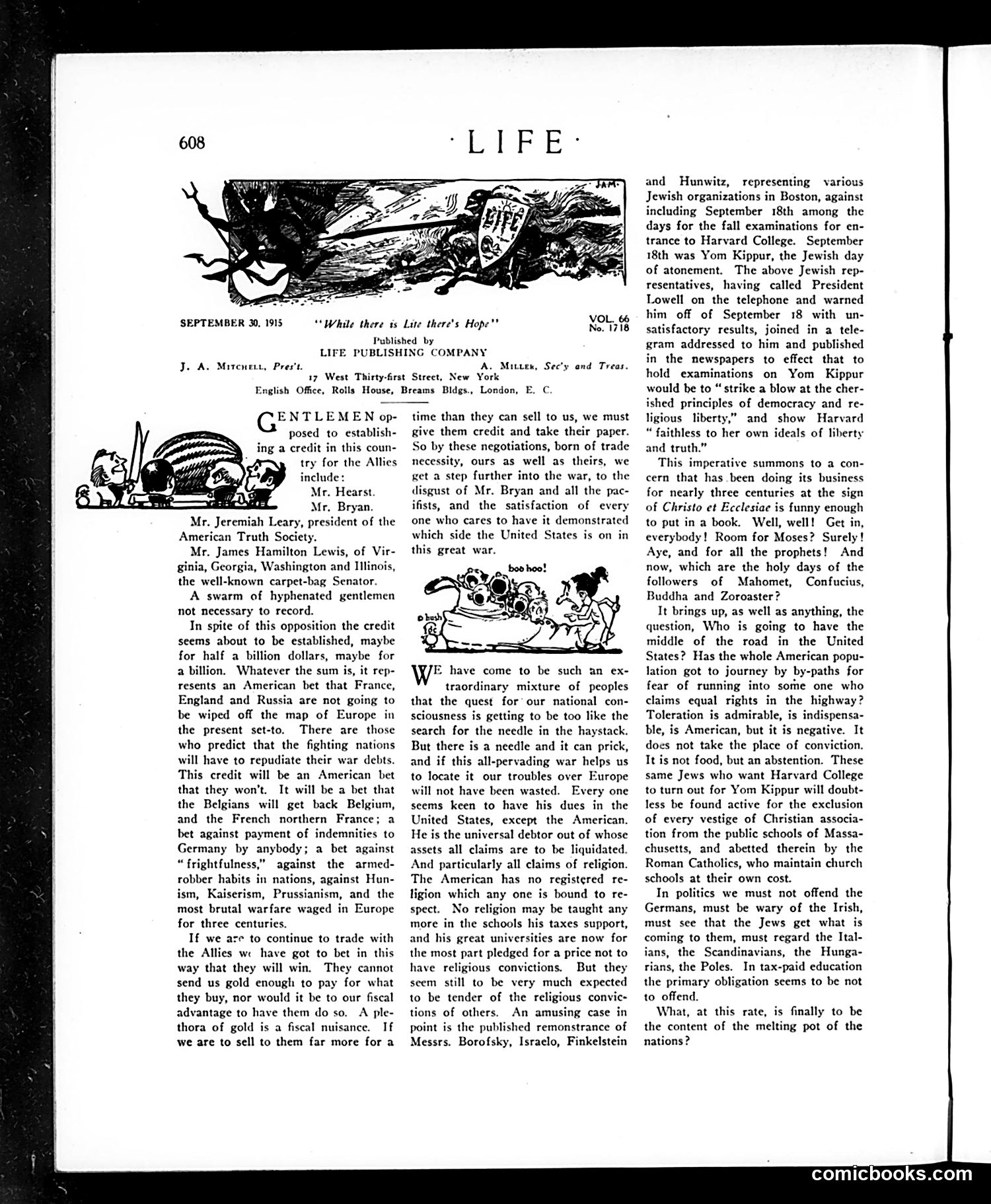
This page discusses American credit to Allied powers during World War I, listing opponents (William Randolph Hearst, William Jennings Bryan, and others) before arguing the loan represents an American bet that the Allies will win. The cartoons visible appear to be small illustrative vignettes supporting the editorial argument about the war effort. More notably, the text includes a satirical attack on Jewish religious accommodation at Harvard College. It mocks Jewish organizations in Boston (naming Borofsky, Israelo, Finkelstein, and Hunwitz) for protesting September 18th exam scheduling, which conflicted with Yom Kippur. The author sarcastically criticizes American tolerance of immigrant religions while Americans themselves receive no religious exemptions—a backhanded antisemitic complaint that immigrants expect special treatment. This reflects early-20th-century nativist anxieties about religious pluralism and immigrant demands.
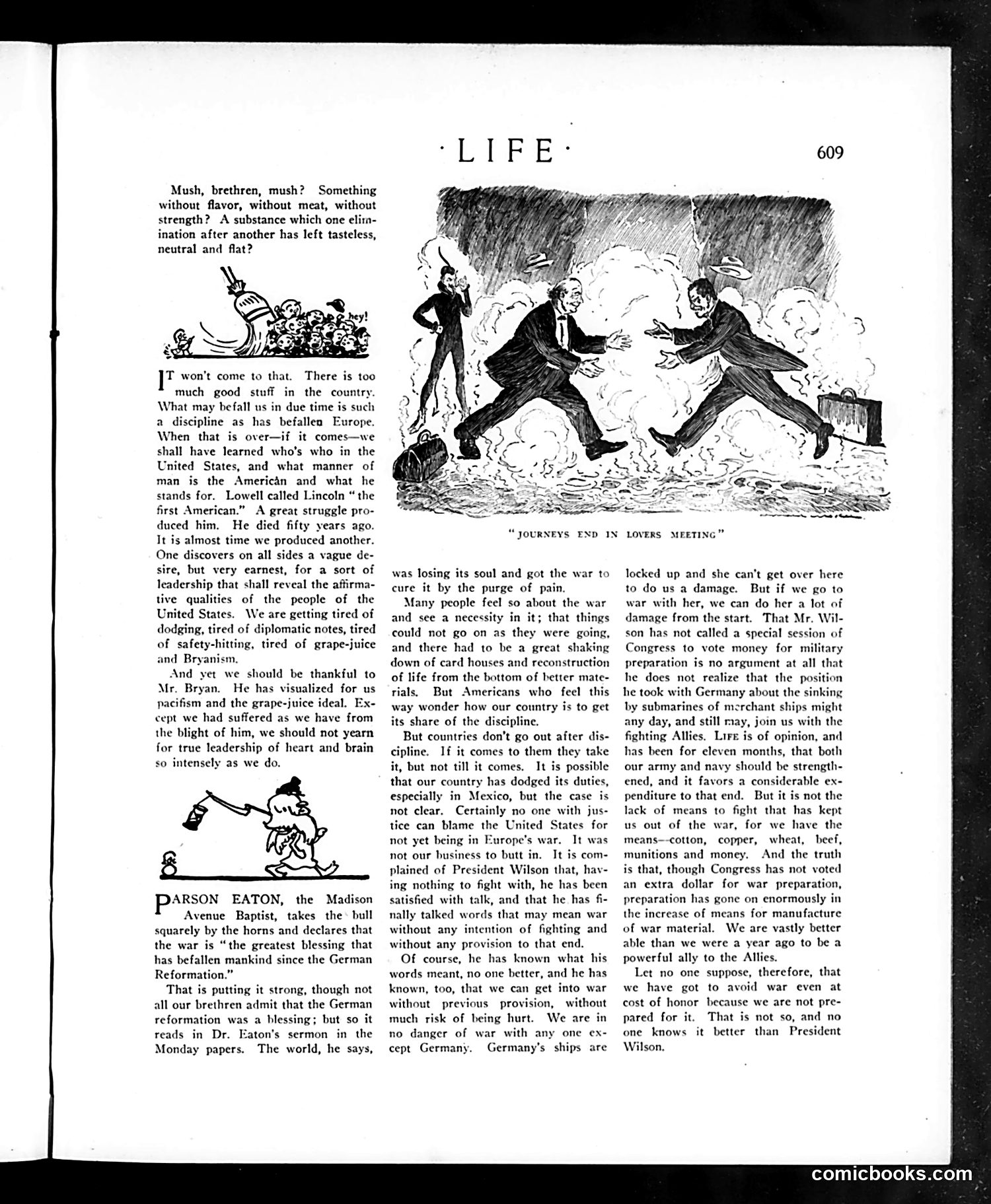
This page discusses American preparedness and leadership during World War I (approximately 1915-1916, before U.S. entry). **Main Content:** The text critiques President Wilson's verbal diplomacy regarding German submarine warfare, arguing that while he's articulated positions that risk war, he hasn't requested Congressional funding for military preparation. The author defends Wilson somewhat, noting America has abundant resources (cotton, copper, wheat, beef) to fight if necessary. **Key Figures Referenced:** - **President Wilson**: criticized for relying on "talk" without military readiness - **William Jennings Bryan**: mocked for "pacifism and grape-juice ideal" (Bryan was a pacifist and prohibitionist) - **Parson Eaton**: a Madison Avenue Baptist minister quoted as calling war "the greatest blessing...since the German Reformation" **The Cartoon** ("Journeys End in Lovers Meeting"): Shows figures meeting in clouds—likely representing warring nations or peace negotiations, satirizing romantic notions about conflict resolution. **The Satire:** Life criticizes both pacifism and lack of military preparation, arguing America needs strong leadership and realistic defense capability.
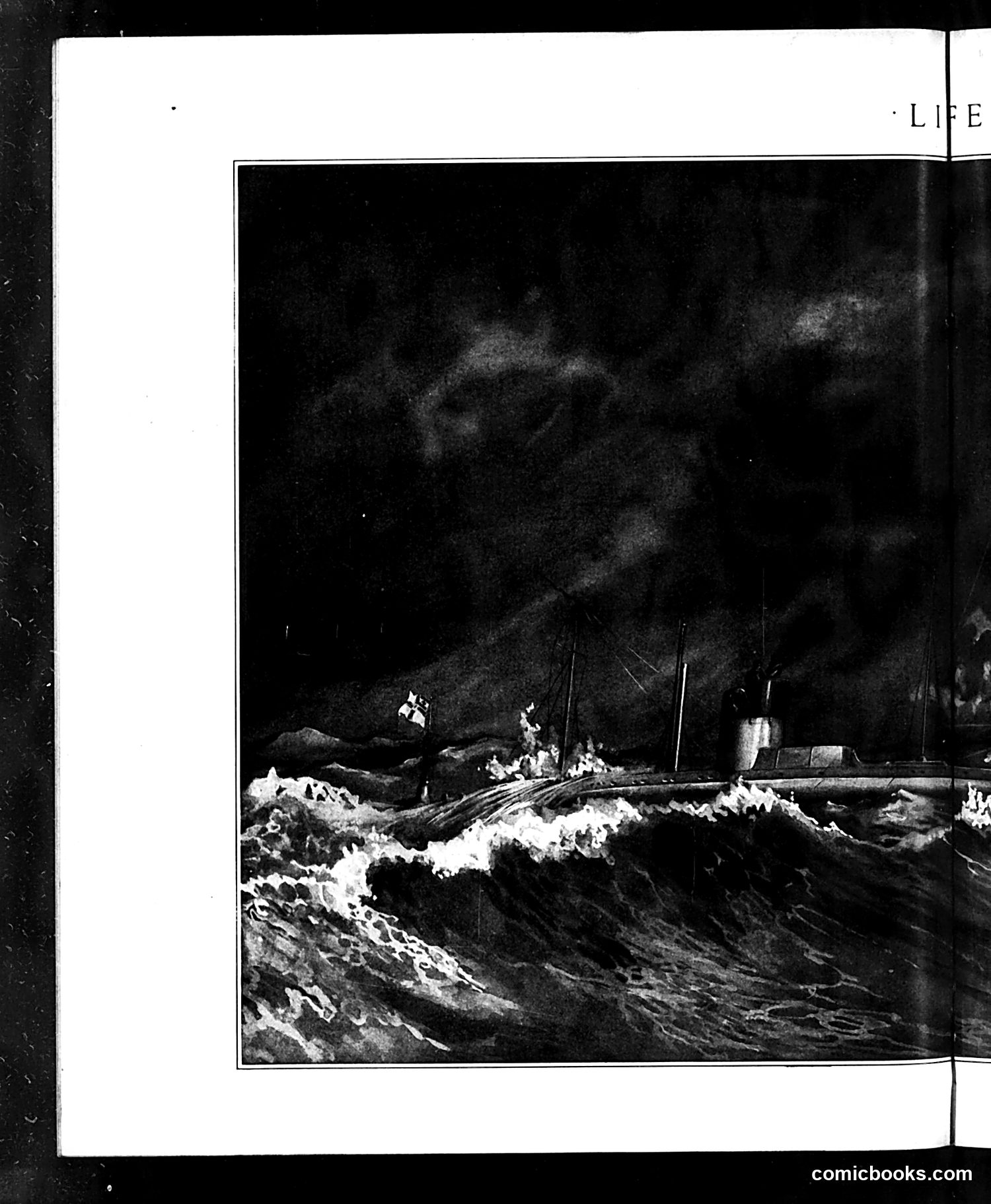
I can see this is a dramatic black and white illustration from Life magazine showing a ship in distress during a severe storm. The vessel appears to be struggling against large, turbulent waves beneath a dark, threatening sky. The image is clearly meant to convey danger and maritime peril. However, without visible caption text or accompanying article content on this page, I cannot definitively explain what political, social, or satirical point this illustration makes. The dramatic seascape could be metaphorical commentary on current events, economic conditions, or political circumstances of its era, but the specific meaning remains unclear from the image alone. The OCR text provided ("comicbooks.com") appears to be metadata rather than page content, so I cannot determine the intended message or historical context with certainty.
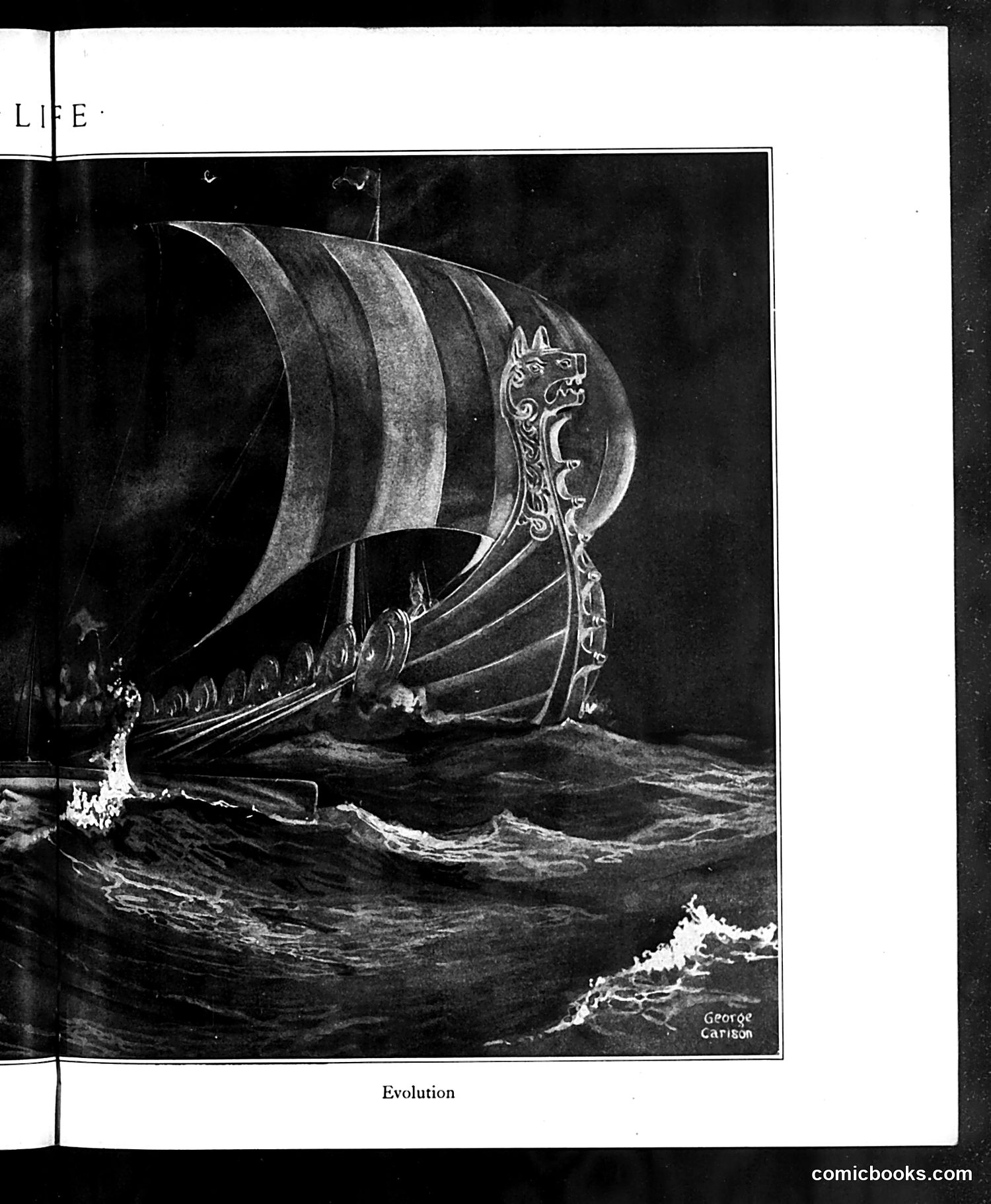
This cartoon depicts a Viking ship with a dragon-headed prow sailing through stormy seas. The title "Evolution" suggests satirical commentary on human progress or development. The image appears to reference Viking maritime exploration and seafaring tradition, likely commenting on themes of historical advancement or cultural development. The ornate dragon figurehead and striped sail are characteristic Viking design elements. Without additional context from surrounding pages, the specific satirical point remains somewhat unclear. It could critique civilization's progress as merely cyclical repetition of ancient patterns, or comment on industrial/technological "evolution" by contrasting it with primitive seafaring. The dramatic stormy sea setting emphasizes struggle or hardship inherent in progress. The artist's signature "George Carlson" appears in the lower right corner.
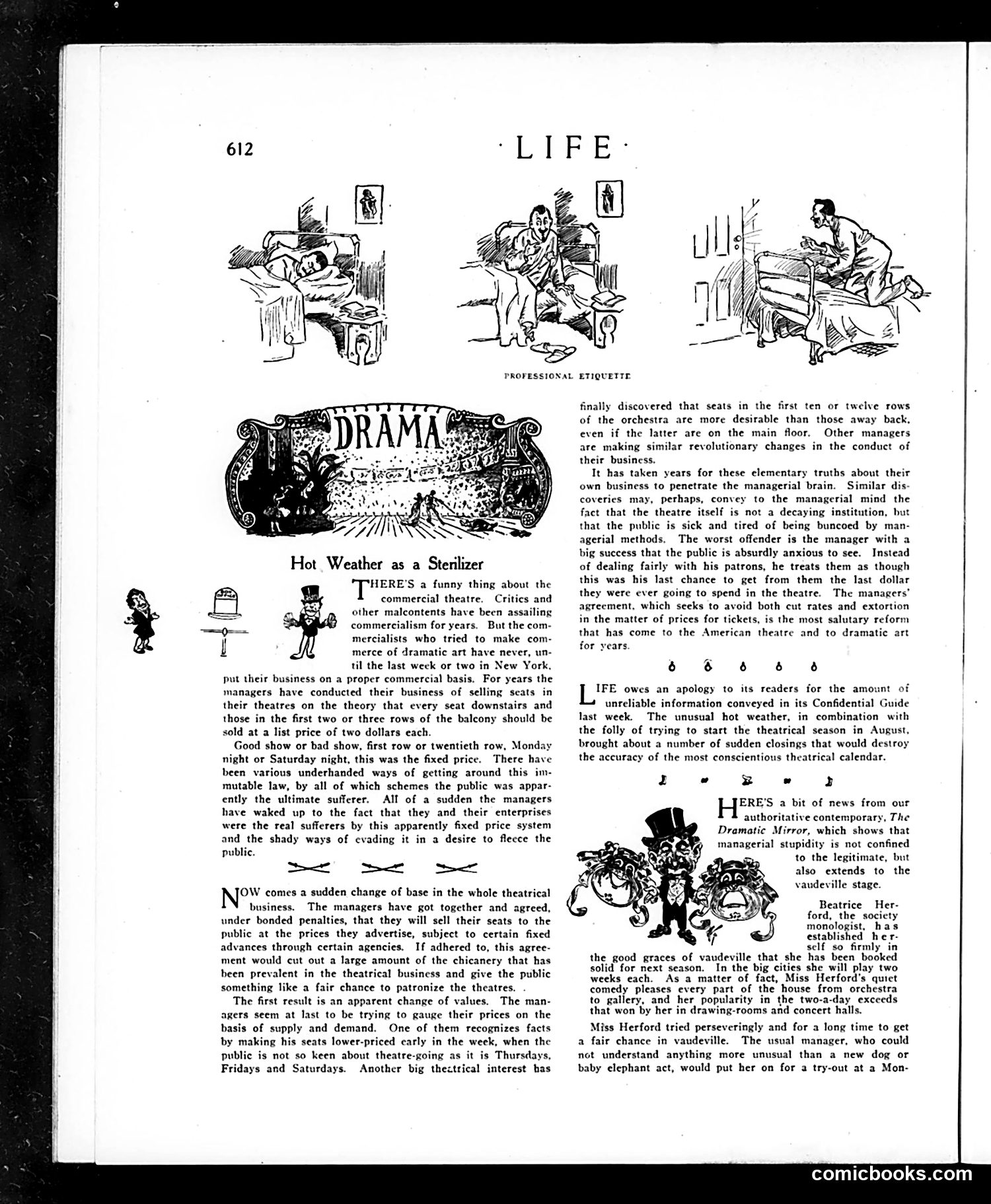
This page critiques **theatrical management practices** during summer theater season. The title "Hot Weather as a Sterilizer" refers to how heat drives audiences away, exposing managerial failures. **The main argument:** Broadway theater managers operated under an outdated fixed-price system—all seats cost two dollars regardless of location or demand. This prevented fair pricing and bred corruption ("shady ways of evading it"). **The satire:** The article celebrates managers who finally adopted **basic business practices**: lower prices early in the week when attendance is weak, premium pricing for desirable orchestra seats. Life mocks that it took "years for these elementary truths" to penetrate managers' brains. **Key complaint:** The worst offenders are successful managers who exploit public demand, squeezing patrons on their "last chance" to attend before shows close. **The bottom sketches** illustrate "Professional Etiquette"—apparently showing proper (and improper) backstage behavior, though specific figures are unclear. Overall, Life attacks theatrical management as incompetent businessmen exploiting customers while claiming to serve art.
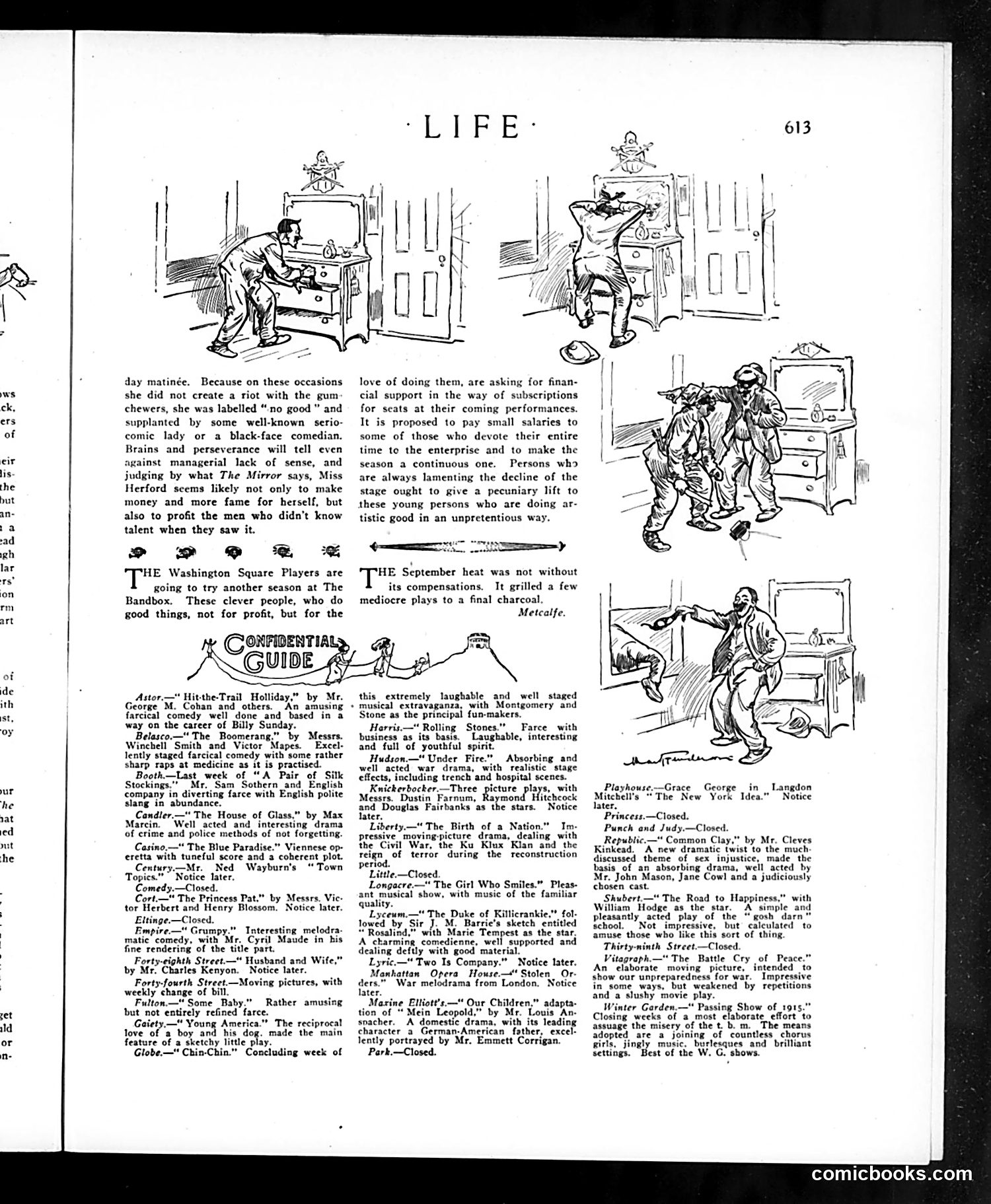
This page from *Life* magazine presents theater reviews and satirical cartoons mocking domestic life. The four cartoon panels (right side) humorously depict a husband's escalating frustrations with household chores and furniture—struggling with a dresser, sitting on a chair, wrestling with a bureau, and finally collapsing in defeat. The satire targets the incompetence of husbands in domestic management, a common theme in early 20th-century humor. The text reviews current Broadway productions (September 1915, based on references to "Birth of a Nation"). Notably, it criticizes Miss Herford's theatrical talent being dismissed by both audiences and managers, while praising the Washington Square Players' non-profit artistic efforts and lamenting theater's decline. The "Confidential Guide" section provides snappy reviews of various shows, from comedies to war dramas, reflecting popular entertainment of the era.
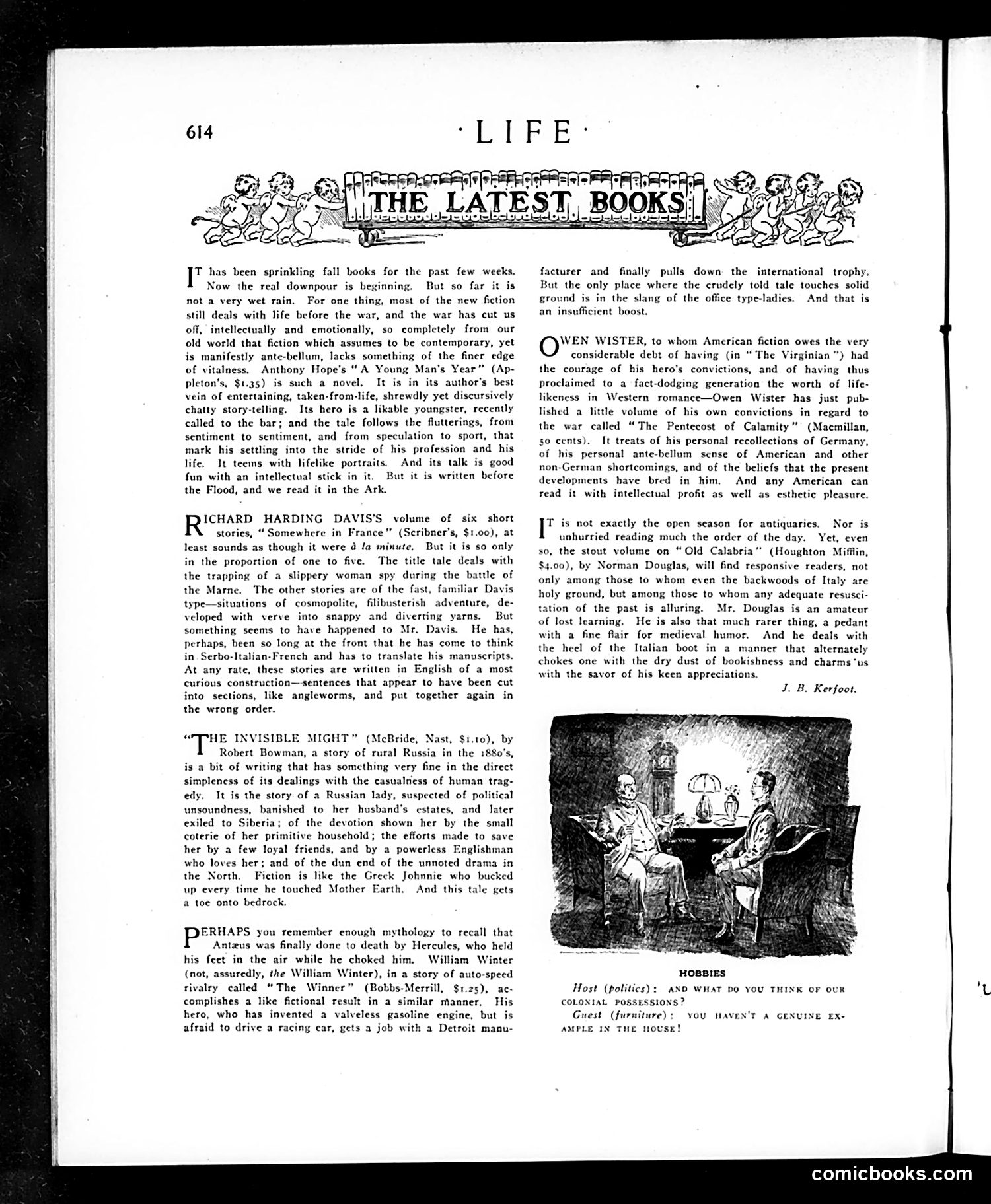
This page reviews several wartime-era novels (circa 1914-1916, based on references to "before the war" and "the Flood"). The critic argues that most new fiction feels outdated because it was written before WWI but published after—creating a disconnect from readers' changed sensibilities. Key reviews critiqued include Anthony Hope's pre-war social novel (dismissed as nostalgic), Richard Harding Davis's spy stories (criticized for awkward, fragmented prose—humorously compared to "angleworms...put together again in the wrong order"), and William Winter's auto-racing tale (praised only for authentic office-girl slang). The cartoon titled "HOBBIES" (lower right) appears to be unrelated social satire about leisure activities and colonial possessions, though details are unclear. The overall tone is intellectual but playful—the critic uses wit to address literature's struggle to remain relevant during wartime upheaval.
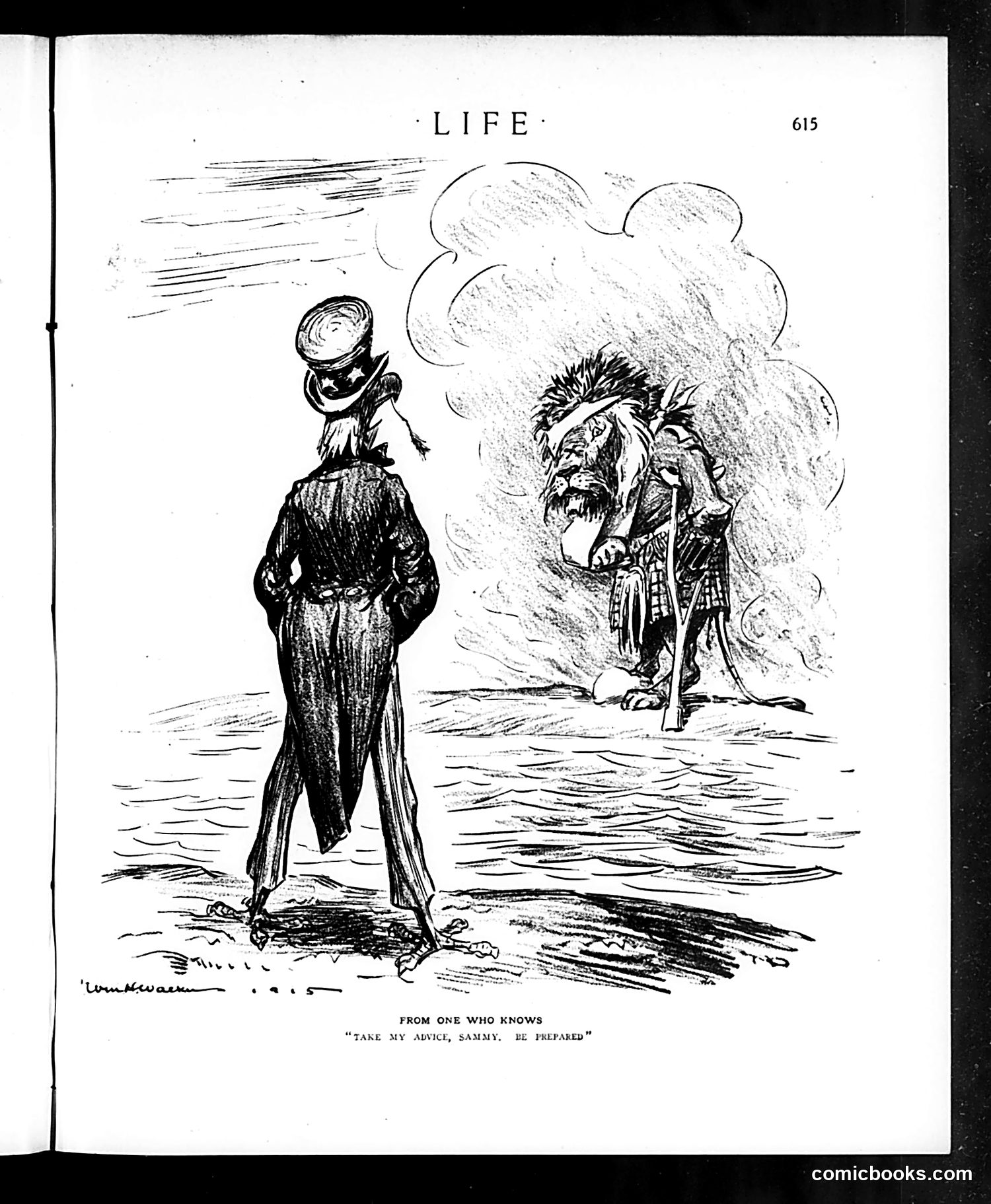
This Life magazine cartoon depicts two figures in a desolate landscape. On the left stands a well-dressed man in formal attire and top hat, viewing a disheveled, emaciated figure on the right emerging from clouds of smoke or dust. The caption "Take my advice, Sammy, be prepared" suggests the well-dressed figure offers guidance to "Sammy" (likely representing an everyman or the general public). The contrast between their appearances—one prosperous, one ravaged—implies a warning about unpreparedness for some crisis or catastrophe. The image's style and "From One Who Knows" attribution suggest this cartoon addresses preparedness for war, economic disaster, or social upheaval. Without the publication date visible, the specific historical context remains unclear, though the aesthetic suggests early-to-mid twentieth century.
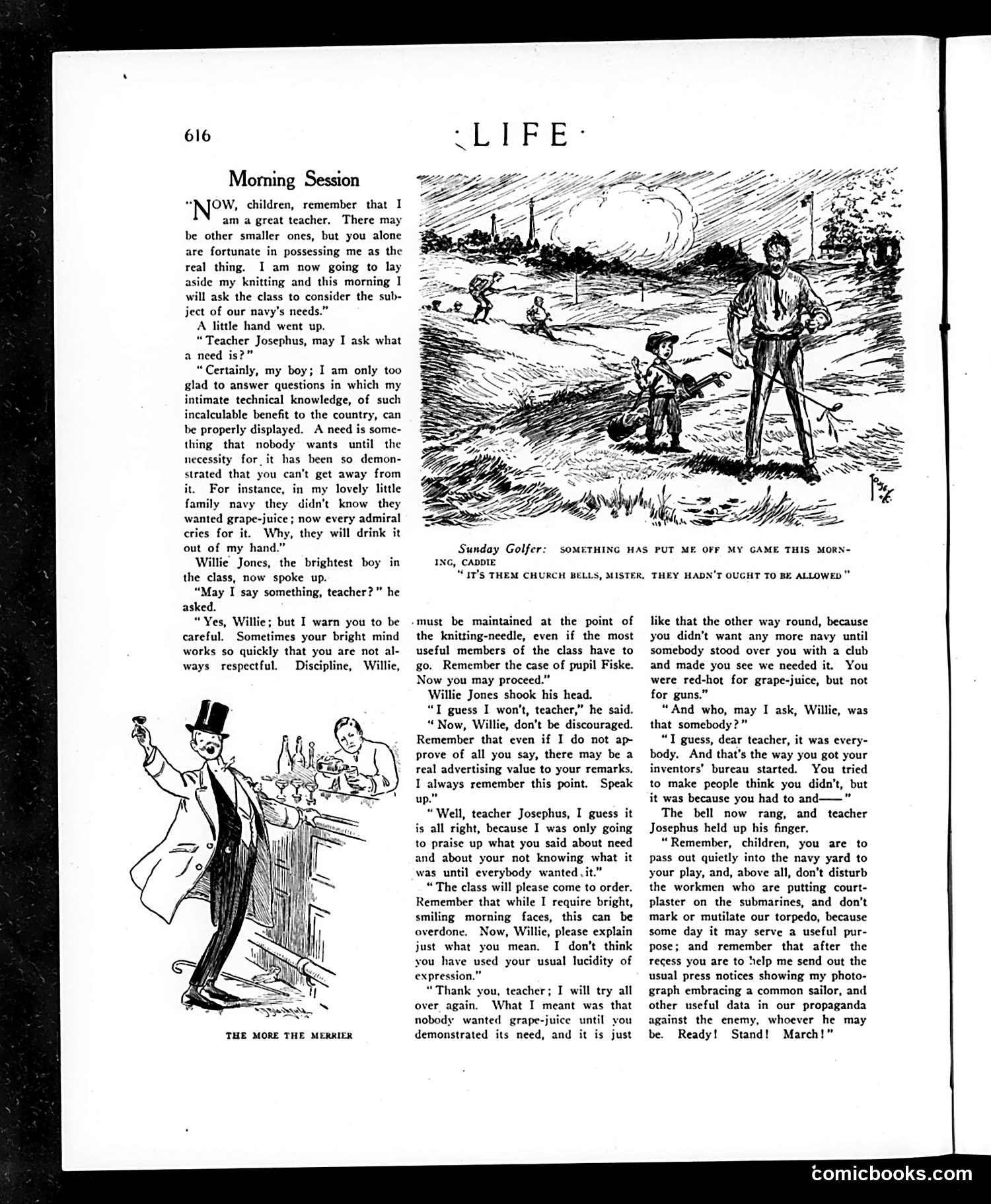
This is political satire attacking Secretary of the Navy Josephus Daniels (referenced as "Teacher Josephus"). The piece mocks Daniels' self-aggrandizement and manipulative approach to naval policy through a classroom allegory. **The satire's targets:** - Daniels' arrogance and self-promotion as "the real thing" - His creation of artificial "needs" through propaganda (the grape-juice example represents manufactured demand for naval expansion) - His use of press manipulation and photo ops with sailors for public relations - His authoritarian control maintained through intimidation **The joke:** Willie Jones—representing the public—catches Daniels in circular logic: Daniels creates needs by convincing people they want things, then claims these wants justify his policies. The satire suggests Daniels didn't genuinely advocate for naval strength until pressured, yet takes credit for it. The accompanying golf cartoon offers lighter social commentary: a golfer blames church bells for poor performance—mild critique of institutional intrusion on leisure.
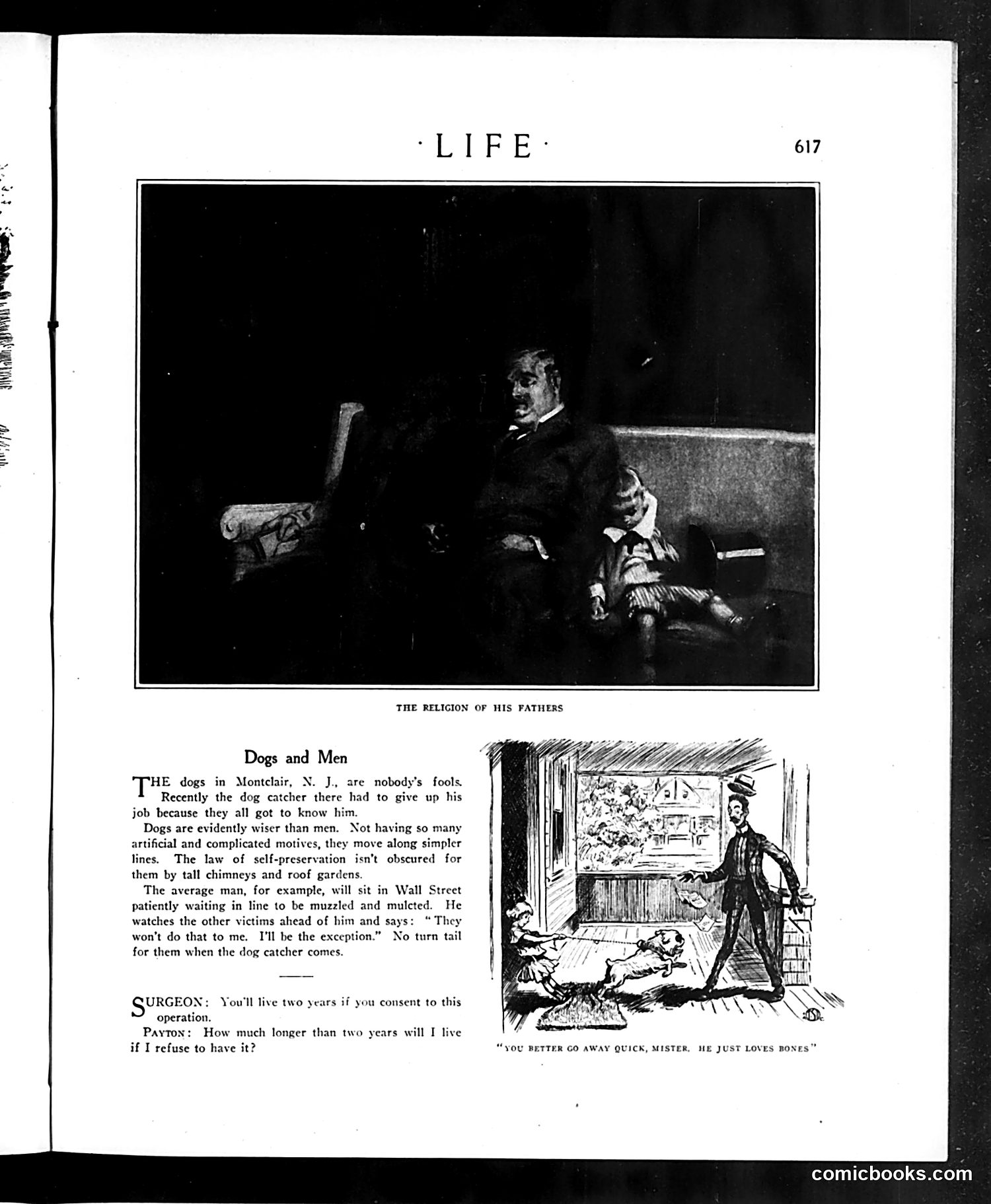
**Main Satire: "Dogs and Men"** This piece compares human and canine behavior to critique human foolishness. Dogs in Montclair, New Jersey supposedly learned to avoid the dog catcher and fled—showing practical self-preservation. Humans, by contrast, lack this wisdom. The Wall Street example illustrates this: men passively accept financial exploitation ("muzzled and mulcted"), watching others ahead suffer while delusionally believing *they'll* be exceptions. The satire suggests humans are blinded by complex social structures and false hopes, making them easier prey than actual dogs. **Secondary Joke: "The Religion of His Fathers"** The surgeon-patient dialogue (labeled as such in the image) presents dark humor: a surgeon offers a two-year lifespan if the patient undergoes surgery, but won't say how much longer refusal guarantees. The patient's question exposes the absurdity—he's essentially choosing between certain death and uncertain survival. **Context**: This reflects turn-of-the-century American anxieties about urban capitalism, financial manipulation, and medical ethics.
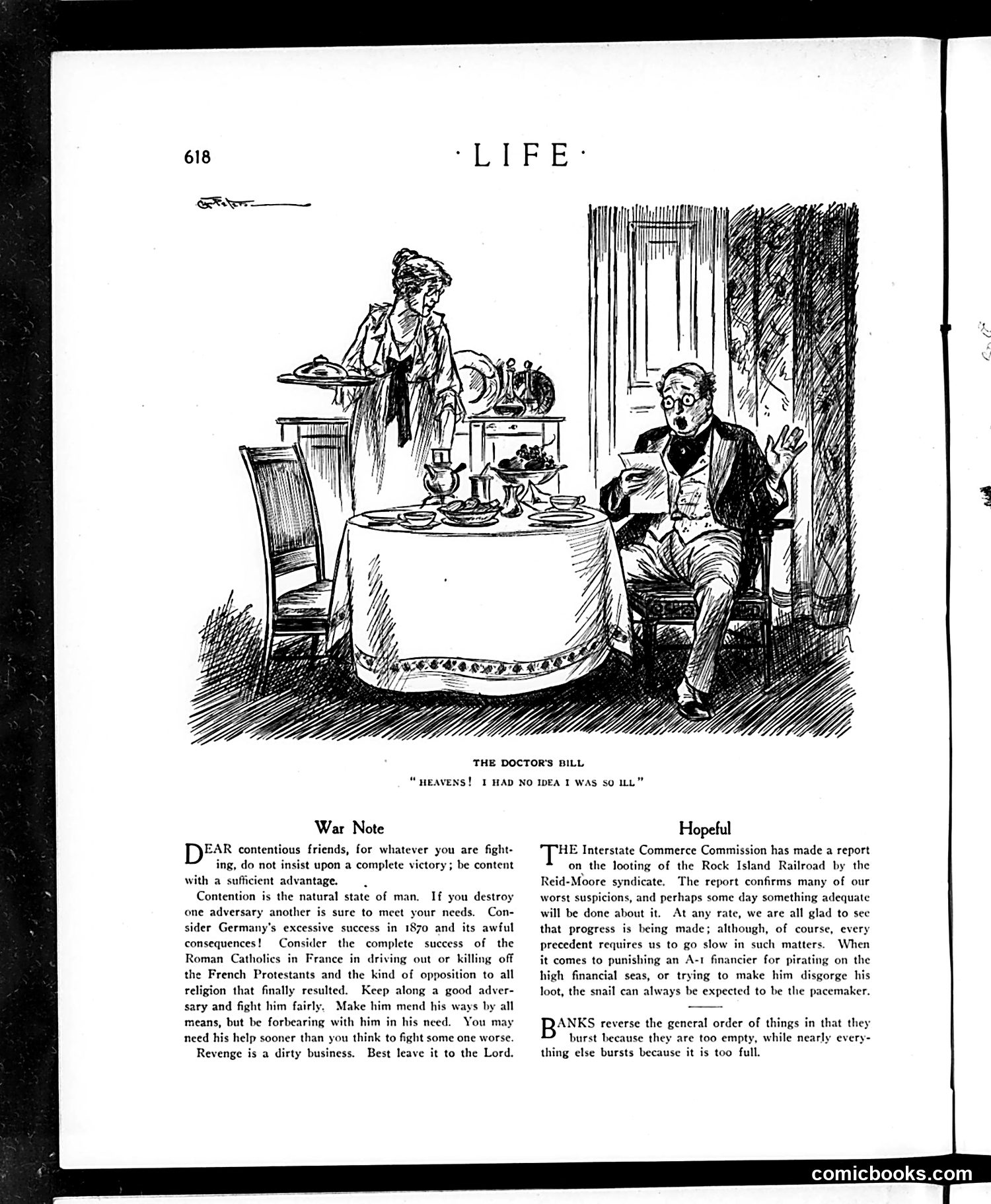
The cartoon depicts a doctor presenting his bill to a patient who is shocked at the cost. The patient exclaims, "Heavens! I had no idea I was so ill"—the joke being that the doctor's exorbitant fee reveals the severity of the illness more than the actual medical condition did. This satirizes the common complaint about doctors' inflated charges, suggesting their bills are disproportionate to services rendered. The accompanying text includes philosophical commentary on avoiding total victory in conflicts (referencing Germany's 1870 success and its consequences), plus brief notes on railroad corruption and banking failures. These articles represent typical *Life* magazine satire of early 20th-century American business and political abuses—ICC investigations into corporate looting and financial instability.
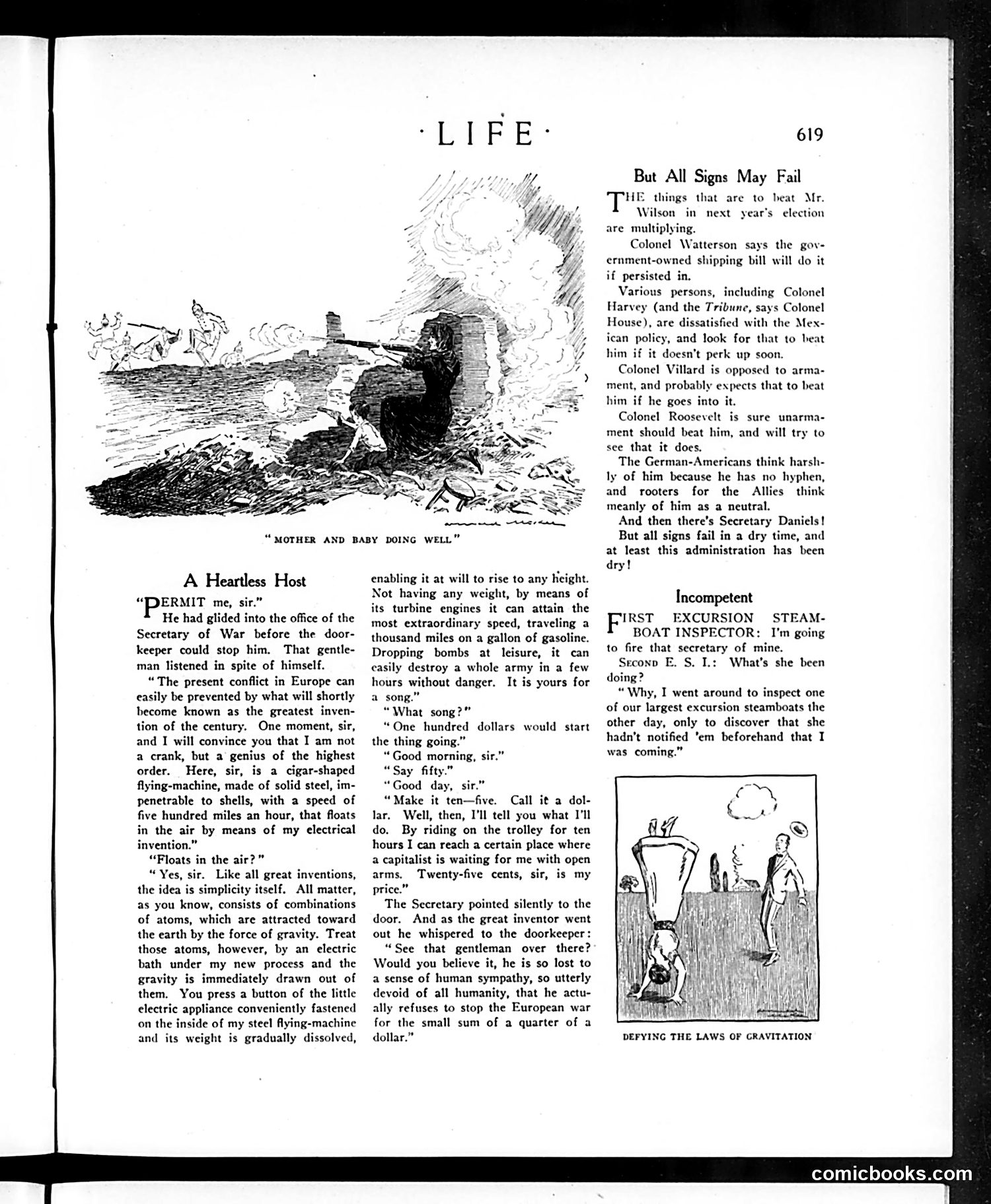
**"A Heartless Host"** (left column): A satirical story mocking both cranks and bureaucratic indifference. An eccentric inventor pitches a gravity-defying flying machine to the Secretary of War as a solution to the European conflict, progressively lowering his price from $100 to 25 cents. The Secretary dismisses him silently. The joke's irony: the inventor then accuses the Secretary of lacking humanity for refusing to stop the war cheaply—when the Secretary's real offense is simply not entertaining an absurd pitch. **"But All Signs May Fail"** (right column): Political satire on President Wilson's vulnerabilities before his 1916 reelection. Lists opposition from various factions (Colonel Watterson on shipping policy, Colonel Harvey on Mexican policy, Colonel Roosevelt on armament, German-Americans, pro-Allies supporters, and Secretary Daniels). The punchline: despite all these criticisms, the administration's Prohibition stance keeps it popular—"at least this administration has been dry!" **Small cartoon**: "Defying the Laws of Gravitation"—a steamboat inspector complains his secretary didn't announce his surprise inspection beforehand, depicting bureaucratic incompetence.
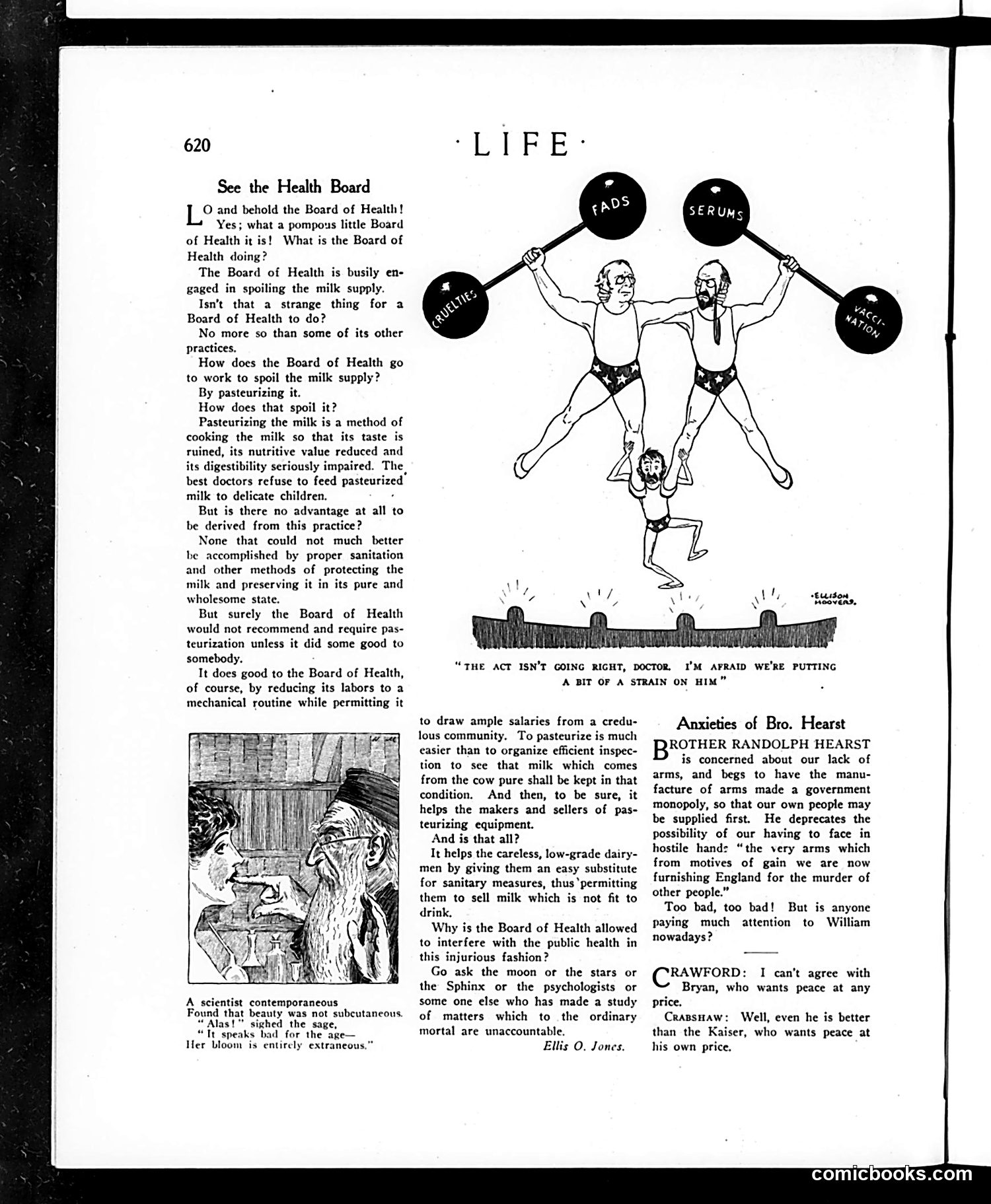
This page contains two distinct satirical pieces: **"See the Health Board"** attacks the Board of Health's pasteurization mandate. The author argues pasteurization reduces milk's nutritional value and digestibility, and that proper sanitation would be superior. The real complaint: the Board uses pasteurization as an easy mechanical substitute for rigorous inspection, benefiting equipment manufacturers and negligent dairies while appearing to protect public health. It's a critique of bureaucratic laziness disguised as public service. **"The Act Isn't Going Right, Doctor"** shows two muscular figures (likely representing military/industrial interests) straining under the weight of a child labeled with various "fads"—criticizing how current social trends burden society. **"Anxieties of Bro. Hearst"** mocks William Randolph Hearst's complaints about insufficient domestic arms manufacturing while America supplies weapons to England. The satirist questions why anyone still listens to Hearst's pronouncements. The page reflects early-20th-century Progressive Era skepticism toward both government regulation and wealthy industrialists' influence.
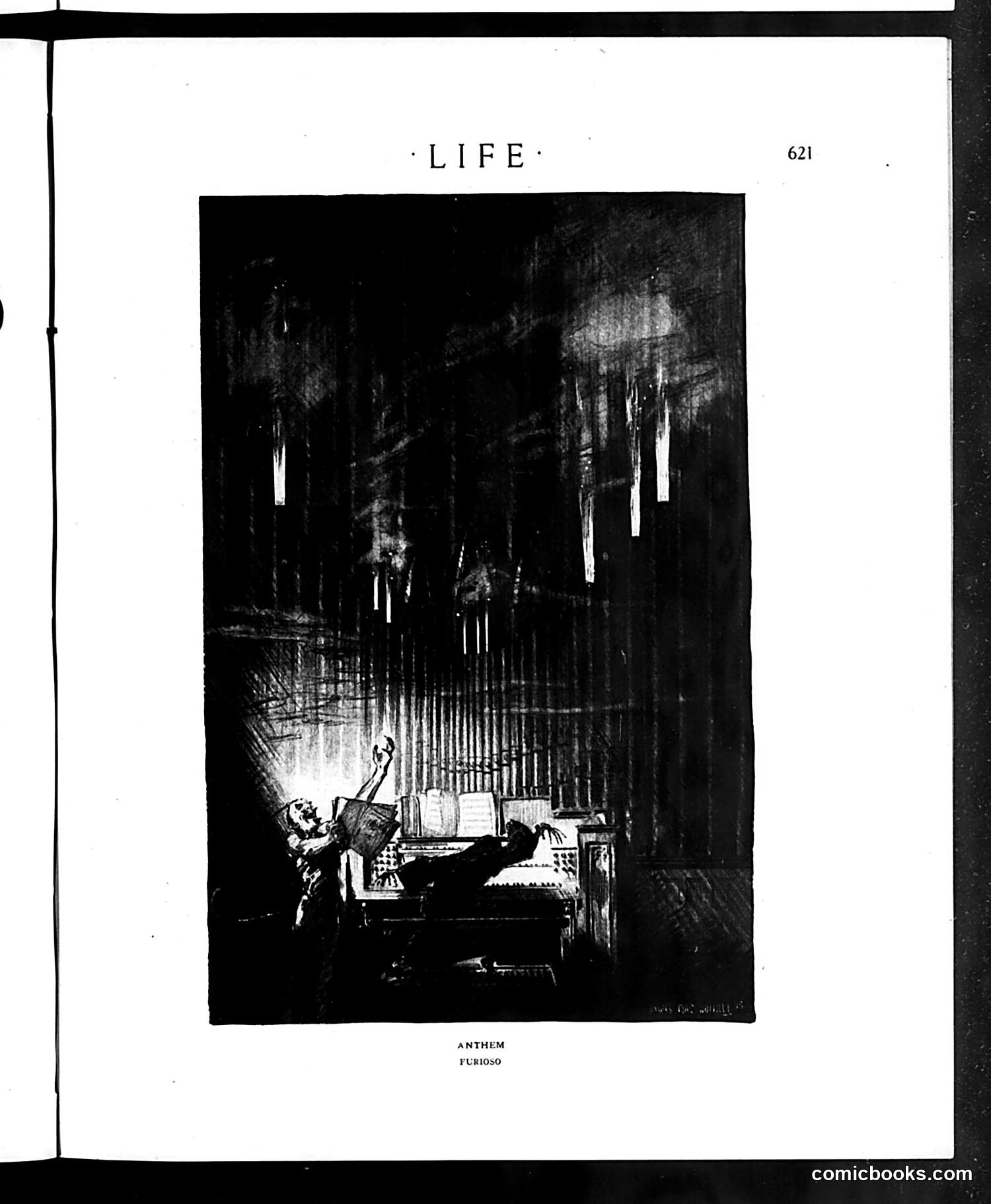
This page from *Life* magazine (page 621) features a single artwork titled "ANTHEM FURIOSO." The image shows a figure at a pipe organ in a Gothic cathedral interior, dramatically reaching upward toward the pipes with an animated gesture. The lighting is theatrical, with strong contrast between the illuminated figure and the dark architectural surroundings. The title "ANTHEM FURIOSO" (furious anthem) suggests satirical commentary on religious music or church services, likely mocking either overly emotional organ performance or zealous religious expression. The exaggerated posture and theatrical lighting emphasize the melodrama of the scene. However, without additional context about the artist or specific historical references visible in the image itself, the precise satirical target remains unclear.
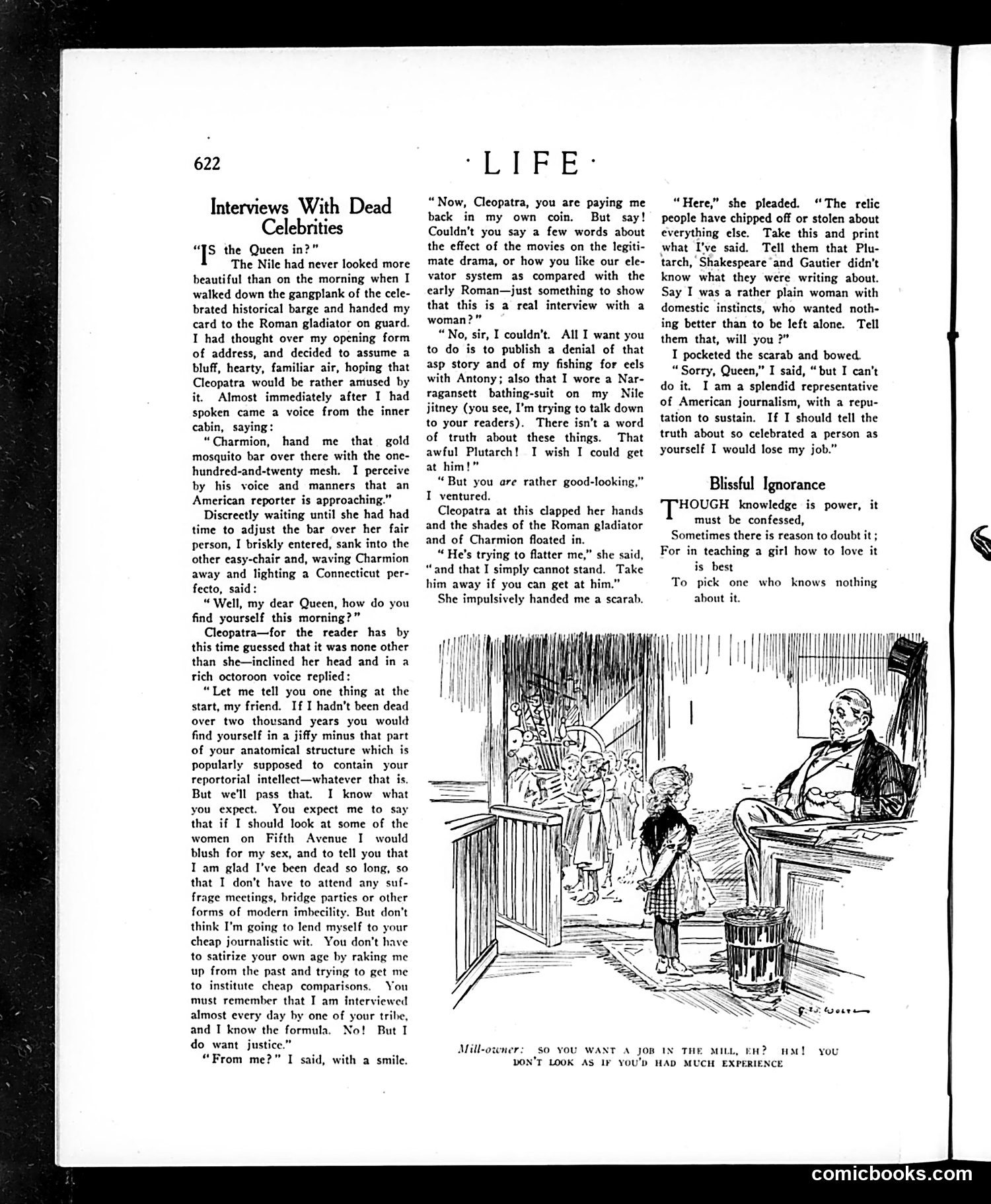
This piece satirizes sensationalist American journalism and yellow journalism practices. A reporter interviews the ghost of Cleopatra, seeking juicy quotes comparing ancient Egypt to modern America—a common trope of the era. The satire's targets: Cleopatra complains that journalists constantly misquote her (the "asp story," false anecdotes about Antony) and rely on ancient sources like Plutarch and Shakespeare rather than truth. She's frustrated by predictable interview formulas where dead figures are manipulated into mocking the modern age. The joke's irony: When she tries to set the record straight—she was actually plain and domestic—the reporter admits he *can't* publish truth because his reputation depends on sensationalism, not accuracy. The bottom cartoon (partial) appears unrelated, showing a mill-owner and job applicant. The satire critiques journalism's prioritization of entertaining fiction over factual reporting—a surprisingly modern concern for this publication.
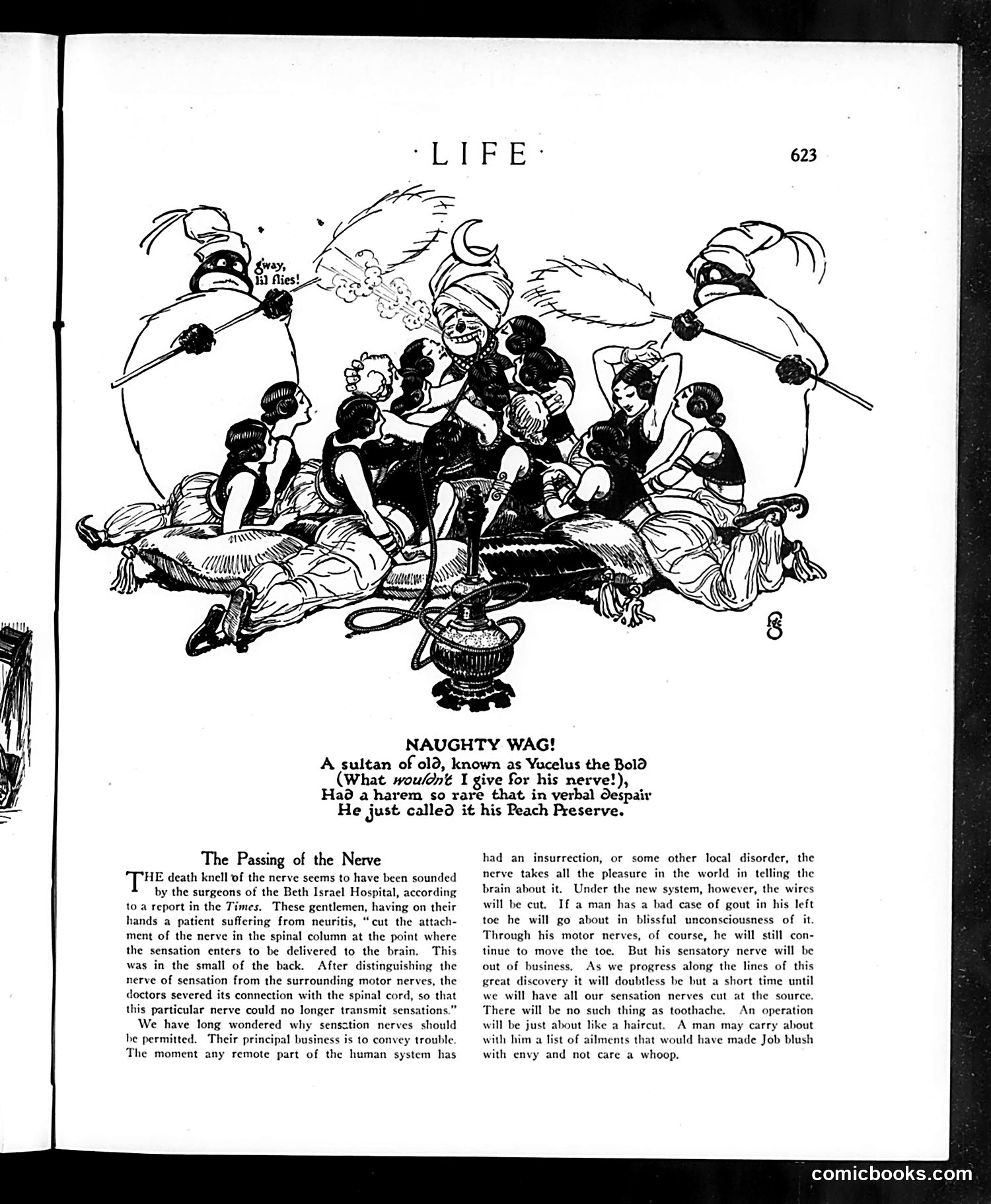
**The Top Cartoon:** A lighthearted limerick about "Yucelus the Bold," a fictional sultan with an unusually large harem he humorously calls his "Peach Preserve." The joke is simply the absurdity of the sultan's nerve (audacity) and the clever wordplay—nothing deeper than risqué humor about harems. **"The Passing of the Nerve":** This is satirical commentary on a real surgical procedure reported in the Times where doctors at Beth Israel Hospital severed sensory nerves to eliminate pain in neuritis patients. Life's writer mockingly celebrates this as progress, sarcastically suggesting that cutting sensation nerves would eliminate all human discomfort—toothaches, gout, etc.—leaving people blissfully unaware of serious ailments while still able to function. The satire critiques the medical establishment's cavalier attitude toward numbing human sensation without considering consequences. The tone suggests this is absurdly dangerous thinking presented as innovation.
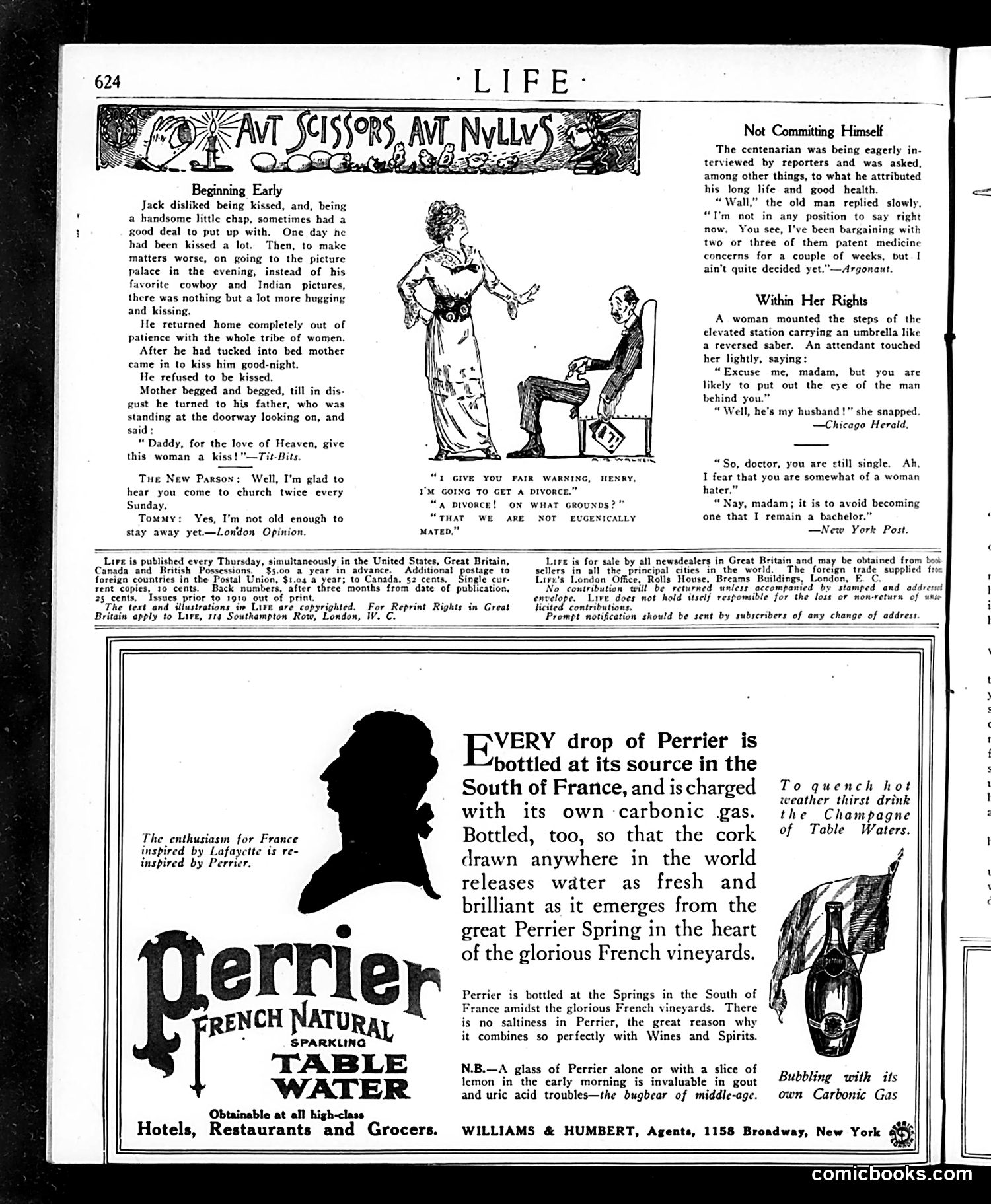
This page contains four brief humorous anecdotes typical of Life's satirical format: 1. **"Beginning Early"**: A young boy named Jack, exhausted from being kissed by women all day (including at a cinema showing romantic rather than action films), refuses his mother's bedtime kiss and demands his father give the woman a kiss instead—satirizing excessive Victorian affection and gender dynamics. 2. **"Not Committing Himself"**: A centenarian, asked his longevity secret, admits he's still negotiating with patent medicine companies—mocking both the dubious health claims of quack medicines and the elderly's gullibility. 3. **"Within Her Rights"**: A woman carries an umbrella like a sword on subway stairs, threatening a man's eye. When warned, she declares "he's my husband"—satirizing marital relations and women's growing assertiveness. 4. **Additional jokes** about clerical celibacy and divorce grounds round out the humor. The page is largely advertising (Perrier water), with satirical content occupying the upper portion.
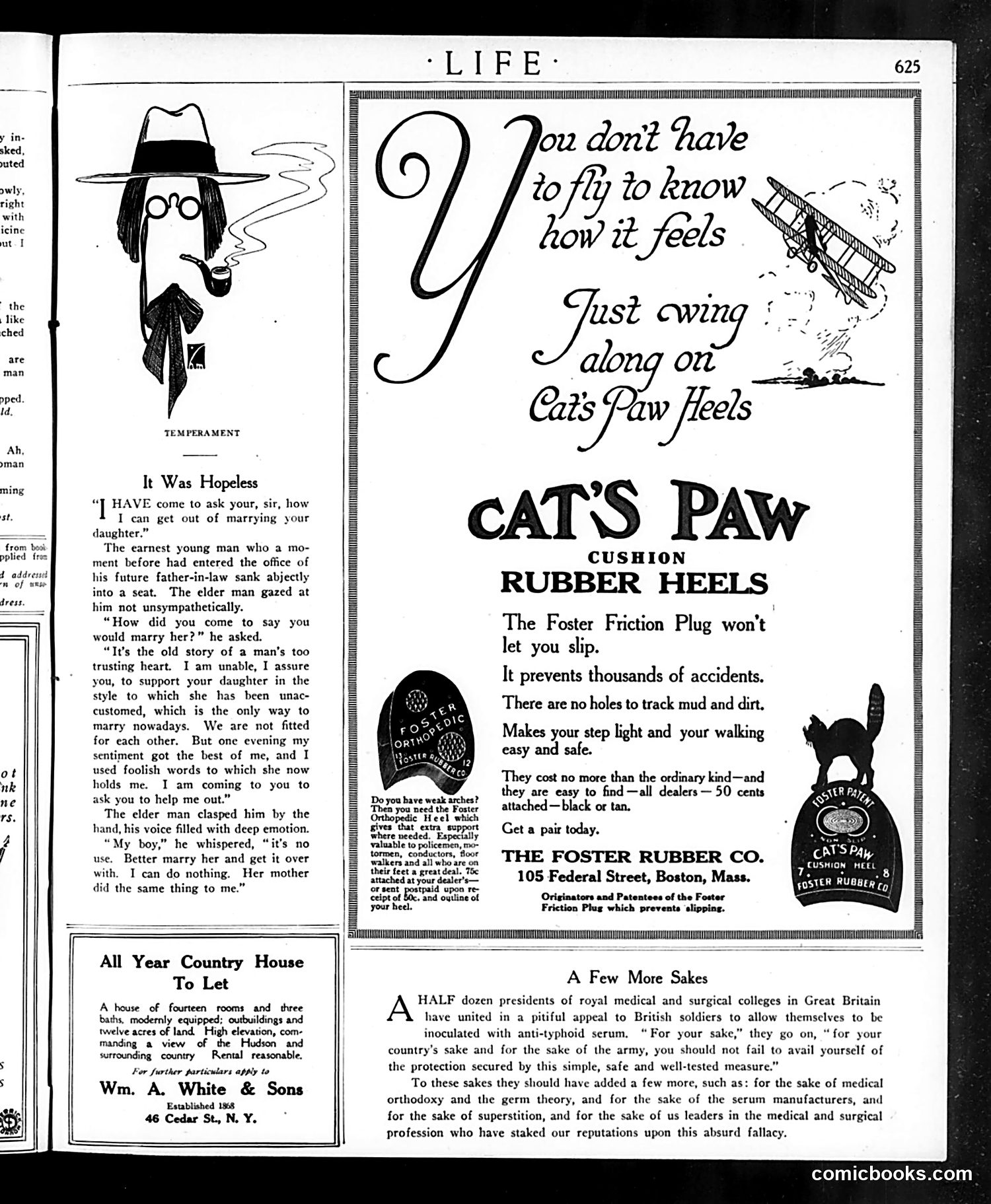
This page mixes humor with advertising typical of early 20th-century Life magazine. **The Cartoon ("Temperament"):** A young man seeks advice from his future father-in-law on escaping an engagement. The father-in-law, sympathetically understanding, reveals he faced the same dilemma with the young man's future mother-in-law—implying he couldn't escape either. The joke satirizes marriage as an inescapable trap, particularly critiquing the era's expectation that men support wives in their accustomed lifestyle. The elder's resignation suggests this is a universal male predicament. **The Advertisements:** The Cat's Paw rubber heels ad and Foster Orthopedic Heel pitch practical footwear solutions. **"A Few More Sakes":** This satirical editorial fragment mocks British medical authorities urging soldiers to accept typhoid inoculation. Life's editors sarcastically suggest the doctors' real motivations are protecting medical orthodoxy, enriching serum manufacturers, and preserving professional reputations—not soldier welfare. It's skeptical of institutional medical authority and corporate interests.
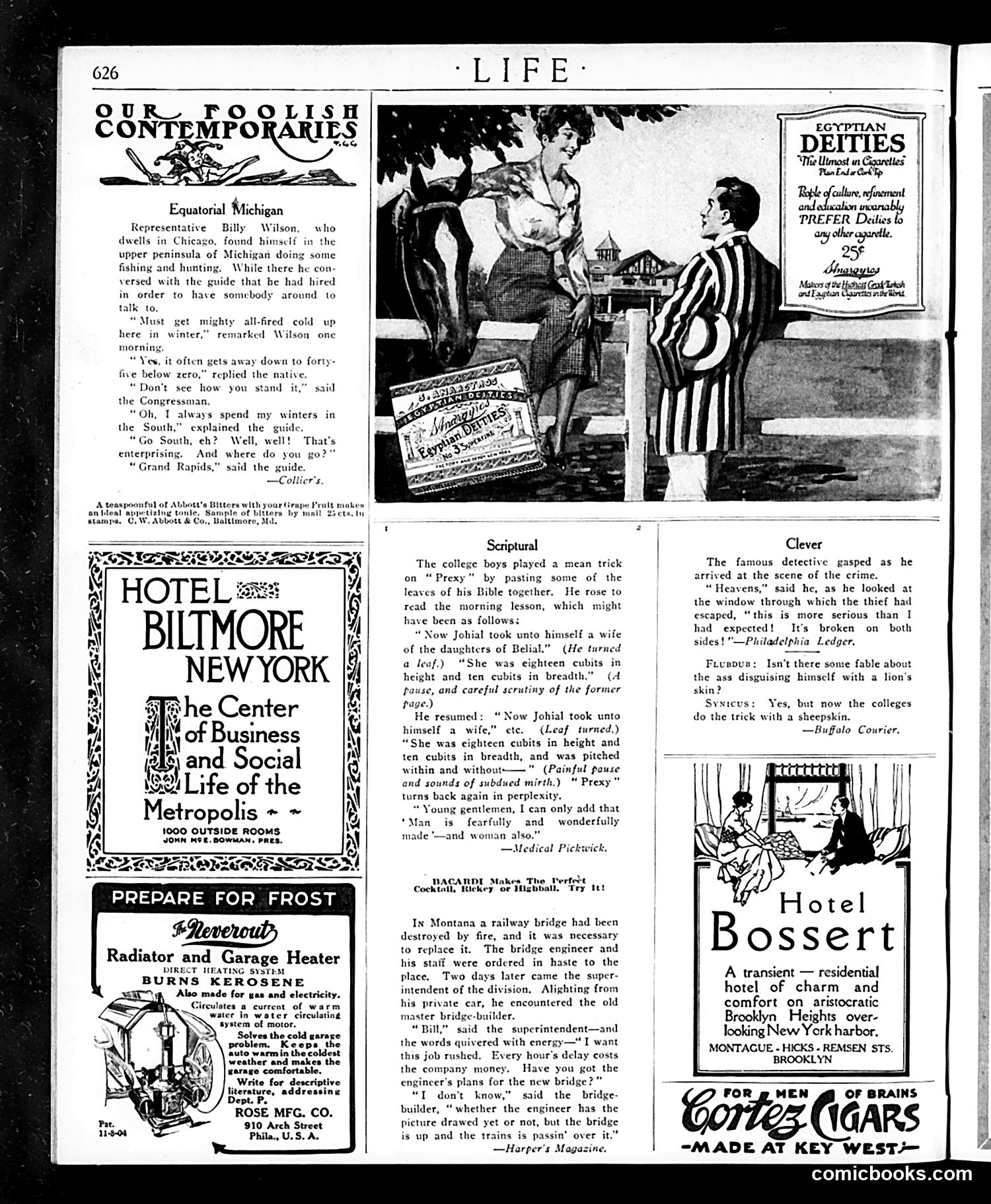
This page features three satirical anecdotes mocking human foolishness: 1. **The Michigan Guide**: Congressman Billy Wilson is ridiculed for his naïveté. A fishing guide claims he endures winters of "forty-five below zero" but escapes to the South—specifically Grand Rapids (a relatively mild Michigan city). The joke: Wilson fails to catch the obvious lie, revealing his gullibility. 2. **The College Prank**: Students paste Bible pages together, causing their college president to read nonsensical scripture ("She was eighteen cubits in height...pitched within and without"). The humor targets both the boys' disrespect and the president's embarrassment. 3. **The Railway Bridge**: A bridge engineer reports a destroyed bridge is already rebuilt and operational—without plans or proper oversight. The superintendent's urgency becomes absurd when the impossible has already occurred. The joke satirizes American pragmatism and corner-cutting. Each anecdote ridicules different American types: the gullible politician, irreverent youth, and overly casual engineering competence. The page is primarily advertising with satirical content interspersed.
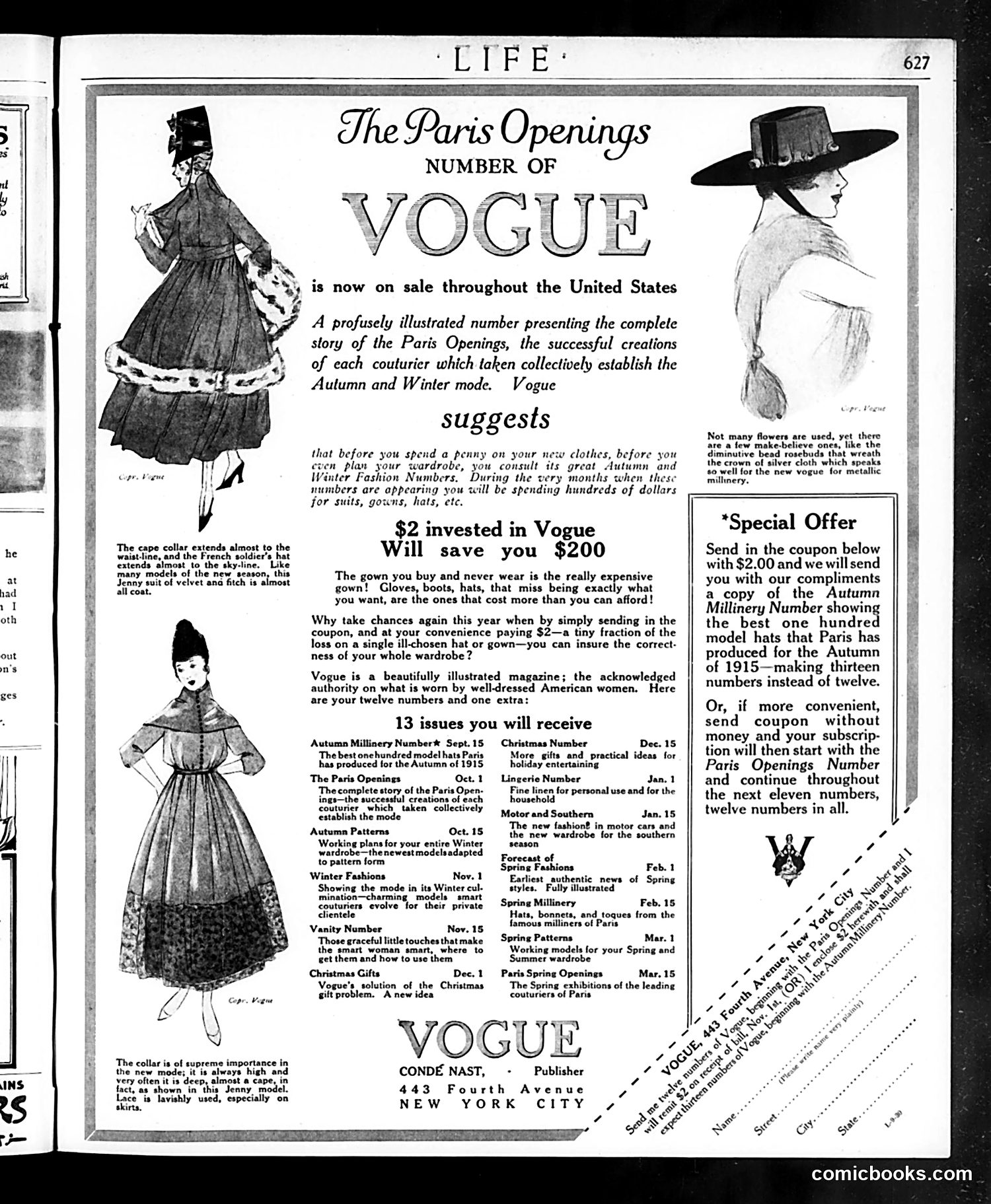
This is primarily a **Vogue magazine advertisement**, not political satire. The page promotes Vogue's Paris Fashion subscription service to American readers in 1915. **What's being sold:** Annual subscriptions to Vogue's fashion reporting, particularly their coverage of Paris couture collections—the season's authoritative source for what wealthy women should wear. **The pitch:** For $2 invested now, subscribers save $200 by avoiding expensive fashion mistakes (ill-chosen hats, unworn gowns). The ad emphasizes that consulting Vogue before purchasing clothes is economically rational. **Historical context:** This reflects pre-WWI consumer culture where Paris dictated American high fashion, and aspirational middle/upper-class women relied on illustrated magazines as their style authority. The detailed illustrations of coat collars, capes, and lace show how fashion details were communicated before television. **No satire present**—this is straightforward advertising using logic appeals and fashion authority to drive subscriptions.
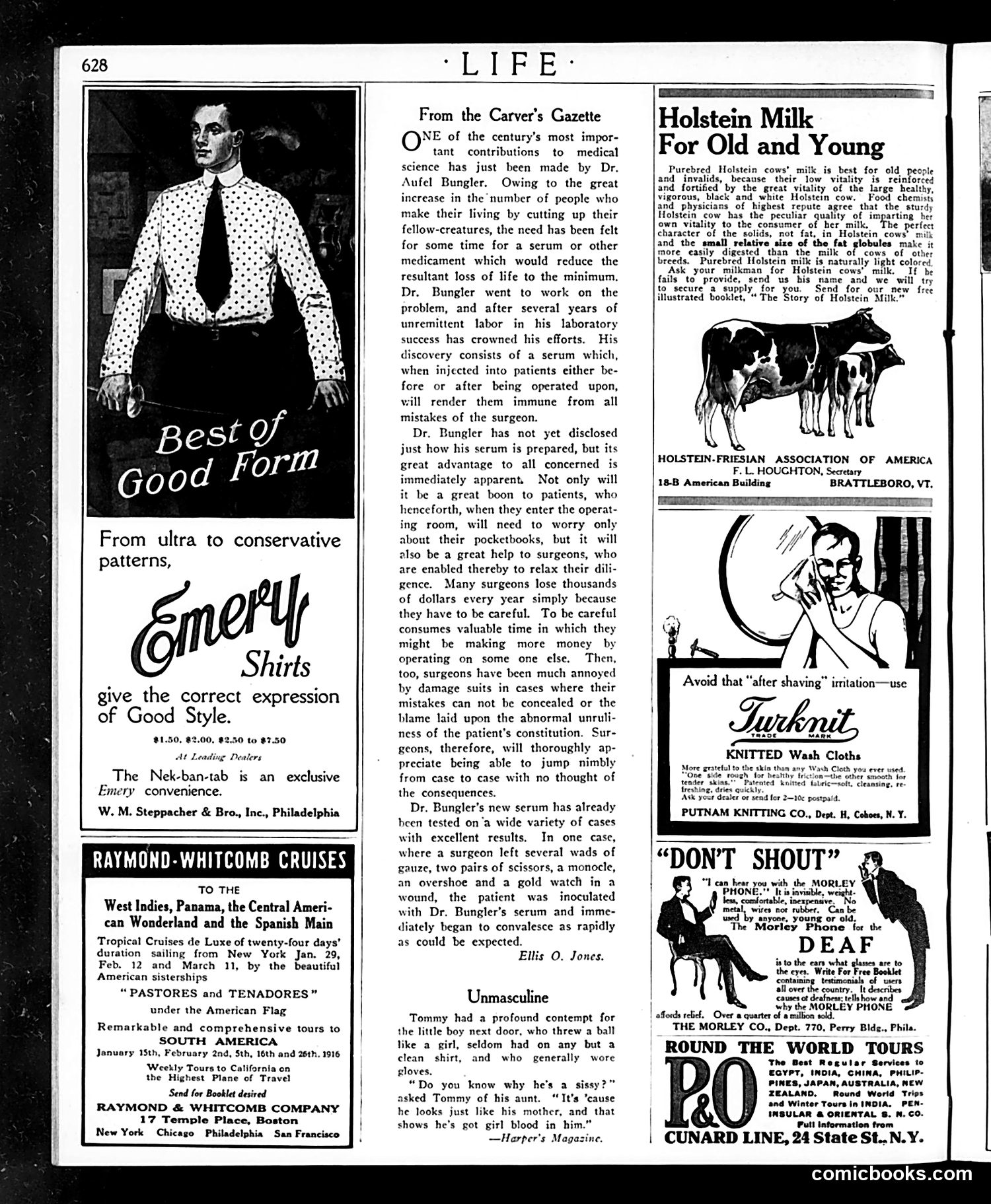
This page is primarily **advertising with one satirical article**. The main content is "From the Carver's Gazette," a mock-serious piece satirizing surgical malpractice and medical negligence. The satire describes a fictional "Dr. Aufel Bungler" who invents a serum to make patients immune to surgeons' mistakes. The joke targets early 20th-century surgeons' carelessness and profit-motive: the serum would allow doctors to work faster without consequence, benefiting their wallets while harming patients. Specific absurdities—surgeons leaving "wads of gauze, scissors, a monocle" inside patients—mock the real dangers of sloppy surgery. The article's title references "Carver's Gazette," likely a humorous medical publication. The satire advocates for surgical accountability, mocking both incompetent doctors and a legal system where wealthy surgeons escape consequences for errors. The remaining content consists of period advertisements for Emery Shirts, cruise lines, Holstein milk, shaving products, and phones—typical of 1916 Life magazine.
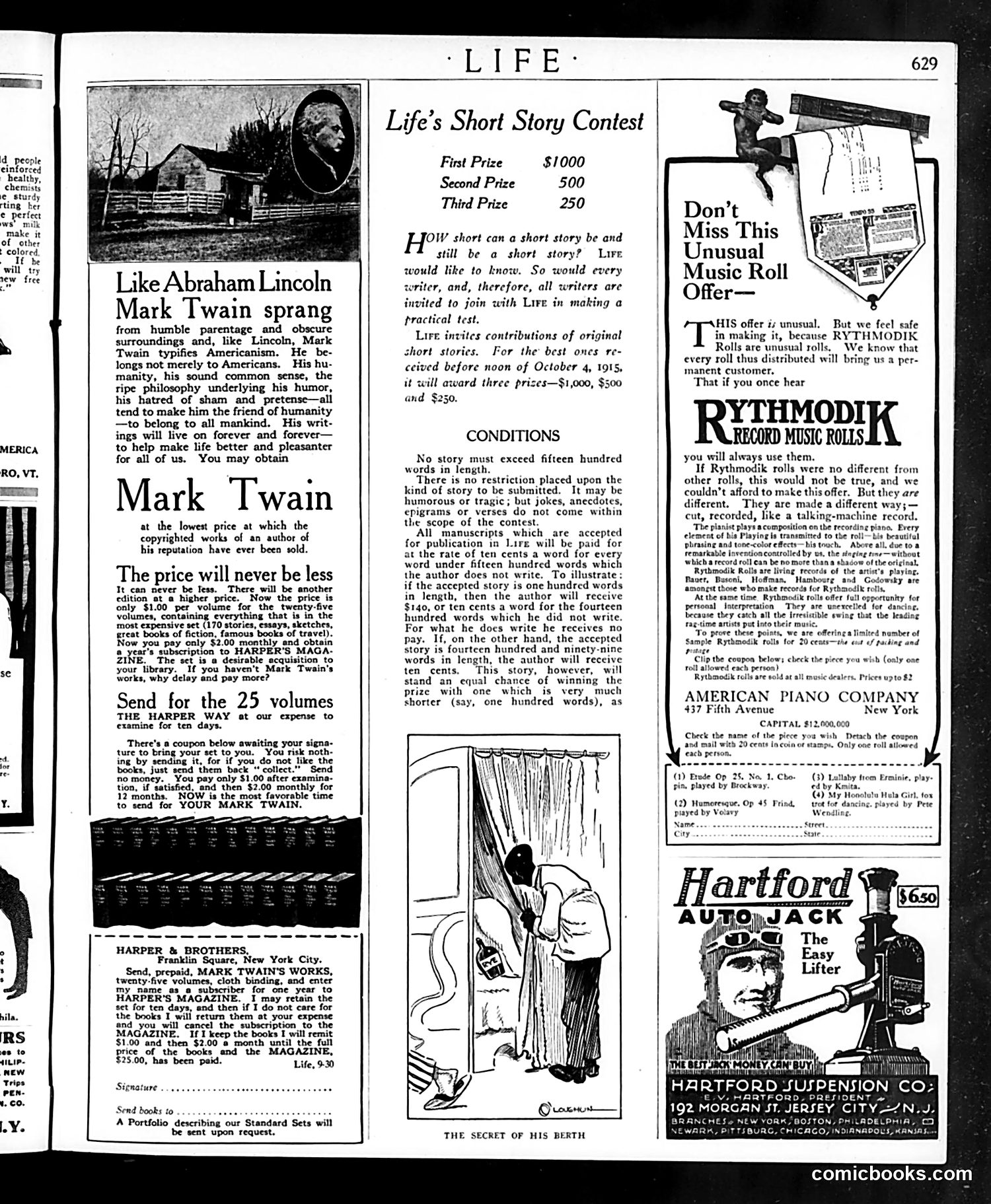
This page primarily features **advertisements and a literary contest**, not political satire. **Main content:** - A **Mark Twain book promotion** comparing him to Abraham Lincoln as embodying American ideals (humility, common sense, hatred of sham). Harper & Brothers advertises his 25-volume collected works at $1.00/volume—remarkably cheap for the era. - **Life's Short Story Contest**: Life magazine invites submissions under 1,500 words, offering $1,000 first prize. The twist: authors are *paid for words they don't write*. A 100-word story earns $140 (ten cents per unwritten word), incentivizing brevity. This satirizes the economics of publishing and editorial preferences for conciseness. **Other advertisements:** Rythmodik music rolls and Hartford auto jacks appear on the right. The cartoon "The Secret of His Birth" (bottom) shows a figure discovering something in curtains—its meaning is unclear without additional context.
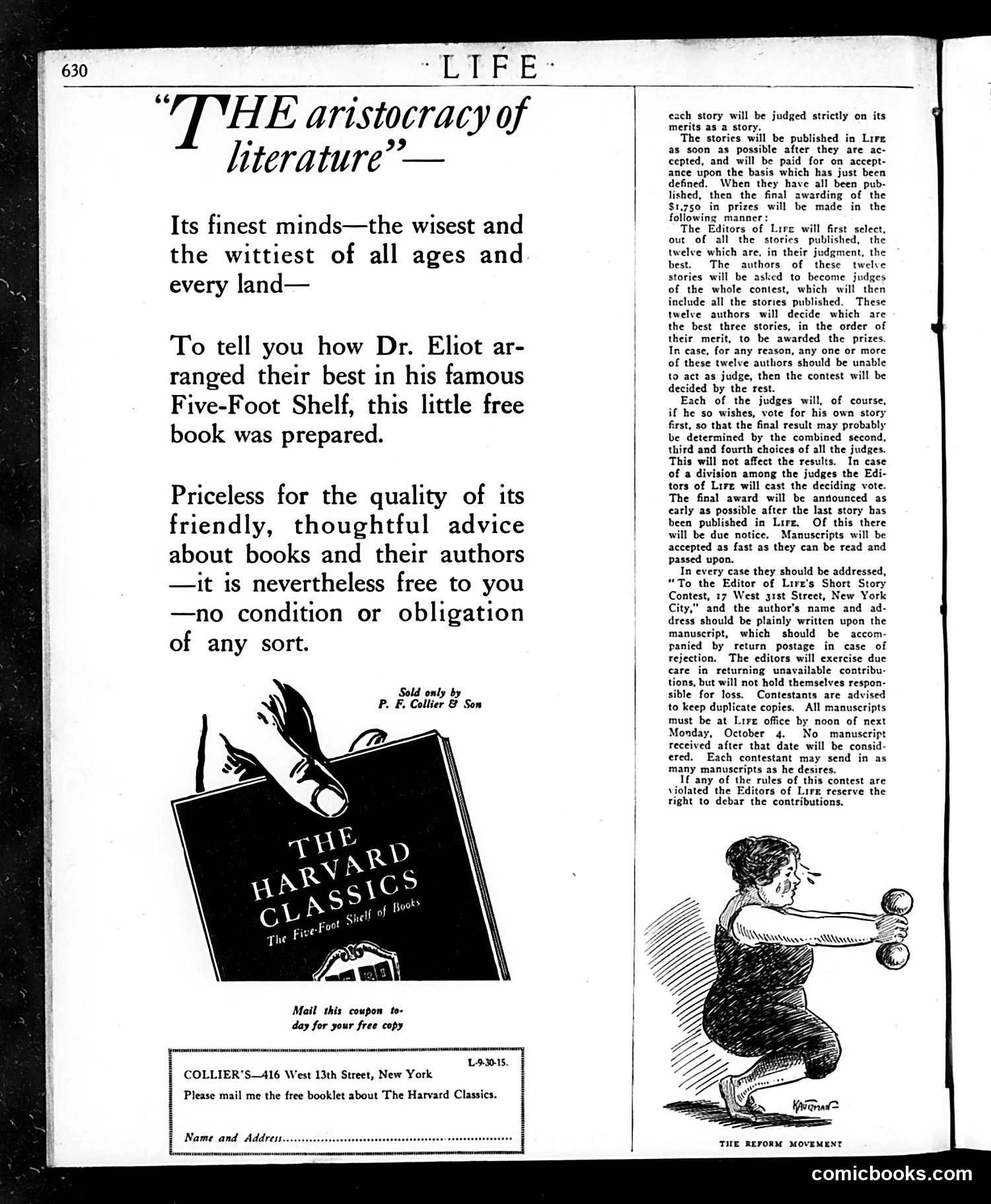
This page combines two distinct advertisements/promotions: **Left side:** An ad for "The Harvard Classics" (Dr. Eliot's Five-Foot Shelf), a curated collection of world literature. The copy sarcastically calls this "the aristocracy of literature"—ironically promoting a *democratic* product (a free booklet) that claims to democratize access to "the finest minds" of all ages and lands. The humor lies in the pretentious language used to sell what is essentially populist education. **Right side:** Details of Life magazine's short story contest offering $1,250 in prizes. The competition structure is notably complex: editors select twelve best stories, whose authors then judge all stories to determine the top three winners. **Bottom right cartoon:** A caricatured figure (labeled "THE REFORM MOVEMENT") performs an awkward juggling act, suggesting the reform movement is clumsy or unstable—likely satirizing Progressive Era social reform efforts as impractical or uncoordinated. The page reflects early 20th-century American tensions between cultural elitism and democratization.
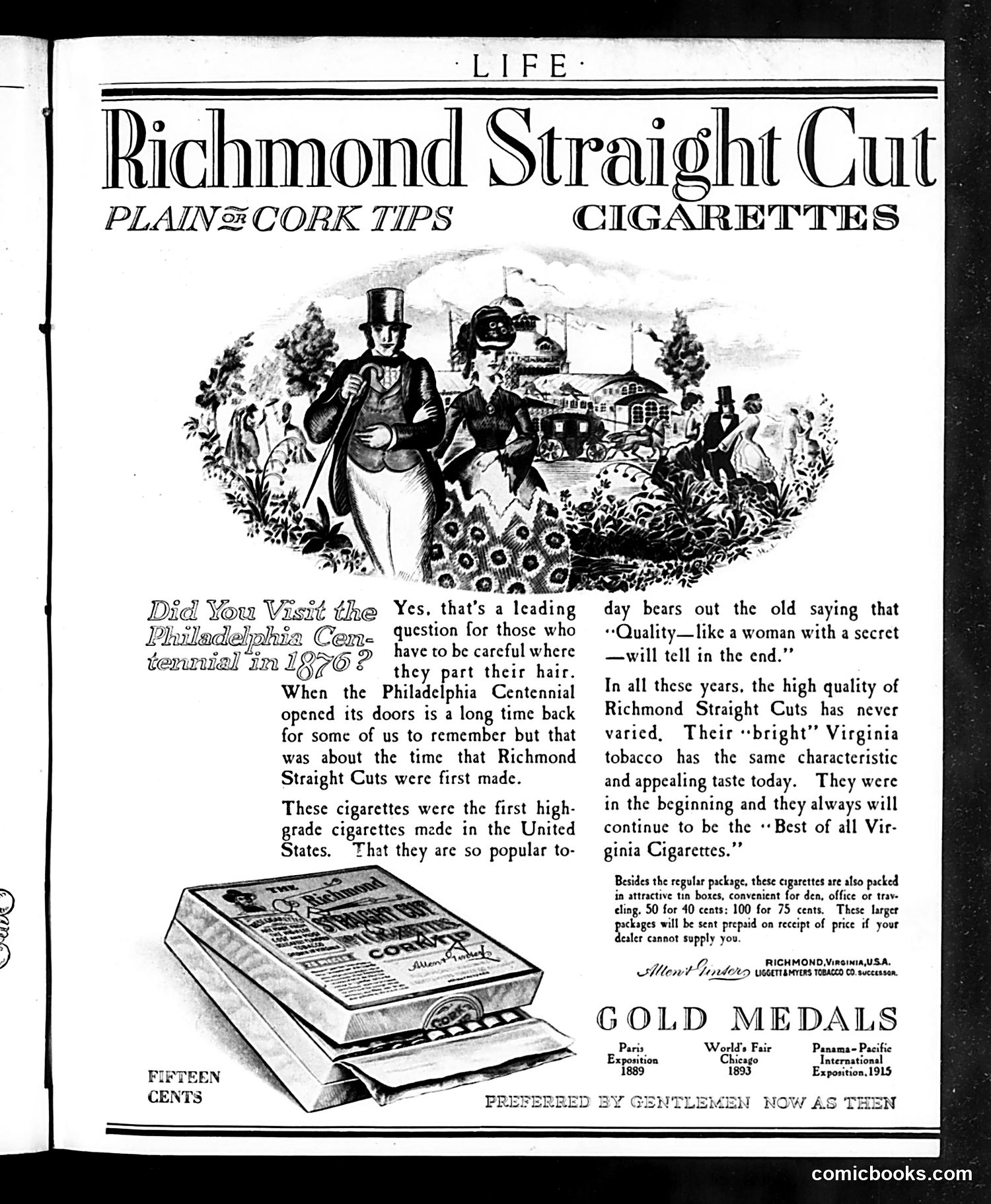
This is primarily a **cigarette advertisement**, not political satire. The page promotes Richmond Straight Cut cigarettes with a nostalgic marketing approach. The ad references the **1876 Philadelphia Centennial Exposition** as a historical anchor, claiming Richmond Straight Cuts were "the first high-grade cigarettes made in the United States" around that time. The opening joke about the "Philadelphia Cemetery" and hair-parting appears to be a mild pun rather than satire—likely a playful reference to something contemporaries would recognize. The advertisement emphasizes **quality and tradition**, using the tagline "Quality—like a woman with a secret—will tell in the end" (a now-dated comparison that relies on gendered stereotypes of the era). Gold medals from Paris (1889), Chicago (1893), and Panama-Pacific (1915) expositions are cited as proof of superiority. The vintage illustration shows well-dressed gentlemen in 19th-century attire, positioning the product as refined and gentlemanly. Pricing is listed at fifteen cents per pack, with bulk options available. This reflects early 20th-century advertising practices before tobacco health warnings.
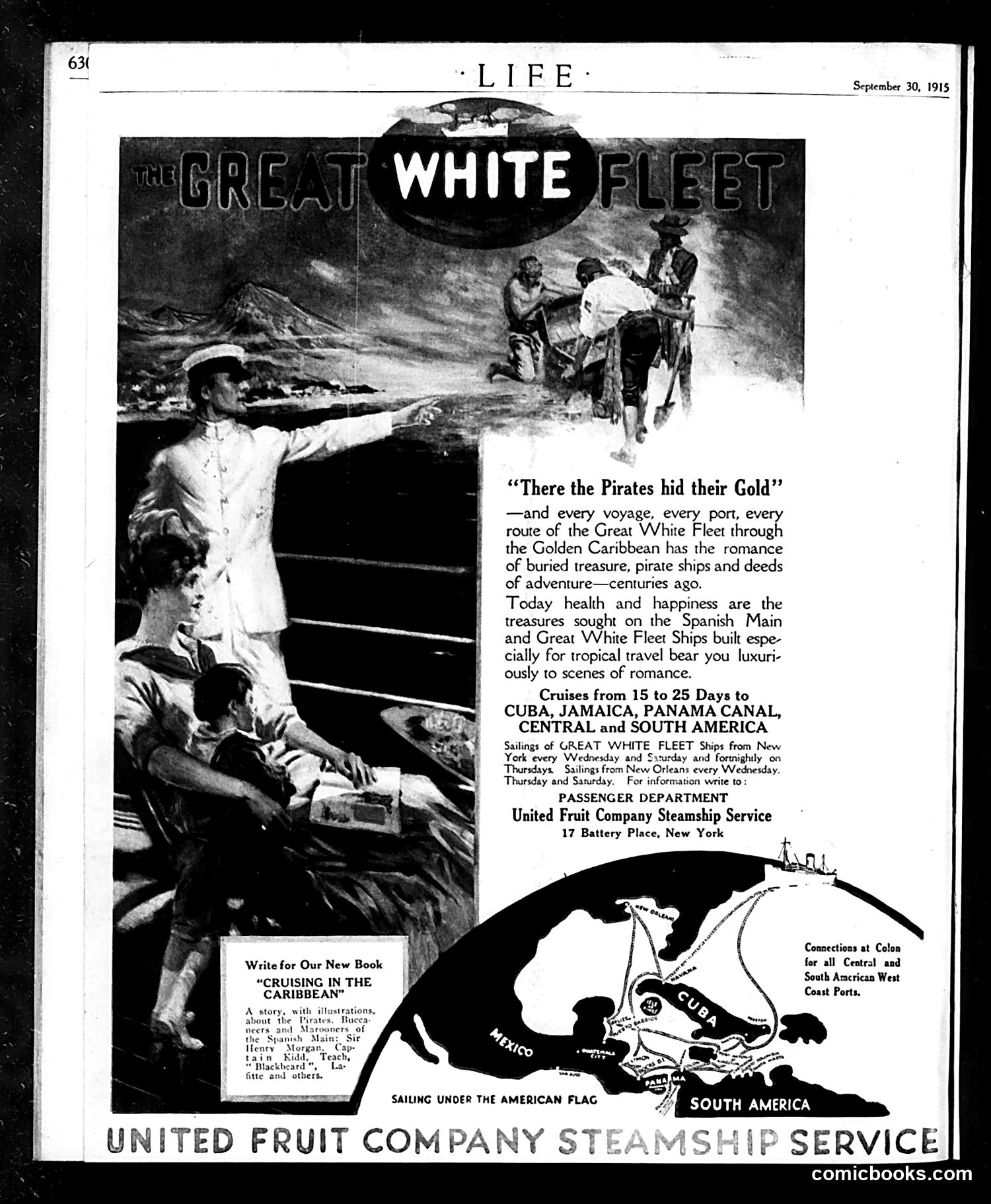
This is primarily **advertising**, not satire. The United Fruit Company Steamship Service is promoting Caribbean cruises by romanticizing piracy and colonial adventure. The ad uses nostalgic imagery of the "Spanish Main" and buried treasure to market luxury tropical travel to wealthy Americans. The illustration shows well-dressed passengers aboard ship, pointing toward exotic lands—positioning Caribbean travel as romantic escapism reminiscent of historical adventure tales. The "Great White Fleet" reference evokes American naval power and imperial reach. The map shows routes through Cuba, Jamaica, and Panama—regions where the U.S. maintained significant political and economic influence in 1915. There's no apparent satire here; rather, this straightforwardly markets leisure travel to the Caribbean by framing it through narratives of adventure, treasure, and American dominance—reflecting early 20th-century attitudes toward the region and U.S. imperial interests.

I can see this is a page from Life magazine dated June 30, 1915, but the image is almost entirely black or severely underexposed, making the content illegible. I cannot discern any cartoon figures, caricatures, text, or visual details that would allow me to identify political or social references, explain satirical points, or describe what the page contains. To provide accurate analysis as requested, I would need a clearer, properly exposed image of the page. Without being able to see the actual content, I cannot responsibly identify figures or explain the historical context.