
Life, 1915-09-30 · page 4 of 45
Life — September 30, 1915 — page 4: what you’re looking at
What you’re looking at
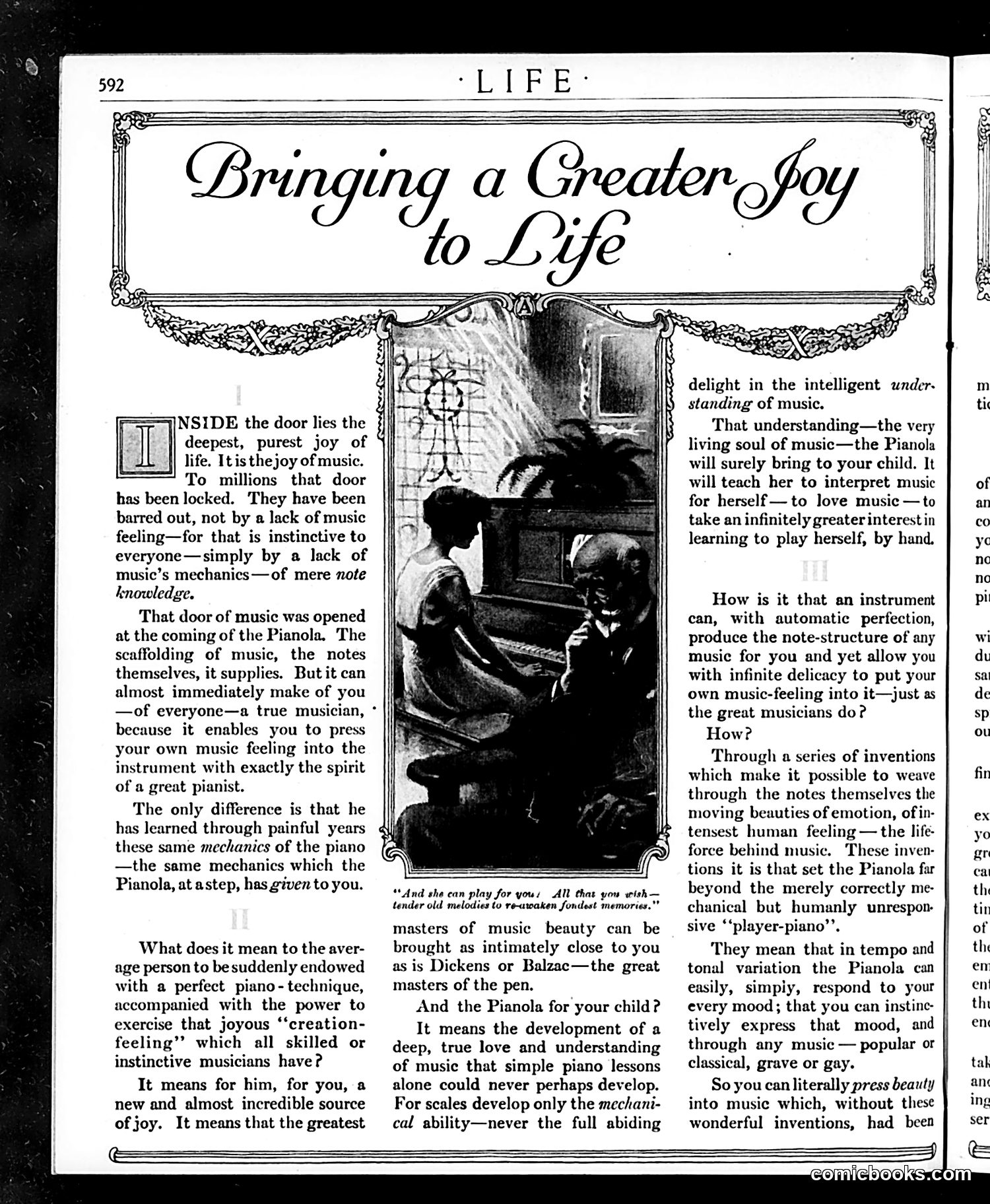
This is **not a political cartoon or satire**—it's a **advertisement for the Pianola player piano**, disguised as editorial content in Life magazine (a common advertising practice of that era). The page promotes the Pianola as a democratizing technology that brings musical sophistication to average households. The central image shows a woman playing the device. The text argues the Pianola enables people without formal training to produce music with "the spirit of a great pianist" by mechanically reproducing recorded performances. The key claim: this invention makes high culture—music by "masters like Dickens or Balzac"—accessible to children and families who couldn't otherwise afford piano lessons or talent. This reflects early 20th-century optimism about technology's ability to elevate middle-class life.
📄 Transcribed text from this page (OCR, searchable)
Machine-transcribed from the original scan — historical spelling and the odd misread are preserved.
NSIDE the door lies the deepest, purest joy of life. Itis thejoy of music. To millions that door has been locked. They have been barred out, not by a lack of music feeling—for that is instinctive to everyone—simply by a lack of music’s mechanics—of mere note knowledge. That door of music was opened at the coming of the Pianola. The scaffolding of music, the notes themselves, it supplies. But it can almost immediately make of you —of everyone—a true musician, * because it enables you to press your own music feeling into the instrument with exactly the spirit of a great pianist. The only difference is that he has Jearned through painful years these same mechanics of the piano —the same mechanics which the Pianola, at astep, has given to you. What does it mean to the aver- age person to be suddenly endowed with a perfect piano- technique, accompanied with the power to exercise that joyous ‘‘creation- feeling’? which all skilled or instinctive musicians have? It means for him, for you, a new and almost incredible source of joy. It means that the greatest “And she can play for yous All that you wisth— tender old melodies to re-aroaken fondest memories.” masters of music beauty can be brought as intimately close to you as is Dickens or Balzac—the great masters of the pen. And the Pianola for your child? It means the development of a deep, true love and understanding of music that simple piano lessons alone could never perhaps develop. For scales develop only the mechani- cal ability—never the full abiding delight in the intelligent under. standing of music. That understanding—the very living soul of music—the Pianola will surely bring to your child. It will teach her to interpret music for herself — to love music —to take an infinitely greater interest in learning to play herself, by hand. How is it that an instrument can, with automatic perfection, produce the note-structure of any music for you and yet allow you with infinite delicacy to put your own music-feeling into it—just as the great musicians do? How? Through a series of inventions which make it possible to weave through the notes themselves the moving beauties of emotion, of in- tensest human feeling — the life- force behind music. beyond the merely correctly me- chanical but humanly unrespon- sive ‘‘player-piano’’. They mean that in tempo and tonal variation the Pianola can easily, simpiy, respond to your every mood; that you can instinc- tively express that mood, and through any music — popular or } classical, grave or gay. So you can literally press beauty into music which, without these wonderful inventions, had been These inven- | tions it is that set the Pianola far | S m tic