
Life, 1915-09-30 · page 26 of 45
Life — September 30, 1915 — page 26: what you’re looking at
What you’re looking at
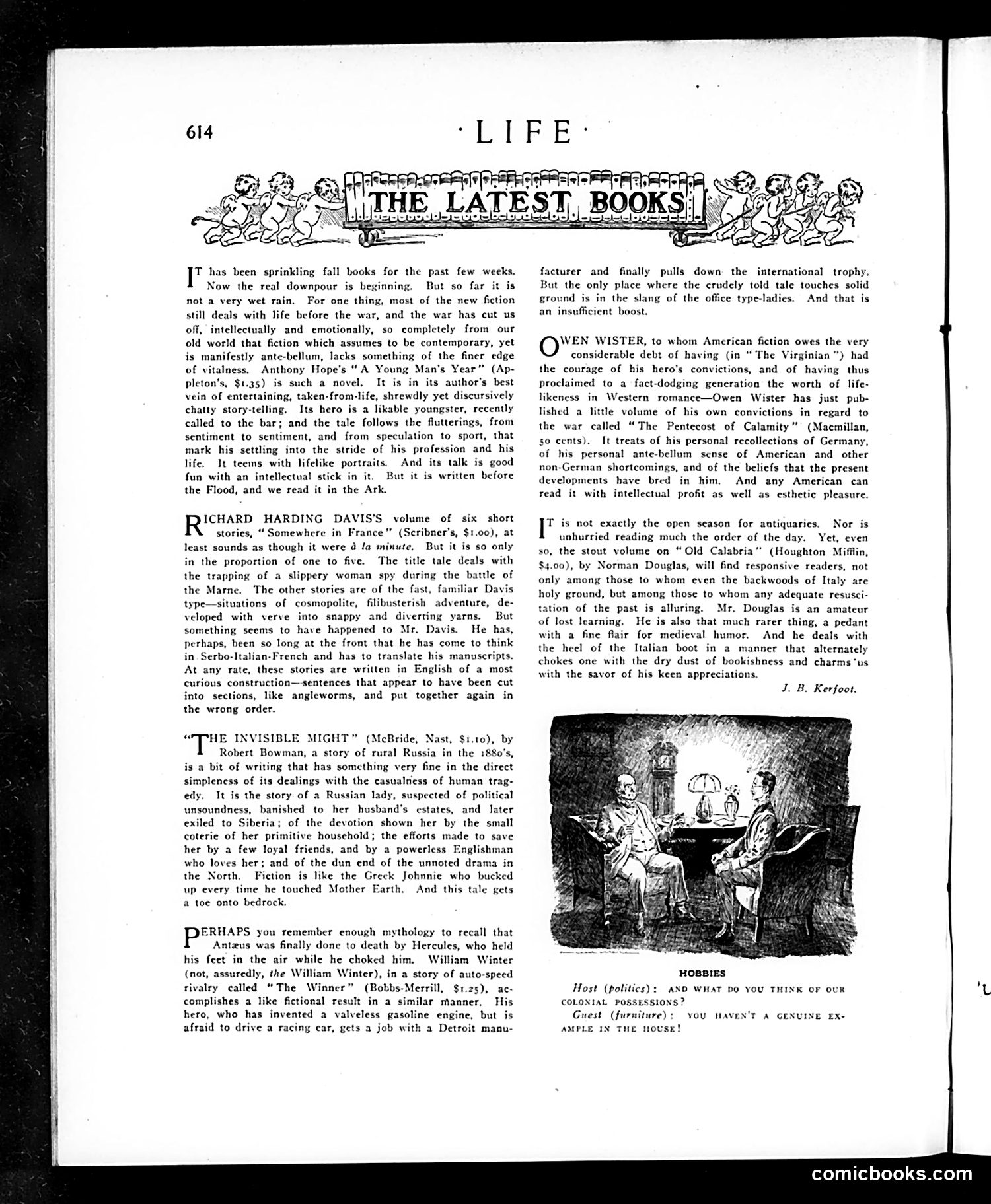
This page reviews several wartime-era novels (circa 1914-1916, based on references to "before the war" and "the Flood"). The critic argues that most new fiction feels outdated because it was written before WWI but published after—creating a disconnect from readers' changed sensibilities. Key reviews critiqued include Anthony Hope's pre-war social novel (dismissed as nostalgic), Richard Harding Davis's spy stories (criticized for awkward, fragmented prose—humorously compared to "angleworms...put together again in the wrong order"), and William Winter's auto-racing tale (praised only for authentic office-girl slang). The cartoon titled "HOBBIES" (lower right) appears to be unrelated social satire about leisure activities and colonial possessions, though details are unclear. The overall tone is intellectual but playful—the critic uses wit to address literature's struggle to remain relevant during wartime upheaval.
📄 Transcribed text from this page (OCR, searchable)
Machine-transcribed from the original scan — historical spelling and the odd misread are preserved.
T has been sprinkling fall books for the past few weeks. Now the real downpour is beginning. But so far it is not a very wet rain. For one thing, most of the new fiction still deals with life before the war, and the war has cut us off, intellectually and emotionally, so completely from our old world that fiction which assumes to be contemporary, yet is manifestly ante-bellum, lacks something of the finer edge of vitalness. Anthony Hope’s “A Young Man's Year” (Ap- pleton’s, $1.35) is such a novel, It is in its author's best vein of entertaining, taken-from-life, shrewdly yet discursively chatty story-telling. Its hero is a likable youngster, recently called to the bar; and the tale follows the flutterings, from sentiment to sentiment, and from speculation to sport, that mark his settling into the stride of his profession and his life. It teems with lifelike portraits. And its talk is good fun with an intellectual stick in it. But it is written before the Flood, and we read it in the Ark. ICHARD HARDING DAVIS'S volume of six short ies, “Somewhere in France” (Scribner's, $1.00), at least sounds as though it were @ la minute, But it is so only in the proportion of one to five. The title tale deals with the trapping of a slippery woman spy during the battle of the Marne. The other stories are of the fast, familiar Davis type—situations of cosmopolite, filibusterish adventure, de- veloped with verve into snappy and diverting yarns. But something seems to have happened to Mr. Davis. He has, perhaps, been so long at the front that he has come to think in Serbo-Italian-French and has to translate his manuscripts. At any rate, these stories are written in English of a most curious construction—sentences that appear to have been cut into sections, like angleworms, and put together again in the wrong order. “THE INVISIBLE MIGHT” (McBride, $1.10), by Robert Bowman, a story of rural Russia in the 1880's, is a bit of writing that has somcthing very fine in the direct simpleness of its dealings with the casualiess of human trag- edy. It is the story of a Russian lady, suspected of political unsoundness, banished to her husband's estates, and later exiled to Siberia; of the devotion shown her by the small coterie of her primitive household; the efforts made to save her by a few loyal friends, and by a powerless Englishman who loves her; and of the dun end of the unnoted drama in the North. Fiction is like the Greck Johnnie who bucked up every time he touched Mother Earth. And this tale gets a toe onto bedrock. ERHAPS you remember enough mythology to recall that Antzus was finally done to death by Hercules, who held his feet in the air while he choked him. William Winter (not, assuredly, the William Winter), in a story of auto-speed rivalry called “The Winner” (Bobbs-Merrill, $1.25), ac- complishes a like fictional result in a similar manner. His hero, who has invented a valveless gasoline engine, but is afraid to drive a racing car, gets a job with a Detroit manu- facturer and finally pulls down the international trophy. But the only place where the crudely told tale touches solid ground is in the slang of the office type-ladies. And that is an insufficient boost. WEN WISTER, to whom American fiction owes the very considerable debt of having (in “The Virginian”) had the courage of his hero's convictions, and of having thus proclaimed to a fact-dodging generation the worth of life- likeness in Western romance—Owen Wister has just pub- lished a little volume of his own convictions in regard to the war called “The Pentecost of Calamity” (Macmillan, 50 cents). It treats of his personal recollections of Germany, of his personal ante-bellum sense of American and other non-German shortcomings, and of the beliefs that the present developments have bred in him. And any American can read it with intellectual profit as well as esthetic pleasure. T is not exactly the open season for antiquai Nor is unhurried reading much the order of the day. Yet, even so, the stout volume on “Old Calabria” (Houghton Mifflin, $4.00), by Norman Douglas, will find responsive readers, not only among those to whom even the backwoods of Italy are holy ground, but among those to whom any adequate resusci- tation of the past is alluring. Mr. Douglas is an amateur of lost learning. He is also that much rarer thing, a pedant with a fine fair for medieval humor. And he deals with the heel of the Italian boot in a manner that alternately chokes one with the dry dust of bookishness and charms ‘us with the savor of his keen appreciations. J. B. Kerfoot. HOBBIES Host (politics): AND WHAT DO YOU THINK OF OUR COLONIAL POSSESSIONS Guest (furniture): YoU MAVEN'T A GENUINE EX- AMPLE IN THE Howse! comicbooks.com