
Life, 1915-09-30 · page 16 of 45
Life — September 30, 1915 — page 16: what you’re looking at
What you’re looking at
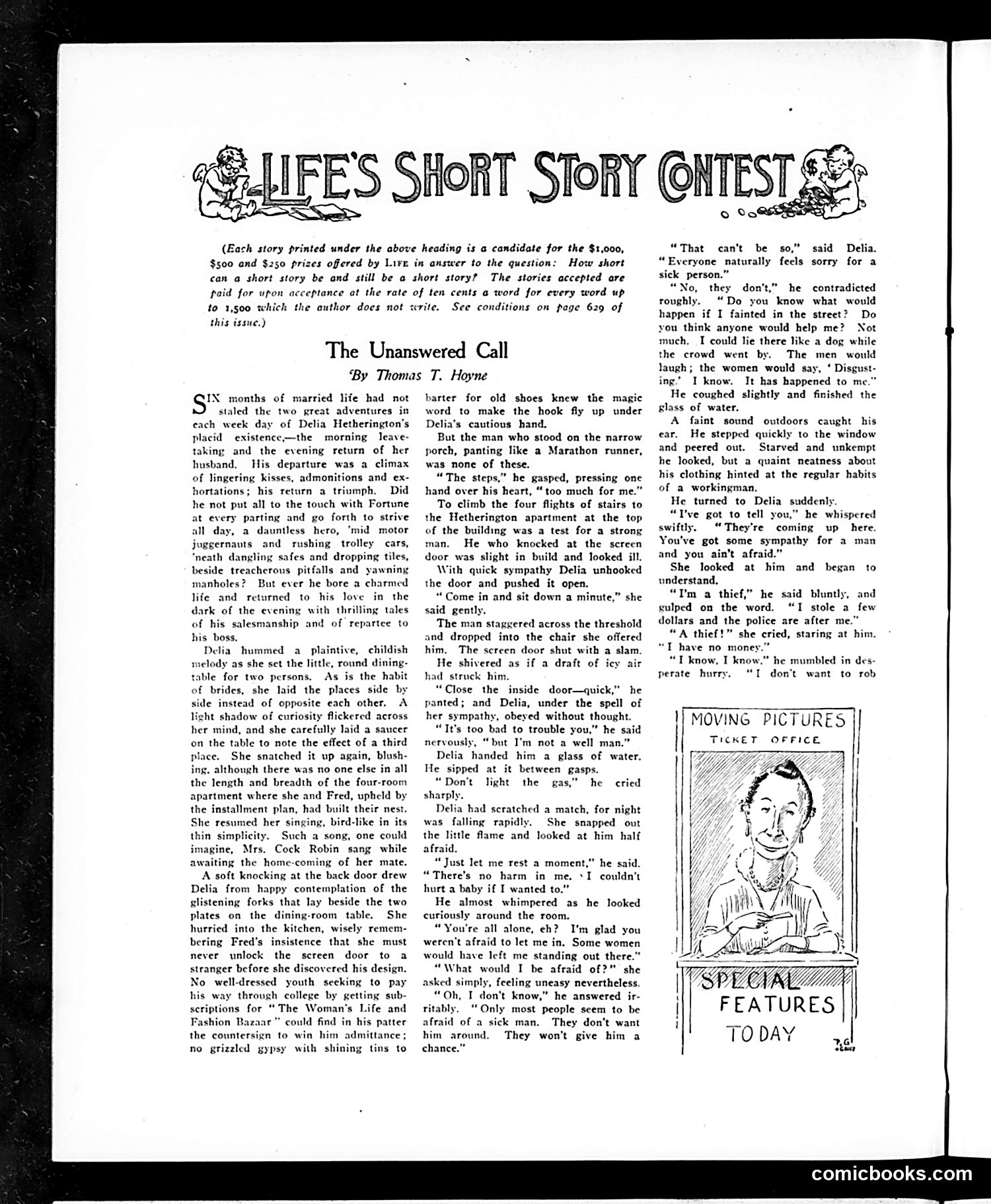
This page presents Life magazine's short-story contest, seeking submissions under 1,500 words at ten cents per word. The featured story, "The Unanswered Call" by Thomas T. Hoyne, depicts a domestic scenario: Delia Hetherington, a devoted newlywed, is interrupted while preparing dinner by a disheveled, gasping stranger at her back door. The narrative appears to be building toward a morality tale common to early 20th-century fiction—testing the protagonist's virtue and judgment. The man's suspicious behavior (demanding darkness, avoiding light) and his cryptic admission of being "not a well man" suggest either illness or criminal intent. Delia's naive sympathy and her husband's warning about admitting strangers sets up dramatic tension. The story illustrates period anxieties about urban danger, social vulnerability, and female propriety—themes that would have resonated with Life's contemporary audience.
📄 Transcribed text from this page (OCR, searchable)
Machine-transcribed from the original scan — historical spelling and the odd misread are preserved.
(Each story printed under the above heading is a candidate for the $1,000, $500 and $250 prizes offered by Lire in answer to the questio How short can a short story be and still be a short story? The stories accepted are paid for upon acceptance at the rate of ten cents a word for every word up to 1,500 which the author does not crite. this issue.) See conditions on page 629 of The Unanswered Call ‘By Thomas T. Hoyne IX months of married life had not staled the two great adventures in cach week day of Delia Hetherington's placid existence-—the morning leave- taking and the evening return of her husband. His departure was a climax of lingering kisses, admonitions and ex- hortations; his return a triumph. Did he not put all to the touch with Fortune at every parting and go forth to strive | day, a dauntless hero, ‘mid motor juggernauts and rushing trolley cars, ‘neath dangling safes and dropping tiles, beside treacherous pitfalls and yawning manholes? But ever he bore a charmed life and returned to his love in the dark of the evening with thrilling tales of his salesmanship and of repartee to his boss. Delia hummed a_ plaintive, childish melody as she set the little, round d table for two persons. As is the habit of brides, she laid the places side by side instead of opposite each other. light shadow of curiosity flickered across her mind, and she carefully laid a saucer on the table to note the effect of a third place. She snatched it up again, blush- ing, although there was no one else in all the length and breadth of the four-room apartment where she and Fred, upheld by the installment plan, had built their nest. She resumed her singing, bird-like in its thin simplicity. Such a song, one could imagine, Mrs. Cock Robin sang while ting the home-coming of her mate. A soft knocking at the back door drew Delia from happy contemplation of the glistening forks that lay beside the two plates on the dining-room table. She hurried into the kitchen, wisely remem- bering Fred’s insistence that she must never unlock the screen door to a stranger before she discovered his design. No well-dressed youth seeking to pay his way through college by getting sub- scriptions for “The Woman's Life and Fashion Bazaar” could find in his patter the countersign to win him admittance; no grizzled gypsy with shining tins to barter for old shoes knew the magic word to make the hook fly up under Delia’s cautious hand. But the man who stood on the narrow porch, panting like a Marathon runner, was none of these. “The steps,” he gasped, pressing one hand over his heart, “too much for me.” To climb the four flights of stairs to the Hetherington apartment at the top of the building was a test for a strong man. He who knocked at the screen door was slight in build and looked ill. With quick sympathy Delia unhooked the door and pushed it open. “ Come in and sit down a minute,” she said gently, The man staggered across the threshold and dropped into the chair she offered him. The screen door shut with a slam. He shivered as if a draft of icy air had struck him. Close the inside door—quick,” he panted; and Delia, under the spell of her sympathy, obeyed without thought. “It's too bad to trouble you,” he said nervously, “but I'm not a well man.” Delia handed him a glass of water. He sipped at it between gasps. “Don't light the gas," he ried had scratched a match, for night Hing rapidly. She snapped out the little flame and looked at him half afraid. “ Just let me rest a moment,” he said. “There's no harm in me. »I couldn't hurt a baby if I wanted to.” He almost whimpered as he looked curiously around the room. “You're all alone, eh? I'm glad you weren't afraid to let me in. Some women would have left me standing out there.” “What would I be afraid of?" she asked simply, feeling uneasy nevertheless. “Oh, I don't know,” he answered ir- ritably. ‘Only most people seem to be afraid of a sick man. They don’t want him around. They won't give him a chance.” “That can’t be 50,” “Everyone naturally feels sick person. “No, they don’t,” he contradicted roughly. “Do you know what would happen if I fainted in the street? Do you think anyone would help m Not much, I could lie there like a dog while the crowd went by. The men would laugh; the women would say, ‘ Disgust- ing.” I know. It has happened to me. He coughed slightly and finished the glass of water, A faint sound outdoors caught his ear. He stepped quickly to the window and peered out. Starved and unkempt he looked, but a quaint neatness about his clothing hinted at the regular habits of a workingman. He turned to Delia suddenly. I've got to tell you,” he whispered swiftly, “They're coming up here. You've got some sympathy for a man and you ain't afraid.” She looked at him and understand, “I'm a thief,” he said bluntly, and culped on the word. “I stole a few dollars and the police are after me.” “A thief!” she cried, staring at him. “T have no money “I know, I know,’ perate hurry, “T said Delia. sorry for a began to he mumbled in des- don't want to rob \/MOVING PICTURES TICKET OFFICE FEATURES TO DAY 2 comicbooks.com