
Life, 1915-09-30 · page 21 of 45
Life — September 30, 1915 — page 21: what you’re looking at
What you’re looking at
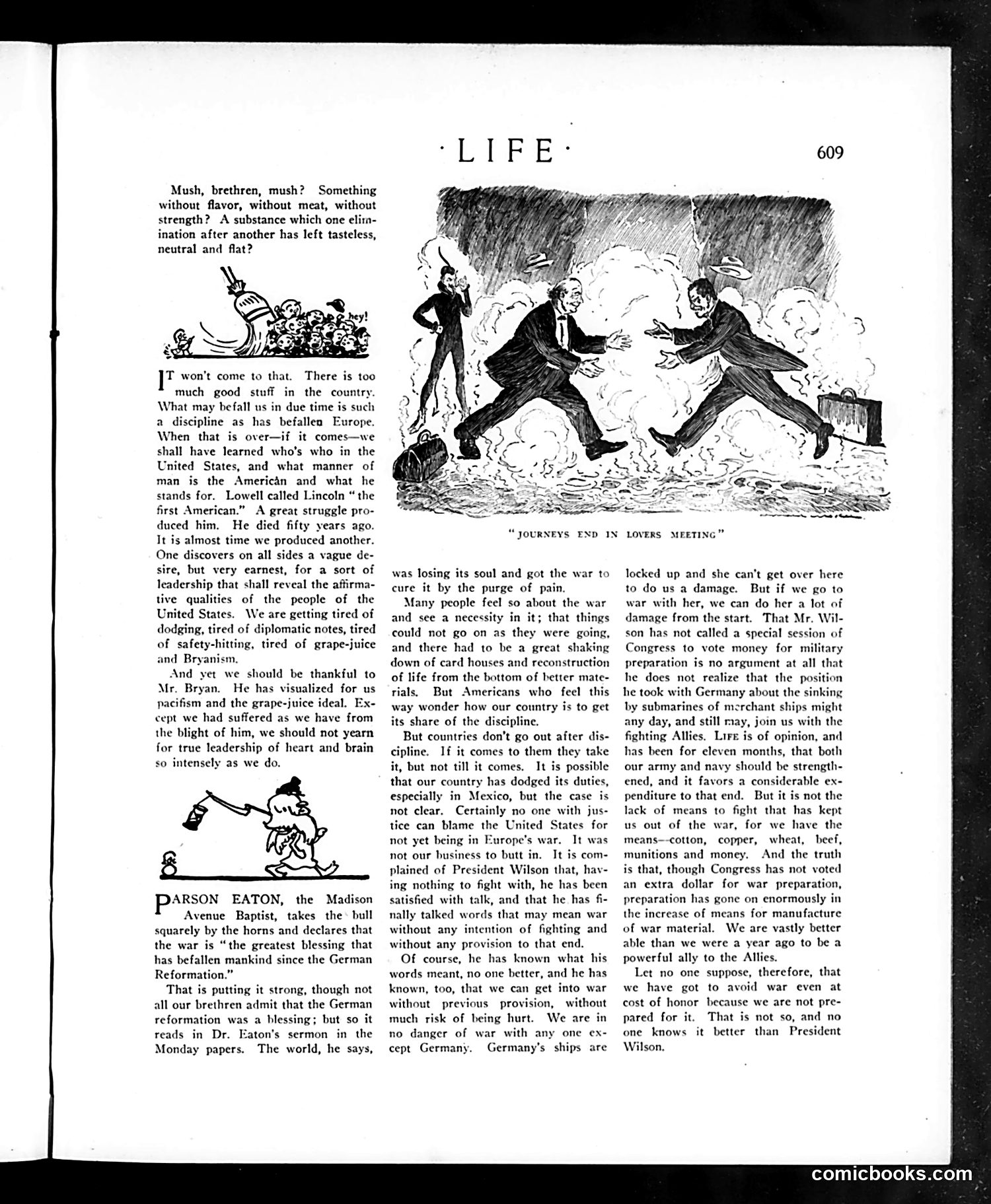
This page discusses American preparedness and leadership during World War I (approximately 1915-1916, before U.S. entry). **Main Content:** The text critiques President Wilson's verbal diplomacy regarding German submarine warfare, arguing that while he's articulated positions that risk war, he hasn't requested Congressional funding for military preparation. The author defends Wilson somewhat, noting America has abundant resources (cotton, copper, wheat, beef) to fight if necessary. **Key Figures Referenced:** - **President Wilson**: criticized for relying on "talk" without military readiness - **William Jennings Bryan**: mocked for "pacifism and grape-juice ideal" (Bryan was a pacifist and prohibitionist) - **Parson Eaton**: a Madison Avenue Baptist minister quoted as calling war "the greatest blessing...since the German Reformation" **The Cartoon** ("Journeys End in Lovers Meeting"): Shows figures meeting in clouds—likely representing warring nations or peace negotiations, satirizing romantic notions about conflict resolution. **The Satire:** Life criticizes both pacifism and lack of military preparation, arguing America needs strong leadership and realistic defense capability.
📄 Transcribed text from this page (OCR, searchable)
Machine-transcribed from the original scan — historical spelling and the odd misread are preserved.
Mush, brethren, mush? Something without flavor, without meat, without strength? A substance which one elirn- ination after another has left tasteless, neutral and flat? T won't come to that. There is too much good stuff in the country. What may befall us in due time is such a discipline as has befallen Europe. When that is over—if it comes—we shall have learned who's who in the United States, and what manner of man is the Americin and what he stands for. Lowell called Lincoln “the first American.” A great struggle pro- duced him. He died fifty years ago. It is almost time we produced another. One discovers on all sides a vague de- sire, but very earnest, for a sort of leadership that shall reveal the affirma- tive qualities of the people of the United States. We are getting tired of dodging, tired of diplomatic notes, tired of safety-hitting, tired of grape-juice and Bryanism, And yet we should be thankful to Mr. Bryan. He has visualized for us pacifism and the grape-juice ideal. cept we had suffered as we have from the blight of him, we should not yearn for true leadership of heart and brain so intensely as we do. ARSON EATON, the Madison Avenue Baptist, takes the> bull squarely by the horns and declares that the war is “the greatest blessing that has befallen mankind since the German Reformation.” That is putting it strong, though not all our brethren admit that the German reformation was a blessing; but so it reads in Dr. Eaton's sermon in the Monday papers. The world, he says, “JOURNEYS END IN LOVERS MEETING” was losing its soul and got the war to cure it by the purge of pain. Many people feel so about the war and see a necessity in it; that things could not go on as they were going, and there had to be a great shaking down of card houses and reconstruction of life from the bottom of better mate- rials, But Americans who feel this way wonder how our country is to get its share of the discipline. But countries don’t go out after dis- cipline. If it comes to them they take it, but not till it comes. It is possible that our country has dodged its duties, especially in Mexico, but the case is not clear. Certainly no one with jus- tice can blame the United States for not yet being in Europe's war. It was not our business to butt in. It is com- plained of President Wilson that, hav- ing nothing to fight with, he has been satisfied with talk, and that he has fi- nally talked words that may mean war without any intention of fighting and without any provision to that end. Of course, he has known what his words meant, no one better, and he has known, too, that we can get into war without previous provision, without much risk of being hurt. We are in no danger of war with any one ex- cept Germany, Germany's ships are locked up and she can't get over here to do us a damage. But if we go to war with her, we can do her a lot of damage from the start. That Mr. Wil- son has not called a special session of Congress to vote money for military preparation is no argument at all that he does not realize that the position he took with Germany about the sinking by submarines of merchant ships might any day, and still may, join us with the fighting Allies. Lire is of opinion, and has been for eleven months, that both our army and navy should be strength- ened, and it favors a considerable ex- penditure to that end. But it is not the lack of means to fight that has kept us out of the war, for we have the means—-cotton, copper, wheat, beef, munitions and money. And the truth is that, though Congress has not voted an extra dollar for war preparation, preparation has gone on enormously in the increase of means for manufacture of war material. We are vastly better able than we were a year ago to be a powerful ally to the Allies. Let no one suppose, therefore, that we have got to avoid war even at cost of honor because we are not pre- pared for it. That is not so, and no one knows it better than President Wilson, comicbooks.com