
Life, 1915-09-30 · page 14 of 45
Life — September 30, 1915 — page 14: what you’re looking at
What you’re looking at
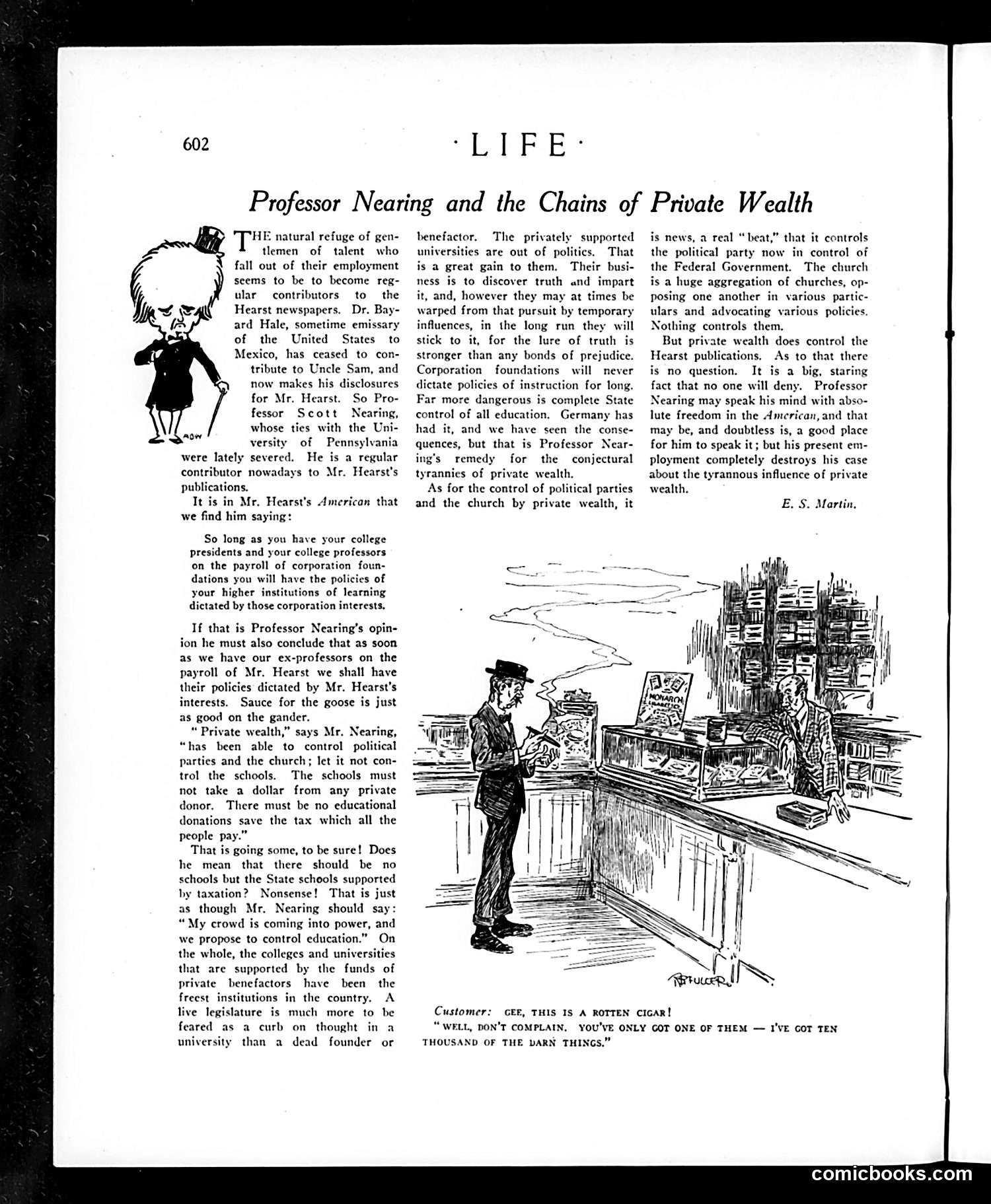
This page critiques how **private wealth influences educational institutions**. The article discusses Professor Nearing's views on corporate foundations controlling college policies. The text argues that accepting donations from wealthy benefactors compromises academic independence—college presidents and professors become beholden to corporate interests rather than pursuing truth freely. The cartoon illustrates this concern: a well-dressed man (representing a wealthy donor or corporate interest) inspects what appears to be educational materials or policies, while a customer complains about receiving only "ten thousand of the darn things" of inferior quality. The satire suggests that when schools depend on private wealth, they become mere commercial enterprises serving donor interests rather than genuine educational institutions committed to truth and intellectual freedom.
📄 Transcribed text from this page (OCR, searchable)
Machine-transcribed from the original scan — historical spelling and the odd misread are preserved.
‘LIFE: Professor Nearing and the Chains of Private Wealth HE natural refuge of gen- tlemen of talent who fall out of their employment seems to be to become reg- ular contributors to the Hearst newspapers, Dr. Bay- ard Hale, sometime emissary of the United States to Mexico, has ceased to con- tribute to Uncle Sam, and now makes his disclosures for Mr. Hearst. So Pro- fessor Scott Nearing, whose ties with the Uni- versity of Pennsylvania were lately severed. He is a regular Aon contributor nowadays to Mr. Hearst's publications. It is in Mr. Hearst's American that we find him saying: So long as you have your college Presidents and your college professors on the payroll of corporation foun- dations you will have the policies of your higher institutions of learning dictated by those corporation interests, If that is Professor Nearing’s opin- ion he must also conclude that as soon as we have our ex-professors on the payroll of Mr. Hearst we shall have their policies dictated by Mr. Hearst's interests. Sauce for the goose is just as good on the gander. “ Private wealth,” says Mr. Nearing, “has been able to control political parties and the church; let it not con- trol the schools. The schools must not take a dollar from any private donor. There must be no educational donations save the tax which all the people pay. That is going some, to be sure! Does he mean that there should be no schools but the State schools supported hy taxation? Nonsense! That is just as though Mr. Nearing should say: “My crowd is coming into power, and we propose to control education.” On the whole, the colleges and universities that are supported by the funds of private benefactors have been the freest institutions in the country, A live legislature is much more to be feared as a curb on thought in a university than a dead founder or benefactor. The privately supported universities are out of politics. That is a great gain to them. Their busi- ness is to discover truth and impart it, and, however they may at times be warped from that pursuit by temporary influences, in the long run they will stick to it, for the lure of truth is stronger than any bonds of prejudice. Corporation foundations will never dictate policies of instruction for long. Far more dangerous is complete State control of all education. Germany has had it, and we have seen the conse- quences, but that is Professor Near- ing’s remedy for the conjectural tyrannies of private wealth. As for the control of political parties and the church by private wealth, it Customer: “WELL, DON’T COMPLAIN, THOUSAND OF THE DARN THINGS. is news, a real “beat,” that it controls the political party now in control of the Federal Government. The church is a huge aggregation of churches, op- posing one another in various partic- ulars and advocating various policies. Nothing controls them. But private wealth does control the Hearst publications, As to that there is no question. It is a big, staring fact that no one will deny, Professor Nearing may speak his mind with abso- lute freedom in the American, and that may be, and doubtless is, a good place for him to speak it; but his present em- ployment completely destroys his case about the tyrannous influence of private wealth, E. S. Martin, GEE, THIS IS A ROTTEN CIGAR! YOU'VE ONLY GOT ONE OF THEM — I'VE GOT TEN comicbooks.com