
Life, 1915-09-30 · page 34 of 45
Life — September 30, 1915 — page 34: what you’re looking at
What you’re looking at
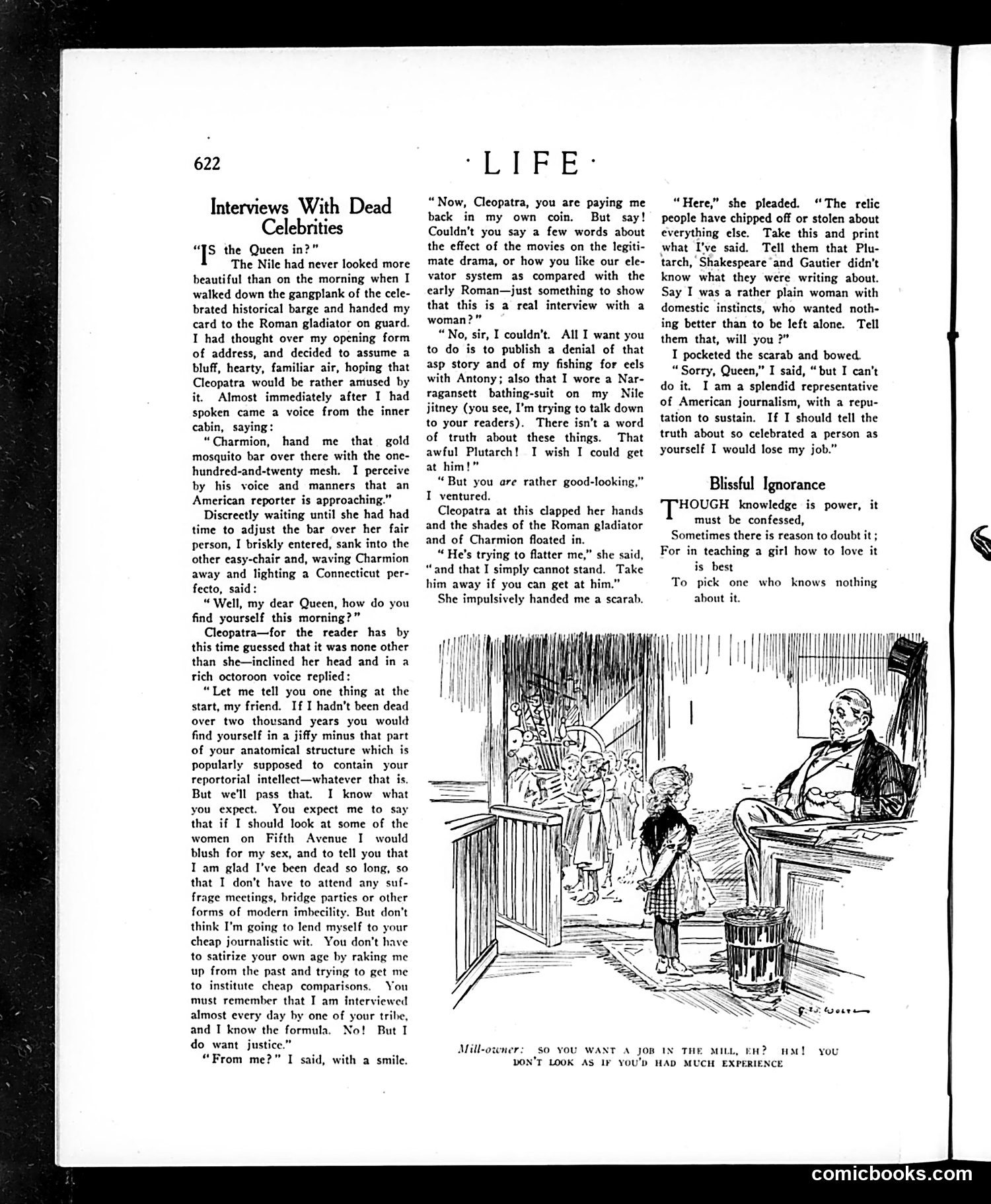
This piece satirizes sensationalist American journalism and yellow journalism practices. A reporter interviews the ghost of Cleopatra, seeking juicy quotes comparing ancient Egypt to modern America—a common trope of the era. The satire's targets: Cleopatra complains that journalists constantly misquote her (the "asp story," false anecdotes about Antony) and rely on ancient sources like Plutarch and Shakespeare rather than truth. She's frustrated by predictable interview formulas where dead figures are manipulated into mocking the modern age. The joke's irony: When she tries to set the record straight—she was actually plain and domestic—the reporter admits he *can't* publish truth because his reputation depends on sensationalism, not accuracy. The bottom cartoon (partial) appears unrelated, showing a mill-owner and job applicant. The satire critiques journalism's prioritization of entertaining fiction over factual reporting—a surprisingly modern concern for this publication.
📄 Transcribed text from this page (OCR, searchable)
Machine-transcribed from the original scan — historical spelling and the odd misread are preserved.
622 Interviews With Dead Celebrities “TS the Queen in?” The Nile had never looked more beautiful than on the morning when I walked down the gangplank of the cele- brated historical barge and handed my card to the Roman gladiator on guard. I had thought over my opening form of address, and decided to assume a bluff, hearty, familiar air, hoping that Cleopatra would be rather amused by it. Almost immediately after I had spoken came a voice from the inner cabin, saying: “Charmion, hand me that gold mosquito bar over there with the one- hundred-and-twenty mesh. I perceive by his voice and manners that an American reporter is approaching.” Discreetly waiting until she had had time to adjust the bar over her fair person, I briskly entered, sank into the other easy-chair and, waving Charmion away and lighting a Connecticut per- fecto, said: “Well, my dear Queen, how do you find yourself this morning?” Cleopatra—for the reader has by this time guessed that it was none other than she—inclined her head and in a rich octoroon voice replied: “Let me tell you one thing at the start, my friend. If I hadn't been dead over two thousand years you would find yourself in a jiffy minus that part of your anatomical structure which is popularly supposed to contain your reportorial intellect—whatever that is. But we'll pass that. I know what you expect. You expect me to say that if I should look at some of the women on Fifth Avenue I would blush for my sex, and to tell you that I am glad I’ve been dead so long, so that I don’t have to attend any suf- frage meetings, bridge parties or other forms of modern imbecility. But don’t think I’m going to lend myself to your cheap journalistic wit. You don’t have to satirize your own age by raking me up from the past and trying to get me to institute cheap comparisons. You must remember that Iam interviewed almost every day by one of your tribe, and I know the formula. No! But I do want justice.” “From me?” I said, with a smile. LIFE “Now, Cleopatra, you are paying me back in my own coin. But say! Couldn't you say a few words about the effect of the movies on the legiti- mate drama, or how you like our ele- vator system as compared with the early Roman—just something to show that this is a real interview with a woman?” “No, sir, I couldn't. All I want you to do is to publish a denial of that asp story and of my fishing for eels with Antony; also that I wore a Nar- ragansett bathing-suit on my Nile jitney (you see, I’m trying to talk down to your readers). There isn’t a word of truth about these things. That awful Plutarch! I wish I could get at him!” “But you are rather good-looking,” I ventured. Cleopatra at this clapped her hands and the shades of the Roman gladiator and of Charmion floated in. “ He’s trying to flatter me,” she said, “and that I simply cannot stand. Take him away if you can get at him.” She impulsively handed me a scarab. Mill-owner: so you WANT A JOB IN THE MILL, “Here,” she pleaded. “The relic people have chipped off or stolen about everything else. Take this and print what I’ve said. Tell them that Plu- tarch, Shakespeare and Gautier didn’t know what they were writing about. Say I was a rather plain woman with domestic instincts, who wanted noth- ing better than to be left alone. Tell them that, will you ?” I pocketed the scarab and bowed. “Sorry, Queen,” I said, “but I can’t do it. I am a splendid representative of American journalism, with a repu- tation to sustain. If I should tell the truth about so celebrated a person as yourself I would lose my job.” Blissful Ignorance *pouse knowledge is power, it must be confessed, Sometimes there is reason to doubt it ; For in teaching a girl how to love it is best To pick one who knows nothing ELSFAE etree SSS eH? uml you DON’T LOOK AS IF YOU'D HAD MUCH EXPERIENCE. comicbooks.com