
Life, 1915-09-30 · page 24 of 45
Life — September 30, 1915 — page 24: what you’re looking at
What you’re looking at
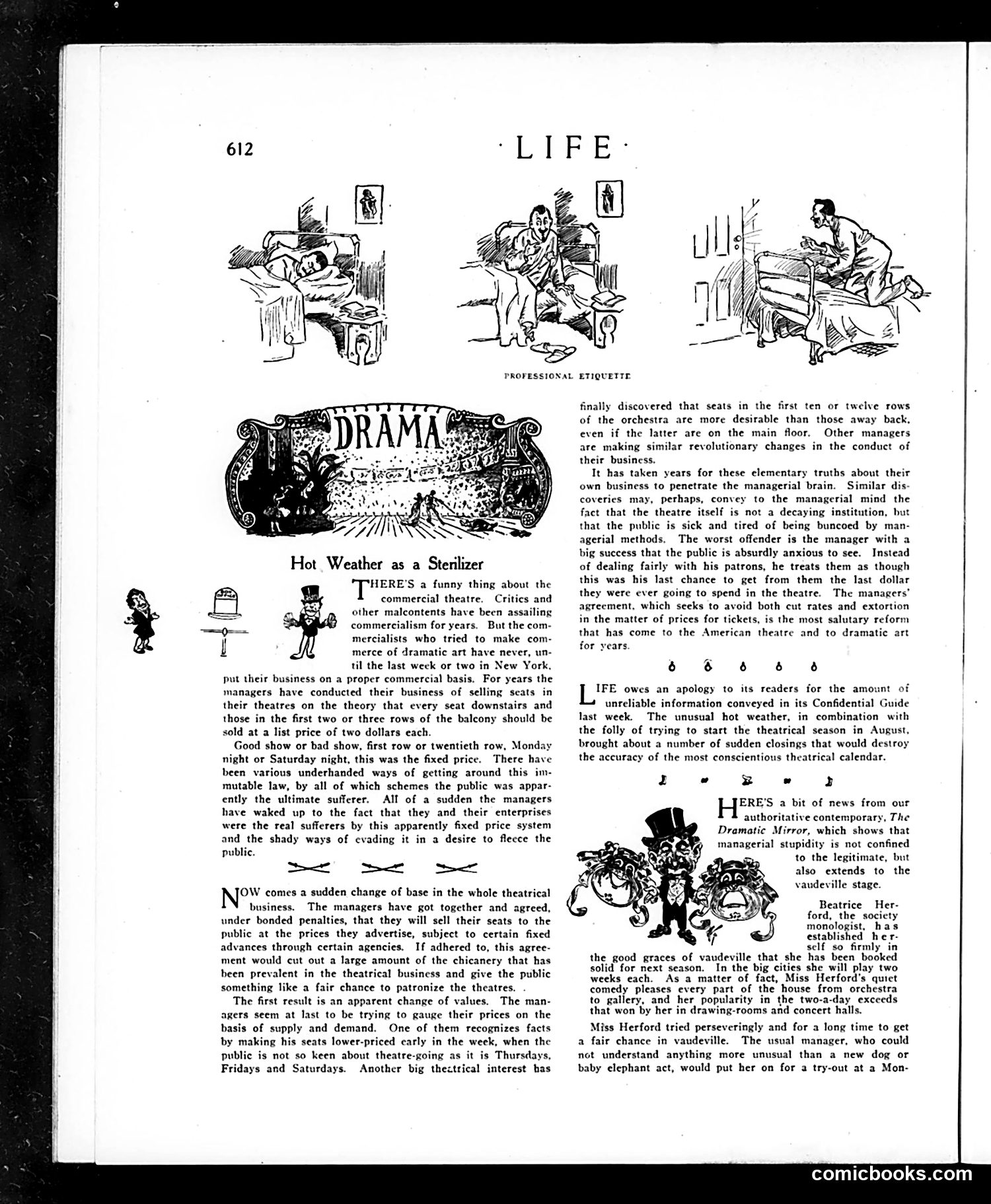
This page critiques **theatrical management practices** during summer theater season. The title "Hot Weather as a Sterilizer" refers to how heat drives audiences away, exposing managerial failures. **The main argument:** Broadway theater managers operated under an outdated fixed-price system—all seats cost two dollars regardless of location or demand. This prevented fair pricing and bred corruption ("shady ways of evading it"). **The satire:** The article celebrates managers who finally adopted **basic business practices**: lower prices early in the week when attendance is weak, premium pricing for desirable orchestra seats. Life mocks that it took "years for these elementary truths" to penetrate managers' brains. **Key complaint:** The worst offenders are successful managers who exploit public demand, squeezing patrons on their "last chance" to attend before shows close. **The bottom sketches** illustrate "Professional Etiquette"—apparently showing proper (and improper) backstage behavior, though specific figures are unclear. Overall, Life attacks theatrical management as incompetent businessmen exploiting customers while claiming to serve art.
📄 Transcribed text from this page (OCR, searchable)
Machine-transcribed from the original scan — historical spelling and the odd misread are preserved.
Hot Weather as a Sterilizer g HERE'S a funny thing about the commercial theatre. Critics and other malcontents have been assailing § commercialism for years. But the com- i mercialists who tried to make com- t merce of dramatic art have never, un- til the last week or two in New York, put their business on a proper commercial basis. For years the managers have conducted their business of selling scats in their theatres on the theory that every seat downstairs and those in the first two or three rows of the balcony should be sold at a list price of two dollars each. Good show or bad show, first row or twentieth row, Monday night or Saturday night, this was the fixed price. There have been various underhanded ways of getting around this im- mutable law, by all of which schemes the public was appar- ently the ultimate sufferer. All of a sudden the managers have waked up to the fact that they and their enterprises were the real sufferers by this apparently fixed price system and the shady ways of evading it in a desire to fleece the public. == => >= | (OW comes a sudden change of base in the whole theatrical business. The managers have got together and agreed, under bonded penalties, that they will sell their seats to the public at the prices they advertise, subject to certain fixed advances through certain agencies. If adhered to, this agree- ment would cut out a large amount of the chicanery that has been prevalent in the theatrical business and give the public something like a fair chance to patronize the theatres. The first result is an apparent change of values. The man- agers seem at last to be trying to gauge their prices on the basis of supply and demand. One of them recognizes facts by making his seats lower-priced carly in the week, when the public is not so keen about theatre-going as it is Thursdays, Fridays and Saturdays. Another big thectrical interest has PROFESSIONAL ETIQUETTE. finally discovered that seats in the first ten or twelve rows of the orchestra are more desirable than those away back, even if the latter are on the main floor. Other managers are making similar revolutionary changes in the conduct of their business. It has taken years for these elementary truths about their own business to penetrate the managerial brain. Similar dis- coveries may, perhaps, convey to the managerial mind the fact that the theatre itself is not a decaying institution, but that the public is sick and tired of being buncoed by man- agerial methods, The worst offender is the manager with a big success that the public is absurdly anxious to see. Instead of dealing fairly with his patrons, he treats them as though this was his last chance to get from them the last dollar they were ever going to spend in the theatre. The managers’ agreement, which seeks to avoid both cut rates and extortion in the matter of prices for tickets, is the most salutary reform that has come to the American theatre and to dramatic art for years. 6 6 6 86 86 IFE owes an apology to its readers for the amount of unreliable information conveyed in its Confidential Guide last week. The unusual hot weather, in combination with the folly of trying to start the theatrical season in August. brought about a number of sudden closings that would destroy the accuracy of the most conscientious theatrical calendar. Zz ” B - Py ERE'S a bit of news from our authoritative contemporary, The Dramatic Mirror, which shows that managerial stupidity is not confined to the legitimate, but also extends to the vaudeville stage. Beatrice Her- ford, the society monologist, has established he self so firmly in the good graces of vaudeville that she has been booked solid for next season. In the big cities she will play two weeks each. As a matter of fact, Miss Herford’s quiet comedy pleases every part of the house from orchestra to gallery, and her popularity in the two-a-day exceeds that won by her in drawing-rooms and concert halls. Miss Herford tried perseveringly and for a long time to get a fair chance in vaudeville. The usual manager, who could not understand anything more unusual than a new dog or baby elephant act, would put her on for a try-out at a Mon- comicbooks.com