
Life, 1915-09-30 · page 20 of 45
Life — September 30, 1915 — page 20: what you’re looking at
What you’re looking at
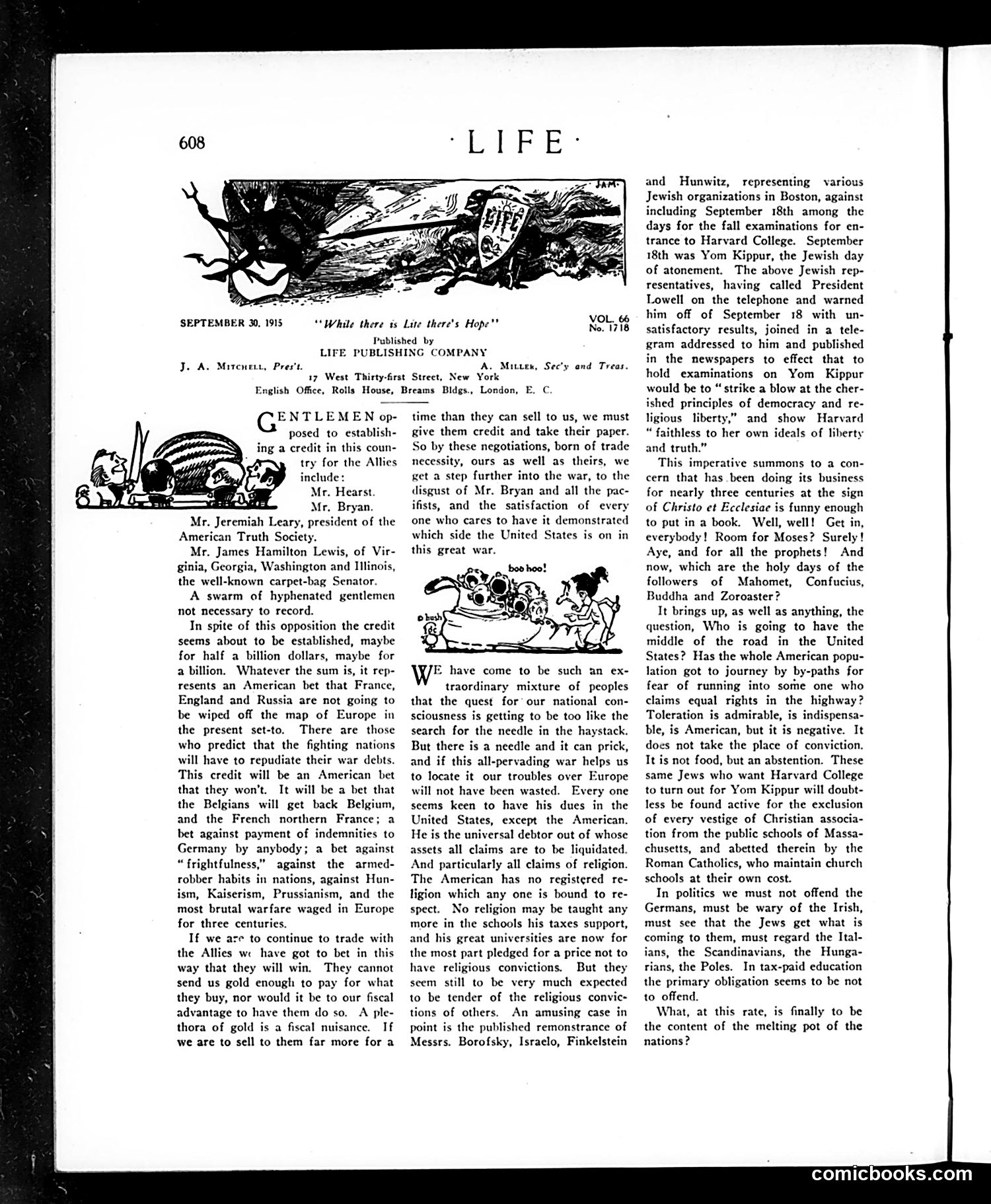
This page discusses American credit to Allied powers during World War I, listing opponents (William Randolph Hearst, William Jennings Bryan, and others) before arguing the loan represents an American bet that the Allies will win. The cartoons visible appear to be small illustrative vignettes supporting the editorial argument about the war effort. More notably, the text includes a satirical attack on Jewish religious accommodation at Harvard College. It mocks Jewish organizations in Boston (naming Borofsky, Israelo, Finkelstein, and Hunwitz) for protesting September 18th exam scheduling, which conflicted with Yom Kippur. The author sarcastically criticizes American tolerance of immigrant religions while Americans themselves receive no religious exemptions—a backhanded antisemitic complaint that immigrants expect special treatment. This reflects early-20th-century nativist anxieties about religious pluralism and immigrant demands.
📄 Transcribed text from this page (OCR, searchable)
Machine-transcribed from the original scan — historical spelling and the odd misread are preserved.
SEPTEMBER 30, 1915 “While there ts Lite there's Hope" Published by LIFE PUBLISHING COMPANY J. A. Mitenent, Pres’t. A. Mitten, Sec'y and Treas. 17 West Thirty-first Street, New York English Office, Rotls House, Breams Bldgs., London, E. C. ENTLEMEN op- posed to establish- ing a credit in this coun- try for the Allies include: Mr. Hearst. Mr. Bryan. Mr. Jeremiah Leary, president of the American Truth Society. Mr. James Hamilton Lewis, of Vir- ginia, Georgia, Washington and Illinois, the well-known carpet-bag Senator. A swarm of hyphenated gentlemen not necessary to record. In spite of this opposition the credit seems about to be established, maybe for half a billion dollars, maybe for a billion. Whatever the sum is, it rep- resents an American bet that France, England and Russia are not going to be wiped off the map of Europe in the present set-to. There are those who predict that the fighting nations will have to repudiate their war debts. This credit will be an American bet that they won't. It will be a bet that the Belgians will get back Belgium, and the French northern France; a bet against payment of indemnities to Germany by anybody; a bet against “frightfulness,” against the armed- robber habits in nations, against Hun- ism, Kaiserism, Prussianism, and the most brutal warfare waged in Europe for three centuries. If we are to continue to trade with the Allies we have got to bet in this way that they will win. They cannot send us gold enough to pay for what they buy, nor would it be to our fiscal advantage to have them do so. A ple- thora of gold is a fiscal nuisance. If we are to sell to them far more for a time than they can sell to us, we must give them credit and take their paper. So by these negotiations, born of trade necessity, ours as well as theirs, we get a step further into the war, to the disgust of Mr. Bryan and all the pac- ifists, and the satisfaction of every one who cares to have it demonstrated which side the United States is on in this great war. have come to be such an ex- traordinary mixture of peoples that the quest for our national con- sciousness is getting to be too like the search for the needle in the haystack. But there is a needle and it can prick, and if this all-pervading war helps us to locate it our troubles over Europe will not have been wasted. Every one seems keen to have dues in the United States, except the American. He is the universal debtor out of whose assets all claims are to be liquidated. And particularly all claims of religion. The American has no registered re- ligion which any one is bound to re- spect. No religion may be taught any more in the schools his taxes support, and his great universities are now for the most part pledged for a price not to have religious convictions. But they seem still to be very much expected to be tender of the religious convic- tions of others. An amusing case in point is the published remonstrance of Messrs. Borofsky, Israelo, Finkelstein and Hunwitz, representing various Jewish organizations in Boston, against including September 18th among the days for the fall examinations for en- trance to Harvard College. September 18th was Yom Kippur, the Jewish day of atonement. The above Jewish rep- resentatives, having called President Lowell on the telephone and warned him off of September 18 with un- satisfactory results, joined in a tele- gram addressed to him and published in the newspapers to effect that to hold examinations on Yom Kippur would be to “strike a blow at the cher- ished principles of democracy and re- ligious liberty,” and show Harvard “faithless to her own ideals of liberty and truth.” This imperative summons to a con- cern that has been doing its business for nearly three centuries at the sign of Christo et Ecclesiae is funny enough to put in a book. Well, well! Get in, everybody! Room for Moses? Surely! Aye, and for all the prophets! And now, which are the holy days of the followers of Mahomet, Confucius, Buddha and Zoroaster? It brings up, as well as anything, the question, Who is going to have the middle of the road in the United States? Has the whole American popu- lation got to journey by by-paths for fear of running into some one who claims equal rights in the highway? Toleration is admirable, is indispensa- ble, is American, but it is negative. It does not take the place of conviction. It is not food, but an abstention. These same Jews who want Harvard College to turn out for Yom Kippur will doubt- less be found active for the exclusion of every vestige of Christian associa- tion from the public schools of Massa- chusetts, and abetted therein by the Roman Catholics, who maintain church schools at their own cost. In politics we must not offend the Germans, must be wary of the Irish, must see that the Jews get what is coming to them, must regard the Ital- jans, the Scandinavians, the Hunga- rians, the Poles. In tax-paid education the primary obligation seems to be not to offend. What, at this rate, is finally to be the content of the melting pot of the nations? comicbooks.com